The Weight of Seconds: A Portrait of Grace Under Fire in the High-Altitude Silence
CHAPTER 1: THE PERSPECTIVE OF ASH
Harold Lawson stood in the aisle, an island of stillness in a sea of thrashing, terrified bodies. He did not grip the headrests. He did not look at the emergency lights hemorrhaging their dim orange glow across the panicked faces. His gaze was fixed on the cabin ceiling, tracing the path where the main wiring bundles pulsed with heat.
The flight attendant’s voice clawed at the air, brittle and shattered, but Harold didn’t hear the panic. He heard the engines. He felt the rhythmic, jagged vibration traveling through the soles of his shoes—a discordant syncopation that had nothing to do with altitude or air pressure.
“Sir, I need you to sit down right now!”
The flight attendant’s hand reached for his arm, but it stopped short, hovering in the void of the aisle. The air marshal, Fuller, pushed past her, his face a landscape of rigid, trembling authority. His hand hovered over his holster, a reflex born of protocol, not insight.
“You heard her, old man. Park it. This is a federal situation.”
Harold turned his head slowly. The movement was measured, devoid of the frantic energy that turned the rest of the cabin into a swirling whirlpool of chaos. His eyes—faded sky blue, rimmed with the exhaustion of eighty-three years—met Fuller’s. In that brief, silent alignment, the air seemed to thin. Fuller flinched, not because Harold threatened him, but because Harold didn’t.
The plane dropped another hundred feet, a pocket of air vanishing beneath them. Screams erupted in the rear, high and piercing, but Harold merely adjusted his weight to the pitch of the deck. His focus drifted to the watch on his wrist—a massive, scarred chronograph. The crystal was webbed with micro-fractures, and the leather band had darkened to the color of wet earth.
For a heartbeat, the Boeing’s cabin vanished. He smelled the thick, acrid smoke of the Asha Valley, tasted the iron of blood on his lips. He saw the flash of white light against a canopy that no longer existed. The green phosphorescence of the watch’s hands glowed in his mind’s eye, the only tether between a dead crew and the living soil.
The sensation snapped shut like a trap. The smell of burning avionics returned, sharper than before.
“The transponder is off,” Harold said. His voice was a rasp of dry gravel, yet it cut through the cabin’s noise like a razor.
Fuller blinked, his hand tightening on his jacket. “What?”
“We’ve changed our vector,” Harold continued, his head cocked toward the floorboards. “Banking southeast. We’re drifting away from the flight path. And the avionics bay under the cockpit floor is cooking. If the hydraulic lines go, we’re not a plane anymore. We’re a rock.”
Fuller’s face flushed a deep, panicked violet. He lunged, his fingers reaching for Harold’s bicep. “You are a threat to this flight! Sit down, or I will put you in the floor!”
Harold didn’t move. He looked down at the hand encroaching on his space, then up at the marshals’ eyes. There, behind the bluster, he saw the cage.
“Son,” Harold whispered, his voice weighted with a sudden, crushing gravity. “You have no idea what a threat looks like.”
A violent, sickening lurch tilted the floor thirty degrees to the left. A suitcase tumbled from an overhead bin, striking the floor with a hollow thud. Somewhere in the dark, a child began to cry, the sound muffled by the growing, hungry roar of the compromised engine. Harold reached out, not to push Fuller away, but to steady the wall as the ship shuddered again, the structural integrity of the cabin groaning under the strain of a ghost-piloted bank. The bridge was breaking; the gap between the living and the lost was narrowing.
CHAPTER 2: THE ANATOMY OF FEAR
The floor beneath Harold’s feet continued to tremble with an irregular, syncopated rhythm—not the steady thrum of a machine, but the erratic, dying pulse of a heart. He remained planted in the aisle, the small, palm-sized emergency radio weighing heavy in his hand. The cabin was a tapestry of frayed edges: the businessman still clutched his dead phone like a talisman, the woman behind him had stopped sobbing but now stared at the emergency floor-strips with glassy, unseeing eyes, and Fuller was still invading his space, though the marshal’s chest hitched with a ragged, uneven cadence.
Harold didn’t look at Fuller. He couldn’t afford the diversion. He was listening. Beneath the ambient roar of the air rushing past the fuselage, there was a new sound—a faint, persistent clicking, metallic and sharp, emanating from somewhere deep beneath the carpeting. It wasn’t the sound of an engine failing. It was the sound of a relay switch in the avionics bay trying, and failing, to cycle.
“Move,” Harold said, his voice quiet but carrying the force of an order. He didn’t point; he simply shifted his stance, nudging Fuller aside with a subtle, grounded weight.
Fuller stumbled back, his face a mosaic of confusion and residual aggression. “You don’t get to tell me where to go,” the marshal hissed, though the conviction in his tone was leaking out like air from a punctured tire. He glanced at the flight attendant, seeking an ally, but she was watching Harold with a desperate, hungry intensity, her hand still pressed against her mouth as if to keep her own terror from spilling out.
Harold knelt. It was a slow, deliberate movement, his joints protesting with a dull ache that he folded into the rhythm of the ship’s descent. He pressed his ear to the carpet. The metallic clicking was louder here, vibrating through the structure of the plane.
“The avionics,” Harold muttered, mostly to himself.
“What about them?” Fuller demanded, hovering over him. “We’ve got standard protocols for this. We wait for the captain to—”
“The captain is gone, son,” Harold cut him off, his eyes scanning the floorboards for a seam, a fastener, anything. “And your protocols are designed for a world that works. This world is broken.”
Harold reached out, his gnarled fingers tracing the edge of a plastic panel near the base of the galley wall. It was a maintenance access point, usually reserved for ground crew. With a steady, calculated pressure, he wedged his fingernails into the gap. His skin was thin, mapped with veins and age spots, but the hands themselves were steady as stone. He pulled. The panel gave way with a sharp, plastic snap that echoed through the silence of the cabin, a sound so final it made the businessman jump.
Inside, the darkness was absolute, save for the faint, flickering orange light that bled in from the aisle. Harold didn’t need to see; he felt. He reached into the crawlspace, his hand hovering over the warm, humming bundles of cable. He felt the heat radiating from them—the smell of singed plastic was overpowering now, a sickly-sweet, chemical scent that clung to the back of his throat.
“There,” Harold breathed. He saw it—a small, blackened junction box. One of the primary data buses had fused, its plastic casing warped into a grotesque, melted shape. It was a death sentence for the navigation systems.
“What is that?” Fuller asked, his voice cracking. He had finally stepped closer, his shadow falling over Harold’s hunched form. The marshal was trembling, his fingers twitching toward his empty holster as if he were trying to find something to hold onto. “Is that… is that the fire?”
“It’s the reason the transponder is dead,” Harold replied, not looking up. He reached into his pocket and pulled out a small, multi-tool he had kept in his jacket—a relic of his own, kept just in case. “The fire started here, but it wasn’t an accident. Look at the insulation on these leads.”
Fuller leaned in, his eyes adjusting to the dim, orange gloom. Where the wires met the junction, the insulation hadn’t just burned; it had been stripped back, clean and precise.
“That’s not a malfunction,” Fuller whispered, the realization draining the color from his face. “That’s… that’s sabotage.”
Harold didn’t answer. He was already working, his fingers moving with a terrifying, rhythmic precision. He knew what he was looking for, not because he was a mechanic, but because he had seen this exact configuration of catastrophe before, under a different sky, in a different century. He was fighting the fire, yes, but he was also fighting the sudden, cold dread that this wasn’t just a random failure.
He glanced at his watch. The green phosphorescent hands seemed to pulse in the dark, a silent countdown. He felt the weight of the aircraft shifting, a subtle, rhythmic swaying as the plane continued its unauthorized, agonizing bank.
“We need to isolate this circuit,” Harold muttered, his voice dropping into that quiet, authoritative register that silenced the air around him. “If I can jump the signal back to the flight computer, we might be able to wake up the radio. But the fire is spreading to the main hydraulic line.”
Fuller stared at the wires, his jaw working silently. He looked at the old man—really looked at him—and saw the scar tissue on Harold’s knuckles, the way his eyes remained fixed on the disaster with a terrifying, unblinking clarity. The marshal’s rage, his bluster, his reliance on the rules—it all seemed to evaporate in the face of this singular, quiet competence.
“What do you need me to do?” Fuller asked, the words forced out of him like a confession.
Harold looked at him, his expression neutral. There was no judgment in his gaze, only a calm, heavy expectation. “Hold this panel,” he said, gesturing to the piece of plastic he had ripped from the floor. “And when I tell you, you’re going to help me bridge these leads. You’re going to be the hands, and I’m going to be the mind.”
Harold’s hand went back into the dark cavity, and for a fleeting moment, he saw the face of his navigator, Mike, mirrored in the shadows—young, terrified, and waiting for an order that Harold had given too late. He wouldn’t make that mistake again. He felt the searing heat of the avionics bay against his knuckles, a physical reminder that the gap between them and the earth was measured only in the time he had left to force this machine to obey. The silence in the cabin was no longer filled with panic; it was filled with the sound of the old man’s steady, rhythmic breathing as he began to rewire the ghost ship, one cauterized connection at a time.
CHAPTER 3: THE GHOST SHIPS HEARTBEAT
Harold’s fingers were buried deep in the bowels of the avionics bay, the heat of the compromised wiring singeing the fine hairs on his forearms, just as the plane shuddered—a sickening, lateral jolt that threatened to rip the delicate connections from his grasp. He didn’t pull back. Instead, he locked his muscles, bracing his weight against the galley bulkhead. The floor plates under his knees groaned, a high-pitched protest of stressed aluminum that vibrated through his very marrow.
“Hold it steady, Fuller!” Harold barked.
Fuller, gripped by a sudden, visceral surge of adrenaline, mashed his shoulder against the plastic panel. The marshal’s face was glistening with cold sweat, his eyes wide and fixed on the exposed cabling. “I’ve got it!” he shouted back, his voice straining. “Just—just make it fast! The flight crew is losing it, the passengers are starting to scream again!”
Harold ignored the rising tide of hysteria. His world had narrowed to the three inches of space between his thumb and index finger. The wires—thin, color-coded veins of the machine’s consciousness—were frayed and weeping tiny, crystalline beads of melted solder. He felt the phantom weight of a similar nightmare from decades ago, the exact same texture of fear, the same smell of ozone and desperation. He was no longer eighty-three; he was back in the Asha Valley, his hands moving with a muscle memory that bypassed his aging nerves.
He twisted two leads together, his touch as light as a hummingbird’s wing.
Click.
The tiny sound of a relay engaging in the dark space was the most beautiful thing Harold had ever heard. Above them, the flickering, dying emergency lights overhead stabilized, the orange glow transitioning to a steady, pale white.
“I have current,” Harold murmured, though his relief was short-lived.
The plane tilted, a violent, unprompted banking maneuver to the right. The turbulence was no longer just air; it was a rhythmic, aggressive assault. The aircraft seemed to be fighting its own internal geometry.
“She’s fighting us!” Fuller yelled, his grip slipping slightly on the panel. “Harold, she’s banking! Why is she banking?”
“She’s not banking,” Harold said, his voice dropping into a dangerous, low calm. “She’s being steered.”
The realization settled in his gut like lead. He retracted his hand, wiping the grease and soot onto his trousers. He looked at the junction box one more time. The deliberate stripping of the wires—it wasn’t just sabotage. It was a failsafe. Whoever had cut these lines had intended for the plane to lose its sense of horizon. They didn’t want it to crash; they wanted it to arrive somewhere else entirely.
“Fuller, listen to me,” Harold said, leaning into the marshal’s space. The fluorescent cabin lights flickered, casting long, stark shadows across Fuller’s terrified face. “This isn’t an avionics fire. It’s a hijack disguised as a tragedy. The fire was just a way to shut up the flight deck.”
Fuller’s eyes went vacant for a second, the magnitude of the statement shattering his last vestiges of protocol-based reality. “But… but if it’s a hijack, where are they? No one’s come back here. No one’s threatened the cabin.”
“They don’t need to be in the cabin,” Harold said, standing up. His knees popped, the protest of a long-neglected body, but his posture remained rigid. “They just need to keep us in the dark. We need to get that radio link to the ground. If I can get a signal to the transponder, I can force a ping on the civilian radar.”
“But you just bridged the circuit!” Fuller gestured at the open floor.
“I bridged the power,” Harold corrected, turning to look toward the cockpit door, which stood like a monolithic, mocking barrier at the end of the aisle. “Now I need the master override code to bypass the internal firewall. And there’s only one place to get that.”
“The captain?” Fuller asked.
“The cockpit,” Harold confirmed.
The cabin had gone eerily quiet, save for the hum of the ventilation and the distant, muffled shouting from the flight attendants. The passengers were watching them—a silent, desperate congregation awaiting a sermon they weren’t sure they wanted to hear. A young soldier, sitting two rows back, stood up. He caught Harold’s eye and nodded. It was a silent pact: he wouldn’t let the mob swarm the cockpit, and he wouldn’t let Fuller lose his mind again.
Harold began the long walk toward the front. Each step was a measured calculation. The carpet felt uneven beneath his feet, the fuselage still vibrating with that erratic, unnatural cadence. He passed the businessman, who was now staring at his blank phone screen as if it were a window into another world. He passed the woman who had been sobbing; she reached out, her fingers brushing the sleeve of his coat, a silent plea for a future that seemed increasingly like a fairy tale.
He didn’t stop. He couldn’t.
When he reached the reinforced door, he laid his hand against the cold, brushed-steel surface. It felt like the skin of a titan—indifferent, cold, and immensely heavy. He pressed his ear to the metal, listening for the internal sounds of the flight deck. There was no engine noise, no instrument beeps. Just the faint, rhythmic scratching of something—or someone—moving inside.
“It’s not empty,” Harold whispered to himself.
He didn’t hear a hijacker. He heard the sound of someone frantic, someone who had been locked in with the controls, struggling to force the machine to obey. The sabotage was external, but the conflict was internal.
He pulled the emergency radio from his pocket, his thumb hovering over the transmit button. He didn’t signal the ground. Instead, he keyed the frequency for the internal cockpit intercom.
“This is Colonel Lawson,” he said, his voice resonant, filling the cramped entryway. “I know you’re in there, and I know the bird is dying. Stop fighting the yoke and start listening to the air. If you don’t open this door, we aren’t going to make it another five minutes.”
A long, agonizing silence followed. The only sound was the wind, screaming past the windowless galley, and the distant, terrifying groan of the starboard engine, which sounded now like a grinding of metal on bone.
Then, from behind the door, came a sound that made Harold’s blood run cold—not a voice, but a sharp, metallic thud, followed by the distinct sound of a bolt sliding home. They were locking the door from the inside.
“They aren’t just hijacking the plane,” Harold realized, the breath hitching in his chest. “They’re trying to erase it.”
The plane lurched again, steeper this time, the nose dipping toward the clouds. Harold braced himself against the door, his eyes locked on his watch, the phosphorescent hands moving with a slow, deliberate cruelty. He had to get in. Not to save the mission, but to save the history that these people were currently walking through. He looked back at Fuller, who was standing ten feet away, his face etched with the kind of primal fear that only comes when one realizes that the rules of the world have been completely rewritten.
“Fuller,” Harold said, his voice barely audible over the increasing roar of the air. “I need you to pull the fire alarm. Right now. We need the automatic pressure-seal release on that door. It’s our only way in.”
Fuller stared at the red pull-handle on the wall, then at the cockpit door. He looked back at Harold, his hesitation palpable. “If I do that, we lose cabin pressure. We won’t be able to breathe.”
“We won’t be able to breathe anyway if we stay at this altitude for another two minutes,” Harold countered. “It’s a gamble, son. But it’s the only one we have.”
Fuller looked at the passengers, at the soldier, and finally at the old man in the aisle. He reached for the handle.
CHAPTER 4: THE FREQUENCY OF GHOSTS
Harold watched Fuller’s hand hover over the red handle—a split second of hesitation that felt like an eternity, the fate of the entire aircraft balanced on the precarious choice of a man whose world was currently shattering. The cabin noise had shifted; it was no longer just the roar of the engines, but the high-pitched, melodic whine of the pressure-release seals preparing to vent.
“Do it, Fuller,” Harold commanded, his voice tight.
Fuller pulled.
The sound wasn’t a bang, but a violent, concussive whoosh as the emergency pressure seal triggered. The air in the galley turned instantly thin, frigid, and sharp, rushing toward the gap between the door and the frame. Harold’s ears popped, a stinging pain that he pushed aside, his eyes locked on the mechanism. The door groaned, the locking bolt retracting with a screech of tortured metal.
Harold lunged before the pressure wave could fully stabilize. He shoved the door inward. It was heavy, a wall of reinforced steel, but the sudden decompression gave it a ghost-like lightness. He stumbled into the cockpit, his momentum carrying him past the pilot’s seat.
The scene was a nightmare of faded textures and broken light. The flight deck was bathed in the same eerie, flickering orange glow of the emergency strips, and thick, acrid smoke billowed from beneath the captain’s console. The first officer, a young man no older than twenty-five, was hunched over the yoke, his knuckles white, his eyes glassy with terror. He wasn’t flying the plane; he was holding onto it as if it were a drowning buoy.
“Get your hands off it,” Harold said, his voice cutting through the cockpit’s claustrophobic silence.
The first officer jerked, his head snapping toward Harold. His face was a mask of sheer, unadulterated shock. “You… you aren’t supposed to be here! The protocol says—”
“Forget the protocol!” Harold stepped forward, his boots crunching on broken glass from a shattered instrument panel. He reached out and placed a firm, steadying hand on the young man’s shoulder. “You’re fighting the plane. Look at the horizon. Don’t look at the gauges, look at the sky.”
“It’s going down,” the officer stammered, his eyes darting to the altimeter, which was spinning downward with sickening speed. “The hydraulics are gone! I can’t—I can’t find the level!”
Harold leaned over the console. The smoke was thicker here, burning his eyes, and the cockpit vibrated with a violent, structural instability that reminded him too vividly of the Asha Valley. For a second, the image of his dead navigator, Mike, flickered in the periphery of his vision—a phantom presence seated in the observer’s chair, staring at the dead screens. Harold blinked, forcing the memory back into the shadows. He had to be here. He had to be now.
“The hydraulic loop isn’t gone, it’s bypassed,” Harold said, his fingers dancing across the overhead toggles with a speed that belied his age. “They cut the main line, but the secondary is still hot. You’ve been looking for a primary signal that isn’t there. You have to feed the pressure manually through the auxiliary pump.”
“That’s impossible,” the officer cried, his voice breaking. “That’s not in the manual!”
“I don’t care about the manual!” Harold’s voice turned into a whip-crack, sharp and absolute. “Mike—” He stopped, correcting himself. “I have flown this specific configuration of hell before. Take your hand off the yoke. Do it now!”
The young officer obeyed, his hands trembling as he pulled them back. Harold sat in the jump seat, his own hands hovering over the controls. He could feel the plane’s misery, the way it tilted and pitched in response to the uneven pressure in the lines. He wasn’t flying a Boeing 777; he was flying a wounded bird of metal and wire, a relic of a time when pilots felt the sky through their fingertips rather than a computer’s calculation.
He keyed the radio, his voice calm, projecting a level of command that he had kept buried for five decades. “Aurora Center, this is Ugly Six. I have control of the deck. I am assuming navigation authority for flight 739. I need an immediate vector to Green Valley. My hydraulics are manual and my fuel is critical.”
The static on the radio died for a second, replaced by a voice that sounded like it belonged to a different world—the senior supervisor, Markx. “Ugly Six, this is Aurora. We hear you, Colonel. We have two Vipers on your wing. They are waiting for your mark. How do you want to play this?”
“I want them to clear the air,” Harold said, his eyes scanning the horizon. The clouds were beginning to break, revealing a jagged, grey landscape below. “I’m coming in hot. I’m going to need every inch of that runway.”
“You have it, Colonel,” Markx replied.
Harold looked at the first officer. The young man was staring at him, not with terror, but with a growing, profound wonder. He was seeing the man—not the passenger, not the old man in the worn-out shoes—but the legend who had stepped out of history to hold the sky up for a few more minutes.
“You’re going to help me,” Harold said, his voice softer now. “When I call out the flap settings, you adjust the manual lever. Don’t look at the screen. Look at me. Watch my hand.”
As he spoke, the radio crackled with a new, authoritative voice: the lead pilot of the fighter jet escort. “Ugly Six, this is Viper 1. We have visual. You’re coming in at a ten-degree bank to the port side. Level out, Colonel. We’re guiding you in.”
Harold gripped the secondary control lever, the metal biting into his palm. He could hear the plane’s structural integrity screaming in protest—the metal rivets popping, the fuselage straining under the weight of the descent. They were moving too fast, the air screaming against the cockpit glass, and the ground was rushing up to meet them like a closing door.
He looked down at his watch again. The green phosphorescent glow seemed brighter now, pulsating in time with his own heartbeat. He felt the weight of the promise—the promise to the ghosts, the promise to the crew he had left behind, and the promise to the people in the cabin behind him who were currently waiting for a miracle. He realized then that he wasn’t just landing a plane; he was finishing a flight that had been interrupted forty years ago.
“Now,” Harold whispered, his hand tightening on the lever. “Drop the flaps.”
The plane bucked violently, a final, defiant protest, and then, as the flaps groaned into position, it shuddered into a stable, albeit terrifying, glide. The runway appeared through the smoke-filled glass—a long, dark ribbon of hope in the middle of the desolated, grey expanse. They were almost home.
CHAPTER 5: THE DESCENT OF THE UGLY SIX
The air in the cockpit was no longer recycled; it was raw, thin, and freezing. The emergency seal release had done its work, but it had turned the flight deck into a wind tunnel. Harold ignored the bite of the altitude, his focus entirely on the horizon line—a thin, wavering ribbon of grey that refused to remain still.
“Hold that pitch!” Harold roared over the scream of the wind.
Beside him, the first officer was pale, his eyes fixed on the airspeed indicator which was fluctuating wildly. The plane was falling like a stone, the engine’s dying wheeze a rhythmic, mournful thrum that threatened to stop at any second. Harold could feel every shudder of the airframe; he felt the missing hydraulic pressure in the resistance of the controls, the way the plane drifted like a kite with a snapped tether.
“It’s not responding!” the officer shrieked. “Colonel, the flaps aren’t holding! We’re going to stall!”
Harold didn’t look at the gauges. He felt the plane’s center of gravity shifting. He remembered the Asha Valley—the way the old, experimental airframe had sighed before it fell. He knew this plane wanted to live, but it needed to be coerced, not commanded.
“Ease off,” Harold said, his voice dropping into the calm, rhythmic cadence that he had used forty years ago to talk a broken machine across a border. “Don’t fight her. Let her find the center. If you force the pitch, she’ll snap. Let the weight of the fuel in the wings do the work.”
The turbulence slammed them again, a lateral jolt that nearly threw Harold from the jump seat. For a terrifying, shimmering moment, his vision blurred. He wasn’t in a 777; he was in a cockpit filled with black smoke, hearing the screams of his navigator, Mike. He saw the fire—not on the circuit boards, but in the sky itself. He blinked, the sensation of falling through time as visceral as the physical drop of the plane.
Stay here, he told himself. Stay in the now.
“Colonel!” the officer shouted. “We’re too low!”
Harold snapped back to the present. The ground was rushing up, a tapestry of grey fields and dark, jagged trees. The Green Valley Air National Guard base was ahead—a sliver of white concrete, foamed and waiting.
“Viper 1, this is Ugly Six,” Harold transmitted, his voice steady despite the adrenaline hammering at his temples. “I’m putting her down. Clear the deck.”
“Copy, Ugly Six. We have visual. You’re coming in high. Correct to your left.”
Harold shifted the yoke. The effort was immense; without hydraulics, he was physically wrestling tons of aluminum and steel against the laws of gravity. His shoulders burned, his hands cramping around the leather, but he didn’t falter. He saw the runway numbers rushing toward them, looming like a giant’s teeth.
“Now,” Harold said. “Cut the starboard engine. Dump the remaining fuel into the fire suppression line. It’s the only way to cool the avionics bay before we hit.”
The first officer hesitated, his hand hovering over the kill switch. “If I do that, we lose all remaining power. We’ll be dead stick.”
“If you don’t,” Harold snapped, his eyes flashing, “we’ll burn up before we reach the threshold. Do it!”
The officer slammed the switch. The engine’s roar abruptly cut out, leaving a haunting, ringing silence that was only broken by the frantic rush of wind. The plane bucked, the loss of thrust causing the nose to drop sharply.
Harold braced his feet against the floorboards. The runway was beneath them, a blur of motion. He felt the plane’s soul—the way it settled onto the air, the way it decided, finally, to trust him. He wasn’t just a passenger anymore. He was the pilot, the navigator, and the ghost of the man he had been in 1971, all wrapped into one.
“Hold her steady,” Harold whispered.
The landing gear hit the tarmac with a sound like a bomb detonating. The aircraft screamed, a long, metallic screech that tore through the cabin as the tires fought for purchase on the foam-covered surface. The force of the impact rattled Harold’s teeth, sending a jolt through his spine that threatened to turn his legs to water. The plane swerved, the lack of hydraulic steering forcing him to use differential braking—a desperate, brutal dance on the rudder pedals.
He wasn’t fighting the controls; he was listening to the friction, the way the metal dragged against the ground. He corrected, countered, and breathed.
Slowly, agonizingly, the monster began to shed its speed. The swaying decreased. The screeching subsided into a dull, rhythmic thudding as the tires rolled over the seams in the concrete. The plane veered off the runway, rolling onto the gravel, and finally, after an eternity of shuddering, came to a dead, shuddering stop.
Silence descended—absolute, ringing, and profound.
Harold’s hands remained on the yoke for a long heartbeat, his knuckles white, his breath coming in shallow, ragged gasps. He looked at his watch. The green light seemed to fade, the frantic pulse of the seconds slowing to a crawl. He felt the weight of the forty-year-old promise lift from his shoulders, leaving a hollow, quiet ache in its place.
He leaned back, the adrenaline crashing down on him with the force of a tidal wave. Beside him, the first officer was trembling, his forehead resting against the instrument panel.
“We made it,” the young man whispered, his voice trembling with disbelief. “Colonel, we actually made it.”
Harold didn’t answer. He looked out the shattered cockpit window at the fleet of fire trucks racing toward them, their lights strobing in the grey afternoon like beacons from another life. He felt old—not just eighty-three, but ancient—yet there was a peace settling over him that he hadn’t known since the moment he touched down in the Asha Valley.
The cabin door behind them banged open. Fuller stood there, his face streaked with soot, his eyes wide and vacant. He looked at Harold, his lips moving as if to speak, but no words came. He just stood there, a man who had seen the boundaries of his cage and watched them dissolve into nothing.
Harold unbuckled his harness. His movements were slow, deliberate, the movements of a man who had finished his last flight. He looked at the watch one last time—the crystal cracked, the metal pitted, but the hands still ticking, moving forward into a time he had never expected to see.
“It’s over,” Harold said, his voice quiet, almost lost in the hiss of the dying electrical systems. “The ghost ship is home.”
CHAPTER 6: THE COFFEE SHOP GRACE
Harold stepped out onto the emergency slide, the static of the cockpit behind him replaced by the vast, open silence of the airfield, his boots sinking into the grit of the tarmac as he left the ghosts of the Ugly Six in the shadow of the fuselage. The light was different here—flat, grey, and forgiving. Emergency crews swarmed the plane like frantic, neon-colored insects, but Harold moved through them with a slow, detached grace. He was a man who had returned from a place that no longer existed, and the clamor of the present felt distant, almost unimportant.
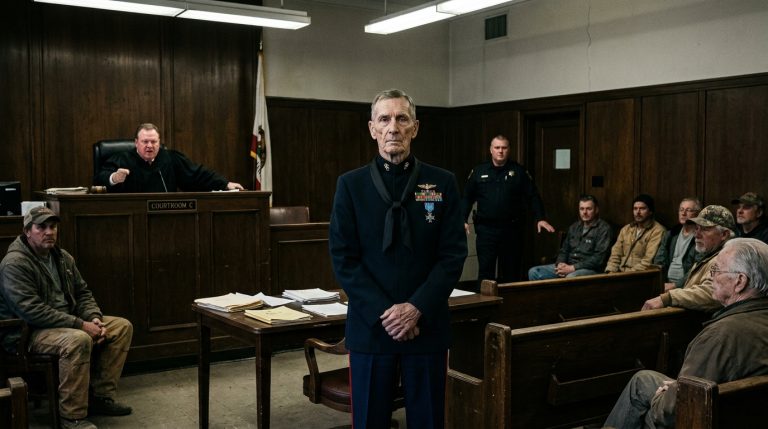
When the general finally found him, the man didn’t speak immediately. He just stood there, his four-star insignia glinting in the dull light, and rendered a salute. It was the sharpest, most precise gesture Harold had ever seen. The general’s eyes were moist, reflecting a deep, marrow-shaking respect.
“Colonel Lawson,” the general said, his voice thick with a emotion that transcended military protocol. “It is the honor of a lifetime, sir.”
Harold returned the salute, his arm stiff but his heart light. The burden of the Ugly Six, the weight of the promise to the crew he had left in the Asha Valley, finally slipped from his shoulders like a heavy coat in winter. He hadn’t just saved the plane; he had validated the secret history of a group of men who were never officially supposed to exist. He had brought them home.
The weeks that followed were a blur of investigations, red tape, and the quiet, steady erosion of Agent Fuller’s rigid, fearful world. Harold watched it all from a distance, refusing to be the face of the headlines. He didn’t want the accolades or the fame; he wanted the peace of his own life, a small, quiet space where he could breathe without the ghost of the Asha Valley hovering at his elbow.
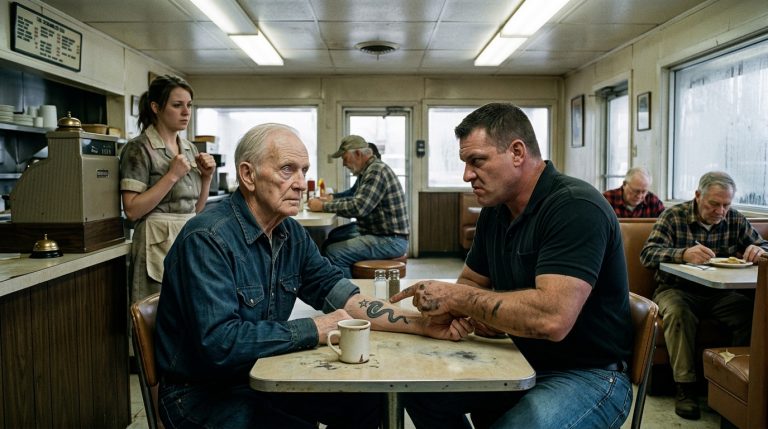
One rainy Tuesday afternoon, he sat in his usual booth at the coffee shop, the smell of roasted beans and damp pavement wrapping around him like a shroud of normalcy. The bell above the door chimed, a sound he had heard a thousand times, but this time, it held a different resonance.
Fuller entered. He was dressed in a plain polo shirt and jeans, his shoulders slumped in a way that stripped away his previous veneer of authority. He looked diminished, smaller, and significantly more human. He walked over to the table and hesitated, his eyes downcast.
“Colonel Lawson,” Fuller said, his voice barely audible over the hum of the espresso machine.
Harold looked up, his expression neutral. He set his newspaper aside and gestured to the empty chair. “Sit down, son.”
Fuller sat, twisting a napkin in his hands until the paper tore. “I’ve been… I’ve been thinking,” he began, his voice breaking. “About the flight. About how I treated you. I was a man in a cage of my own making, convinced that the only way to keep the world safe was to force it to follow a set of lines. When I saw you… when I saw that you didn’t need the lines, it broke me.”
Harold reached across the table, his hand scarred and weathered, and placed it over the napkin, stopping Fuller’s nervous movement. “Fear makes you deaf, Fuller. It’s a cage we build to protect us from the things we don’t understand. Courage isn’t the absence of that cage. It’s the ability to find the key when the door is locked.”
“How do you do it?” Fuller asked, his eyes searching Harold’s. “How do you live with what you’ve seen?”
Harold looked down at his wrist. The oversized chronograph—the scarred face, the cracked crystal—was ticking away the seconds, steady and sure. He remembered the green phosphorescence, the fire in the sky, and the faces of Mike and Jesse. They weren’t ghosts anymore; they were memories, part of the fabric of the man he had become.
“I don’t live with them,” Harold said softly. “I live for them. Every day is a gift I shouldn’t have had, and I try to make it count.”
He unbuckled the watch. He held it for a moment, the weight of it familiar and grounding, and then he slid it across the table toward Fuller.
“What is this?” Fuller asked, looking at the relic.
“It’s a reminder,” Harold said. “That you were part of something bigger than your own fear. You helped me that day, Fuller. You pulled the handle. You chose to trust when it would have been easier to remain a prisoner. That watch saw a lot of history. Maybe it’s time it saw a little bit of your future.”
Fuller touched the scarred steel, his fingers trembling. He looked up at Harold, a flicker of something like grace beginning to dawn in his eyes.
“I don’t know if I deserve this, Colonel.”
“Nobody deserves the time they get,” Harold said, a faint, weary smile touching his lips. “We just have to make the most of what’s left.”
As the rain washed the world clean outside, Harold sat back, the empty space on his wrist feeling strange, yet oddly light. For the first time in forty years, he didn’t need the watch to count the seconds. He wasn’t waiting for the crash, and he wasn’t looking back at the fire. He was simply existing, a man who had guided the ghosts home and, in doing so, had finally found his own way back to the present. He watched Fuller lift the watch, a quiet, fragile connection forming between two men who had been broken, only to be mended by the simple, human act of mercy. The shop was warm, the coffee was bitter and strong, and for the first time, Harold Lawson was perfectly, profoundly, silent.