A Quiet Echo of Honor: The Resilience of a Soldier in a World of Unseen Scars
CHAPTER 1: The Weight of the Blue Ribbon
The silence in Courtroom C was not the absence of sound; it was a physical weight, a thick, suffocating blanket of floor polish and stale coffee. Judge Albbright sat perched behind the bench like a gargoyle in a tailored suit, his eyes dancing with the cruel, bright spark of someone who had finally found a target small enough to bully.
“I’m sure it doesn’t,” the judge remarked, his voice a sharp, dismissive whip that echoed against the wood-paneled walls. He was looking at the jacket—Fred Hudson’s jacket. It was a faded, soft denim, frayed at the cuffs and worn thin by decades of sun and salt air. But it wasn’t the denim the judge was staring at. It was the three rows of ribbons pinned to the left breast, and the single star-shaped metal hanging from a pale blue ribbon.
Fred stood perfectly still. He was eighty-four years old, but his posture held the kind of rigidity that defied age—the kind of back that had been forged in a furnace and tempered by time. He didn’t fidget. He didn’t look at the public defender, Sarah Jenkins, who was hovering beside him like a nervous bird, her face flushed with a mixture of fear and growing indignation.
“Let me guess,” the judge continued, leaning forward until his face was a blotchy map of smug authority. “You bought them at a surplus store. A little costume jewelry to impress the folks at the VFW.”
A ripple of laughter moved through the back row of the gallery—mostly people waiting for their own minor infractions, looking for any reason to feel better about themselves. Fred remained detached. His eyes, clear and steady as a winter sky, were fixed on the state flag hanging limp behind the bench. He wasn’t seeing the courtroom anymore; he was seeing something else, a distant horizon that no one else in the room could perceive.
“I asked you a question, sir,” the judge pressed, his voice rising, sensing that his prey was not responding to the bait. “Are you going to answer me, or are you as deaf as you are decorated?”
Sarah stepped forward, her hand trembling as she touched the edge of the defense table. “Your honor, this is deeply inappropriate. Mr. Hudson is a veteran—”
“Respect is earned, counselor,” the judge snapped, cutting her off. “And parading around with a chest full of tin doesn’t automatically earn it in my courtroom.” He pointed a finger at the blue ribbon. “Take the jacket off, Mr. Hudson. This is a court of law, not a theater.”
The air in the room seemed to vanish. Fred didn’t move. He didn’t even blink. He looked down at the ribbons on his own chest, and for a fleeting, terrifying second, his hands—gnarled, speckled with age—twitched, as if reaching for something that wasn’t there. Then, he looked at his jacket collar. There, pinned with a simple, understated dignity, was a small, tarnished crest—a sword soaring behind a castle tower. It was the only thing in the room that wasn’t trying to be noticed, yet it held the weight of a thousand secrets.
The judge’s face darkened, his composure fracturing under the silence. “Bailiff, add a charge of contempt of court and a five-hundred-dollar fine. And since you seem so attached to your little costume,” he muttered, “take it off, or I’ll have you removed by force.”
Fred’s gaze shifted back to the judge, a look of profound, unshakable calm, but in his eyes, there was a sudden, dark clarity—the look of a man who knew exactly what the cost of his silence would be.
CHAPTER 2: The Scent of Cordite
The order hung in the air, acidic and sharp. “Take the jacket off, Mr. Hudson, or I will find you in contempt.”
Fred did not move, but the atmosphere in Courtroom C shifted. It was a subtle, almost imperceptible transformation. The sterile, humming silence of the climate-controlled chamber—the smell of floor wax and stale, recycled air—was suddenly pierced by a phantom note. A metallic, biting scent. It was the sharp tang of cordite, the acrid bite of spent gunpowder that clung to the back of the throat like dry dust.
Fred’s hand hovered near the breast of his jacket. The denim felt coarse and real under his fingertips—a faded, softened texture he had lived in for years. But beneath the denim, the weight of the ribbons was not merely metal; it was the gravity of Miller’s limp body, the dead-weight warmth of a boy from Ohio soaking through a standard-issue green fatigues.
He didn’t look at the judge. He looked at the floor, at the scuffed, gray linoleum that seemed to ripple like the mud of a rice paddy outside Hue City. The judge’s voice—that smug, patronizing whip-crack of power—faded into a muffled roar, the distant, pulsing thrum of a rotor blade struggling against a monsoon storm.
Focus, a voice commanded in his head. It wasn’t his own. It was the memory of a sergeant major from a lifetime ago, a man who had taught him that the only way to survive the crushing pressure of a combat zone was to locate the center of the storm and anchor yourself to it.
Fred closed his eyes for a fraction of a second. The bright, sterile lights of the courtroom blurred into the blinding, impossible white of a sun breaking through a jungle canopy. He was back in the crater. The mud was sucking at his boots, a hungry, clinging thing. Miller was behind him, a fragile, broken promise of a human being. The chatter of an enemy machine gun was rhythmic, a mechanical heartbeat that was trying to end his own.
Back in reality, the courtroom went deathly silent. The bailiff, a man named Henderson who had spent twenty years keeping order in this room, took an instinctive step forward. He wasn’t reaching for handcuffs; he was reaching out, his hand half-extended, as if he expected the old man to collapse. He could see the change in Fred—a subtle, terrifying stillness that had nothing to do with surrender and everything to do with the preparation for a final, desperate stand.
“Mr. Hudson?” Sarah Jenkins whispered, her voice tight with panic. She reached out, her fingers brushing the sleeve of his jacket. The contact was a jolt, a tether back to the present.
Fred blinked. The jungle vaporized. The smell of blood and wet earth retreated, replaced by the suffocating scent of cheap paper and floor polish. He felt the cold, hard wood of the defense table under his hand. He was in Northwood County. He was a defendant. And he was being asked to strip away the only tangible connection he had to a man who never made it home.
He turned his head slowly to look at the judge. Albbright was leaning forward, his face flushed with the exhilaration of his own cruelty, his gavel poised. He was looking for a breakdown. He wanted the old man to tremble, to beg, to admit that the medals were a lie.
“I won’t,” Fred said. His voice was not loud, but it possessed a resonant, grounding quality that seemed to dampen the acoustics of the room. It wasn’t a plea for mercy. It was a simple statement of fact, carved from the same stone that had formed his spine.
“Contempt of court,” Albbright spat, the words dripping with the sudden, reflexive anger of a man whose dominance had been questioned. “Bailiff, remove the jacket. If he resists, escort him to the holding area.”
Henderson hesitated. He looked at the old man—really looked at him—and saw the small, faded crest on the collar. He didn’t know what it was, but he knew the look of a man who had seen things that would break the judge in half before the morning was out.
“Your Honor,” Sarah interjected, her voice rising in a desperate, frantic cadence. “My client has a right to be treated with dignity. You are demanding he remove personal property without due process—”
“I am demanding decorum!” the judge roared, his fist slamming down on the desk. The sound was a harsh, discordant crack that shattered the tension. “This is my courtroom, Counselor. And I decide what is permissible. If he wants to cling to his delusions of grandeur, he can do it in a holding cell.”
Fred didn’t fight the bailiff as he stepped forward. He didn’t struggle, didn’t raise his hands, didn’t offer a single word of protest. He merely let his arms hang at his sides, his shoulders square, his expression a mask of granite. But as the bailiff’s hand reached for the collar of the denim jacket, Sarah pulled out her phone. Her hand was shaking so violently that she almost dropped it, but her eyes were fixed on the small, sword-and-castle crest on Fred’s collar. She had to find out who he was. She had to find the anchor he was holding onto.
As the bailiff began to unbutton the worn, brass-colored fasteners, Fred looked up at the ceiling, his breathing deep, steady, and terrifyingly measured. The courtroom was moving toward a point of no return, a collision between the hollow pride of a man with a gavel and the quiet, iron-willed sacrifice of a man who had already been through hell and survived.
Sarah slipped toward the side aisle, her feet silent on the carpet. She had to get to the alcove. She had to find the answer before the judge stripped the jacket—and the last shred of the old man’s protection—away completely.
CHAPTER 3: The Ghost in the File
The hallway of the Northwood County Courthouse was a tunnel of artificial light and abrasive linoleum. Every step Sarah took felt weighted, the echoes of her heels sounding less like purpose and more like a desperate, frantic scramble. Behind her, the heavy oak doors of Courtroom C groaned shut, muffling the judge’s voice. She didn’t look back. She couldn’t afford the luxury of second-guessing. If the bailiff finished stripping the jacket, the physical anchor—the tangible proof of Fred’s identity—would be gone, relegated to the pile of “evidence” on the judge’s desk.
She ducked into the small alcove—a space meant for quiet contemplation, now a sanctuary for her panic. The air here was thinner, smelling of industrial cleaner and the stale, lingering scent of a thousand cigarette breaks taken by tired clerks. She pressed her back against the cool, painted cinderblock, her chest heaving.
What are you doing? The thought arrived unbidden, cold and sharp. You’re a public defender. You’ve seen hundreds of clients. Old men with confused memories, veterans with fractured stories. What if he’s just… confused?
She pulled out her phone, the screen’s harsh blue light illuminating her face. Her hands were still trembling, not from fear, but from the sudden, sharp realization that her entire professional reputation was currently tethered to a man who refused to defend himself. She looked down at the file she had snatched from the desk. It was thin—pathetically thin. Name: Fred Hudson. Age: 84. Previous offenses: Three minor speeding tickets over the span of two decades. No military branch listed, no rank, no years of service. Just that single, handwritten “Yes” in the box for military history.
The doubt hit her like a physical weight, a sudden, paralyzing phantom of failure. She stared at the screen, her thumbs hovering over the search bar. She had to search for the crest. If she was wrong—if the crest was a replica, a hobbyist’s trinket, or a misunderstanding—she wasn’t just losing a case. She was making a spectacle of her own incompetence.
She took a shaky breath, the dry, sterile air of the hallway catching in her throat. Focus.
She typed: US Army crest soaring behind a castle tower.
The search engine worked with agonizing, brutal speed. Results flickered onto the screen: Special Forces. Green Berets. SOG. The acronyms meant little to her, but the images appearing in the grid were unmistakable. The same jagged, silver-and-gold silhouette as the pin on Fred’s collar. Her breath hitched, a small, involuntary sound that escaped into the empty alcove. This wasn’t a local VFW hobbyist’s pin. It was the mark of men who lived in the shadows, men whose lives were classified long before they were ever recorded.
She scrolled, her eyes scanning the paragraphs of history. Studies and Observations Group. Secret war. Impossible missions. The words were sterile, clinical, but beneath them lay the crushing weight of reality. These weren’t the stories of men who bragged. These were the stories of men who didn’t even exist on the official roster.
She needed a contact. A real person. Not a general mailbox. She scrolled past dozens of outdated links until she found a directory for Joint Base Lewis-McChord. Public Affairs.
She pressed the number. The phone rang—a flat, indifferent sound that seemed to mock her urgency.
“Fort Lewis Public Affairs, Specialist Miller speaking,” the voice on the other end was clipped, efficient, and utterly bored.
Sarah’s voice failed her for a second. She leaned her forehead against the wall, the paint grit biting into her skin. “I… my name is Sarah Jenkins,” she started, forcing the words out. “I’m a public defender. I have a client. Sergeant Major Fred Hudson.”
“Ma’am, we don’t provide legal counsel for civilian infractions,” the voice replied immediately, the rhythm of his dismissal already rehearsed. “You need to contact a local attorney or—”
“He’s in a courtroom right now,” Sarah interrupted, her voice cracking. She had to be louder, more insistent. The image of the bailiff’s hand on Fred’s jacket flickered in her mind. “A judge is holding him in contempt. He’s being humiliated. He’s wearing a First Group pin, and the judge is calling it costume jewelry.”
There was a pause on the other end. Not the pause of a bored civil servant, but the sudden, sharp silence of a gear clicking into place.
“Spell the name,” the voice said. It was different now—sharper, stripped of the boredom.
“H-U-D-S-O-N,” Sarah spelled, her heart hammering against her ribs like a trapped bird. “Fred. He’s eighty-four. He’s—he’s just sitting there. He’s not fighting back.”
She heard the sound of keys—a frantic, rhythmic tapping that echoed through the receiver. It sounded like gunfire, a staccato rhythm that seemed to bridge the two thousand miles between her and the base.
“Stay on the line,” the specialist commanded.
Sarah leaned her head back, closing her eyes. The coldness of the cinderblock provided no comfort. She realized then that she hadn’t just called for help; she had breached a wall. She had alerted an institution that was used to keeping its ghosts buried. If she was right, if Fred was who she thought he was, she wasn’t just a lawyer anymore. She was a witness to a story that was never meant to be heard.
“Ms. Jenkins?” the voice returned. It was deeper, colder, and focused. “Where are you?”
“Courtroom C. Northwood County Courthouse.”
“Do not leave,” the voice stated. “Do not let that jacket leave his sight. We are on our way.”
The line went dead. Sarah stood in the alcove, the phone still pressed to her ear, the silence of the hallway suddenly feeling heavy, charged with an electricity that made the hair on her arms stand up. She looked down at the file in her hand. It seemed different now. The paper was just paper, but the name written on it—Fred Hudson—felt like a live wire.
She turned and began the walk back to the courtroom, her steps no longer frantic, but precise. She had to get back before the judge realized that he wasn’t just bullying an old man anymore. He was waking up something far, far larger.
CHAPTER 4: The Sentinels Decision
The General’s office at Fort Lewis was a landscape of polished hardwood and cold, clinical order. Outside the windows, the base was alive with the mundane rhythm of training—the distant, rhythmic thud of artillery practice in the impact zone, the hum of heavy machinery—but inside, time had contracted into a single, razor-sharp point of urgency. General Marcus Thorne stood at the center of his command suite, his three stars catching the afternoon light. The logistics reports that had been his focus moments ago were now scattered across his mahogany desk, discarded like autumn leaves.
“Sir?” The colonel who had brought the news stood by the doorway, his posture rigid, his eyes fixed on a point just above the General’s shoulder.
Thorne didn’t look at him. He was looking at the map on the wall, his eyes tracing the geography of the Northwood County area. He was a man who had spent forty years constructing a wall between the brutal, unvarnished reality of his service and the civilian world he had helped defend. He was a man of granite and steel, but right now, his jaw was tight enough to crack bone.
“Code Nightingale,” Thorne murmured, the words feeling heavy on his tongue. It was a protocol that belonged to a different era, a time when the lines between the institution and the individual were blurred by the necessity of survival. He hadn’t spoken the words in a decade. “He’s in a county courtroom being dragged through the dirt by a man who thinks the law is a blunt instrument.”
“The Northwood County judge has him under a contempt order, sir,” the colonel provided, his voice tight with controlled disgust. “He’s moving to remand him to a state psychiatric facility. He’s calling the Medal of Honor a replica.”
Thorne turned, his movement slow and deliberate, a predator assessing the terrain. “He’s not just a man,” the General said, his voice dropping into that low, resonant rumble that had once been the only warning an enemy needed. “He’s the record of every soul we lost in the highlands. If we let them erase his dignity, we’re telling every soldier who ever wore this uniform that their sacrifice was just a temporary logistical error.”
He didn’t need to ask for a plan. He had been planning for this, in some subconscious corner of his mind, for years. He had seen the way the world treated the old men who faded into the background, the way the institutions grew brittle and forgetful.
“Get the car,” Thorne commanded, his voice sharp enough to cut through the stillness. “I want full escort. Dress blues. I want this to look less like a legal intervention and more like a return of a sovereign representative.”
The colonel hesitated. “Sir, the civil legal precedent—”
“Forget the precedent,” Thorne cut him off, his eyes flashing with a cold, focused light. “Call the state governor’s office. Don’t ask for permission. Tell them I am on my way to reclaim a national treasure, and if there is any interference from the local judiciary, the Army will be forced to conduct an immediate audit of every public official’s connection to federal funding in that district.”
The colonel snapped a salute, his face unreadable but his resolve crystalline. He exited the room, his boots clicking in a precise, measured rhythm.
Thorne remained standing alone in the room. He walked over to his private safe, hidden behind a nondescript portrait of a former Chief of Staff. He dialed the combination—a series of numbers that only he and a handful of dead men knew—and the heavy door swung open. Inside, nestled in a velvet-lined case, was a duplicate file—the real one. Not the sanitized, bureaucratic summaries stored in the base archives, but the raw, unfiltered reports. The commendations written in the dark of a tent in ’68, the ones that mentioned acts so singular, so terrifying, that they had been redacted to keep the world from looking too closely at the cost of the victory.
He picked up the folder. It felt heavy—not with weight, but with the pressure of a thousand unspeakable truths. He looked at the photograph of Fred Hudson from 1968. He was young, his face smeared with grease, his eyes staring into the camera with the haunted, hollowed-out clarity of a man who had already seen the end of the world.
Thorne pulled on his jacket, checking his medals in the reflection of the glass. The gold and bronze glittered under the harsh light of the office, but they felt like tinsel compared to the weight of the file in his hand. He wasn’t going to Northwood County to argue law. He was going there to remind the world that there were things in this country that could not be bought, sold, or insulted by a small-town judge with a bruised ego.
He walked out of his office, his strides long and purposeful. He reached the waiting vehicle—a black, military-standard transport—and slid into the back. As the engine roared to life, he looked at his watch. One hour. He had one hour to close the distance, to navigate the mess of civilian legal bureaucracy, and to reach the courtroom before they broke the only man who could tell the truth about what it really meant to serve.
The base blurred past the tinted windows. Thorne didn’t watch the scenery. He watched the reflection of his own steady, granite-hard expression in the glass. The, the “system” wanted to be procedural? The “system” wanted to follow the rules? He would give them the rules. He would show them exactly what the law looked like when it was backed by the people who had sacrificed everything to keep the law in existence.
CHAPTER 5: The Shattered Silence
The hallway leading to Courtroom C was bathed in the harsh, flickering hum of fluorescent tubes, but as Sarah Jenkins rounded the final corner, the lights gave a sickening, metallic pop and died. The darkness was instantaneous and absolute, a heavy shroud that swallowed the sterile linoleum and the distant, muffled sound of the judge’s voice.
Sarah froze. Her heart was a frantic, trapped bird against her ribs. In the pitch black, the sounds of the courthouse took on a distorted, ominous weight. The distant echo of her own breathing sounded like a storm. From deeper in the building, she heard the heavy, rhythmic thud of boots—not the frantic click of a lawyer, but the measured, deliberate percussion of soldiers. They were moving with a synchronization that sliced through the darkness.
Don’t move, she told herself. The air felt colder here, stripped of the antiseptic warmth of the previous hour. She reached out, her hand grazing the rough, peeling paint of the corridor wall. The texture was abrasive, dry and crumbling under her fingertips—a tactile reminder of the courthouse’s age, its decaying authority.
Suddenly, the floor beneath her feet trembled. It wasn’t an earthquake, but the heavy, thundering impact of a door being pushed open against the inertia of a jammed frame. The light returned in a blinding, strobing flash—a temporary surge of the backup power—and for a fraction of a second, the hallway was a stage of harsh, high-contrast shadows.
General Marcus Thorne stood at the entrance of the main concourse. He was a towering silhouette, his dress blues immaculate, the medals on his chest glinting with a cold, unforgiving light. Flanking him were two soldiers, their faces impassive, their eyes scanning the dark corridor with the terrifying efficiency of men who were currently calculating a thousand variables of threat and terrain.
Sarah’s breath caught. They looked like they had stepped out of a different reality, one where purpose was absolute and the law was not a set of words on a page, but a physical force.
“Counselor,” the General’s voice boomed. It wasn’t loud, but it possessed a subsonic authority that made the floorboards vibrate. “Where is the defendant?”
Sarah stepped into the light, her legs feeling unsteady. “Courtroom C,” she managed to say, pointing down the hall. “He’s still inside. The judge… he’s trying to remand him.”
Thorne didn’t waste time with pleasantries. He took a step forward, his boots ringing out on the tile. Click. Click. Each sound was an indictment. He moved with a, grace that belied his age, his eyes fixed on the doors of the courtroom. The soldiers behind him fell into a perfect, silent formation, their eyes sweeping the dark corners of the hall.
As they reached the heavy oak doors, the flicker of the emergency lights died again, plunging them back into shadow. Thorne didn’t hesitate. He reached out, his hand—gloved in white, pristine fabric—finding the heavy iron handle of the door.
Inside the courtroom, the voice of Judge Albbright was a thin, high-pitched whine, fueled by the manic energy of a man whose control was slipping. “I am holding you in contempt, Mr. Hudson! You will be taken from here, and your delusions will be dissected by experts who understand the law better than you understand your own pathetic fantasies!”
Thorne pushed. The door groaned, the hinges protesting under the force of a man who didn’t know how to yield. It swung inward, hitting the interior wall with a violent thud that echoed like a cannon blast.
The courtroom was frozen. The bailiff, who had been moments away from placing his hands on Fred, jerked back as if he’d been struck. The judge sat behind the dais, his mouth frozen mid-sentence, his gavel clutched in his hand like a child’s toy.
Thorne stepped into the room. He didn’t say a word. He didn’t look at the judge. He looked past the bailiff, past the nervous court reporter, and straight at the man standing in the center of the floor. Fred Hudson was still standing there, his posture unchanged, his eyes clear and steady.
For a heartbeat, the air in the room was electric, the tension so thick it felt like it could be sliced with a knife. The General walked down the center aisle, his eyes locked on Fred. The soldiers moved to the corners of the room, their posture a terrifying, silent threat.
The judge’s face went from a blotchy, enraged red to a sudden, sickly, ash-white. He gripped the edges of his bench, his knuckles whitening, his eyes darting toward the General’s chest, where the uniform was a display of more service and sacrifice than he could have ever imagined in his narrow, sterile life.
“General,” the judge squeaked, his voice cracking. “I… this is a closed proceeding. You cannot—”
Thorne stopped. He turned his head, his gaze sweeping over the dais with the icy indifference of a winter storm. He didn’t raise his voice. He didn’t shout. He simply looked at the man, and for the first time, Judge Albbright looked like exactly what he was: small, frightened, and utterly out of his depth.
“Proceeding?” Thorne repeated, the word dripping with quiet, lethal disdain. “You call this a proceeding, Your Honor? I call it an insult to the uniform this man wears, and a waste of the taxpayers’ money you were entrusted to manage.”
He didn’t look back at the judge. He kept his eyes on Fred, his face softening into a look of profound, almost reverent respect.
“Sergeant Major,” the General said, the title ringing out with the finality of a bell. “I am here to ensure that you are no longer burdened by the incompetence of this room.”
Fred Hudson, for the first time, shifted. He slowly, deliberately raised his hand in a salute. It was the movement of a soldier, a gesture of absolute, mutual acknowledgment that transcended the courtroom, the judge, and the chaos of the day. And in that one, simple movement, the judge’s world began to crumble.
CHAPTER 6: The Weight of Unspoken Truths
The silence was absolute, a heavy, suffocating pressure that seemed to drain the very oxygen from Courtroom C. General Thorne held his salute, his arm a rigid, unyielding line, his eyes fixed on Fred Hudson with a depth of reverence that effectively erased the presence of everyone else in the room. Fred, for his part, slowly lowered his hand, his movements fluid despite the ache of age. When he looked at the General, there was no surprise, no relief—only a profound, quiet recognition, as if they were two men standing on the shore of a river that had finally stopped flowing.
Judge Albbright was visibly unraveling. He sat slumped, his face a pasty, sickly white, his hands—which had, moments before, been tight with the arrogance of absolute authority—now gripped the edge of the mahogany bench so hard that his knuckles were bleached of blood. They were shaking. The tremor started in his fingertips and traveled up his wrists, a betrayal he could no longer mask. He looked at the General, then at the soldiers, then at the gallery, where the people who had been waiting for their own petty cases were now leaning forward, their faces caught in a mixture of awe and dawning shame.
“General,” the judge stammered, his voice thin and reedy. “This… this is highly irregular. The decorum of this court—”
Thorne didn’t look at him. He stepped to the side, his boots ringing out on the linoleum with a heavy, final tone, and moved toward the defense table. He didn’t offer a hand to Sarah, who was still standing with her phone clutched in her white-knuckled grip, but he acknowledged her with a single, sharp nod that spoke volumes—a silent recognition of the chain of events she had initiated.
“Your Honor,” Thorne began, his voice dropping into that low, resonant rumble. “The ‘decorum’ of this court requires a respect for the truth. You questioned the legitimacy of these decorations.”
Thorne turned, his gaze finally fixing on the judge. The temperature in the room seemed to drop. “You called them ‘costume jewelry.’ You questioned if they were bought at a surplus store.”
The judge’s gaze darted to the medals on Fred’s chest. The blue ribbon looked impossibly bright against the faded, fraying denim of the old jacket. It was a stark, jarring contrast—the beauty of the metal against the worn, lived-in reality of the man who wore it.
“I have the files,” Thorne said, reaching into his inner jacket pocket and pulling out the heavy, leather-bound folder. He placed it on the defense table with a thud that seemed to echo through the silence. “Every record, every commendation, every report from the men who served alongside Sergeant Major Hudson. I don’t need to speak them out loud for you to understand, Your Honor. The history of this man’s service is written in the blood of the people he brought home—people whose families are still living today because he refused to leave them behind.”
The judge’s eyes locked onto the folder. He looked as though he wanted to reach out and touch it, to see if the weight of it was real, but he couldn’t move. He was trapped behind his bench, a prisoner of his own narrow, self-serving perspective.
“I am not a lawyer, Your Honor,” Thorne continued, his tone turning cold, academic. “But I understand the burden of the law. And I understand the burden of the oath. You took an oath to uphold justice. Today, you used your authority to attempt to break a man who has lived a lifetime of service.”
Fred Hudson shifted. He didn’t look at the judge. He looked at his hands, which were resting calmly on the table. “Marcus,” he said, his voice soft, cutting through the General’s rising intensity.
The General stopped. He looked at Fred, his expression softening, the granite-hard lines of his face yielding to a look of profound, quiet sorrow.
“He doesn’t understand,” Fred said, and for a moment, the room felt as if it had expanded. “He never did. You can’t teach a man to see the weight of the air, Marcus, if he’s never had to carry it.”
The judge looked between the two of them. He seemed to shrink, his presence on the dais becoming smaller, less significant. The arrogance was gone, replaced by a raw, naked insecurity that was far more uncomfortable to witness. He tried to speak, but the words died in his throat, choked off by the weight of the room’s collective gaze.
Sarah stepped forward, her voice steady. “Your Honor, in light of the documentation now presented to this court, I move for an immediate dismissal of all charges, as well as a formal motion for expungement.”
The judge looked down at the gavel. It lay on the desk, a wooden tool of power that suddenly seemed like nothing more than a scrap of wood. He didn’t lift it. He didn’t call for order. He just looked at it, his breathing shallow and labored.
“Granted,” the judge whispered.
The word was lost in the room, muffled by the sheer weight of the moment.
“I said,” the judge repeated, his voice stronger, though still strained, “the case is dismissed. You are free to go.”
Thorne stood tall, his presence a towering reminder of the world beyond the courtroom walls. He waited for Fred. He didn’t rush him. He gave him the space to rise, to adjust the collar of his jacket, and to acknowledge the weight of what had just passed.
Fred stood. He didn’t look at the judge. He didn’t look at the gallery. He turned toward the door, his steps slow and measured. But as he passed the defense table, he paused. He reached down and picked up the file—the folder of secrets, the weight of the past—and held it, not as a badge of honor, but as a responsibility.
As they walked out—the General, the Sergeant Major, and the lawyer—the courtroom began to stir. People started to stand, but nobody spoke. The silence wasn’t broken by the usual chatter of a relieved gallery; it was a heavy, thoughtful quiet, the kind that follows the shattering of a long-held belief.
Judge Albbright remained on the bench. He watched them go, his hands still trembling, his eyes wide and vacant. He was still the judge, but he knew—with a terrifying, absolute certainty—that he would never be the same man again. The walls of his courtroom, once a sanctuary of his own authority, now felt like a prison.
CHAPTER 7: The Lingering Shadow of Grace
The walk to the diner was not a victory lap; it was a slow, deliberate trudge through the debris of the afternoon. Fred led the way, his stride steady but weighted, his faded denim jacket catching the dying light of a late afternoon sun. Sarah and General Thorne followed, a trailing escort of silence. Every step they took felt like moving through deep water, the momentum of the courtroom battle still pulsing in their veins, but the urgency had been replaced by a lingering, dull ache of exhaustion.
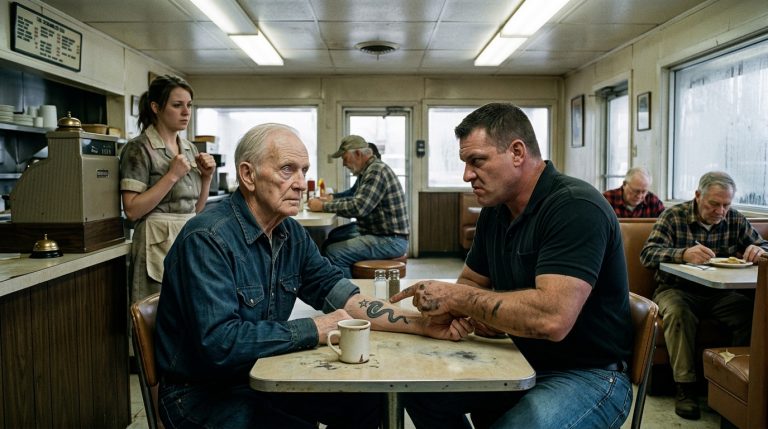
The diner—a small, local establishment with peeling yellow paint and a sign that hummed with a low-voltage buzz—was mostly empty. The bell above the door chimed as they entered, a bright, cheerful sound that felt jarringly out of place.
Fred didn’t head for the counter. He walked straight to a corner booth—the one with the cracked vinyl seats and the view of the quiet, empty street outside. He slid into the booth, his movements careful, his shoulders slumping just a fraction of an inch. General Thorne sat opposite him, while Sarah, feeling like an intruder in a conversation that had begun decades ago, took the seat on the edge, her hands folded tightly in her lap.
“Coffee?” a waitress asked, approaching with a pot that rattled against the ceramic mugs. She didn’t look at them—she was used to the quiet types, the ones who came in to disappear for a while—but she noticed the General’s uniform. Her hand paused, her eyes flickering with a sudden, confused respect, but she said nothing.
“Black,” Fred said, his voice raspy.
As the coffee steamed in the cool air of the diner, the smell hit him—a bitter, roasted aroma that, for a fleeting, disorienting second, wasn’t coffee at all. It was the smell of a mess tent outside Hue, the air thick with damp heat and the metallic tang of unwashed bodies and burnt rations. He remembered the taste of the tin cup, the way the coffee had been watered down and gritty with sediment, and the sound of Miller’s voice, teasing him about the “gourmet” quality of their breakfast.
Fred blinked, the memory receding like a tide. He looked at the mug in front of him. The porcelain was chipped, a small, jagged flaw in the rim. He traced it with his thumb, the texture familiar and grounding.
“You didn’t have to come, Marcus,” Fred said, his gaze fixed on the steam rising from the mug.
“I didn’t have to,” the General replied, his voice low and steady. “I chose to.”
Thorne looked around the diner. He was a man of high command, a man who functioned in rooms of glass and steel, but here, in the fading light, he looked merely like an old man who had traveled a very long way to see a friend. “They forgot, Fred. The systems, the courts, the people… they all forgot. They see the jacket, they see the medals, and they try to measure it against their own little yardsticks. They don’t understand the cost.”
“They aren’t supposed to understand,” Fred replied, taking a slow, measured sip of the coffee. He wasn’t bitter. There was a surprising, quiet grace in his tone. “If they understood, it would mean they had been where we were. And I wouldn’t wish that on any of them.”
Sarah watched them, her heart aching with a sudden, overwhelming empathy. She had spent the last few hours trying to find legal leverage, trying to use the system to fight the system, but sitting here, she realized how small her battle had been. She had been protecting a man’s reputation; they were protecting the memory of a soul.
“The judge,” Sarah began, her voice tentative. “He’s finished, General. The governor’s office sent word. He’s going to be stepping down.”
“He was always finished,” Thorne said, his eyes hard. “He just didn’t know it until he stood against the wrong truth.”
Fred shook his head, his hands steadying the mug. “It doesn’t matter what happens to him. He’s just a man who lost his way in his own little kingdom. The damage he did wasn’t to me, Sarah. It was to the idea of what we owe each other.” He looked out the window, his eyes reflecting the streetlamps as they flickered to life. “That’s all it ever was. We spent our lives learning that the only thing that actually matters, in the middle of all the noise, is the person standing right next to you.”
The silence returned, but it was no longer heavy or suffocating. It was a comfortable, earned quiet—the silence of two men who had spoken all the words that needed to be said. Sarah looked at her own hands, folded neatly on the table. She realized that she wasn’t just a lawyer anymore. She was part of the circle.
The diner door chimed again. A young man, probably in his twenties, walked in. He looked tired, his work clothes stained with the grime of the garage down the road. He caught sight of the General, froze for a split second, and then, with a hesitant, almost shy nod, he offered a quiet, “Thanks, sir.”
He didn’t know why he said it. He didn’t know the story. He just saw the uniform, the medals, and the way the two older men were sitting, and he recognized the gravity of it.
Thorne acknowledged him with a curt, respectful nod.
Fred didn’t look up, but a small, almost invisible ghost of a smile touched his lips. He picked up his mug, the chipped porcelain warm against his palm, and took another sip. The battle was over. The records were straight. The judge was a relic of a failed past. But for Fred, it wasn’t about the vindication. It was about the fact that, even in the quietest, most forgotten corner of a small town, the truth had finally managed to breathe.
As the evening light deepened into a soft, bruised purple, they remained in the booth—a soldier, a general, and a lawyer—anchored by the shared, unspoken weight of a memory that was finally, after so many decades, safe in the light.
CHAPTER 8: The Gear and the Grace
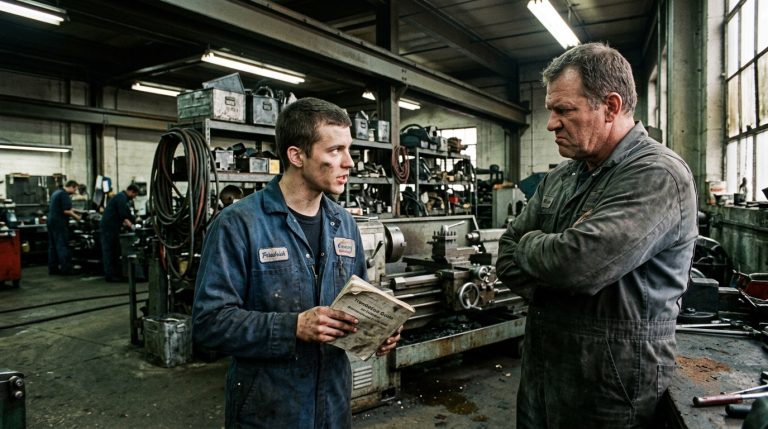
The garage was a sanctuary of dust motes and the sweet, heavy scent of old motor oil. It was a cathedral of discarded parts and patient labor, a place where time did not measure itself in court dockets or judicial threats, but in the slow, rhythmic turning of a wrench against a stubborn bolt. Fred Hudson stood at his workbench, the light from the singular, grime-streaked window falling across the exposed engine of his motorcycle.
He was alone. The frantic energy of the courthouse—the soldiers, the General’s booming voice, the judge’s unraveling—felt like a dream from a life he had lived a century ago. Here, the only pressure was the tension of a spring and the precise torque required to keep a machine running. He picked up a cloth, the fabric rough and stained, and wiped a smear of grease from the engine block.
His hands, which had trembled not once through the entire ordeal of the previous day, moved with the steady, practiced grace of a man who found his equilibrium in maintenance. He reached for a crescent wrench, his fingers finding the familiar, cold weight of the tool.
The door to the garage creaked open. It wasn’t the heavy, assertive thud of a soldier’s boot; it was a hesitant, dragging sound. Fred didn’t look up immediately. He knew the gait.
Albbright stood in the doorway. He looked smaller than he had in his courtroom, his expensive suit rumpled and hanging loose on a frame that seemed to have lost its internal structural support. He didn’t look like a judge; he looked like a man who had been hollowed out.
“I didn’t know where else to go,” the man said, his voice a ghost of the whip-crack authority he had wielded just twenty-four hours prior.
Fred wiped his hands on the cloth and set the wrench down. He turned, leaning his hip against the workbench. He didn’t invite the man in, but he didn’t turn him away. He simply waited.
“I lost everything,” Albbright said, staring at the concrete floor. “The bench. The reputation. The… the illusion that I knew what I was doing.” He finally looked up, his eyes bloodshot and raw. “You let me walk away in the diner. Why?”
Fred looked at the engine. It was an old machine, scarred by road grit and the vibration of a thousand miles, but it was functional. It held its own history in every scratch and dent.
“Because you were never my enemy,” Fred said. His voice was steady, lacking any trace of malice or triumph. “You were just a man who forgot that the uniform doesn’t make the person. You thought the chair you sat in gave you the right to judge the heart, and when you realized it didn’t, you had nowhere left to stand.”
Albbright took a step forward, his boot scuffing against the oil-stained concrete. “I treated you like a criminal.”
“And you were wrong,” Fred agreed, his tone matter-of-fact. “But you’re not a criminal, Albbright. You’re just a man who is currently waking up. That’s a painful process, but it’s the only way to eventually see what’s in front of you.”
Fred reached out, his hand—gnarled and speckled with the marks of his service—resting for a moment on the frame of his bike. He wasn’t talking about his medals anymore. He was talking about the life that had been lived in the shadows of those medals. He was talking about the young boy named Miller, whose weight he had carried out of the mud, and the captured enemy soldier to whom he had offered a drink of water.
“The medals aren’t the truth,” Fred said, his eyes meeting the former judge’s gaze with a terrifying, absolute clarity. “They are just the evidence of the choices. The truth is what you do when the world isn’t watching, and when there is no one left to give you a commendation. The truth is that you’re responsible for the person standing in front of you, regardless of the rank on their shoulder or the dust on their coat.”
Albbright looked at the garage—the tools, the spare parts, the mess of a life reclaimed. He seemed to understand, for the first time, the scale of his own error. He wasn’t looking at a veteran; he was looking at the person he had failed to become.
“What do I do now?” Albbright asked, his voice barely a whisper.
Fred picked up the wrench again. He turned back to the motorcycle, his focus returning to the engine. “You start by fixing what you broke,” he said. “Not in a courtroom. In the places where it counts. And you stop thinking that you’re the one who decides who is worthy of respect.”
He gestured to a pile of scrap metal near the door. “If you want to stay, you can start by sorting those.”
It wasn’t a punishment. It was an invitation—a simple, grounding task for a man who had spent his life building empires of ego, only to find them crumbling into nothing.
Albbright hesitated, then slowly walked toward the scrap heap. He knelt, his expensive slacks dusting over with concrete grit, and picked up a rusted, discarded bracket.
Fred didn’t watch him. He returned to his engine, the metallic click of the wrench echoing through the quiet garage. Outside, the world continued its frantic, noisy dance, oblivious to the small, silent shift that had taken place. But here, in the smell of oil and the dust of the afternoon, the storm had finally passed. The weight of the medals—the weight of the entire, complex, and beautiful human struggle—had been balanced, not by law or rank, but by the quiet, steady labor of living.
Fred smiled to himself, a small, private gesture of peace. The machine would run again. And for the first time in eighty-four years, he didn’t feel the need to explain why.