A Fragile Bloom in the Concrete: The Architect, the Mother, and the Promise of Tomorrow
CHAPTER 1: The Weight of Sunlight
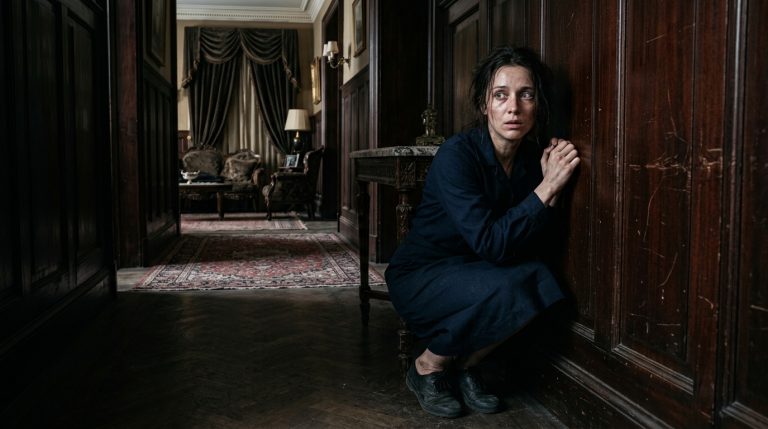
The air in the east corridor always tasted of floor wax and expensive, filtered isolation. Maya gripped the mop handle, her knuckles white, her breath hitching in the sudden, suffocating quiet of the room. She hadn’t meant to cross the threshold. The door, usually a silent sentinel, had yielded with a soft, velvet click, revealing a space that felt less like a room and more like a mausoleum for a future that had never happened.
On the far wall, centered as if it were a holy object, hung the photograph.
It was Lily. Three years old, captured in the hazy, honest light of a Tuesday afternoon in Riverside Park. Her dimples were there, etched into her cheeks, and her curly hair was a wild, joyful halo. It wasn’t the kind of photo a stranger took; it was the kind a father took. A father who existed only in the frame, in the memory, and in the agonizing, silent distance between Maya and the man who currently walked through the rest of the house.
Maya’s cloth hit the hardwood floor with a sound like a gunshot. Her heart stuttered, the steady, rhythmic pulse of her survival instinct—keep your head down, keep your job, keep Lily fed—faltering against the sheer reality of the image. Someone had watched. Someone had waited. Someone had hung her daughter’s laughter on a wall in a house of gold.
The coldness that washed over her wasn’t fear; it was the sudden, sharp clarity of a blade. She didn’t think about the rent or the empty fridge or the drafty window in Lily’s room. She turned, her boots silent on the runner, and marched toward the office. The hallway seemed to stretch, the walls closing in, but for the first time in three years, Maya wasn’t looking at the floor. She was looking for an ending.
She didn’t knock politely. She struck the heavy mahogany door with the flat of her palm, the sound echoing through the cavernous house.
“Mr. Harrington,” she said, her voice dropping into the steady, dangerous cadence she used when she knew she had nothing left to lose. “Why is my daughter’s photo on your wall?”
The silence that followed was heavy, ancient, and thick. It wasn’t the silence of a surprised man. It was the silence of a man who had been holding his breath for months, waiting for the floor to give way. From behind the door, the sound of a chair shifting on the rug sounded painfully loud.
“Come in,” he replied. His voice was a calm, low hum that didn’t match the frantic thrumming in Maya’s own veins.
As she pushed the door open, she caught a glimpse of a file left open on his desk—a report with a familiar date. Her breath hitched. The secret wasn’t just the photo. It was the report. And beneath the paper, she saw the glint of something else—a small, silver key that felt entirely out of place in such a sterile, modern workspace.
CHAPTER 2: The Geometry of Secrets
The office air was still, heavy with the scent of old paper and the sharp, antiseptic sting of expensive floor wax. Dominic Harrington didn’t move. He stood behind the heavy mahogany desk, his posture rigid, his gaze fixed on the silver key that sat like a jagged piece of debris against the polished wood.
Maya’s pulse thudded in her ears, a frantic, irregular rhythm that clashed with the clinical order of the room. Every instinct she possessed—the ones that had kept her and Lily fed through three years of lean winters—screamed at her to retreat, to turn back to the mop and the safety of the east corridor. But her feet remained planted on the carpet, anchored by the sheer, terrifying weight of what she had seen.
“You left the door open,” she said, her voice sounding thinner than she intended, yet remarkably steady.
Dominic slowly raised his eyes. They were grey, like a morning sky over a city you didn’t quite recognize. “I left it unlocked, Maya. There is a difference.”
“A difference of intent, perhaps,” she countered, her gaze flicking toward the file still spread open on his desk. She caught a glimpse of a header: Project Echo: Asset Observation. Her stomach turned over. “Is that what I am? An asset? You watched us. You kept files. You put her on your wall like a trophy.”
“Not a trophy,” he said, his voice dropping, losing its professional edge for the first time. He took a single, cautious step toward her, but stopped when he saw her hand twitch toward the door frame. “A reminder. Of what happens when people walk away.”
Before Maya could respond, a sudden, sharp ping erupted from Dominic’s desk—a reminder from his digital calendar, or perhaps an alarm. The sound was abrasive, cutting through the fragile tension like a blade through silk. Dominic glanced at the desk, his jaw tightening, and he reached out to swipe the notification away. In his haste, his sleeve caught a heavy glass paperweight, sending it skittering toward the edge of the desk.
Maya acted without thinking, reaching out to steady the object. As she caught it, her fingers brushed the edge of the Project Echo file. She saw a date stamped on the corner—just last week—and a series of bullet points that didn’t look like surveillance notes. They looked like medical diagnostic logs.
“What is this?” she asked, her fingers stalling on the paper.
“Maya, don’t,” Dominic warned, his voice sharp, lacking its usual measured tone.
“You don’t get to tell me what to do in my life when you’ve been documenting my every move from the shadows,” she snapped. She pulled her hand back, the paperweight cold and solid in her palm. The diversion—the small, clattering accident of the paperweight—had served its purpose. It had momentarily stripped away the billionaire’s armor, revealing a flicker of raw, undisguised fear in his eyes.
He wasn’t protecting a secret; he was protecting himself.
She looked at him, really looked at him, for the first time. She noticed the slight tremor in his hand as he adjusted his sleeve, the way the light from the tall window accentuated the hollows under his eyes. This wasn’t the cold, untouchable power she had imagined. It was something far more brittle.
“You wanted me to find the room,” she realized, the words tasting like copper on her tongue. “You didn’t just forget to lock it. You reached a point where you couldn’t hold the truth in anymore, but you were too much of a coward to say it out loud.”
Dominic looked away, staring toward the floor-to-ceiling windows that overlooked the north side of the city. His reflection was ghost-like against the glass, a faded texture against the harsh, bright morning. “Cowardice is a luxury I lost a long time ago, Maya. I am simply a man running out of time.”
The statement hung in the air, hollow and profound. Maya didn’t ask what he meant. She couldn’t. The proximity of the Project Echo file and the sudden shift in his demeanor had opened a chasm between them, one she wasn’t ready to bridge. She set the paperweight back on the desk, the sound of glass on wood echoing like a gavel.
“I need to leave,” she said.
“I know,” he replied, not turning back to face her. “But you’ll be back on Monday. Because you have questions, and deep down, you’re the kind of person who needs to understand why the ground you walk on is shifting.”
Maya turned and walked out, her footsteps silent on the deep-pile carpet. She didn’t stop until she was out in the hall, the heavy oak door clicking shut behind her, sealing him away with his files and his silver key. She was shaking, but for the first time in years, she wasn’t shaking because she was afraid of being fired. She was shaking because she realized she was already involved, and the room at the end of the hall was no longer the most dangerous thing in this house.
CHAPTER 3: The Echo of Walls
The apartment was too quiet. For three years, Maya had curated this silence, treating it as a sanctuary from the frantic, jagged edges of the outside world. Tonight, however, the silence felt heavy, layered with the dust of secrets she hadn’t known were settling in the corners. She walked into the kitchen, the linoleum cold beneath her socks, and set her bag on the counter. It felt heavier than usual, as if the air of the Harrington estate had clung to the fabric.
Lily was already asleep, her breathing a rhythmic, soft whisper behind the closed door of the yellow room. Maya stood in the hallway for a long moment, her hand hovering over the doorknob. She didn’t go in. She couldn’t face the paper stars and the library books right now—the small, beautiful world she had built with so much pride, only to realize, in the span of a single afternoon, that it might be tethered to a history she had never understood.
She moved to the living room window, pulling back the thin curtain just enough to look out at the parking lot below. The streetlights cast long, sickly yellow rectangles across the asphalt, illuminating the dents in the bumper of her aging sedan. Everything looked the same as it had on Friday, yet the perspective had shifted. She was no longer just a woman cleaning floors; she was a participant in a story she hadn’t authored.
The Project Echo file. The name stuck in her mind like a splinter. She hadn’t managed to read the details, but the header was enough. Asset Observation. The clinical, detached language of a man who measured the world in systems and outcomes. Had he really just been “watching” to ensure they were safe, or was Lily part of some larger, colder architecture of his own design?
She sat on the edge of the sofa, her hands resting flat on her knees. The apartment felt smaller than it had that morning. The yellow paint, once a symbol of her defiance against the grey world, now looked like a frantic attempt to cover up something much more complicated. She thought about the way Dominic had looked at her—the tremor in his hand, the way he had retreated into the grey reflection of the window.
Was he the predator, or was he a man clutching at the last fraying threads of his sanity?
She pulled her phone from her pocket, the screen glowing against the dim room. She had the contact for Patricia, the household manager, saved in her recent calls. It would be so easy to call, to demand answers, to threaten to never step foot in that house again. But Maya didn’t act on impulse. She took a breath, watching the way her own reflection in the darkened window looked back at her—tired, wary, and unyielding.
If she walked away now, she would never know. She would go back to scrubbing floors for less, to worrying about the cost of textbooks, and to watching Lily grow up in a world where her father’s shadow was a total blank. The mystery of the photograph—the way it had been centered, framed, and guarded—was not just a billionaire’s quirk. It was an invitation.
She stood up and paced the small space, the floorboards creaking under her weight. The “Observation Plan” wasn’t just a threat; it was a map. If Dominic Harrington was keeping tabs on her, he was also keeping tabs on the people who had abandoned them. Maybe that was the key. She needed to know what the logs contained, not because she trusted him, but because she needed to understand the leverage he held over her life.
She caught a glimpse of her reflection in the hallway mirror. She looked older than twenty-eight, but her eyes were sharp, scanning the room as if looking for a hidden exit. She wasn’t going to quit. Not yet. She was going back on Monday, and she was going to be the one observing the observer. She would move through that house not as a ghost, but as a person who understood exactly what the stakes were.
She walked to the kitchen and made a cup of tea, the kettle whistle a sharp, jarring intrusion in the quiet. She took the mug to the small table and opened her notebook. She didn’t write down her fears; she wrote down what she knew.
Dominic isn’t cold; he’s brittle.
He has been tracking the family connections for years.
The Project Echo logs are medical, not just social.
She looked at the third point for a long time. The medical aspect didn’t fit with a simple “welfare check.” It suggested a long-term interest in the physical well-being of the subjects. She pushed the notebook away and stared into the dark liquid of the tea. The room seemed to expand, the shadows stretching across the yellow walls, whispering that the truth was buried somewhere deep within the Harrington estate—not in the private room at the end of the hall, but somewhere far more personal.
She would go back on Monday. She would be the one to ask the questions. And if Dominic Harrington wanted to play the game of observations, she would make sure he knew that she was no longer a piece on his board. She was the one who had cleared the board in the first place.
CHAPTER 4: The Calibration of Intention
The front door of the Harrington estate opened with a sound like a heavy, silent breath. Patricia, the household manager, was waiting in the foyer, her posture a fraction less rigid than before. She held a tablet in one hand, her expression neutral—that carefully curated mask of efficiency that Maya had once found intimidating, but now merely recognized as a layer of armor.
“Mr. Harrington is in the morning room,” Patricia said, not looking up from her screen. “He has asked that you begin there today, rather than the east corridor.”
Maya felt a spike of alertness, a phantom jolt of adrenaline, but she forced her shoulders to drop. “The morning room,” she repeated, keeping her voice even. “I’ll start there, then.”
As she moved through the house, the textures were all too familiar—the polished stone under her feet, the muted, expensive tapestries on the walls—yet everything seemed sharpened by her new awareness. She stopped in the kitchen to gather her supplies, her eyes scanning the familiar countertops. Amidst the organized array of silver canisters, she spotted it: a small, dark grey key fob, resting near the edge of the granite. It was nondescript, lacking any logo, yet it sat there with a sense of deliberate placement. It didn’t belong to the household staff.
She paused, her hand hovering over the fob. Was this a test? Or was it something else? She didn’t touch it—she wasn’t going to be caught in a simple trap—but she committed its shape to memory before moving on. The house felt like a puzzle now, every object a potential clue in the “Observation Plan” she was trying to decipher.
The morning room was bathed in the thin, pale light of a damp spring morning. Dominic stood by the window, his back to her, a cup of untouched coffee held in his hand. The room was sparse, elegant, and unforgiving. He didn’t turn when she entered. He didn’t have to.
“You’re early,” he said.
“I’m here when I said I would be,” Maya corrected, setting her cleaning supplies on the table. She moved with a calculated purpose, starting with the dusting, her eyes never staying on one spot for too long. She needed to observe him, but she needed to do it while maintaining the “invisible” role that kept her safe.
“The key fob in the kitchen,” he said, still looking out at the gardens. “It’s for a secondary storage unit. Not here. It’s for things that don’t fit into the current… environment.”
Maya’s cloth paused mid-swipe. She hadn’t expected him to address the object directly. “I’m not interested in your storage, Mr. Harrington. I’m interested in why my daughter’s life was documented in a file that seems to have more in common with a clinical chart than a welfare check.”
Dominic turned then. His face looked tired, the skin around his eyes showing a fine web of lines that hadn’t been there when she started three months ago. The morning light washed out the warmth of the room, leaving only the stark contrast between his expensive suit and his fragile, hollow posture.
“You have a very sharp mind, Maya. I knew that the day I hired you. I also knew that once you started looking, you wouldn’t stop.” He set the coffee down, his hand steadying the saucer with a slow, deliberate movement. “That file isn’t a weapon. It’s a record. If I told you the truth—if I told you everything right now—you wouldn’t believe me. You would take Lily and you would run. And I cannot afford for you to run.”
“Because of the photograph?” she asked, her voice tight. “Because she’s your only link to a family you’ve managed to alienate?”
“Because of what comes next,” he said. The air in the room seemed to thin. He didn’t elaborate, but the weight of the statement landed between them, a heavy, unmovable object. He walked past her, his footsteps quiet on the rug, and stopped near the doorway. “Do your work, Maya. But look closely at the things you think you know. Not everything in this house is as it appears.”
He left without another word, leaving Maya alone in the morning room. She looked at the cloth in her hand, then at the empty space where he had been standing. The Project Echo files, the clinical notes, the storage key, and now this sudden, cryptic warning—the boundaries of her world were expanding, and the ground was no longer just shifting; it was cracking.
She finished the morning room, but her movements were different now. She wasn’t just cleaning; she was calibrating her own position. She had come here to reclaim her autonomy, but she was finding that the closer she got to the heart of Dominic Harrington’s secrets, the more she was being pulled into the gravity of his world. She didn’t trust him. She didn’t even like the way the house made her feel. But as she stood in the center of the room, listening to the hum of the cooling system, she realized she couldn’t leave. The truth was somewhere in the dust, and she was the only one left to sweep it away.
CHAPTER 5: The Decoy Revealed
Maya stood in the center of the morning room, the silence pressing against her skin like a physical force. Dominic was gone, his final, cryptic warning lingering in the air, a phantom presence that made her pulse climb. She looked at her cleaning supplies—the mundane tools of her trade—and realized how profoundly useless they were against the reality she was now navigating. She wasn’t just a cleaner anymore; she was an investigator, one who had stumbled into a labyrinth and was just beginning to realize that the walls were shifting.
She didn’t return to the hallway immediately. Instead, she took a steadying breath, her mind circling back to the Project Echo file. It had been sitting on his desk, vulnerable. The impulse to reach out and possess it—to claim the truth for herself—was so strong that her fingers twitched. She knew the risk. If he caught her, the tenuous thread of trust he was trying to build would snap, and with it, any hope of learning the truth about Lily. But the alternative was remaining in the dark, a passive observer in her own daughter’s story.
She turned back toward the office, her movements fluid and silent. The hallway was empty; the estate was unnervingly quiet, as if the house itself were waiting for the next collision. She pushed the office door open—it was unlocked, a deliberate, maddening sign of arrogance or invitation—and stepped inside. The room felt smaller today, dominated by the desk.
The Project Echo file sat exactly where she had left it. She pulled it toward her, the paper crisp and cold.
As she flipped through the pages, her breath hitched. It wasn’t just observation. It was a projection. There were dates, projections of future care, and a list of names: legal firms, trust administrators, and one name she recognized from the news—a high-profile medical foundation known for specialized pediatric care. Her heart hammered against her ribs. She was reading an adoption contingency plan, a complex legal framework built around Lily’s future.
A sudden, sharp memory flared—the sound of her father’s voice, the smell of cheap laundry detergent on his work clothes, the way he had just walked out without looking back. The fear that had been dormant for three years surged, cold and biting. He was planning to take her. He was planning to “manage” Lily’s life, to remove her from the orbit of her mother and place her into a curated, billionaire-approved existence. The “Observation Plan” was nothing more than a prelude to a legal strike.
She snapped the file shut, her hands trembling. She had been so wrong. He wasn’t reaching out to connect; he was preparing to possess. The decoy was the “welfare check,” the false bottom of his concern, which hid a much more clinical, calculated move to secure his legacy.
She shoved the file into her apron pocket, just as the sound of footsteps echoed in the corridor.
She turned, her heart in her throat, and faced the door. Patricia appeared, her face a mask of polite, terrifying efficiency. “Mr. Harrington has finished his call,” she said, her eyes flickering toward the desk. “He’s expecting you in the study.”
Maya gripped the edge of the desk, the weight of the file in her pocket burning against her hip. The game had changed. The “soft” billionaire was gone; in his place was a man who had built an empire on taking what he wanted. He wasn’t a guardian; he was a shark.
“I’m coming,” Maya said, her voice steady, despite the way the world felt like it was tilting on its axis. She didn’t know what he had in the study, but she knew one thing for certain: she was walking into a trap, and she needed to make sure she was the one who sprung it. She walked toward the door, her pace deliberate, her internal compass recalibrating to the only thing that mattered now—the survival of the world she had built for Lily, and the destruction of the man who thought he could buy it.
As she stepped out into the hall, she felt the cold draft from a window left slightly ajar, the chill of the outside world bleeding into the sterile perfection of the Harrington estate. It was a sign of the cracks forming in his fortress, and she was going to be the one to pull them wide open.
CHAPTER 6: The Fragile Truth
Maya’s pulse was a drumbeat in her throat. Every stride she took toward the study felt like crossing a minefield. She knew that Patricia’s gaze was fixed on her back—a steady, predatory observation that made the skin between her shoulder blades itch. The file was heavy, its sharp edges digging into her side, a constant reminder of the stakes. She wasn’t just a cleaning woman anymore; she was an infiltrator in a house built on glass foundations.
She reached the threshold of the study. The door stood slightly ajar, a sliver of warm, golden light spilling onto the polished floor. Before she could step inside, Patricia’s voice cut through the air, cool and measured.
“Mr. Harrington is waiting, Maya. And he prefers for his staff to arrive empty-handed.”
Maya froze. Her heart skipped a beat, then hammered with renewed force. She turned slowly. Patricia was standing at the end of the corridor, her arms folded, her expression unreadable. She wasn’t just managing the house; she was managing the narrative.
“I’m just bringing the final supply list,” Maya said, keeping her voice level, though the lie felt like lead in her mouth.
“The list is already on his desk,” Patricia replied, stepping closer. The distance between them shrank, and Maya could smell the faint, sharp scent of lavender and starch. “You seem… distracted today. Perhaps it’s the pressure of the new responsibilities.”
“I’m fine,” Maya said, moving past her with a stiff, unnatural gait.
She didn’t wait for a rebuttal. She pushed the study door open and slipped inside, the heavy wood closing with a soft, final thud that severed the tension in the hallway. The study was a fortress of leather and mahogany, smelling of expensive tobacco and age. Dominic was sitting at the massive desk, his head bowed over a document. He didn’t look up immediately.
“You’re late,” he said, his voice quiet.
“Patricia had some concerns about my focus,” Maya said, stepping further into the room. She kept her right hand pressed against her apron, anchoring the file.
Dominic looked up. The light from the desk lamp cast deep shadows across his face, accentuating the hollows of his cheeks. He looked frail, the mask of the powerful billionaire slipping to reveal a man who was fighting a war he was destined to lose. The sight of him—unexpectedly vulnerable—sapped some of the defensive fire from Maya’s stance.
“She’s just doing her job,” he said, gesturing to the chair opposite him. “Sit.”
Maya remained standing. “I found the file, Dominic. The Project Echo file.”
The room went completely silent. Dominic’s expression didn’t shift, but his fingers, which had been resting on the desk, curled into a tight, white-knuckled grip.
“I read it,” she continued, her voice trembling despite her best efforts. “I saw the contingency plans. I saw the adoption logs. You aren’t watching her to keep her safe; you’re building a cage for her, and you’re waiting for the right moment to lock the door.”
Dominic let out a long, ragged sigh that sounded like the collapse of a structure long overdue for demolition. He didn’t deny it. He didn’t offer a platitude. He simply leaned back, his gaze fixed on a point somewhere behind Maya, his eyes clouded with a profound, weary sadness.
“I am not building a cage, Maya,” he whispered, the words barely audible. “I am building a lifeboat.”
He reached into his desk drawer, his movements slow and pained, and pulled out a small, metallic folder. He didn’t slide it across the desk; he simply held it out.
“You think this is about control,” he said, his voice gaining a sudden, desperate clarity. “You think I have the luxury of time to play these games. But look at these, Maya. Look at what they say about my blood. Look at the reality of the inheritance I’m leaving behind.”
Maya hesitated, then moved forward. She took the folder, her hands shaking, and opened it. The documents were technical, filled with medical terminology that made little sense, but the concluding summary was written in plain, brutal English. A prognosis. A diagnosis. A terminal timeline.
The file in her pocket—the adoption plan—suddenly took on a new, devastating context. It wasn’t about stealing Lily. It was about ensuring she had a place to go when he was gone, a way to anchor her in a world that had always been eager to discard the people he loved. The “cage” she had feared was, in his eyes, a bridge to a future he would never see.
The floor seemed to sway beneath her. The anger that had been her shield began to dissolve, replaced by a cold, numbing hollow. She looked at him, really looked at him—the tremor in his hands, the grey skin, the way he seemed to be barely holding himself together.
“You’re dying,” she breathed.
“I am,” he said, his voice a ghost of its former self. “And I have no one else, Maya. Daniel is gone, and I am the last of a line that always knew how to build things, but never knew how to keep them. You were the only one who didn’t look at me like a bank account. You looked at me like a person.”
The room seemed to shrink. Maya felt the weight of the file in her apron—the “adoption plan”—and realized it wasn’t a document of theft. It was a document of desperation. He hadn’t been planning to take Lily; he had been planning to leave her everything, and he didn’t know how to do it without destroying the mother who was the only reason Lily was worth saving in the first place.
She didn’t know whether to scream or to collapse. The enemy she had built up in her mind, the cold, calculating billionaire, was nothing more than a man terrified of the dark. She sat down, her legs giving way, the silence of the study no longer a weapon, but a tomb.
CHAPTER 7: The Bridge
The park was draped in the long, melancholic shadows of a late-afternoon sun. The air was crisp, tasting of damp earth and coming autumn. Maya stood by the gate, her hands trembling as she adjusted the collar of Lily’s coat. The little girl was a whirl of energy, her laughter a bright, piercing sound that cut through the heaviness pressing down on Maya’s own chest. A few yards away, Dominic stood near a weathered stone bench. He looked diminished, his coat hanging loosely on his frame, his eyes fixed on Lily with an intensity that bordered on the painful.
He didn’t move toward them. He waited, his posture marked by a new, heavy caution.
Maya took a step, then another. The file—the evidence of his terminal diagnosis—was burning in her mind. Every time she looked at him, she didn’t see the billionaire who had orchestrated a surveillance plan; she saw a man who had realized he was running out of breath. The anger that had been her only defense for the past week was rapidly fraying, replaced by a deep, hollow ache of shared mortality.
Lily spotted him. She didn’t hesitate, her small boots crunching on the gravel as she sprinted toward him, her arms outstretched. “The conductor is here!” she shouted, her voice full of an unfiltered, radiant joy.
Dominic’s face broke—a jagged, raw expression of relief that he made no attempt to hide. He sank to one knee, a movement that looked labored, and when Lily collided with him, he didn’t pull back. He wrapped his arms around her, burying his face for a fleeting second against her shoulder. It was the movement of a man grounding himself to the earth, anchoring his spirit to the only thing he believed was real.
Maya watched, her throat tightening. She had come here to confront him, to demand a final accounting of the “lifeboat” he had planned, but the sight of them together silenced the protest on her lips. She saw the way he was looking at her daughter—not with possessiveness, but with the quiet, terrified wonder of a person who has found something precious just as the lights were beginning to go out.
She joined them, her feet feeling leaden.
“You didn’t have to come,” Maya said, her voice barely a whisper above the rustle of the wind in the trees.
Dominic looked up at her. He didn’t rise; he stayed on his knee, his eyes swimming with a mixture of shame and hope. “I had to see if I could be someone worth knowing, Maya. Even if it was only for a day.”
“You’re playing a dangerous game, Dominic,” she said, though the venom she had intended was gone. “You’re asking me to bridge a gap that’s three years wide with a man who thought he could buy his way into my daughter’s life.”
“I never thought I could buy you,” he said, his voice straining with an effort to be understood. “I only ever wanted to ensure that when the end came, she would be cared for. I was a coward. I thought if I put enough money into the right channels, I could ignore the fact that I had never actually reached out to you as a person. I thought I could outsource my own humanity.”
Lily, oblivious to the gravity of the exchange, tugged on his sleeve, holding up a leaf she had found. “Look! It’s orange. Like the sun.”
Dominic took the leaf, his fingers brushing Lily’s hand. The contact seemed to drain the last of his resistance. “It’s beautiful,” he said. He looked back at Maya. “I have no more strategies. I have no more contingency plans. I have only this moment, and the realization that I have wasted so much time pretending that I could control the future.”
Maya looked down at them—the billionaire who had everything and yet was losing the only thing that mattered, and her daughter, who was entirely, defiantly alive. She realized that the “lifeboat” wasn’t a trap; it was his last, desperate act of love, and in rejecting it, she would be fulfilling the very cycle of isolation that had destroyed his family.
She crouched down, placing a hand on Lily’s shoulder, then slowly extended her other hand to Dominic. It was an act of surrender, not to him, but to the reality of the broken, Kintsugi-like future they were all standing in.
“We have time,” Maya said, the words feeling like a vow. “But you start by being honest. No more surveillance. No more files. You show up, you listen, and you learn who she actually is. Not the version you’ve been building in your head.”
Dominic’s hand reached out, shaking as he took hers. The connection was cold, but beneath it, she could feel the pulse of a human being reaching for the light. It wasn’t the beginning of a fairy tale. It was the beginning of a long, hard road, one that would be defined by the heavy, honest work of healing. But as they sat there on the gravel path, with the autumn leaves falling around them, Maya felt the weight of the last three years finally, mercifully, begin to lift.
CHAPTER 8: The Foundation
The walk back to the mansion felt like a journey across a border. Maya held Lily’s hand, the small, warm pressure of her daughter’s palm a grounding force against the surreal developments of the afternoon. Beside them, Dominic walked with a measured, uneven gait, his eyes tracing the contours of the house as if he were seeing it for the first time—or perhaps, the last. The sun was dipping low, casting long, bruised purples and golds across the manicured lawn. The estate, which had once felt like an impenetrable fortress, now appeared merely as a structure of brick and glass, waiting to be repurposed.
When they reached the foyer, the air inside was cool, smelling of beeswax and the faint, persistent scent of lavender from Patricia’s office. Dominic stopped in the center of the entrance hall, his shoulders finally dropping from their perpetual, rigid guard. He looked at the grand staircase, then back at Maya, his expression stripped of the strategic artifice he had worn for three months.
“I’ve already contacted the lawyers,” he said, his voice quiet but steady. The exhaustion was still there, but the manic intensity had vanished. “The arrangements for the trust, the medical directives, the transition of the estate—everything is being reorganized to prioritize the stability of your life with Lily. You don’t have to stay here, Maya. You don’t even have to use the house. But the resources are yours. Use them to build whatever you couldn’t afford before.”
Maya stood still, the weight of his words settling over her. She looked at him, seeing the pale, translucent quality of his skin and the way he leaned slightly against the marble pedestal of a hallway bust. He wasn’t the monster she had feared, nor was he the savior she had hoped for. He was a broken man trying to do one final, irreparable good.
“I don’t want the house,” she said, her voice soft but firm. “I want the time. I want you to tell her about the music. I want you to be the person who hears her laugh without needing a file to record it.”
Dominic’s mouth quirked in that small, genuine smile she had only recently begun to recognize. “I’d like that.”
The following weeks were not a whirlwind of cinematic change, but a slow, tectonic shifting of their lives. The “Observation Plan” was dismantled, the files shredded, the cameras in the halls disabled. The estate became less of a mausoleum and more of a staging ground. Maya didn’t quit her cleaning jobs; she kept them, but she reorganized her hours, using the new stability to return to the nursing program she had abandoned at twenty-two. She found a quiet satisfaction in the work—the slow, disciplined acquisition of knowledge that she knew would allow her to care for others, just as she had cared for Lily.
Dominic’s health declined, but he remained present. He didn’t occupy the study anymore; he spent his afternoons in the sunroom, reading to Lily or watching her dance to the commercials she still found endlessly amusing. He grew thinner, his voice quieter, but the frantic, searching look in his eyes had been replaced by a serene, anchored focus. He was no longer trying to outrun his legacy; he was participating in it.
One afternoon, in the quiet depth of a mid-summer day, Maya found him in the sunroom, looking at the faded yellow dress Lily had outgrown. It was draped over the back of a chair—a fragile, frayed thing, stained at the hem from too many adventures in the park.
“I’ve been thinking about the stars,” he said, not looking up. “The paper ones you hung in her room. You made a whole galaxy out of nothing.”
Maya walked over, picking up the dress. She smoothed the fabric, feeling the worn threads—the texture of their struggle, the weight of the years when she had been the only one. She didn’t feel the sting of old wounds anymore; she felt a quiet, hard-won peace. She sat down next to him, and for a long time, they just watched the way the light played on the floor.
“We’re going to be okay,” she said, and for the first time, she truly believed it.
Dominic nodded, his gaze drifting toward the window where Lily was playing in the garden. “I know. The foundation is solid now.”
He leaned back, his eyes closing, his breathing shallow but rhythmic. Maya didn’t move. She stayed there, watching the transition of the light, the way the world outside kept turning regardless of their histories. She had come here to protect her daughter, and she had ended up protecting the one person who had been the most lost of them all.
As the sun disappeared behind the horizon, leaving the house bathed in the soft, blue velvet of twilight, Maya took a needle and thread from the sewing kit she had brought with her. She began to mend the hem of the yellow dress, her stitches precise and deliberate. It was a small act, a simple repair, but it felt monumental. She was fixing the edges, mending the fraying parts, and preparing for whatever came next.
The house was quiet, but it was no longer empty. It was filled with the resonance of a life being lived, a bridge being built, and the profound, simple truth that even the most fractured things could be made whole if you were willing to hold them together long enough.