The Line of Possession: A Quiet War of Paper, Property, and the Architecture of Truth
CHAPTER 1: THE PERIMETER SURVEY
The morning light was thin and gray, the kind of dawn that smells of cold dew and dry, unyielding ground. I stood at the threshold of my property, my boots pressing into the boundary line I had mapped with a transit level and a singular, obsessive focus. Behind me lay the silence of my home; ahead, the rusted chain-link fence of the subdivision that sat like a weight on the land.
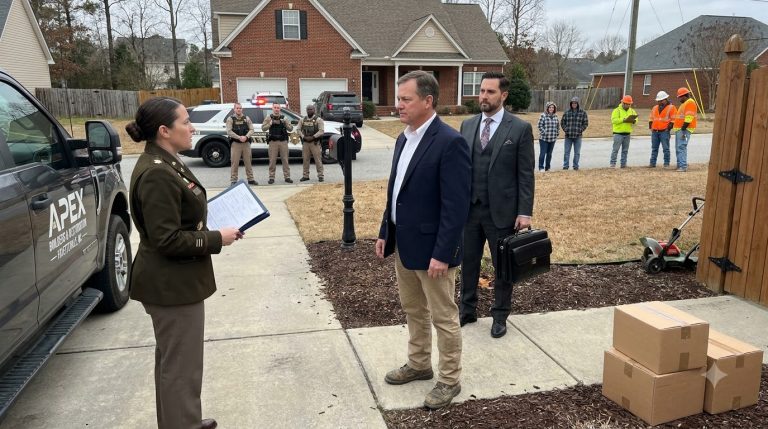
The landscaping truck had arrived at exactly 9:17 a.m. It was a heavy, industrial thing, emblazoned with a logo that felt like a challenge. The foreman stepped out, his high-visibility vest a jarring neon shock against the muted tones of the canal bank. He was followed by five others, their movements practiced and arrogant, the posture of men who were used to being told that the ground they stood on belonged to someone else.
I didn’t reach for a camera immediately. I reached for the weight of the document in my left hand.
The foreman checked a clipboard, his eyes scanning the shore with the detachment of a man counting bricks, not measuring a life. He pointed toward a cluster of native reeds that I had spent three seasons nurturing to prevent bank erosion.
“Start here,” the foreman called out, his voice thin in the morning air. “Straight line to the bulkhead.”
I stepped off the porch. My path was intentional, a steady, measured gait that matched the internal cadence of my pulse. I stopped precisely three inches shy of the property marker—a small, rusted iron rod I’d driven into the earth years ago.
“Gentlemen,” I said. My voice was steady, pruned of any inflection that might suggest anger. Anger was a variable I couldn’t afford. “You are currently standing on private property. Who authorized this?”
The foreman stopped, a wooden stake dangling in his gloved hand. He looked at me, then at the stake, then back at me. He didn’t look malicious, just tired. He reached into his back pocket and produced a stapled packet. “HOA hired us. We’ve got authorization for the corridor.”
“Authorization is a word with a specific definition,” I said, my gaze dropping to the packet. “And that is not a court order.”
From the curb, a white SUV door slammed shut. Karen Whitlock emerged, her presence a sudden, sharp clarity in the morning haze. She wore sunglasses that turned the world into dark, unreadable shapes. She didn’t walk toward us; she stood at the boundary, a spectator to her own creation.
“It’s a community safety project,” she called out, her voice pitched for an audience I couldn’t yet see. “He’s refusing reasonable cooperation. Continue, please.”
I felt the familiar, cold shift in my gut—the realization that the conversation had already ended before I’d even begun. I reached into my pocket and touched the cold metal of my phone. The reality of the moment wasn’t in her words; it was in the discrepancy between the map in her hand and the survey pins buried beneath the weeds.
I looked at the foreman, locking eyes with him. “If you drive that stake into the ground, it won’t just be an encroachment. It will be the first entry in an affidavit of trespass.”
The foreman hesitated. He looked at Karen, then at the dirt beneath his boots.
Behind them, a neighbor walked by with a stroller, casting a quick, confused glance toward the shore. In that split second, I noticed something that didn’t fit the narrative of a simple “walking path”—a surveyor’s mark on the neighboring property that was angled toward my land, not away from it. It was a detail that felt like a jagged piece of glass beneath the skin, a hint that this wasn’t about a path at all.
“Stop,” I said, the word simple and heavy.
The foreman froze. Karen’s smile tightened, a fracture appearing in her composure. She took a step forward, ready to argue, but I didn’t wait for her. I began to record.
CHAPTER 2: THE DIGITAL SIEGE
The silence that followed my command to stop was thick, heavy with the smell of turned earth and the impending heat of the day. The foreman didn’t strike the ground. He stood with the stake hovering inches above the soil, his knuckles white against the wood. His eyes flicked from my phone—still recording—to the subdivision fence, then finally to Karen. He was a man caught between a contract and a sudden, sharp instinct for self-preservation.
“The work order, sir,” I repeated, my voice steady and devoid of threat. “If you are being misled, you will want proof. I am not asking you to take my side; I am asking you to protect your license.”
Karen took a sharp, jagged breath. She sensed the fracture. She stepped forward, her heels digging into the soft turf of the buffer zone. “Don’t listen to him. He’s a property-line crank. We have the legal authority. The HOA board signed off on this corridor, and the city approved the survey map.”
“The city approved nothing,” I said, not looking at her. My attention remained locked on the foreman. I needed him to see the truth, not hear the argument. “Ask her for the permit number. Ask her to show you the municipal seal on that authorization form. If she can’t, you are committing a trespass for which you—not her, not the HOA—will be legally liable.”
The foreman’s face went pale. The “community safety project” was losing its luster, replaced by the grim reality of a potential lawsuit. He looked at Karen, and for the first time, she didn’t look like an authority figure; she looked like someone desperate for the ground to stop shifting.
“We need to check the coordinates,” the foreman muttered to his crew. He lowered the stake. “Pack it up. We’re not dropping anything else until I see the permit.”
“You are under contract!” Karen snapped, her voice losing its composed, soft-toned veneer. “Finish the line!”
“Not without a permit, ma’am,” the foreman said, his voice clipped.
I didn’t gloat. I didn’t smile. I stood perfectly still, recording the entire exchange—the retreat of the crew, the way Karen’s hands shook as she clutched her clipboard, the look of genuine betrayal on the face of the board member who had been watching from the curb. When the trucks finally pulled away, leaving behind only the ruts in my soil and the tension of a victory only half-won, I turned back toward my porch.
The victory was thin. I knew Karen. She wouldn’t retreat; she would pivot. This was the first move in a siege, and I was now the primary target.
I went inside and immediately sat at my desk. The room was cool, a stark contrast to the humid, iron-scented air outside. I opened my laptop and began the systematic process of the “Digital Siege.” I took the video files, the screenshots of the GIS overlay, and the metadata from the emails Karen had sent earlier that week. I cross-referenced the HOA’s stated goal—a “community walkway”—with the municipal tax maps I had spent weeks studying.
There was a discrepancy.
Karen’s project map overlapped a narrow, dark strip of land that wasn’t included in the HOA’s development footprint. It was a utility easement, ancient and largely forgotten, intended for the reservoir’s secondary drainage system. I hadn’t thought much of it before, but looking at the surveyor’s lines again, I realized the trajectory of their proposed “walkway” didn’t lead to the community park. It led directly toward the intake valves of the reservoir, where the soil was notoriously unstable.
If they built a path there, the vibration of foot traffic alone might be enough to trigger a collapse of the canal bank. It wasn’t just an encroachment; it was a disaster waiting to happen, and Karen was trying to bury it under the guise of public utility.
My phone pinged. A notification from the title monitoring service. A new document had been filed with the county.
I opened the link with shaking fingers. It was a “Notice of Claim” filed by the HOA against my property. It referenced an easement that didn’t exist, using language designed to trigger a lien. It was a brute-force tactic—a paper bomb meant to scare me into submission.
I checked the timestamp. 8:12 a.m. She had filed it while we were standing on the canal bank.
I didn’t feel anger. I felt the cold, sharp focus of a predator. I took a screenshot, saved the PDF to my encrypted drive, and began drafting an email to my attorney. I didn’t need to shout. I didn’t need to argue. I just needed to be precise. I attached the metadata of the filed notice, the timestamps of our interaction, and the police incident number I’d requested earlier that morning.
The battle wasn’t being fought on the canal bank anymore. It was being fought in the records, in the silent, unfeeling architecture of the law. I watched the cursor blink on my screen, a steady, rhythmic pulse. The HOA thought they were dealing with a property owner. They were actually dealing with an auditor of their own destruction.
I looked out the window. The sun was beginning to hit the canal, illuminating the ruts the trucks had left. It was a mess, a scar on the land, but it was evidence. I saved the file, labeled it with a clear, unambiguous title, and pressed send. The siege had begun, and I had the higher ground.
CHAPTER 3: THE CONSTRUCTION INTRUSION
I didn’t wait for the sound to resolve into something identifiable. I pushed away from the desk, the legs of the chair scraping against the floorboards with a jarring finality. The email was out—a digital shot across the bow—but the response was physical, immediate, and entirely uninvited.
I walked out of the back door, the midday sun hitting me like a physical blow. The air had grown heavy, holding the stagnant heat of the canal. Down by the shoreline, the landscaping trucks had returned. This time, there were no handshakes, no clipboards, and no pretense of community coordination. The foreman was there, but he stood by the truck, his face obscured by the shadow of the cab, while two new men—larger, quieter, wearing plain, unmarked gear—began unrolling heavy-duty silt fencing with a violent, practiced speed.
They weren’t building a path. They were securing a perimeter.
I didn’t run. I moved with the same measured, deliberate gait I had used earlier, my eyes scanning the ground. The silt fence was being driven in a curve, deviating sharply from the line Karen had proposed in her “brochure.” It was arcing deep into my parcel, cutting off access to the drainage intake—the very point where the ground was most fragile.
“Gentlemen,” I said, my voice cutting through the mechanical rattle of the truck.
The men didn’t stop. They didn’t even look up. The foreman finally stepped out from the shadow of the truck, his expression flat. He held a new document—a single, freshly printed page in a plastic sleeve.
“Authorized access,” he said, the words sounding rehearsed, stripped of all personal inflection. “We have the documentation. You’re interfering with municipal infrastructure maintenance.”
“Show me the work order,” I countered, stopping at the edge of the new silt line.
He didn’t offer the packet this time. He just pointed at the plastic sleeve. “It’s all there. Move back, sir. This is a restricted site.”
I took a breath, the metallic tang of the canal water filling my lungs. I reached into my pocket, not for my phone, but for the printed surveyor’s map I had kept ready on my porch table. I unfolded it slowly, the paper crisp and authoritative.
“Municipal infrastructure,” I said, leveling my gaze at the foreman. “That’s a specific category. It requires a permit from the county, a certified engineer’s signature, and a public notice period. You have none of those.”
I looked past him, scanning the site. That’s when I saw it—a discrepancy that tightened my chest. One of the workers was using a heavy-duty drill to anchor a metal stake into the ground, but he wasn’t just driving it into the dirt. He was forcing it into a concrete casing buried beneath the topsoil. My property map didn’t show a concrete casing there. It showed the original drainage pipe, now rusted and compromised.
They weren’t maintaining infrastructure; they were reinforcing the bank to hide the fact that the drainage pipe had already collapsed.
The weight of it hit me with the force of a sudden realization. Karen wasn’t just trying to steal land to inflate property values; she was trying to stabilize the ground long enough to pass the HOA’s liability off to the next owner—or to the city, once the “walkway” was deeded over as public land.
“You’re not reinforcing the drainage,” I said, my voice low, reaching the foreman’s ears with a clarity that made him flinch. “You’re trying to cap a sinkhole.”
The foreman stopped, the drill still in his hand. The silence that stretched between us was no longer about property lines; it was about the dangerous, hidden geology of the land. He looked at the drill, then at the concrete casing, his professional detachment shattering for a fraction of a second. He was a contractor, and he knew enough about soil to understand the implication of a collapse.
“I have a job to do,” he muttered, though his hand shook.
“Your job is to follow the law,” I said, stepping closer, my shadow falling over the silt fence. “And the law says that if you knowingly cap a failing drainage system without a structural report, you’re not just an employee. You’re a co-conspirator in a massive fraud.”
I didn’t need to record this. The fear on his face was a better witness than any camera. I watched him weigh the contract against the impending reality of the ground beneath us. He was a man who worked with his hands, and he knew that sometimes, the foundation is too rotten to save.
“Shut it down,” he barked at the worker.
“What?” the worker yelled back, the drill still vibrating against the casing.
“I said shut it down! Now!”
The machinery died, replaced by the ringing silence of the canal. The foreman threw the plastic sleeve into the dirt, his face flushed with a mix of anger and cold, hard realization. He didn’t look at me. He didn’t look at the site. He just signaled for the trucks to back up.
“It’s not my problem anymore,” he said, passing me without looking up.
I stood there, the surveyor’s map still gripped in my hand, as the trucks began their slow, rhythmic retreat from my land. I had won the day, but the victory felt different now. The ground felt softer, more precarious. The secret wasn’t just in the paperwork; it was under my feet. And the more they tried to cover it, the more dangerous it became.
I turned back toward my house, the weight of the surveyor’s map feeling heavier than before. The siege was no longer just a legal battle. It was a race to uncover a truth that was literally waiting to swallow the land whole.
CHAPTER 4: THE PAPER TRAIL ESCALATION
The retreat of the construction crew didn’t bring peace; it brought the heavy, expectant quiet of a chess player waiting for a blunder. I walked back toward the house, my boots crunching over the disturbed earth. The ruts left by the tires were deep, exposing the gray, slick clay of the bank—a stark, visual warning of the instability beneath.
Inside, the house felt too small, the air still and stale. I sat at my desk, but I didn’t reach for the computer. I reached for the thick envelope that had arrived in my mailbox that morning, a delivery I’d been too preoccupied to open during the morning’s standoff. The return address was the HOA management company, the logo embossed in a sterile, authoritative blue.
I slit the top with a letter opener, the steel singing against the paper. Inside was a formal “Notice of Non-Compliance,” drafted in language so dense it felt designed to trip the reader up. It cited bylaws I’d never agreed to, codes of conduct that didn’t apply to my deed, and a demand to remove my private property sign within forty-eight hours or face “daily administrative fines.”
I laid the pages out on the desk, overlapping them. Karen wasn’t just throwing paper at me; she was creating a mountain of technical jargon to bury the actual issue: the unauthorized construction. She was creating a record of me as a “non-compliant resident,” which would later serve as her justification for whatever drastic move she had planned next.
I picked up a highlighter. As I began to parse the text, I noticed a subtle discrepancy. The document was dated three days ago, but the timestamp on the digital file I’d received via the HOA portal earlier that morning showed a different creation date. She was back-dating her correspondence to create a false timeline of “due process.”
My hand hovered over the highlighter, the yellow tip trembling slightly. I had been so focused on the physical encroachment—the stakes, the silt fence, the bank collapse—that I’d treated her paperwork as a secondary nuisance. But what if the paperwork was the construction? What if the “walkway” was never intended to be built, but was instead a performative project meant to generate the legal records she needed to seize control of the easement?
I pulled out my phone and called the county recorder’s office. I didn’t identify myself as an adversary, just a curious property owner looking for clarification on a specific instrument number.
“The filing you’re referencing?” the clerk asked, her voice echoing in the background of a busy office. “That’s an internal HOA filing, sir. We record them, but we don’t verify the board’s meeting minutes unless there’s a dispute.”
“And if the board minutes are fabricated?” I asked, keeping my tone mild.
There was a pause. “Then that’s a civil matter for the courts, not the county. We only track the trail; we don’t judge the integrity of the steps.”
I hung up, the silence of the room rushing back in. She had found the blind spot in the system. As long as she could produce a paper trail—no matter how flawed, no matter how manufactured—she could tie up my property in litigation for years. She didn’t need to win the case; she just needed to make the cost of defending it higher than the value of the land itself.
I looked at the documents again, but this time, I ignored the text. I focused on the font, the signature block, the way the paper was folded. It was a masterpiece of administrative theater. And then, I saw the flaw—a tiny, microscopic detail in the footer of the document. A serial number that didn’t match the HOA’s registered management software. It was a ghost in the machine, a remnant of a personal, non-official document template she’d likely pulled from her own private computer.
I felt a surge of cold, analytical clarity. I wasn’t just fighting a neighbor; I was fighting an amateur who thought she was a sovereign. I pulled out my ledger, the one where I tracked every interaction, every timestamp, every threat. I began to map out the connections, linking the dates of the forged documents to the dates of her neighborhood group posts.
The puzzle was beginning to take shape. It wasn’t about the walkway. It was about the corporate buyout of the neighboring subdivision, the one the board had kept quiet about for months. The easement was the “missing link” for the developers, and Karen had promised them it was clear. She was failing to deliver, and she was terrified.
The fear wasn’t mine anymore; it was hers. And as I stared at the mismatched footer in the document, I realized that if I could document the forgery, I wouldn’t just stop the walkway—I would blow the entire board’s reputation wide open. I didn’t need to play by her rules. I just needed to show that the game she was playing was entirely illegal.
I picked up the phone, not to call the lawyer, but to contact the surveyor again. I needed a professional assessment of the drainage pipe’s integrity, something that would hold up under the scrutiny of an environmental inspector. If I could prove the land was geologically compromised, the HOA would have no choice but to admit the project was a failure.
The sun began to dip, casting long, sharp shadows across the desk. I was ready. The paper trail had been her weapon, but I was about to turn it into her cage.
CHAPTER 5: THE MIDPOINT DISCOVERY
I sat at the kitchen table, the surveyor’s map spread before me like a dead language. The report was blunt: the soil composition near the drainage intake was “critically unstable,” a condition exacerbated by decades of neglect that the HOA had been legally obligated to address. That was the Layer 1 decoy—the HOA’s panic over their fiscal liability for the pipe failure. But as I traced the lines of the pipe with my finger, I felt a shift in the air, a phantom pressure against my temples.
I remembered this canal as a child. It hadn’t been a straight, concrete-lined ditch. It had been a wild, meandering artery, fed by a natural spring that the subdivision’s original developers had simply… buried.
I stood up, the chair screeching against the floor, and grabbed a heavy flashlight. I didn’t care about the fading light. I needed to see the intake valve, not from the top, but from the edge of the bank where the silt fencing had been torn down.
The walk down to the canal was a physical struggle against the encroaching dark. The wind coming off the water was sharp, carrying the taste of silt and iron. When I reached the spot where the construction workers had been drilling, I shone the light into the ruts. The silt fence hadn’t just been a barrier; it had been a structural wall, anchored deep into the soil.
I knelt, pressing my palm against the clay. It was damp—too damp.
I pushed my fingers into the soft earth near the casing of the pipe. They didn’t hit soil. They sank into a hollow space. My heart thudded against my ribs as I swept the light around. The entire bank wasn’t just unstable; it was being hollowed out by an unseen, constant flow of water that shouldn’t have been there.
This wasn’t a pipe failure. This was a redirection. Someone had purposefully diverted the natural spring flow under the foundation of the proposed “walkway” to create the exact instability they claimed they were “fixing.”
Karen wasn’t just negligent. She was orchestrating a collapse. If the walkway was built, the weight would trigger a total bank failure, effectively “cleaning” the area of the old, failing pipe and allowing the developer to sue for a full-scale redesign of the site—funded by the city as a “disaster mitigation” project.
The logic was cruel, pragmatic, and entirely hidden behind layers of bureaucracy. I felt a cold shiver that had nothing to do with the night air. The decoy was the “community safety” path; the truth was the planned catastrophe.
I took a deep breath, the smell of damp earth filling my mouth. I had the confirmation I needed, but it changed everything. I wasn’t just protecting my property anymore; I was standing on the trigger of a bomb. I stood up, my legs feeling leaden. The wind whipped at my jacket, and in the distance, I heard the faint, rhythmic sound of a heavy engine starting up.
They were coming back. Not to build, but to finish the job before I could get the environmental inspector to the site.
I retreated toward the house, my footsteps uneven on the soft ground. I reached my porch just as the headlights of a SUV swung onto the canal-side access road. It wasn’t the construction crew. It was Karen’s white SUV, stopping at the exact edge of my property line.
She didn’t get out. She sat there, the headlights washing over the front of my house, illuminating the “Private Property” signs I’d posted with such naive certainty. The engine hummed, a low, predatory sound in the dark.
I stood in the shadow of my doorway, my hand resting on the lock. I had the knowledge now, but I was suddenly aware of how small my house looked against the machinery of her ambition. She knew I had been down at the bank. She knew I had seen the hollow.
The headlights blinked twice—a deliberate, rhythmic signal. She was waiting. And for the first time in this battle, I felt the terrifying, absolute weight of being truly alone against a system that was designed to swallow anyone who didn’t fit into its lines. I turned the lock, the sound of the deadbolt clicking shut like a gunshot in the silent house. The game had changed. The time for paperwork was over.
CHAPTER 6: THE COURTROOM ARCHITECTURE
The headlights cut through the front window, turning my living room into a stage of harsh, artificial light and long, dancing shadows. I didn’t move away from the door. I watched through the narrow gap of the blinds as the SUV’s door finally opened. Karen didn’t walk toward the house. She simply stepped out, leaned against the hood, and pulled out her phone. She was waiting—not for me to come out, but for me to break.
I turned away, my pulse a steady, metronomic count in my throat. I walked to the kitchen, where the blueprints I’d found tucked into the screen door’s frame—an anonymous, silent arrival—lay spread across the counter. They were dated thirty years ago, the ink faded, the paper brittle. They showed the natural spring, the original flow, and the critical point of intersection where the current “maintenance” was being performed. It was the smoking gun. Whoever had left this knew exactly what the HOA was trying to hide.
I didn’t have time to wonder who the benefactor was. I had a hearing in the morning, and the “Courtroom Architecture” was no longer a theoretical concern. It was my only leverage.
I spent the next six hours in a state of hyper-focused maintenance. I reorganized my files, creating a physical timeline that would make the judge’s job effortless. I didn’t want to argue; I wanted to demonstrate. I aligned the forged documents Karen had sent with the metadata I’d extracted, and then I placed the old, faded blueprints alongside the HOA’s current “project” plans. The discrepancy was undeniable: they were digging into a known failure zone, and they had documentation of that failure dating back to the development’s inception.
They weren’t just incompetent; they were malicious.
Around 3:00 a.m., the headlights finally cut out. The darkness that rushed back into the room felt heavy, suffocating. I didn’t sleep. I sat in the armchair, the blueprints folded carefully in my lap, listening to the wind pick up outside. The storm was coming, the kind of heavy downpour that would test the integrity of that hollowed-out bank.
When the sun finally began to bleed through the blinds at 6:00 a.m., the world looked different. The air was washed clean, the edges of the furniture sharp and unforgiving. I stood up, my joints stiff, and walked to the door. I had everything I needed.
I drove to the courthouse in the same car I’d used to monitor the site, my movements fluid and efficient. The courtroom was a sterile, echoing box. When I walked in, I saw Karen sitting at the plaintiff’s table, her attorney hovering over her like a vulture. She looked composed, her hair perfectly coiffed, her expression one of rehearsed, calm expectation. She looked up as I entered, her eyes sweeping over me with a dismissive, cold contempt.
I took my seat, placing the heavy, organized binder on the table. My attorney leaned in, his voice a low, gravelly whisper. “You ready?”
“I’m ready,” I said, opening the binder to the very first exhibit: the ancient blueprints.
The hearing began with the usual legal theater—the HOA attorney’s practiced, sweeping narrative of “community welfare” and “the obstructive nature of the defendant.” He spoke of families, of safety, of the need for progress. He spoke for twenty minutes, his voice rising and falling with the rhythm of a man who believed his own lies.
The judge sat, her face a mask of judicial neutrality, her pen resting on the blotter. She didn’t look at the attorney; she looked at the stack of documents before her.
“Counsel,” she interrupted, her voice cutting through the courtroom’s stale air. “The plaintiff claims this walkway is essential for public safety. How do you respond to the assertion that the proposed construction site intersects with a known, unaddressed drainage failure?”
The HOA attorney paused, his rhythm broken. “Your Honor, those are, frankly, outdated concerns. Our engineers have assessed the site—”
“Engineers?” I spoke up, the word sounding loud and harsh in the quiet room. “There are no engineering reports filed with the county. Just a work order, signed by the president of the board, for a project that has no permits.”
Karen leaned forward, her face flushing, the mask slipping. She whispered something sharply to her attorney, who turned to look at me, his eyes widening. I didn’t look at him. I held the judge’s gaze, placing the blueprints on the judge’s bench.
“Your Honor,” I continued, “these aren’t just blueprints. They are the record of a deception.”
The judge leaned down, her glasses sliding to the end of her nose as she inspected the yellowed, brittle pages. The silence that followed wasn’t the heavy, expectant quiet of the night before; it was the sharp, dangerous silence of a trap finally snapping shut. I looked across the aisle. Karen was white-knuckled, her eyes fixed on the blueprints as if they were a physical threat. I hadn’t just brought evidence; I had brought the truth, and for the first time, she had no counter-move.
The courtroom was still, the weight of the moment pressing down on all of us. The judge didn’t look up, her finger tracing the lines of the old pipe. The architecture of the lie was collapsing, and we were all just waiting for the ceiling to come down.
CHAPTER 7: THE SYSTEMIC COLLAPSE
The courtroom was still ringing with the judge’s final admonition when the first cracks of thunder shook the windows. I didn’t wait for the bailiff to dismiss the room. I was already moving, my mind racing ahead to the intake valve. If the bank was as hollowed out as I suspected, this downpour—a deluge of historic proportions—wouldn’t just be an inconvenience; it would be the catalyst for the catastrophe Karen had been trying to camouflage.
I didn’t speak to Karen as I pushed past her. I didn’t need to. Her face was a mask of cold fury, but underneath it, there was the flicker of panic. She knew, just as I did, that the rain was stripping away her cover.
The drive to the canal was a nightmare of hydroplaning tires and blinding sheets of water. Every turn was a test of friction, every bridge a potential bottleneck. I arrived at the access road at the same time as a municipal maintenance truck, its lights flashing amber against the gray, drowning horizon. The inspector I’d contacted weeks ago was there, standing by the curb with a rain poncho whipped into a frenzy by the wind.
“It’s failing!” he shouted over the roar of the downpour.
I left the car, the rain hitting me like thousands of tiny needles. I ran toward the shoreline, my boots slipping in the churned-up clay. The silt fencing was already gone, flattened by the force of the runoff. Where the ground had been stable the night before, it was now a churning, liquid mess.
And then, I saw it: the collapse.
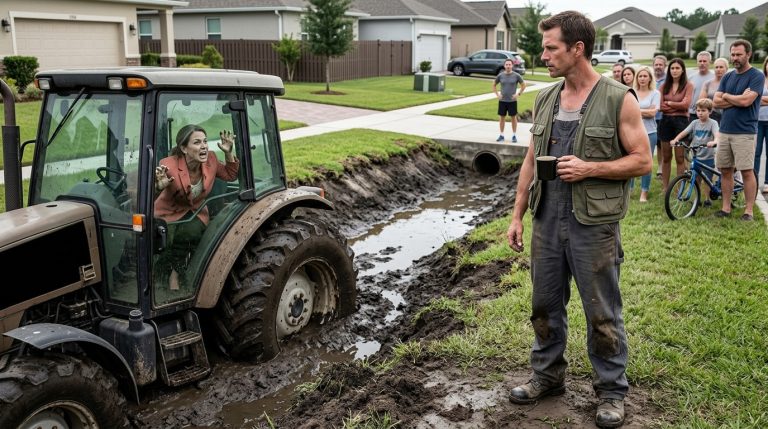
It wasn’t a sudden slide. It was a slow, agonizing consumption of the land. The earth around the old, forgotten drainage casing was sinking, pulled into the hollow void below. The weight of the rain-soaked soil was dragging the entire bank toward the water, a massive, weeping wound in the landscape.
Karen’s SUV pulled up behind me, her tires spinning in the mud. She jumped out, her expensive boots immediately ruined by the slop, her expression one of utter, bewildered defeat. She didn’t look at me. She looked at the hole in the earth, the very thing she had tried to hide with her “community walkway.”
“I told you,” she screamed at someone on her phone, her voice barely audible over the thunder. “I told you it was fine!”
She was still fighting the reality, still trying to project blame onto a contractor or a surveyor, but the land didn’t care about her spreadsheets. The bank surged, a massive chunk of sod and rock sliding into the intake channel with a sound like a crumbling cathedral. The water in the reservoir surged in response, muddied and black.
The inspector was pulling out his phone, documenting the disaster, his face grim. “This is it,” he shouted toward me. “The whole system is going to blow.”
I stood there, soaked to the bone, watching the erosion take back what had been stolen. I didn’t feel the triumph I’d expected. I felt the hollow, cold weight of the truth finally surfacing. The “walkway” project was gone, washed away by the very element it had been designed to misrepresent. The liability was no longer a secret to be kept; it was an open, bleeding disaster that would bring every municipal authority in the county down on the HOA’s head by morning.
Karen stopped screaming. She just stood there in the freezing rain, watching her authority disintegrate with the mud. The HOA board members were nowhere to be seen. The contractor, having smelled the rot days ago, had vanished. She was alone, standing on the edge of the ruin she had built with nothing but paperwork and ego.
I looked at the surveyor’s map in my mind—the lines, the boundaries, the “corridors.” They were all meaningless now, shredded by the raw physics of a system that refused to be manipulated.
I turned away from the collapse, my legs heavy, my chest aching. The struggle had been an endurance test, but as I walked back toward my car, I knew that the silence would return. But this time, it wouldn’t be the silence of a house under siege. It would be the silence of a world where the truth had finally been allowed to speak for itself. I looked back one last time. The rain was still falling, washing the last of the paperwork into the dark, hungry water of the canal.
CHAPTER 8: THE QUIET SETTLEMENT
The morning after the bank collapse, the world felt like it had been scrubbed clean. The air was thin and sharp, carrying the faint, metallic scent of ozone and wet stone. I stood at the edge of my property, the ground beneath me no longer a site of contention, but a raw, open wound in the earth that the city had finally, reluctantly, begun to address.
Karen was gone. She hadn’t appeared at the final emergency board meeting, nor had she been seen at her home. The HOA had effectively dissolved into a cloud of lawsuits and insurance claims. The insurance companies, faced with the overwhelming evidence of the structural deception I’d documented, had pulled their coverage within hours of the collapse. The “walkway”—that fragile facade of community progress—was now just a series of yellow tape markers and warning signs flapping in the breeze.
I walked along the shoreline, my boots sinking into the soft, settling mud. This was where the stakes had stood, where the string line had cut across my view, and where I had held my ground against the pressure of a small, manufactured empire. I reached down and picked up a single, discarded wooden stake, the last remnant of their intrusion. It was weathered, stained by the damp, and entirely useless.
I didn’t keep it as a trophy. I tossed it onto the pile of debris the municipal crew was already loading for removal.
Later that afternoon, the final paperwork arrived—not from the HOA, but from the county and my own attorney. It was a formal confirmation that the easement claim had been permanently expunged, that the property line was legally secured, and that the restoration costs would be covered by the developer’s liability fund, not by me. The “5-Pillar Catharsis” was complete. The antagonist had been defeated by the very system she tried to weaponize; the public failure of the drainage system had triggered an investigation that laid bare the entire corporate conspiracy behind the buyout.
My attorney sat across from me in the living room, his briefcase open, the documents laid out in orderly, crisp stacks. He didn’t speak for a long time, just looked at the quiet view of the canal through the window.
“You realize,” he said, finally breaking the silence, “that most people would have folded at the first certified letter. You didn’t. You treated this like a system to be debugged.”
“It was,” I said, my voice quiet. “I didn’t want a war. I just wanted the math to add up.”
He nodded, a slow, appreciative gesture. After he left, the house felt exceptionally still. The weight of the past months, the constant, low-level hum of anxiety that had dictated my sleep and my waking hours, had finally evaporated.
I went to the backyard, where I had kept a small, damaged portion of the original stone retaining wall—a section I’d been meaning to fix since the first day the construction trucks arrived. I pulled out my tools, the familiar, grounding weight of the hammer and the level in my hands. The work was slow, methodical, and satisfying. I replaced the loose stones, filling the gaps with fresh mortar, making the wall stronger than it had been before the encroachment. It was a small act of repair, a symbolic closure to the chaos that had threatened my home.
As the sun began to dip behind the reservoir, the light turned a soft, golden amber. I sat on the wall, the stone cool against my palms. The canal was quiet, the water moving in its natural, unforced rhythm once more. There were no cameras, no timestamps, no digital ghosts in the machine. Just the steady, enduring presence of the land.
I had learned that the truth isn’t something you fight for; it’s something you patiently, persistently maintain. I reached out and brushed a bit of mortar from the stones, smoothing the seam until it was flush. The property was mine, the boundaries were clear, and for the first time in a long time, the silence was mine to keep. I looked up at the horizon, where the first stars were beginning to prick the darkening blue, and felt the quiet, profound growth of having survived the storm.