The Survey Line: A Gritty Account of One Man’s Stand Against Institutional Theft and Administrative Erosion
CHAPTER 1: The Unauthorized Line
The air was heavy, thick with the dry, metallic tang of an approaching storm that never seemed to break. I watched the tow truck vanish, the silence that followed feeling heavier than the noise. My property, a quiet rectangle of land I had spent five years maintaining, felt suddenly exposed.
I didn’t move toward the gate. Instead, I looked down.
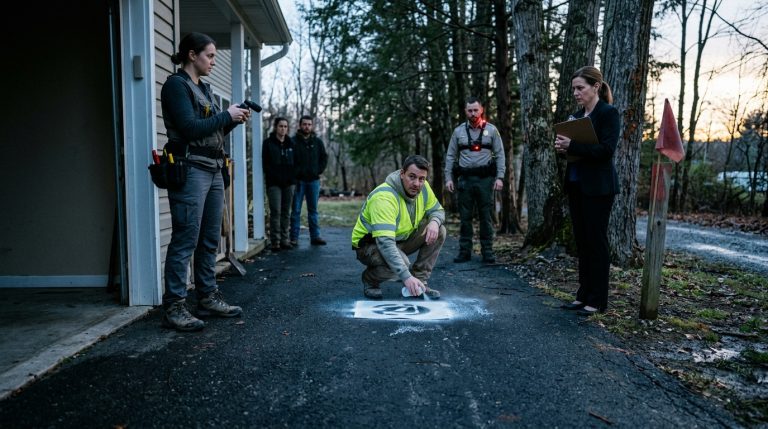
There, cutting directly through the center of my yard, was a line of rebar stakes. They had been driven deep into the parched, iron-rich soil, topped with caps that glowed an unnatural, synthetic orange against the dusty gray of the landscape. It was a precise, surgical scar on the earth.
“Boundary adjustment,” a voice said.
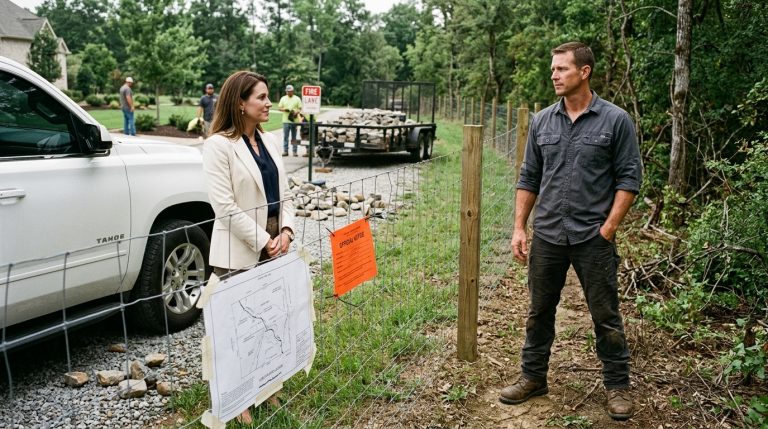
I didn’t have to look up to know it was Sloan Reic. She stood at the edge of the property line, her posture as rigid as the rebar she’d planted. Her clipboard was tucked under her arm, a flat, sterile object that seemed to contain the sum total of her authority. She didn’t look like an invader; she looked like an accountant tallying a deficit.
“That van was a visual hazard,” she continued, her voice devoid of inflection. “Safety removal, as per the emergency resolution.”
I kept my eyes on the line of stakes. They were perfectly spaced. Too perfect. A human hand, working in haste, would have left a wobble, a slight deviation in the path. This was the work of a template, a pre-calculated vector meant to maximize disruption.
“I didn’t vote on a resolution,” I said, my voice sounding hollow in the heat.
“The board voted,” she replied, and there was a flicker of something—not quite a smile, just the tightening of a muscle in her jaw. “When you bought this lot, you agreed to the bylaws. We are installing a storm water runoff corridor. Your lot is the optimal path for the mitigation.”
I took a step toward the nearest stake, the dry earth crunching under my boots. I reached down and gripped the rebar. It was cold, resistant, anchored deep into the subsoil. It felt less like a marker and more like a shackle.
“Who signed off on the geological study?” I asked.
Sloan shifted, the clipboard moving with her. “The infrastructure committee. Documentation is available in the portal. You should have received the notice.”
“I received nothing.”
“Then you haven’t been checking your mail.” She turned away, her shoes clicking sharply against the gravel as she retreated toward the street. “Compliance is mandatory, Mr. Carter. You can move your equipment, or you can watch us do it for you. The corridor is non-negotiable.”
She walked away, not glancing back, leaving me standing in the center of a yard that no longer felt like mine. I stared at the orange caps, then at the empty space where my van had been. A neighbor’s porch light clicked on across the street, a brief, flickering orange eye that watched me for a moment before turning away. I was being mapped, partitioned, and erased, and the stakes in my yard were merely the first pins in a much larger, darker strategy. I felt a strange, cold clarity settle into my chest. This wasn’t about storm water. It was about who held the deed, and who held the pen.
CHAPTER 2: The Paper Wall
The morning didn’t bring clarity; it brought a persistent, low-frequency ache in my jaw. I spent the first hour after dawn walking the perimeter of my lot. The dew had settled on the orange caps of the rebar, making them look like drops of dried blood against the gray, parched earth of the yard. I didn’t pull them out. To remove them would be to invite a confrontation I wasn’t prepared to win. Not yet.
I left the house at eight, the smell of damp soil and iron hanging heavy in the air. The HOA clubhouse was a brick-and-mortar manifestation of the rules they enforced—clean, muted, and aggressively unremarkable. I stood in the foyer, the tile cold under my boots, watching the sunlight play across the dust motes dancing in the sterile air.
Sloan Reic’s office door was frosted glass, opaque and uninviting. I didn’t knock. I waited. The lobby felt like a holding cell. Every few minutes, a resident would walk through, heads bowed, clutching envelopes or leashes, avoiding eye contact with the thin, vertical windows that looked out over the ridge. This was the texture of life under the bylaws: a quiet, frantic avoidance of friction.
When the door finally opened, it wasn’t Sloan who emerged. It was an assistant, a man whose clothes were too crisp for a Tuesday morning, his face a mask of practiced, pleasant indifference.
“Mr. Carter,” he said, his voice as smooth as polished stone. “The board is not currently in session. Access to the infrastructure files requires a formal written request, processed through the portal.”
“I’m not here for a schedule,” I said, keeping my hands at my sides. The friction of the day was already starting to build, a static charge in the air. “I’m here because a work van was removed from private property based on a resolution that doesn’t exist in the county records.”
The assistant’s smile didn’t waver; it just flattened. “The association acts under the authority granted by the membership. All actions are logged and audited.”
“Show me,” I said. “Show me the audit trail. Show me the meeting minutes where the vote for the storm water corridor was recorded and ratified.”
He looked at me as if I were asking for the contents of a private vault. “You are welcome to consult our FAQ on the website, sir. Now, if you’ll excuse me, I have a mandatory review of the perimeter landscaping to conduct.”
He stepped past me, his leather shoes clicking against the tile with a rhythmic, measured authority. I watched him go, feeling the weight of the paper wall between me and the truth. It wasn’t a physical barrier; it was a bureaucratic one, designed to be porous for them and impenetrable for everyone else.
I didn’t follow him. I walked back out to the parking lot, the heat of the day already beginning to bake the asphalt. I pulled my phone from my pocket and stared at the empty space where my van had sat the day before. The neighborhood looked the same, but the geometry of it was irrevocably broken.
My next move had to be precise. The HOA operated on the assumption that I was a lone homeowner, easily rattled and unversed in the language of municipal code. They believed that if they made the process expensive enough, time-consuming enough, I would eventually tire and surrender. They relied on the hope that I would look for a fight in the street, rather than in the ledger.
I turned back toward my house, every step feeling like a calculation. I needed to see what they were hiding in the digital ether. If the board was operating on a resolution that the county hadn’t authorized, then the resolution was just a piece of paper, and paper—no matter how official it looked—could be shredded.
As I reached my gate, I caught movement in the corner of my eye. My neighbor, a man who had lived here longer than I had, was standing in his driveway, pretending to inspect his mailbox. His hands were shaking slightly. He didn’t wave. He didn’t acknowledge me. He just stared at the rebar stakes in my yard, a look of profound, weary terror etched into his features. He knew. He knew that the line cutting through my land wasn’t just a survey mark; it was a harbinger.
I locked my gate, the sound of the latch a small, sharp metallic click in the quiet morning. I went inside, the house feeling suddenly small, a fragile fortress against the encroaching tide of the ridge. I opened my laptop, the screen illuminating my face in the dim room, and began to dig into the portal. I wasn’t looking for excuses anymore. I was looking for the mistake—the single, rusted link in the chain that would cause the whole structure to collapse.
CHAPTER 3: The Portal Audit
The cursor didn’t blink so much as it throbbed, a steady, rhythmic reminder that the digital world was just as indifferent as the people who built it. My eyes felt like they were coated in sand. I had spent three hours deep-diving into the county’s provisional plat overlay, clicking through layers of PDF files that were designed to hide more than they revealed.
The portal was a labyrinth. Every time I thought I’d found a path to the core data—the actual, recorded boundary map—the system redirected me to a “Maintenance Required” page or a dead-end directory. It was a classic administrative stall, the kind that relied on the assumption that a layman would eventually give up out of sheer, soul-crushing boredom.
I dragged my fingers through my hair and took a breath, the air in the house feeling stale, recycled, and entirely devoid of life. Then, it happened. I clicked a nested sub-folder labeled “Infrastructure_Adjustments_2026,” and the entire interface shivered. A pop-up box, jagged and outdated, stuttered across the screen: Data Retrieval Error 404: Node Unreachable.
I didn’t close it. I moved the cursor to the “View Source” command.
The screen exploded into a cascade of raw code, a waterfall of syntax and metadata that looked like the skeletal architecture of the HOA’s deceit. I scrolled, my heart hammering against my ribs like a caged bird. I wasn’t an engineer, but I understood structure. I understood when something had been built to be seen and when something had been built to be invisible.
There, buried under a string of internal reference numbers, was the timestamp for the “Provisional Plat Overlay.” The upload date was stamped 48 hours before the van had been towed, but the “Recorded_By” field was blank. It hadn’t been processed by the county clerk. It had been pushed through a secondary gateway—a portal extension designed for “Emergency Utility Access.”
I leaned back, the chair groaning in protest. They had created a backdoor. They weren’t using the official county channels; they were using a parasitic interface that piggybacked on the county’s infrastructure site, making their illegal boundary changes look like official, pre-approved maintenance.
My phone buzzed on the desk, the vibration rattling against the wood like a warning. A text from an unknown number: Don’t fight this. Phase two is happening with or without you.
I looked at the screen, at the clean, perfect lines of the code, and then back at the message. The realization hit me with the force of a physical blow. This wasn’t a local dispute. They weren’t just after my yard. They were using the HOA as a front to aggregate small, contiguous parcels into a single, usable block for Ridgeway Civil Consulting. Once they had the land, they didn’t just build a storm water corridor; they built a legal precedent for high-density, high-profit infrastructure that the county would find too expensive—or too messy—to ever contest.
I stood up, the chair scraping against the floorboards, and walked to the window. The neighborhood was quiet, the streetlights humming in the dark. I could see the silhouette of the rebar stakes in my yard, the orange caps reflecting the pale light of the moon. They looked like teeth, biting into the dirt, marking the property for slaughter.
I reached into my desk drawer and pulled out a notebook, the one I’d used to sketch out the initial measurements of the lot when I first bought the place. I didn’t need the digital records to tell me what was mine. I had the original deed, the physical survey from when the house was built, and the memory of the ground beneath my feet.
I grabbed my jacket. I didn’t care about the hour. I needed to see the stakes again, to touch them, to compare their placement against the literal map I had in my head. I walked out the front door, the night air biting and cold. The silence of the neighborhood felt oppressive, a blanket laid over a crime scene.
As I approached the property line, I stopped. There was a figure standing near the fence—a silhouette, small and motionless, tucked into the shadows of a nearby oak. It was the neighbor from earlier, the man with the shaking hands. He was looking at my yard, his eyes wide and fixed on the stakes.
“They’re not just staking the ground, Mr. Carter,” he whispered, his voice trembling so badly the words were barely audible.
I stepped closer, my boots silent on the grass. “Who are they, exactly?”
He looked at me then, and in the dim light, I saw the absolute exhaustion in his eyes. “The people who own the signatures. You think this is the HOA? This is the liquidation. They’re clearing the ridge for the consulting group, and every stake they drive is a nail in our coffin.”
He turned and melted into the darkness before I could ask another question. I stood alone in the center of the yard, the wind whipping through the trees, feeling the weight of the land under me. It was just dirt, just grass, but suddenly, it felt like the most valuable thing I had ever held. And I wasn’t going to let them bury it under a pile of fake paperwork.
I knelt by the nearest stake, gripped the rebar, and felt the iron bite into my palm. It wasn’t just a survey mark. It was the center of a war, and for the first time, I knew exactly which line I had to defend.
CHAPTER 4: The Verification
The county engineering building smelled of floor wax and stale coffee—a sharp, sterile contrast to the damp, nervous earth of my yard. I stood at the counter, the original survey map from my mortgage folder feeling heavy and dangerously fragile in my hands. The clerk, a woman with spectacles chained to her neck and a look of permanent, administrative fatigue, didn’t look up from her screen.
“I need to verify an overlay,” I said, my voice steady, though the muscles in my neck were coiled tight. I slid the folder across the counter. “File number ending in 042. It’s labeled as an emergency infrastructure adjustment.”
The clerk tapped a key, her movements mechanical. She scanned the screen, her eyes moving with the precision of a barcode reader. Then, she paused. She leaned in, her brow furrowing, and clicked a second time. “Sir, there’s no record of a completed filing for this address. It’s marked ‘Pending – Secondary Access.'”
“Pending what?”
“Validation,” she said, finally meeting my eyes. “But looking at the notes, it was flagged for review three days ago. Whoever uploaded it used a municipal gateway, but they didn’t attach the required easement signatures. Without those, it’s just a draft.”
I felt the tension in my chest loosen, just a fraction. A draft. They had been acting like it was law, using the threat of it to bulldoze the neighborhood, but it was just a ghost on the screen.
“I need a certified copy of the last recorded parcel map,” I said, “and I need to speak to the duty engineer. Someone is trying to force an infrastructure corridor through private property using a backdated, incomplete file.”
She looked at the clock on the wall—10:15 a.m.—and then back to me. Her demeanor shifted; the fatigue was replaced by a flicker of professional interest. “Follow the yellow line on the floor to the back office. Ask for Miller. If he’s in, he’s the one who signs off on secondary access audits.”
The walk to the back office felt like crossing a minefield. Every desk I passed held stacks of paper—permits, plats, surveys—the physical architecture of a system that was supposed to protect people like me. I was counting on the rigidity of that system to be my shield.
Miller was an older man with sleeves rolled up to his elbows, his desk covered in blueprints that looked like complex star charts. He didn’t look up when I knocked, just gestured toward a chair with a pencil. I sat, the plastic seat groaning under the weight of my anxiety.
“Mr. Carter,” he said, finally dropping the pencil. He’d clearly been briefed, or perhaps he’d already seen the flagging on the file. “You’re the one complaining about the storm water corridor at Brookil Ridge.”
“I’m not complaining. I’m reporting an unauthorized land grab.” I opened the folder and spread out my survey. “They’ve placed stakes on my property. They towed my work vehicle. They’re claiming a municipal need that doesn’t exist.”
Miller leaned forward, his eyes scanning the map. He didn’t offer sympathy or reassurance. He worked with the detached, brutal honesty of a man who dealt in angles and math. He pulled a clear plastic overlay from a nearby tray and laid it over my survey.
“They’re using a standard template for storm water mitigation,” Miller observed, his voice a low rumble. “But look at the grade. Your property sits at a four-degree incline. Water doesn’t flow uphill, Carter. Any corridor placed here would need a lift station, pump mechanisms, and heavy concrete reinforcement. It’s not a natural drainage path. It’s an engineered funnel.”
The memory of my father losing his own workshop to a ‘redevelopment’ project surged in my mind—the same cold, corporate logic, the same promise of ‘progress’ that left nothing but scorched earth. I had to force myself to breathe, to keep my hands flat on the table, to stay in the present. This wasn’t my father’s battle; this was mine.
“So they’re lying,” I said.
“They’re creating a problem to sell the solution,” Miller replied. He picked up his phone and punched a button. “Get me the audit logs for the Brookil Ridge gateway. And flag the 042 overlay for immediate deletion.”
He looked at me, his gaze sharpening. “If they towed your vehicle, that’s a civil matter, but if they moved the stakes without a recorded easement, that’s a trespass. I can’t stop them from walking on your land, but I can strip their authority to do anything else. How fast can you get a surveyor out there to certify these boundaries?”
“By noon,” I said, the words coming out before I’d even thought of the logistics.
“Do it,” Miller said, turning back to his blueprints. “And Carter? Don’t let them intimidate you with more paperwork. They’re betting on you being a coward. Once you have that certification, bring it back here. I’ll make the deletion permanent.”
I stood, my pulse hammering a frantic, rhythmic beat against my skin. I walked out of the office, the sterile smell of the building now feeling like the scent of an impending victory. I had the truth, I had an ally, and I had a window of time.
I reached the exit, but as I pushed through the glass door, a black sedan sat idling by the curb—the same vehicle that had been crawling past my house for the last two days. The driver didn’t look at me, but I knew he was recording. The stakes were still in my yard, waiting, but the game had shifted. I wasn’t the prey anymore. I was the one holding the map.
CHAPTER 5: The Siege
The walk from the parking lot to the clubhouse doors felt like moving through deep water. Every shadow cast by the security lights looked like a barrier, every rustle of the wind in the overgrown landscaping sounded like a whispered warning. I gripped the file containing the certified survey and the county’s audit flag, the edges of the paper cutting slightly into my palm. It was thin, just a few sheets, but it carried the weight of a demolition charge.
Inside, the clubhouse was an oven. The air was stagnant, smelling of floor polish and the pressurized, artificial scent of a room that hadn’t seen an open window in years. Fifty pairs of eyes turned toward me as I stepped over the threshold—a mixture of fear, expectation, and a dull, collective resignation.
Sloan Reic stood at the front, her silhouette sharp against the hum of the projector. She was running a slideshow of the neighborhood, highlighting ‘hazard zones’ with a red laser pointer that danced like a frantic insect over our homes. When she saw me, her hand faltered. The red dot stabilized on the wall behind her, right over a photo of my front porch.
“Mr. Carter,” she said, her voice amplified by the room’s speakers, carrying that familiar, practiced veneer of civility. “You’re late. We’re in the middle of a mandatory infrastructure briefing.”
“I’m not here for a briefing,” I said, my voice cutting through the thick, humid silence. I didn’t stop walking. I moved toward the front, past the folding chairs and the rows of neighbors who leaned back to give me space. “I’m here because your infrastructure project is a lie.”
The room went still. I could hear the hum of the projector, the frantic whir of its cooling fan. Sloan’s expression hardened, the pleasant mask dropping to reveal the cold, calculated edges of someone who had factored everything into her plan—except for a direct challenge.
“You’re disrupting a public meeting,” she snapped, though her eyes flicked to the side, searching for the HOA attorney who usually sat in the wings. He wasn’t there. “Security will escort you out if you don’t take a seat.”
“There is no security,” I said, stopping ten feet from the projector screen. “And there’s no storm water corridor. I’ve been to the county engineering office this morning. Your ‘provisional overlay’ is a draft, not a record. It was uploaded through an unauthorized municipal gateway to bypass the oversight board. I have the audit logs right here.”
I held up the file. The rustle of the paper seemed to echo off the high ceilings. A murmur rippled through the crowd—not a shout, but a low, dangerous sound like the tide pulling away from the shore.
“He’s lying,” Sloan said, her voice rising, losing its cadence. “This is a standard procedure to ensure the safety of the ridge. The county delegated the authority to us to expedite the process.”
“Delegated?” I looked at the neighbors, then back at her. “You mean you paid a consultant eighteen thousand dollars to build a path that doesn’t exist on any drainage map. That money didn’t go to the county. It went to Ridgeway Civil Consulting. And I have the transfer receipt.”
The air in the room didn’t just feel heavy; it felt electrified. A woman in the front row stood up, her chair clattering against the floor. “Where did that money come from, Sloan? That was part of our reserve fund.”
Sloan looked around, her composure fracturing. She tried to click the remote for the projector, but the image on the screen—the map of my yard—flickered and died, leaving her bathed in the harsh, white glare of the projector bulb. She looked diminished, exposed.
“You don’t understand the scope of what we’re doing,” she said, her voice a desperate, thin rasp. “This isn’t about one yard. It’s about the integrity of the whole ridge.”
“No,” I said, walking toward her, forcing her to retreat behind the podium. “It’s about liquidation. You were clearing the land, parcel by parcel, to make the site attractive for a bulk sale. You weren’t building for us. You were selling us out.”
The door at the back of the room creaked open. It wasn’t security. It was a pair of county inspectors in high-visibility vests, their faces grim, carrying a stack of official seals. The room turned. The silence became absolute.
I turned back to Sloan, but she was already backing away, her eyes darting toward the side exit, toward the black sedan that I knew was still waiting in the dark. She had lost the room, she had lost the narrative, and more importantly, she had lost the authority that had acted as her armor. The siege was over. The structure she had built, layer by layer, had been dismantled by a single, verified truth. I didn’t need to say anything more. I just placed the file on the podium, the papers settling with a heavy, final sound.
CHAPTER 6: The Correction
Sloan Reic didn’t leave with a bang; she left with the pathetic, dragging sound of heels on linoleum. The room watched her go, a collective expulsion of breath. When the door clicked shut behind her, the silence that filled the clubhouse wasn’t empty. It was heavy, textured with the realization of the massive, hidden machine we had inadvertently been feeding with our silence.
I remained at the podium, the county seals on the table before me looking like alien artifacts. The engineer, Miller, stepped forward and took the seals. He didn’t look at me with triumph; he looked at me with the tired, pragmatic acknowledgment of a man who spent his life fixing the jagged edges of a broken world.
“The records are under a preservation order,” Miller said, his voice low and devoid of theater. “They’ll be moved to the county vault tomorrow. You won’t have to worry about the ‘provisional plat’ disappearing again. It’s logged as evidence now.”
He turned to the room, his gaze sweeping over the neighbors who were slowly beginning to stir, breaking out of their shock. “You were being played,” he said, not unkindly. “The corridor was never about water. It was about creating a ‘utility bottleneck’—a legal status that forces land parcels to be combined. If this had succeeded, you would have lost the individual rights to your own property lines. The consulting group would have bought the consolidation for pennies.”
The room reacted like a singular organism—a collective, sharp intake of breath. I watched the woman in the front row, the one who had asked about the reserve fund. She put her hands to her face, a tremor running through her shoulders. It wasn’t just the money; it was the violation of the quiet, safe lives they thought they were living.
I stepped away from the podium and walked toward the back of the room. I felt light, but it was the hollow lightness of a soldier who had dropped a heavy pack after a long march. My phone, which had been buzzing with anonymous warnings all afternoon, suddenly went dead. The burner line had been deactivated.
I walked out of the clubhouse and into the night. The parking lot was clearing out, taillights fading into the darkness like dying embers. I found my work van sitting near the gate, the tow company having dropped it off without a word. The engine still smelled of the impound lot—oil and stale exhaust—but when I turned the key, it roared to life with a familiar, mechanical grit that felt like home.
I drove the short distance to my house, the neighborhood streets feeling like a foreign country. Everything was the same—the manicured lawns, the darkened windows, the suburban stillness—but I knew now that it was all an illusion. I had seen the guts of the machine, the way the paperwork was manufactured to bleed the land dry.
When I pulled into my driveway, the orange rebar stakes were still there, cutting through the grass. I got out of the van, the air smelling of cooling metal and the first damp hint of rain. I walked to the edge of the property, the spot where the line of stakes started.
I didn’t reach for them in anger. I reached for them with a dull, methodical precision. I grabbed the first cap, felt the cold resistance of the earth, and pulled. It came up with a wet, sucking sound, the iron stake coated in red clay. I tossed it onto the concrete driveway, the clatter echoing in the quiet night. One by one, I pulled them. Each stake was a physical piece of the lie, a small, tangible anchor of the ‘utility corridor’ that never was.
By the time I reached the last one, my hands were raw, stained with the rust and dirt of the job. I stood in the middle of my yard, the silence settling around me, complete and absolute.
I walked to my front porch and picked up the small, battered toolbox I’d left on the steps when the tow truck first arrived. I opened it, the smell of grease and steel a sharp, grounding comfort. I spent the next hour working on the gate latch that had been sticking for weeks, the repetitive, rhythmic motion of the screwdriver the only thing that felt real.
The front door opened. My neighbor, the one with the shaking hands, stepped out onto his porch. He didn’t cross the street; he just stood there, watching. I didn’t call out to him. I just nodded, a simple, acknowledging gesture, and he returned it.
The land was just dirt. Just grass. Just space. But as I tightened the last screw, the gate swinging shut with a crisp, perfect click, I knew that for the first time in years, it was mine. Not because the paperwork said so, but because I had stood in the center of the storm and forced it to break.
The rain began to fall then, a soft, cleansing drizzle that turned the gray dust of the road into a darker, deeper earth. I went inside, the house warm and quiet, and left the door unlocked. The structural status of the world hadn’t changed—the corruption, the greed, the cold machines of bureaucracy—they were all still out there, somewhere, turning their gears. But tonight, at least, the boundary was clear. The line was held.