A Foundation of Dust: Dismantling the Rusted Authority of a Corrupt Neighborhood Empire
CHAPTER 1: The Weight of the Slab
The silence was the first thing that hit me—a heavy, unnatural stillness that felt wrong for a Monday morning. After ten months in a desert warzone, I had expected the peace of my own driveway to feel like a benediction. Instead, it felt like an interrogation.
Three excavators sat in my driveway like oversized, dormant beasts. Their buckets were caked in the dust of my history. Where my workshop—a solid, timber-framed sanctuary with a cedar-plank floor and a workbench planed smooth by years of labor—had stood, there was nothing but a bare concrete slab. It was stark, cold, and offensively clean, as if the building had never existed.
My duffel bag slipped from my shoulder and hit the pavement with a dull thud. My mouth still tasted like the metallic tang of jet fuel from the flight, but as I scanned the jagged edges of the surrounding lawn, a different taste rose in my throat: bile.
My tools. Every chisel, every hand-plane, the lathe I’d spent months restoring—all gone.
“What the hell?” The words left my lips before I could process them. I walked toward the slab, my boots grating against tiny remnants of crushed drywall.
Then came the sound.
Click. Click. Click.
The rhythm was precise, measured, and utterly devoid of hesitation. It was the sound of someone who walked on ground they believed they owned. I didn’t turn around immediately. I looked down at the concrete, noticing a deep scratch across the surface where a hydraulic outrigger had gouged the slab during the demolition. A permit tag that should have been posted on the door frame was nowhere to be found. Just a clean, empty space.
I turned.
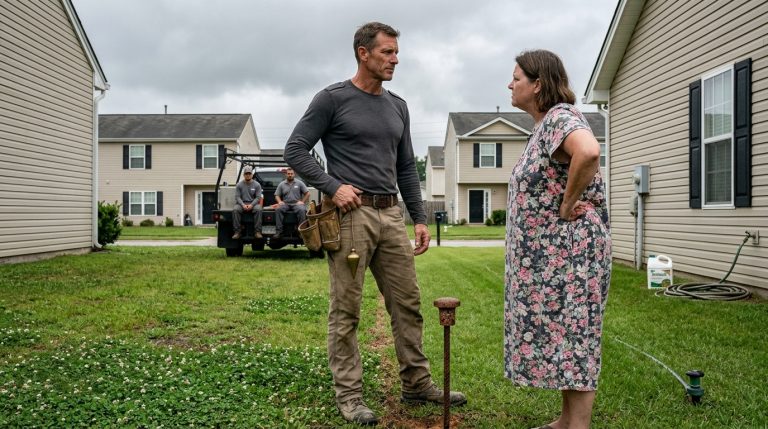
Harriet Thompson stood at the edge of the asphalt, a pink cardigan draped over her shoulders despite the morning chill. She held a clipboard like a priestess holding a scripture. Her bob was perfectly, aggressively blond, and the smile she offered me wasn’t meant for a neighbor—it was the thin, practiced grin of an administrator who had just closed a successful audit.
“Oh, you’re back early,” she said, her voice bright and brittle.
“Where is it?” I asked. My voice was low, stripped of everything but the immediate, sharp demand for logic in a situation that defied it.
She didn’t flinch. Her gaze flicked over the slab, then back to my face, her expression one of mild, weary disappointment. “That old thing? We had it removed. It was in violation of community standards. We tried to reach you, of course, but the letters were returned.”
I stared at her, noticing for the first time the way she clutched the clipboard—her knuckles were white. The air around us felt thick with the grit of pulverized wood and the subtle, sharp scent of her expensive, cloying perfume. She hadn’t even looked at the ruins; she was looking at me, checking to see if I would break.
I took a slow, calculated breath. I wouldn’t. The predator-prey dynamic was clear, but she had made a tactical error. She had assumed that because I was gone, I had stopped paying attention.
“You tore it down,” I said, my voice steadying, hardening into a cold, transactional weight. “Without a permit. Without notice.”
She waved a hand, a gesture that was meant to dismiss a triviality. “The board voted, and the HOA approved it. You really should keep up with your correspondence, dear. It’s for the good of the neighborhood.”
She turned, her heels clicking back toward the sidewalk, leaving me standing on the empty gray slab. My eyes drifted to the corner of the concrete. There, half-buried in the dirt, was a piece of shattered wood from my workbench. I reached down and picked it up. It was rough, splintered, and solid.
I looked back up, but Harriet was already halfway down the street, her posture perfectly rigid. I felt the weight of the wood in my palm—a piece of the past—and realized that if she wanted to play by the rules, I would show her exactly how sharp those rules could cut.
I pulled my phone from my pocket and dialed, not the authorities, but the one person who knew the difference between a fine and a crime. The silence of the neighborhood, I realized, was no longer a peace—it was a battleground.
CHAPTER 2: The Paper Trail
The cab of my truck smelled of stale coffee and the phantom scent of diesel, a stark, functional contrast to the cloying perfume Harriet had left hanging in the air like a taunt. I gripped the steering wheel, my knuckles pale, the wood fragment from my workbench still pressing into my palm. It wasn’t just a piece of timber; it was the only piece of evidence I had that wasn’t a bureaucratic ghost.
I fired the engine. The truck rattled, a deep, guttural sound that vibrated through the floorboards—the same floorboards that had been my only steady ground for years.
My destination was three miles away: Amanda Greer’s office. She was a woman who dealt in the currency of statutes and precedents, the kind of person who could see through the polished veneer of an HOA board member with a single glance. But as I pulled out of the driveway, the neighborhood looked different. It wasn’t just my property that looked violated; it was the entire street. The hedges were trimmed to an identical, sterile height, and the silence felt curated, enforced.
I had barely reached the first stop sign when the truck’s engine sputtered—a sharp, hiccupping cough that sent a jolt of alarm through my chest. I cursed under my breath and pulled over onto the shoulder, the gravel crunching aggressively under my tires.
I popped the hood. The engine block radiated a heat that stung, but as I leaned in, I didn’t see the usual wear of an old vehicle. A thick, viscous black substance had been smeared across the alternator belt, and a wire—the primary ignition lead—had been neatly, surgically severed.
I stood there, the hood framing the horizon, watching the street. It wasn’t a random breakdown. It was a message. My stomach tightened, not with the erratic panic of a green soldier, but with the cold, methodical assessment of a target. Someone had been watching the driveway, waiting for me to leave. Harriet’s threat wasn’t just in the demolition; it was in the intimidation that followed.
I didn’t have time to fix it, not here on the side of the road with the neighborhood eyes peering through curtains. I pulled my phone and checked the time. Amanda’s office closed in forty minutes. I left the truck where it was—a rusted iron monument to the HOA’s interference—and started walking.
The heat of the day was rising, kicking up dust that tasted of dry earth and old, neglected things. Every step I took toward the city center felt like pulling away from the gravitational pull of Harriet’s “community standards.” I passed the communal clubhouse—a brick edifice that stood like a fortress at the center of the development—and for the first time, I looked at it not as a neighbor, but as a forensic investigator.
The clubhouse looked perfectly maintained, yet I noticed the trim on the south side was peeling, the paint yellowed and brittle. It was a facade of perfection masking a crumbling interior. Just like the HOA board.
When I finally reached Amanda’s office, my shirt was damp with sweat and my boots were coated in the fine, gray silt of the neighborhood construction. I didn’t wait to be announced. I walked into the reception area, my presence an abrupt, jarring shift in the atmosphere of the quiet, sterile office.
Amanda looked up from a stack of files. Her desk was a landscape of organized chaos—folders labeled by date, case, and property tax ID. She didn’t flinch at my disheveled appearance. She simply gestured to the chair across from her.
“You look like you’ve been through a war,” she said, her voice dry, clinical, and sharp.
“I’ve been through a demolition,” I corrected, dropping the wood fragment onto her polished desk. It clattered, leaving a smudge of dirt on the mahogany. “Harriet Thompson. She didn’t just tear down a shed, Amanda. She sent a signal.”
I recounted the morning’s events—the excavators, the smugness, and the sabotaged truck on the road. As I spoke, Amanda didn’t offer sympathy. She leaned forward, her eyes narrowing as she pulled a blank legal pad toward her. She didn’t care about the emotional weight; she was mapping the causality.
“If she claims it was a violation of community standards,” Amanda said, her pen poised, “she has to produce the record of the board vote, the notice of violation, and the certified mail receipts showing service to your address. All of which,” she paused, her gaze locking onto mine, “are matters of public record. If she didn’t follow the procedure, the demolition wasn’t just illegal. It was a felony trespass.”
“They claim they sent letters,” I said. “I never saw a single one.”
“Then they either didn’t send them, or they sent them to a false address to justify the action.” She tapped the wood fragment. “You said you found this in the dirt? Don’t touch it anymore. If this goes to a civil suit, we need to document everything. But if they’re playing this dirty, I want more than just your workshop. I want to see the HOA’s budget allocations for the last three years.”
She stood up, moving to a filing cabinet with the grace of a hunter. “If they’re spending money on demolition crews without a vote, they’re funneling that money somewhere. And follow-the-money is the one rule that never changes, regardless of how small the neighborhood is.”
I felt a surge of cold, focused energy. The rage that had been burning since I saw the empty slab had crystallized. It wasn’t about the workbench anymore; it was about the structure of the lies they had built to cover their tracks.
“Start with the county recorder’s office,” Amanda instructed, handing me a list of document requests. “I’ll handle the board. But keep your head down. If they’re bold enough to sabotage your vehicle in broad daylight, they aren’t going to stop until they’ve buried you.”
I left her office with the stack of requests, the late afternoon sun casting long, harsh shadows across the pavement. I walked back toward the edge of town, the neighborhood in my sights. I was no longer just a resident living under an association’s thumb. I was an observer, and I was starting to see the rust beneath the paint.
CHAPTER 3: The Watcher in the Grass
The walk back from Amanda’s office wasn’t just a physical trek; it was a transition into a deeper level of suspicion. My boots, heavy with the dust of the construction zone, felt like lead weights against the suburban perfection of the sidewalk. The sun had dipped lower, casting long, skeletal shadows of the oak trees across the manicured lawns.
I reached the spot where I’d left my truck. It sat exactly as I’d left it—hood popped, a jagged silhouette of failed utility. As I approached, I didn’t rush. I kept my stride rhythmic, the kind of pace I’d perfected when I didn’t want to draw attention to myself in volatile territory. I slowed down twenty yards out, my eyes tracking not the truck, but the periphery.
There, parked three blocks down, was a dark sedan—a late-model vehicle, nondescript and blending perfectly with the expensive aesthetic of the neighborhood. The engine was off, but the silhouette of the driver was visible, a statue in the front seat. They weren’t moving. They were waiting.
The scent of dry, parched grass mingled with the faint, lingering smell of diesel from my severed fuel line, and in an instant, the neighborhood’s quiet air evaporated. My brain shifted, the civilian context dissolving. I was back in the cycle of the predator and the prey, the environment no longer a street, but a corridor.
I didn’t stop at the truck. If I stopped, I was a target. Instead, I continued walking, my posture relaxed, though my muscles were coiled, ready to react to a sudden movement from the sedan. I noticed a large, overgrown hedge separating two properties—a dense, unkempt wall of green that offered a brief respite from the sightlines of the street.
I ducked behind it, the scratchy branches catching on my jacket. I wasn’t hiding; I was maneuvering. I circled wide, moving through the backyards, my movements calculated to stay in the blind spots of the house windows. The silence of the suburbs felt heavy, suffocating.
I crept toward the rear of the property nearest the dark sedan. The back garden was a masterpiece of organized, artificial beauty—a fire pit, a pristine grill, and a shed that looked suspiciously like the one Harriet had demolished. Seeing it, I felt a sharp, cold spike of irony. My workshop had been a “violation,” yet here, this structure stood as a monument to HOA hypocrisy.
I took a breath, the air tasting of stale irrigation water and trimmed turf. I reached into my pocket and touched the edge of the documents Amanda had given me. This was the proof of the imbalance—the discrepancy between who they fined and who they protected.
As I neared the alleyway, I heard it. The low, resonant thrum of an engine starting.
I pressed my back against the brick side of a neighbor’s garage, the rough, sun-warmed masonry grounding me. I peered around the edge just in time to see the dark sedan pull away. It didn’t drive toward the exit of the neighborhood. It drove toward my house.
My heart didn’t race; it slowed, dropping into the steady, mechanical rhythm of a defensive posture. They weren’t just watching; they were moving to secure the site, to ensure I couldn’t reach the debris of my own life. I realized then that my workshop hadn’t been destroyed to clean up the neighborhood. It had been destroyed to hide something buried beneath the concrete slab—something that necessitated a constant, rolling patrol of the property.
I moved with quiet, practiced efficiency, cutting through the shadows. I reached my house not from the street, but through the rear fence line. The area around my driveway was bathed in the orange glow of a streetlight.
The truck was still there, hood still open, but the atmosphere had shifted. I saw someone near the concrete slab—a figure in a high-visibility vest, crouching, scraping at the edge of the foundation with a small trowel. They weren’t cleaning up. They were searching for something they had missed during the demolition.
The sight of the trowel—a simple, small tool—was the final piece of the puzzle. They were looking for a cache, a record, or perhaps a hidden junction box that Harriet hadn’t been able to extract before the wrecking ball swung.
I didn’t confront them. I stood in the dark, watching, my hands curling into fists. If they were looking for it, it meant they didn’t have it. And if they didn’t have it, then it was the one thing that could dismantle their entire infrastructure. I pulled out my phone and switched the camera to silent, zooming in on the vest. I needed to see the company name.
The figure shifted, the streetlight catching the back of the vest. I didn’t recognize the logo, but I knew the pattern of the threat. It wasn’t just Harriet’s nephew. It was a contracted cleanup crew—a layer of plausible deniability they were using to scrub the site of my existence.
I retreated into the darkness of the yard, the information in my hand burning brighter than any anger. I wasn’t just fighting for a shed. I was fighting for the truth buried under ten inches of reinforced concrete. And for the first time, I knew exactly where to look when the sun came up.
CHAPTER 4: The Shared Burden
I didn’t head straight back to my own house. I knew the contractor’s crew or whoever was monitoring the site would be doing a sweep of the perimeter. Instead, I circled through the service alley, my footsteps silent on the damp asphalt. The air felt heavy, saturated with the scent of wet pine needles and the distant, metallic tang of the suburban drainage system.
My destination was three doors down: Lewis’s place. He was an older man, a retired civil engineer who spent his days pruning his rose bushes with the precision of a surgeon. His house was a sanctuary of un-manicured authenticity in a neighborhood of manufactured perfection.
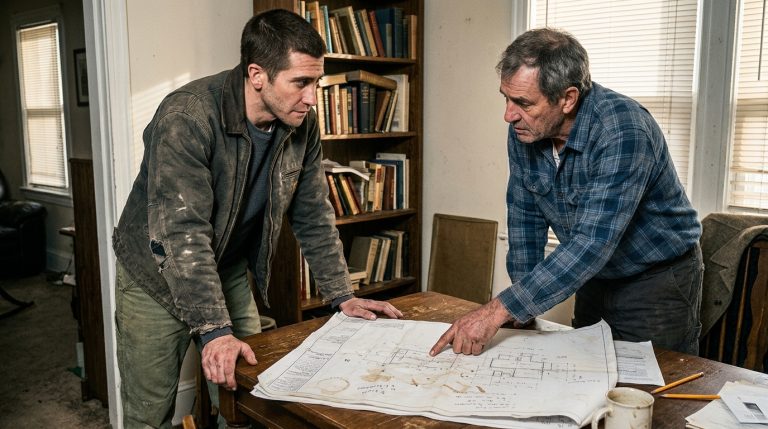
I didn’t knock on the front door. I went to the side gate, nudging it open until it gave a soft, familiar creak. Lewis was on his back porch, a dim yellow porch light casting a narrow cone of illumination over a small table littered with schematics. He looked up, his eyes sharp behind thick spectacles. He didn’t seem surprised to see me at this hour.
“I saw the trucks,” he said, his voice raspy, a low gravel sound. “They’re circling the drain, aren’t they?”
I stepped into the light, my clothes still coated in the dust from the concrete slab. “They’re searching for something, Lewis. Something buried under my workshop.”
He put down his pen, his hands steady. “I’ve lived here for twenty years. I’ve seen the HOA board change hands four times. But Harriet? She’s not just a control freak. She’s a bookkeeper of other people’s misery.”
I pulled out my phone and showed him the photo I’d taken of the vest, the logo still partially obscured by the poor lighting. Lewis squinted at the screen, his thumb tracing the pixelated outline of the emblem.
“That’s not a standard municipal contractor,” he muttered, shaking his head. “That company… I’ve seen those trucks before. They aren’t in the public directory. They’re a shell. Harriet didn’t hire a crew; she hired a cleanup squad to sanitize the site.”
“Why?” I asked, my voice tight. “It’s a concrete slab. What could be so important that they need to scrape the dirt after the fact?”
Lewis leaned back, the wooden chair groaning under his weight. “Maybe it isn’t what’s under the slab. Maybe it’s what’s in the records of the slab’s original permit. If that permit was fraudulent, then the money trail goes all the way back to the neighborhood’s founding. You’re looking for a missing brick, but you might have just stumbled onto the foundation of their entire scam.”
His words hit me with the weight of cold, hard reality. I had been looking at the crime as a recent event, a single act of spite. But if it was tied to the founding, this wasn’t just embezzlement—it was systemic, institutionalized racketeering.
“I need your help, Lewis,” I said, my voice steady. “I have a lawyer, but I need people. I need everyone who’s been bullied, everyone who’s been fined for the ‘wrong shade of fence’ or the ‘wrong height of grass.’ I need a chorus.”
Lewis looked at me, a flicker of something long-dormant in his eyes—not fear, but a weary, hardened resolve. He reached under his table and pulled out a battered, leather-bound binder. It was packed with papers—receipts, hand-written notes, photos of HOA notices, and copies of bank transfers that had no logical explanation.
“Marcy and I have been keeping a ledger,” he admitted quietly. “We knew we were being stolen from, but we didn’t have the proof to link it together. We just had the individual scars.”
I took the binder, the weight of it surprising. It was thick with the history of the neighborhood’s quiet oppression. Each page was a story of someone who had given up, someone who had paid the fine just to keep the peace.
“This is more than enough,” I said, scanning the entries. “This shows the pattern. The fines, the ’emergency repairs,’ the lack of transparency—it’s all here.”
“Harriet thinks we’re just a collection of individuals,” Lewis said, his gaze fixed on the dark, manicured lawn beyond the porch. “She thinks that as long as she keeps us isolated, she’s safe. She never accounted for the fact that a hundred small cuts eventually lead to a hemorrhage.”
We sat in silence for a while, the only sound the distant rustle of leaves and the faint hum of the neighborhood’s security lights. The air felt charged, a volatile mixture of anticipation and the impending confrontation. I realized then that I wasn’t just building a legal case; I was building a movement.
“They’re going to come for me,” I said, more of a statement than a question. “Now that I’m pulling these threads.”
Lewis smiled, a thin, grim expression that didn’t reach his eyes. “They’ve already come for us, kid. You’re just the one holding the hammer now.”
I stood up, the binder tucked firmly under my arm. The neighborhood looked different now, less like a pristine collection of homes and more like a carefully maintained prison. But as I walked back toward the shadows of my own yard, I felt the sharp, cold clarity of my purpose. I didn’t need to be afraid. I had the ledger, I had the lawyer, and most importantly, I was no longer standing alone.
CHAPTER 5: The Ledger of Ruin
The county recorder’s office was a vacuum—a place where the noise of the world was replaced by the low, continuous hum of fluorescent lights and the rhythmic, hollow clicking of computer keys. I walked in just as the morning shift was settling into the grind. The air here was thin, sanitized of the humidity and the scent of suburban life, tasting only of toner and old paper.
I didn’t have time for a slow approach. I walked to the information desk, the binder from Lewis still tucked firmly under my arm like a shield. I wasn’t just here to request documents anymore; I was here to verify the foundation of the lies.
“I need to pull the original property title for the entire subdivision,” I said, sliding a request form across the counter. “And I need the corporate charter for the HOA.”
The clerk, a man with skin the color of parched parchment and eyes that rarely looked higher than the desk, didn’t argue. He tapped his keyboard, the sound echoing in the stillness. “That’s a lot of archive access. It’ll take some time.”
“I have time,” I said, leaning against the counter. My pulse was a steady, rhythmic thud against my ribs.
While I waited, I opened the binder. I needed to cross-reference the fraudulent payments Marcy and Lewis had documented with the legal entity that Harriet was using to funnel the funds. The pages were a map of systemic abuse—receipts for “emergency landscaping” on houses that didn’t exist, “security upgrades” that were never installed, and hundreds of thousands of dollars in “maintenance” payments to Silver Pines Property Services.
It was when I reached the end of the binder that I saw it—a slip of paper wedged between the ledger pages, almost invisible against the thicker documents. It wasn’t an invoice. It was a property tax transfer notification for a lot that had been designated as ‘community space’ but had been quietly re-zoned three years ago.
The beneficiary wasn’t Harriet. It wasn’t the HOA. It was a holding company—Blue Horizon Investments.
I stared at the name. It felt hollow, a corporate ghost. I scanned the list of names associated with the filing. They were obscured behind layers of legal jargon, but the address listed for the company’s primary office was a PO Box in a state three thousand miles away.
The clerk returned, dropping a thick stack of folders onto the desk. “Here’s the subdivision charter.”
I set the binder down and began to flip through the files, my fingers moving with the precision of a mechanic. I wasn’t looking for the board members anymore. I was looking for the architect. And there, buried in the final appendix of the subdivision’s founding documents, I found the signature of the primary developer—a name that had been absent from every HOA meeting and community newsletter since I’d moved here.
It was the same name that appeared as the registered agent for Blue Horizon Investments.
The revelation didn’t hit me with a shock; it hit me with the weight of absolute clarity. Harriet wasn’t the mastermind. She was the gatekeeper, the enforcer, the one tasked with keeping the neighborhood compliant so that the underlying assets could be stripped, rezoned, and sold off to a silent, unseen entity. The embezzlement wasn’t the goal; it was the mechanism to keep the property values low and the community disorganized, creating the perfect environment for the land to be liquidated when the time was right.
I felt a chill that had nothing to do with the office’s air conditioning. They were preparing to dissolve the neighborhood. The workshop wasn’t just a casualty; it was the test run to see if they could reclaim the individual lots without a public outcry.
I took a picture of the document, the flash of the camera reflecting off the glass of the document scanner. The sound of the shutter seemed deafening in the silence of the room.
My phone vibrated in my pocket—a text from Amanda. The board is calling an emergency session tonight. 7:00 PM. They’re planning to vote on a new “maintenance” levy that will effectively force anyone with an outstanding lien to forfeit their property.
They were accelerating the timeline. They knew I was digging.
I closed the folder, the weight of the information heavier than the binder itself. The atmosphere of the office—once sterile and boring—now felt like the calm before a catastrophic collapse. I walked toward the exit, my boots sounding loud and urgent on the tiled floor.
I didn’t head home. I headed straight to Marcy’s house. If we were going to survive the emergency session, we needed to reach every homeowner in the subdivision, and we needed to do it before the sun went down. The neighborhood was on the brink of being dismantled, and I was the only one with the map of how it was happening.
The rust was deep, far deeper than I had imagined, and the sound of the structure groaning under the pressure of its own rot was becoming impossible to ignore. I reached my truck—still parked where I’d left it, a permanent mark of the neighborhood’s decay—and gripped the door handle. I was going to turn this, even if I had to dismantle the entire board by hand.
CHAPTER 6: The Emergency Session
The community clubhouse was a brick-and-mortar manifestation of the HOA’s rigid authority. As I pulled my truck into the lot, the asphalt felt like thin ice over a deep, dark reservoir. The building was already buzzing with the low, agitated hum of a crowd that knew something was wrong.
I sat for a moment, my hands gripping the wheel until the leather groaned. The scent of ozone from the approaching evening storm mingled with the smell of the parking lot’s scorched pavement. My mind played back the images from the county recorder’s office—the signature, the shell company, the calculated dismantling of the neighborhood. Was it paranoia, or was the world truly tilting? Every shadow seemed to hold a watcher; every flickering streetlight seemed like a signal. I pushed the thought away. I had to focus on the objective.
I walked into the clubhouse, the heavy oak doors closing behind me with a sound like a gavel. The room was packed. Residents stood shoulder to shoulder, the air thick with the smell of damp coats and brewing resentment. At the front of the room, behind a long, polished mahogany table, sat Harriet, Ron, and Marsha. Harriet looked impeccable—her cardigan pristine, her bob motionless—but I noticed the way her fingers drummed a frantic, uneven rhythm on the clipboard.
She saw me enter. Her gaze didn’t waver, but the color drained from her cheeks, leaving her skin looking like powdered chalk.
“We are here to discuss necessary maintenance levies,” she began, her voice amplified by a microphone that crackled with static. “To ensure the continued property value of this community…”
“Property value for who?” I didn’t shout. I didn’t need to. My voice cut through the room’s murmur, cold and deliberate.
The crowd turned. I walked toward the front, the binder heavy under my arm. I felt every eye on me, a mixture of fear, hope, and uncertainty. Harriet’s grip on the microphone tightened.
“Mr. Miller, this is a private board session,” she said, her voice rising in pitch. “You are out of order.”
“The order you’ve established is a fraud,” I said, reaching the table. I didn’t stop. I dropped the binder directly in front of her. It landed with a sound that echoed through the hall—a heavy, final impact.
I looked at Ron and Marsha. Ron’s eyes were darting toward the exits, his chair pushed back. Marsha looked down at the binder, then at Harriet, a look of dawning terror crossing her features. They hadn’t seen the evidence. They were just puppets; they didn’t even know who was pulling their strings.
“Look at the appendix,” I said to the room, my voice steady, gaining momentum as I felt the collective shift in the crowd’s energy. “Look at who owns the holding company that stands to gain everything when you’re all forced out by these ‘maintenance’ fees.”
Harriet opened her mouth to interrupt, but I didn’t give her the oxygen. “You haven’t been protecting this community. You’ve been liquidating it. You sold the title for a handful of silver, and now you’re trying to squeeze the last few coins out of the people you swore to serve.”
A man near the front—I recognized him as a neighbor whose fence had been torn down two years ago—stepped forward. “Is it true, Harriet?”
“It’s a fabrication!” she shrieked, the sound distorting through the speakers. “He’s a disgruntled tenant who—”
“I’m the one who did the homework,” I interrupted. I stepped closer, my shadow falling over her clipboard. I saw the tremor in her hands. The ‘perfect’ administrator was unraveling, the facade cracking under the pressure of the truth.
The room erupted. It wasn’t a riot; it was a release. People started moving, the tightly packed crowd shifting as the realization of what had been happening moved through them like an electrical current. Someone near the back shouted, “Where’s the money, Harriet?” and the question was picked up, a refrain that grew in intensity.
I watched Ron. He stood up, knocking his chair over, and bolted for the side door. He didn’t even look back. Marsha put her head in her hands. Harriet was still clutching the microphone, her eyes searching the room for an ally who didn’t exist.
I felt no satisfaction—only a cold, hollow necessity. I had brought the storm, and now there was nowhere left for them to hide. I walked to the side of the table and leaned down, my voice a whisper only she could hear. “The sheriff is already on his way, Harriet. And they aren’t looking for maintenance receipts.”
She dropped the microphone. It hit the floor with a harsh, feedback-heavy squeal that silenced the room. For a second, there was nothing but the sound of the rain starting to lash against the clubhouse windows.
The weight of the last few weeks—the demolition, the surveillance, the cold nights in the dark—seemed to press down on me, the adrenaline leaving my body and being replaced by a profound, exhausted focus. This was the turning point. The system hadn’t just broken; it had been dismantled by the very people it was designed to exploit.
As the heavy oak doors opened and the blue lights of the sheriff’s cruisers began to pulse against the wet pavement outside, I finally exhaled. The battle wasn’t over, but for the first time, the balance of power had shifted. The neighborhood was no longer a cage; it was a foundation that was finally, after years of rot, beginning to hold its own weight.
CHAPTER 7: The Collapse
The transition from chaos to containment happened with a cold, mechanical speed. The clubhouse, a room that only moments ago had been an arena of righteous fury, was transformed into a processing center. Deputies moved through the crowd with practiced indifference, their uniforms a crisp, blue barrier against the mess.
Harriet sat on the floor, her back against the mahogany table. The composure she had worn like a suit of armor was gone, replaced by a vacant, static stare. She was no longer a president; she was a witness to her own dissolution.
I stayed in the center of the room, my boots planted on the floor, feeling the sudden, hollow absence of the struggle. For weeks, every muscle in my body had been coiled, reacting to the phantom threat of letters, trucks, and surveillance. Now, the threat was manifest in handcuffs and stern, bureaucratic voices.
Amanda pushed through the crowd, her face a mask of professional intensity. She didn’t look at me; she went straight to the lead deputy, pointing at the files on the table and the binder I had dropped. “The financial records are all there,” she said, her voice carrying over the low murmur of the room. “Including the transfers to the shell entity. You need to secure the clubhouse servers immediately. They’re purging the digital trail.”
The lead deputy nodded, his eyes scanning the room before settling on Harriet. He stepped forward, the metallic clink of his cuffs a sound that felt, to me, like the final locking of a vault.
“Harriet Thompson,” he said, his voice flat and devoid of emotion. “You’re under arrest for wire fraud, embezzlement, and the falsification of government records.”
I watched as they pulled her to her feet. She didn’t struggle. She seemed to be looking at something far away, her eyes unfocused, perhaps seeing the neighborhood not as a home, but as the ledger she had failed to balance. As they guided her toward the door, she looked at me—a fleeting, momentary flicker of recognition. It wasn’t hatred. It was the look of a mirror reflection that had finally realized it was made of glass.
The room emptied slowly. People moved out into the night air, talking in low, hushed tones, the anger having given way to a stunned, quiet relief. Lewis stood by the door, his hand resting on the frame. He looked at me, gave a single, curt nod, and disappeared into the cool, damp dark of the parking lot.
I was left alone in the clubhouse. The fluorescent lights flickered, a hum that grated on my nerves. I walked to the table where Harriet had sat for years, the seat of her petty, manufactured authority. I picked up the clipboard she had left behind.
It was a mundane object—cheap plastic, a metal spring-clamp, and a stack of lined paper. But holding it now, it felt impossibly heavy. It was the instrument of a thousand small violences, the tool that had marked the ‘violations’ of my life and the lives of my neighbors.
I turned it over. Tucked into the back pocket was a small, handwritten note: Project Horizon – Rezoning Timeline: Phase 1 Complete.
I felt a surge of cold air hit my chest. Even in the wreckage, they had been operating on a schedule. Phase 1. If this was the end of the HOA, it was only the end of the first act of a much larger, more clinical operation.
I walked out of the clubhouse. The storm had broken, leaving the air washed clean, smelling of wet asphalt and iron. My truck was still at the curb, its hood still popped open, a rusted iron silhouette against the pulsing blue of the cruisers.
I started to walk toward it, but I stopped halfway across the lot. I needed to see it. Not the clubhouse, not the police, but the concrete slab.
I walked the distance to my house, the silence of the neighborhood now feeling honest, stripped of the manufactured order that had been imposed upon it. When I reached the edge of my property, I stood in the dark. The moonlight hit the concrete slab, illuminating the jagged, scratched surface.
It was ugly. It was scarred. It was everything that had been taken from me.
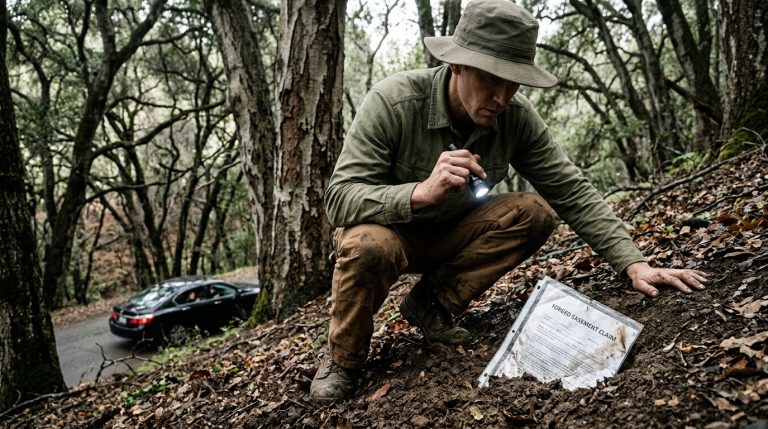
But as I looked down, I saw something else. In the dirt at the edge of the foundation, where the contractors had been scraping earlier that day, a piece of something was protruding—a corner of a heavy, weather-proof box.
I dropped to my knees, the damp earth soaking into my jeans. My fingers scraped at the dirt, the grit under my nails a sharp, sensory tether to the truth. I dug, not with a tool, but with my hands, my movements methodical and steady.
The box was made of heavy-duty synthetic, sealed with a rubber gasket. It wasn’t a cache of money. It was a digital drive, encased in foam, and a stack of blueprints—not for a workshop, but for the original, un-altered layout of the neighborhood.
The HOA wasn’t just managing the neighborhood. They were keeping the map of its original, hidden purpose. I tucked the drive into my jacket, the weight of it suddenly making the entire fight feel like a prelude. The truth wasn’t just in the ledger; it was buried in the very dirt I had been standing on for five years.
The collapse of the HOA was just the beginning. I stood up, the drive warm against my ribs, and looked toward the house. The night was quiet, but for the first time, it was my quiet. I didn’t need to be the defender anymore. I had the keys to the structure. And when the sun rose, I knew exactly how to use them.
CHAPTER 8: The Reconstruction
The glow of the laptop screen was the only light in the living room, casting sharp, angular shadows across the walls. Outside, the night was quiet, the frantic energy of the clubhouse raid replaced by the heavy, settled stillness of a neighborhood waking up to a new reality. I sat at my makeshift desk, the digital drive I’d pulled from the foundation of my own workshop plugged into the port.
The files were an intricate web of land titles, shell company charters, and long-term zoning projections—a blueprint for a neighborhood designed to be cannibalized. The developer, a man named Arthur Vance, hadn’t just built a housing community; he had built a long-term asset-stripping engine. Harriet was just the maintenance crew.
I moved through the files with the clinical detachment of a surgeon. Everything was documented. The kickbacks to the local zoning commission, the falsified environmental reports that allowed the ’emergency’ repairs to move forward without public oversight, and the true purpose of the ‘community spaces’—they were never meant for residents. They were landing pads for high-density, low-quality commercial zones that Vance had planned to trigger as soon as the neighborhood’s original HOA covenant expired in six months.
My phone chimed. It was Amanda. The DOJ is in. They’ve tracked Vance to a private jet terminal. He’s not going to make it out.
I felt a surge of cold, final satisfaction. It wasn’t the fiery, reactive anger I’d felt when I first arrived home to find my workshop leveled. It was something deeper—a steady, anchoring resolve. I looked at the screen, the data scrolling by like lines of code for a system that had finally been debugged.
I turned from the computer and walked to the door, stepping out into the cool, damp air of the morning. The concrete slab remained, a stark, gray scar on the property. But it no longer felt like a grave for my past. It was a blank page.
I reached into the bed of my truck and pulled out a heavy canvas bag—new tools, ones I’d purchased with the money saved from the legal settlements that had started to trickle through once the corporation’s assets were frozen. I sat on the edge of the slab and began to unpack: a square, a level, and a set of chisels that caught the first, pale light of dawn.
I wouldn’t build the same workshop. This time, I’d build something that lasted.
Marcy walked up the driveway an hour later, a thermos of coffee in her hand. She didn’t say anything, just set the cup on the concrete and sat down beside me. She’d been the one to coordinate the neighborhood’s collective testimony, the one who had turned the individual, isolated fears of twenty families into a singular, undeniable case.
“The park is finally ours,” she said, nodding toward the clubhouse area. “The sheriff says the city is going to manage the transition until the new, transparent board is elected.”
“It’s a start,” I said, my hand tracing the grain of a new cedar beam. “The foundation is solid now. That’s the only thing that matters.”
We sat there for a long time, watching the sun crest the horizon, the light warming the cold, gray surface of the concrete. The neighborhood was waking up. Doors were opening, curtains were being drawn back, and for the first time in years, people weren’t checking the street for trouble. They were just living.
I picked up the level, checking the alignment of the first wall frame. The work was slow, physical, and deeply grounding. The rust of the past had been scraped away, leaving a surface that was clean, honest, and ready for the future.
As I drove the first nail into the wood, the sound rang out—clear, sharp, and permanent—a marker of the reconstruction. The battle for the neighborhood had been won not through the roar of a crowd or the intensity of a conflict, but through the patient, stubborn refusal to let the truth remain buried.
I looked over at Marcy, who was sketching out a design for a community garden on a legal pad. The air smelled of damp earth and new lumber—the scent of a place being reborn. The corruption, the greed, and the systemic rot that had nearly swallowed us whole were gone, stripped away by the very evidence we had unearthed.
I went back to the wood, the grain smooth under my fingertips. The workshop would rise again. And this time, it wouldn’t just be a place for me to find peace. It would be a monument to a community that had finally learned how to stand its own ground. I took a steady, deep breath of the morning air, the weight of the past finally light, and began to build.