The Small Coin That Bought a Fortress for the Invisible Hearts and Shattered the Chains of Audacity
CHAPTER 1: THE COLD CURB
The metal box rattled against the dashboard as Gus slammed his palm onto the steering wheel.
The air inside the number 40 bus smelled of diesel fumes and wet wool, but outside on the curb, the wind simply bit right through denim.
An older woman stood frozen on the cracked concrete, her fingers clutching the frayed edge of a stained camel-hair coat.
“No pay, no ride, lady,” Gus barked, his thick neck flushing a dark, angry crimson under the flickering street lamp. “Read the plastic sign or get your feet moving.”
The woman blinked, her pale blue eyes clouding over as she patted her empty pockets with trembling hands. “I just set it down near the stone wall—my phone, everything is in that bag.”
“I got a schedule to keep,” Gus said, his hand wrapping around the black rubber lever to hiss the doors shut.
Betsy didn’t think about the milk.
She didn’t think about the two crumpled bills sitting at the absolute bottom of her right pocket, the ones her mother told her to never touch unless the world was ending.
Her worn sneaker jammed right into the rubber seal before the door could lock into place.
“Hey! Get your foot out of the mechanisms, kid!” Gus roared, leaning over the massive plastic steering wheel.
Betsy stepped up the metal stairs, the corrugated steel cold through her thin soles, and dropped the bills into the clear plastic slot.
The paper crumpled against the metal separator with a sharp, definitive slap.
“That’s for both of us,” Betsy said, keeping her chin level and her eyes locked right onto his badge.
Gus stared at the cash, grunted out a wet breath, and released the brake with a violent shove of his foot. “Whatever. Get to the back and don’t make me look at you.”
Betsy turned around and extended a small, calloused hand toward the shivering woman on the pavement. “Come on, ma’am. It’s warm enough inside.”
The woman looked at the small hand as if it were a steel anchor dropped into a dark river.
Her fingers were papery and ice-cold as they locked onto Betsy’s grip, stepping up the high riser with a heavy, uneven drag of her boots.
The bus lunged forward before their boots even cleared the yellow line, sending them both bouncing against the cracked vinyl seats.
“You shouldn’t have done that,” the woman murmured after the engine settled into a deafening roar. “That was your family’s money.”
“It’s just paper,” Betsy replied, pulling her mother’s white work apron closer against her chest to hide her own shivering arms. “My mom says nobody gets left in the dark.”
The older woman smoothed her soiled coat, a sharp, aristocratic dignity suddenly hardening behind the exhaustion in her face. “I am Eleanor. Eleanor Caldwell.”
Betsy nodded, her thumb tracing the plastic edge of her digital watch. “I’m Betsy. We get off in four stops.”
The city outside turned gray, the manicured hedges of the hill district fading into the broken brick facades of the East End.
Eleanor watched the girl’s thin arms shake under her white t-shirt, then looked down at the small face that asked for absolutely nothing in return.
“Your mother,” Eleanor said softly, her voice cut short as the bus hit a deep pothole that set the window panes rattling in their frames. “She raised a soldier.”
CHAPTER 2: YELLOW LINOLEUM
The plastic grocery bag hit the laminate table with a soft, crinkling sigh, spilling the scent of lemon polish and industrial bleach into the small room.
Linda didn’t look up right away; her thumb was pressed hard into the small of her back, right where the muscle knotted into a hot, radiating spike.
A high-end botanical garden donor directory sat half-exposed in the top flap of her work tote, its glossy cover stamped with a prominent red ink cross right through the Harrison name.
“Sit, Mom,” Betsy murmured, sliding the floral armchair forward until the worn fabric touched the back of Linda’s knees.
Linda dropped into the cushions, a low gasp escaping her teeth as her spine settled against the frame.
Eleanor stood near the doorway, her stained camel-hair coat looking entirely absurd against the faded 1970s wallpaper, her eyes tracking the precise, deliberate economy of the girl’s movements.
“We have chamomile,” Betsy said, her voice dropping into the small space between the humming refrigerator and the stove as she filled a chipped ceramic mug with hot tap water.
“Chamomile is perfect, sweetheart,” Linda managed, her fingers trembling slightly as she reached up to adjust the heavy black tape holding the left arm of her reading glasses together.
The glass table up at the hill house had required three separate moves to satisfy Beatatrice Harrison, and each inch had cost a fraction of Linda’s alignment.
Eleanor sat on the edge of the sofa, the vinyl groaning under her slight weight, her gaze fixing on the stack of envelopes neatly organized by size on the table corner—the top one screaming Urgent in bold crimson print.
“The number 40 bus was late again,” Linda said, her voice blunt and flat, the everyday language of a woman who measured her survival in minutes and pennies.
“Gus was driving,” Betsy added, setting the mug down with a small click.
Linda closed her eyes, the taped frame of her glasses sliding down the bridge of her nose as she took a slow, deliberate breath to mask the pain. “Then it’s a miracle you made it back at all.”
Eleanor reached out, her fingers brushing the cold glaze of the mug, her sharp blue eyes locking onto the small, stark details of the kitchenet.
The single carton of eggs on the counter was missing three, leaving an uneven space that felt louder than any spoken complaint.
“You work for the Harrisons,” Eleanor stated, the name dropping into the room like a heavy stone.
Linda’s posture stiffened instantly, the defensive instinct of the invisible workforce kicking in before the pain could stop it. “They pay on time, Mrs. Caldwell—that’s what matters.”
The overhead bulb flickered again, casting a long, rhythmic shadow across the yellow linoleum floor, highlighting the stark emptiness of the room’s single shelf.
Betsy cracked the remaining eggs into a dented aluminum skillet, the sharp sizzle of iron meeting fat cutting through the heavy silence of the apartment.
Linda looked at the red-lettered envelope at the bottom of the pile, her fingers twitching against her apron, but she kept her mouth shut, suppressing the sheer absurdity of the world outside through a long, slow exhale.
CHAPTER 3: THREE KNOCKS
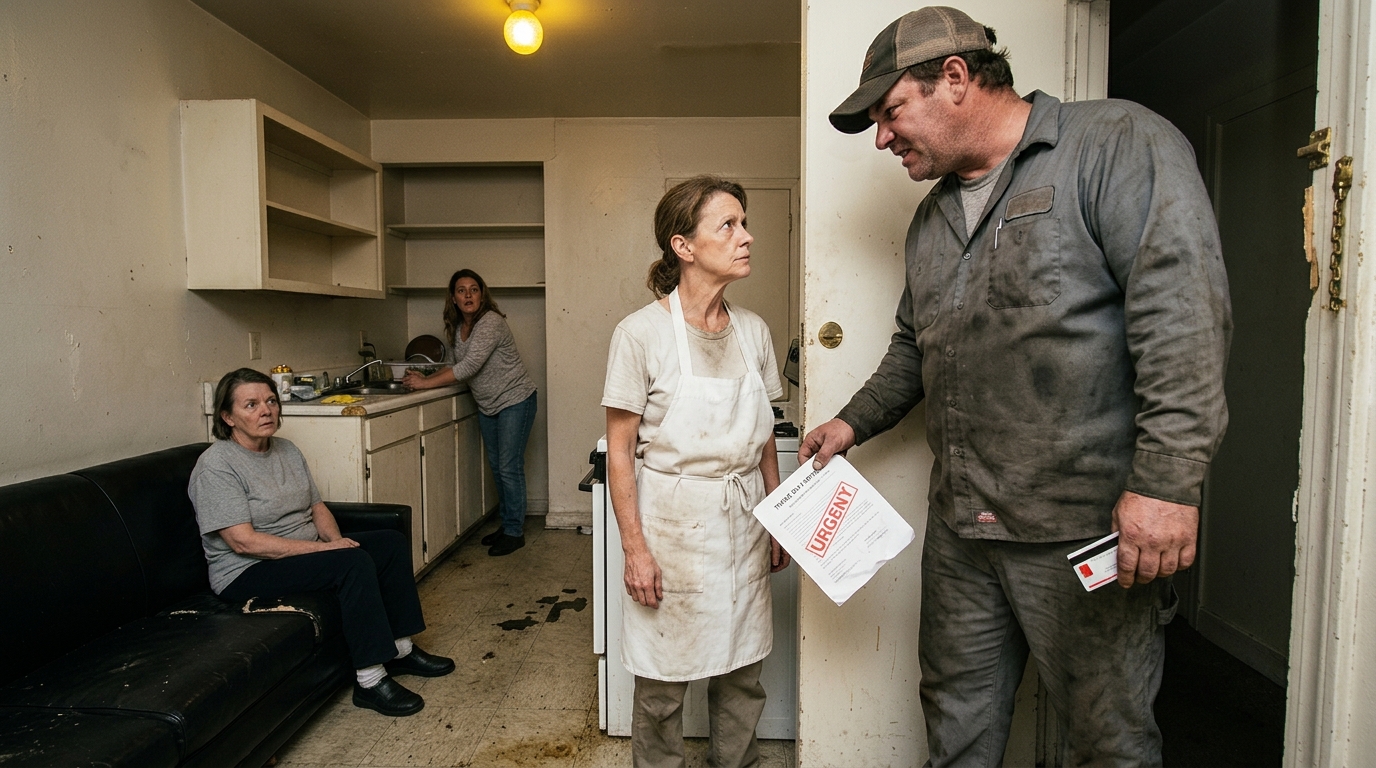
The cheap brass latch groaned as the door frame splintered slightly inward under the weight of an aggressive shoulder.
Henderson stood in the cramped entryway, his grease-stained baseball cap pulled low, his eyes actively bypassing Linda’s pale face to calculate the cost of the furniture inside.
He slid a heavy, calloused hand into his back pocket, pulling out a folded square of blue legal paper with an unearned, aggressive confidence.
“Friday was yesterday, Linda,” Henderson rumbled, his voice scraping against the low ceiling as he stepped straight across the threshold without an invitation. “You’re five days late on the lease, and my patience doesn’t pay the property tax.”
Linda pushed herself up from the floral cushions, a sharp spasm locking her lower spine as her fingers gripped the edge of the kitchen counter for leverage.
Her right hand instinctively checked the black tape on her reading glasses, her voice dropping into a dry, desperate whisper. —”Mr. Henderson, please—I got docked my afternoon shift at the hill house, but I have the diner hours on Saturday morning.”
“Saturday don’t clear the bank,” Henderson spat, his boots leaving a dark trail of street grime right onto the clean yellow linoleum.
He thrust the folded paper directly at her chest, weaponizing the petty authority of a three-day notice to crush whatever compliance she had left.
“You pay the full amount by Thursday noon, or the county sheriff puts every single stick of this plastic garbage on the curb.”
Eleanor sat perfectly still in the shadow of the drafty window, her fingers tracking a strange physical discrepancy—a heavy brass Caldwell subsidiary keycard slipping out from under Henderson’s dirty thumb as he shifted his grip on the paperwork.
Betsy stepped between her mother and the large man, her small frame rigid as she held her chin level against the unhinged audacity standing in their kitchen.
“We don’t owe you anything until the grace period clears,” Betsy said, her plain language cutting right through his corporate bluster.
Henderson let out a harsh, mocking laugh that sent a spray of stale tobacco breath across the small dining table. —”You got cash for extra mouths to feed, but you ain’t got my rent? Tell your old guest to chip in or you’re all sleeping behind the grocery store.”
The hollow door slammed shut with a concussive bang that rattled the single overhead bulb, leaving the smell of diesel and damp wool hanging in the thick silence.
Linda sank back down, her shoulders shaking against the vinyl as the realization of Thursday’s deadline locked around their lives like a vice.
CHAPTER 4: THE GRAY MORNING
The mechanical gears inside the old housing clicked as her fingers swept the dial with absolute, decades-old muscle memory.
Linda was still huddled near the dark oven for heat, her body rigid with a quiet, exhausting fear, her taped reading glasses sliding down her nose as she watched the old woman take charge.
“Robert, stop the frantic noise,” Eleanor spoke into the mouthpiece, her voice instantly dropping the frail grandmother facade to project the stone-cold authority of an empire built from nothing. —”I am fine. I am at 402 Elm Street, apartment 3B.”
A high-pitched, desperate murmur rattled the tiny black speaker on the other end, filling the narrow space between the linoleum floor and the water-stained ceiling.
“No, do not bring the local authorities, and do not call an ambulance,” Eleanor cut in, her plain words striking the air with immense weight. —”Bring the car. The Commodore. And Robert—bring the entire security detail. I have hosts who require protection.”
She set the plastic piece back onto its cradle with a sharp, definitive snap that seemed to lock the apartment’s perimeter.
Linda pushed herself up from the sofa, a deep groan slipping past her teeth as her lower spine flared in protest. —”Eleanor, you don’t understand the real world down here—if I don’t catch the 7:15 bus, Mrs. Harrison will fire me before noon.”
“Mrs. Harrison does not possess that kind of leverage anymore,” Eleanor replied, her posture settling into an immovable baseline of calm calculation.
Betsy stood by the cracked window pane, her watch ticking down the final seconds of their isolation, her watchful eyes sweeping the silent street below for the first sign of friction.
The wind outside rattled the loose glass, but inside, the heavy tension had shifted away from the threat of the landlord’s notice and anchored entirely onto the quiet authority standing by the refrigerator.
CHAPTER 5: THE BLACK CONVOY
The floorboards hummed under Linda’s worn sneakers as three armored vehicles pulled into a flawless, street-blocking wedge directly outside the iron gate.
A collective silence slammed down onto Elm Street, the neighborhood’s standard sirens and morning coughs completely vaporized by the low, precision purr of high-end machinery.
Robert stepped out into the damp air, his massive six-foot-four frame filling the narrow third-floor doorway after three crisp, metallic raps left the thin wood trembling on its hinges.
“Mrs. Caldwell,” Robert spoke, his granite jaw tightening as his eyes swept past Betsy to lock onto the stark emptiness of the kitchenet shelves. —”The entire board has been in a panic since the account signatures froze yesterday morning.”
Eleanor didn’t move from the floral chair, her hand resting on the table next to the glossy garden directory, her fingers pointing toward the corporate card Henderson had dropped. —”The freeze is exactly why I stayed, Robert—the Harrison firm has been systematically draining the East End logistics subsidiary from the inside out.”
Linda backed up against the counter, her hand white-knuckled against the taped arm of her glasses as the unearned audacity of her daily workforce shattered right in her own home.
The door to the stairwell burst open again, and Henderson charged onto the landing, his grease-stained cap pushed back as he weaponized his petty lease authority one last time. —”Hey, Linda! What is this circus? You think a few expensive cars mean you can skip out on Thursday’s cash?”
Robert shifted his weight, a single fluid movement closing the physical distance until his shoulder completely eclipsed the landlord’s line of sight.
“Is there a legal dispute regarding this unit, sir?” Robert asked, his plain, blunt language carrying the crushing weight of an institutional wall.
Henderson stammered, his eyes dropping to the golden Caldwell crest stamped clearly on the vehicle keys in Robert’s grip, the blood draining from his face so fast his skin turned the color of wet slate. —”No—no dispute—just making sure the tenants are settled.”
Eleanor stood up, her crumpled camel-hair coat suddenly carrying the absolute finality of an executioner’s gavel. —”We will be in touch with the main office regarding your management license by noon, Mr. Henderson.”
The giant bodyguard guided Linda and Betsy down the narrow stairs, the three-day notice left fluttering against the peeling wallpaper as the neighborhood watched the entire balance of power spectactularly collapse in silence.
CHAPTER 6: THE NEW NORMAL
Linda smoothed the edge of a new wool blanket draped across her knees, her back supported firmly by a specialized orthopedic brace that allowed her to sit without the agonizing fire of three herniated discs.
On the digital screen in front of her, the final legal transfer sheet displayed the complete acquisition of the Elm Street complex, the structural renovation order already stamped and approved by the new board directors.
Beatatrice Harrison had spent the previous evening screaming at institutional lawyers, trying desperately to weaponize old social decorum to freeze the bank assets, but the hard audit numbers had crushed her leverage under their own massive weight.
“The estate cottage needs the south gate schedules rewritten for next week,” Linda said, her plain language carrying the quiet, earned authority of a woman who managed everyday realities with common-sense precision.
Eleanor set down her porcelain cup, a single, sharp nod confirming the tactical transition as she watched the new manager adjust a pair of clean, untaped reading glasses. —”You carry the clipboard now, Linda—the staff coordinates entirely through your office.”
Mr. Henderson had been escorted from the premises by county field officers before noon on Tuesday, his desperate shouting about bookkeeping technicalities completely ignored as the local tenants stood on their porches in silent vindication.
Betsy walked into the light of the tall glass windows, her new private academy blazer hanging straight, her small fingers reaching into her pocket to pull out a single, clean quarter.
She flipped the small piece of metal into the bright air, catching it against her palm with a smooth click that had absolutely nothing to do with emergency funds or missing dinner.
The old plastic grocery bags and the lemon-bleach fumes were gone, completely replaced by the quiet hum of a functioning household and the warmth of a stove that didn’t require permission to burn.
Linda signed the last line of the property manifest, her hand steady as she locked the immovable boundary of their new life into place with a definitive stroke of the pen.