The Concrete Line That Sparked A Quiet Neighborhood War Against Corrupt Bureaucracy And Greed
CHAPTER 1: THE ORGANISED RETREAT
The sun had barely cleared the subdivision rooftops.
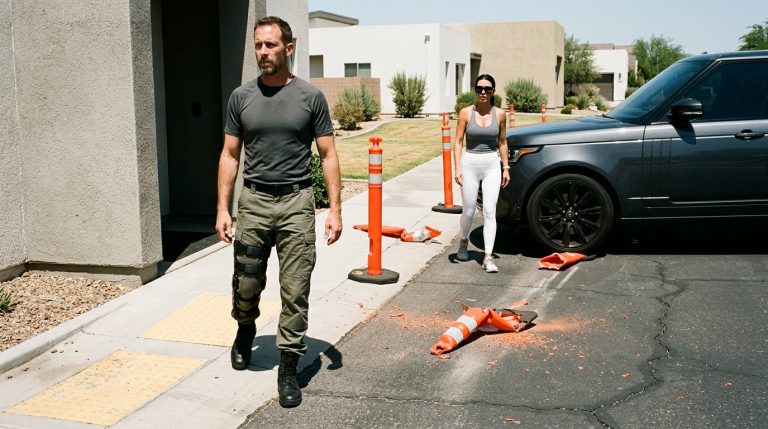
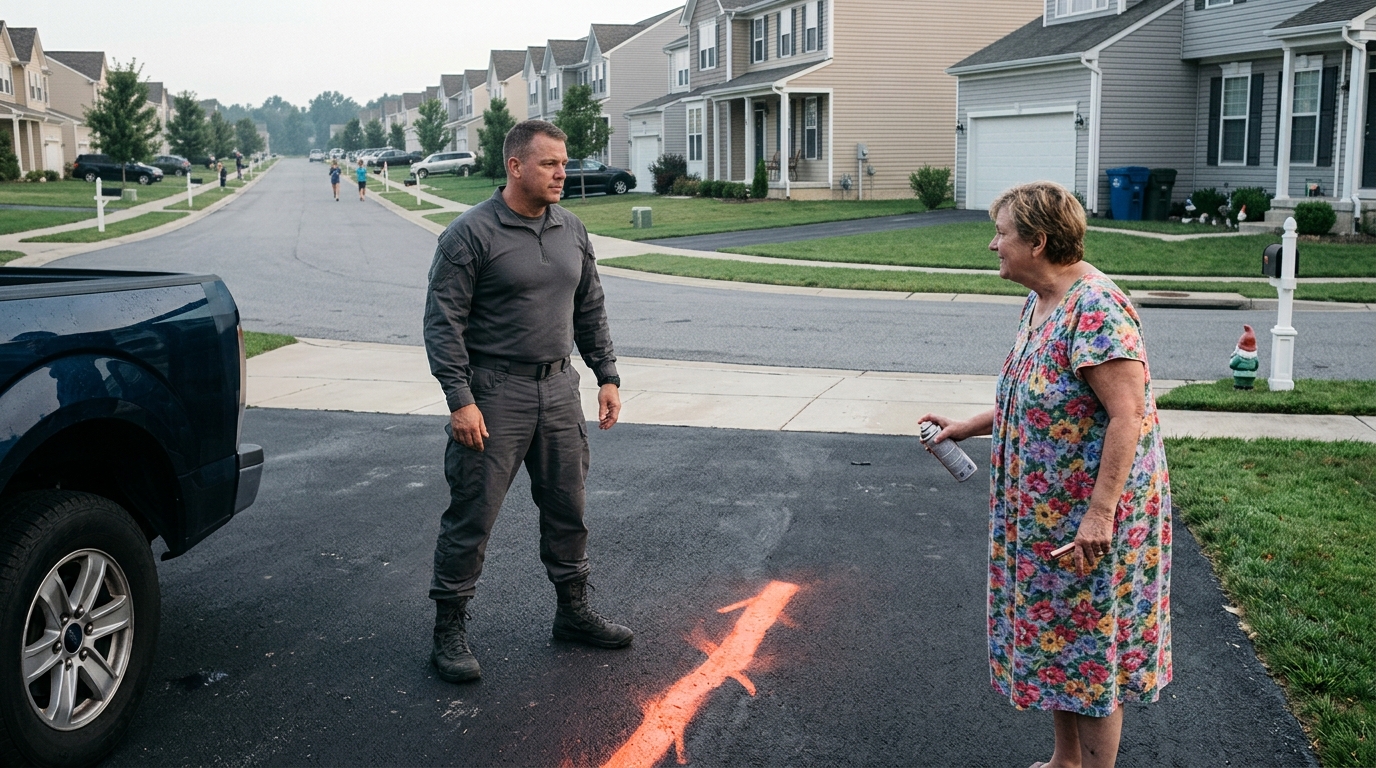
I stood at the edge of my driveway, staring down at the jagged stripe of fluorescent orange paint slashing across the fresh blacktop.
My hand rested on the open door of my Ford, fingers curling into a tight grip against the cold metal.
Karen stood ten feet away in her floral muumuu, holding the empty aerosol can like a trophy of her petty authority.
“That is a five hundred dollar fine, Major,” she announced, her voice dripping with self-satisfied entitlement. “Rectify it immediately or face the consequences.”
I took a slow, measured breath through my nose, forcing the heat of irritation down into my chest.
Three decades in the Corps taught me one fundamental truth about hostile engagements: never fight on an enemy’s chosen ground when you can simply walk away and rewrite the rules.
Without raising my voice, I pulled my phone from my pocket and unlocked the screen.
“You are trespassing on private property,” I said, my tone flat, hard, and devoid of emotion. “Leave this property right now, or the sheriff’s department will handle the report.”
Her smug grin flickered for a fraction of a second at the mention of law enforcement.
She opened her mouth to bluster about her official HOA status, then glanced around at the quiet morning street before snapping her jaw shut.
Without another word, she turned on her heel, climbed into her electric cart, and sped off down the cul-de-sac.
I watched her go, letting the dust settle before I turned back toward the house.
The security cameras I usually relied on were offline for routine software maintenance, leaving me entirely stripped of my digital safety net.
That meant every piece of evidence, every violation notice, and every financial trail had to be gathered manually, the hard way.
I stepped inside the quiet kitchen where Sarah sat at the table with her coffee cup cradled between her hands.
“She came back, didn’t she?” Sarah asked softly, looking up with tired eyes.
“She did,” I said, pulling out a clean manila folder and a black ballpoint pen from the drawer. “And now we start building the file.”
CHAPTER 2: GATHERING THE BROKEN PIECES
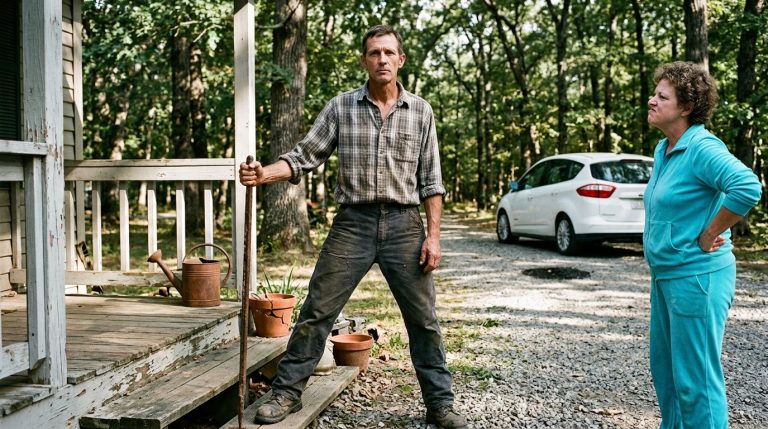
“She didn’t start with the spray paint, Mac,” Arthur said, his weathered fingers adjusting his reading glasses as he pushed the book aside.
“She started small. A quarter of an inch on a flag holder, a blade of grass a fraction too high, and then she locked down the budget.”
I leaned back in the creaking wooden chair, watching the sunlight glint off the polished chrome of a passing postal truck.
Without the security camera footage to prove the vandalism in court, my only weapon was the paper trail Arthur was about to lay bare.
” Prestige Property Management,” I said, repeating the name I had heard whispered by the mailboxes. “The contract history doesn’t add up for a standard subdivision.”
“It doesn’t add up because it’s a closed loop,” Arthur replied, sliding a yellowed sheet of paper across the table.
“Look at the contractor registration dates. That company popped up right after she took the presidency, registered to an out-of-town address under a relative’s name.”
I studied the faded ink of the vendor agreements, noting the absence of competitive bidding stamps.
Every single landscaping and asphalt maintenance order over the past five years had gone straight to a single pocket, bypassing the community vote entirely.
“She used the bylaws as a weapon to drive people out, and she used the contracts as an ATM to keep herself afloat,” I said, feeling the weight of the injustice settle into my shoulders.
“And she thinks nobody is looking because everyone else was too exhausted to dig through ten years of municipal filings,” Arthur added, swirling the melting tea.
“You need more than just my word, Mac. You need the families who paid those fines under duress.”
I stood up from the porch, the wood groaning beneath my boots as I slipped the yellowed documents into my manila folder.
“I’ll start with the Garcias down the street,” I said.
“They’ve been fighting an impossible battle over a child’s basketball hoop for six months.”
CHAPTER 3: BUILDING THE ALLIANCE SILENTLY
Mr. Garcia stood on his porch with his hands shoved deep into his pockets, staring down at the grass where his son’s plastic basketball hoop sat dismantled.
“She told me the net color brought down property values,” he said, shaking his head slowly as I stepped onto the concrete.
“A blue net on a standard black pole. Five hundred dollars for that, then another hundred a week until we took it down.”
I pulled the manila folder from under my arm, letting the warm wind flip the edge of Arthur’s vendor records.
Without digital video to prove her trespass, individual complaints were easily buried, but a collective ledger of identical harassment carried an entirely different weight.
“You aren’t the only one paying for her landscaping budget,” I said, handing him a printed summary of the unbid property management contracts.
“She’s been running this neighborhood like a private toll booth for five years.”
Lisa stepped out from the doorway behind him, wiping her hands on a kitchen towel with tired, hurried motions.
“She left a citation on my front door because my rosebushes grew three inches past the approved border while I was working double shifts,” Lisa said, her voice dropping into a bitter murmur.
“Every time I think I’m catching up, another yellow envelope shows up in the box.”
“The letters stop when we stop fighting her one by one,” I replied, meeting their eyes with steady, uncompromising focus.
“Arthur has the history, you have the violation logs, and I have the legal framework. We pool our fines into a single fund, or she bleeds us dry one driveway at a time.”
Mr. Garcia looked down at the paperwork, his jaw tightening as he read through the list of inflated contractor payouts.
“What’s the next step?” he asked, his voice finally losing its defeated edge.
“We draft formal dispute letters under state statute, demand a public board hearing, and force her to answer for every single dollar,” I said, turning toward the street.
“Pack your files, because we’re taking the fight straight to her office.”
CHAPTER 4: THE LEGAL SHARK STRIKES
“She signed for your certified letter on Tuesday,” David said, his fingers steepled against the mahogany desk as he slid a fresh copy of the state statutes toward me.
“Which means the fourteen-day clock on her mandatory public hearing is officially ticking.”
I adjusted the manila folders containing the neighborhood violation logs, ensuring every tab aligned with the state regulations David had highlighted in yellow.
Without our security camera footage to lean on, every single procedural requirement had to be ironclad, leaving no room for her standard administrative deflection.
“She’s used to running her office like a closed star chamber,” I said, tapping a finger against the section guaranteeing open resident appeals.
“Force her into a room with a crowd, and her entire administrative structure starts to crack.”
David gave a sharp, humorless nod, pulling a thick stack of finalized demand letters from his printer tray.
“We aren’t just asking her to review the fines anymore,” he said, handing me the formal notices for the Garcias, Lisa, and Arthur.
“We are citing state statute violations, demanding a full public accounting of the board’s vendor payments, and backing her into a corner she can’t sign her way out of.”
I gathered the documents into a tight, orderly stack, feeling the solid weight of preparation replacing the earlier frustration.
“Mail them certified, return receipt requested, to every board member tonight,” I said, standing up and sliding the stack back into the leather case.
“Let’s see how she handles a paper trail that doesn’t go through her shredder.”
CHAPTER 5: THE TRAP SPRINGS SHUT
Karen sat at the center of the elevated board table, her hands flat against the wood as she stared down at the standing-room-only crowd.
Her usual self-satisfied smirk was gone, replaced by a tight, defensive glare that darted toward the hallway where David stood carrying our heavy binders.
“This is an administrative session, not a public spectacle,” Karen snapped, banging her gavel against the wood with a sharp crack that echoed off the drywall.
“We will address the violation dockets in order, and all unauthorized recording devices will be turned off immediately.”
I stepped forward into the aisle, placing our comprehensive evidence binder directly onto the edge of her desk before she could close the registry.
“The session is public by your own governing bylaws, Madam President,” I said, my voice cutting cleanly through the murmur of the room.
“And the state statutes regarding financial transparency require every vendor payment to be entered into the permanent record.”
Karen’s face flushed a deep, mottled red as she looked down at the tabbed index markers separating her unbid contracts from the shell company filings.
“The committee’s decisions are final and binding,” she retorted, her voice rising in frantic volume as she tried to shout over the brewing unrest in the front rows.
“You brought an unapproved surface alteration into this community, and you will pay the full penalty!”
David stepped smoothly beside me, laying out the satellite mapping photographs of Karen’s own unpermitted deck and storage shed across the mahogany surface.
“Let’s discuss those architectural standards, Madam President,” David said, his tone razor-sharp.
“Starting with the three major structural violations currently sitting on your own personal property while you fine your neighbors for garden heights.”
The room erupted into a deafening wave of overlapping shouts and demands for accountability as the sheer hypocrisy hit the crowd like a physical shockwave.
Karen slammed her gavel down twice more, her hand trembling against the handle as she realized the administrative trap had closed around her completely.
CHAPTER 6: THE NEW PAVEMENT
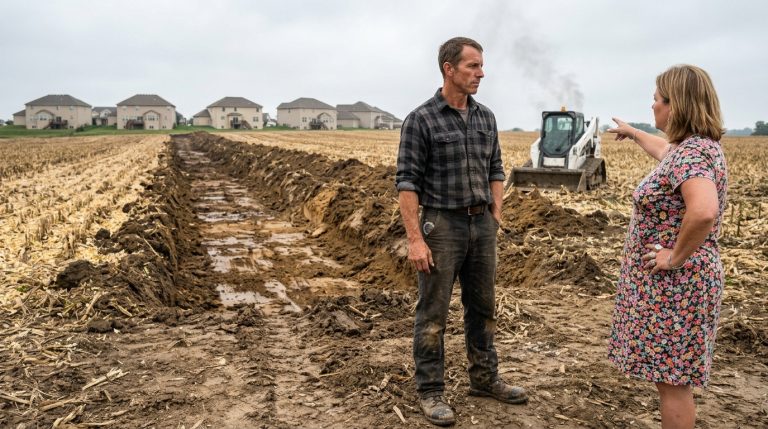
The heavy equipment hummed softly at the bottom of the drive where the old, scarred blacktop had been ground away to nothing.
Arthur stood near the curb with his hands resting lightly on his cane, watching the professional paving crew lay down a smooth, unbroken sheet of fresh aggregate.
“The bank finalized the foreclosure papers on her house this morning,” Arthur said quietly, not taking his eyes off the workers.
“When they audited the escrow accounts, they found she’d drained over two hundred thousand dollars into her brother-in-law’s shell company just to stay afloat.”
I shoved my hands into my pockets, feeling the solid resistance of the ground beneath my boots without any trace of orange paint or bureaucratic harassment.
Karen had attempted to fight the recall vote with emergency injunctions and wild accusations of fraud, but her desperate counter-moves collapsed the moment the state investigators froze her accounts.
She had built her entire authority on the assumption that everyone else would fold under pressure, leaving her entirely exposed when the final bills came due.
“She wanted control over everyone else’s property so badly she lost her own,” I said, watching the steam rise faintly from the cooling surface.
“And now the neighborhood finally has a board that answers to the residents instead of a tyrant.”
Sarah stepped out onto the front porch carrying two glasses of iced tea, her shoulders relaxed and free of the constant tension that had weighed on her for months.
She walked down the fresh pavement and handed a glass to Arthur before sliding her hand into mine.
The orange line was gone, replaced by a smooth, uniform blacktop that looked exactly as it should have from the very beginning.
There were no grand speeches left to make, and no looming notices waiting in the mailbox.
Just the quiet hum of paving equipment down the street, the distant sound of children playing basketball near the cul-de-sac, and the profound peace of a boundary held and won.