The Iron Pin on Oak Meadows Lane: How a Retired Surveyor Dismantled a Tyrant’s Empire
CHAPTER 1: THE RUSTED REBAR
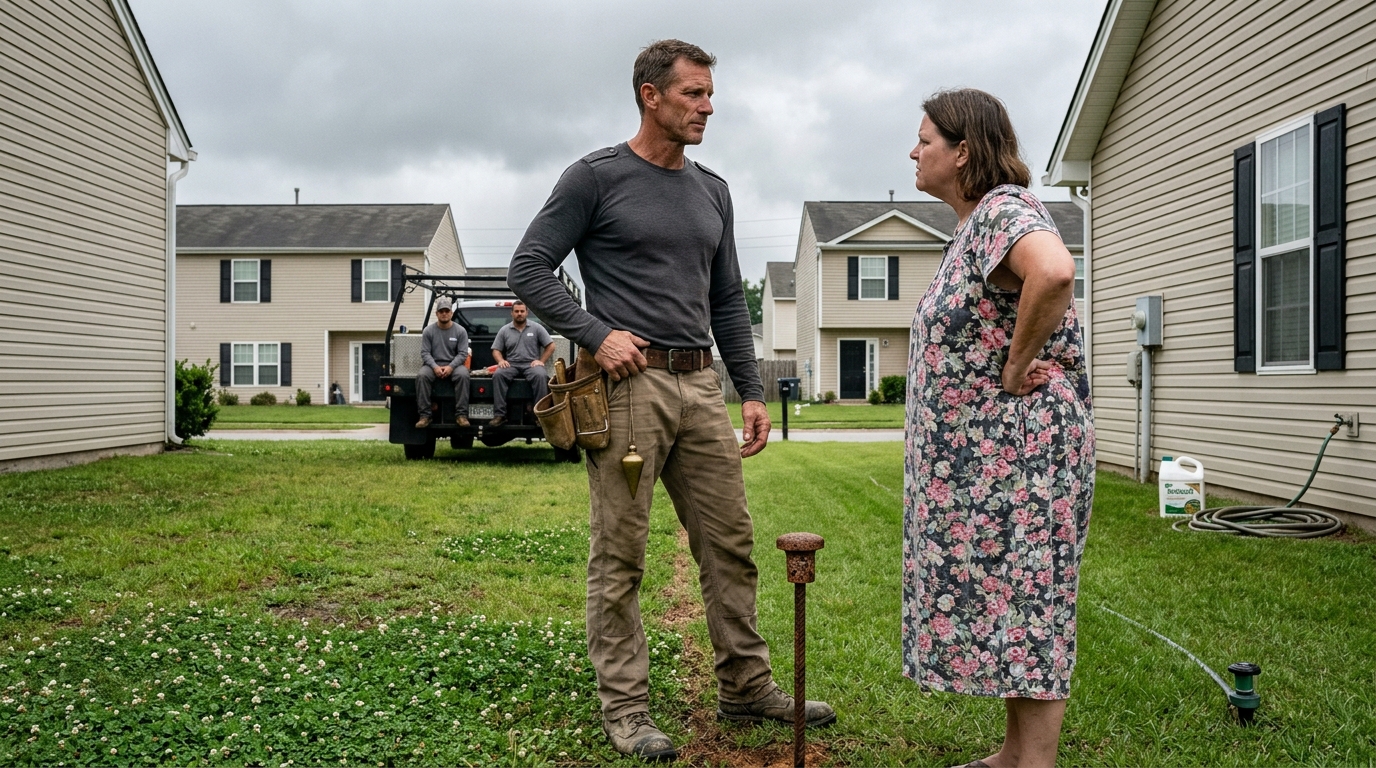
The morning air was thick enough to chew, smelling faintly of cut Bermuda grass and exhaust from the subdivision perimeter. I stood on the damp clover of my own side of the line, my boots planted firmly over the small, rusted rebar cap my grandfather had driven into the earth fifty years ago.
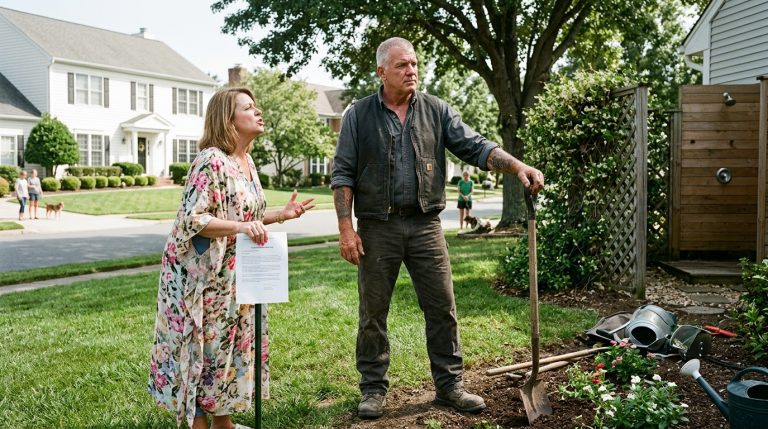
Karen’s floral print muumuu billowed like a spinnaker in the humid draft off the Oak Meadows retention pond. She planted both hands on her hips, her fingers digging into the fabric with practiced theatricality.
“Your little metal sticks are an eyesore, Mr. Thorne,” she said, her voice dropping into that gravelly register designed to project absolute municipal authority. “The board has voted. They are a violation of aesthetic standards. They’re coming out tomorrow, whether you like it or not.”
I did not blink. I did not shift my weight.
Instead, I reached into my pocket, my thumb finding the cold, scarred metal of the heavy brass plumb bob I had carried since my days in the Corps of Engineers. I rolled it once against my knuckles, feeling the familiar heft of its point.
“That pin stays,” I said, my voice level and dry as salt. “It is registered with the county recorder under book four, page twelve. You pull it, you are committing a misdemeanor.”
Karen scoffed, a sharp, dismissive expulsion of breath that rustled the artificial pink roses pinned near her collar. “County recorder? This is Oak Meadows. We govern ourselves here. That strip of grass belongs to the association.”
Behind her, the white maintenance truck idled on the asphalt, its diesel engine ticking in the heavy heat. The two men inside stared straight ahead through the windshield, avoiding eye contact with either of us, waiting for an order that would cross a legal wire they couldn’t see.
I watched the way Karen’s jaw tightened, the skin around her mouth whitening as she realized my silence wasn’t submission. It was calculation.
CHAPTER 2: THE PAPER FORTRESS
The white envelope sat on the oilcloth kitchen table like an unexploded round, bearing the official stamp of the Oak Meadows Homeowners Association.
I didn’t open it with anger. I opened it with the steady, practiced detachment of a man checking logbooks after a grueling engineering shift.
“Another one?” Sarah asked from the doorway, her voice tight as she leaned against the wooden frame.
“Fiftieth notice this month,” I said, my pen moving across the ledger page without a tremble. “This time it’s for the color of the porch screening. Apparently, charcoal grey violates their earth-tone harmony guidelines.”
I reached into the shallow drawer beside the sink, retrieving the heavy brass plumb bob and rolling it once between my palms to steady my pulse.
The fines were accumulating at a theoretical rate of thirty dollars a day, piling up into thousands of dollars on paper while the real battle sat quietly out in the damp grass.
“She thinks paper will break us,” I murmured, sliding the envelope into the thick plastic sleeve of my 3-inch binder. “She doesn’t realize she’s just handing us the itemized inventory of her own harassment.”
Sarah crossed the room, her hand resting briefly on my shoulder before she pointed toward the driveway window.
“Look out there, Jack. She’s walking the perimeter again.”
Through the double-paned glass, the garish flash of a floral muumuu moved past the azalea bushes, pausing near our property line where no sidewalk existed.
Karen leaned down, peering intently at the grass as if searching for an unregistered dandelion or an unauthorized blade of fescue.
I didn’t rush to the door to yell at her. I simply picked up my camera, stepped onto the porch, and captured the timestamped digital frame of her trespassing across our clearly marked boundary.
She stood there for a long moment, tapping a clipboard against her thigh, entirely unaware that every single piece of paper she mailed was another nail in her own coffin.
CHAPTER 3: THE ARCHIVAL GHOST
Marge at the records desk tapped her fingernail against the corner of the laminate counter, her expression softening into genuine concern as she slid the heavy map tubes toward me.
“You sure you want to open this old can of worms, Jack? Oak Meadows has enough lawyers on retainer to choke a bull.”
“The ground doesn’t lie, Marge,” I said, untying the faded cotton string securing the 1961 Henderson family tract.
I unrolled the stiff parchment, anchoring the curling edges with two small brass weights from my toolkit.
My eyes scanned the elegant, spidery script of the original surveyor’s notes, tracing the precise measurements tied to the concrete county monument down the road.
The rebar pin outside my driveway wasn’t an isolated anomaly; it was the anchor of an absolute, mathematically verified truth.
Beside it, I unrolled the computer-drafted Oak Meadows development plat from 1993, aligning the reference grid with steady, unhurried precision.
That was when the discrepancy leaped out from the paper like a tripwire.
The developer’s surveyor hadn’t measured from the grandfathered monuments at all; they had started their calculations directly from the proposed centerline of the new access road.
A quiet, suffocating stillness filled the back room of the archive as my scale ruler verified the grim reality.
It wasn’t a few stray inches of overlap or a drafting error.
The entire six-hundred-foot artery of Oak Meadows Lane—the asphalt, the curbs, the streetlights, and the underground utilities—sat squarely on twenty feet of my family’s ground.
CHAPTER 4: THE LASER LINE
Marcus didn’t waste breath on small talk as he locked the aluminum legs into place right over our contested rebar cap.
He sighted his instrument down the edge of Oak Meadows Lane, the laser dot blinking a bright red against the weathered asphalt.
“Mr. Thorne,” Marcus muttered, his hands adjusting the fine-tune screws with absolute focus. “Let’s show them where their road actually lives.”
Across the street, a familiar orange golf cart screeched to a halt, tires spitting gravel against the curb.
Karen marched across the asphalt, her floral muumuu snapping in the morning wind, her two board lieutenants trailing behind like anxious ducklings.
“You have no authorization to be on common property,” she shrieked, pointing a thick finger at the tripod.
Marcus didn’t even look up from his eyepiece, his voice deadpan and flat.
—Step back, ma’am. You’re standing in an active survey zone.
—This is our neighborhood—she barked, her face mottling into a dark purple shade as her hands flew to her hips.
—It’s twenty feet inside my property line—I said, stepping forward as Marcus drove the first bright pink lathe flag deep into the manicured parkway.
The pink markers marched steadily down the asphalt like a row of stacked dominoes, exposing the raw, undeniable truth for every neighbor watching from their porches to see.
CHAPTER 5: THE HALFMILLION BILL
Attorney David Chen tapped a single finger against the certified survey map spread before us, his eyes sharp as broken glass.
“They wanted your land for free,” Chen said, a cold, predatory edge slipping into his tone. “So we’re going to bill them for thirty years of unauthorized use, engineering costs, and malicious harassment.”
The ten-page demand letter rested beside the binder like a loaded weapon, addressed directly to Karen and every member of the Oak Meadows board.
It laid out the exact math of the twelve thousand square feet of asphalt and infrastructure resting on our deeded property, totaling four hundred and eighty-five thousand dollars.
“They have two choices,” Chen continued, sliding a copy toward me. “Option A, buy the land outright at our price. Option B, spend millions ripping up their own road and utilities within ninety days.”
I picked up my pen, feeling the familiar weight of steady control as I signed the authorization line.
There was no negotiation left, no room for petty administrative bullying.
When those certified letters landed in subdivision mailboxes across the street, the shockwave was going to hit Karen’s empire dead center.
CHAPTER 6: THE COLLAPSING KINGDOM
Karen slammed her gavel against the wooden podium, her face flushing into a dark, blotchy purple as the room erupted around her.
—Order! This is a private executive matter—she shrieked, her voice cracking over the mounting roar of residents holding their own violation files.
—Half a million dollars because of your personal vendetta?—Mr. Garcia shouted from the center aisle, holding up a thick stack of bogus citation notices.
The board members sitting behind her physically dragged their chairs backward across the linoleum, cutting ties in real-time.
Frank stood up, his jaw set hard against the mounting panic.
—She lied to us, and now she’s going to pay for it—he announced, handing a signed recall petition straight to the floor.
Karen swung around, her eyes wide with frantic, cornered desperation as she tried to scream that the demand letter was a hoax.
Nobody listened.
Within forty-eight hours, the recall petition went through, Karen resigned in utter disgrace, and the new board quietly settled for five hundred thousand dollars paid over time.
A week later, a professional crew drove permanent brass-capped monuments into the ground, locking our boundary in solid steel and concrete.
I stood on the back porch with Sarah as the sun dipped behind the tree line, watching the last moving van roll down Oak Meadows Lane without looking back.
My grandfather’s old rebar pin was gone, replaced by a permanent truth, and the quiet earth beneath our boots finally belonged to us alone.