The Quiet Price of Independence: How One Woman Shattered a Lifetime of Control and Claimed Her Future
CHAPTER 1: THE KITCHEN SKILLET
The water ran lukewarm from the faucet, smelling faintly of old iron and chlorine. My thumb pressed hard against the abrasive side of the green sponge, dragging it in tight, repetitive circles across the bottom of the pan.
Across the dining room, the floorboards creaked under the rhythmic weight of my father’s boots. Gerald sat at the head of the table, his newspaper unfolded wide enough to block out the fading light of the Harlan afternoon.
“The plant’s parking lot is half-empty,” Gerald said without lowering the pages. His voice was flat, carrying the dry authority of a man who spent nineteen years managing machines that didn’t talk back. “men standing around waiting for a handout. Unbelievable.”
My mother stood at the kitchen counter, her back turned to both of us. She wiped down a laminate surface that was already spotless, her rag moving in a frantic, silent tempo.
“People just don’t want to work with their hands anymore, Gerald,” she murmured, her voice thin and rehearsed.
I didn’t answer. I kept my eyes fixed on the black grease curling away from the iron. The weight of the skillet felt heavy in my palms, grounding me against the quiet pressure pressing in from the hallway.
Gerald turned a page. The dry snap of newsprint echoed off the bare walls.
“You’ve got a roof over your head, Caroline,” he said, repeating the nightly phrase like a punctuation mark. “Food on the table. What else does a girl your age need to worry about?”
My fingers tightened around the handle of the skillet. The metal was cold where the water hadn’t reached.
“Nothing, Dad,” I said, keeping my voice level as I rinsed the soap away. “Just cleaning up.”
CHAPTER 2: THE BLUE NOTEBOOK
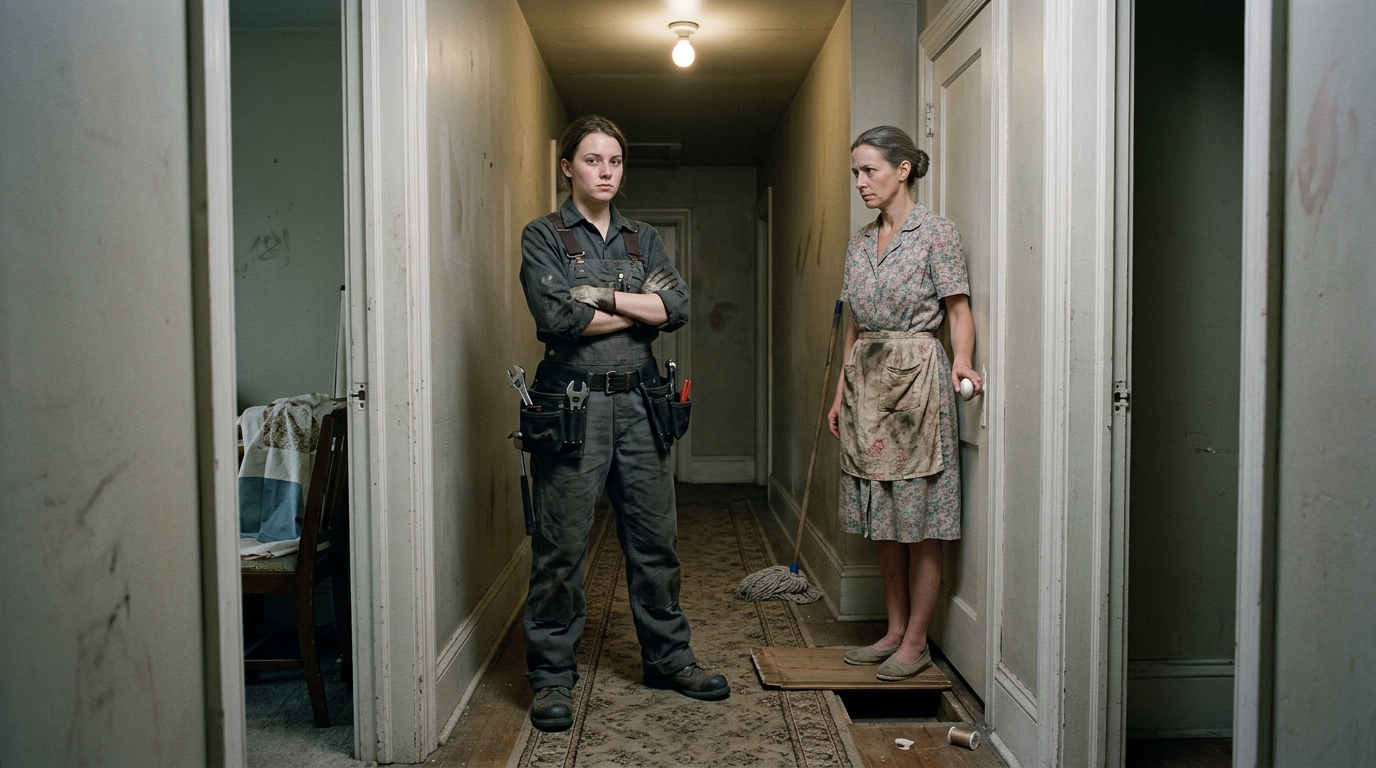
The loose floorboard yielded with a dry, muffled snap under the toe of my sneaker. I dropped to my knees on the patterned rug, my fingertips scraping against the rough plywood underneath.
The cold winter draft from the crawlspace bit into my knuckles. I reached into the dark cavity, my fingers brushing against the smooth, familiar spine of a spiral-bound notebook.
My mother kept her sewing room locked during the day, but the latch had a loose screw Gerald had ignored for three years.
I pulled the blue notebook into the dim light of the hallway. The pages smelled faintly of lavender starch and machine oil.
I flipped the cover open, the paper catching slightly on a stray thread. Down the left margin, neat rows of ink spelled out the names of businesses thirty miles beyond Harlan.
Millfield Hardware. Ridgeway Freshmart. County Line Logistics.
Beside each name, a series of red check marks bled slightly through the thin paper. Each mark represented an interview canceled before it could even begin, a door slammed shut before I had a chance to touch the handle.
The kitchen floorboards creaked overhead, signaling my mother’s slow, methodical steps approaching the back hallway.
I shoved the notebook back into the dark recess beneath the floor, pressing the wood down until it clicked flat against the joist.
My heart hammered against my ribs, but my breathing stayed shallow and controlled. I stood up just as the doorknob turned, wiping my palms against the denim of my jeans.
Denise pushed the door open two inches, her eyes scanning the room with the practiced vigilance of a prison guard.
“You shouldn’t be in here, Caroline,” she said, her voice dropping into that quiet, wounded register she reserved for family disappointments.
“I was looking for the mending thread,” I said, meeting her gaze without flinching.
CHAPTER 3: THE GAS STATION CURB
The heavy rubber tread of a semi-truck tire crunched against the gravel lot, kicking up a cloud of stale dust that tasted like exhaust and damp asphalt.
Inside the glass doors of the station, the night cashier kept his eyes locked on a small portable television, ignoring the girl sitting outside with a single nylon backpack.
My phone hummed once against my thigh, flashing a dead screen before slipping entirely into darkness.
The vibration was brief, but the weight of it lingered like a physical hand pressing against my spine.
I didn’t have an address to walk toward, and the shelter wouldn’t open its intake doors until sunrise.
The wind cut through the thin fabric of my jacket, carrying the sharp, iron scent of autumn frost sweeping down from the county line.
A shadow shifted across the fluorescent glow of the pavement as the cashier stood up to flip the lock on the front door for the night.
I pushed myself up from the cold concrete, my joints stiff from hours of motionless waiting in the damp air.
“Store’s closing,” the man said through the glass, his voice flat and uninterested as he slid the deadbolt home.
“I know,” I said to the empty air, turning my back to the highway and stepping out onto the gravel shoulder.
CHAPTER 4: THE SHELTER BLUEPRINT
The baseboard heater hummed a low, metallic vibration against the linoleum floor.
Linda pushed her glasses up the bridge of her nose, her eyes scanning my face with a sharp, professional assessment.
“You don’t have to explain why you’re here, Caroline,” Linda said, her voice dropping beneath the steady background cough of the resident two beds down. “You just have to want to get back up.”
I dropped my nylon backpack onto the gray blanket of bed 14, the zipper catching slightly on the worn stitching.
“I need to replace my documents,” I said, keeping my tone flat to block out the rising panic in my throat. “Birth certificate, temporary ID. Everything was left behind.”
Linda crossed her arms, leaning slightly against the metal doorframe.
“The county backlog takes weeks, and without proof of identity, they won’t even look at your file,” she said, her expression hardening not out of cruelty, but out of grim familiarity with the system. “You’ll have to start from scratch with the mail-in requests.”
A heavy silence settled over the aisle between the cots, broken only by the relentless buzzing of the ceiling fluorescent tubes.
My fingers traced the edge of the twelve crumpled dollars in my pocket, realizing how far away Milford and my old life truly were.
“I’ll sweep the floors, wash the dishes, do whatever needs doing,” I said, meeting her gaze head-on.
Linda let out a short breath through her nose, a faint trace of respect cutting through her tired exterior.
“Breakfast starts at six,” she said, turning on her heel. “Be in the kitchen, or you miss it.”
CHAPTER 5: THE BRIEFCASE
The metal latches clicked open with a sharp, synchronized pop that cut through the low buzz of the shelter’s baseboard heaters.
Ruth Callan didn’t rush, her weathered fingers sliding across the faded black ink scrawled on the leather flap—five words written in Grandma Maggie’s unmistakable handwriting.
“For Caroline, when she’s ready,” Ruth said, her voice steady and stripped of all professional pretense.
She lifted the top divider to reveal a cream-colored envelope and a thick manila folder tabbed with exact dates and phone records.
“Your mother made thirty-seven separate calls to your prospective employers,” Ruth said, sliding the documentation across the scratchy gray blanket. “And your father compiled five fabricated police reports through the home IP address.”
I stared down at the crisp white paper, my vision blurring slightly as the weight of three stolen years condensed into neatly typed metadata.
“She planned this a decade ago,” I whispered, tracing the edge of the retainer agreement signed by an old woman on a sold farm.
“Every detail,” Ruth confirmed, tapping the corner of a yellow legal envelope bearing the stamp of Philip Durn’s office. “She knew the walls would close in; she just made sure you had the key to push back.”
CHAPTER 6: THE FINAL LEDGER
The heavy oak desk smelled of old furniture polish and paper dust.
Ellen Briggs kept her pen capped, her gray blazer unbuttoned as she watched the ink dry on the court order.
“The default judgment is binding under Ohio law,” Ellen said, her voice entirely even. “And the lien on Maple Street means the property transfers only after the settlement is satisfied.”
Across the room, Philip Durn folded his reading glasses and placed them neatly beside the fern by the window.
“Your grandmother anticipated every single piece of this,” Durn said softly. “She wanted you to have a clean slate, Caroline. Not out of spite, but out of necessity.”
Two weeks later, the notice of the house sale arrived through the mail slot of my ground-floor apartment in Millfield.
Gerald and Denise walked away from Maple Street with barely enough to secure a trailer park lease outside of Galion.
No amount of shouting at town council meetings or drafting memos on old company letterhead could rewrite public court records.
My phone sat silent on the kitchen counter, its screen dark and undisturbed by late-night threats or manipulative text messages.
Maggie the cat curled into a warm ball beside my laptop, her purr vibrating steadily against the wood.
I opened a blank spreadsheet for my new job at Durn’s office, typing out the morning schedule with both hands.
The apartment was quiet, the door was locked from the inside, and the key belonged entirely to me.