The Red Dust Protocol: How a Two-Star General Discovered That True Authority Cannot Be Stamped on a Uniform
CHAPTER 1: THE RING KNOCKER
The Ford staff car bounced hard through a rut in the baked scrubland, sending a dry cloud of red dirt across the canvas tents of the staging area.
Major General Theodore Callaway did not blink.
He sat upright in the passenger seat, his uniform pressed with razor-sharp precision, his three-day-old campaign ribbons gleaming in the brutal tropical glare.
Twenty-seven years at West Point and garrison commands from Georgia to the Philippines had taught him one immutable truth: an army was a machine of absolute gears.
When a gear slipped, you fixed it immediately.
Captain Lewis Emery shifted gears with a quiet wince, his hands gripping the steering wheel as another pothole threatened to jar their teeth.
“Camp perimeter, General,” Emery said, keeping his eyes straight ahead. “First Australian Corps staging area.”
Callaway looked out the window at the sprawling, haphazard collection of canvas shelters and improvised vehicle bays.
There were no painted stones marking the boundaries.
There was no spit-and-polish sign welcoming visitors to a United States military installation.
It looked less like a brigade encampment and more like a frontier mining settlement that had survived a hurricane.
“Stop the vehicle, Captain,” Callaway said. His voice was low, flat, and completely devoid of warmth.
The staff car crunched to a halt beside a supply tent where a young soldier was hauling a heavy wooden crate of ammunition across the dirt.
The soldier looked to be about twenty-three, sunburned to the color of a dried brick, his slouch hat cocked back at an insolent angle, and his shirt unbuttoned halfway down a chest matted with sweat and dust.
Callaway pushed the door open, his polished leather boots hitting the red soil with deliberate force.
He stood fully erect, a striking two-star emblem gleaming on each collar point, waiting for the inevitable snap of attention.
The young soldier paused his stride, glanced lazily in Callaway’s direction, and offered a casual nod.
“G’day,” the corporal said, before turning his back and walking around the corner of the supply tent without breaking his rhythm.
Callaway remained frozen on the spot, his right hand twitching downward by a fraction of an inch before stiffly locking back against his trouser seam.
Emery stepped out of the driver’s side, holding his breath as he watched the color tighten around the general’s jawline.
“Did that man just walk past a major general without rendering a salute?” Callaway asked, his gaze fixed on the empty patch of dust where the soldier had vanished.
“Yes, sir,” Emery muttered, staring intently at his own boots.
“Is he aware of my rank, Captain?”
“He may not have noticed, General.”
“He was looking directly into my eyes, Emery.” Callaway turned his head slowly, his eyes narrowing into cold gray slits. “Find his commanding officer. Now.”
CHAPTER 2: THE STAINED MEMORANDUM
Captain Lewis Emery stood by the requisition schoolroom door, holding a three-page document that smelled faintly of fresh ink and bad judgment.
Callaway did not look up from his desk.
“Read it, Captain,” the general said, his voice dropping into that low, flat register that preceded every disciplinary action he had ever signed.
Emery cleared his throat, his eyes scanning the dense typewritten lines of the directive.
“Subject: Military Courtesy Standards, Allied Personnel,” Emery read aloud, his voice tight. “It specifies that all Allied personnel, regardless of national origin, will render appropriate salutes to officers of equivalent or superior rank. It cites Allied command protocols.”
“Does it leave any room for misinterpretation?” Callaway asked, finally raising his cold gray eyes.
“No, sir. It is remarkably thorough.”
“Good.” Callaway slid a heavy brass artillery shell casing across the wood, his thumb pressing into the dented metal. “Deliver it to the Australian 20th Brigade headquarters before noon. Make sure it reaches Lieutenant Colonel Dwyer’s hands personally.”
Ten minutes later, the jeep crunched across the sun-bleached gravel outside the Australian administrative tent.
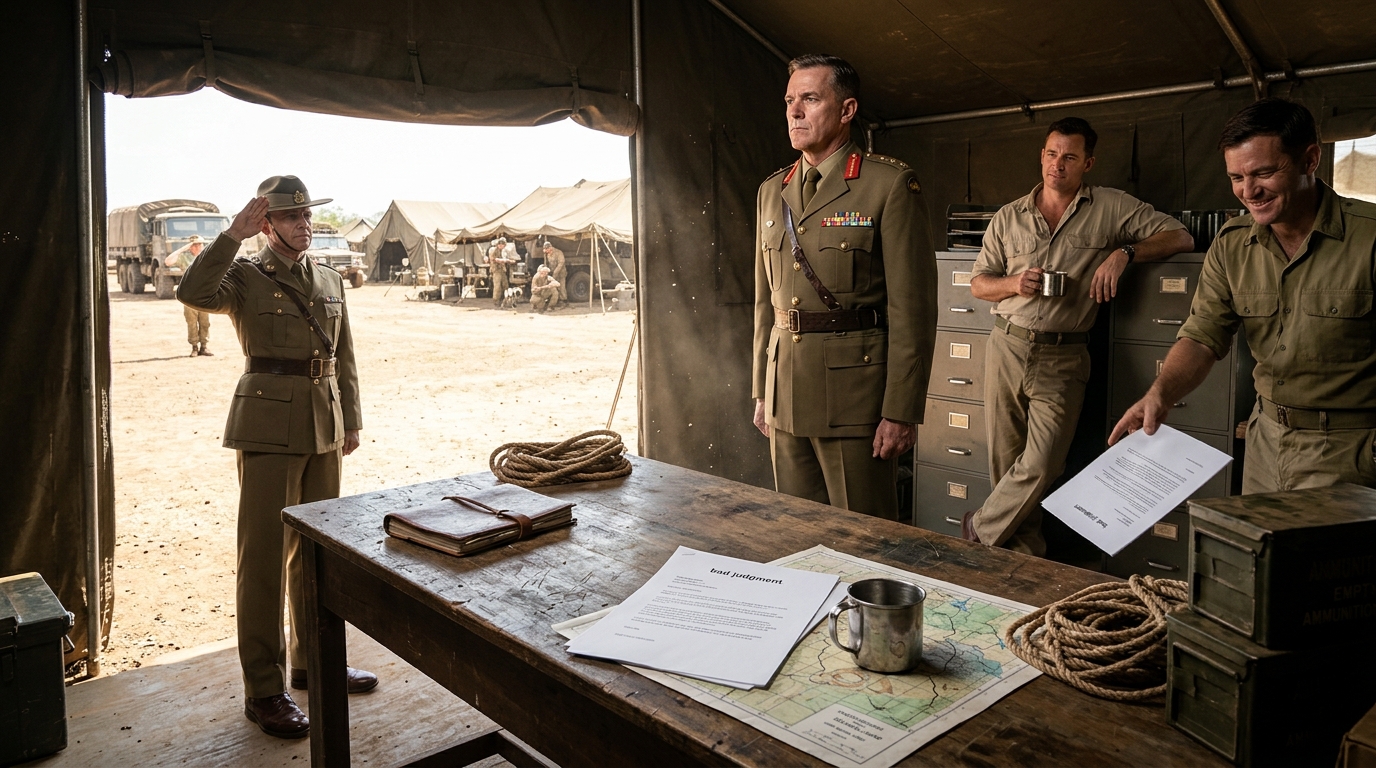
Lieutenant Colonel Patrick Dwyer sat with his shirtsleeves rolled to his shoulders, a map of the northern Queensland staging grid spread flat before him.
He did not look up when Emery entered.
“Captain,” Dwyer said quietly, taking a slow sip from a chipped tin mug of lukewarm tea. “You look like a man carrying an unexploded mortar shell.”
Emery placed the crisp three-page memorandum squarely in the center of the tactical map.
“Orders from Major General Callaway, sir regarding inter-force courtesy and standard saluting protocols across the staging area.”
Dwyer picked up the document with two fingers, his expression shifting from mild indifference to a thin, razor-like amusement.
He read the first paragraph, turned the page, and read the second.
Then he reached across the table and tossed the paper toward his adjutant, Captain Reg Sullivan, who was leaning against a filing cabinet with a grease-stained notebook.
Sullivan caught the memo with one hand, scanned the text, and let out a dry, rattling cough that sounded suspiciously like a laugh.
“He’s serious,” Sullivan muttered, tossing the paper onto an empty ammunition box. “He wants the boys to salute every American officer they see marching through the dust.”
Dwyer did not answer immediately.
He picked up his tin mug, swirled the dregs of the tea, and stared out the open canvas flap toward the sun-scorched parade grounds where Australian infantrymen were repairing vehicle tracks.
“Pass the word,” Dwyer said softly, his voice cutting through the hum of the flies. “Tell the boys to behave themselves.”
Sullivan stared at his commanding officer with a hard, skeptical squint.
“Are you telling them to salute, Pat?”
“No,” Dwyer replied, setting the mug down with a sharp, heavy click against the wood. “I’m telling them to behave themselves. Those are two entirely different things.”
CHAPTER 3: THE THEATRICAL BARRAGE
Callaway adjusted his campaign cap, his eyes scanning the sun-bleached expanse where three Australian privates ambled past a row of parked transport trucks.
They did not look at the ground.
They looked directly at him with an unsettling, synchronized intensity that carried zero military deference.
Without breaking stride, the lead private halted, slammed his heels together with exaggerated theatrical weight, and threw up a left-handed salute that wobbled deliberately in the hot air.
“Good day to you, General,” the soldier drawled, his voice carrying clearly across the compound.
The second soldier bowed deeply from the waist like a courtier greeting royalty in a third-rate picture show, while the third held a steady, twelve-second salute with his thumb hooked grotesquely over his nose.
Callaway stopped dead in his tracks, his jaw hardening into an iron line.
Captain Lewis Emery hurried to keep pace, his hand twitching toward a clipboard he wasn’t even holding.
“Sir,” Emery muttered, his voice dropping into a tense whisper. “I think they are making a point.”
“They are mocking a direct order,” Callaway said, his voice cold and flat as a slate slab.
He turned on his heel and marched straight toward the nearest tent opening, ignoring the muffled bursts of laughter echoing from behind the water tanks.
Everywhere he looked across the staging grid, the performance repeated itself with maddening precision.
A corporal perched on top of a canvas-covered supply stack snapped a crisp, exaggerated greeting using two fingers pressed against his belt buckle.
Another group near the mess hall saluted in three-part harmony, singing a loud, dragging verse of an Australian bush ballad that hung heavy in the stifling heat.
Not a single regulation had been broken on paper.
Every man was technically rendering a salute, and that technicality was precisely what made it an intolerable insult.
Callaway reached his temporary office, shoved the wooden door open, and slammed his heavy leather gloves down onto the desk.
“Captain,” Callaway said without turning around, his knuckles whitening against the edge of the wood. “Arrange a meeting with Brigadier Brennan immediately.”
Emery swallowed hard, watching the dust motes swirl in the shafts of harsh light cutting through the window.
“Yes, sir,” Emery replied, knowing full well that walking into the 20th Brigade commander’s tent was like marching barefoot into a brush fire.
CHAPTER 4: THE HAMMER OF QUEENSLAND
Brigadier Niall Brennan did not bother looking up as Major General Callaway stepped across the threshold.
The tall Australian grazier sat with his long legs stretched out, casually finishing a thick wedge of tinned beef sandwiched between two slabs of dry camp bread.
“General,” Brennan muttered around a mouthful, his pale blue eyes finally rising to meet the icy glare of the American officer. “Take a seat if you can find one that isn’t broken.”
Callaway remained standing, his posture rigid, his fingers tightening around the edge of the desk.
“Your men are turning a military staging area into a public theater, Brigadier,” Callaway said, his voice dropping into a dangerous, clipped register. “The memorandum I issued was explicit regarding Allied courtesy standards.”
Brennan swallowed slowly, set his lunch tin down with a dull metallic clatter, and leaned back until the folding chair groaned in protest.
“General, I’ve been soldiering for twenty-seven years since before you earned those stars on your collar,” Brennan said, his voice as flat and unyielding as a slab of granite. “You know what I’ve learned in that time?”
“Enlighten me.”
“A salute doesn’t make a soldier,” Brennan replied, leaning forward into the stifling air between them. “Fighting makes a soldier. Dying makes a soldier. Standing in a trench with water up to your thighs while artillery shells come in every thirty seconds and refusing to run—that makes a soldier.”
Callaway’s jaw tightened until the skin turned bone-white.
“It is a symbol of the chain of command, Brennan. Without it, discipline dissolves.”
“So is not getting your men killed for no reason,” Brennan countered sharply, his gaze locking onto Callaway with unblinking intensity. “My lads have a pretty clean record on that score, and they don’t need a theatrical wave of the hand to prove they know who’s leading them.”
The silence in the tent grew heavy, thick with the dry dust blowing in from the scrubland outside.
Callaway realized then that he could not bully this man with paperwork or parade-ground threats.
The barrier before him wasn’t an act of petulant rebellion; it was an ironclad wall of shared survival.
“This is not the desert, Brigadier,” Callaway said quietly, turning on his heel toward the exit. “And you will find that regulations carry weight whether your men choose to respect them or not.”
Brennan picked up his unlit pipe, tapping the bowl against his thumb without a hint of concern.
“The boys survived Rommel’s armor, General,” Brennan called out to Callaway’s rigid back. “They’ll survive your paperwork.”
CHAPTER 5: THE BUREAUCRATIC COLLAPSE
Major General Callaway dragged his pen across the thick paper of a formal complaint, his hand moving with mechanical fury.
If the brigade commanders refused to enforce his memorandum, the structure would simply have to be fixed from the very top.
Captain Lewis Emery stood quietly by the window, watching the heat waves ripple across the baking earth outside.
“General,” Emery said, his voice hesitant. “General MacArthur’s office in Melbourne… are we certain an administrative escalation is the right path?”
“It is the only path left when discipline is abandoned,” Callaway snapped, his pen slicing another sharp line across the page. “The agreement is clear. Inter-force coordination requires unified standards.”
He folded the document, sealed it inside an official dispatch envelope, and stamped it with the red wax seal of the Deputy Liaison.
“Get this onto the morning courier flight to Melbourne,” Callaway ordered, pushing the envelope across the desk. “Directly to the Chief of Staff.”
Two days later, the reply arrived on Callaway’s desk.
It wasn’t a vindication. It wasn’t an order enforcing court-martials or disciplinary reviews.
It was a small, cream-colored note bearing the personal initials of Lieutenant General Sir Thomas Blamey, commander of the Australian military forces.
Callaway unfolded the sheet, his eyes scanning the formal, devastatingly polite prose.
Blamey noted the complaints of theatrical salutes with an unsettling lightness, defending the informal bond between Australian ranks as the cornerstone of their frontline success.
The note concluded with a sharp, immovable suggestion: Callaway should direct his considerable energy toward logistics and leave the management of Australian soldiers to Australian officers.
Before Callaway could even draw breath to protest, a second slip of paper fluttered out from the envelope.
It was a direct wire from General MacArthur himself, consisting of exactly seven words.
Ted, focus on signals integration. Leave the saluting question alone.
Callaway stared at the paper, the silence of the room pressing down on his chest like an iron weight.
CHAPTER 6: THE DUSTY DEPARTURE
Captain Lewis Emery watched the general’s shoulders drop by a fraction of an inch, the rigid posture finally yielding to the silent, suffocating weight of the Queensland heat.
There would be no court-martials.
There would be no disciplinary hearings for privates who said g’day instead of snapping a parade-ground salute.
The system Callaway had trusted all his life had just drawn a hard boundary, and it wasn’t the one he wanted.
“Pack the files, Captain,” Callaway said, his voice stripped of its earlier iron edge, sounding instead like a man who had walked straight into a stone wall and finally felt the granite.
“Sir? To Brisbane?”
“To Brisbane,” Callaway replied, turning his back on the window and the sprawling, dust-choked camp outside. “Logistics command. Where the books are balanced and the salutes are counted by people who care about paper.”
Within forty-eight hours, the staff car rolled out through the staging gate, kicking up the same red dirt that clung stubbornly to every vehicle, tent, and boot in the valley.
As they passed the outer perimeter, Corporal Teddy McClean was hauling another wooden crate across the compound, his slouch hat cocked at the exact same insolent angle.
McClean didn’t look up, and Callaway didn’t look down.
The car gathered speed, leaving the camp behind in a rising cloud of red dust.
Back in the command tent, Lieutenant Colonel Patrick Dwyer poured a fresh mug of tea, the broken ceiling fan rattling softly above him as the afternoon sun beat down on the corrugated iron roof.
The rules hadn’t changed.
The men hadn’t changed.
And out on the ridges of the Pacific, where courage mattered more than ceremony, the only salute that would ever count was the steady hand of a bloke holding the line for the mate beside him.