The Iron Bridge and the Paper Wall: A Kentucky Common-Sense Reckoning Against Corporate Entitlement
CHAPTER 1: THE RUSTING BOUNDARY
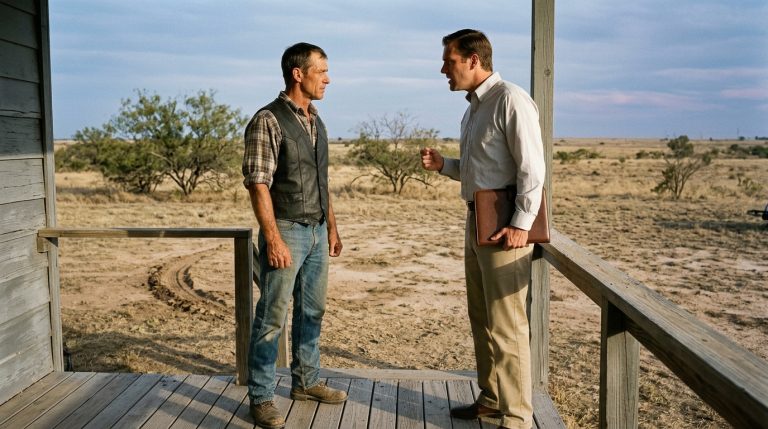
The lawn chair is bolted to the porch floorboards with three-inch galvanized screws so the October wind off the ridge can’t flip it down the gully.
I sit there with a mug of chicory coffee that has already grown a skin across the top while the sun burns the mist off the creek rocks.
Down the slope, the cattle are bunching up near the north fence, their hides dusty and moving slow like heavy wool.
It’s quiet enough to hear the water sliding over limestone, a steady, low-slung hiss that hasn’t changed since my grandfather hauled the first steel I-beams across this gap in seventy-two.
Then the mailbox down by the gravel turnout gives a sharp, hollow groan.
That’s the sound of the tin lid dropping back against the post.
I don’t rush.
A man with a bad left knee and forty years of engine grease under his fingernails doesn’t jump for the mail like it’s a winning ticket.
I set the mug down on the weathered armrest, the wood cold and damp with dew, and work my way down the steps one boot at a time.
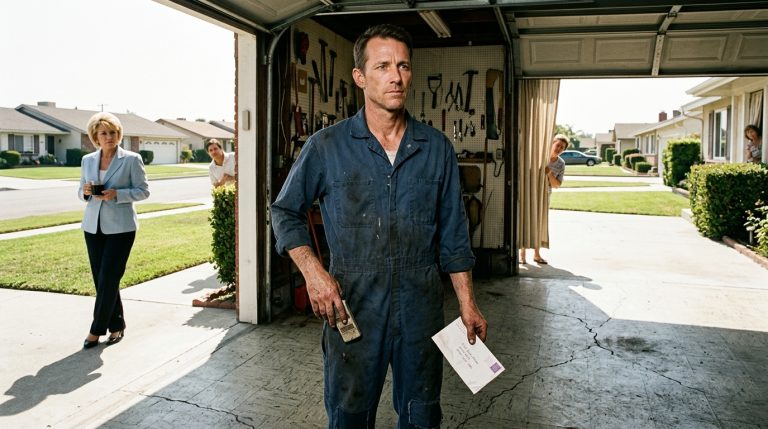
The envelope sitting inside the gray box isn’t a seed catalog or an electric bill.
It’s thick, cream-colored linen stock with square corners that look entirely out of place next to the rusted latch.
I pull it out, my thumb catching on the heavy flap, and look at the return address stamped in neat, hurried purple ink.
Echo Vista Property Owners Association.
President Karen Gilmore.
I don’t even make it back to the porch before I tear the top open with a calloused thumb.
The paper inside smells faintly of lavender and dry-cleaner plastic, a smell that makes my jaw tighten right where an old molar cracked back in ninety-four.
The words are typed out in a clean, sans-serif font that looks like it belongs on a hospital computer screen.
Neighborly discussion, it calls it.
They want to use my bridge as a secondary community exit for the new box-houses sprouting up across the creek.
Safety and shared accessibility, they write, like my grandfather’s oak planks were poured out of public concrete for anyone with a leased SUV to bounce across.
I fold the paper twice, stiff and precise, and slide it into my flannel pocket right next to a pocketknife with a worn horn handle.
The cows down by the creek give a low, rumbling bawl, restless with the morning heat.
I look across the water at the neat rows of solar panels gleaming on the roofs of Echo Vista, flashing hard and bright against the green timber.
They think a polite letter on heavy paper turns private dirt into a driveway.
I walk back up the steps, pick up my cold coffee, and look down at the bridge where the oak meets the steel.
The letter stays in my pocket, burning a hole against my thigh like a hot coal wrapped in linen.
CHAPTER 2: CAMERAS AND CONCRETE
The aluminum sheets are thin enough to bend if you kick them hard, but they rattle loud enough in a high wind to wake the dogs three ridges over.
I tighten the last self-tapping screw into the seasoned oak of the bridge approach, the cordless driver whining before the clutch chatters against the metal.
Private property.
No trespassing.
Not a public thoroughfare.
The words are painted in heavy black block letters that I stencilled myself with a steady hand.
Across the creek, one of the Echo Vista garage doors hums open on nylon rollers, and a man in a gray fleece vest steps out to pick up his morning paper.
He stops halfway down his paved driveway, his eyes locking onto the new aluminum flashing in the morning sun.
He doesn’t wave.
He just stands there with the rolled-up gazette in his fist, watching me like I’ve put up a razor-wire fence across a church aisle.
I drop the driver into the milk crate at my feet and reach for the heavy link chain.
The shipping container sits parked dead-center at the far end of the span, its faded blue corrugated steel baking under the rising sun.
It leaves just enough clearance on the left side for my farm truck’s dual wheels to squeeze past by a finger’s width, and not an inch more.
Anything wider than a standard pickup hits iron and stops cold.
Behind me, in the utility room off the back porch, the small monitor screen glows in the dim light, cycling through the four new lenses I bolted to the cedar eaves yesterday.
Motion sensors sweep the timberline, and the hard-drive hums a steady, low bass note as it records every rustle in the brush.
Dale called last night from his office in town, his voice rattling over the landline like dry beans in a tin cup.
He told me to keep the cameras rolling, every minute of every hour, because people who write linen letters don’t stop when you tell them no once.
They just change the stationery.
The man in the gray fleece across the creek turns on his heel and marches back inside his house, letting the heavy insulated door swing shut with a hollow thud.
I pull the padlock through the heavy steel eye of the chain, click the shackle home, and pocket the brass key.
The bridge is locked down tight, but the air feels too still, like the heavy sulfur smell hanging in the timber right before a summer squall cracks open the sky.
CHAPTER 3: THE TWENTYTHREE MINUTE WAR
The coffee mug shatters against the linoleum floor, spraying dark drops across my boots as Catherine clutches the counter with both hands, pale as unpainted drywall.
Her left arm hangs heavy, her breathing coming in ragged, shallow hitches that tell me everything I need to know without a doctor standing in the room.
I don’t waste breath asking questions; I reach the landline, punch three digits, and bark our coordinates to a dispatcher whose voice sounds miles away through the static.
Twenty-three minutes, the voice says.
I wrap my arm around Catherine’s waist, feeling the cold sweat soaking through her flannel shirt, and lead her out to the porch steps where the autumn air hits her face like cold water.
We sit there counting heartbeats against the slow tick of the kitchen clock, waiting for the wail of a siren to wind its way up the valley gravel.
The siren hits the lower pasture at minute twenty-one, screaming loud and hard before it abruptly chokes dead against the timberline.
Not a fade—a flat, ugly stop that leaves only the crickets and the wind in the pines.
I ease Catherine down against the porch post, tell her to hold tight, and break into a flat-out run down the slope toward the creek bridge.
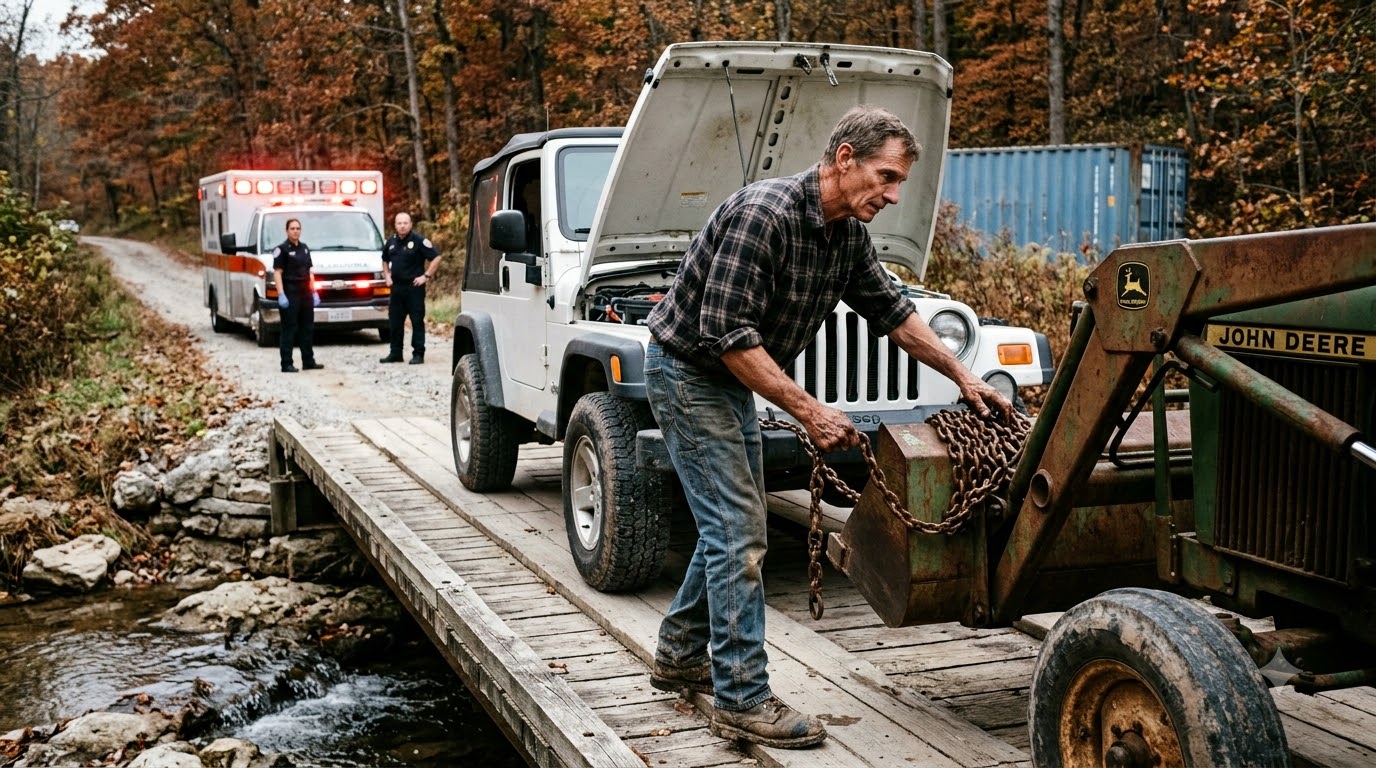
A white Jeep sits parked sideways right across the oak planks, its hood up, hazard lights blinking amber against the afternoon glare, and across the windshield someone has slashed black grease-pencil words: Call me.
Forty feet back down the approach, the ambulance idles with its red beacons spinning uselessly against the leaves.
One of the paramedics stands by his open door, shaking his head and staring at the barricade like a man trying to solve a puzzle with missing pieces.
My wife is sweating on my porch, and every second bleeding off that clock feels like a heavy fist to my chest.
I don’t bother looking for a key, and I don’t waste time shouting across the water.
I turn my back on the blocked bridge, sprint past the rusted tractor in the high grass, and pull the starter cord until the diesel coughs blue smoke into the cold air.
The John Deere groans as I slam it into gear, a heavy steel tow chain rattling in the bucket behind me as I back right up to the fender of the white Jeep.
I loop the chain around the axle myself, my fingers clumsy with adrenaline, and hook the links tight.
The tractor engine roars, throwing gravel and dirt up against the cedar rails as the clutch engages with a sharp, metallic bite.
The Jeep screams as metal grinds against metal, its tires sliding four inches before the suspension catches and tears.
I drop the bucket, throw my weight forward against the steering wheel, and pull until the frame twists.
The vehicle teeters on the edge of the limestone shelf for half a heartbeat, its tires spinning uselessly in empty air.
Then it drops sideways off the drop-off, hitting the creek rocks below with a dull, sickening crunch that vibrates straight up through the steering column.
The hazard lights flash twice more underwater before the wiring shorts out in a fizz of gray smoke.
The bridge deck is clear, and the ambulance tires roll forward over the oak planks before the dust even settles.
The paramedics are running with their kit before the vehicle stops rolling, but my hands are still shaking hard on the tractor throttle.
CHAPTER 4: THE COURTROOM PAPER TIGER
The courthouse air smells like floor wax and decades of burnt coffee trapped behind limestone walls.
Karen sits three rows up at the plaintiff’s table, wearing a cream wool blazer and pearl earrings that catch the fluorescent glare like small, hard teeth.
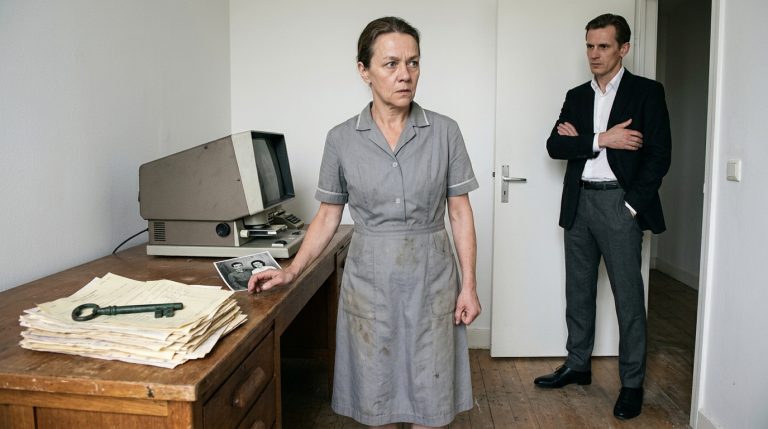
Her attorney stands, clearing his throat with a dry, theatrical rasp, and pulls a crisp, yellowed document from a leather folio.
This is the historic easement survey from 1968, your honor—he says, his voice sliding across the room like oil on gravel—proving public right-of-way access across the defendant’s parcel.
The judge takes the paper, his glasses slipping down the bridge of a nose that has seen ten thousand neighborhood squabbles and believed about three of them.
I feel a cold knot tighten right behind my ribs, knowing every official deed map from the county vault is locked out of our hands today.
Dale doesn’t blink; he leans over the varnished rail and asks the bench for a formal forensic review of the document’s physical stock.
The clerk carries the yellowed map back to the high desk under the fluorescent tubes while the ceiling fan hums a slow, rhythmic drone.
Karen turns her head half an inch, her jaw tight and a single bead of sweat tracking down her makeup right beside her left ear.
The judge squints down at the page, turning it over to inspect the watermark against the overhead light.
That map looks old, but the fibers don’t match fifty years of storage—he mutters, tossing the paper onto the blotter.
In fact, the font spacing and the laser stock paper belong to a desktop printer model manufactured right around the turn of this century.
A sharp murmur ripples through the wooden benches behind us like dry wind through corn husks.
Karen’s attorney drops his pen against the blotter with a hollow, plastic click that stops the room cold.
CHAPTER 5: THE COLLAPSE OF LEVERAGE
Karen stands up so fast her leather portfolio slides off the defense table and spills a stack of clean-printed notes across the linoleum.
This court is biased—she snaps, her voice cracking right at the edge of a shriek as the judge lifts a heavy white brow.
That document came from proper community archives, and we have every right to—she starts, but the judge holds up one thick palm to shut the room down.
Mrs. Gilmore, you submitted a digitally drafted exhibit on modern laser paper with a fabricated seal and tried to pass it off as a half-century-old county record—the judge says, his voice flat and hard as an anvil.
That isn’t a civil dispute anymore; that’s obstruction of justice and falsifying legal instruments.
Dale shifts his weight beside me, his thumb hooked in his belt loop as he watches Karen’s pristine pearl necklace rise and fall against a chest that’s suddenly moving too fast.
She doesn’t sit down, and she doesn’t apologize; she just turns her glare toward me with a look so cold it could freeze well water in July.
You haven’t won anything—she spits out, leaning over the partition with her fingernails digging hard into the varnished mahogany.
Her attorney is already gathering his papers into his briefcase with frantic, jerky motions, refusing to look her in the eye.
The county prosecutor leans over from the front bench, sliding a new folder across the partition with a quiet scrape of manila against wood.
Obstruction of emergency services, criminal trespass with intent, and document fraud carry heavy penalties in this district, Mrs. Gilmore—the prosecutor says softly.
Karen’s hands start to tremble, a fine, involuntary twitch in her fingers that she tries to hide by clutching her blazer lapel.
She refuses to yield an inch, her chin tilted up even as the bailiff steps two paces closer to the aisle.
Take a plea or face the docket on all four counts—the judge snaps, dropping his gavel with a dry, wooden crack that shakes the dust off the overhead lamps.
Karen slams her briefcase shut so hard the metal latch bites her thumb, leaving a thin, red crescent of skin before she storms up the aisle without a word.
CHAPTER 6: THE NEW NORMAL
Six new concrete footings sit deep in the creek bank, reinforced with inch-thick rebar that grips the limestone bed like clenched fingers.
I drop the heavy steel bollard into its sleeve at the bridge entrance and lock the brass padlock with a firm, solid click that echoes off the cedar rails.
The county recorder’s paperwork sits on the kitchen table inside, officially designating the span as a strategic private access point protected by ironclad physical signage.
Echo Vista changed its tune before the ink on Karen’s probation papers even dried, trading linen envelopes and morning stares for high hedges and online meetings.
Catherine sits on the porch swing now with her sketchbook open, washing watercolors across heavy paper until the landscape turns into a wash of stormy blues and silent green timber.
Her brush strokes move slow and steady, capturing the rusted tractor parked by the barn like an old sentinel that stood its ground when the valley got loud.
I step up the porch stairs, my boots clearing the grit off the bottom board, and sink back into the bolted lawn chair with a cold glass of well water.
The wind pushes through the pines up on the ridge, rattling the tin roof just enough to let you know the house is settling for the evening.
Down by the creek, the water slides over the limestone rocks with a clean, unbothered hiss, leaving only tiny bits of old plastic wedged deep between the gray stones.
There are no more letters in the mailbox, no more law firms testing the edges of the cedar fence, and no more strangers measuring our dirt with corporate clipboards.
Ownership isn’t just ink on a court order or a line drawn on an old map when the world is looking the other way.
It’s the weight of the steel in your hands, the cameras blinking red in the dusk, and the quiet comfort of knowing your boundary is yours to keep.
I take a long pull from the glass, wiping the condensation off the rim with my thumb, and watch the sun drop behind the timberline until the valley turns to shadow.
The porch light flickers on automatically against the dusk, burning steady and bright for anyone with sense enough to stay on their own side of the creek.