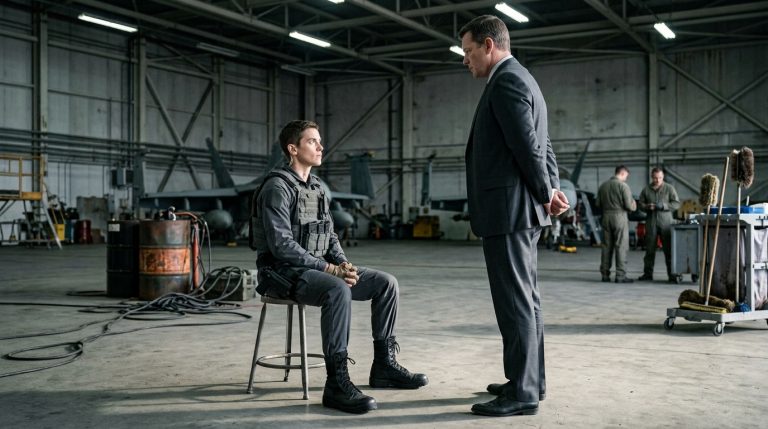
The Frozen Iron: How a Spent Casing and Unyielding Grit Outlasted an Empire
CHAPTER 1: THE FOURMILE DROP
The intercom went dead with a metallic pop that tasted like copper on the back of Eugene Moran’s tongue.
At 20,000 feet, the air inside the tail section of Ricky Tickabi was minus forty degrees, but the sweat inside Moran’s flight suit was burning hot. Flak didn’t sound like thunder up here. It sounded like gravel hitting a tin roof at two hundred miles an hour.
Crack. Crack-crack.
Then the world split in two.
A deafening roar ripped through the oxygen line as a direct hit severed the fuselage behind the radio compartment. Moran felt a violent, stomach-churning lurch as gravity dropped out from underneath his boots. The forward three-quarters of the B-17 vanished into a fireball of aviation fuel and torn aluminum, taking eight men with it into the gray cloud deck above Bremen.
Moran didn’t scream. There was no air left in his lungs to make a sound.
He gripped the twin handles of his .50-caliber Brownings until his knuckles turned white inside his heavy leather gloves. The tail section was falling, but it wasn’t tumbling like a brick. The 13-foot vertical fin and the wide horizontal stabilizers caught the freezing slipstream, forcing the severed tail into a steep, sickening spiral glide.
The altimeter dial on the wrecked panel in front of him spun backward like a broken clock.
18,000.
15,000.
Centrifugal force slammed Moran against the curved metal bulkhead. The skin of his skull rattled against the iron gunsight mount as the tail spun. Blood, hot and sticky, ran down from a split across his hairline, freezing instantly into red crust over his left eyelid.
Through the shattered Plexiglas tail cone, a Messerschmitt Bf 109 swooped past, its pilot banking hard, canopy reflecting the pale winter sun. The German pilot was checking for survivors.
Moran didn’t think about his home in Soldiers Grove, Wisconsin. He didn’t think about his mother’s Sunday pot roast or the cold waters of the Kickapoo River. He leaned his head against the cold steel of the spade grips, lined up the yellow-painted nose of the fighter through the frost-rimmed sight, and squeezed the manual triggers.
THUM-THUM-THUM-THUM.
Spent brass casings rained down, clattering off his leather boots. The heavy vibrations rattled through his jaw, popping two gold fillings straight out of his teeth from the sheer harmonic shudder. Tracers arced through the freezing sky, snapping close enough to the Messerschmitt’s wing root to force the German pilot to dive away in sheer disbelief. A severed tail was shooting back.
10,000.
6,000.
3,000.
The air grew thick, heavy, and wet. The flat gray farmland south of Bremen rushed up to meet him, transforming from a distant patchwork quilt into a terrifying wall of dark green pine needles.
“Brace,” Moran grunted to the empty, freezing metal.
He jammed his elbows against the ribs of the aluminum fuselage, wedged his knees against the ammo boxes, and dug his heels into the deck plates.
1,000.
The top of the German forest didn’t welcome the tail section; it fought it.
The vertical stabilizer struck a eighty-foot pine trunk with the sound of a cannon shot. The entire tail assembly cartwheeled horizontally, snapping thick branches like wooden matches. The deceleration threw Moran forward. His forearms slammed against the twin steel receivers of the Brownings with a sickening, wet crack. The bones in both arms sheared at fifteen-degree angles, the blinding white pain instantly swallowing his vision.
Aluminum skin tore away in long, screaming ribbons. Tree limbs punched through the thin metal, smashing into his chest, fracturing six ribs in a single, brutal compression.
Then came the final ground impact.
The lower tail skid dug into three feet of frozen mud and rotting pine needles, plowing a fifty-yard trench through the undergrowth before coming to a dead stop against a massive oak.
Silence fell over the German forest, heavy and suffocating, broken only by the hiss of hot hydraulic fluid dripping onto the snow.
Moran lay crumpled in the dark corner of the crushed tail, his face pressed into frozen mud. He tried to move his hands to wipe the blood from his eyes, but his forearms were dead weight—bent unnaturally between his wrists and elbows.
His chest burned with every shallow, ragged breath. But under his left heel, wedged deep inside the torn leather lining of his boot, his toes felt the hard, small cylinder of a spent .50-caliber brass casing he’d picked up off the hangar floor back in Snetterton.
He was still breathing.
CHAPTER 2: THE FOREST FLOOR THE FIRST ASSESSMENT
He didn’t move. Moving meant letting the broken bones in his forearms grind together like gravel in a tin cup.
The mud beneath him was half-frozen, sucking the residual heat from his cheek. Above him, the splintered skeleton of the pine canopy creaked in the sharp wind.
Two pairs of heavy wool trousers stopped inches from the twisted aluminum skirt of the tail section. German field boots, scuffed and caked with gray mud, shifted weight.
A guttural voice snapped an order in rapid, harsh German. A second voice grunted a tired reply.
They weren’t elite SS units looking for glory. They were local territorial defense guards—older men with pinched, gray faces, carrying standard Kar98k rifles more out of bureaucratic habit than genuine enthusiasm. They expected a corpse, not a breathing animal.
Moran let his eyelids droop half-mast, filtering his vision through a fringe of frozen eyelashes and dried blood.
His right hand was entirely unresponsive, locked at an awkward, unnatural tilt. But his left foot, wedged deep inside the torn leather of his boot, pressed upward against the small, hard cylinder of the brass .50-caliber casing. His thumbnail had notched three small marks into the rim back at Snetterton. It was his only anchor against the spinning void he had just survived.
Then came the anomaly.
Amidst the rhythmic shifting of the guards’ boots, something else hit the pine needles with a heavy, flat clack. Not a cartridge clip. Not a trench tool.
It was a small, rusted tin box, dropped carelessly near the edge of the wreckage, leaking the pungent, bitter smell of ersatz chicory coffee. Civilians hadn’t been near this sector. The nearest labor camp was five miles west.
One of the guards kicked the aluminum frame with a dull thud.
“Nicht hier,” the first guard muttered, his voice flat with exhaustion. “Kein Leben.”
They didn’t want to dig through the wreckage. They wanted to log the tail, report the coordinates to the garrison in Bremen, and get back to a stove before frostbite set in.
Moran waited, his breathing shallow, forcing his cracked ribs to slide past each other with minimal friction. Every second of silence cost him physical energy, but every second kept him off a stretcher bound for a basement interrogation room.
The guards turned on their heels. The crunch of their boots faded slowly into the dense pine woods, leaving behind only the dripping of melting frost and the smell of torn bark.
He was alive. But he was deep inside hostile territory with no weapon, shattered arms, and no friendly army within a hundred miles.
He had to get his boots off before his feet swelled entirely shut inside the frozen leather.
Using his teeth, Moran gripped the zipper of his survival vest, yanking downward with a sharp jerk that pulled at his torn chest muscles. He had no plan, no map, and no backup. There was only the cold dirt, the ticking clock of the winter afternoon, and the stubborn refusal to die in a German ditch.
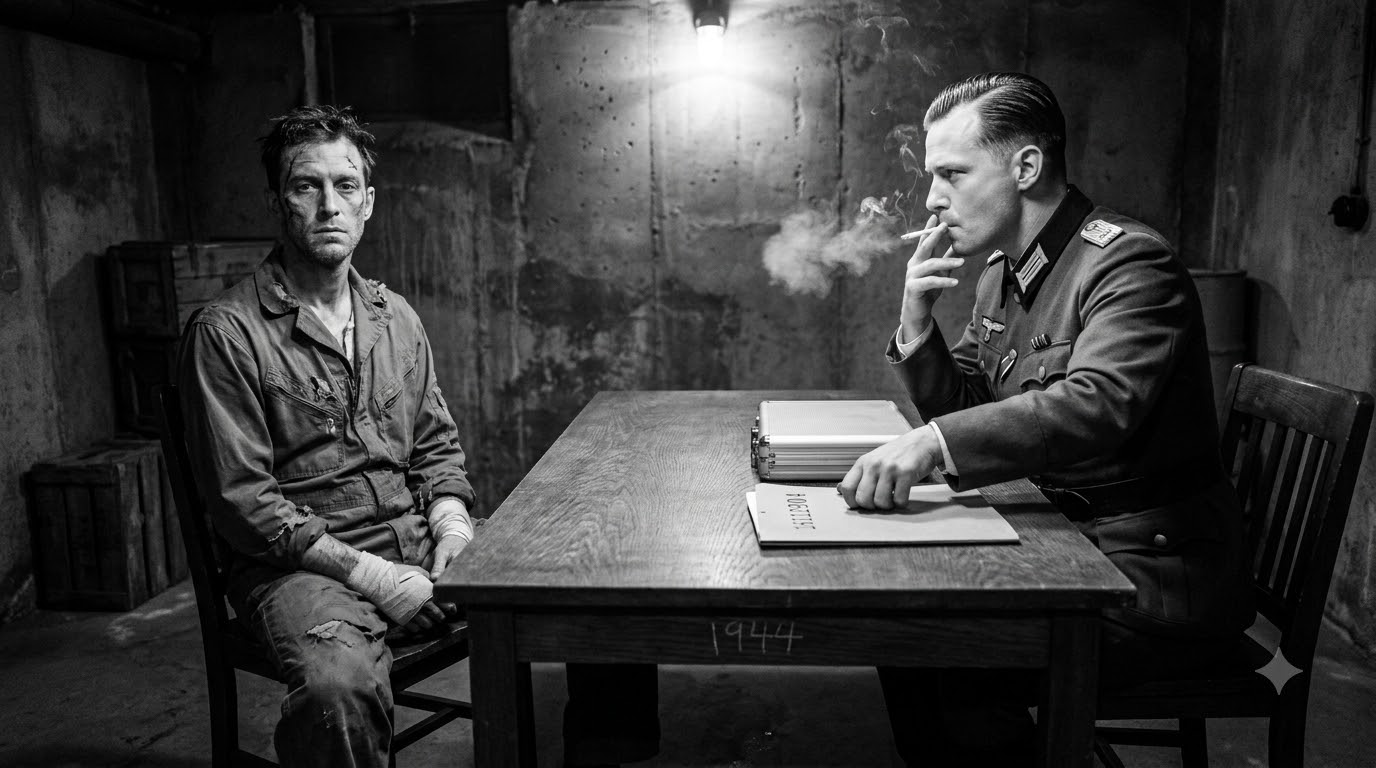
CHAPTER 3: THE COLD ROOM INTERROGATION
The basement room in the Bremen garrison smelled of damp concrete and coal smoke.
Moran sat on a straight-backed wooden chair, his swollen forearms resting uselessly in his lap, held together by coarse burlap strips the field medic had slapped on three days ago. Across the bare oak table stood Captain Voss, a intelligence officer with crisp gray lapels and an unblemished leather holster.
Voss didn’t look like a man who spent his afternoons in mud trenches. His hair was slicked back with lavender-scented pomade, and his hands were smooth—unmarred by grease or labor.
“Let us drop the peasant act, Sergeant,” Voss said. His English was precise, clipped at the edges with soft Bavarian vowels. “A tail section does not glide four miles down through flak batteries unless it is stabilized by mechanical intervention.”
Moran kept his spine pressed against the hard wooden slats. His cracked ribs throbbed in time with his heartbeat, each pulse sending a cold spike of pain straight into his lower back.
“Eugene Paul Moran,” he said, his voice dry and flat as sawdust. “Staff Sergeant. 16112904.”
Voss leaned forward, resting both palms flat on the cold oak table. “You carry a tracking apparatus. An experimental gyroscopic flight recorder embedded in the tail assembly. Tell me how to activate the frequency signal, or you will not see a prisoner-of-war camp. You will be handed directly to the Security Service as a commando.”
Moran didn’t blink. He knew the truth about the tail—the massive 13-foot vertical stabilizer had acted as a simple rudder, and the heavy ammo boxes in the tail had balanced the center of gravity just enough to turn a fatal plummet into a gliding spin. It was an engineering fluke. A fluke born of luck and drafty metal.
But Voss couldn’t accept that. To an officer steeped in military order, a simple fluke felt like an insult to German precision.
With his left boot, Moran subtlely pressed his heel against the leg of his chair, feeling the hard, notched cylinder of the .50-caliber brass casing shift against his ankle lining. He used the sharp pressure against his skin to hold his face completely expressionless.
“Name, rank, serial number,” Moran grunted.
“Your persistence is not bravery; it is stupidity,” Voss snapped. He tapped a manicured fingernail against an official manila folder on the table. “You think your air fleet will save you? You think an army is coming to pull you out of this room? There are no Allied rescue columns here, Sergeant. There is only this basement.”
Voss pulled a silver cigarette case from his tunic, snapping it open with a sharp, arrogant flick of his wrist. He didn’t offer one. He lit his smoke, blowing a thin stream of gray haze straight across the table into Moran’s eyes.
“Give me the activation code for the tracking beacon,” Voss said, leaning in so close Moran could smell the stale coffee on his breath. “Or we leave you in this cellar until the damp finishes what the trees started.”
Moran slowly lifted his head. He let the blood-caked hair fall away from his forehead, exposing the jagged, purple scar running across his crushed skull. He met the captain’s eyes with the weary, unbothered gaze of a Wisconsin farm hand looking at a stubborn mule.
“You want a code, Captain?” Moran rasped.
Voss paused, his silver lighter hovering half an inch from his chin, his eyes flashing with sudden, greedy expectation.
“16112904,” Moran said softly. “Staff Sergeant. Eugene Paul.”
Voss’s face darkened, the polite composure cracking into cold, arrogant fury. He slammed his silver case onto the table, the sharp metal clatter ringing against the concrete walls like a gunshot.
CHAPTER 4: THE 600MILE MARCH OF FROZEN IRON
The evacuation column stretched three miles along the rutted, ice-slicked road leading east toward Spremberg.
Fifteen degrees below zero. The air didn’t just smell like winter; it felt like powdered glass sliding into Moran’s lungs with every shallow breath.
Ten thousand Allied airmen marched in four-abreast columns, flanked by armed guards wearing heavy gray wool overcoats and carrying Slung MP-40 submachine guns. Anyone who fell behind by more than ten paces was left in the ditch. The guards didn’t waste rifle rounds; the frost took care of the rest within twenty minutes.
Moran walked with his head down, his shoulders hunched inside his torn flannel shirt and a single threadbare blanket.
His broken forearms, fused at awkward fifteen-degree angles inside filthy burlap splints, throbbed with a dull, sickening ache that matched the rhythm of his steps. Every time his left boot struck the frozen dirt, his toes pressed against the small cylinder of the .50-caliber brass casing tucked in his lining.
Step. Press. Step. Press.
It was a rhythm. A mechanical, unyielding cadence that kept his mind off the raw, oozing blisters bursting inside his socks.
Beside him, an American bombardier from Ohio stumbled, his knees buckling under the weight of a waterlogged woolen coat. The man’s face was gray, his lips split and bleeding from severe frostbite.
“Keep your boots moving, son,” Moran growled softly out of the side of his mouth, not turning his head.
“Can’t…” the bombardier gasped, his eyes glazed over with delirium. “Feet… I can’t feel my heels, Sarge.”
“You don’t need to feel ’em,” Moran said, his voice flat and steady as a fence post. “You just need to put one in front of the other. Lean on my shoulder. Do it now.”
The young man dragged his weight onto Moran’s left side, the sudden impact tearing a sharp, silent spasm of pain through Moran’s fractured ribs. Moran didn’t flinch. He adjusted his stance, dug his frozen boots deeper into the snow, and kept the cadence going.
Behind them, a guard yelled a sharp command, the bolt of a Mauser rifle snapping shut with a cold, metallic threat.
Moran didn’t look back. He didn’t ask for help from the guards, and he didn’t expect a column of American tanks to roll over the hill to break the line. There was no army coming to carry him. There was only the road, the cold, and the stubborn weight of his own two feet.
Layer 1 was breaking behind them—the myth of the secret tracking code had dissolved in the fires of Bremen, leaving Voss and his interrogators chasing imaginary ghosts while the German front collapsed under its own weight. All that remained was the raw, unvarnished reality of survival.
Moran dragged the bombardier through another two miles of dark pine woods as the blizzard deepened, his thumb secretly pressing through his pocket to trace the notched edge of his brass casing. He was going to walk until the road ran out.
CHAPTER 5: THE BITTERFELD FACTORY SIEGE
The guards were gone.
They had unlocked the heavy iron gates at dawn, dropped their keys into the mud, and vanished into the treeline, leaving three hundred skeletal men trapped inside the ruined machine shop without rations or medics.
Through the shattered factory skylights, the Western horizon flickered with orange flashes. The rumble of Allied artillery grew closer by the hour, shaking dust from the iron trusses overhead.
Near the main loading doors, a desperate group of retreating German rearguards—three boys in oversized helmets clutching panzerfausts and a fanatical sergeant with a bleeding neck wound—pushed into the courtyard.
The sergeant swung his machine pistol toward the factory entrance, shouting in a cracked, furious screech. He didn’t want prisoners. He wanted shelter, fuel, and a clear line of fire to make a suicidal last stand from the upper catwalks.
Inside the dark doorway, no one moved. The men on the concrete floor were too weak to stand, their bodies drained by weeks of black bread and frozen snow.
Moran stepped out of the shadow of the heavy lathe.
He didn’t have a rifle. He didn’t have an officer’s authority or a pristine uniform. His forearms hung at twisted fifteen-degree angles inside filthy, hardened bandages, and his weight had dropped under a hundred pounds.
He slid his left boot forward, wedging the sole firmly against a thick iron crowbar jammed beneath the flywheel housing.
“This floor is full,” Moran said. His voice was quiet, raspy, and stripped of all emotion, but it carried across the silent, cavernous room like iron scraping on stone.
The sergeant jerked his weapon toward Moran’s chest, his eyes bloodshot and wild with the cornered panic of a dying empire. “Aus dem Weg! Out of the way, swine!”
“You fire that in here,” Moran said softly, nudging the iron crowbar three inches to the left with his boot heel, “you hit a line of unvented coal gas under the floorboards. We all go up together. You want to make your stand, do it in the yard.”
It was a bluff born of pure Wisconsin common sense—a plain statement delivered with the cold, unyielding certainty of a man who had already fallen four miles through the sky and survived.
The German sergeant glared at Moran, his jaw trembling, the barrel of his machine pistol shaking against the freezing air. He looked at Moran’s twisted arms, at his hollowed-out cheeks, and at the unblinking gray eyes that showed zero fear, zero compromise, and zero intention of giving an inch.
For five agonizing seconds, the only sound was the distant thrum-thrum of heavy artillery shaking the concrete floor.
The sergeant spat into the dirt, cursed under his breath, and backed out into the courtyard, dragging his young soldiers with him into the rain.
Moran didn’t cheer. He didn’t raise his voice. He leaned his shoulder against the cold iron of the flywheel, reached down into his boot lining with his stiff fingers, and felt the notched brass edge of his .50-caliber casing.
The threat in the yard was moving on. The collapse was complete.
CHAPTER 6: THE QUIET PORCH IN SOLDIERS GROVE
The air in the valley smelled of damp clover, pine bark, and fresh-turned earth.
No sirens. No artillery thumping three miles out. No jackboots crunching on frozen pine needles.
Moran rested his elbows on his knees. His forearms, fused at those strange, crooked fifteen-degree angles, looked awkward to anyone watching from the road, but they held the coffee cup steady.
On the small wooden side table next to his chair sat the dented, brass .50-caliber shell casing. The three notch marks his thumbnail had carved into the rim back at Snetterton were smoothed down by decades of handling, but the hard metal remained unchanged.
The grand illusions of the war were long gone. Layer 1—the imaginary Allied tracking devices, the elaborate military conspiracies the interrogators obsessed over—had crumbled into dust along with the interrogators themselves.
Layer 2 stood clear and unvarnished in the morning light: a nineteen-year-old farm boy had fallen four miles inside a severed tail section simply because thirteen feet of vertical fin and heavy brass ammo boxes created a fluke of balance in the sky. It wasn’t magic, and it wasn’t a military secret. It was simple balance, raw luck, and a stubborn refusal to let go of the grips.
When the military bureaucracy had tried to lock him into hospital wards and endless medical evaluations after his return, Moran had simply walked away. He hadn’t asked for pension adjustments or formal parades. He came back to the farm, picked up a hammer with his twisted hands, and went to work.
His wife, Helen, stepped out onto the porch, the screen door closing with a soft, familiar thump-snap. She set a small plate of warm biscuits on the table beside the shell casing without a word. She didn’t ask about Bremen, Stalag Luft 3, or the road to Bitterfeld. She didn’t need to.
Moran took a slow sip of the hot coffee, letting the heat settle in his chest.
The frostbite in his feet still ache on cold winter nights, and his fractured ribs still remembered the hit against the gunsight. But the threat was entirely gone. The empire that tried to break him had collapsed into ash, while he sat on his own porch, on his own land, surrounded by the quiet green hills of Wisconsin.
He set his coffee cup down, rolled the spent brass casing once between his scarred fingers, and leaned back against the warm wooden wall of his home.
He had survived the fall. He had survived the march. And now, he enjoyed the peace he had earned.