Subdivision President Pours Concrete Over Rancher’s Driveway Until Old Mineral Deed Breaks Her Project
CHAPTER 1: THE SCRAPED BOUNDARY
The front left tire of the flatbed dropped three inches into fresh, wet marl where hard gravel had sat since dawn. Brett Callahan let the clutch out slow, listening to the dry rattle of loose iron in the bed before the engine lugged down and quit against a five-foot berm of raw subsoil dumped across his fence gap.
Dust from a tracked excavator drifted through his open window, tasting like powdered lime and diesel soot.
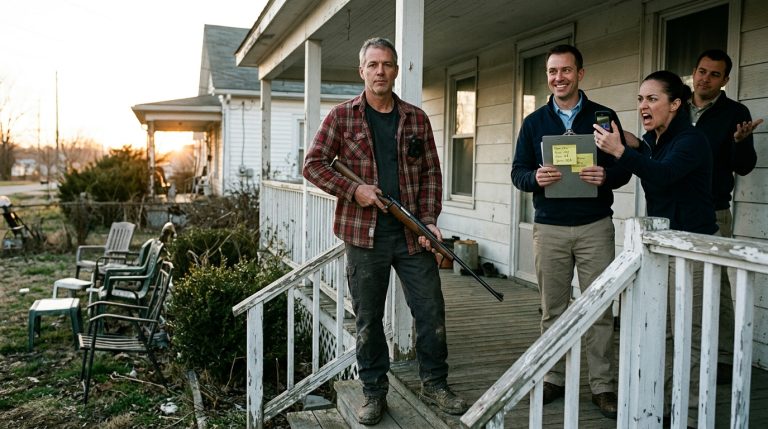
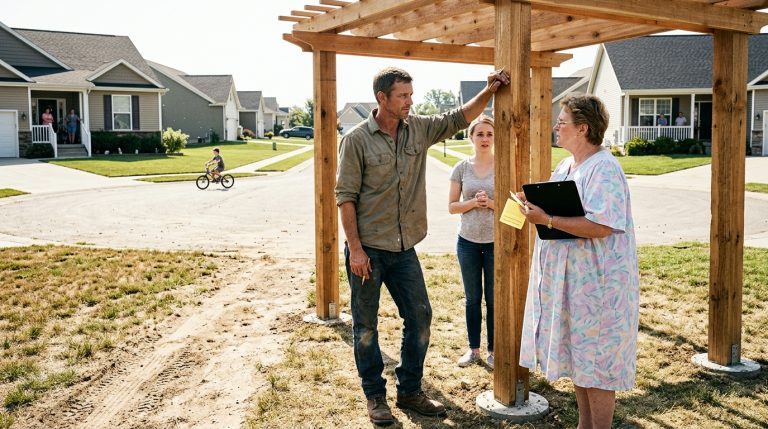
A yellow trenching bucket hung six feet above the ground, its steel teeth shiny from chewing through topsoil. Beyond the tooth marks, two men in orange vests were driving green steel T-posts straight into the shoulder of his access track. Standing between them with a clipboard tucked under one arm was Mara Whitam. Her windbreaker had the Stonegate Ridge logo embroidered in white thread over the pocket, spotless despite the wind rolling off the pasture.
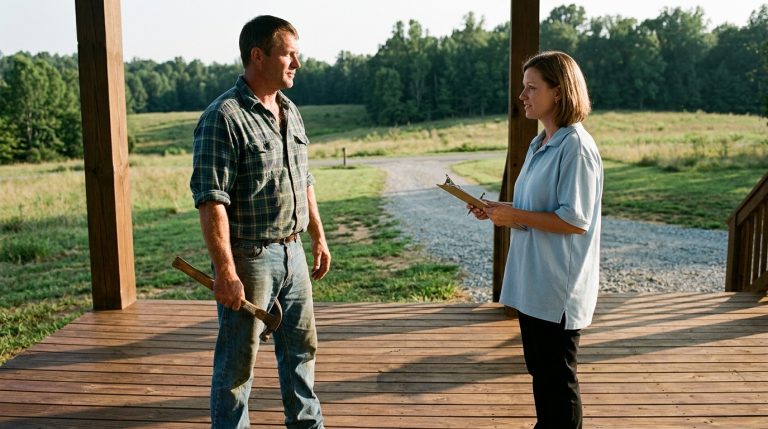
Brett shut off the ignition, pulled the handbrake until the cable clicked tight, and stepped down into the dust. His boots hit the dry clay with a dull thud. He didn’t slam the door. He walked to the edge of the berm, pulling a shop rag from his hip pocket to wipe grease from between two knuckles.
“Road’s closed, Brett,” Mara said. She didn’t shout. Her voice had the flat, practiced rhythm of someone chairing a budget committee on a Tuesday night. “Survey crews finished at four. Everything west of the cedar line belongs to the association parcel now.”
Brett looked past her shoulder. Thirty yards back, where the open pasture used to roll toward the creek bed, two bulldozers had stripped six inches of turf down to gray stone. An orange banner flapped along temporary chain-link fence panels. In the middle of his turnaround circle, a fresh sheet of sign aluminum was bolted to a treated four-by-four: Private Association Property. No Trespassing. No Exceptions.
“Turnaround’s on my deed map,” Brett said.
“Old map,” Mara said. She tapped the clipboard against her hip. “The developer bought the lot outright on Friday. Closed at nine this morning. We’ve got a four-point-eight million dollar recreation center going up right here. Fitness wing, board room, seventy-two parking stalls.” She stepped closer to the wire fence, pointing down at the ditch where loose shale was already sliding toward his cattle gate. “You’ve been using this easement on good faith. Good faith ends when real money comes in.”
She held out a white folder across the top wire.
Brett didn’t reach for it. He kept his thumbs hooked in his belt. “What’s that?”
“Conditional access agreement,” she said, letting her arm hang there. “The board approved it yesterday. You sign an agreement recognizing Stonegate Ridge’s authority over the access corridor, agree to maintain the ditch line to our architectural standard, and we leave you an eight-foot lane along the north retaining wall. Otherwise, you can cut a new gate out to the state route through your own pasture.”
“State route’s got a four-foot culvert and an eight-percent grade,” Brett said. “Can’t haul cattle out that way without rolling a trailer.”
“Then you should probably sign the paper,” Mara said. A small, dry smile touched the corners of her mouth. “Your family lived on an island out here for forty years because nobody owned the ditch. Now we own it.”
A gust of wind caught the edge of the berm, blowing pale powder across the radiator of his truck. Down in the excavation pit, the diesel engine of a drilling rig kicked on with a heavy, rhythmic thump, vibrating through the soles of Brett’s boots. The drill bit bit into the rock shelf fifteen yards away, screamed against something hard, and shuddered to a dead stop. The operator cut the throttle, cursing loud over the idling engine.
Brett looked at the drill rig, then down at the white folder still hovering between them in the cold wind. He didn’t take it.
“Did your board check the county books before you closed?” Brett asked.
Mara dropped the folder back against her chest, letting out a short breath that was half a laugh. “We used a commercial title firm out of the capital, Brett. We don’t rely on grease-pencil notes from a barn drawer.”
Brett turned back toward his truck without another word. He climbed inside, turned the key, and backed the flatbed down the single-lane dirt road in reverse, leaving Mara standing alone by the fresh dirt.
CHAPTER 2: CORE AND IRON
Five hours after the drill bit broke on the ridge, the diesel clatter across the fence finally died, leaving the smell of scorched hydraulic oil hanging over the pasture. Brett wiped a streak of yellow primer from his forearm, stepped into the dark machine shed, and jammed a flathead screwdriver under the rusted latch of his father’s two-drawer filing cabinet.
The steel popped with a sharp crack that scattered dry dirt dauber nests across the concrete floor.
Inside, green hanging folders leaned forward under three decades of humidity, the cardstock swollen and soft like felt. Brett flipped past tractor receipts, dead heifer registration forms, and handwritten hay yields from summers he could barely remember. Near the bottom, where damp had rusted the wire rails, sat an unlabelled accordion file bound with a rotted rubber band that snapped the second he touched it.
He spread the papers across an oak workbench under the bare bulb.
The top sheet was an aerial plat from 1951, drawn on linen-backed butcher paper with red wax pencil. A red line cut straight through the center of what was now the Stonegate Ridge construction site, bisecting the low saddle where Mara’s crew had spent the day chewing dirt. In the margin, in his father’s heavy, block handwriting, sat four words: Mineral Tract B. Reserved.
Brett picked up the folder, walked out the side door, and cut across the lower paddock.
The wind had dropped with the sun. Across the wire fence, the construction site sat deserted under a battery-powered floodlight trailer that hummed with a loose belt. The excavation was twelve feet deep in the center, cut into the bench where Tully planned the clubhouse foundation. Piled high on the spoil bank was a heap of pale, chalky stone that hadn’t been there at noon.
Brett crouched by the property post, reached through the lower strands of barbwire, and picked up a chunk the size of a hay brick.
The rock was cold, dense, and fractured in clean, sharp rhomboids rather than the crumbly sandstone common on the ridge surface. He scraped a thumbnail across the fracture. It didn’t powder; it bit clean into the horn of his nail. It was high-grade dolomitic limestone, the deep seam his grandfather had refused to lease to the highway contractor back in the seventies.
A shadow broke the glare of the light trailer.
Mason Reic, the site foreman, was locking the tool trailer with a heavy brass padlock. He saw Brett by the wire, hesitated, then stepped over an unrolled spool of silt fabric to walk to the fence line.
“Can’t have you taking spoil off the site, Callahan,” Mason said. His boots were caked three inches thick with dry gray slurry. “Mara’s got three game cameras pointed at this corridor. She sees you touch the rock, she calls the county sheriff for theft of building materials.”
“Your auger sheared on it,” Brett said, setting the stone on a cedar post on his side of the wire.
“Dulled two tungsten heads in ninety minutes,” Mason said. He pulled a pack of tobacco from his vest, looked around the empty cut, and didn’t light it. “Poured three thousand gallons of water down the hole trying to cool the head. Hit solid bench rock at eleven feet. That whole foundation plan is engineered for shale. If we can’t drive piles through this shelf, Tully’s got to blast, and county won’t permit blasting within two hundred yards of a gas main.”
“You tell her that?”
“She told me to bring in an air hammer at seven tomorrow morning,” Mason said, turning his back to the wind. “She’s got a completion milestone tied to the first floor joists. She don’t care if we burn ten thousand dollars in bits to hit it.”
Brett pulled his phone from his pocket, angled the lens under the spill of the floodlight, and took three clean shots of the stone pile, the sheared drill bit lying in the mud, and the orange boundary stake driven four inches over his survey line.
“Appreciate the time, Mason.”
“Didn’t talk to you,” Mason said, and walked back toward his pickup.
Brett walked up to the house, boots scraping on the porch step. He dropped the chunk of gray limestone onto the kitchen table, dialed Laurel Brackett’s direct line, and didn’t sit down.
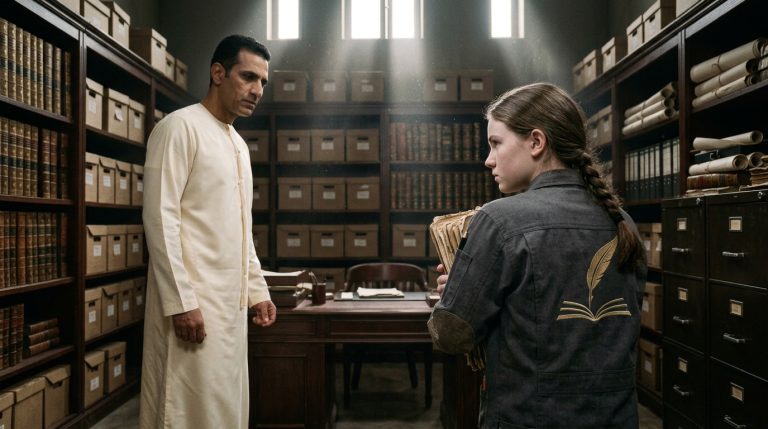
“Laurel,” he said when the line clicked open. “Find Wesley Pritchard. Tell him I need forty years of severance deeds out of the county basement by breakfast.”
CHAPTER 3: THE COLD INJUNCTION
By six the next morning, four heavy barrel mixers were already idling in line along the gravel grade, their diesel exhausts blowing gray ribbons across the frosty pasture. Brett stood thirty feet back from the surveyor’s orange stake, his boots caked in wet rye grass, holding a manila envelope with Laurel’s office seal stamped across the flap.
Mara Whitam was already out of her SUV. She wore rubber slip-ons over her shoes and carried a clip-board with a yellow site manifest. When the lead truck hissed its air brakes to back toward the trench, she swung her hand in a wide, aggressive circle.
“Guide him in, Mason!” she yelled over the engine roar. “First chute goes into the west footer! Keep the mud flowing!”
Mason Reic stood near the trench with his hands shoved deep into his canvas jacket. He looked at the churning drum, then down at the rock shelf at the bottom of the pit. He didn’t wave the truck back.
Brett walked to the barbed wire, stopped at the boundary post, and took his phone from his coat. He tapped the speaker button and held the device level.
Laurel’s voice cut through the mechanical grind, flat and dry. “The county clerk certified the 1948 mineral deed at five-fifteen this morning, Brett. Wesley pulled the book and page from the deep basement rolls. Instrument number 4412. It’s a permanent severance. Surface transferred, minerals explicitly retained for the Callahan line, including all rights to stone, limestone, dolomite, and surface access for extraction.”
Mara turned on her heel. The rubber of her shoes squeaked against the wet clay as she closed the distance to the wire. “Keep that noise on your side of the post, Callahan. I told you yesterday, your old paper doesn’t supersede a recorded warranty deed. Once that concrete hits the rebar, your access claim is moot. You want to litigate? You can sue for trespass damages after the clubhouse is framed.”
“It isn’t an access easement, Mara,” Brett said. He tapped the manila envelope against the cedar post. “It’s the mineral estate. My grandfather never sold the ground beneath eighteen feet. You bought the dirt on top. You don’t own the rock.”
Mara laughed, but her eyes snapped down to the thick packet under his hand. “Nobody mines stone in a residential zone. Current county zoning prohibits quarrying. Your lawyer knows that.”
“Zoning restricts processing, not the underlying property right,” Laurel’s voice came back over the phone, loud enough for Mason to hear from twenty feet away. “And the deed contains a negative covenant: no permanent improvements may be erected on Mineral Tract B that substantially impair access to the mineral owner without prior written consent. Graham Tully’s foundation sits square across eighty percent of the vein.”
A second mixer groaned into gear, its drum spinning heavy with ten yards of wet aggregate.
Down in the cut, Graham Tully stepped out of his field office trailer. He wasn’t wearing an association badge; he had a rolled set of blueprints under his arm and a hardhat pulled low against the cold drizzle. He walked past Mara without looking at her, stepped to the fence, and looked straight at Brett.
“You sent this to First Interstate Bank?” Graham asked.
“Ten minutes ago,” Brett said. “Laurel served the lender’s loan officer, the county recorder, and your title insurer’s regional claims desk. The bank’s title commitment lists Exception 14. They know the policy excludes unextinguished mineral estates.”
“Exception 14 was waived at closing,” Mara said sharply, her voice pitching up against the idling engines. “Our counsel reviewed it. It was cleared.”
Graham pulled a phone from his pocket as it began to buzz against his palm. He looked at the caller ID, held up a single finger toward Mara, and pressed it to his ear.
“Tully,” he said. He listened for thirty seconds, the wind whipping the loose corners of his blueprint. He didn’t argue. He didn’t raise his voice. He glanced down at the churning chute of the lead cement truck, then back up at the wire. “Understood. Freezing the draw now.”
He clicked the screen dark and turned to Mason.
“Cut the drums,” Graham said. “Kill the pump. Send the trucks back to the batch plant.”
“What are you doing?” Mara stepped directly into Tully’s path, her hands balling into fists inside her pockets. “We’re scheduled for three hundred yards today. Every truck that turns around costs this association an eight-hundred-dollar dump fee!”
“The bank just froze our second construction draw, Mara,” Graham said, his voice dropping into hard, flat utility. “Title insurance won’t indemnify the lender against a recorded reservation. If I pour one yard of mud on this trench before this exception is settled in writing, my company carries the structural liability without a funded draw. I’m not pouring your concrete on my nickel.”
The lead mixer driver cut his engine. The sudden silence left only the hiss of leaking air hoses and the steady drip of rain falling off the cold iron of the boom.
Brett slid his phone back into his coat pocket, turned his back on the line of idling trucks, and walked up the gravel rise toward his barn.
CHAPTER 4: THE ALTERED RECORD
Eighteen hours after the last mixer rolled away, the ruts left by thirty tons of turning tires had dried into jagged cement-colored troughs along the fence. Brett was scraping dried loam off a spade in the kitchen when his landline clicked, followed by the dry, hesitant throat-clearing of Damon Kesler.
“Callahan,” the treasurer said. He wasn’t speaking from an association office; there was the clatter of a domestic dishwasher running behind his voice. “I have the loan binder on my desk. The one the board voted on last November.”
Brett didn’t set the spade down. He wedged the receiver between his shoulder and ear, scraping the blade with an oily putty knife. “Talk to Laurel Brackett.”
“Laurel Brackett isn’t the one who had an excavator three feet off her cattle gate yesterday,” Damon said, his voice dropping an octave. “I’m looking at the title schedule Mara submitted for the reserve draw. Twelve pages. Page nine is missing. It skips from Schedule B-1 straight to the tax assessment.”
“Check the county recorder’s microfilm,” Brett said. “Page nine is Exception 14.”
“I did,” Damon whispered. A paper sheet rustled hard against the mouthpiece. “Exception 14 reserves all subsurface stone, dolomite, and access corridors to the Callahan estate. It was flagged by First Interstate’s closing counsel six months before we closed on the parcel.”
Brett stopped scraping. The steel edge of the knife rested against the flat iron of the shovel. “And Mara signed off on the purchase anyway.”
“She didn’t just sign off,” Damon said. The sound of a cabinet drawer opening came through the line, followed by the heavy thud of a file folder hitting timber. “She had the developer’s contract restructured under a third-party management entity. High Ridge Advisory Services. If the footer inspection cleared before the first of the month, that entity pulled a two-hundred-and-ten-thousand-dollar completion disbursement straight out of the reserve fund.”
The kitchen went dead quiet except for the hum of the refrigerator coil.
“Her firm?” Brett asked.
“Her brother’s name is on the state registration,” Damon said. “Her residential address is listed as the principal office. We authorized a one-point-six-million-dollar land acquisition based on an altered title packet. If the bank pulls the primary note because of a title failure, the association’s reserve account gets seized to cover the deficiency balance. Every homeowner in Stonegate Ridge will face a forty-thousand-dollar special assessment.”
Brett looked out the kitchen window. Across the fence, the abandoned pit sat under a sheet of standing rainwater, the exposed dolomite shelf looking like raw bone under the distant security trailer light.
“She tell the board about the fee?” Brett asked.
“She told us it was a standard site-readiness contingency required by Tully’s bonding company,” Damon said. His breathing was rapid now, thin and ragged. “She’s calling a general assembly for tomorrow night at seven. She sent an email blast to two hundred owners claiming you’re running a shakedown to put an open-pit quarry next to their backyards.”
Brett wiped the spade blade with the oily rag, turned it over, and hung it on the wall peg. “Let her talk.”
“You don’t understand these meetings, Callahan,” Damon said, his voice tight. “She’ll get eighty proxies signed by people who think their home values are about to drop thirty percent. She’ll vote an emergency litigation assessment before anyone reads the deed.”
“Bring the complete binder,” Brett said, his voice level and slow. “Not the copy she printed for the packet. The original with the clerk’s blue ink stamp on the margin.”
“She’ll claim it was an administrative oversight,” Damon said.
“Let her claim it to the people paying the bill,” Brett said, and set the receiver back into its cradle.
He walked out to his porch. The night air was sharp, carrying the bitter tang of wet limestone dust and unburned diesel fuel drifting across his pasture. He didn’t turn on the porch light. He stood in the dark, watching the red beacon on top of the stalled crane blink against the cloud cover, steady and indifferent.
CHAPTER 5: THE PUBLIC FRACTURE
Nineteen hours after Damon’s midnight call, sixty folding chairs scraped across the linoleum of the temporary recreation hall, packing the room with neighbors whose coats still smelled of wet wool and cedar mulch. Brett sat in the back row by the fire exit, his work boots tucked tight under the metal rungs, a stack of blue-stamped deeds resting across his knees.
Mara Whitam stood behind the particle-board podium under two humming fluorescent tubes. Her blazer was pressed sharp, and a stack of white proxy envelopes was neatly squared against the microphone base.
“We face an existential threat to our property values,” Mara said, her voice amplified clean through the wall speakers. “An adjacent parcel owner is attempting to revive an archaic eighty-year-old reservation to force a commercial aggregate operation directly onto our boundary line. We have eighty proxy votes ready to authorize an emergency fifty-thousand-dollar defense retainer.”
“Point of order, Madam President,” Damon Kesler said from the front table.
He didn’t stand up. He pulled a black video cable from his laptop, wiggled the connector until the projector screen on the wall hissed white, and dropped the digital image straight onto the cinder block.
The screen flickered green twice, settled, and showed a scanned title policy.
“That’s the title commitment from First Interstate Bank,” Damon said, tapping his finger against the table. “Dated six months before the board voted to spend one-point-six million on the nine-acre strip.” He dragged his cursor over a block of black text highlighted in red box outline. “Exception 14. Mineral reservation recorded 1948, Volume 88, Page 112. It specifically excludes Stonegate Ridge from owning or disturbing the limestone and dolomite layers beneath the tract.”
A murmur moved through the third row of chairs. An elderly man in an oilskin jacket leaned forward, squinting through bifocals.
“That language was reviewed by outside closing counsel,” Mara said. She didn’t look at the screen; she looked straight at the center of the crowd. “It’s boilerplate historical residue. It holds zero force under the state’s dormant mineral statute.”
“It isn’t dormant, Mara,” Damon said. He clicked to the next slide. “In 1998, Brett Callahan’s uncle filed a statutory preservation notice with the county recorder. In 2007, an active core-drill agreement was recorded by the state geological survey. The rights are unbroken. And our title company confirmed at noon today that they will not defend or indemnify us against Exception 14 because it was disclosed to you prior to closing.”
Mara’s hand clamped down on the edge of the podium, her knuckles whitening against the veneer. “The board voted unanimously to proceed with construction.”
“The board voted on an eleven-page packet,” Damon said, his voice flat and deliberate. “You pulled page nine out of the binder before you ran the copies for the November meeting. You knew the exception was active because Graham Tully sent you an email warning that the foundation crossed the tract boundary.”
The room went dead. A radiator valve clanked in the corner, hissing steam into the silence.
“That email was an informal technical assessment,” Mara said. Her voice jumped half an octave, the smooth rhythm of her presentation cracking down the middle. “We were working against a loan expiration. Relocating the foundation would’ve added a four-month delay and blown our seasonal sitework window.”
“And blown the completion bonus,” a voice called out from the second row. It was Miller, one of the newer lot owners on the north circle. He was holding a printout pulled from the Secretary of State’s corporation database. “High Ridge Advisory Services. Two hundred and ten thousand dollars payable to your brother’s LLC the day footers passed county inspection.”
Mara didn’t answer. She stared at the paper in Miller’s hand, her chest rising and falling in short, rigid jerks. For three seconds, nobody in the hall moved. The proxy envelopes on the podium slipped slightly under her wrist, exposing the blank signature lines of neighbors who hadn’t attended.
Brett stood up from the back row. He didn’t walk down the aisle; he stepped to the perimeter table where the coffee urn sat cold and laid his manila folders in a neat stack beside the sign-in sheet.
“Deed’s on the table,” Brett said, his voice cutting through the linoleum room without effort. “So is the 2007 survey. I don’t want a quarry beside my pastures any more than you want one behind your decks. I offered your board three ways to settle this before the first excavator tore up my ditch. She threw every one of them in the trash.”
Mara stepped around the podium, her finger pointing straight at Brett’s face. “You don’t have standing to speak in this hall! You aren’t an owner!”
“He isn’t,” Damon said, standing up from his chair and closing the laptop screen with a hard plastic snap. “We are. And the chair is out of order.”
Damon turned to the room, his arm raised level. “I move to suspend the president’s spending authority immediately, pending a full forensic audit of the reserve account by outside counsel.”
Four hands went up in the front row before Damon even finished the sentence. Behind them, twenty more arms rose into the fluorescent light.
Mara stood on the open linoleum, her hands empty, surrounded by the silence of her own neighborhood.
CHAPTER 6: THE UNBROKEN GROUND
Eleven weeks after the board stripped Mara’s spending authority, the last orange equipment container was winched onto an axle trailer and hauled south toward the highway. Brett stood at the open ditch where the berm had been shoveled flat, his hands resting on the cold steel collar of a manual post driver.
The temporary chain-link fence was gone. Across the nine-acre bench, the foundation trench had been backfilled with washed bank-run gravel and graded level with a road grader until the gray dolomite shelf was tucked four feet under earth again. Autumn rye was already spiking green through the packed silt.
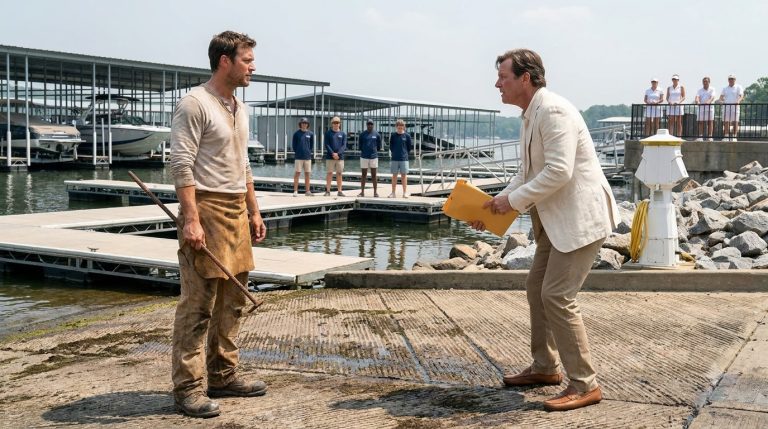
A white county pickup pulled up the gravel track, tires crunching slow over the washboard. Wesley Pritchard climbed out, his wool cardigan buttoned crooked against the October draft. He held an unsealed manila folder against his ribs.
“Recorder finished indexing the transfer at two,” Wesley said, walking to the fence line without looking at his feet. “Volume 142, Page 90. Stonegate Ridge Homeowners Association to Brett Callahan. Nine point two acres, surface estate, seven hundred and eighty thousand dollars.”
Brett set the driver on the ground. The iron rang once against a buried cobble and tipped over into the rye. “Lender approve the loss?”
“They took seventy cents on the dollar to clear the development note before the quarterly call,” Wesley said. He slid two sheets of paper from the sleeve and laid them side by side on the top cedar rail. “Original forty-eight severance on the left. New warranty deed on the right. First time in eighty years the top dirt and the deep stone share a signature.”
Brett looked down at the documents. The corner of the 1948 parchment was soft as flannel, yellowed by sixty years in a steel drawer smelling of sulfur and gear oil. The new deed smelled of toner ink and county stamps.
“Mara sold her house on the west cul-de-sac,” Wesley said, looking across the pasture toward the line of suburban roofs half a mile away. “Moved into the county seat. Association filed their indemnity claim on Monday. Seeking two hundred and fourteen thousand for unauthorized sitework commitments and legal overhead. Her brother’s LLC dissolved itself three days ago.”
Brett pulled his pocketknife, opened the short sheepfoot blade, and scraped a scab of dried blue marking paint off the top fence strand. “Damon call you?”
“He did,” Wesley said. “Wanted to know if you were going to lease the extraction tract to the aggregate company.”
“Told them they can run core tests on the back forty if they stay off the ridge,” Brett said. “Paid four-fifty for the exploration option. That covers the bank note on the surface dirt. The stone stays where it sits.”
A cool gust rolled off the limestone breaks, bending the rye grass in long, pale waves. Down where the clubhouse lobby would’ve looked out over his stock pond, Brett had driven a three-foot length of scrap railroad rail straight into the bedrock, painted with a single dab of black iron enamel: Tract B. 1948.
Wesley folded both deeds back into the cardstock folder, tapped the edge against his palm, and handed the packet across the wire. “She spent sixteen months and a million and a half dollars trying to box you out of a turn-around.”
Brett took the folder, tucked it inside his canvas jacket, and zipped the brass zipper all the way to his throat.
“She bought the dirt,” Brett said.
He picked up the post driver by the handles, turned his back to the road, and walked down the fence line toward the cattle gate, his boots leaving dry, clean prints in the crushed gravel.