A Stripped-Down Reserve Cadre Faces A Broken Roster And Old Black-Budget Friction
CHAPTER 1: THE BRASS EYELET
The left eyelet of her boot had sheared through its brass grommet two miles before the intake gate, leaving raw cord to saw against wet cowhide with every step. Olivia didn’t stop to knot it until the tailgate dropped.
Cold pine water dripped from the eaves of the intake shack, drumming against the cab of her rust-pocked Ford like gravel thrown against zinc. Around her, thirty men and women in stiff, unwashed utility jackets cursed the rain and dragged olive duffels across gravel that smelled of spent diesel and churned clay.
“Look at this,” someone muttered near the rack of training vests. A thick-necked boy with a buzzcut so fresh his scalp showed red through the stubble kicked a loose duffel into her shin. “Logistics sent us their scrub crew.”
Olivia stepped over the canvas. She didn’t look at his face. Her knuckles were split around the cuticles from three days of driving with a loose steering box, gray road grease packed deep into the ridges of her palms. She reached into her cargo pocket, thumbing the edge of her transfer slip—standard paper, smudged with rain, bearing the clean rubber stamp of a third-tier logistics depot out of Yakima.
“Name,” the corporal behind the field table barked. His rain poncho was split down the armpit, patched with duct tape that curled at the corners.
“Mitchell. Trans-supply.”
A short scoff ripped through the queue behind her. Lance stood with his thumbs hooked into his web belt, broad across the shoulders and smelling of wintergreen chew. He leaned in, his breath fogging white against the gray light. “Yakima didn’t give you boots that fit, Mitchell? Or did you dig those out of a surplus bin behind a truck stop?”
Laughter skittered down the intake line, thin and nervous in the wet cold. A blonde girl named Tara crossed her arms, shifting her weight to keep her new Vibram soles out of the grease puddle. “Gender quota,” Tara murmured, just loud enough to bounce off the corrugated zinc roof. “They have to pad the roster somewhere.”
Olivia took her stencil card from the corporal’s numb fingers. “Line four,” the corporal said without looking up. “Move.”
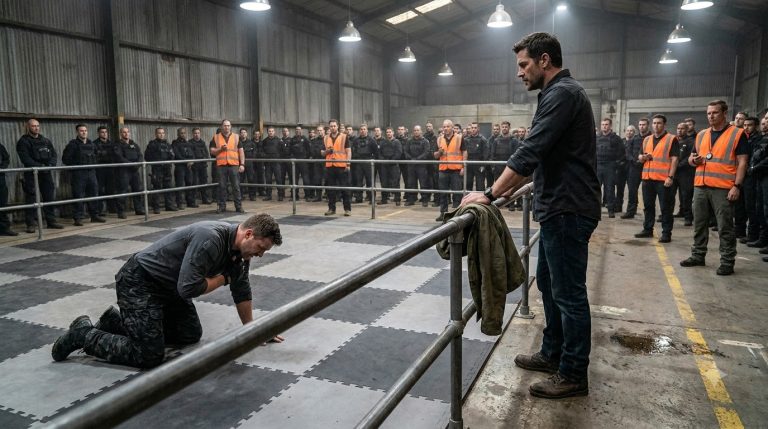
She didn’t answer. She turned toward the gravel pit where Captain Harrow stood on a stack of timber, his poncho slick as grease. He didn’t waste time on a muster speech. He didn’t welcome them to Camp Vance. He swung an arm toward the chalk circle marked in the mud.
“Two by two. Close-contact sorting,” Harrow bellowed, his voice raspy from twenty years of diesel fumes and wet wind. “Find out who knows how to hold their center and who goes back to folding laundry. Lance. Mitchell. Front.”
The recruits parted, their boots sucking in the sodden earth. Lance stepped into the circle, grinning sideways at the queue. He was two inches over six feet, his bulk packed heavy into clean Gore-Tex. “Go easy on the laundry girl, Captain?”
“Shut your mouth and engage,” Harrow spat.
Lance didn’t wait for the whistle. He lunged across the chalk, heavy boots kicking up a spray of yellow gravel, thick hands hooking straight for the collar of her washed-out field blouse. It wasn’t a standard drill grip. It was a street tackle, built to throw her flat into the stones and draw a cheer from the fence line.
Olivia stepped inside the arc of his lead arm. The air between them tasted of wet wool and sour mud. She caught the meat of his thumb with two fingers, intending to guide his mass past her hip—a clean, bloodless redirection that would drop him into the gravel without breaking skin.
Her frayed left bootlace caught under her heel.
The traction gave way on the slick clay. Lance’s fingers missed her collar, hooked the worn seam at the nape of her neck, and wrenched downward with all two hundred pounds of his forward momentum.
The dry-rotted cotton surrendered with a sharp, wet crack.
The fabric tore from collar to shoulder blade, peeling down her back in a ragged flap. Lance stumbled forward off-balance, his shoulder slamming into her ribcage before he caught himself against the post.
The yard went utterly dead.
The wind drove a spray of icy mist across the circle, but nobody laughed. Lance straightened, wiping mud off his cheek with the back of his hand, a sneer halfway formed on his mouth—then his eyes dropped to her exposed skin.
Between her pale, scarred shoulder blades, black ink stood out against cold gooseflesh. It wasn’t modern tattoo parlor work. The edges were blown out, driven deep into the dermis with a single-needle field rig: an iron-jawed viper coiled tight around the base of a split military skull, its tail barbed with five hash marks.
Captain Harrow didn’t shout. The timber beneath his boots gave a slow, dry creak as he stepped down into the mud.
His face had lost its red drill-sergeant flush. He walked toward the chalk circle, his right hand falling away from his belt, his eyes fixed on the graying scar tissue beneath the tail of the snake. He stopped four feet from Olivia, his posture stiffening, the habit of muscle memory snapping thirty years of service into a rigid, paralyzed lock.
“Where,” Harrow whispered, the rain dripping off the rim of his patrol cap onto his lip, “did you pull that transfer slip from, Mitchell?”
Olivia pulled the torn cotton up over her shoulder, tucking the ragged tail into the band of her trousers. The cold air stung the raw skin of her back.
Across the fence line, past the recruits who were still staring with stupid, half-open mouths, an unmarked Dodge pickup with government plates had just killed its headlights at the motor-pool gate.
CHAPTER 2: THE BURRED PIN
Three hours after the chalk circle, the cold settled into the damp weave of Olivia’s trousers like wet lead.
The supply shed smelled of mineral spirits, cosmoline, and old rain trapped in concrete. Rain hit the tin roof in a steady, dull roar that drowned out the mutter of twenty cadets lined up along the galvanized steel benches.
Sergeant Pulk slammed a stopwatch down on the pine planking. The spring inside the casing buzzed, loud in the cramped shed.
“Two minutes flat,” Pulk said. His breath carried the bitter tang of chicory coffee. “Receiver group down to bolt carrier. Scrape the tail, drop the extractor, reassemble, function check. If you pinch an O-ring or drop a pin in the cracks, your squad runs the ridgeline till midnight.”
Lance stood three stations down, his fresh field blouse dark with sweat under the arms. He didn’t look at his rifle; his eyes stayed locked on the side of Olivia’s neck. A dull red friction burn marked his collarbone where the wet canvas had whipped him.
“Mitchell,” Pulk barked. “Bench four. Move.”
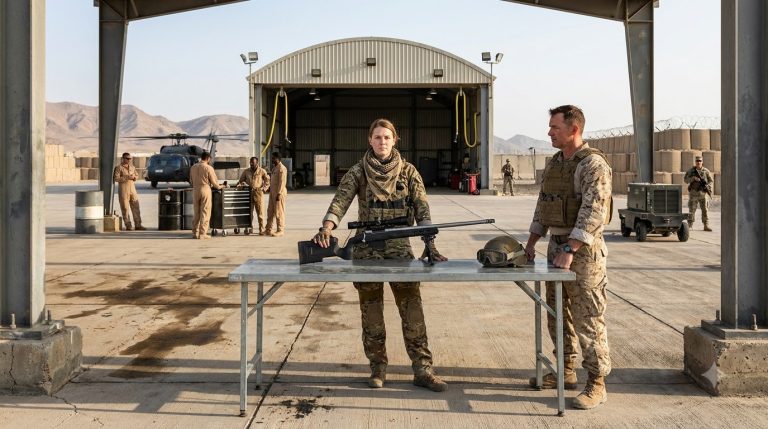
Olivia stepped up to the galvanized table. The weapon resting on the rubber mat wasn’t an armory display piece. It was an old Colt carbine, its phosphate finish worn to raw silver along the receiver fences, the buffer tube scarred from decades of recruits dropping it on basalt rocks.
“Timers run together,” Pulk growled. “Ready. Go.”
Around her, the shed exploded into metal-on-metal clatter. Lance hit his takedown pin with the heel of his palm, swearing as the upper receiver stuck against years of baked lacquer. Across the row, Tara dropped a firing pin retaining pin; the tiny cotter wire pinged off the concrete and rolled into a drain grate.
Olivia’s right hand didn’t strike the rifle. Her fingers were cold, the nerve damage from a forgotten blast in the Arghandab valley locking the tendon in her index finger into a rigid, stubborn hook. She pressed her knuckle flat against the edge of the steel table until the joint popped, forcing blood back into the numb tip.
Thumb the rear pin. Don’t force the hinge.
The rear pin was burred at the detent, swollen from moisture. Instead of hammering it, she pulled the charging handle back an eighth of an inch to take the tension off the bolt face. The pin slid out with a dry click.
Upper separated from lower. Bolt carrier group out.
She laid each piece down on the rubber mat in a straight, horizontal line, spacing them by the width of two fingers: carrier, bolt, cam pin, firing pin, retaining cotter. Her hands moved without the jerky haste of the boys around her. When she pulled the extractor pin, her thumb caught the spring before it could launch the microscopic rubber buffer across the floor.
“Time,” Pulk called from behind her shoulder. “Minute fifteen.”
Lance slammed his magazine well into the bench, panting. “Done.”
“One-forty-three, Lance. Sloppy on the sear,” Pulk muttered, not looking at him. Pulk had stopped two feet behind Olivia. His shadow fell across her mat.
Olivia didn’t look up. She picked up the bolt, sliding it into the carrier until the cam pin hole aligned. Her fingers didn’t shake, but the thumb on her right hand dragged slightly across the steel, leaving a smudge of dark sweat on the gas key.
Click. Slide.
She drove the buffer forward, pinned the receivers, racked the charging handle with a sharp pull, and dropped the hammer. The dry-fire snap cracked flat against the zinc walls.
Fifty-two seconds on Pulk’s dial.
The silence around bench four spread outward like oil on water. Lance wiped grease from his chin, his mouth twisting into a hard, sour knot.
Pulk reached out, picked up the carbine, and turned it over in his calloused hands. He checked the gas ring stagger through the ejection port, then looked at the straight, grease-free grid on her rubber mat.
“Yakima logistics,” Pulk said, his voice dropping below the drum of the rain. “They teach you to cradle the cam pin like that while you’re sorting paper clips, cadet?”
“Instruction manual, Sergeant,” Olivia said. Her voice remained flat, empty of breath or boast.
“Manual don’t teach a recruit to relieve the bolt face before working a swollen detent,” Pulk said. He set the rifle down. The steel clicked once against the galvanized sheet. “That’s field-depot habits. Units that don’t get new parts.”
From the door of the shed, a shadow shifted against the gray light of the yard. Captain Harrow stood there, a manila service folder tucked under his left arm. He didn’t come inside. He raised two fingers toward Pulk, caught the sergeant’s eye, and tilted his head toward the administrative trailer near the gravel pit.
Pulk stepped back, wiping his palms on his trousers. “Mitchell. Secure your weapon.”
He turned and walked toward Harrow, his heavy field boots tracking grease into the rain.
Lance leaned over the divider, his chest heaving, his face red from the humiliation in the yard. “You think you’re smart, Mitchell?” he hissed, his voice thin against the rain on the tin. “Wait till we hit the brush tonight. Nobody’s checking stopwatches in the pine.”
Olivia picked up her carbine, seated the empty magazine until the catch locked with a dead thump, and slid her stencil card into her pocket.
CHAPTER 3: THE GRID NINE OVERLAY
Five hours after the supply shed, the wet dark swallowed the ridgeline, turning the Douglas firs into jagged black teeth against a pewter sky.
The wind off the sound carried the stench of decaying cedar mulch and diesel exhaust drifting up from the low road. Olivia drove the edge of her boot into the spongy duff of an old skid trail, her right hand clamped over the baseplate of her lensatic compass to keep the brass loop from clicking against her harness.
Behind her, dead branches cracked under clumsy weight.
Kyle came through the salal bushes first, his field jacket unbuttoned, his helmet canted crooked over one ear. Two other recruits from Lance’s squad trailed him, their plastic scabbards slapping their thighs in an undisciplined, heavy rhythm.
“Look at her,” Kyle called, his voice rough from shouting through the gully. “Little rabbit thinks she’s running point.”
Olivia didn’t break stride. One hundred and twenty paces to the ravine fork. Bearing three-four-zero.
Her left heel was wet inside the leather, skin peeling where the torn grommet let grit grind into the tendon. She kept her chin level, scanning the tree line for the yellow surveyor’s tape that marked the safe perimeter of Sector Four.
Kyle broke into an awkward trot, his shoulder catching her rucksack and spinning her sideways into the wet trunk of a hemlock. Before she could regain her balance, his bare hand darted across her chest, snatching the waterproof map case dangling from her yoke.
“Let’s see how logistics finds the chow hall without a picture,” Kyle barked.
With a wet rip, he tore the acetate sleeve off the lanyard. He didn’t just toss it; he ripped the paper insert into three damp strips and threw them into the brush where the drainage ditch ran fast and black. The boys behind him let out a short, ragged laugh.
Olivia stayed pressed against the rough bark of the hemlock. Her hand didn’t drop to her sidearm holster—she had no sidearm, only an unloaded training carbine across her back. She didn’t raise her fists.
“The culvert behind you,” Olivia said, her voice dropping into the quiet space between wind gusts, “drops twenty feet into broken basalt. Step back.”
Kyle sneered, his chest heaving. “Don’t lecture me, Mitchell. You’re lost. You’re done.” He turned his back on her, waving his group forward. “Check the ridge road! Leave her in the brush!”
Their boots churned the mud, their heavy breathing fading into the sound of rushing runoff.
Olivia waited four breaths until the timber quieted. Her right thumb traced the bezel ring of the compass, clicking it three notches west. Without the grid map, she had only dead reckoning—and Harrow had altered the course markers. The surveyor’s tape on the lower birch trees wasn’t standard day-glo pink; it was weathered white tape, five years old, marking an older boundary that wasn’t on the company roster.
A branch snapped five yards to her left.
Olivia shifted her weight, locking her right elbow against her ribs, ready to hook an incoming jaw.
“Don’t swing,” a voice whispered from the brush.
Elena stepped out from behind a fallen cedar. Her face was smeared with dark grease, her eyes wide, darting back toward the skid road where Kyle’s crew had gone. She reached into her cargo pocket and pulled out a damp, folded sheet of greaseproof paper, thrusting it into Olivia’s chest.
“Take it,” Elena said. Her breath smelled of peppermint ration candy and sheer terror.
Olivia didn’t touch it immediately. “Cadets carrying unissued cartography get recycled to basic.”
“It’s not base issue,” Elena hissed, forcing the paper into Olivia’s stiff fingers. “My brother was with Third Auxiliaries. Two years ago, they brought him out of Grid Nine in a rubber bag and called it a training mishap. That map shows the unlogged burn pits. Harrow didn’t route your group here to test navigation, Mitchell. He’s herding you toward the old ordnance trench.”
Olivia unfolded the paper with her left thumb.
Under the faint red filter of her penlight, the grease pencil lines revealed the truth. The official training grid had been drawn over a closed salvage site: marked by a small hand-drawn insignia at the trench margin—the same split skull and viper tail that was scarred into her own flesh.
Harrow hadn’t lost her service records. He knew exactly what unit had dumped their spent gear in this ravine five years ago.
“Why give me this?” Olivia asked, folding the paper into her inner pocket.
Elena looked toward the dark ridge, her hands buried deep in her armpits. “Because he was carrying the same mark when he came home in that box. And nobody here will say his name.”
A flare hissed into the wet canopy above the timber, bathing the pine needles in a harsh, sputtering magnesium glare.
CHAPTER 4: THE OVERPRESSURE CRIMP
Four hours after the magnesium flare died in the hemlocks, the taste of damp copper was still glued to the roof of Olivia’s mouth.
Kill House Bravo sat in the hollow of the firing fan, four cinderblock boxes roofed with corrugated sheet metal and soaked in diesel exhaust. Floodlights on wooden telephone poles cast yellow pools across the pea gravel, buzzing with the sound of water frying against hot glass.
“Stack on the threshold,” Harrow’s voice crackled through the bullhorn from the observation gantry. “Simulated compound search. Three rooms, blank-fire clearance. Move on the siren.”
Olivia leaned her shoulder against the damp cinderblock of Room One. The yellow blank-firing adapter clamped to her M4 barrel was pitted with rust around the bleed vents.
Behind her in the stack, Tara’s breathing came fast and shallow, the synthetic nylon of her plate carrier rasping against the block wall.
“Stay tight on the frame,” Olivia said without turning around. Her voice was flat, low enough to stay beneath the rattle of the generator. “The lintel’s buckled. Don’t crowd the breach.”
“Save the advice, Mitchell,” Tara whispered. Her teeth clicked against her gum shield. “You don’t run this stack.”
The siren howled—a short, mechanical wail that cut through the valley fog.
Olivia kicked the breach door with her right heel, aiming straight for the lock plate. The rusted latch snapped, but the rotted bottom rail of the door jammed hard on a mound of wet gravel wedged in the threshold.
Half-open. Fatal funnel.
Instead of kicking it a second time, Olivia caught the raw splintered pine with her gloved left hand and hauled it inward, putting her weight against the hinges until the wood screamed and tore free.
She cleared the corner, muzzle sweeping the dark room: stacked tires, a rubber mannequin behind a sandbag, empty ammunition crates. “Clear left.”
Tara didn’t wait for the sector call. She shoved past Olivia’s shoulder, boots skittering on the slick wet concrete, hunting the lead position. Her rifle came up high, her thumb clicking the selector off safe.
Across the doorway of Room Two, three inches above the sill, an olive-drab trip wire ran taut toward an unpainted ammo tin bolted to the floorboards.
“Hold,” Olivia snapped.
Tara’s lead boot caught the wire.
The spring on the trip flare released with a sharp, metallic ping. Tara froze, her eyes widening behind her polycarbonate glasses as the striker hit. But it wasn’t a training flare that cracked in the dark.
A bright flash popped from the floorboard, followed by the heavy, concussive bark of an over-pressured blank charge—far louder than the standard five-grain training powder.
Tara panicked. Her finger clenched on the trigger of her carbine.
The yellow adapter on Tara’s muzzle blew its set-screw under the unexpected gas pressure. The steel collar stripped forward with a violent screech, the barrel whipping upward straight toward Olivia’s throat.
Olivia didn’t pull back. She drove the flat of her palm upward into Tara’s delta ring, forcing the rifle’s muzzle sideways into the cinderblock wall.
The rifle fired.
A gout of hot burning powder and unburned propellant slammed into the masonry four inches from Olivia’s ear. The muzzle blast slapped her cheek like a wet board, blackening her collar and filling the narrow room with the stench of scorched sulfur. The recoil ripped the carbine out of Tara’s hands, sending it clattering across the floor.
Tara dropped to her knees in the pea gravel, her hands clamped over her helmet, gasping in the dark.
From the observation catwalk, boots hammered down the wooden stairs. Harrow was through the door before the smoke cleared, his halogen flashlight cutting through the cordite haze, pinning Olivia against the wall.
“Cease fire! Cease fire!” Harrow roared. His eyes swept from Tara shivering in the gravel to the scorched wall, then locked on the stripped threads of the blown blank adapter lying by Olivia’s boot.
“Reckless discharge,” Harrow growled, his face inches from Olivia’s. His breath was sour, his jaw set in a hard, pre-planned line. “Tampering with armory munitions on an active run. Step away from the weapon, Mitchell.”
Olivia didn’t blink. Her left ear rang with a high, dead pitch, but her hands stayed loose at her sides, away from her harness.
She looked down at the brass casing Tara’s gun had ejected onto the wet floor.
It wasn’t a commercial crimp. Around the neck of the spent shell, two microscopic red lacquer bands marked it as high-pressure test brass—ammunition kept exclusively in the back safe of the depot commander’s office to test barrel tolerances.
Harrow’s eyes flicked to the shell, then back to her face. For a fraction of a second, the sergeant’s bluster faded, replaced by the cold, calculating look of a man who realized his trap had left its serial number in the mud.
“Step out to the gravel,” Harrow said, his voice dropping into a harsh rasp. “Provost marshal wants your gear. Now.”
CHAPTER 5: EIGHT SECONDS IN THE SAWDUST
Six hours after the over-pressure charge detonated in Room Two, the grease-smoke on Olivia’s cheek had hardened into a crust of black salt.
Dawn didn’t bring light to Camp Vance; it just turned the fog from black to the yellow-gray of a dead tooth. The sawdust pit was sixty square feet of pine chips soaked with last night’s downpour, ringed by railway ties slick with moss.
Thirty recruits stood on the ties, their boots shifting in the mud, nobody talking. Tara was in the third row, a white gauze pad taped over her left cheekbone where the blown gas had peppered her skin. She didn’t look up.
In the center of the pit, Lance had already stripped down to his olive tank top. The chill pebbled the skin of his shoulders, but his chest was flushed hot, veins corded across his forearms like twine.
“Cadet evaluation,” Captain Harrow announced from the railway timber. He held a steel clipboard against his hip, his rain poncho unfastened. His eyes didn’t touch Olivia’s face; they stayed fixed on her boots. “Full contact. Neutralization or surrender. Engage.”
Lance stepped forward before Harrow’s hand dropped.
“Rifle range was cute, Mitchell,” Lance said, his voice flat with venom, pitched low for the sawdust ring. “Let’s see what that black snake on your back does when somebody hits you back.”
Olivia stood in the wet chips. Her feet were set shoulder-width apart, knees unlocked, her weight settled over the balls of her feet to compensate for the dead tone humming in her left ear. She didn’t raise her fists. She left her palms open, fingers curved naturally, thumbs pressed tight to the knuckles.
Lance lunged.
He didn’t feint. He came with two hundred and ten pounds of weight behind an overhand right meant to crush her cheek against the logs.
The Inhale.
The world slowed to the drag of water dripping off the timber lintel. Lance’s boot heel tore a wet wedge of pine chips from the earth; his chin drifted two inches forward of his chest; the fabric of his tank top pulled tight across his shoulder blades, exposing the throat.
The Exhale.
Olivia didn’t duck under the punch. She took half a step forward into the arc, ducking her ear inside the crook of his swinging bicep. The forearm grazed her cropped hair with the force of an iron pipe, but the bone missed her jaw.
Her left hand slipped like oil behind the nape of his neck, driving his crown downward toward her sternum.
Lance snorted, his left hand clawing for her ribs to drive her into the timbers. “Bitch—”
Olivia wrapped her right forearm under his chin, sliding the bony blade of her radius against the left carotid artery. She hooked her left hand into her own bicep, locking the vise shut with a sharp, levered tuck of her chin over his shoulder.
A standard rear naked choke. No theatrics. Just ten pounds of hydraulic pressure on the blood supply to the brain.
Lance’s eyes bulged. His feet hammered the wet chips, spraying gray pulp against the recruits on the timber rail. He reached back with both hands, thick fingers digging into the skin of Olivia’s forearms, ripping fingernails through flesh to break the lock.
Olivia didn’t flinch. She dropped her hips, using his own bulk as a counterweight, leaning her skull against his temple so he couldn’t throw a headbutt.
One. Two. Three.
Lance’s fingers lost their purchase on her skin, sliding down her sleeves like wet paper.
Four. Five. Six.
His knees hit the sawdust with a dull, hollow thud. The breath hitched in his windpipe—a dry, clicking rattle.
Seven. Eight.
His chin went slack against her forearm.
Olivia unlocked her grip instantly, stepping backward as Lance folded forward onto his face, his forehead burying three inches into the wet pine shavings. He didn’t twitch. Only the rhythmic rise and fall of his ribs proved he was drawing air.
The yard was dead. The only sound was the drone of the camp generator half a mile away through the trees.
Harrow’s steel clipboard slipped an inch in his grip, the metal edge rapping against his belt buckle. His mouth opened, but no words came out; the breath caught in his throat, his eyes darting from Lance’s limp shoulders to the woman standing four feet away.
Olivia didn’t shake out her hands. Blood welled where Lance’s nails had scored her forearm, dripping dark into the wood chips.
She raised her eyes and met Harrow’s gaze through the drizzle.
Down the service road, past the gravel sorting yard, the gate chain rattled.
The black Dodge pickup didn’t slow for the sentry arm. It crushed the wooden barricade flat into the mud, its heavy front bumper glistening with rain as it rolled straight toward the sawdust pit.