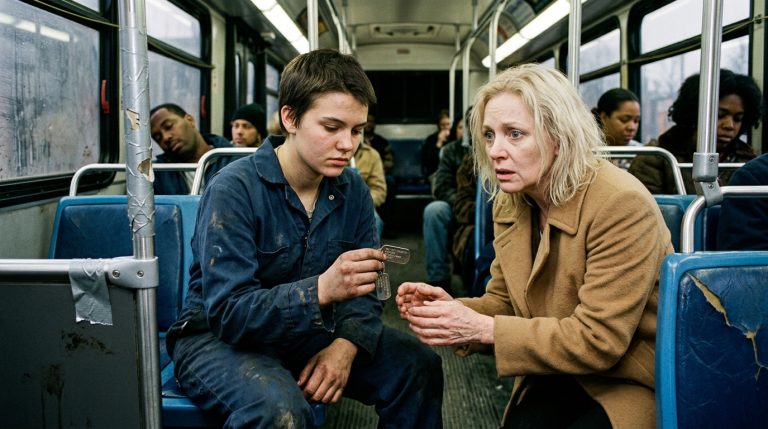
A Silent Reckoning: The Tactical Echoes of a Decorated Veteran in a World of Entitlement
CHAPTER 1: THE TERMINAL FUNNEL
The sliding glass doors of the terminal hissed shut behind her, sealing her into a cathedral of recycled air and frantic movement. Kristen kept her pace steady, a rhythmic, military gait that stood out like a jagged stone in a flowing stream. She didn’t look at the departure boards. She didn’t check her watch. She felt the weight of her backpack against her shoulders—not the weight of clothing or a book, but the heavy, grounding presence of gear she hadn’t touched since the flight.
She reached the baggage claim, a sprawling concrete loop vibrating with the screech of metal belts. She didn’t stand with the crush of people at the edge. Instead, she took up a position by a structural pillar, a vantage point that gave her line-of-sight to every exit and the rotating carousel.
Her eyes flicked across the crowd. A man in a tan jacket was checking his phone too frequently, his posture misaligned with his surroundings. He wasn’t waiting for a bag. A woman near the coffee kiosk wasn’t drinking her espresso; she was using the reflection in the dark glass to watch the crowd.
They were professionals. Or at least, they were trained. But they lacked the economy of movement that defined her world.
She felt a flicker of cold annoyance. She had expected to disappear into the civilian fabric, to let the uniform fade into the background. But someone had already tagged her. The incident on the plane wasn’t a quirk of fate; it was a flare. Sterling had been a convenient instrument, but these—the tan jacket, the woman with the cold coffee—they were the true residue of the flight.
As the carousel groaned into motion, dumping a load of dented suitcases into the light, Kristen spotted a piece of luggage that shouldn’t have been there. It was a matte-black hard-shell case, devoid of airline stickers, drifting alone toward the chute. On its handle, dangling by a single plastic thread, was a yellow baggage tag.
She stepped away from the pillar, her boots hitting the polished floor with zero sound. As she neared the carousel, her fingers brushed the plastic tag. It wasn’t a destination identifier. It was a sequence of numbers—a geographic coordinate and a timestamp.
She felt the air tighten in her chest, a familiar constriction. The scent of ozone and burning rubber flickered at the edge of her senses, replacing the smell of floor wax. She didn’t pick up the case. She simply looked down, memorizing the digits, and realized with a sickening, clinical clarity that she was being walked into a trap.
Someone bumped her shoulder, a heavy, deliberate impact.
“Sorry,” a voice muttered—flat, mechanical, devoid of empathy.
Kristen didn’t turn. She shifted her weight, her core tightening. She felt the cold press of something hard and slim against her kidney—a message, or perhaps a warning. She didn’t need to look. She knew the game had moved from the air to the ground, and for the first time in three years, the target in her crosshairs wasn’t a shadow. It was herself.
CHAPTER 2: THE VECTOR OF INTENT
Kristen didn’t flinch. Her reaction was a learned, microscopic contraction of muscle, shifting her center of gravity an inch to the left, away from the contact. The man had bumped her, but he hadn’t moved on. He lingered, his shoulder pressing into her back with the practiced heaviness of someone trying to hold her in place.
He was breathing too shallowly, his rhythm out of sync with a man distracted by a busy airport.
She kept her gaze fixed on the carousel, watching her own reflection in the metal trim of the baggage chute. She didn’t look at the man, but she monitored the pressure against her side. It was a cold, hard point of contact, likely the barrel of a suppressor-equipped pistol, or perhaps something even more primitive. A shiv. In this environment, it didn’t matter. The intent was identical: she was being pinned.
“Keep walking,” the man breathed, the words barely a vibration against the ambient roar of the terminal.
Kristen recognized the cadence. It was the clipped, flattened tone of a private contractor, someone who had spent too much time operating in zones where rules were negotiable and lives were currencies.
“I’m not walking anywhere you want me to,” Kristen said, her voice a low, steady hum that barely carried past the space between their bodies.
She felt him tense. The phantom smell of burning diesel and copper, the stagnant air of the Syria cave, surged into her mind—the V-2 phantom she had suppressed for years, pulling her back to the moment the vent shaft collapsed. Her vision blurred at the edges, the fluorescent lights of the terminal momentarily bleeding into the strobing flash of a tactical flare.
She forced the memory back into its box. Focus. This wasn’t the cave. This was a baggage claim in Washington.
She acted.
She didn’t fight him head-on; she exploited the environment. As a group of travelers surged forward to grab their bags, pushing against the man, Kristen utilized the chaos. She leaned into the woman to her right, feigning a stumble, and simultaneously pivoted her torso with the grace of a rotating turret. She didn’t strike the man; she caught his wrist with a sharp, downward wrenching motion, twisting his pressure point.
The man grunted, his grip failing. The cold object against her kidney slipped, and for a heartbeat, Kristen saw the sliver of steel.
She didn’t let him recover. She stepped into his space, her forearm finding the vulnerable nerve cluster beneath his jaw, and shoved him backward with a calculated, precise amount of force. It was enough to send him staggering into the path of a TSA officer crossing the terminal, but not enough to cause a public spectacle.
The man stumbled, his eyes widening as he realized he had been played. He reached for his jacket, perhaps to pull a weapon or a badge, but the presence of the TSA officer—a woman with a tired, impatient look—stopped him. He cursed under his breath, his eyes darting toward the exits, and then he turned, fading into the sea of people as if he were nothing more than another traveler missing a flight.
Kristen didn’t follow. She stood still, her heart rate steadying at a pace that would have been flatline to anyone else. She observed him until he crossed the threshold of the automatic doors. He wasn’t alone; the woman at the coffee kiosk had folded her newspaper and was now trailing him.
They were coordinated. They were failing.
She reached down, her hands steady, and picked up her own duffel bag, which had just arrived on the belt. She didn’t look at the matte-black case with the yellow tag again. It was a lure, a piece of bait for a trap that had already been compromised.
She walked toward the taxi line, her pace brisk but unhurried. She needed a secure connection. Her phone was in her pocket, a burner she had kept for three years, its battery barely holding a charge. She needed to reach a clean line, someone who could tell her if the extraction had actually happened or if she had merely been sent home to be harvested.
The terminal doors opened, and the humid, heavy air of the city hit her. It felt like walking into a different, more dangerous theater of operations. She signaled a cab, keeping her back to the wall, her eyes tracking every movement within a fifty-foot radius.
She knew they would be back. Not here, maybe—this had been a tactical failure for them—but they had the asset they needed: her signature. They knew she was back in play.
As the cab pulled up, a dark sedan with tinted windows lingered at the curb behind it. It didn’t have a taxi light. It didn’t have a purpose other than to exist in her peripheral vision. Kristen slid into the back of the taxi, her hand resting on the handle of her duffel. She didn’t look back, but she watched the sedan in the side-view mirror.
It followed.
“Where to, miss?” the driver asked, his voice muffled behind a plexiglass partition.
Kristen looked at the driver, then at the sedan, then back to the city skyline that rose up like a jagged, threatening wall. She wasn’t going home. She was going to the one place she had never registered—the dead drop she had scouted three years ago, just in case the silence ever broke.
“Just drive,” she said, her voice as hard as the steel she had touched in the terminal. “And if we aren’t clear of that sedan in five blocks, I’m going to need you to stop the car.”
The driver glanced at her in the rearview mirror, his eyes lingering on the raw, cold determination in her face. He didn’t ask for a destination again. He simply nodded, accelerated, and the car merged into the gray, grinding pulse of the city.
CHAPTER 3: THE SHADOW IN THE REARVIEW
The taxi lurched forward, joining the flow of traffic like a drop of water returning to a river. Kristen didn’t watch the buildings. She kept her eyes on the sedan in the side-view mirror, a ghost of dark metal clinging to their bumper. The driver, an older man with hands scarred by decades of gripping a steering wheel, caught her gaze in the mirror and said nothing. He didn’t ask again where they were going. He sensed the weight of the air, the way Kristen had positioned herself to be ready to exit the vehicle at a second’s notice.
She turned her attention to the backseat, the leather cracked and cool against her skin. Something caught her eye—a small, crumpled slip of paper tucked into the crevice of the seat. She reached out, her fingers quick and precise, and pulled it free.
It was a receipt. Not a standard taxi slip, but a small, thermal-printed voucher for a burner phone, time-stamped less than an hour ago. The location listed was a kiosk in the very terminal she had just vacated.
A V-1 mystery, sharp and intrusive. Someone had been sitting here, waiting for her, or perhaps waiting for the person trailing her. It wasn’t a coincidence. The game was tighter than she had imagined; they weren’t just watching her, they were leaving breadcrumbs to guide her into the next phase of their design.
She looked at the sedan again. It had dropped back, a deliberate move to lose the tail-lights and blend into the heavy city traffic.
“We’re being followed,” she said, her voice cutting through the hum of the tires on the asphalt.
The driver didn’t jump. He gave a single, curt nod, his eyes flicking to his own mirror. “I know. You want to lose them? I know the alleyways of this city better than my own name. But it’s going to cost you more than just the fare.”
“Lose them,” Kristen replied. “And don’t worry about the cost.”
The driver shifted, the taxi accelerating with a sudden, aggressive burst of power that threw Kristen back against the seat. He cut hard to the right, ignoring a chorus of horns as he wove through the gridlock, his maneuvers erratic but calculated. He was using the heavy traffic as a screen, cutting across lanes with a disregard for the rules that felt, for a fleeting moment, like the chaos of a breach.
Kristen felt the tension of the chase, the physical feedback of the car swaying through the turns. She pulled her phone from her pocket. It was still dark. She held the power button, the device stuttering as it tried to boot up, the screen flickering with the logo of a network she hadn’t accessed in years.
She wasn’t looking for a signal to call for help. She was looking for a ghost. She had a file buried in the encrypted root of this device—the only thing she had salvaged from the Syria mission. It was a digital map of a sector that didn’t exist on any satellite image, a series of coordinates that had cost her unit everything.
As the phone finally blinked to life, a flurry of notifications flooded the screen—most of them old, cached messages that had been waiting for a handshake with a tower. One caught her eye: an encrypted ping from a burner number, sent only minutes ago.
The anchor is slipping. Return to the waypoint.
Her breath hitched. The “anchor” was a phrase they had used for the extraction point. If someone was using it now, it meant the operation wasn’t over. It meant the black-box mission she had survived was currently being reopened, and the people behind it were actively scrubbing the board.
The taxi hit a pothole, the suspension groaning in protest. They were in the older part of the city now, the streets narrow and shadowed, lined with brick buildings that seemed to lean in and conspire. The sedan was gone—lost somewhere back in the gridlock of the main thoroughfare.
“We’re clear,” the driver said, pulling the car to a halt in the deep shadow of an abandoned warehouse district. He killed the engine, and the silence that rushed back into the cab was heavier than before.
Kristen sat still, the phone glowing faintly in her palm. The receipt, the text, the pursuit—it was all pointing toward a single conclusion. They wanted her to go to the waypoint. They weren’t just chasing her; they were herding her.
She looked out the window. Across the street, a dim light flickered in a window three stories up—a sign, perhaps, or merely the pulse of a dying bulb. She felt the weight of the scar on her shoulder, the physical reminder of why she had walked away from the service. She hadn’t left because she was weak; she had left because she knew the truth of what they were doing in the dark.
“You aren’t just a driver,” Kristen said, not looking at him, but watching the light in the window.
The driver turned, his face illuminated by the dim streetlamps. His eyes were hard, tired, and familiar. He was an operator who had long since aged out of the field, a remnant of a different era. “No,” he replied softly. “I’m the one who was supposed to make sure you got home. But it seems home doesn’t exist anymore.”
He leaned over
CHAPTER 3: THE DUSTY GRID
The taxi lurched as the driver navigated a sharp turn, the tires humming against the damp, oil-slicked asphalt of the city streets. Kristen watched the dark sedan in the rearview mirror. It took the turn with a smooth, disciplined motion, maintaining exactly three car lengths. It didn’t speed up, it didn’t lag, and it didn’t engage in the erratic braking common to impatient city drivers. It was a lock.
“They aren’t going to break off,” Kristen said, her voice low and devoid of alarm. It was a statement of fact, as clinical as a wind-speed calculation.
The driver glanced at her in the mirror. He was older, his face etched with the kind of weariness that comes from decades of watching the city change while you stay in the same seat. “You want me to lose them, or you want me to park?”
“Neither,” Kristen replied. “I want to see who they are.”
She reached into her jacket pocket and pulled out a small, crumpled piece of paper she’d found on the floorboard of the cab—a discarded receipt for a burner phone purchased three hours ago, just three blocks from the terminal. It was a classic misdirection: a trail left for someone, though she couldn’t be sure if it was for her or the people following her. She slid the receipt into her sleeve, her mind compartmentalizing the data. The trail was messy, which meant whoever was running this surveillance was either careless or trying to force a collision.
“Take the next exit toward the industrial park,” she instructed. “Slow down near the loading docks. I’m getting out.”
“That’s a dead end, miss,” the driver noted, but he didn’t argue. He signaled, his blinker clicking in a steady, metronomic beat that seemed to mock the tension rising in the car.
The taxi slowed as it transitioned from the main thoroughfare into the labyrinthine grid of the industrial zone. Here, the city became a landscape of rusted iron, looming brick walls, and the sharp, chemical tang of dormant manufacturing. It was a place of hard edges and deep shadows, a perfect arena for a forced engagement.
As the taxi rolled to a stop beneath the flickering orange halo of a sodium-vapor streetlamp, Kristen didn’t wait for the vehicle to completely settle. She pushed the door open, her movements fluid and silent. She didn’t look at the sedan, which had pulled to the curb a hundred yards back, its headlights cutting through the darkness like twin, unblinking eyes.
She moved into the shadows between two shipping containers, her boots finding purchase on the grit-covered concrete. She was no longer the passenger. She was the ghost.
The sedan’s doors opened, and two men stepped out. They weren’t in uniform. They were in nondescript, functional clothing—tactical trousers, sturdy boots, jackets that hung heavy at the hip. They moved with the same, practiced fluidity as the man in the terminal, but there was a subtle difference in their cadence. They were hesitant. They weren’t hunting; they were waiting for orders.
Kristen observed them from the darkness, her breathing slowed to a rhythmic, controlled crawl. She saw the lead man speak into a lapel mic, his head tilting toward the shadows where she had vanished. They were professional, but they were working off a template—a set of rules that didn’t account for a target who stopped running to watch the hunter.
She felt the old, familiar weight of the Syria mission pressing down on her, the phantom memory of Miller whispering in the dark of the cave, The hunter who forgets to look behind them is already dead. She didn’t let the memory shatter her focus. Instead, she used it. She moved, not toward the men, but around them, circling the periphery of the dock until she was behind the sedan.
She reached the vehicle, her hands ghosting over the trunk. She felt for an electronic signature—a tracker, a bug, anything that could reveal who had authorized this. Her fingers grazed the license plate, then moved to the seal around the rear window. There was nothing electronic. It was a clean car, stripped of all identification.
“They’re not government,” she whispered to the empty air.
If they were agency, there would be a protocol, a tether to a local station. This was something else. Private. High-end. Someone had the resources to shadow a priority-one asset but lacked the clearance to make it look legitimate.
The lead man started walking toward the shipping containers, his hand drifting toward his waist. Kristen didn’t wait for him to get closer. She stepped out from the shadow of the sedan, her presence sudden and absolute. She didn’t draw a weapon. She simply stood there, in the middle of the aisle, her silhouette framed by the harsh, yellow light of the streetlamp.
The men stopped, their confusion visible in the rigid, sudden halt of their bodies. They had expected her to be hiding, to be fleeing, to be doing anything other than confronting them.
“You’re tracking the wrong person,” Kristen said, her voice projecting with the effortless authority of someone who had commanded teams in the most lethal environments on earth. “Tell your handler that if I see you again, I won’t be checking for your credentials.”
The lead man hesitated, his hand hovering inches from his holster. He looked at her—really looked at her—and the arrogance of the hunter evaporated, replaced by the instinctual, primal fear of a man who suddenly realizes he’s staring into the abyss.
“We were told…” the man started, his voice cracking slightly.
“You were told wrong,” Kristen cut him off, her posture shifting from defensive to predatory. “Clear the area.”
She held their gaze, her face a mask of iron, until the lead man slowly raised his hands, signaling his partner. They retreated to the sedan, their movements jagged and hurried. As the car sped away, leaving only the smell of burning rubber and the echo of its engine, Kristen remained in the dark, her eyes tracking their taillights until they disappeared into the city grid.
She was alone again, but the air felt different. Thicker. Someone was burning resources to follow her, and they were desperate enough to use untrained contractors to do it. She reached into her sleeve and retrieved the burner phone receipt she’d found in the cab. She unfolded it, the paper crackling in the silence.
There was a series of coordinates scribbled on the back—a location, not far from here, that she recognized from her old life. It was a place she hadn’t been to in years, a safe house that technically no longer existed on any map.
She wasn’t just being followed; she was being drawn home.
CHAPTER 4: THE BREACH OF PROTOCOL
The industrial district didn’t have the mercy of city noise. Here, the silence was a physical weight, pressing against Kristen’s eardrums, broken only by the distant, rhythmic clanging of a train shunting on a track somewhere to the east. She remained standing in the shadow of the shipping container for several minutes, her pulse steady, her eyes scanning the grid. The sedan was long gone, but she didn’t move. She waited for the inevitable—the second team, the mop-up crew, the arrival of someone who wouldn’t be frightened off by a direct, tactical challenge.
Nothing happened.
That silence was worse than a confrontation. It suggested a high level of discipline. They weren’t reacting to her; they were managing her.
She turned the slip of paper over in her hands. The coordinates were written in a familiar, jagged hand—a script she hadn’t seen since the Syria extraction. It was Miller’s handwriting. The realization struck her with the force of a physical blow. Miller had died in the cave; she had carried his body for two kilometers through a ravine while taking mortar fire. If these were his coordinates, someone was playing a game that reached far beyond the boundaries of the living.
She folded the paper and tucked it into the lining of her tactical boot. She couldn’t walk to the location; it was three miles of open terrain, and the industrial zone was currently a no-man’s-land of abandoned warehouses and high-security fences. She needed a vehicle, or at least a way to move through the grid without being pegged by a surveillance camera.
A low, guttural rumble echoed through the district—the sound of an engine struggling with a heavy load. Kristen ducked deeper into the shadows. A patrol car, its light bar dark, rolled slowly past the intersection, its tires crunching on the loose gravel. It wasn’t local police; the vehicle was too clean, the markings too subtle. It was a private security detail, likely under contract for the logistics firms that owned these docks.
A V-3 variance—a sudden, unwanted patrol forcing her to deviate from her direct route to the coordinates. She waited until the car turned the corner, its taillights fading, before she moved. She needed to cross the tracks, but the path was blocked by a chain-link fence topped with razor wire.
She walked the perimeter, her boots making no sound on the wet pavement. She found a section where the fence had been compromised—a small hole cut near the bottom, probably by scavengers or local kids. She went through it, her movements fluid, the sharp wire snagging the hem of her royal blue top.
She didn’t stop to repair the tear. She kept moving, the scent of stagnant water and cold iron filling her lungs. The coordinates were in the center of an abandoned railyard—a place of rusting tracks and rotting wooden ties.
As she emerged into the yard, she saw it: a small, concrete bunker embedded into the side of a gravel embankment, partially reclaimed by the encroaching weeds. It looked like a standard storage shed for railway equipment, but Kristen knew better. The vents on the side were designed for circulation, not drainage, and the door was reinforced with a steel plate that hadn’t been there three years ago.
She approached the bunker, her body angled to maintain a 360-degree awareness. She pulled a small, multi-tool from her pack, its edge sharpened to a razor finish. She wasn’t expecting a key; she was expecting a lock, and she was prepared to defeat it.
But as she reached for the handle, she stopped.
There was a faint hum coming from behind the door. It was the low, steady vibration of a high-end electronic cooling system. The safe house was active. Someone hadn’t just known she was coming; they had prepared the environment for her arrival.
She didn’t open the door. Instead, she leaned in, placing her ear against the steel. She heard something else—a voice, thin and distorted, playing over a looped recording. It was a name. Her name.
Chief Paul. Chief Paul.
It wasn’t a distress signal. It was a diagnostic. They were running a check on her presence, a proximity trigger intended to verify the target.
She moved back, her hand dropping to the small of her back where she kept a tactical flashlight. She didn’t trigger the recording. She moved to the side of the bunker, to the vents. She peered through the slats, her flashlight beam cutting through the gloom.
Inside, the bunker was pristine. A single desk sat in the center of the room, illuminated by a bank of computer monitors. The screens were scrolling through raw, real-time surveillance data—not of the terminal, but of the street she had just traveled. They were watching the industrial park. They were watching her.
And there, sitting in the chair, was not a person, but a drone operator’s station, automated and waiting.
The realization cold-snapped in her chest. They hadn’t expected her to survive the terminal. This setup was a backup, a “dead man’s switch” designed to verify her biometric signature if she ever returned to the grid.
She wasn’t being lured into a house. She was being lured into an automated kill-box.
She turned to leave, but the sound of the train shunting on the track behind her suddenly stopped. The silence that followed was so absolute it felt like the earth had held its breath. A laser sight, faint and red, ghosted across the steel plate of the bunker door, then steadied on the ground where she had been standing seconds before.
They weren’t just watching. They were ready to close the trap.
Kristen hit the ground, her body tucking into a roll, as the air where she had been standing was shattered by the crack of a suppressed rifle. It wasn’t the sound of an automated turret; it was the sound of a professional trigger pull.
She didn’t look up. She scrambled under the bunker, into the deep, dark crawlspace beneath the concrete foundation, her fingers digging into the cold, wet dirt. The bullets chewed into the concrete above her, sending a shower of gray dust into the air, choking and blinding.
She was in the trap, and for the first time since the valley burned, she wasn’t the one dictating the pace of the engagement.
CHAPTER 5: THE GHOST IN THE MACHINE
The air beneath the concrete slab was thick with the taste of pulverized limestone and damp, rotted wood. Kristen pressed her body as low as she could, her cheek against the cold, uneven soil. Above her, the muffled, rhythmic thud of heavy boots paced the perimeter of the bunker. The shooter—or shooters—were methodical. They weren’t spraying the area with fire; they were listening.
She pulled her breathing into a slow, controlled cycle, the kind she had used to wait out mortar barrages in the valley. Her heart didn’t race; it thrummed like an engine idling in the cold. She checked her position. She was pinned, but not trapped. Beneath the bunker, the ground sloped downward toward the railyard drainage system. If she could reach the main culvert, she could move beneath the cover of the tracks and bypass the kill-box entirely.
But the light of the shooter’s tactical beam cut through the vents, slicing through the darkness of the crawlspace like a white-hot blade. She froze, her hand gripping her multi-tool. The beam swept over the dirt inches from her boots. She didn’t breathe. She didn’t shift. She became a part of the darkness, a shadow among shadows.
The beam lingered, then pulled away. The footsteps moved toward the steel door of the bunker. A metallic clang—the sound of a bolt being retracted—echoed through the concrete.
Kristen saw her opening. While they were distracted by the bunker’s entry, she moved. She didn’t crawl; she flowed, her body gliding over the debris-strewn earth with the silent intent of a predator. She reached the edge of the crawlspace, where the slab met the gravel embankment. The mouth of the drainage pipe was a dark, jagged opening ten feet ahead.
She surged.
The movement was explosive, a sudden release of coiled energy. She hit the gravel, her boots kicking up a spray of small, sharp stones. A shout erupted from the bunker—a sharp, guttural command. The world around her shattered into the roar of gunfire.
Bullets chewed into the gravel near her feet, sending shards of rock stinging into her skin. She didn’t flinch. She dove into the culvert just as a volley of rounds slammed into the concrete lip of the opening.
She landed in a pool of stagnant water, the cold, black liquid drenching her clothes. She didn’t stop. She crawled through the pipe, the darkness absolute, her fingers brushing the rusted, slime-slicked walls. The pipe opened into a larger tunnel, a forgotten relic of the railyard’s construction. She was beneath the tracks now, the vibrations of the passing train above rattling the walls of the tunnel, masking her movement.
She stopped, her chest heaving, the adrenaline finally beginning to flush through her system, burning like acid. She wasn’t safe, but she was out of their line of sight.
She reached into her boot, her fingers finding the folded receipt. She unfolded it, the paper damp and fragile, and shone her light onto the ink. The coordinates weren’t just a destination; they were a sequence. She cross-referenced them with the map she had memorized from the burner phone’s encrypted file.
The bunker hadn’t been the target. It was a relay. A signal booster for a much larger network.
Her mind, sharpened by the necessity of the moment, clicked into place. The people following her—the ones in the sedan—weren’t the architects. They were the ground-level assets, the hands sent to turn the key. The mind was somewhere else, likely controlling the bunker from a remote location.
She was being tracked by a network, not a person.
She looked at her phone, the battery indicator flashing red. She had less than ten percent. She didn’t have enough power to decrypt the full signal, but she had enough to trigger a ping of her own. A localized jammer. It wouldn’t stop them, but it would blind the automated sensors in the bunker, creating a window of time for her to move.
She performed a quick, precise sequence of keystrokes. She had built this code back in Syria, a “brute-force” override for the signal-repeaters her team had used to bypass insurgent comms. It was a risky play—sending a signal would reveal her exact position—but it would force them to recalibrate.
She hit the button.
Above her, the world changed. The rhythmic, automated sound of the bunker’s electronics spiked into a high-pitched whine, then died. The silence that followed was heavy, total. She waited for the sound of pursuit, the hum of drones, the flash of lights.
Nothing.
She crawled out of the drainage tunnel, emerging near the base of a rusted water tower. She checked her surroundings. The railyard was empty. The shooters had abandoned the bunker.
She stood, her body aching, her clothes clinging to her like a second, freezing skin. She looked up at the water tower, the steel skeleton rising into the night sky. She saw a flicker of movement at the top, a silhouette against the moon.
They weren’t moving away. They were moving up.
They had shifted from a search-and-destroy formation to a vantage point. They were waiting for her to move, to expose herself in the open grid.
Kristen felt a grim, cold smile touch her lips. She wasn’t the target anymore. She was the one holding the board. She didn’t head for the tracks. She turned toward the maintenance shed near the water tower—the very place where the automated surveillance network was being fed from.
If they wanted to watch her, she would give them a performance they’d never forget. She moved toward the shed, her steps purposeful, her hands checking the grip of the multi-tool. The game had evolved, and for the first time in three years, the ghost was starting to bleed.
CHAPTER 6: THE MIRRORS EDGE
The air inside the maintenance shed was heavy with the smell of ozone and overheated circuit boards. Kristen kept her back to the wall, her breathing steady, her ears straining against the ambient hum of the servers. Outside, the world had gone eerily quiet again. No more gunshots. No more pacing. Just the wind whistling through the rusted skeletons of the railyard.
It was a setup. She knew it, but the knowledge didn’t make it any less dangerous.
She moved toward the central console, the monitors flickering with raw, unencrypted video feeds. One screen showed the bunker she had just fled; another showed the very shed she was currently occupying. She saw herself—a silhouette standing in the corner, captured by a hidden thermal camera.
She wasn’t just being hunted; she was being documented.
She scanned the interface, her fingers dancing over the keys. She wasn’t trying to hack them; she was looking for the source. And there it was—a secondary uplink, routed through a satellite bridge she recognized. It was the same bridge the Syria team had used to coordinate the extraction of the ambassador in 2019.
The weight of the realization was cold and absolute. This wasn’t an rogue contractor operation. This was something deep-rooted, an internal audit of a past that was supposed to have been purged from the archives.
A sharp, metallic click sounded behind her—the distinctive sound of a safety being disengaged.
Kristen didn’t turn. She didn’t have to. She caught the reflection in the black screen of the monitor. A man was standing in the doorway, his silhouette blocking the moonlight. He was dressed in the same nondescript tactical gear as the others, but there was a stillness to him, a deliberate, patient intensity that marked him as something else entirely.
“I expected you to be halfway to the state line by now, Chief,” the man said. His voice was calm, almost conversational, but it held the serrated edge of a blade.
Kristen pivoted, her hands raised, but not in surrender. She stood in a balanced, combative stance, her eyes locking onto his. She recognized him. It had been years—a lifetime of scars ago—but she knew the eyes. They were the same eyes that had looked at her across the briefing table in the tent outside the valley, the eyes of the man who had ordered the final breach of the cave.
“Miller said you were gone,” Kristen said, her voice steady, hard. “He said you died in the collapse.”
The man stepped forward, the light catching his face. It was scarred, aged, but the cold, calculating intelligence was unmistakable. “Miller saw what he needed to see to survive,” he replied. “And you, Kristen, saw what you needed to see to earn that trident. We all have our illusions.”
He held a pistol in his hand, but he didn’t aim it. He held it at his side, a tactical gesture of indifference.
CHAPTER 6: THE MIRROR IN THE STATIC
The maintenance shed smelled of ozone and ionized air. Kristen stepped inside, her boots crunching on the thin layer of dust covering the concrete floor. The only light came from the bank of monitors arrayed on a rusted metal desk. They were alive, flickering with data streams that tracked her movement across the rail yard through the network of cameras she had just bypassed.
She walked to the desk, her eyes scanning the interface. It was a closed-loop system, custom-built, requiring a high-level administrative key. She didn’t have the key, but she had the override code she’d used to jam the signal. She plugged her phone into the console, its battery pulsing with a dim red glow.
The screens stuttered. The surveillance feed shifted, jumping from the railyard to a different, more familiar feed: a grainy, black-and-white recording of a room she hadn’t seen in three years. It was the bunker in the Syria valley.
Her breath caught. The file wasn’t just a record; it was a live stream.
On the screen, a figure moved. He was sitting at a desk, his face partially obscured by the shadows of the cave, but the posture—the way he held his left shoulder—was unmistakable. Miller.
She stood frozen, the phantom smell of the cave rushing back. The dust, the screams, the searing heat of the grenade blast that had supposedly taken his life. The room began to spin. Her perception fractured—was this a recording? A deep-fake designed to break her? Or was it the truth she had been running from since the moment she dragged his body to the extraction point?
Focus.
She forced her eyes to analyze the digital architecture of the feed. The frame rate was inconsistent, the timestamps jumping in a way that suggested the signal was being routed through multiple layers of encryption. It wasn’t live. It was a digital ghost, a construct meant to trigger a psychological response.
But then, the figure on the screen turned. He looked directly into the camera, his eyes devoid of the warmth she remembered. He reached out and tapped a command on his own console, and the screen in the shed shifted again. It displayed a map of the city, and on it, a single red dot blinking at her current coordinates.
A text box appeared on the monitor.
You were always the smallest, Kristen. That’s why you were the only one who could fit through the shaft. But you forgot one thing: you were the only one who didn’t want to come back.
The logic shattered. The decoy secret—that this was a test of her cover by a shadow organization—dissolved. The Layer 1 illusion was gone, revealing the true stakes. This wasn’t a corporate extraction or a political play. This was a private reckoning, led by a ghost who had built his own kingdom from the wreckage of their unit.
She felt the cold, hard reality of the situation. He hadn’t died in the blast. He had orchestrated it, using the extraction as a cover to disappear into the black-box world of the contractors. He had left her to carry the weight of his “death,” while he built this network to monitor the only person who knew the truth about the Syria mission.
She didn’t feel rage. She felt a profound, chilling clarity.
She typed a command into the console, her fingers moving with the precision of a surgeon. She wasn’t trying to decrypt his feed; she was embedding a tracker into the broadcast signal. If he was monitoring her, he had to have a connection to the network. And where there was a connection, there was a point of entry.
The monitor flashed, a series of cascading error messages filling the screen. Access Denied. Integrity Failure.
She wasn’t going to get in, but she had marked him.
A sharp, metallic click echoed from the doorway behind her. She didn’t turn. She knew the sound of a safety being disengaged.
“You always were faster than the rest of them,” a voice said—a voice that was older, raspier, but unmistakably his. “But you’re also predictable. You couldn’t help but come to the coordinates.”
Kristen turned slowly. Miller stood in the doorway, his silhouette framed by the harsh industrial lights of the yard. He wasn’t the man she remembered. He was leaner, his face hardened by the years of operating in the shadows, but he was undeniably alive.
“You left me in that cave,” Kristen said, her voice steady, despite the way the ground seemed to shift beneath her feet.
“I left you in that cave because you were the only one who could finish the mission,” he replied, his eyes tracing the line of her shoulder, where the memorial tattoo lay hidden under her shirt. “And you did. You became the legend everyone needed. But legends have a shelf life, Chief. And I think yours is about to expire.”
He stepped into the light, his pistol held in a low, disciplined ready. “We have so much to talk about, Kristen. About Syria. About the assets we left behind. And about why you’re the only person in the world who needs to disappear.”
The shed felt like it was closing in, the monitors casting a flickering, ghostly light over their faces. She wasn’t just facing an old teammate. She was facing the architect of her entire life, the man who had authored every tragedy she had ever tried to outrun.
And for the first time, she knew she wasn’t leaving this shed unless she tore it down, brick by brick.
CHAPTER 7: THE CONVERGENCE
The light in the shed didn’t just fade; it vanished, ripped away as if by a physical hand. The hum of the monitors, which had served as the shed’s artificial heartbeat, sputtered and silenced into a flat, dead static. Darkness became an absolute presence, thick and suffocating, smelling of cooling copper and the stagnant dust of the railyard.
Kristen didn’t need vision. She knew the dimensions of the room. She knew the distance to the doorway where Miller stood, and she knew the weight of the air he displaced. She moved before the last of the after-images burned out of her eyes. She dropped to a crouch, her boots sliding silently across the concrete, and banked left, away from the path of the doorway.
A flash of muzzle light blinded the shed for a fraction of a second—a harsh, violent orange bloom. The sound of the suppressed shot was a dull thwip against the metal shelving where she had been standing a moment before.
She didn’t return fire. She didn’t possess a weapon, and Miller was too disciplined to waste rounds on a guess. She needed to close the distance. She moved like a shadow, guided by the memory of the floor’s layout—the rusted metal crate, the discarded cooling unit, the uneven dip in the concrete. She was a ghost navigating the wreckage of her own history.
She reached the cooling unit and shoved it with everything she had. The heavy iron chassis skidded across the floor with a screech of tortured metal, a deliberate, jarring sound designed to mask her true position.
Miller fired again, the sound echoing toward the center of the room.
Kristen used the sound to triangulate. He was still in the doorway, blocking the exit. He hadn’t moved forward; he was holding the choke point, waiting for her to panic. She circled wide, her hands feeling the jagged edge of a metal partition, then reached for the heavy industrial power cable hanging from the ceiling—a relic she had noted when she first entered the shed.
She caught the cable, her fingers wrapping around the thick, insulated rubber. She swung, not at Miller, but toward the wall, forcing the cable to snake out in a wide, unpredictable arc. It snapped against the steel shelving, creating a chaotic clatter that hit every corner of the small room.
Miller turned, his focus pulled toward the noise.
In that heartbeat of distraction, Kristen moved. She launched herself from the floor, her body a coiled spring finally finding its release. She didn’t strike for his throat or his weapon hand. She went for the one thing he couldn’t protect: his momentum. She collided with his midsection, her shoulder driving into his solar plexus, her own weight and speed combined with the element of surprise.
They went down in a tangle of limbs, hitting the concrete with a bone-jarring impact. Miller grunted, the wind forced from his lungs in a ragged gasp, but his grip on the pistol remained tight. He swung the barrel toward her head, his eyes burning with the cold, focused fury of a man who refused to believe he could be beaten by his own student.
Kristen locked onto his wrist, her grip like iron. She didn’t pull away; she twisted, her thumb finding the nerve cluster she knew was there—a technique he had taught her in the valley, a lesson learned in the dark, whispered between mortar rounds.
Miller hissed, his fingers spasming. The pistol clattered to the floor, sliding away into the deep, absolute dark.
For a second, the struggle devolved into something primal—a raw, frantic scramble of breaths and bruised knuckles on the cold, unforgiving ground. It wasn’t combat anymore; it was the inevitable, brutal friction of two ghosts fighting for the right to haunt the present. She could feel his sweat, his heartbeat, the rhythm of his breathing—the very personification of the mission that had cost her everything.
She pinned him, her knee pressed into his chest, her hand firm on his throat. He didn’t fight back for a moment. He lay there, his chest heaving, a dark, jagged laugh bubbling up from his throat.
“You really did learn,” he wheezed, his voice sounding like dry leaves. “You really are the best of us.”
“I’m the only one left,” Kristen said, her voice a low, dangerous vibration.
“Are you?” Miller whispered. He reached up, his fingers brushing her arm, and tapped the memorial tattoo on her shoulder. “Look at the ink, Chief. Look at the star. You didn’t just save me. You preserved the chain. And the chain is what we’re both fighting for.”
He clicked something into the floor—a small, magnetic device he had kept hidden in his palm. The shed groaned. Beneath the floorboards, a hidden compartment slid open, revealing not a weapon, but a row of glass drives—the missing assets from Syria. The source of the network. The truth he had been protecting.
“It wasn’t a mission, Kristen,” he said, his voice fading into the darkness as the shed’s emergency power hummed to life, bathing them in a sudden, harsh red light. “It was an inheritance. And now, it belongs to you.”
The realization hit her with the weight of the mission itself. The assets, the network, the ghosts—they weren’t things she had survived; they were the tools she had been groomed to manage. The trap hadn’t been to kill her; it had been to see if she was finally broken enough to lead.
She looked at the drives, then at the man beneath her, the man who had authored her entire existence. She stood up, her hand releasing his throat, her stance shifting from combative to the cold, dead stillness of a professional. She had the assets. She had the truth. And now, she had the power to burn it all to the ground.
CHAPTER 8: THE WEIGHT OF THE ANCHOR
Kristen stood in the center of the shed, the red emergency lighting casting long, jagged shadows against the rusted corrugated walls. Miller was still on the floor, his breathing ragged, his eyes fixed on her with a mixture of pride and a terrifying, hollow resignation. He wasn’t reaching for a weapon; he was watching to see if she would break.
She looked down at the drives in her hand. They were cold, heavy, and unremarkable, yet they contained the entire architecture of the black-box operation. They were the map to the bodies Miller had left in the Syrian valley, the financial logs of the contractors who had profited from the chaos, and the encrypted identities of every asset currently being “harvested” across the globe.
“You think this gives you control,” Miller rasped, his voice echoing in the small space. “But you’re just holding a detonator, Kristen. Once you expose this, you become a liability. The people who authorized this don’t just erase files; they erase the environment.”
“Let them try,” Kristen replied. Her voice was flat, devoid of the hesitation that had plagued her since the flight from the coast.
She stepped over him, moving to the main terminal. She didn’t use the override code again. She didn’t try to hack the network. Instead, she took the multi-tool from her belt and physically opened the interface housing, exposing the delicate, glowing fiber-optic spine of the entire shed’s data stream.
With a single, calculated motion, she disconnected the primary uplink and routed the output directly to the phone in her pocket. It wasn’t a transfer; it was a broadcast. She initiated a pre-set packet, a “dead man’s switch” she had programmed three years ago, intended for the only agency contact she still trusted—an oversight division that existed solely to police the projects Miller had been running.
The monitors erupted into a cascade of red text. Data Uploading. 10%… 30%… 60%…
Miller shifted, trying to stand, but he stumbled, his strength failing him. He watched the screens, his face a mask of crumbling arrogance. “You’ve destroyed everything we built,” he whispered. “You think you’re a hero? You’re just a suicide bomber with a conscience.”
“I’m not a hero,” Kristen said. She walked to the doorway, her silhouette standing against the cool, dark air of the railyard. “I’m just the cleanup crew.”
100%. Upload Complete.
The screens went black. The shed’s power flickered once, then died completely. The hum of the network was replaced by the distant, mournful whistle of a train—the only sound in a city that felt suddenly, terrifyingly still.
Kristen walked out of the shed. She didn’t look back at Miller. She didn’t need to. He was a man out of time, an architect of a ruin that had finally collapsed. She walked toward the center of the yard, the gravel crunching beneath her boots. She reached the spot where she had first been targeted, where the first bullet had shattered the concrete.
She took the drives from her pocket and dropped them into the dark, stagnant water of the drainage culvert. She watched them sink, the murky blackness swallowing the evidence of the past.
She reached up and touched the memorial tattoo on her shoulder. The ink felt different now—not a burden to be carried, but a scar of a life that had finally, fully ended. She wasn’t the “Chief” anymore. She wasn’t an asset, a threat, or a legend. For the first time in her life, she was simply Kristen.
She walked toward the perimeter of the yard, toward the distant city lights that pulsed like a heartbeat in the dark. She would be leaving in the morning, moving into the gray, anonymous space of a world that didn’t know her name. She had no destination, no mission, and no commander.
As she reached the fence, she noticed the repair she had made to her shirt—a jagged, messy stitch she had pulled together in the heat of the standoff. She smoothed it out, a quiet, symbolic gesture of repair, a small act of grace in a landscape of iron and rust.
She didn’t run. She didn’t look over her shoulder. She walked into the night, her pace steady, her breath light, disappearing into the city like a whisper in a storm. The weight of the anchor was gone, and for the first time, she could feel the wind on her face. She was finally, profoundly, free.