HOA President Illegally Rekeyed My Mountain Lodge for a Wedding, Unaware County Dispatch Was En Route
CHAPTER 1: THE RUSTED THRESHOLD
The plastic fluorescent vest didn’t belong on my gravel turnaround, and the teenager wearing it looked entirely too comfortable standing in front of three tons of idling diesel. He held a clipboard against his sternum like a shield, stepping squarely into the path of my front bumper as if a homeowner association badge conferred physical mass.
“Private event, sir,” the kid called out, tapping a plastic ballpoint against his thigh. “Turnaround is reserved for the Caldwell wedding party. You’ll need to head back down to the lower turnout.”
I didn’t cut the Cummins. The engine rattled the steering column in a steady, bone-deep rhythm as I looked past his narrow shoulders.
Sixty white folding chairs were driven straight into my damp crabgrass. A commercial catering crew was unloading heavy Cambro warmers beside my winter woodpile, and twenty yards away, a man on an aluminum step stool was drilling lag screws into the aged cedar rail of my wrap-around deck to hang a canopy of white hydrangeas.
“That’s ambitious,” I said, rolling the window down four inches into the mountain chill. “Because nobody reserved it from the man who pays the property taxes.”
His corporate customer-service smirk fractured. I dropped the transfer case into four-low, eased off the heavy clutch, and let thirty-five-inch tires grind through the crushed river stone, forcing him to skip backward into the ditch.
Beside three commercial sprinter vans, a sheet of exterior plywood had been driven into my topsoil: Caldwell Wedding — Main Lodge, painted in gold script with an arrow pointing directly at my front door.
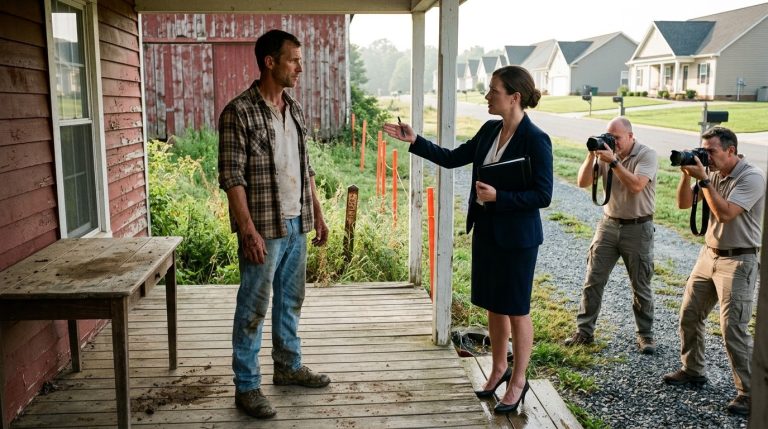
Patricia Caldwell was already descending the pine stairs before my driver’s door finished swinging open. She wore a tailored beige linen blazer with a white carnation pinned to the lapel, moving with the brisk, performative urgency of a woman accustomed to having sub-committees yield the floor.
“Daniel, don’t do this,” she said, keeping her voice pitched to that smooth, patronizing hum designed to calm difficult tenants. “My niece has two hours before the photographer arrives. We are not turning this into an administrative debate.”
“Who authorized lag bolts into my deck timber?” I asked, stepping down into the gravel.
“The board approved the recreational calendar six months ago,” Patricia said, holding her ground on the bottom riser with her chin tilted up. “The master amenities declaration lists this parcel as the community gathering house. You know that brochure as well as I do.”
“A sales brochure printed in ninety-nine isn’t a deed, Patricia. My father never signed the dedication rider, and you’ve known it since probate.”
“Daniel, be reasonable,” she whispered, her smile tightening until the edges showed white. “We have sixty guests driving up from the valley. You aren’t ruining a family milestone over a clerical footnote.”
Robert Hayes stepped around the corner of the firewood shed, balancing a plastic milk crate stacked with glass hurricane lamps. The moment he spotted my truck, his arms dropped, nearly spilling the glassware onto the stones.
“Daniel?” Robert exhaled, his neck reddening instantly. “Patricia said you executed the recreational lease on Monday.”
“He didn’t execute a thing,” Patricia snapped, spinning on him before I could answer. “There was a filing delay with county records, Robert. It is handled.”
“It isn’t handled,” I said.
I took the stairs two at a time, moving past her toward my front entryway. When my hand reached for the latch, my fingers hit cold, textured plastic instead of my heavy brass Baldwin handle.
The mortise deadbolt was gone. Bolted into the freshly chiselled pine jamb was a cheap, battery-powered electronic keypad, its plastic faceplate smeared with contractor grease.
I rattled the brass knob against the strike plate. It didn’t budge. A digital red light pulsed mockingly above the rubber buttons.
“Where is my lock?” I turned around, looking down at her from the threshold.
Patricia adjusted the lapel of her blazer, her fingers perfectly steady, though her eyes locked onto mine with cold, bureaucratic arrogance.
“Maintenance installed vendor access so the florists wouldn’t have to track you down at your shop,” she said evenly. “It’s temporary, Daniel. Stop performing for the caterers.”
Gravel exploded at the bend of the tree line.
A county pickup crested the rise, followed immediately by the twin whip antennas of two green-and-white sheriff cruisers, their tires chewing through my stone before the engines died in unison.
CHAPTER 2: PAPER SCARS AND THE BADGE
Laura Bennett climbed out of her dust-caked pickup before the engine fully died, holding a thick vinyl property binder against her ribs like armor. Her face was bloodless, her knuckles white.
“Daniel,” Laura called out over the chatter of linen-suited guests. “Your lower gate cameras didn’t glitch. The feeds went black at zero-seven-forty-two.”
I didn’t step toward her. I stayed on the bottom timber riser of my porch, letting my boots grind into the gray stone.
“Show me the terminal log,” I said.
She turned the tablet outward. Three camera sectors—lower turnaround, pump house, and front deck apron—displayed flat gray test cards stamped with identical red system notifications: HARDWARE SIGNAL LOSS: 07:42 AM.
Patricia Caldwell didn’t retreat an inch. She stepped down from the second riser, her heels punching small, precise punctures into the soft crabgrass. Her tone carried the effortless, acoustic projection of a veteran board director commanding an annual general meeting.
“Daniel, stop fabricating emergencies,” Patricia said, waving a dismissive hand toward the catering vans. “The mountain line has had voltage drops since winter. Our event staff brought an electrician up to patch a jumper line so sixty pounds of sea bass wouldn’t spoil in eighty-degree heat.”
“You touched my junction box?”
“We ensured an association-designated venue remained viable for a scheduled community milestone,” she countered, tilting her chin up. “Your property manager knows full well that our reciprocal covenants permit emergency maintenance on shared ridge runs.”
“There is no shared utility run on parcel four,” Laura said, her voice shaking with restrained fury as she flicked her tablet to the county tax parcel grid. “Not since ninety-six.”
A sharp crunch of crushed river rock cut the air in two.
Two green-and-white county sheriff cruisers rolled into the clearing, their low-profile grilles nosing past the rows of white folding chairs. The light bars remained dark, but the steel whip antennas whipped violent arcs against the lower pine boughs as they braked beside my rear tires.
Deputy Michael Grant stepped down first, his duty belt creaking as his boots hit the stone. Behind him, Deputy Rebecca Collins circled wide around the nearest catering sprinter, her eyes scanning the white hydrangeas, the sixty bewildered spectators holding lemonades, and the commercial prep line blocking my fire turn.
“Dispatch logged an active trespass and structural lock tampering,” Grant said, adjusting his Stetson against the midday glare. “Who called it in?”
“I did,” I said, stepping off the riser with my phone unlocked. “Daniel Morgan. Sole deed holder on parcel four.”
“This is an internal association matter, Deputy,” Patricia said smoothly, stepping between us with a hand outstretched that Grant pointedly looked past. “I’m Patricia Caldwell, president of the Cedar Ridge HOA. We are operating within our recorded master amenities charter.”
Grant let his thumbs rest behind the magazine pouches on his tactical vest. He didn’t take her hand. His gaze drifted to the clipboard clutched against the young parking kid’s ribs, then to the florist still ratcheting lag screws into my deck.
“You have the deed, Mr. Morgan?” Collins asked, unhooking a metal ticket binder from her door.
“Deed, plat survey, and the timber tax receipt stamped ten days ago by the county assessor,” I said, handing the screen to Collins.
She scrolled with a gloved thumb, comparing the coordinate bearings on the screen against the brass county survey cap half-buried in the moss ten feet from my bumper.
“Everything on file clears to Daniel Morgan,” Collins told Grant. “No active municipal liens, no public access dedications, no shared-amenity riders.”
Grant turned his gaze back to Patricia. His voice dropped into the flat, unhurried cadence of a road deputy who had spent twenty years untangling bad neighbors.
“Ma’am, where’s your signed lease agreement with Mr. Morgan?”
Patricia didn’t blink. Her smile set into hard porcelain.
“We don’t require an individual lease for an established historical amenity,” she said, gesturing vaguely toward the ridge crest. “The developer’s master plan clearly shows this lodge as the Cedar Ridge recreation hall. It has hosted seasonal events since before Daniel’s father passed.”
“Brochures aren’t legal titles, Patricia,” Robert Hayes muttered from behind her, his arms stiff, his face mottled red. “I asked you Tuesday night if you had Daniel’s signature on the usage rider.”
“The board approved the calendar, Robert,” she snapped, her voice tightening like a wound spring.
“The board doesn’t have the authority to saw a deadbolt off a private front door,” I said.
An old Ford Ranger wearing the faded blue stencil of Cedar Ridge HOA Maintenance rattled up the incline, spitting gravel and gray exhaust before shuddering to a halt behind Collins’s cruiser. Kevin Brooks stepped out clutching a stained cardboard box, his tool belt clinking against his thighs.
The instant he saw two marked units and Grant’s badge, every drop of color drained from his jaw.
“Kevin,” Grant said, knowing him on sight. “What do you have in the box?”
Kevin looked desperately toward Patricia, his throat bobbing as he choked on his own saliva.
“The… the original hardware, Deputy.”
“Set it on the hood,” Grant said.
Kevin shuffled forward, keeping his head ducked, and rested the carton on Collins’s cruiser. Inside sat my solid brass Baldwin mortise lock. The hardened steel retaining bolts had been sheared clean through by a reciprocating saw, lying next to two steel four-by-four posts sawed off at the root.
Both posts still bore their baked-enamel plates: PRIVATE PROPERTY — NO TRESPASSING.
“You cut my posts at the cattle guard?” I asked.
“I was handed a written work order,” Kevin stammered, pulling a crumpled yellow carbon slip from his pocket and thrusting it toward Collins. “Said to clear visual site line obstructions and install vendor keypad access for the Caldwell wedding. Signed by the board president at four-thirty this morning.”
Collins smoothed the wrinkled paper against her metal binder, reading each handwritten line under the glare.
Her head came up slowly, her eyes locking straight onto Patricia’s face.
“Ms. Caldwell,” Collins said, her voice completely stripped of procedural patience. “Why does this work order explicitly command the contractor to finish cutting the locks before five AM?”
CHAPTER 3: THE ARCHIVE ON SPEAKER
Patricia didn’t answer Deputy Collins immediately. She smoothed the lapel of her beige linen blazer, her manicured fingers tight against the fabric.
“Contractors in high-altitude terrain begin early to manage ambient temperatures,” Patricia said, her voice dropping into a dry, practiced cadence. “It is standard operational procedure across the Cedar Ridge development.”
“Not on deeded private ground, it isn’t,” I said.
I picked up the sheared brass bolt from the hood of Collins’s cruiser. The metal was still cold, the score marks bright and jagged where Kevin’s saw had chewed through the hardened pins. I thumbed the gouged face, letting the rough edge catch against my skin.
“Deputy,” Robert Hayes interjected, stepping out from the catering shadow with his phone held out. “Let’s put an end to the administrative ambiguity right now. I’m calling Elaine at the central office.”
He pressed the speaker toggle, holding the illuminated screen between Grant and Patricia. The line clicked twice against the mountain wind, carrying the restless murmur of sixty wedding guests across the turf.
“Elaine, you on the line?” Robert asked.
“I’m here, Robert,” a woman’s voice rasped through the small speaker. “I just pulled the digitized archive for Parcel Four.”
“Tell Deputy Grant what the original covenants say about the Morgan lodge,” Patricia ordered, taking a sharp half-step toward the phone.
“Do not coach the record, Ms. Caldwell,” Grant said without looking at her. “Go ahead, ma’am. What does the title chain indicate?”
The phone crackled with the sound of turning digital pages.
“The initial sales prospectus from nineteen ninety-nine shows a proposed community facility,” Elaine stated, her words carrying clearly across the driveway. “However, no deed conveyance was ever executed to the Cedar Ridge HOA. The master developer inventory explicitly stamped the parcel: Unacquired. Retained Morgan timber tract.“
Patricia’s mouth flattened into a thin, bloodless line.
“Check the executive board minutes from sixty days ago, Elaine,” Robert said, his jaw tightening until the tendons showed. “The session where Patricia moved to absorb the upper turnaround into the shared amenities schedule.”
A caterer carrying two white tubs of melting ice brushed past my shoulder, aiming for the kitchen ramp.
“Set those on the gravel,” I told him, stepping squarely across the timber incline. “Nothing crosses this threshold.”
The caterer looked at my boots, glanced at Grant’s sidearm, and dropped the tubs with a wet thud onto the stones.
“I have the entry,” Elaine’s voice returned, tighter now. “Regular session, March fourteenth. President Caldwell moved to formally incorporate the Mountain Lodge into the spring event calendar.”
“And the recorded vote?” Robert demanded.
“Three to one against,” Elaine answered. “Motion failed. The board entered a binding directive: No association events, maintenance funds, or equipment permitted on Parcel Four without an executed, notarized lease from Daniel Morgan.“
A dead silence fell over the turnaround, heavy enough to drown out the idling diesel.
Robert lowered the phone slowly, his eyes fixed on Patricia with cold disgust.
“You knew,” Robert said. “The board formally barred you from this parcel two months ago.”
“That resolution addressed long-term capital liability,” Patricia said, her voice rising as she glared at the circle of onlookers. “It did not revoke executive emergency discretion to accommodate an active resident hardship.”
“A hardship?” Laura Bennett stepped forward, thrusting her tablet toward Deputy Collins. “She didn’t just borrow your grass, Daniel. Look at the service panel on the eastern cedar wall.”
Collins took four long strides toward the utility shed near the back deck. The heavy master padlock securing my two-hundred-amp breaker enclosure had been sheared off with a pry bar, dangling from a fractured hasp.
Inside the open metal cabinet, two industrial orange feeder lines were tapped directly onto the unmetered main bus bar with raw alligator clamps, vibrating with a greasy, low-frequency hum.
Collins turned slowly, one hand resting on her tactical belt.
“Mr. Brooks,” Collins said, her voice dropping all remaining warmth. “Who authorized an unmetered, exposed bypass onto a live service panel on dry timber?”
Kevin backed up until his spine slammed into the tailgate of his Ranger, both hands raised in the air.
“I didn’t touch the panel,” Kevin stammered, his eyes darting toward the tree line. “She had an independent crew up here at dawn. She swore to them Daniel had executed an emergency utility waiver.”
A timber door swung open on the second-story deck.
The bride stepped out into the crisp mountain light, clutching the gathered satin train of her gown with both hands, her veil fluttering against the split-cedar rail.
“Aunt Patricia?” the young woman called down, her voice trembling in the silence. “The kitchen power just dropped out. What is going on?”
Patricia opened her mouth to project her standard reassurance, but Deputy Collins took two measured strides toward the steps, unsnapping the carbon-copy summons pad from her chest pocket.
“Don’t answer that, Ms. Caldwell,” Collins ordered. “Step away from the porch stairs. Immediately.”
CHAPTER 4: THE STRATEGIC EVICTION
The hum coming off that breaker box was a low, greasy drone that vibrated straight through the sole of my boots into the dry cedar decking.
I didn’t wait for a utility truck. I walked past Patricia, straight to the bed of my truck, and pulled my insulated eight-inch lineman’s pliers from the steel box.
“Daniel, don’t touch that line,” Laura called out, tracking me from the steps. “Let the county inspector log it.”
“The county inspector is forty-five minutes down the pass,” I said. “And this whole porch is dry-cured pine.”
I stepped up to the open metal box. The insulation on the orange drop cords was already bubbling where the alligator clamps met the copper bus bar, giving off the sharp, sickly stench of scorched resin and ozone. With one clean, two-handed bite of the hardened steel jaws, I sheared the secondary lead feeding the patio warming array.
A violent blue spark cracked against the enclosure wall, and the heavy drone died.
Across the lawn, three commercial holding cabinets cut out with a dull click, their digital heat displays winking dark.
“You have no right to do that!” Patricia screamed, lunging forward until Deputy Grant’s forearm came up like an iron gate. “There is four thousand dollars of prepared catering in those warmers!”
“You’re running an exposed high-voltage tap on dry mountain timber without an inspection sticker,” Grant said, his voice flat as slate. “Be grateful Mr. Morgan isn’t pressing for immediate reckless endangerment.”
Up on the second-story balcony, the bride hadn’t moved. The afternoon wind pulled at her veil, whipping the lace against the handrail where Kevin’s saw had left raw, jagged gouges in the cedar.
“Aunt Patricia,” she called down again, her voice shaking hard enough to carry across the sixty silent guests. “You told us the board donated the lodge. You told Mark the booking was filed in January.”
Patricia didn’t look up at her niece. Her eyes remained fixed on the badge pinned to Grant’s chest, her jaw twitching as the veneer of neighborhood authority gave way to raw, cornered malice.
“We have sixty guests who drove two hours from the valley, Deputy,” Patricia rasped, dropping into an urgent, conspiratorial whisper. “Give us twenty minutes. Just twenty minutes for the processional and one photograph on the lawn. Everyone leaves immediately after.”
Grant looked over his shoulder at me. He kept his thumbs hooked behind his utility belt, leaving the jurisdiction entirely on deeded ground.
“Your parcel, Mr. Morgan. Your call.”
I looked across the crabgrass—at the floral arch bolted into my railing, the crushed river stone kicked across the yard, and the six catering workers already standing back with their arms crossed.
“No,” I said. “Not twenty minutes. Not five.”
Patricia’s face contorted, every trace of suburban polish tearing away.
“You are a bitter, miserable man, Daniel,” she hissed, stepping close enough that I could catch the stale chemical scent of her hairspray. “Ruining a young girl’s wedding over an empty patch of mountain dirt nobody touches ten months of the year.”
“I touch it,” I said, dropping the pliers back into my canvas pocket. “And I don’t break into your house when I need a venue.”
Deputy Collins didn’t wait for Patricia to answer. She turned squarely toward the wedding coordinator, who was clutching two vibrating phones against her waist.
“Ma’am,” Collins said, using her command voice. “Instruct your crews to pack the sprinter vans. Move all private vehicles down to the county pullout at mile marker four. Orderly, quiet, and right now.”
The coordinator didn’t look at Patricia. She gave Collins a single, sharp nod, whistled toward the deck, and within thirty seconds the florist was unbolting the steel brackets from my cedar rail.
There were no handcuffs. There was no shouting. The entire performance dissolved under the quiet, steady pressure of two county uniforms watching every folding chair get stacked into the trucks.
The bride came down the stairs slowly, gathering her train off the dusty stones with both hands. When she reached the apron of my driveway, she stopped beside my front fender, her eyes red, her shoulders tight.
“I’m sorry,” she whispered. “We honestly didn’t know.”
“I know you didn’t,” I told her. “Take the reception to the valley hotel. They have open ballrooms on weekends.”
She nodded once, pulled a wool coat over her shoulders, and climbed into the back of a black SUV.
By the time the last catering van crested the ridge, the only sound left was the mountain wind whispering through the high needles of the pines.
Kevin Brooks stayed on his knees by my front entry, sweating through his shirt as he backed the last sheet-metal screw out of the plastic keypad, carefully setting my original brass mortise deadbolt back into the splintered pine jamb.
Robert Hayes walked out of the empty lodge, holding a heavy manila folder he had pulled from the kitchen counter beside the utility meter.
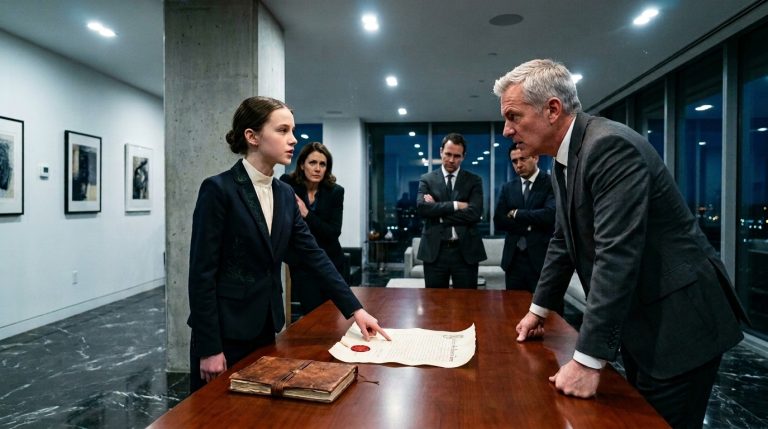
“Daniel,” Robert said, his face pale under the afternoon shadow. “You need to see what Patricia left beside the ledger.”
CHAPTER 5: THE CLUBHOUSE RECKONING
Five hours of scraping floral adhesive off my cedar decking didn’t lift the stench of scorched insulation, but the fluorescent lights of the Cedar Ridge clubhouse were cold enough to freeze it.
I dropped the manila folder onto the laminate conference table with a flat, hollow slap.
Thirty homeowners packed the folding chairs along the back wall. The murmurs died the second the cardstock hit the fake wood. At the head of the long table, Patricia sat rigid, her beige blazer traded for charcoal wool, her knuckles resting flat over an empty yellow legal pad.
“This assembly is completely out of order without a fifteen-day statutory notice,” Patricia said, addressing the gallery rather than the directors seated beside her. “Mr. Morgan had an operational disagreement with our logistics vendor. It is a neighborly friction, not an executive emergency.”
“It’s a criminal trespass file, Patricia,” Robert Hayes said, not looking up as he peeled the top document from my folder. “And you paid Kevin Brooks out of the common grounds fund to commit a break-in.”
Mark Ellis, the association’s legal risk representative, leaned forward from the far corner of the table, tapping a red ballpoint against an open policy binder.
“Mr. Hayes is correct,” Ellis said, his voice stripped of small-town gentility. “I pulled the general liability declaration for Cedar Ridge twenty minutes ago. Parcel Four has never been an insured common element. If that spliced drop line had sparked a brush fire, every director at this table would have faced direct, unindemnified joint-and-several personal liability.”
A sharp, collective intake of air hissed through the gallery.
“The original sales prospectus clearly established customary recreational usage,” Patricia shot back, her voice tightening like wire. “The developer’s explicit intent was to absorb the lodge into the master plan.”
“Intent?” Elaine Foster spoke up from behind the audiovisual console. She tapped a keystroke, and the white projection wall flickered with the scan of an aged land transfer. “Here is the final developer settlement checklist from nineteen ninety-nine. Your handwritten initials are on the margin from April third of this year, Patricia.”
She zoomed in on the recorded release clause: Parcel Four retained exclusively by Morgan estate. All temporary drainage and utility licenses terminated upon phase-one completion.
“You reviewed this,” Robert said, turning squarely toward her. “You sat in the county records basement sixty days ago, read the termination, and still handed Kevin a hacksaw.”
“I was protecting this development’s solvency!” Patricia snapped, her voice cutting through the room with sudden, vicious ferocity. “The lower drainage berms behind the fourth fairway have sixteen hundred feet of unmitigated runoff washing down from Daniel’s ridge. If we don’t establish active maintenance and public domain over that ground, the county water district is going to assess Cedar Ridge four hundred thousand dollars for watershed stabilization!”
The silence in the hall was instantaneous and suffocating.
The grand alibi was gone. This had never been about a family wedding or a niece’s dress. It was a calculated, fraudulent annexation designed to force my private timber line into an unmaintained drainage basin to shield thirty over-leveraged suburban lots from a county assessment.
“You don’t cure a civil drainage debt by stealing a man’s front door,” Robert said softly.
He turned his gaze around the board table, where the other three directors were already holding their pens ready.
“I move to strip Director Caldwell of all executive signing power, administrative oversight, and financial access, effective immediately, pending a complete forensic audit of the maintenance ledger.”
“Seconded,” called the treasurer from the far end.
“All in favor?” Robert asked.
Four hands went into the air without a second’s hesitation.
Patricia didn’t move. Her jaw set hard enough to crack enamel, her hands frozen against the blank legal pad as thirty of her neighbors watched her authority evaporate.
The rear crash door swung open with a heavy mechanical wheeze. Deputy Collins walked through the doorway, her boots squeaking against the waxed floor, holding a green carbon-copy citation sleeve.
“Mr. Morgan,” Collins said, stepping up to the perimeter of the table. “Our dispatch just received the itemized billing logs from the valley catering firm.”
She slid the paperwork onto the table, stopping it an inch from Patricia’s rigid fingers.
“They provided the original billing intake,” Collins said, her voice carrying into every corner of the dead-silent hall. “The deposit wasn’t billed to any wedding party. It was paid with an association cashier’s check drawn directly from the Cedar Ridge Capital Reserve account.”
CHAPTER 6: THE BOUNDARY LINE HOLDS
Ninety days later, the mountain timber didn’t care about association minutes, but the cedar posts held their ground.
I drove the final galvanized lag screw into the lower gatepost with a short, heavy pull of the ratchet, feeling the coarse threads bite deep into the green heartwood. The socket clicked twice, dead solid.
The new steel sign sat level against the timber, black baked enamel over quarter-inch brushed aluminum: PRIVATE PROPERTY — MORGAN TIMBER PARCEL — NO PUBLIC ACCESS — TRESPASSERS PROSECUTED UNDER COUNTY CODE 44-A.
Beside the turnaround, Laura Bennett leaned against the tailgate of her pickup, checking off the final line on her tablet before sliding the stylus into her leather vest.
“The settlement voucher for the deck restoration cleared the bank yesterday morning,” Laura said, looking up toward the wrap-around porch. “Robert Hayes signed the draw himself as interim receiver. No dispute from the new board.”
“Good,” I said, dropping the ratchet into my steel chest with a sharp clang.
The deck looked right again. The saw marks Kevin’s reciprocating blade had chewed into the handrail had been planed true, sanded flush, and sealed with double coats of dark boiled linseed and pine tar. In the front entry jamb, the original brass Baldwin deadbolt was bedded into fresh oak shims, throwing its heavy square bolt with a deep, mechanical thud that required neither batteries nor a four-digit permission slip from a suburban committee.
Down the winding switchbacks, Cedar Ridge sat under a thin blue autumn haze, its red-tiled roofs clustered inside their manicured loop like cattle bunched against a fence.
The emergency audit had done its work without mercy. Elaine Foster’s forensic trail exposed eighteen months of fraudulent “facilities maintenance” transfers, forcing the county prosecutor to take the catering check and contractor work orders to a grand jury.
The insurance carrier’s denial stuck like cement. Stripped of indemnification, Patricia Caldwell was personally facing the contractor liens, the caterer’s civil judgment, and a special assessment levy that the interim board slapped on her home to repay the raided capital reserves.
Her beige linen blazers were gone from the clubhouse. Her name had been scrubbed from every digital ledger, replaced by a court-appointed monitor tasked with restructuring the four-hundred-thousand-dollar drainage deficit she had tried to dump across my timber line.
A white commercial van rattled up the incline, its tires crunching slow across the fresh three-quarter-minus gravel.
The driver rolled down his window as he reached the cattle guard, looking past the steel boundary plate toward the open lodge.
“Daniel Morgan?” he called out.
“That’s me,” I said, stepping off the grass with my work gloves tucked under my arm.
“Delivery for the weekend forestry retreat,” he said, handing a clip manifest through the cab window. “Booked through Bennett Land Management. Copy of the county land-use permit, insurance certificate, and deposit receipt attached.”
I checked the signature lines, verified the policy endorsement, and initialed the carbon slip against the van’s door.
“Drive five miles an hour through the culvert,” I told him. “The gravel is still setting.”
“Understood, sir.”
He eased the van through the cleared approach without scraping a single post, parking cleanly beside the side ramp to unload folding survey tables.
A sharp gust of wind came through the upper canopy, smelling of cured cedar, dry pine needles, and the cold, unyielding iron of the tools in the bed of my truck.
The front door was locked. The deed was clean. And down the mountain, the boundary held.