A Silent Storm: The Calculated Reclamation of Honor in a Town Built on Forgotten Scars
CHAPTER 1: The Weight of Steel
The asphalt was a textured expanse of gray, slick with the remnants of morning dew and spilled oil. Walter Briggs didn’t feel the sting of the slap so much as the calculation of its impact. He remained upright, his boots braced against the concrete, though the sudden force had sent a jarring vibration up through his spine. In his left hand, the paper bag containing his loaf of bread had snagged, the crust now speckled with oily grit and city dust.
He didn’t reach for his face. To acknowledge the pain was to grant the biker an audience he hadn’t earned.
The biker stood over him, a mountain of synthetic leather and polished chrome, his sunglasses reflecting the overcast sky with a flat, impenetrable stare. He wasn’t breathing hard; he was feeding on the silence of the street. Behind him, the bar crowd lingered—a loose assembly of figures sipping lukewarm beer, their faces masks of deliberate indifference. They weren’t just ignoring the violence; they were actively curating the space where it was allowed to exist.
Walter turned his head slowly. The movement was stiff, methodical, the result of years of keeping his range of motion within the limits of a body that had survived two separate war zones. He looked down at the bread. The tear in the paper was jagged, exposing the soft white interior to the sterile air of the street.
“You missed,” Walter said. His voice was a rasp, a sound built of gravel and quiet patience.
The biker scoffed, a quick, sharp exhale that smelled of stale tobacco and fermented ego. “Old man, you should have watched where you were walking. Your kind doesn’t belong on this side of the road.”
Walter didn’t respond to the bait. He didn’t look at the biker’s fists, but at the reflection in the chrome handlebar of the motorcycle. In that warped, convex mirror, he saw not just the biker, but the entire street—the way the shadows elongated, the way the waitress at the diner began to turn her back, and the way the boy across the street pulled his jacket collar up, obscuring his face. It was a precise, calculated erasure.
He reached into his jacket pocket. His fingers found the rigid, rectangular edge of his phone. It was an archaic piece of technology, its screen fractured into a spiderweb of hairline cracks, but the buttons remained responsive.
As he withdrew his hand, he noticed something that shouldn’t have been there. Lying on the ground, inches from where his cane had skidded, was a small, silver pin. It wasn’t his. It was a unit insignia—the 7th Infantry—clean, polished, and entirely out of place in the grime of the gutter. He frowned, the sharpness of the realization cutting through the throbbing in his jaw.
The biker stepped forward, his boot looming, but Walter was already looking past him, his eyes scanning the horizon where the tree line met the sky. A low, subsonic vibration began to hum beneath the soles of his boots. It wasn’t the sound of a truck. It was too rhythmic, too deliberate.
The biker shifted, his smirk faltering as the air around them suddenly grew heavy, pressing down with the weight of an approaching storm.
CHAPTER 2: The Echo of the Rotor
The vibration traveled through the soles of Walter’s boots, climbing his shins like an icy current. It was a frequency he hadn’t felt since the border in Kosovo, a sound that bypassed the ear and resonated directly in the bone. Beside him, the biker had ceased his posturing. The man’s head was tilted, his gaze flickering toward the treeline with a sudden, twitchy agitation. He didn’t know what was coming, but his nervous system did.
Walter remained seated on the weathered wooden bench, his hands resting on the curved grip of his cane. He watched the biker’s hands—the way the knuckles whitened as they gripped the brake lever of the motorcycle. The arrogance was still there, but it was thinner now, fraying at the edges like a cheap garment caught on a nail.
“You hear that?” the biker muttered to his friends. His voice lacked its earlier bite, dropping into a jagged, questioning register.
One of the men by the bar squinted into the sky, shielding his eyes from the weak, grey light of the noon sun. “Sounds like a storm,” he replied, though the tone was hesitant.
Walter didn’t look up. He was busy cataloging the shift in the environment. The waitress, who had moments ago turned her back to the sight of an old man cleaning bread off the pavement, was now standing at the diner window, her palm pressed flat against the glass. The teenager with the earbuds had pulled them out, the white wires dangling like discarded umbilical cords against his chest.
In the silence that followed the thrum, Walter felt a sudden, sharp intrusion: the phantom smell of diesel fuel and burning rubber, a sensory ghost from 1970. He felt the phantom weight of a soldier’s webbing against his chest, the familiar, suffocating heat of a jeep engine fire. He blinked, grounding himself in the cool, biting air of 2025. This was not a memory. This was an arrival.
The thrum matured into a rhythmic, air-shattering beat. The birds in the street-side trees went silent at once. From beyond the brick facade of the hardware store, the first edge of the Blackhawk emerged, black against the bruising clouds. It was moving with an unnatural, predatory grace, descending low enough to make the storefront windows rattle in their frames.
Walter felt his jaw tighten, not from the insult of the slap, but from the immense, crushing weight of what this arrival represented. His son didn’t just come to help an old man. He came to dismantle the environment that had allowed the violence to occur.
The biker stumbled back a step, losing his footing on the loose grit of the gutter. He looked frantic now, his gaze darting toward his friends as if hoping for a collective denial of the reality descending upon them. “What is this?” he shouted, but the rising roar of the rotors swallowed his voice, turning his panic into a silent, frantic pantomime.
The helicopter descended into the open lot behind the row of shops, kicking up a whirlwind of dust, discarded receipts, and street-level debris. The pressure shifted, the air becoming thick with the scent of jet fuel—a hard, chemical sharp edge that burned in the back of Walter’s throat.
The biker made a move to climb onto his motorcycle, his movements frantic and uncoordinated. He was no longer the predator; he was a trapped animal caught in the sudden illumination of a searchlight.
Walter stood, his joints protesting with a dull ache, but he moved with a fluid, practiced resolve. He didn’t look at the biker. He looked at the horizon, where the matte black SUV was already tearing around the corner, its tires biting into the pavement with surgical precision.
The scene was collapsing. The social order that had allowed the biker to strike him—that comfortable, passive ignorance of the crowd—was being systematically disassembled by the sheer velocity of the response. Walter saw the waitress pull her hand back from the glass, her face pale. He saw the teenager drop his phone, his mouth hanging open in a silent gasp.
The SUV screeched to a halt in front of the bar, the sound of the brakes a harsh, metallic scream that seemed to signal the final curtain on the biker’s display of power. Doors opened. The figures that emerged didn’t move like civilians; they moved like gears in a master clock, each step calculated to close the gap, each gaze scanning for threats that didn’t exist, but which they were entirely prepared to neutralize.
Walter leaned on his cane, the cold metal biting into his palm. The biker was standing paralyzed, his bike idling, his bravado gone. He was looking at the lead man stepping from the SUV—a man who carried himself with the same weary, steel-edged authority that Walter had spent his entire life trying to hide.
The air smelled of iron and cold, wet asphalt. The silence between the biker’s realization and the soldiers’ arrival was absolute, a vacuum that waited to be filled with the weight of consequence. Walter breathed in, the scent of the street sharpening, his heart steadying into the rhythm of a man who had seen the end of a conflict before, and knew precisely how it had to be resolved.
He took a step toward the edge of the curb. He wasn’t afraid. He was simply waiting for his son to speak, and for the world to finally be forced to pay attention.
CHAPTER 3: The Tactical Sequestration
The ringing in Walter’s ears was a thin, high-pitched wire of sound, a residual ghost of the rotor wash that had just scoured the street clean of its complacency. He didn’t reach for his hearing aid; he simply stood there, his boots planted on the cracked sidewalk, and watched the transformation of the scene. The dust was still settling, a fine grey powder coating the chrome of the motorcycles and the polished leather of the biker’s vest.
The street felt smaller now. The tactical team had fanned out with a silent, synchronized efficiency that made the surrounding shops look like mere props on a stage. They weren’t armed in the traditional sense—no weapons were drawn—but the way they stood, their hands resting near the small of their backs, their gazes fixed on the biker with the cold, unblinking intensity of predatory birds, created a barrier that no one dared cross.
The biker was trembling. It was a fine, rhythmic tremor that started in his hands and traveled through his entire frame, causing the leather of his jacket to creak in the sudden, oppressive quiet. He looked at the soldiers, then at the Blackhawk looming like a dark monolith in the empty lot behind the stores, and finally at Walter.
Walter saw the realization hit him. It wasn’t just the display of force; it was the specific, targeted nature of it. This wasn’t a police response. This was something older, something more deliberate.
“I didn’t… I didn’t know,” the biker stammered. His voice was a thin, reedy thing, stripped of all its earlier bravado. He reached out, his hand hovering near his motorcycle, but a sharp look from one of the tactical officers—a man with deep-set, hollowed-out eyes—froze him in place.
Walter took a step forward, his cane tapping rhythmically against the concrete. Each sound was like a hammer blow in the vacuum of the street. He didn’t rush. He moved with the slow, inevitable momentum of a glacier. He was acutely aware of the tactical team’s presence, the way they shifted slightly to provide him a clear path, treating him not as an injured civilian, but as a superior officer entering a secure zone.
The sensory world felt warped. The air still tasted of jet fuel, sharp and biting, but the edges of the buildings seemed to blur, a disorienting ripple in his perception caused by the high-pressure descent of the helicopter. He focused on the biker’s face, looking for the telltale signs of the trauma he suspected lay beneath the surface. He saw the way the man’s eyes darted, the frantic, panicked rhythm of his breathing, the specific, defensive posture of his shoulders.
“You didn’t know,” Walter repeated. His voice was steady, lacking any trace of heat. It was the voice of a man who had spent forty years repairing engines, meticulously searching for the source of a breakdown. “You thought you were standing on solid ground. You thought the silence of the street was an invitation.”
The biker looked at him, and for a fleeting second, the wall of anger dropped, revealing a hollow, aching vulnerability. “My dad…” he started, then cut himself off, his jaw clamping shut.
Walter paused, his internal perception sharpening. The V-4 variance—the lingering, disorienting effects of the sonic pressure—seemed to recede, leaving him with a clear, crystalline view of the man before him. He saw the way the biker’s gaze rested on the insignia on the tactical team’s gear, a look not of hatred, but of a confused, deeply rooted resentment.
The tactical lead, the man in his early fifties who Walter recognized as the operational commander of the unit, stepped forward. He stood at the edge of the biker’s personal space, his posture relaxed but completely dominant. He didn’t speak. He simply waited, his presence a wall of iron that effectively cut the biker off from the rest of the world.
Walter looked at the commander. He recognized the jawline, the way the man held his shoulders, the inherent, disciplined focus that had been passed down, not through words, but through the hard, relentless training of a life spent in the service of others. This was the contingency he had helped build, the silent net cast over the members of the Old Guard, a promise that they would never truly be alone.
He looked back at the biker. The man was trapped. He was caught between the physical reality of the blockade and the psychological weight of his own history. The people in the diner were no longer peering through the glass; they were stepping out onto the sidewalk, their faces etched with a mixture of fear and growing understanding. The dynamic of the street had shifted permanently.
Walter felt the weight of the moment—the convergence of past and present, the collision of a forgotten duty and a desperate, fractured future. He knew the tactical team would hold the space until the local authorities arrived, but he also knew that the true resolution wouldn’t be found in a police report. It would be found in the silence that remained after the motors stopped, in the moment when the dust finally settled and the man before him had no more excuses left to hide behind.
He leaned slightly on his cane, the metal cold against his palm, and waited for the next movement in the orchestration of this, the most public and the most private of his deployments.
CHAPTER 4: The Mirrors Edge
The air felt thin, ionized by the lingering presence of the tactical team, but for Kyle, the world had shrunk to the space between his own trembling boots and the tip of Walter’s cane. The detachment that had defined his earlier behavior—the swagger, the practiced cynicism—had evaporated, leaving behind a raw, exposed nervous system. He wasn’t looking at the soldiers anymore. He was looking at the man he had struck, and for the first time, he wasn’t seeing an obstacle to his pride. He was seeing a reflection he didn’t recognize.
“My dad,” Kyle repeated, the words tearing out of his throat like jagged glass. He didn’t look at the tactical commander, who remained an immovable silhouette of authority just a few feet away. His eyes were fixed on the faded, patched olive of Walter’s jacket, the fabric a testament to decades of endurance that made his own leather vest look like the fragile, costume-like armor it was. “He didn’t come back right. He… he sat in the garage for three years. Just stared at the wall.”
Walter stayed perfectly still. He felt the cold concrete beneath his heels, the hum of the distant, idling Blackhawk vibrating through the soles of his boots. He noticed the way the tactical commander’s hand moved almost imperceptibly toward his radio, a subtle signal that the objective had shifted from containment to de-escalation. The environment had become a pressure cooker, and Kyle was beginning to boil over.
“I hated the smell of that oil,” Kyle continued, his voice rising, breaking into a frantic, high-pitched register that drew the attention of the growing crowd of onlookers. “Every time he put that jacket on, I knew I was losing him again. I saw you… you reminded me of every day I spent wondering if he was ever going to look at me, or if he was just going to stay trapped in that uniform.”
Walter felt a cold, sharp stab of recognition. This was the decoy—the “why” that Kyle had built to justify his existence. He had spent years externalizing his father’s trauma onto anyone who dared to embody the service he despised. It was a perfectly constructed, fragile logic, and it was currently collapsing under the weight of the tactical reality surrounding him.
The variance—the butterfly detour—hit when Kyle suddenly lunged, not toward Walter, but toward the ground, his fingers clawing at the asphalt. He snatched up the piece of his life he’d been trying to hide: a small, weathered photograph that had fallen from his pocket during the initial encounter. He gripped it so hard his knuckles turned white, a desperate, clumsy attempt to anchor himself to the reality he was currently losing.
“You don’t know what it’s like!” Kyle hissed, his gaze darting around the circle of men who watched him with eyes like cold flint. “You think you’re heroes? You’re just ghosts. You’re all just ghosts holding onto a war that ended before I was born!”
The commander stepped in, his movement not aggressive but absolute. He didn’t raise his voice. He didn’t use his hands. He simply closed the distance until he was a looming, inescapable shadow in Kyle’s peripheral vision. “Your father’s service didn’t take him from you, son,” the commander said, his voice deep and resonant, vibrating with the authority of the contingency Walter had helped forge. “The trauma took him. And you’ve spent your life fighting the wrong enemy.”
Walter watched the interaction with a detached, clinical focus. He saw the way the commander’s words acted as a physical blow, grounding Kyle’s erratic energy. The air on the street seemed to grow heavier, the shadows lengthening as the sun began to dip behind the buildings. The silence was no longer empty; it was laden with the weight of unsaid truths.
Kyle collapsed back onto his heels, the photograph crinkling in his grip. The bravado had failed him; the social armor he’d constructed from hate had been stripped away by the tactical reality of the situation. He looked at the soldiers, really looked at them, and saw that they weren’t the monolith he had feared, but men—men who, like him, carried the scars of a life defined by duty and service.
Walter felt the shift in the atmosphere. The “Open-Ended” clause of his own mission was tightening. The situation had escalated beyond the simple enforcement of order; it had become a confrontation with the psychological debris of an entire generation. He saw the local police cruiser pull to the edge of the lot, its lights muted, its officers hesitant to interfere with the scene that had already been brought to a calculated, orderly standstill.
“It isn’t too late,” Walter said, his voice cutting through the ringing in his ears. He didn’t move toward Kyle, but his presence was a magnetic force. “But it requires you to stop fighting the mirror and start looking at the man.”
Kyle looked up, his face streaked with dirt and sweat. He was a man who had reached the absolute edge of his own capability, and for the first time, he didn’t try to cross it. He stayed on the ground, a broken, exposed figure, finally still, while the city around them stood in frozen, breathless anticipation of what would come next.
CHAPTER 5: The Cleansing Silence
The air felt electrified, heavy with the scent of ozone and the damp, metallic tang of the cooling asphalt. Kyle remained on his knees, his hands resting in the dirt, his focus narrowed to the grain of the pavement. He looked smaller now, stripped of the leather and the motorcycle, a man caught in the spotlight of his own failures. Around him, the street had undergone a subtle, tectonic shift. The diners were no longer hiding; they were forming a ragged, cautious perimeter, their movements hesitant but deliberate.
Walter felt the shift in the pressure of the scene. The tactical commander remained at his post, a silent sentinel, but the focus was moving away from the tactical blockade. It was moving toward the town itself. A woman moved through the crowd—the waitress from the diner, the one who had peered through the glass when the initial assault occurred. She walked with a stiff, unnatural gait, her hands clutching a small, bundled object to her chest.
She stopped several paces away from Walter. She didn’t look at the tactical team or the prone man on the ground. Her gaze was locked onto the faded, patched olive jacket on Walter’s frame. The object she held was a piece of fabric—a service cap, frayed at the edges, the brim cracked and stained with the patina of decades. It looked exactly like the gear Walter had worn in the service, a piece of his own history manifesting in the present.
“I kept it,” she whispered. Her voice was thin, barely audible over the distant thrum of the idling Blackhawk. “My father left it behind. He never talked about it. He just… he just left it in the back of the closet.”
Walter felt a cold shiver run down his spine, not from the temperature of the air, but from the weight of the realization. This wasn’t just a coincidence. This was the ripple effect of the silence he had maintained for years. Every time he stayed quiet, every time he accepted the invisibility, he had allowed the town to bury the truth of what he—and men like him—had done. The cap in her hands was a mirror of his own history, a physical token of the burden the townspeople had been carrying in their own basements and closets.
Kyle looked up, his eyes glassy and unfocused, as he saw the cap. He recoiled slightly, as if the object itself were a physical threat. “You keep them all,” Kyle muttered, his voice a broken wheeze. “You keep the secrets and you keep the uniforms and you act like you’re the only ones who remember.”
“We didn’t know how to ask,” the waitress said, her voice strengthening, though her hands trembled. She stepped forward and laid the cap on the bench beside Walter. It sat there, a crown of forgotten duty, resting on the worn wood.
The tactical commander stepped back, granting them the space. The crowd watched in breathless, agonizing silence. The tactical team’s presence, once a tool of intimidation, had become a catalyst for a public, agonizing exposure. The town was no longer a stage for the biker’s display; it was a confessional.
Walter looked at the cap. He felt the phantom weight of his own gear, the memories he had tried to leave behind in the mud of other countries. He realized then that the contingency his unit had planned—the “Eagle 6” protocol—was not just for his protection. It was for the protection of the history that lived in the blood of this town. By forcing the issue, by creating this moment of unavoidable clarity, they were breaking the seal on a decades-long silence.
“I didn’t ask you to remember,” Walter said, his voice reaching out to the crowd, to the woman with the cap, and to the broken man on the ground. “I just asked you to see.”
The atmosphere in the street grew even more claustrophobic. The local police, standing near their cruiser, seemed to recede into the background, their role rendered moot by the sheer gravity of the human exchange. The silence was absolute, a heavy, velvet curtain that silenced the hum of the city and left only the sound of breathing, of weeping, of the slow, grinding realization that the world had changed.
Kyle lowered his head, his chin resting against his chest. The fight had drained out of him, replaced by a devastating, hollow clarity. He finally understood that his rage was a ghost, a reaction to a void he had helped maintain through his own indifference.
Walter turned, his gaze scanning the people he had lived among for twelve years. He saw the recognition in their eyes, the dawning shame, and the beginning of an empathy that felt, in its nascent form, like the most dangerous thing they had ever encountered. The blockade held, but the walls were no longer made of tactical gear. They were made of the collective memory of a town that had finally been forced to wake up.
CHAPTER 6: The Final Equilibrium
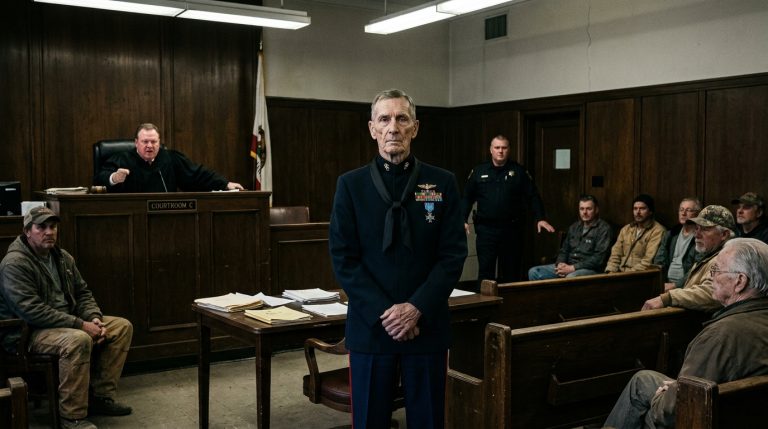
The courthouse room was small, lit by the harsh, unflattering fluorescent glow that seemed to strip the color from everything it touched. Kyle sat at the defendant’s table, his shoulders hunched, his hands resting on the laminated surface. He wasn’t the same man who had stood outside the bar with a smirk and a fist; the intervening weeks of therapy, the grueling, repetitive work at the VA, and the crushing weight of the public exposure had scoured him clean.
Walter sat in the gallery, his cane leaning against the wooden pew. Beside him sat the commander, his tactical gear replaced by a sharp, civilian suit. They were there not as a show of force, but as witnesses to the conclusion of a sequence that had begun on a cold, grey sidewalk.
The judge entered, the room rising in a rustle of fabric. There was no spectacle. The trial had been brief, the outcome predetermined by the sheer, undeniable reality of the public record. As the judge spoke, detailing the restitution, the mandated service, and the clear, legal weight of the actions taken, Walter felt a strange, detached stillness. The Layer 2 truth—the “Eagle 6” contingency—was no longer a shadow-protocol. By its very nature of being used, it had become a public, tangible fact. It was a shield, forged in the fires of past service, designed to ensure that those who had stood in the line of fire would never be left to face the cold indifference of the world alone.
“Mr. Briggs,” the commander said quietly, leaning toward Walter as the proceedings wound down. “The town is ready. The field is being prepared.”
Walter nodded. He looked at Kyle, who had turned his head slightly to catch a glimpse of the gallery. For the first time, their eyes locked. There was no malice left, only the hard, grinding acknowledgment of a shared, painful road. Kyle turned back toward the judge, his posture straight, his commitment to the service he was about to render clearly etched into the set of his jaw.
The exit from the courthouse was a quiet affair. Outside, the air was crisp, the sky a clear, piercing blue. The town square was not the same one Walter had navigated for twelve years. The memorial plaque, mounted on the polished stone wall, caught the light of the afternoon sun. In honor of Sergeant Walter Briggs, a quiet shield between us and chaos.
Walter walked to the base of the stone. He reached out, his weathered hand resting on the cool surface. He thought of the bread, the dust, the cold wind, and the sound of the rotors. He thought of his son, standing a few paces back, his face a map of the same discipline and burden he had carried his entire life. The contingency had worked. The Old Guard had been protected, not by violence, but by the overwhelming, quiet weight of accountability.
He reached into his pocket and pulled out a small, steel repair kit—a legacy from his time as a mechanic, an object he had used to fix jeeps in Hugh City and to tighten the handle of his own cane on the day of the assault. He knelt, a difficult, deliberate motion, and adjusted the brass fitting at the base of the plaque that had been slightly misaligned by the construction crew. It was a small act, a moment of maintenance, a symbolic repair that mirrored the work he had done on the street.
The crowd that gathered was sparse, respectful. No cameras, no fanfare. Just people—a mother and her son, a veteran in a faded navy cap, the waitress from the diner—standing in a semi-circle. Kyle approached, his gait steady, his movements measured. He stood beside Walter, and without a word, he placed a small, white flower on the stone.
“I’m starting my shift at the center,” Kyle said, his voice level. “I’ll see you there.”
Walter watched him walk away. The sun began to dip, casting long, elegant shadows across the field that now bore his name. He felt a deep, profound sense of equilibrium. The mystery of the “Eagle 6” was no longer a secret, but a quiet, foundational truth that gave the town a new set of stakes. They knew now that they weren’t alone, that there was a weight to their community, a history that demanded to be seen and respected.
He sat on the bench, the same one he had occupied on the day the rotors hummed, and exhaled. His son sat beside him. They didn’t speak; they didn’t need to. The wind moved through the trees, a soft, rustling sound that might have been the phantom of the Blackhawk, or might have just been the breath of the town itself.
Walter felt the weight of his jacket, the familiar, comforting ache in his joints. He had spent his life standing, a quiet marker in a world that often forgot the cost of its peace. Now, he was part of the landscape. He was part of the history. And as he watched the boy on the bicycle pause at the edge of the field, nod respectfully, and continue on his way, he knew that the shield was secure. The chaos had been held at bay, the scars had been acknowledged, and for the first time in a very long time, the road ahead felt quiet, steady, and entirely his own.