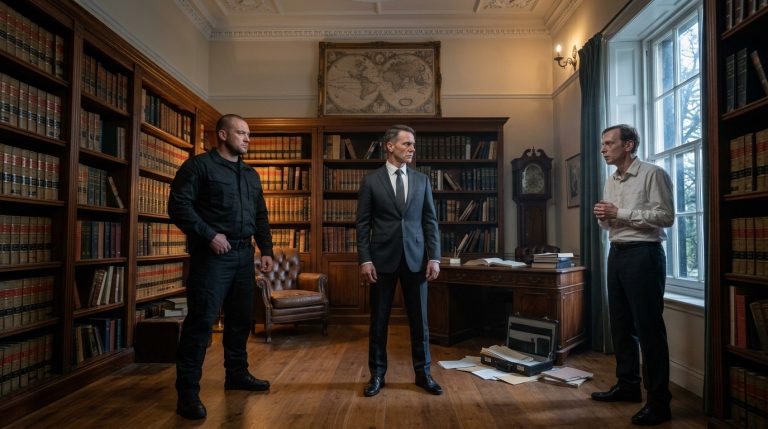
A Softness in the Stone: How a Broken Maid Built a Sanctuary in a Syndicate Fortress
CHAPTER 1: The Threshold of Stone
The air inside the Romano estate did not move; it sat heavy and pressurized, as if the mansion itself were holding its breath against a storm. Ruby Jenkins smoothed the front of her navy thrift-store dress, the fabric coarse against her skin, and looked up at the ceiling that arched far higher than any home had a right to. Her flats, worn thin at the soles, made no sound on the polished floors. She was a smudge of ink on a pristine white page, a girl from the Southside slums who had lived her life in the margins, now standing in the very center of a fortress built on secrets.
She followed the man with the scarred jaw through the gallery, her gaze flitting over the oil paintings—stern men in dark suits, landscapes of gray seas, and portraits of women with eyes that seemed to follow her with judgment. She kept her chin tucked, her hands clutched tight around the worn strap of her purse, trying to minimize the space she occupied. She knew the shape of her own body, knew how it drew eyes on the bus and whispers in the grocery aisle, and here, amidst the sharp, expensive angles of the Gold Coast, she felt it as a physical weight—a trespass.
As they passed a grand alcove, the man stopped to adjust a light, and Ruby’s eyes caught something that halted her heartbeat. One of the portraits—a serene landscape of a garden—was hung at a distinct, crooked angle. Beneath it, the wallpaper was a pristine, unfaded cream, save for a sharp, jagged square of pale, unblemished color where a smaller frame had been ripped away in haste. It wasn’t the kind of cleaning or maintenance she was used to; it was a violent removal, a ghost left behind on the wall.
“Miss Jenkins,” the guard grunted, his voice a gravelly intrusion. “The library is straight ahead. Don’t touch anything.”
Ruby pulled her gaze away, her skin prickling with an instinct she couldn’t name. She wasn’t just here to clean. The house felt like it was grieving, like the very foundation had been hollowed out by something that was still echoing in the dark. She moved forward, her heart hammering a frantic, uneven beat against her ribs, sensing that every pristine surface here was a mask for a truth that had been recently and violently unmade.
She turned the corner, the massive library doors looming ahead, and for the first time, she wondered if the danger she was walking toward wasn’t the child, but the house itself.
CHAPTER 2: The Echo of Broken Things
The click of the library door behind Ruby sounded like a gavel strike in a silent courtroom. She stood on the threshold, her breathing shallow, the fabric of her thrift-store dress suddenly feeling restrictive against her skin. The room was expansive, smelling of aged paper, leather, and a sharp, metallic undertone of cold security. It was a space designed for someone who commanded the world from behind a desk, and Ruby felt every inch of her own uncertainty as she stepped onto the plush, deep-pile carpet.
She did not sit. The white leather sofas looked like porcelain sculptures, too fragile for her existence. She crossed her arms tightly over her chest, the heavy weight of her own body suddenly feeling like a vulnerability. She scanned the room: floor-to-ceiling mahogany shelves laden with thick volumes, a sprawling desk carved from dark, polished wood, and heavy curtains drawn tight against the afternoon sun. But it was the silence that pressed against her ears. It wasn’t the natural silence of a quiet house; it was the suffocating, heavy stillness of a tomb.
She remembered the wallpaper in the hall—the jagged, pale square where something had been torn away. Here, the room felt equally stripped. There were no photographs of family, no personal trinkets, no signs of the life that had been violently unmade. Just order. Meticulous, cold, frightening order.
A shadow fell across the threshold before she heard the footsteps. Vincent Romano entered the room, and the air seemed to drop several degrees, shifting from stagnant to sharp. He moved with a predator’s economy of motion, his presence filling the space until the library felt smaller, tighter. He was dressed in a suit that looked as though it had been stitched to his skin, his hair dark and severe, his eyes scanning the room and then, inevitably, locking onto her.
He didn’t greet her. He didn’t offer a polite preamble. He simply stopped, his dark gaze sweeping over her with a clinical precision that made her want to retreat into the shadows. He took in the flushed roundness of her face, the worn flats, the way she was holding her own arms as if to keep herself from shattering. To him, she was clearly a miscalculation—a variable that didn’t fit the rigid geometry of his life.
“Mrs. Hastings is prone to sentimental errors,” Vincent said, his voice a low, gravelly baritone that vibrated in the floorboards. “She promised me a professional. She sent me a woman who looks as though the house itself might intimidate her into leaving before the first night is out.”
The sting of the words hit her instantly, sharp and direct. Ruby felt the heat rise in her cheeks, but she didn’t look away. She had spent a lifetime being judged, being told she was too much of everything and not enough of what mattered. She swallowed the urge to apologize, to shrink, to shrink away. She squared her shoulders, the movement ungraceful but stubborn.
“I’m not intimidated by a house, Mr. Romano,” Ruby replied, her voice surprisingly steady, the soft Southern lilt in her tone cutting through the sterile coldness of the room. “I’m intimidated by the silence. It’s too loud in here. If you want a professional, I’m the one who knows how to clean up a mess. And from what I’ve seen in your hallway, you’ve got a lot of messes you’re trying to hide behind those paintings.”
Vincent’s eyes narrowed, the dark pupils shifting. For a heartbeat, the air crackled with a sudden, dangerous tension. He hadn’t expected the defiance, nor had he expected the observation. He moved closer, his gaze dropping to her hands, then back to her face, his expression unreadable. He was used to people trembling in his presence; he was not used to them looking back at him with a gaze that understood the weight of his own secrets.
“A mess,” he repeated, the word tasting like iron on his tongue. He didn’t ask her what she meant. He didn’t demand an explanation. He simply turned away, walking toward the window to pull back a heavy curtain, letting in a sliver of harsh, gray afternoon light. “My son is not a mess, Miss Jenkins. He is a consequence. If you think you can handle him, keep that same level of scrutiny focused on his room, not my walls.”
He turned back, his shadow stretching long and thin across the floor to touch the tips of her worn shoes. “You start tonight. My security will show you the perimeter. Do not wander. Do not touch anything that isn’t related to the boy. If you fail, you will be escorted off the grounds, and I promise you, you will not want to return to whatever life you left behind.”
Ruby nodded, her pulse hammering against her ribs like a trapped bird. As he walked toward the door, he paused, the silence in the room thickening. The library felt as if it were holding its breath, the very furniture sensing the shift in the room’s center of gravity. She stood still, watching him, realizing that the man in front of her was not just a grieving father or a dangerous syndicate leader. He was a man who had built a wall of stone around his own heart, and for some reason, he had just invited her to stand on the other side of it.
CHAPTER 3: The Weight of the Kitchen
The silence left behind by Vincent Romano was not a reprieve; it was a physical weight, thick and suffocating. Ruby stood anchored to the center of the deep-pile carpet, her fingers still trembling from the residual electricity of his presence. The library, once a sanctuary for books and quiet contemplation, now felt like a cage constructed of mahogany and cold ambition. She waited for the sound of his receding footsteps to fade entirely, the rhythm of them echoing against the marble hallway outside like a metronome counting down to a deadline she didn’t quite understand.
She moved finally, her steps heavy and cautious. She had to find the kitchen. The mansion was a labyrinth of East Wing corridors, each one lined with the same watchful oil paintings and the same suffocating stillness. As she navigated the hallways, a scent drifted out from the baseboards—the sharp, chemical bite of industrial floor wax. It was a scent that didn’t belong in a home; it belonged to the linoleum corridors of the hospice where she had spent the last six months of her father’s life.
Ruby stopped, the memory hitting her with the force of a physical blow. She saw the white-tiled floors of the hospital, the way the light glinted off the metal bed frames, the sterile, unfeeling precision of a place where life was systematically managed toward an end. The Romano estate, with all its wealth and grandeur, mirrored that same sterile detachment. She wasn’t just here to work; she was being drawn into a machinery of grief that she was ill-equipped to service. She shook her head, forcing the image of the hospital bed from her mind. She wasn’t the daughter watching her father fade anymore; she was the woman who had to keep a different kind of life from breaking.
She reached the industrial kitchen, a cavernous space dominated by stainless steel surfaces that caught the dim evening light like dull, silver mirrors. It was spotless—colder and more clinical than the rest of the house. Ruby approached the center island, her hands feeling clumsy as she looked for the ingredients. She needed the rhythm of work. She needed the physical friction of dough against the counter to drown out the echoes of the library.
She found the flour, the sugar, the cinnamon. She began to work, her movements slow and deliberate at first, then gaining a frantic, necessary momentum. Her thick arms, dusted with white, moved with a grace that surprised her—the grace of someone who had spent her entire life serving others, finding solace in the act of transformation. But even here, the house intruded. Every creak of the floorboards, every distant slam of a security door, made her flinch. She was hyper-aware of the space, of the cameras tucked into the corners, of the way the air itself seemed to be analyzing her.
Midway through kneading the dough, she heard the soft, muffled thud of a heavy object hitting a floor somewhere above her—followed by a high-pitched, jagged sound that might have been a laugh or a sob. She froze, her hands buried in the soft, yielding mass of the dough. The silence that followed was even more aggressive than before. It felt as though the house were holding its breath, waiting for her to move, waiting for her to break.
She took a long, steadying breath, the scent of cinnamon rising to meet her, sweet and grounding. She was not a maid anymore, not in the way they saw her. She was the only person in this fortress who knew how to touch a broken thing without looking for a way to fix it by force. She looked toward the darkened doorway of the kitchen, her reflection ghosting against the polished steel of an oven door. She looked solid, broad, and entirely out of place, but she also looked like the only thing in this mansion that was actually alive.
She left the dough to rise, wiping her hands on her apron with a sharp, decisive flick. She didn’t head for her room. She didn’t head for the front gates. She walked toward the grand staircase, her heart hammering a slow, steady rhythm. The house was waiting for her to make a mistake, to wander where she shouldn’t, to touch what she wasn’t allowed to see. She turned the corner, the stairs looming ahead like the spine of a sleeping giant, and she knew that the boy—the little hurricane who had nearly broken her yesterday—was waiting just behind the wood and stone, locked in his own version of this quiet, gilded hell. She wasn’t just here to bake. She was here to listen to the things the house was trying to keep buried beneath the marble.
CHAPTER 4: The Ascent of Shadows
The dough sat, rising under a damp cloth, but Ruby had left it behind. The kitchen felt suddenly claustrophobic, the polished steel surfaces reflecting a woman she barely recognized—someone who was no longer just a maid, but a trespasser in a life that wasn’t meant for her. She walked into the hallway, the air cool and stagnant. Her footsteps were heavy, yet she moved with an uncharacteristic purpose, her gaze fixed on the grand staircase. It rose into the dark upper reaches of the mansion like a gargantuan, wooden spine.
She reached the base of the stairs and hesitated. The house felt expectant, as if it were watching her, waiting for the inevitable moment she would cross a line. She reached out and gripped the mahogany banister; the wood was cold, polished to a mirror finish, and felt strangely hard beneath her hand—almost like stone. Every movement she made felt like a defiance of the mansion’s rigid, clinical order. She began to climb, her flats making soft, rhythmic thuds that seemed to echo far too loudly in the hollow space of the foyer.
Halfway up, she passed the gallery again. The crooked painting she had noticed earlier seemed to taunt her. She stopped, her breath catching. In the dim, ambient light of the evening, the contrast between the dusty wall and the pale, clean square where something else had hung was more pronounced. It wasn’t just a missing frame; it was a scar. She leaned in, her hand trembling as she reached out toward the empty space, but she stopped inches away. She could see the faint outline of where a heavier, wider frame had rested—a family portrait, perhaps, or something far more incriminating.
The house was not just grieving; it was actively scrubbing away its own history.
A sudden, sharp movement from the floor above made her pull her hand back as if burned. She continued upward, her heart hammering against her ribs like a trapped bird. Reaching the second-floor landing, she found herself in a hallway even darker than the one below. It was lined with closed doors, each one a mystery, each one a barrier. She heard the sound again—a low, rhythmic thumping—coming from the third door on the left. It wasn’t the sound of play. It was the sound of something being struck, repeatedly and with a weary, hollow persistence.
She pushed the door ajar, the hinges silent. Inside, the room was a chaotic landscape of broken toys and torn paper. Leo was there, sitting on the floor in the center of the destruction, his small, dark curls disheveled. He was holding a wooden block, hitting it against the floorboards over and over, his movements robotic. He didn’t look up when she entered. He didn’t scream. He just kept hitting, his face a mask of profound, desolate vacancy.
“Leo?” she whispered, the softness of her Southern drawl feeling alien in the stark, hostile room.
The boy stopped. He didn’t look at her, but his shoulders slumped, the tension draining out of his small frame in a way that made Ruby’s throat tighten. She walked over, moving slowly, deliberately, and sat down on the rug beside him. She didn’t try to take the block. She didn’t try to clean the room. She simply settled into the wreckage of his grief, her broad, soft presence a silent anchor in the middle of his storm.
He turned his head then, his dark eyes—so much like his father’s—searching her face with a desperation that shattered her defenses. He was not a terror; he was a child who had been taught that the world was made of sharp edges and that his only defense was to sharpen himself. She reached out, her hand calloused from work, and rested it gently on his small, trembling shoulder.
“The world is a hard place, little one,” she murmured, the words meant more for herself than for him. “But you don’t have to break everything just to see if it’s real.”
Leo leaned into her touch, his small frame trembling, and for the first time, he let the block fall from his hand. It clattered against the floor, a hollow sound that seemed to signal a shift in the house itself. Ruby sat there in the dark, surrounded by the remnants of a life that had been torn apart, and realized that the mystery of this house wasn’t just about what had been lost—it was about who was being erased, and why. She felt a sudden, cold draft, and looking toward the doorway, she saw a figure standing in the shadows of the hall—a silhouette that didn’t move, watching them both with an intensity that made the hair on the back of her neck stand on end. She didn’t turn to look, but she knew: the house wasn’t just holding secrets. It was guarding them.
CHAPTER 5: The Fraying Edge
The shadows in the hallway seemed to solidify, stretching toward Ruby like ink spilling across a page. She stayed frozen on the rug, her hand still resting on Leo’s shoulder, the boy’s small frame anchored against her side. The figure in the doorway hadn’t moved. It was a silhouette carved out of the darkness, taller than the doorframe, still as a statue. Ruby’s breath hitched, the air in the room turning brittle. She opened her mouth to speak, to demand to know who was watching them, but the words died in her throat.
Before she could form a sound, the entire estate gave a low, shuddering groan. The lights, which had been humming with a clinical, steady hum, flickered violently and then died. The plunge into total darkness was instantaneous and absolute. Outside, the storm had finally arrived, a low rumble of thunder vibrating through the stone walls, but inside, the silence was suddenly charged with a different kind of intensity.
Leo let out a startled, thin cry, his small hands clutching at her dress. Ruby instinctively pulled him closer, her heart hammering against her ribs like a drum. In the pitch black, every sense she possessed sharpened to a razor’s edge. She smelled the ozone of the lightning, the faint, lingering scent of the flour still on her apron, and something else—a faint, metallic tang of cold steel. The person in the doorway—the shadow—was gone.
She wasn’t alone. She could hear the faint, rhythmic sound of breathing that wasn’t her own, and it wasn’t coming from the doorway anymore. It was coming from the corner of the room, near the wreckage of the toy box.
“Who’s there?” Ruby asked, her voice tight, though she managed to keep the tremor at bay.
There was no answer. Just the scrape of fabric against wood.
She stood up slowly, keeping Leo shielded behind her legs. Her hands groped in the darkness, finding the edge of a heavy bookshelf. She needed to get to the hallway, needed to find a light, or at least a way out of this room. But the mansion felt different in the dark. The hallways she had memorized now felt like a shifting maze, the geography of the rooms distorted by the absence of light. She took one step, then two, her foot hitting something hard—a piece of the wooden train set—and she stumbled, the sound of the crash ringing out like a gunshot in the tomb-like silence.
As she struggled to find her balance, a hand—firm, calloused, and freezing cold—brushed against her arm. She stifled a scream, throwing her weight backward, but the figure didn’t grab her. It moved away, the sound of boots on hardwood moving with a predatory, silent grace toward the door.
“You don’t belong here, Ruby Jenkins,” a voice rasped. It wasn’t Vincent’s. It was thin, reedy, and sounded like sandpaper on dry bone. “The walls are already thin. Don’t go looking for the rot beneath them.”
The voice vanished, followed by the soft, deliberate click of the door latch.
Ruby stood paralyzed in the center of the dark room, the weight of the house pressing in on her from all sides. The light returned as suddenly as it had gone, flickering to life with a buzzing protest. The room was empty. Leo was sitting on the floor, staring at her with wide, terrified eyes. The doorway was vacant. There was no sign of the intruder, no shadow, no scrap of evidence that anyone had been there at all.
She looked down at her arm where the hand had touched her. There was a faint, red smudge on the fabric of her sleeve—a smear of something dark, tacky, and distinctly metallic. She backed away toward the hall, her heart racing. She had come here to find the truth about the house, about the missing portrait, about the emptiness at the core of the Romano estate. But now, she realized the truth wasn’t something she would find in a document or a hidden room. It was something that was currently trying to bleed the life out of the mansion itself. She grabbed Leo’s hand, his small fingers tight in her palm, and began to run—not away from the house, but toward the library. If the house was a fortress, Vincent Romano was the man who had built it, and she needed to know exactly what he was keeping trapped inside its walls before the shadows came back to finish what they had started.
CHAPTER 6: The Cold Siege
The hallway seemed to stretch, the floorboards groaning under their combined weight as Ruby hurried toward the library. Her pulse thundered in her ears, a frantic, ragged rhythm that mimicked the storm lashing against the mansion’s exterior. Leo’s hand was a small, clammy anchor in hers, his fingers gripping her skin with a strength born of pure, unadulterated fear. Ruby didn’t look back. Every instinct screamed at her to keep moving, to find the one room in this fortress that still held a semblance of order. The red smear on her sleeve felt like a brand, a tangible piece of evidence that the sterile, controlled environment of the Romano estate had been breached—or perhaps, it had been rotting from the inside all along.
They rounded the final corner, the library doors looming ahead like the maw of a beast. Ruby didn’t wait for permission; she threw her shoulder against the heavy oak, stumbling into the room. The library was bathed in a singular, sickly glow from the embers in the fireplace, casting long, dancing shadows that seemed to mock her haste. Vincent was there, standing by the mahogany desk, his back to her. He was illuminated by the dying fire, his frame silhouetted against the dark expanse of books. He held a phone to his ear, his voice a low, jagged rasp that she couldn’t quite decipher.
“Get them out of the house,” he commanded, the authority in his tone so absolute it stopped Ruby in her tracks. “If they’ve reached the east wing, lock the secondary gates. I don’t care about the cost. Burn the manifests if you have to.”
He turned then, his eyes catching sight of her, and the cold, predatory intensity that had defined him vanished, replaced by a momentary flash of something raw—something vulnerable. He didn’t ask why she was there; his eyes went straight to the red smear on her sleeve. The air in the room grew heavy, charged with a sudden, violent shift in pressure.
“Ruby,” he said, his voice dropping to a dangerous, low rumble. “Stay behind the desk.”
“Who was in the hallway?” she asked, her voice failing to hide the tremor of exhaustion. She moved closer, dragging Leo toward the safety of the heavy furniture. “Who is trying to get into this house?”
Vincent didn’t answer. He stepped toward her, his movements fluid and unnervingly controlled. He reached out, his hand hovering over her arm, tracing the edge of the smear, his touch lighter than she expected. There was no warmth in his fingers, only a chilling, metallic resolve.
“The house is being purged,” he said, his eyes scanning the room as if he were measuring the distance to every potential threat. “I told you it was a fortress, Ruby. But I didn’t tell you what the walls were keeping in.”
He pulled a small, silver key from his waistcoat and pressed it into her palm. The metal was cold, biting into her skin. “There is a room behind the main portrait in the gallery—the one that isn’t quite right. The key opens the panel. Take Leo, go inside, and do not make a sound until I come for you. Whatever you hear, whatever you see, do not open that door.”
“Vincent, you can’t just—”
“Go!” he snapped, the command cutting through the air like a blade.
The house shuddered again, a more violent tremor this time—the sound of something heavy slamming against the front iron gates. The storm outside had reached a fever pitch, but it was the silence that followed the impact that was truly terrifying. Ruby looked at him, searching for the man who had baked cinnamon rolls in the early morning, searching for the man who had looked at her like she was the only real thing in his world. But there was no softness left. There was only the cold, hard architect of a war she was now trapped in the middle of.
She gripped Leo’s hand, the key tight in her other, and turned back toward the door. As she reached the threshold, she glanced back one last time. Vincent was standing in the center of the room, looking not at the doors, but at the portrait above the mantle—a painting of a family that had been scrubbed from existence. The realization hit her with the force of a tidal wave: this wasn’t an invasion by an outside force. It was a reckoning. The secrets she had been sniffing out weren’t hidden by the mansion; they were being protected by the very man who had hired her to keep his son safe from the world. She stepped into the darkness of the hall, the weight of the key in her hand feeling like a sentence. The house was screaming, and she was the only one left to listen.
CHAPTER 7: The Ledger of Dust
The panel clicked shut behind Ruby with a finality that made her heart skip a beat. She stood in the pitch-black space, the air tasting of ancient paper and stagnant time. Her fingers fumbled in her pocket until she found her phone, the screen casting a pale, cold light that illuminated a tiny, hidden chamber. It was nothing like the rest of the mansion. Here, there were no polished surfaces, no velvet, no cold marble. There were only stacks of boxes, shelves overflowing with files, and the oppressive, overwhelming smell of decay.
She set Leo down, his grip on her hand loosening as he stared at the shelves with wide, uncomprehending eyes. Ruby shone the light around the room, her breath hitching as the beam landed on a leather-bound book sitting on a makeshift desk. It wasn’t a business ledger. It was a diary of sorts, the pages filled with names—names of politicians, judges, and syndicate heads—all cross-referenced with dates and specific, horrifying dollar amounts.
She opened the book, her heart hammering against her ribs. The handwriting was sharp, jagged—Vincent’s handwriting. But the entries weren’t about commerce. They were about leverage. They were about the systemic dismantling of every person who had once dared to challenge the Romano name. And nestled between the pages was a photograph: a candid, haunting shot of a younger Vincent, his face not hardened by the cold mask she knew, but twisted by a raw, naked kind of grief as he stood over a burning wreckage—the car bombing that had taken his wife.
Ruby realized then that the decoy secret she had suspected—the idea of a rival syndicate coming for the ports—was a distraction. The rot wasn’t coming from the outside; it was a self-inflicted wound. Vincent hadn’t been fighting to protect an empire; he had been systematically destroying it, burning down the very foundations he had built, because he couldn’t live with the reality that his own ambition had been the architect of his family’s destruction. The “threats” he spoke of, the purges, the security grid—it was all a theater designed to distract from the fact that he was the one pulling the strings of his own demise.
“Ruby?” Leo whispered, his voice tiny in the cramped room.
She looked at him, then back at the ledger. She saw the truth now, laid bare in the dust and ink. Vincent wasn’t a hero, and he wasn’t a villain. He was a man drowning in a sea of his own making, desperately looking for a way to sink the ship before it could drag his son down with it. She felt a sudden, sharp pang of sorrow—not just for the boy, but for the man who had traded his soul for a throne of thorns.
She closed the ledger. There was a sound from the other side of the panel—a heavy, muffled thud, followed by the distinct sound of a bolt sliding home. They were locked in. She shone the light toward the floor, finding a heavy, iron lever recessed into the wall. It wasn’t meant to open the door. It was meant to trigger something else.
She walked to the lever, her hand hovering over the cold, rusted metal. She knew that if she pulled it, she would be changing the course of everything Vincent had built. She would be exposing the heart of the rot, not just to herself, but to the world he had spent his life terrorizing. She looked at Leo, who was huddled by a stack of files, his small face etched with a maturity that broke her heart.
She pulled the lever.
The room shuddered. A section of the back wall—the one facing the exterior of the house—slid open with a violent, grinding screech, revealing the storm-lashed woods beyond. The secret wasn’t just a ledger; it was an exit strategy. Vincent had built this room to be the final repository of his sins, and now, it was the only way out. Ruby grabbed Leo’s hand and stepped into the driving rain, the cold air hitting them like a physical blow. She didn’t look back at the mansion. She didn’t look back at the life she had started to build in the East Wing. She ran into the trees, the weight of the ledger tucked firmly under her arm, knowing that the man she had begun to love would be coming for the truth—and he wouldn’t let it leave the property, no matter what it cost.
CHAPTER 8: The Architecture of Mercy
The rain was a freezing lash against Ruby’s skin, turning the ground beneath her flats into a slick, treacherous slurry of mud and rotted leaves. She didn’t slow down. With Leo tucked firmly against her side, his small face buried in her coat, she drove herself forward through the density of the woods. The mansion loomed behind them, a dark, jagged silhouette against the bruised purple of the stormy sky. She could feel the weight of the ledger—the cold, hard truth of Vincent Romano’s life—pulsing against her ribs. Every step away from the house felt like a physical tearing of the fabric of her own identity, but there was no going back.
She reached the edge of the estate’s secondary perimeter, the iron fencing a rusted, imposing line in the dark. She didn’t head for the gate. Instead, she pushed through a thicket of overgrown briars, the thorns catching on her dress, dragging at her skin. She needed to reach the road, to get to the city, to bring the truth into the light before Vincent could erase it.
She was halfway to the treeline when the sound of an engine growled through the storm. A pair of headlights cut through the rain, sweeping across the canopy of trees like a searchlight. She ducked behind the thick trunk of an ancient oak, her breath coming in ragged, painful gasps. The car slowed, its tires crunching over the gravel path that ran parallel to the woods. It was an armored Escalade, the same one that had brought her here, the same one that symbolized the suffocating luxury of the Romano estate.
The door opened. Vincent stepped out, his suit sodden, his hair plastered to his forehead. He didn’t look like a kingpin. He looked like a man who had finally been stripped of his armor. He wasn’t holding a weapon. He was standing in the middle of the rain, looking toward the woods, his eyes searching the darkness with an intensity that made Ruby’s heart stall.
“Ruby!” he shouted, his voice stripped of its lethal authority, sounding instead like a man calling out into an abyss. “I know you have it. I know you’ve seen what’s in those pages.”
Ruby stepped out from the cover of the tree, her legs trembling. She didn’t hide the ledger. She held it out in front of her, the rain soaking the cover, the ink beginning to bleed.
“I saw what you did,” she called back, her voice firm, steadying despite the terror that was vibrating through her. “I saw that you weren’t protecting an empire. You were burying your own ghost, Vincent. You were so busy playing the villain that you forgot you were the one who started the fire.”
Vincent stared at her, the rain streaming down his face, masking whether or not he was crying. He didn’t move toward her. He stood there, vulnerable and exposed in the middle of the deluge, the weight of his own history finally catching up to him.
“I didn’t mean to destroy them,” he said, his voice breaking. “I only wanted to be enough. I thought if I built the walls high enough, no one would ever have to pay for my mistakes. But the walls just kept getting higher, and I lost everything.”
“You didn’t lose Leo,” Ruby said, stepping closer, her boots sinking into the mud. “You were just too afraid to love him because he reminded you of the man you were before the fire.”
She walked up to him, the gap between them closing, the tension that had defined their entire relationship finally giving way to a quiet, harrowing peace. She handed him the ledger. He didn’t take it at first. He just looked at her, his dark eyes searching hers for the one thing he had never found in his world: grace.
He took the book, his fingers brushing hers—a cold, fleeting contact—and then, with a sudden, decisive motion, he turned and tossed the ledger into the center of the rain-swollen creek that ran along the property line. The current caught it instantly, pulling the truth away, dragging the pages into the dark, churning water, erasing the leverage, the debts, and the history that had fueled the Romano syndicate for a decade.
The silence that followed was profound. The storm seemed to dampen, the fury of the rain settling into a steady, rhythmic tap against the leaves.
“It’s over,” he whispered, looking at her as if he were seeing her for the first time.
Ruby reached out and took his hand, pulling him away from the car, away from the mansion, and toward the flickering lights of the highway in the distance. She didn’t know what they were going to do, or where they were going to go, but for the first time, she wasn’t hiding. She was a woman from the slums who had walked into a palace of stone and had found the one thing money couldn’t buy: a chance to break the cycle.
They walked into the night, hand in hand, the mansion behind them slowly disappearing into the gray, misty veil of the storm. Inside, the house was dark, the secrets finally settled into the dust, and for the first time in a year, the air in the estate felt clean. Ruby looked down at Leo, who was sleeping now, his head resting against her shoulder, and realized that the greatest mystery wasn’t the man behind the desk or the power he held. It was the capacity of a broken thing to be repaired, not by force, but by the quiet, terrifying act of letting go.