The Geometry of Silence: How Captain Anna Cruz Dismantled the Walls of Command to Save a Battalion
CHAPTER 1: THE WEIGHT OF EVIDENCE
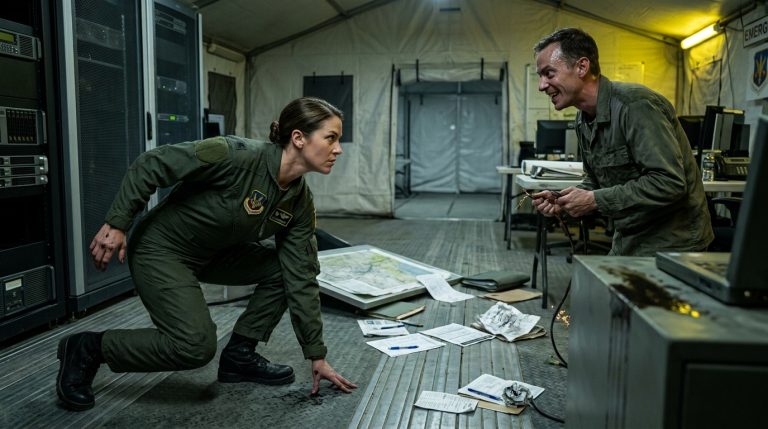
The air in the office was recycled, stale, and tasted of ozone and burnt coffee. Anna stood on the far side of the desk, her boots rooted to the linoleum, her posture an exercise in absolute, motionless obedience. She watched Hayes’s fingers. They were heavy, manicured, and currently tapping against the cover of her kneeboard—the leather worn soft by sweat and constant friction.
“I didn’t expect to see you again, Anna,” Hayes said, not looking up. He flipped the cover. The pages were a mess of grid coordinates, wind-drift vectors, and recoil harmonics. It looked like gibberish to an administrative mind, but to anyone who understood the language of flight, it was a death warrant.
“I assumed my mission parameters were clear, Colonel,” Anna replied. Her voice was steady, a flat plane of sound. She focused on the way the fluorescent light caught the edge of the ledger. It was the only thing in the room that felt real.
“Clear?” Hayes stood, the metal of his chair scraping against the floor like a scream. He walked to the window. Outside, the flight line was a blur of dust-devils and the silhouette of a Warthog being stripped of its pylons. “You turned a routine sweep into a tactical anomaly. You bypassed the chain of command, violated the two-hundred-meter rule, and effectively neutered the authority of this base. Do you have any idea what that looks like on the record?”
Anna didn’t flinch. She had spent months watching him calculate the lives of 480 men as if they were variables on a whiteboard. She saw the tremor in his left hand—a minute, almost invisible vibration that spoke of something deeper than mere frustration. Fear.
“I saw a threat to the battalion, sir. I neutralized it.”
“With a cannon pass that wasn’t authorized.” He turned, his face hardening into a mask of professional disappointment. “You’ve made yourself a problem, Captain. A very talented, very noisy problem. And the thing about problems in this theater is that they tend to resolve themselves through… attrition.”
He slid the ledger across the desk. It stopped inches from the edge. When Anna reached for it, she noticed something that stopped her breath. The spine—the hidden pocket where she kept the transit logs for the valley sweeps—was slightly puckered. Someone had opened it. Someone had looked at the raw data, the data that traced not the enemy’s positions, but the location of the munitions drops.
“I’m keeping it for the investigation,” Hayes said, his voice dropping to a low, intimate hum. “But here’s the complication, Anna. Your logs show you were nowhere near the ridge lines when the fire started. Which means, if the records are to be believed, the battalion saved itself. I’m giving you a chance to align your story with the official timeline. If you don’t… well, let’s just say you might find the sky a much more dangerous place than the ground.”
The silence in the room thickened, pressing against her ears. She looked down at the ledger, then at the shadow Hayes cast against the wall. It was jagged, distorted, and entirely wrong. She realized then that the threat wasn’t the enemy in the valley; it was the man standing across from her, holding the truth hostage.
“I understand, Colonel,” she said, her voice devoid of inflection.
“Good.” He walked toward the door, opening it just enough to reveal the armed MPs waiting in the corridor. “Then we shouldn’t have any further disagreements.”
As he stepped out, Anna’s hand brushed against her side, catching the edge of her flight jacket. Tucked into the inner lining, hidden from even the most invasive search, was the original, handwritten master key for the weapon employment tables. They had the copy. She had the cipher. And as she turned to follow the guards, she realized the game hadn’t ended in the valley. It had only just begun.
CHAPTER 2: THE ERASURE OF AN AVIATOR
The hallway stretched out like a throat, cold and lined with gray, sound-dampening panels that seemed to swallow the click of the MPs’ boots. Anna walked in the center. She didn’t look at the soldiers flanking her. Their movements were jerky, practiced, and distinctly uncoordinated—men who relied on the badge of authority rather than the fluid geometry of true competence.
She felt the master key pressed against her ribs. Every step she took was a calibrated movement, designed to mimic the gait of a subordinate who had accepted her defeat. Her shoulders were dropped, her head tilted just enough to suggest the weight of a reprimand. But inside, her mind was a whirlwind of data, replaying the pucker on the spine of the ledger Hayes had confiscated.
Someone had been inside it.
“Don’t get comfortable, Captain,” the MP to her left said, his voice a gravelly monotone. He didn’t look at her. He was staring straight ahead, his eyes tracking a point on the wall that didn’t exist. “Orders are to keep you in the holding block until the colonel reviews your status.”
Anna didn’t answer. She remembered her father’s voice in the garage back in Redcliffe—the way he would describe the sound of a well-oiled engine. Consistency is the only truth, Anna. Everything else is just noise. The noise in this corridor was the artificial hum of the ventilation system, a sound that felt like it was trying to drain the oxygen from the room. She was being erased. The Colonel wasn’t just investigating a mission; he was dismantling her record, pulling out the threads of her service until she became a ghost in the system.
They passed the mess hall. The laughter from within was clipped, sharp, and entirely devoid of the camaraderie she had observed during the earlier weeks of the deployment. She noticed a group of technicians near the door, their faces turned toward the floor, refusing to make eye contact as she walked by. The contagion of her “insubordination” was spreading.
As they turned the corner toward the administrative holding block, she felt a sudden, sharp phantom sensation—the smell of motor oil and hot desert sand, the exact scent of her father’s old hunting rifle after a long day of practice. It was a mental anchor, a sensory memory that cleared the haze of the hallway. She realized with a cold, analytical chill that her current predicament was not a random act of disciplinary cruelty. It was a calculated isolation. If she was in the holding block, she was away from the flight line. She was away from the data nodes. She was away from the warthogs.
“Wait,” she said, her voice cutting through the corridor’s acoustic deadness. She stopped, forcing the MPs to stumble to a halt.
“Keep moving, Cruz,” the MP to her right growled, reaching for her arm.
Anna moved before he could make contact. It wasn’t a strike; it was a simple, fluid shift of her center of gravity, a pivot that put her slightly behind him, forcing him to overreach and stumble. She kept her hands open, palms visible, the universal sign of surrender, even as her mind mapped the exit routes of the hallway.
“I left my flight gloves on the desk in Hayes’s office,” she said, her tone steady, practiced, and utterly neutral. “They’re issued equipment. If they go missing, that’s an administrative write-up for everyone involved. I’m sure the Colonel wouldn’t be pleased if his holding block team was cited for negligence.”
The MP paused, his face flushing a mottled red. He looked at his partner, then at the locked door of the office they had just exited. The logic held, not because it was true—she hadn’t left the gloves—but because it was bureaucratic enough to cause hesitation.
“Stay here,” the lead MP muttered, glaring at her before turning back toward the office.
The moment he was out of sight, Anna turned her focus to the remaining guard. He was younger, his stance less assured. She let her gaze soften, projecting the image of a tired, broken pilot, while she scanned his belt for the keycard access. Her world narrowed down to the small, plastic rectangle clipped to his tactical vest.
“Rough day,” she said, her voice dropping into a register of guarded vulnerability. “I’m just ready to get back to the bunk.”
The guard relaxed by a fraction of a degree. “Yeah. It’s been a long cycle.”
She looked at the ceiling, pretending to study the ventilation grate, and used the movement to check the clearance of the surrounding hallway. Empty.
“Do you think the Colonel is actually going to ground me?” she asked, her voice barely a whisper. “I mean, I saved those men. Doesn’t that count for anything?”
The guard shifted, looking uncomfortable. He was a pawn in a game he didn’t understand, and she was the piece that was currently being removed from the board.
“I don’t know, Captain. I just follow orders.”
She looked back at him, her eyes catching the light of the overhead fluorescent panels. She didn’t need him to know anything. She just needed him to be distracted for three more seconds.
“I just wanted to make sure I had my record straight,” she said, reaching into her pocket. She pulled out a small, metallic stylus—the one she used for the kneeboard—and let it slip from her fingers. It clattered onto the floor, rolling toward the edge of the hallway.
As the guard instinctively ducked his head to look for the object, Anna moved. She didn’t run. She didn’t fight. She took a step forward, her hand moving with the precision of a pilot adjusting the trim in a crosswind, and placed a thumb against the release of his keycard. It popped free without a sound.
“Sorry,” she whispered, her voice apologetic. She retrieved the stylus, her fingers sliding the keycard into the cuff of her flight sleeve in one continuous motion.
The lead MP returned, empty-handed and irritable. “Gloves weren’t there. Let’s go.”
Anna straightened her posture, the weight of the keycard against her skin feeling like a live wire. She fell into step between them, her mind already running through the floor plan of the base. She knew where the secondary servers were kept. She knew the override codes for the flight log database. And now, she had the means to reach them.
The hallway continued to stretch, but for the first time since leaving the command office, the geometry of her situation had shifted. She was no longer a prisoner being led to an erasure. She was a ghost, walking through a system that had already decided she was dead, while she prepared to dismantle it from the inside out.
CHAPTER 3: THE SHADOWED HANGAR
The holding block was a series of cells designed for psychological attrition. The walls were painted a shade of off-white that didn’t catch the light so much as it deadened it, and the floor was polished concrete that hummed with the vibration of the base’s main generator. When the MPs shoved her into the holding cell and the door clicked shut—a sound of heavy, electromagnetically-engaged iron—Anna didn’t sit on the cot. She stood in the center of the room, listening to the diminishing cadence of their boots on the linoleum.
Once the sound vanished, she allowed herself to move.
Her first action was not to check the door, but to evaluate the room’s ventilation. The grating high on the wall was industrial, held in place by four recessed screws. It wouldn’t lead to freedom, but it would provide enough airflow to carry a signal if she needed to jam the local monitoring frequency later. She was already mentally stripping the room of its variables: the blind spots in the security camera’s sweep, the thickness of the door’s threshold, and the precise, mechanical rhythm of the guards’ patrol outside.
She withdrew the stolen keycard from her sleeve. It was a standard-issue proximity card, encoded for administrative and logistics access. She held it against the palm of her hand, feeling the slight heat it had gathered from her skin. It was more than a plastic card; it was a skeleton key to the base’s digital nervous system. If she could interface it with a maintenance console, she could bypass the local network’s security, creating a “ghost” signal that would loop the surveillance cameras while she moved toward the hangar.
The corridor outside pulsed with the rhythmic click of the guard’s heel-to-toe patrol. She timed her breathing to the interval between those clicks. Every few seconds, there was a dip in the hum of the overhead lights—a voltage fluctuation caused by the base’s power-intensive operations. That was when the camera’s frame-rate would stutter.
She waited. One. Two. Three.
The lights flickered, a nearly imperceptible dimming of the luminescence.
Anna moved to the door. She didn’t press the card to the reader immediately. Instead, she pressed the edge of the card into the seam where the door met the frame, working the stiff plastic down toward the electronic strike plate. The mechanism was a standard solenoid-driven lock. It relied on a magnetic field to hold the deadbolt in place. By sliding the card against the spring-loaded latch, she could create a friction point that might force the solenoid to release if the power fluctuated at exactly the right micro-second.
She pushed. The card resisted, catching on a burr in the metal. She adjusted her angle, using the tactile feedback through her fingertips to feel the resistance of the internal spring.
The lights flickered again. She pushed harder, the plastic of the card bending.
Click.
The door eased open a fraction of an inch. She didn’t rush out. She stepped into the threshold, her body language shifting into the slumped, subservient posture of a pilot who had given up. She walked toward the maintenance closet at the end of the hall, her feet moving with the quiet, calculated precision of a predator stalking through tall grass.
Inside the maintenance closet, the air smelled of stale grease and ionized dust. She pulled the primary server panel from the wall, exposing the nested cables. She didn’t look for the main connection; she looked for the splice point where the hangar’s logistics feed joined the administrative line.
She opened her kneeboard notebook—the physical copy she’d hidden inside her boot, unknown to the MPs. It was filled with hand-written sequences of hex-code overrides. She had spent months of long nights, beneath the red lens of her flashlight, mapping these exact protocols. She began to feed the sequences into the console, her fingers moving with a speed that belied her calm expression.
As the terminal screen flooded with cascading data, she saw it: a discrepancy. A logistics shipment dated three days ago, marked “Internal Training Ordinance.” The weight of the shipment, expressed in kilograms, was inconsistent with the volume of the containers. It was too heavy for training rounds. It was consistent with the high-yield experimental munitions that had been rumored to be circulating in the sector.
The realization sat in her chest, a cold, hard lump of truth. The ambush in the valley hadn’t been a trap for the Marines; it had been a testing ground. The enemy hadn’t just been waiting for them—they had been guided to the slaughter, pinned in a killbox so that the experimental munitions could be deployed in a real-world environment.
She pulled her hand back as if the screen were burning. Her father’s voice echoed in her mind: Steady breath, Anna. Let the shot surprise you.
She wasn’t just a witness; she was the person holding the only record that this had happened. She looked at the terminal, her pulse steady as a metronome. She hit a key, initiating a batch download of the logistics logs onto the stolen keycard, masking the traffic by routing it through the base’s own routine maintenance backup.
The screen blinked. The transfer completed.
She pulled the card, wiped the console of any stray signals, and stepped back into the hallway. The silence of the base felt different now—sharper, more dangerous, and entirely focused on her. She had the proof, but the proof was a death sentence. She wasn’t just walking toward the hangar; she was walking into the crosshairs of an entire command structure that couldn’t afford for her to survive the night.
CHAPTER 4: THE FIRST TRACE
The silence that followed the guard’s stop was absolute, a vacuum waiting to be filled. Anna held her breath, her spine pressed against the cold, jagged metal of the server housing. Her hand, still gripping the keycard, didn’t tremble. She felt the slight vibration of the base’s main power grid through the wall, a constant, low-frequency thrum that served as a reminder of the machine she was currently trying to subvert.
Outside, the guard’s boots shifted—a dry, scuffing sound on the concrete. He wasn’t passing by. He was waiting.
Anna glanced at the status light on the terminal. The amber pulse had slowed, but the data transfer icon was still hovering. She had the logs, but they weren’t fully integrated into the card’s encrypted sector yet. If she pulled the card now, the file would be corrupted. If she stayed, the guard would eventually investigate the closet’s access light.
She scanned the room. The maintenance closet was narrow, barely enough space for her shoulders to fit between the racks and the door. Her eyes locked on a junction box located just above the door’s threshold. It was a secondary power feed for the sector’s lighting—an older system that hadn’t been replaced during the recent facility upgrades.
She moved with the silence of a shadow, reaching up to the junction box. Her fingers worked the latch—another familiar, mechanical puzzle—and she saw the exposed copper wiring. It was a raw, dangerous solution, but it was the only one.
She took a small, copper wire from her tactical kit, a tool she kept for bypass operations, and bridged the connection to the lighting circuit.
Pop.
A sharp, electric smell of ozone filled the closet as the lights in the entire corridor went dark. The hum of the facility’s power load shifted instantly—a momentary surge that would trigger the base’s automated emergency response.
The guard shouted, the sound muffled by the door, followed by the frantic click of a radio being keyed. “Control, this is Sector 4. We’ve got a localized power failure. Lighting is out. Resetting breakers now.”
In the momentary chaos of the dark, Anna didn’t hesitate. She waited for the sound of the guard’s footsteps receding toward the breaker box—a rhythmic, heavy pace—and then she slipped out. She didn’t head for the holding block. She moved in the opposite direction, toward the secondary stairwell that led to the lower-level equipment bays.
Her heart rate remained perfectly steady, a disciplined cadence she’d practiced since she was twelve years old, lining up shots on soda cans back in Arizona. She kept her back to the wall, her eyes scanning the shadows. The base was waking up. Emergency red lights began to rotate along the ceiling, casting long, distorted shadows that turned the corridor into a series of jagged, shifting geometries.
As she rounded the corner near the equipment bays, she saw a technician rushing toward the server room she had just vacated. He was carrying a portable diagnostic tool, his face pale and focused. She ducked into a narrow service crawlspace, the metal floor grating cold against her knees. From here, she could see the entrance to the equipment bay—the place where the maintenance logs were cross-referenced with the flight schedules.
She watched as the technician reached the closet door. He hesitated, then pulled a master key from his belt.
She didn’t need to stay and watch; she knew what he would find. A cold, empty closet. A terminal that looked like it had never been touched. The brilliance of her work wasn’t just in the theft; it was in the erasure. She had programmed the terminal to reset its own logs the moment the card was removed, effectively masking her presence as a system glitch.
But as she watched the technician, she noticed something that stopped her breath. He wasn’t just checking the breaker box. He was pulling a small, handheld scanner from his vest—a device used for detecting unauthorized data transfers. He swept the room, his eyes scanning the readout with the clinical detachment of a man checking for a leak.
The scanner chirped. Once. Twice.
He stopped, his head snapping toward the door. He wasn’t just a maintenance technician. The way he held his posture, the precision with which he moved, it was the training of an internal security operative.
Anna pulled back into the crawlspace, her pulse still steady, but her mind sharpening. The leak she had discovered wasn’t just about the experimental munitions; it was about the surveillance of the base itself. They were tracking the data. And now, they were tracking the ghost.
She looked at the keycard in her hand. It was no longer just a key; it was a beacon. She needed to move the data, and she needed to do it before the scan reached the secondary junction she had triggered. She realized that she hadn’t just stolen logs; she had alerted the architects of the trap.
She turned and began to crawl toward the secondary maintenance duct, the cold metal biting into her palms. She had the proof, but the proof was becoming increasingly volatile. Every step she took was an exercise in avoiding the very system she was trying to expose.
CHAPTER 5: THE SIEGE OF SILENCE
Anna stayed pressed against the top of the vent, peering through the slats of the grate. The corridor below was bathed in the harsh, flickering orange of the emergency lighting, casting elongated shadows that danced with the oscillating pattern of the base’s power instability. She waited, her muscles locked in a state of controlled tension, monitoring the movement of two security personnel who were sweeping the area with handheld scanners.
They were systematically checking the barracks, moving from door to door. It was no longer a routine patrol; it was a manhunt.
She felt the keycard in her hand—a small, rectangular weight that represented her only leverage. The data was inside, but she couldn’t risk a direct upload to the base’s central server now. The operative she had seen in the equipment bay had confirmed her suspicion: they were monitoring every signal, looking for the ghost that had bypassed their security.
She needed an analog delivery. A way to bypass the digital dragnet.
Her eyes moved to the end of the hall, where a heavy, fire-rated door led to the supply logistics office. That office had a direct, hard-wired line to the command hub—an old-fashioned, secure telegraph and printer system that bypasses the modern digital network during power surges. It was archaic, a relic from the base’s initial construction, but it was the only system that wasn’t being monitored by the modern scanners.
She shifted her weight, the metal grating groaning slightly under her boots. She froze, her breath held, as one of the security guards paused, his head cocking to the side. He lingered for three agonizing seconds, his scanner emitting a low, rhythmic pulse that seemed to resonate in the marrow of her bones. Then, he moved on, turning the corner toward the mess hall.
Anna kicked the grate outward, catching it with her free hand before it could clatter against the floor. She dropped down into the corridor, landing in a silent, perfectly balanced crouch.
The air in the hallway was cold, tasting of industrial solvents and the lingering ozone from the power failure. She moved toward the logistics office door, her boots barely touching the ground. She pulled the stolen keycard from her pocket and inserted it into the door’s mechanical bypass, using the same rhythmic, pressure-sensitive technique she had used in the holding block.
The door yielded with a soft, metallic thud.
Inside, the office was a tomb of paper files, dusty ledgers, and the steady, rhythmic clicking of the aging printer. It was a space designed for a bygone era of warfare, where information was recorded in ink and carbon, not bits and bytes. She moved to the desk, her eyes scanning the printer’s output queue.
Her heart skipped a beat.
Lying on the tray was a freshly printed manifest. It was a transfer order for the next shipment of experimental munitions, signed by Colonel Hayes himself, but the destination wasn’t the valley. It was a coordinates grid that she recognized instantly. It was the location of a civilian-populated transport zone—a “collateral optimization” test, designed to measure the impact of the munitions in a high-density, unhardened environment.
She picked up the manifest, her hand steady, but her grip tightening. This wasn’t just a military test. It was a calculated, civilian-targeted atrocity.
She realized then that her “insubordination” in the valley had broken their schedule. They weren’t just trying to catch her because she was a witness; they were trying to recover the data because they needed it to refine the parameters for the next test. She wasn’t just a pilot anymore. She was the single obstacle between the command structure and the completion of a war crime.
She laid the manifest on the printer’s glass. She had the logs on her card, and now she had the signature. She needed to copy this document, to create a paper trail that couldn’t be wiped by a system reset.
As the printer began to hum, a shadow crossed the frosted glass of the door. The sound of a key in the lock was slow, deliberate—an intruder who wasn’t in a hurry because they already knew exactly who was inside.
Anna grabbed the original manifest and ducked under the desk, her back pressing against the cold, metal frame. She held her breath, the scanner’s pulse—once distant—now growing louder, vibrating the floorboards of the office. Someone had tracked her signal to this specific sector.
The door opened.
She didn’t look up, but she saw the silhouette of a boot—a heavy, tactical-grade sole that matched the ones worn by the security operative in the equipment bay. The person walked into the room, their movements calm, assured, and predatory. They didn’t search the room. They walked straight to the printer, their hand reaching for the output tray.
“I know you’re in here, Captain,” the voice was cool, precise, and entirely devoid of emotion. It was the voice of a mirror image—someone who understood the same geometry, the same patience, and the same discipline she had learned from the desert. “And I know what you’re trying to build.”
Anna remained motionless, her fingers tracing the sharp, cold edge of the manifest in her lap. She wasn’t cornered. She was positioned. She looked at the desk’s underside, her eyes tracing the wiring for the office’s primary fire-suppression trigger. She had three seconds before they checked the space beneath the desk.
She moved.
CHAPTER 6: THE DECOY REVEAL
Anna didn’t move. She remained pressed against the underside of the heavy, steel-framed desk, her lungs burning as she suppressed the urge to cough. The room was a landscape of white, swirling particulate foam. Through the haze, the intruder—a silhouette of tactical discipline—stepped forward, their movements slowed by the blinding mist.
She watched the intruder’s boots. They stopped precisely three feet from the desk.
“The printer didn’t just print a manifest, Captain,” the intruder said, their voice calm, echoing slightly against the metal walls. “It printed a decoy. You’ve been playing with the logs for hours, thinking you were the hunter. But you were merely the test subject, measuring the speed at which a high-value asset attempts to breach secure protocols.”
Anna’s grip tightened on the manifest she held. A decoy? She thought back to the data she had downloaded, the specific sequences she had pulled. They had been too easy to access, too logically ordered for a secure server. Her skin prickled with a cold, sharp realization. The data hadn’t been real logs; they were seeded markers designed to track exactly where she would attempt to egress.
The intruder took another step, the foam muffling their footfall. “You’re a brilliant pilot, Anna. But you think in three dimensions. You think in geometry and wind-drift. You don’t think in terms of institutional containment.”
Anna shifted her weight, moving silently toward the back of the desk frame, her hand finding the release for the office’s secondary fire-exit conduit. She needed to break the line of sight. She watched the intruder’s shadow—a dark, angular shape cast against the white fog. They were distracted, scanning the perimeter, confident in their own surveillance.
She triggered the release.
A heavy, corrugated metal sheet dropped from the rear wall, the sound echoing like a gunshot. The intruder spun, their weapon raised—not toward her, but toward the noise.
Anna surged forward, not in a straight line, but in a tight, kinetic arc that took her behind the heavy industrial printer. She grabbed a metal waste bin, sliding it across the floor in the opposite direction.
“Contact!” the intruder shouted, swinging toward the sound of the bin.
Anna took the gap. She didn’t head for the door; she headed for the very printer the intruder had been guarding. She slammed her hand into the manual override, forcing the device to purge its entire memory cache. It wasn’t just a data wipe; it was a physical destruction of the hardware. The machine groaned, the heat of the internal components spiking, and then it sparked, a cascade of white-hot embers showering the room.
The intruder cursed, firing a single, controlled shot into the darkness. It missed by inches, burying itself in the metal desk leg where Anna had been lying moments before.
She reached the fire-exit conduit, pulling herself into the narrow, dark tunnel. As she scrambled away from the office, she looked back one last time. Through the thinning foam, she saw the intruder standing over the destroyed printer. They weren’t angry. They were watching her exit point with a strange, clinical satisfaction.
She realized then that the decoy wasn’t just the data—it was the entire pursuit. They had led her to this office, had let her destroy the printer, and had observed her tactics in a high-stress scenario. Every move she had made, every “calculated” choice she had taken since the holding block, had been a data point in their assessment of her capability.
She scrambled through the dark conduit, the walls pressing against her shoulders. She was still holding the paper manifest, the only thing they hadn’t been able to digitally track. But she was exhausted, the weight of the pursuit settling into her joints. She was no longer a ghost; she was a marked target.
The tunnel ended at a junction above the central hangar. She pushed the grate open, looking down into the sprawling, dimly lit space where her Warthog sat, partially dismantled.
She could see the security teams moving in the hangar below, their searchlights sweeping the rafters. They were waiting for her to make the one move she had to make—the move to the cockpit. She had the proof, but she was trapped in a facility that had already prepared for her return. She looked at the manifest in her hand, the coordinates screaming the truth of what they intended to do. She had to get to the plane, but to do so, she would have to walk through the exact web they had spent the entire night spinning.
The silence of the hangar was no longer a sanctuary. It was a countdown.
CHAPTER 7: THE GHOST SIGNAL
Anna didn’t jump. She dropped, a deliberate fall that she cushioned with a roll, landing on the soft, oil-stained rubber matting that lined the floor beneath the A-10’s left wing. The hangar was a cavern of deep shadows and sharp, metallic highlights. Far across the bay, she heard the heavy, rhythmic thud of security personnel repositioning their search grid. They were sweeping from the outer perimeter inward, clearing the maintenance bays one by one.
She reached into her flight sleeve, her fingers brushing the cold, smooth plastic of the stolen keycard. It was warm now, buzzing with the encrypted weight of the logistics logs. She didn’t head for the cockpit immediately. To enter the flight deck while the hangar was under surveillance was suicide; the canopy’s electronic unlock signal would trigger a facility-wide alert.
She needed to force a system-level distraction, one that would override the security grid’s priority protocols.
She navigated the shadows, moving beneath the belly of a neighboring aircraft. Her father’s voice echoed in her mind again—ease the trigger, let the shot surprise you—a phantom echo of a life governed by precision. She reached the hangar’s main power distribution hub, a massive, wall-mounted circuit array that controlled the hangar’s internal grid.
She opened the casing, the metal clicking softly against her knuckles. The complexity of the wiring here was a sharp, angular mess, but to Anna, it was a map. She looked for the terminal lead connected to the facility-wide fire-suppression system. If she could trigger a low-level discharge of the overhead Halon gas, the facility’s emergency lockout protocols would force every fire-rated bulkhead in the hangar to seal, effectively partitioning the security grid and isolating the bays from the command center.
She pulled the connection, her hand steady, her breathing an unbroken cycle of focus. She bypassed the safety diode and bridged the output directly to the hangar’s main lighting feed.
Spark.
A sudden, sharp arc of white electricity illuminated the hangar. Above, the Halon system shrieked—a high-pitched, pneumatic groan as the pipes pressurized. Within seconds, thick, white plumes of suppression gas flooded the bay, creating a wall of particulate density that rendered the security team’s searchlights useless.
“Breach! Sector 2! Fire suppression triggered!” a voice shouted from the far end of the bay.
Anna used the confusion. She moved through the white, swirling clouds of gas, her movements calibrated to the rhythm of the emergency alarms. The air tasted like chalk and dead, metallic air. She reached her aircraft, its hulking, grey silhouette appearing through the gloom like a monolith.
She didn’t use the ladder. She climbed the landing gear, her boots finding the familiar grip of the pylon mountings. She pulled herself into the cockpit, the smell of recycled cabin air and old sweat greeting her like a familiar companion. She slid the canopy, keeping it locked to its manual override to prevent the digital system from flagging the unauthorized start.
She sat in the pilot’s seat, the familiar shape of the flight controls grounding her. She powered on the battery array, the HUD flickering to life, displaying a cascade of diagnostic warnings—most of them stemming from the facility’s current lockout state.
She didn’t need the hangar’s power. She needed the engine start sequence.
As the auxiliary power unit whined to life, a sudden, sharp glare pierced the gas. A searchlight, mounted on a mobile platform, had tracked the movement in the cockpit.
“Viper 206! Shut down the engine! You are in restricted territory!”
The voice on the ground was amplified, cold, and authoritative. It was the same intruder from the office. They were standing beneath the wing, weapon drawn, their silhouette framed against the blinding, flickering light of the hangar’s emergency strobes.
Anna stared through the canopy. She didn’t reach for the radio. She reached for the fuel cut-off and the engine start. She knew what they were doing; they were waiting for her to acknowledge, waiting for her to enter the comms net so they could triangulate her exact position to a remote kill-switch.
She didn’t acknowledge. She initiated the sequence. The turbine began to spool, a deep, resonant rumble that shook the entire frame of the aircraft.
The intruder didn’t fire. They knew the danger of an armed A-10 in a pressurized hangar. Instead, they reached for their own device, a portable override console—the final contingency. Anna felt a surge of cold, analytical dread. They weren’t trying to kill her; they were trying to lock the aircraft’s avionics into a terminal diagnostic loop, turning her warthog into a ten-ton piece of scrap metal.
She had to override the diagnostic loop, and she had to do it by hand. She flipped the master flight-control bus to ‘Manual/Direct,’ bypassing the digital flight control computer. The controls stiffened, the stick resisting her grip with the heavy, stubborn weight of pure hydraulic pressure. It was a brute-force approach, the kind of flying she had practiced in the simulators during those long, quiet nights, the kind that forced a pilot to fight for every degree of pitch and yaw.
The engine reached a roar, a wall of sound that pushed against the hangar walls. She grabbed the stick, her muscles straining as she prepared to taxi—not through the hangar doors, which were already locked—but through the side-wall, the structural weak point she had mapped months ago.
She was going to punch a hole through the very heart of the facility. She had the proof, she had the plane, and now, she had the only exit route that didn’t involve the ground.
CHAPTER 8: THE FRICTION POINT
Anna didn’t feel the G-force as much as she felt the strain of the hydraulics. Without the flight control computer to buffer her inputs, every movement of the stick was a contest against the air resistance pushing back against the ailerons. She didn’t steer; she manhandled the aircraft. The warthog lurched forward, its tires screaming against the slick, foam-covered hangar floor.
The intruder—the operative who had been so clinical in the office—was now a blur of motion in her peripheral vision. They were moving toward the hangar’s master override, a secondary control pillar shielded by reinforced glass. If they hit that switch, the base’s automated internal defenses—turrets designed to stop unauthorized vehicle movement—would activate, turning the hangar into a killbox.
Anna didn’t look back. She leaned into the turn, the aircraft’s massive bulk swinging with a lethargic, heavy grace. She aligned the nose, not with the exit, but with the control pillar itself.
It wasn’t a choice; it was a calculation.
She felt the nose wheel lift as she hit a patch of debris, the aircraft vibrating with the resonance of a structure nearing its breaking point. She didn’t throttle back. She increased power, the twin engines howling. The hangar was a distorted echo chamber of alarms and white gas, the strobing red lights making the environment look like a series of disjointed, hellish frames.
She saw the intruder reach the pillar. Their hand was on the glass.
Anna didn’t fire the cannon. She knew the recoil would flip the aircraft on the slick floor. Instead, she banked the right wing, using the leading edge to sweep the path in front of the pillar, the air pressure of the massive turbine intake creating a localized vacuum that sucked the remaining fire-suppression foam into the intakes. The engines sputtered, a momentary, terrifying loss of thrust that sent the aircraft sliding toward the side wall.
She corrected, her arms burning as she fought the heavy, unassisted stick. She corrected into the slide, the tires regaining traction just feet from the side wall.
The hangar wall, built from aged, brittle reinforced concrete, groaned. She didn’t aim for the doorway. She aimed for the structural seam where the wall met the support column.
Impact.
The sound was less of a collision and more of a total structural failure. The wingtip slammed into the concrete, the force of the blow jarring her teeth. She felt the aircraft tilt, the left side lifting as the fuselage ground against the rebar-thickened structure. She pushed the throttle further, the engines screaming in protest, the air intake howling as it sucked in dust, concrete shards, and the remnants of the suppression gas.
The wall shattered.
Sunlight—a blinding, jagged, natural white—floored the cockpit. She didn’t look at the hangar. She didn’t look at the intruder, who was now pinned beneath the debris of the pillar she had clipped. She looked at the horizon.
She was airborne.
She banked the aircraft hard to the left, the sudden shift in altitude sending a wave of nausea through her stomach. She was heavy, unbalanced, and leaking hydraulic fluid from the damaged wing, but she was clear. The base, a cluster of gray geometric shapes, fell away beneath her.
But as she pulled into a stable climb, her HUD flickered. A warning light—red, insistent, and diagnostic—flashed on the auxiliary monitor. It wasn’t a damage alert. It was a signal override.
Her flight controls went dead.
She pulled the stick, but the surfaces didn’t respond. The aircraft, now flying on its own inertial momentum, began a slow, majestic roll. She had escaped the hangar, but she hadn’t escaped the trap. The internal system, the one she thought she had bypassed, was actively re-integrating via a hidden, hard-wired diagnostic link in the pylon she had damaged.
She was flying a glider with a turbine that was rapidly losing fuel pressure.
She looked out the canopy, her eyes scanning the terrain below. She had the manifest in her lap, but she no longer had the ability to deliver it to the coordinates she had identified. She was descending, the wind rushing past the canopy with the low, whistling tone of an aircraft that was losing its integrity.
The “ghost signal” she had been chasing was no longer just an investigation; it was a ghost she was becoming. She was the one being tracked, the one being measured, and now, the one being grounded. She reached for the manual bypass lever, the one she had used to force the initial start, but it was jammed, fused by the heat of the hangar impact.
She was alone in the sky, trapped in a cockpit that was slowly turning into a cage.
CHAPTER 9: THE HARD CHOICE
Anna didn’t fight the roll; she used the centrifugal force to snap the aircraft back into a level, albeit descending, attitude. She knew the avionics were compromised. The diagnostic loop was trying to cycle the flight surfaces back into a default ‘parked’ configuration, essentially turning the jet into an unpowered brick.
She reached beneath the pilot’s seat, her fingers clawing at the auxiliary locking pin—a rarely used, legacy safety feature designed for catastrophic electronic failure. It was stiff, rusted by the humidity of the base’s storage cycle, but she hammered it home with the heel of her boot.
Clunk.
The digital command system went silent. The flight surfaces groaned, then locked into a fixed position. She was flying on mechanical linkage alone, a heavy, unresponsive configuration that required every ounce of her upper body strength to keep level. The aircraft’s nose dropped, the horizon tilting as the airspeed bled away.
She had to make a choice. She had the physical manifest tucked into her flight suit, and she had the digital logs on the stolen keycard. But she didn’t have the altitude to reach the broadcast relay at the mountain station.
She looked at the fuel gauge. The tanks were dry, but the low-pressure sensors were still screaming. She scanned the ground below—a desolate, wind-swept stretch of desert plateau that mirrored the terrain of her childhood. It was a landing zone, but not a safe one.
She realized then why they hadn’t shot her down. They didn’t want the wreckage spread across a high-density area. They wanted her to crash here, in the middle of nowhere, where the evidence—and the pilot—would be erased by the environment long before a recovery team could arrive.
She banked, the aircraft responding with the heavy, stubborn inertia of a rusted gate. She felt the vibration of the engines—the final, dying gasp of the fuel pumps. She kept the nose up, trading speed for the last possible moments of controlled descent.
As the ground rushed up to meet her—a textured, brown landscape of rocks and dry scrub—she saw a small, abandoned fire-watch tower at the edge of the plateau. It was a structure built of iron and weathered wood, a relic of the era before digital monitoring. If she could land near it, if she could survive the impact, she could use the emergency radio that was still hard-wired into the tower’s base.
She adjusted her trim, the stick vibrating in her grip as the aircraft buffeted in the turbulent, low-altitude thermals. She kept the descent shallow, her eyes fixed on the tower’s base. She wasn’t landing; she was aiming.
The landing gear groaned as she touched down—a brutal, bone-jarring impact that ripped the left tire from the strut and sent the aircraft into a violent, sideways skid. The nose slammed into the dirt, the cockpit frame warping under the pressure, the glass spider-webbing into a thousand tiny fractures.
The roar of the engine died. Silence, heavy and absolute, rushed back into the cockpit.
Anna didn’t wait. She clawed at the canopy release, the mechanism jammed and stiff. She threw her shoulder against it, once, twice, until the metal gave way with a screech. She scrambled out of the cockpit, her legs buckling as she hit the dry, powdery earth.
She didn’t look at the plane—a smoking, twisted wreckage that was already beginning to settle into the sand. She didn’t look at the sky. She ran toward the tower, her lungs burning, the manifest clutched in her hand like a lifeline.
She reached the base of the tower and clawed her way up the rusted ladder, the metal biting into her palms. At the top, in the small, glass-enclosed cabin, she found the emergency radio. It was a heavy, vacuum-tube set, archaic and reliable. She hooked the keycard into the port, the interface clunky and outdated, but she wasn’t looking for a digital handshake. She was looking for a frequency.
She keyed the mic, her voice rough and strained.
“Mayday. Mayday. This is Captain Anna Cruz. I am in possession of documents detailing a direct breach of humanitarian treaty. I am requesting broadcast to the civilian oversight board. This is not a drill.”
She waited. The only sound was the static—a vast, empty white noise that felt like the indifference of the command structure she had spent her life trying to serve. She looked out the window, toward the horizon, and saw the faint, rising dust clouds of a vehicle column. They were coming for her, and they were closing the distance fast.
She had given them the decoy. She had given them the assessment they wanted. But she had kept the one thing they couldn’t afford to have public: the proof of their intent. She keyed the mic again, her grip on the device white-knuckled.
“If anyone is listening… the geometry of this war is broken.”
CHAPTER 10: THE LAST TRANSMISSION
Anna didn’t look at the door. She looked at the signal meter on the archaic radio console. The needle was pinned to the right, indicating a successful uplink to the regional civilian broadcast relay. The data—the logs, the manifests, the signature of the command structure’s direct involvement in the Blackthorne Valley atrocities—was being pushed through the airwaves, a stream of raw, unfiltered truth that no internal server could scrub or quarantine.
The tower door groaned, the iron hinges shrieking as they were forced open.
“Captain Cruz,” the voice was familiar—Colonel Hayes, his tone stripped of all professional posturing, replaced by the tired, brittle edge of a man who realized his geometry had failed. “Step away from the console. You’re done.”
Anna remained seated, her hands resting on the radio’s control panel. She didn’t turn around. She watched the signal output, the green light blinking in rhythm with the transmission.
“I’m not done, Colonel,” she said, her voice quiet, steady, and echoing within the glass-enclosed cabin of the tower. “I’m just the echo.”
Hayes stepped into the cabin, followed by the operative from the hangar. They looked tired, the tactical gear coated in the dust and grime of the desert chase. They didn’t move to attack; they moved to secure, their posture one of tactical closure. They knew the broadcast was already out. They knew the moment she had hit the uplink, the base’s credibility had collapsed.
“You have no idea what you’ve done,” Hayes said, walking toward the window to look out at the burning wreckage of the Warthog on the plateau. “You think this is about justice? You think the board is going to care about the math of a few thousand rounds of experimental ordinance? This is a war, Captain. There are no clean lines.”
“There are,” Anna replied, finally turning to face him. She stood up, her uniform torn, her hands scarred and dusty, but her eyes possessed a clarity that made the Colonel flinch. “There’s the line of the truth, and then there’s the line you drew to bury it. You’re on the wrong side of both.”
The operative raised their weapon, a gesture that was mechanical and hollow. They were waiting for a command that Hayes was struggling to give.
“The Payoff,” Anna continued, her voice gaining strength, “isn’t my survival. It’s the fact that when the board arrives—and they will arrive, because the data is already in the public cache—they won’t be looking for a pilot who disobeyed orders. They’ll be looking for a command structure that sold its honor for a test run.”
The Colonel’s face paled. He looked at the radio, then back at Anna. For a moment, the silence was heavy enough to crush the air out of the room. He realized that the defeat wasn’t physical; it was operational. By forcing the truth into the open, Anna had turned their own methods against them. The transparency of the board’s inquiry would make it impossible to cover the tracks of the munitions testing. The antagonist was defeated by the very system of accountability they had tried to circumvent.
Hayes lowered his head. He didn’t order the operative to fire. He simply signaled for them to stand down. The Poetic Justice was complete: the man who had preached protocol was now being dismantled by the very rules he had abused.
“Take her to the detention transport,” Hayes said, his voice flat. He walked out of the tower, his shoulders slumped, his authority leaking away with every step.
The operative led Anna down the rusted ladder, their hand resting on her shoulder. But as they touched the gravel, the air changed. The distant sound of a secondary helicopter—not a black-op asset, but a civilian search-and-rescue bird—pulsed in the distance, descending toward the plateau.
The Cool Down began. The sun was dipping below the horizon, painting the desert in hues of deep violet and burnt orange. The world, so sharp and aggressive just minutes ago, settled into a profound, atmospheric peace. Anna stood on the plateau, the wind tugging at her hair. She reached into her pocket and pulled out the small, battered hunting rifle shell she had carried since her father’s death—a memento she had kept through every deployment. She pressed it into the dirt, burying it at the base of the tower. It was a symbolic closure, a return of the discipline he had taught her, now transformed into something that had survived the fire.
She sat on the edge of a rock, her hands trembling for the first time in months. She had lost her wings, she had lost her aircraft, and she had lost her place in the military, but as she watched the rescue helicopter approach, she felt a quiet, deep emotional connection to the men she had saved in the valley. They were out there, somewhere, and they would know the truth.
The operative stood back, respecting the silence of the moment. There was no more tension, no more hunt. Only the long, slow process of the world resetting.
Anna closed her eyes, the heat of the desert day fading into the cool, rising breeze of the evening. She had fought for the truth, and the truth had held. The journey was over, the geometry was complete, and for the first time, she was simply, finally, still.