The Geometry of Winter: How Precision and Silence Brought the Metobrook Empire to Its Knees
CHAPTER 1: THE TANGIBLE LOSS
The black BMW didn’t just cross the line; it devoured it.
I stood on the porch, the air biting at my lungs with the clean, sharp edge of a razor. Below, the machine tore through the snow-packed pasture, its heavy tires spinning with a frantic, guttural sound that sliced through the stillness of the fifty-acre ranch. I didn’t shout. I didn’t run. I watched, my pulse steadying into the rhythm of a drill, as the vehicle barreled directly toward the center of my life: the raised beds of the herb garden.
When the heavy chassis hit the corner post, the sound wasn’t a dull thud. It was the sharp snap of winter-brittle wood, a high-pitched protest that felt like a fracture in my own spine. Sage, winter thyme, and the fragile, frost-kissed stalks of echinacea were pulverized into the frozen mud. Soil, dark and rich with life, sprayed across the white sheet of the driveway like blood on a clean sheet.
My wife, Sarah, was inside, her breathing measured against the rhythmic hiss of her oxygen tank. She didn’t need to see this. She didn’t need to know that the very medicine keeping her steady was being ground into the ice by the HOA president’s morning commute.
Melissa Hart hopped out of the driver’s side, her designer coat sharp and dark against the blinding snow. She didn’t look at the fence. She didn’t look at the cattle, which were now skidding and panicking toward the far tree line, their bellows muffled by the wind. She looked at her clipboard. She walked with the clinical, practiced gait of someone who had never once considered that the ground she walked on wasn’t hers to claim.
I felt the familiar, heavy weight of the binoculars in my hand. Through the lens, her face was a map of cold, calculated intent. She wasn’t just driving through; she was taking inventory. She was documenting the collapse of my boundary as if it were a successful field maneuver.
She looked up then, her eyes locking onto mine on the porch. She didn’t flinch. There was no apology in her posture—only a sharp, predatory satisfaction. She raised a finger, pointing toward the destroyed garden as if flagging a site for future construction.
I lowered the binoculars. The silence that followed the engine’s idling was heavy, pressurized. My hand hovered over the remote clipped to my belt. The trap doors I had spent the last three nights burying in the frozen earth were a few inches deeper than the snow. They were silent, patient, and completely invisible.
Melissa turned, walking back toward her vehicle, but she stopped for a second to scrape a bit of mud—or perhaps a sprig of crushed echinacea—off her designer heel. She flicked it away with the cold indifference of a queen dismissing a peasant.
I gripped the remote. The temptation to trigger the mechanism now, to drop her front axle into the hidden trench, hummed through my nerves. It would be a tactical success. It would be an immediate, violent stop to her intrusion.
But I checked the impulse. I looked at the way she signaled her convoy—the two SUVs idling at the perimeter—and I realized the scale of the game had shifted. This wasn’t just a trespass. It was a test of my structural resolve. If I triggered the trap now, I would only be dealing with the symptom. I needed the disease.
I let go of the remote. I watched her climb back into the BMW, her silhouette framed by the stark, unforgiving light of the winter sun. The real battle, I understood, would not be fought with speed, but with the cold, unyielding persistence of a man who had already decided the outcome.
She drove off, leaving deep, jagged ruts that cut through the silence of the ranch. I waited until the sound of her engine faded into the wind before I stepped down from the porch. My boots crunched on the frozen soil, each step deliberate, every movement accounted for.
I knelt by the broken garden. I picked up a crushed stalk of echinacea, the scent of crushed herbs and exhaust mingling in the bitter air. I felt the sharp, jagged edges of the broken fence post, then glanced down at a series of strange, asymmetrical marks in the mud near the rear tire track—something that didn’t match the car’s weight or the path of the wheels. A discrepancy. A mistake in her perfect geometry.
I realized then that she hadn’t just been here to destroy; she had been looking for something buried beneath the frost.
CHAPTER 2: THE COST OF THE GARDEN
I didn’t move for a long time. The wind picked up, a thin, whistling draft that slipped through the gaps in the perimeter fence. It carried the scent of the ranch’s frozen heart—cold pine, damp musk, and the faint, bitter tang of disturbed soil.
I knelt, my knees pressing into the frozen mud until the dampness seeped through my denim. I reached down, my fingers brushing against a crushed, lavender-hued petal. It was bruised, its life-giving properties leaking into the ice. This wasn’t just a flower; it was a calibrated component in a chemistry set I had spent years refining for Sarah. Every dosage mattered. Every leaf held the promise of a night without pain. And Melissa Hart had treated it like gravel.
I pulled my hand back. I didn’t allow myself to feel the heat of anger; heat was a waste of energy. I compartmentalized. I cataloged the damage: three stalks of echinacea broken, the root system of the winter ginseng compromised, and a five-foot section of the cedar-post fence requiring immediate repair.
I stood, my joints popping in the quiet. I checked the perimeter. Melissa’s tire tracks were deep, biting into the subsoil. As I traced the path of her BMW’s exit, I spotted the discrepancy I had noted moments before. It wasn’t just the weight of the car. There was a faint, secondary furrow—an indentation in the snow, slightly offset from the tires, almost like a dragging cable or a heavy, metallic chassis-scraping.
I followed the line. It didn’t lead toward the driveway gate. It angled sharply toward the northern drainage point, where the land dipped into the ravine. That was not the path of a woman merely driving through; that was the path of a woman looking for a specific marker. My military background kicked in, the pattern-recognition software in my mind clicking into place. She was mapping the contour of the slope. Why? If this were simply about “emergency infrastructure,” she wouldn’t need to check the drainage angle with such precision. She was checking the gradient.
A low, guttural snort broke my focus. Thunder, my prize Angus bull, was standing near the barn door. He was agitated, his tail swishing rhythmically against his flanks. He wouldn’t usually stand this close to the gate, not after the machine had smashed through it. He was watching the ravine.
I walked toward the barn, my boots making no sound on the packed snow. Every motion was deliberate, measured. I didn’t want to alert anyone—or anything—that I was monitoring the property lines again. I reached the barn and pulled a heavy, canvas-wrapped toolkit from the shadow of the workbench.
Inside the barn, the air was warm, smelling of dried hay and deep, ancestral labor. I didn’t reach for my phone to call the sheriff. Not yet. If I called now, it would be a complaint, a civil matter, a headache for the local police who were already tired of HOA squabbles. I needed to move the needle from civil nuisance to tactical intrusion.
I laid the tools out: a high-precision laser level, a thermal scanner, and a ruggedized tablet. I worked in the dim light, my breath visible in the air like ghostly markers of my intent. I checked the status of the trail cameras I’d installed along the northern fence line. The feed flickered to life on the tablet screen.
Empty frames. Static.
I zoomed in. The cameras were active, but the playback for the last hour was pixelated—almost as if someone had been using an infrared jammer to scrub the footage of the last ten minutes.
My pulse remained steady. If she was using jamming equipment to hide her maneuvers, this was no longer a dispute over a driveway. This was a professional-grade encroachment. She was hiding something beneath the snow, and she was doing it with tools that suggested she had the backing of someone with more capital than a simple HOA president.
I looked back at the ravine. The northern drainage point was the lowest, most porous part of the ranch. If there were a leak, or a structure, or an access point to the aquifer below, that was where it would be.
I packed the gear. I didn’t rush. I walked out of the barn and headed toward the house, keeping the tree line between me and the main road. I needed to reach Sarah before she noticed the extra time I’d been outside. I needed to act like nothing had changed, while everything had.
I reached the porch. The door creaked slightly as I pushed it open. The smell of warm tea and the faint, clinical odor of the oxygen concentrator hit me. Sarah was sitting in the corner, her gaze fixed on the winter garden through the window. She saw me, her eyes tracking the mud on my boots. She knew. She didn’t ask what happened; she just watched the way I moved, the way I hung my coat.
I crossed the room and touched her shoulder. Her skin felt fragile, like paper, but she looked at me with a quiet, terrifying clarity.
“She’s coming back, isn’t she?” she whispered.
I didn’t answer with a lie. I walked to the kitchen, poured a cup of coffee, and set it on the table. My hands were perfectly still. “She’s not just coming back, Sarah. She’s looking for something. And I’m going to make sure she finds exactly what I want her to see.”
I pulled the remote from my pocket and set it on the table, face down. I had a lot of work to do before the sun went down. The trap was ready, but the land was telling me a different story—one about secrets buried deeper than winter.
CHAPTER 3: THE INVISIBLE EYE
I didn’t turn the remote over to look at the buttons. I didn’t need to. The layout was burned into my mind, a tactile map of every sensor and tripwire I’d embedded into the frozen pasture over the last three weeks. I set it on the kitchen table, precisely aligned with the edge of the wood grain, and turned my focus back to the kitchen window.
Sarah was still watching the garden. Her reflection in the glass was pale, ghost-like against the darkening expanse of the ranch. The sun was dipping below the horizon, casting long, bruised-purple shadows across the snow. Those shadows were my new perimeter.
I left the kitchen and moved to the utility room, where my laptop was tethered to the external arrays. The screen cast a sterile, blueish light across the room, illuminating the dust motes dancing in the air. I tapped the keys, re-initializing the sensor grid. The system reported back in silent, monochromatic lines of text.
The infrared jammer I’d detected earlier—the one that had scrubbed the footage—was still pinging. It was a low-frequency pulse, barely perceptible, tucked away in the background noise of the rural spectrum. Someone was sitting on the ridge, probably in one of the neighboring treelines, cycling the device to see if I was actively monitoring the digital traffic.
I didn’t try to trace it. That would alert them that I was onto the game. Instead, I did something more precise: I fed the system a ghost signal. I routed the sensor input through a loop of recorded data from a calm, windless night three days ago. On their end, their jammer would show them a view of the ranch that looked perfectly peaceful, perfectly empty.
I watched the screen as the ghost loop took over. Their signal pinged again, testing the water. The system held. I had bought myself a curtain.
I stood up and went to the heavy wooden gun cabinet against the far wall. I didn’t unlock it for a firearm; I unlocked it to retrieve a set of passive optical sensors—small, hand-crafted glass lenses I’d scavenged from a defunct security firm. They weren’t digital. They didn’t pulse, they didn’t transmit, and they didn’t jam. They were simply eyes.
I pulled on my heavy wool coat, the fabric stiff with the cold. I didn’t take the flashlight. In the dark, a beam was a beacon for anyone watching. I moved by memory, stepping out the back door and sinking into the deep, drifted snow at the edge of the woods.
The cold was absolute, a physical pressure that squeezed the breath from my chest. I moved through the treeline, keeping to the shadows of the evergreens. My boots found purchase on the frozen ground where the wind had swept it bare. I wasn’t just patrolling; I was placing the hardware.
I reached the northern drainage point, the very area Melissa had been mapping earlier. The ground here was uneven, pockmarked with ruts and the skeletal remains of winter-killed brush. I knelt at the base of an old, gnarled oak, its bark frozen solid. I worked the soil with a small hand-trowel, prying up the ice-hardened crust.
I buried the passive sensor in the roots, angled to cover the specific dip in the ravine Melissa had been obsessed with. I checked the alignment against the stars, the geometry of the sightline perfect. If she came back—and she would—she wouldn’t be able to jam this. It didn’t belong to the digital world. It was nothing more than an observation point, a silent witness I could check with a handheld scope from the porch.
As I finished, a sound cut through the wind: the distinct, rhythmic clatter of an ATV engine in the distance. It wasn’t on my property; it was on the public easement trail that ran along the western ridge. I flattened myself against the trunk of the oak, my breath held until my lungs burned.
The lights of the ATV swept across the sky, two yellow eyes peering into the dark. It slowed near the ridge, stopped, then pivoted. I watched through the dark, my heart a dull, steady thud against my ribs. Whoever was riding it wasn’t just passing through. They were looking at the ranch, their head turning as they swept the binoculars over the fence line.
They lingered for a full minute, long enough for the engine’s heat to rise in a visible plume of steam. Then, with a sudden, sharp rev, they turned and vanished back into the dark.
I stayed motionless for another five minutes. The cold began to seep into my bones, dulling the edges of my focus. I didn’t let it. I stood, brushed the snow from my coat, and began the slow, circuitous walk back to the house.
I hadn’t just placed a sensor; I’d confirmed the geometry of the intrusion. They were surrounding the property. They weren’t just after the land—they were looking for the fracture in it. And now, I knew exactly where to watch.
I entered the kitchen through the back door, the heat of the house feeling like a physical weight. Sarah hadn’t moved from the window. She didn’t turn when I walked in.
“They were on the ridge,” she said, her voice steady, devoid of fear.
I stopped, my hand on the back of the kitchen chair. I didn’t look at her, not yet. “I know.”
“You need to be careful, Clayton,” she said, finally turning to look at me. Her face was a study in resolve. “If you try to out-calculate them, don’t forget that they’re not playing by the rules of this neighborhood. They’re playing by the rules of the land.”
I nodded. She was right. I sat down, the chair scraping against the floorboards. I picked up the remote again. I wasn’t playing by the rules of the neighborhood either. I was playing by the rules of the Marines.
I opened the tablet on the table and pulled up the GPS logs for the northern ridge. I looked at the coordinates of the ATV stop. Then, I overlaid them with the drainage map Pete had generated for me. The two points intersected perfectly at the ravine.
I realized then what she was looking for. She wasn’t just checking the slope for “infrastructure.” She was looking for the point where the drainage shifted, where the water table would be closest to the surface. She was looking for an excuse to claim a geological hazard that would allow them to excavate the entire northern quadrant.
I didn’t smile. I just leaned in, my eyes tracking the data. If they wanted a geological hazard, I’d give them one. But it wouldn’t be the kind they were expecting to find.
CHAPTER 4: THE SURVEYORS DECEPTION
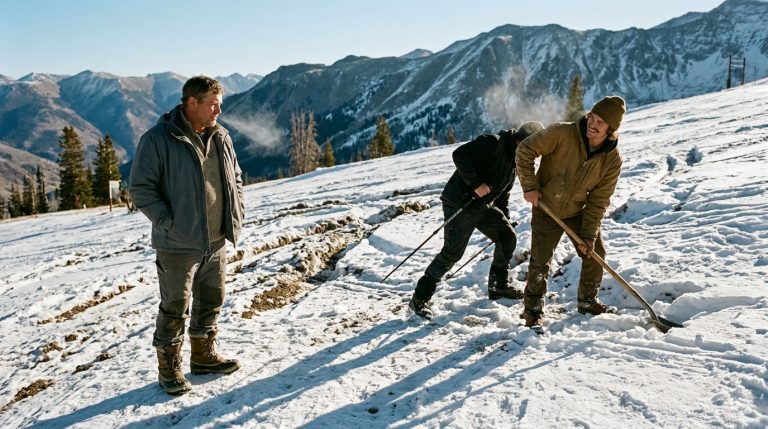
The morning air tasted of iron and impending storm. I stood by the gate, the chill working its way through my layers of wool, watching Pete’s truck pull onto the gravel. He was a man of few words, his face a landscape of deep-set lines etched by years of working in the unforgiving geometry of the high desert. He stepped out, his boots crunching loudly on the frozen ruts.
“Found something,” he said, not offering a greeting. He reached into the passenger seat and pulled out a tripod case and a heavy, leather-bound notebook.
I nodded, my eyes scanning the driveway behind him for any sign of Melissa’s BMW. The ridge was quiet, but the air felt thin, like the silence before a mortar strike. “You checked the northern drainage?”
“I did,” Pete said, setting the gear down with a heavy thud. “And I checked the survey markers from the county records you sent over. Clayton, those markers have been moved.”
My hand tightened around the handle of the gate. “Moved? By how much?”
“About twelve feet, encroaching on your eastern boundary, and a solid twenty-foot shift at the ravine entrance,” he replied, his voice low. “Someone went through the trouble of sinking new, treated-timber posts with professional-grade surveying equipment. It wasn’t a lazy afternoon hack-job. It was done by a crew that wanted those lines to look permanent.”
I looked toward the ravine, the shadows still clinging to the scrub brush. Twelve feet. Twenty feet. It was the difference between a private ranch and a municipal thoroughfare. It was the precise amount of land needed to bypass the natural rock shelf and gain heavy-machinery access to the aquifer.
Suddenly, the smell of the damp earth shifted. A memory pushed through the mental wall I’d built: the desert, years ago, auditing a supply line that had been ‘re-routed’ by contractors to inflate their fuel mileage costs. The logistics were different, but the intent was identical—manipulating the terrain to justify a resource drain.
“They aren’t just looking for an easement, Pete,” I said, my voice barely audible over the wind. “They’re trying to turn my ravine into a staging area for a deep-drill project.”
Pete looked at me, his eyes narrowing. “You know what that means for the water table, don’t you?”
“I do,” I said. It meant the drying up of the pasture, the death of the garden, and the eventual devaluation of the property until it was worthless, making it easy pickings for a developer buy-out.
I walked to the trunk of my own truck and pulled out the passive optical sensor I’d retrieved from the ravine earlier. I handed it to him. “Check the casing. Tell me if you see anything.”
Pete inspected the glass lens, squinting under the gray light. He pulled a jeweler’s loupe from his pocket and traced the rim of the mounting bracket. “This is custom-machined. You didn’t buy this at a hardware store.”
“I made it,” I admitted. “Someone’s been jamming the digital grid. They don’t want me recording what they’re doing in that ravine.”
Pete handed the lens back, his expression grim. “If they’re using military-grade electronic countermeasures, this is beyond the scope of a local HOA president, Clayton. You’re dealing with developers who have a long reach.”
“Let them reach,” I said, a cold, hard resolution settling into my gut. I didn’t reach for my phone; I reached for the radio I’d hidden in the glove box—a frequency-hopping long-range unit tuned to a private channel I’d established with Jennifer Martinez.
The strategy had to pivot. If I fought them on the ground as an HOA grievance, I’d lose the war of attrition. But if I documented the structural fraud—the moved markers, the industrial-grade surveillance, and the evidence of site preparation for a project that hadn’t been permitted—I could force a federal inquiry before they even broke ground.
“I need you to map the exact locations of those moved markers,” I told Pete. “Every one of them. Do it as if you’re testifying in front of a federal judge. Use the GPS, and keep the raw logs uncompressed.”
Pete started to nod, but then he stiffened, his head snapping toward the ridge. I heard it too—the faint, distant hum of heavy tires on asphalt, moving slow, deliberate.
“That’s not an SUV,” Pete muttered.
I moved to the edge of the gate, peering through the binoculars. A utility-grade flatbed truck was crawling along the perimeter road, its crane arm folded neatly against the bed. It wasn’t just patrolling; it was carrying equipment.
I didn’t panic. I calculated. If they were bringing in equipment now, they were escalating the timeline. They wanted the markers set and the site prepped before the next snow dump.
“Finish the map,” I commanded, my voice flat, professional. “I’m going to ensure they don’t get a chance to sink those anchors today.”
I turned and walked toward the barn, my mind already working through the physics of the snowgate trap. I had one chance to stall them. If I could cause a mechanical failure of their heavy equipment on the access trail, I could buy Pete the three hours he needed to lock down the evidence.
I didn’t feel the cold anymore. I felt the mission. The garden, the cattle, the water, Sarah—it was all condensed into a single, precise, and absolute imperative. I reached the barn and pulled a pair of high-tension wire cutters from the tool belt, my hands steady, my mind clearing of everything except the next movement.
They were coming to take the land, but they were about to find out that this ground was occupied by someone who understood exactly what it took to defend a line.
CHAPTER 5: THE LEGAL SIEGE
I didn’t sprint toward the ravine. That was the mistake they wanted me to make—the desperate, emotional lunge that would justify a “safety intervention” by their private security team. Instead, I moved with the calibrated, slow-motion grace of a predator who had already accounted for the terrain. I reached the treeline and transitioned into a crouch, the snow crunching almost imperceptibly under my weight.
From this vantage point, I had a clear line of sight to the access trail. The utility flatbed was idling, its crane arm swinging in a slow, hypnotic arc as the operator tested the hydraulic pressure. Beside it stood the HOA treasurer, a man named Henderson, shivering in a high-end down jacket that looked entirely out of place against the raw, jagged reality of the canyon wall. He was holding a stack of laminated permits, his posture stiff, rehearsed.
They weren’t just clearing the path. They were marking the spot for the core samples.
I brought the radio to my lips, the push-to-talk button cold against my thumb. “Jennifer, I have visual on the unit. They’re positioning for the drill. The markers are confirmed as tampered. They’re violating the federal land-use ordinance I flagged in the last packet.”
Jennifer’s voice crackled through the earpiece, calm and clinical. “Hold your position, Clayton. If you move now, you jeopardize the admissibility of the evidence. I have the injunction drafted, but I need them to actually break the seal on that soil. If they drill, they commit the federal felony. Let them start.”
I lowered the radio. My jaw ached from the tension. Letting them start meant watching them puncture the integrity of the land, potentially triggering the very erosion they were claiming to “fix” as a pretext for their operation. It went against every instinct I had as a rancher, as a protector. But it was the only way to ensure the gavel came down hard enough to end this permanently.
I shifted my position, the snow pressing into my shins. I watched as the operator deployed the stabilization jacks. The steel legs punched into the frozen earth with a sickening, grinding thud. Henderson was on the phone, his face animated, gesturing wildly toward the ridge—the same spot where the ATV had been lurking last night.
He was reporting to someone. Not just a developer, but someone higher up the chain.
I waited, my breath forming plumes of mist that I carefully dissipated with the collar of my coat. The operator revved the engine. The drill bit—a massive, auger-style cylinder tipped with carbide—began to spin. It hummed, a low, vibration that I felt through the soles of my boots.
Suddenly, a shift in the wind carried a sound from the ridge. A metallic click. It wasn’t the machinery. It was the distinct, unmistakable sound of a long-range scope mounting being adjusted.
My muscles locked. They had a spotter.
They weren’t just drilling; they were protected. The realization hit me with the force of a physical blow. If I stepped out now, if I even made my presence known, they wouldn’t stop—they’d silence the observer. And I was the only observer currently on site.
I pulled back further into the shadows of a pine, my heart rate steady, my breathing rhythmic. I didn’t look through the binoculars. I used the passive glass lens I’d mounted earlier, checking the ravine’s edge from an oblique angle. Through the distorted glass, I saw a flash of light—not a reflection, but a purposeful, rhythmic signaling. Someone was on the ridge, guiding the drill operator toward the exact point where the aquifer was most vulnerable.
They weren’t just looking for soil data. They were looking for the pressure release point. They were planning to bleed the aquifer, which would turn the entire valley floor into a liability and allow the developers to declare the land “unstable” and seize it for pennies on the dollar under an eminent domain emergency clause.
The sewage leak cover-up I’d suspected was the distraction. The aquifer theft was the payload.
I watched them, my fury turning into a cold, diamond-hard clarity. I stayed motionless as the drill bit kissed the surface of the frozen ground. Dust and ice chips sprayed outward in a plume. They were doing it. They were crossing the line.
“Jennifer,” I whispered into the radio, my voice steady enough to be a recording. “They’re drilling at the point of origin. They’re at the site. The evidence is being generated as we speak.”
“Confirming,” she replied. “I’m triggering the alert to the local precinct and the federal marshals now. Clayton, do not—I repeat, do not—engage. You are the witness, not the operator. Stay invisible.”
I let the radio fall back to my chest. I watched the drill bit dig deeper, the earth groaning in protest. I felt a strange sense of detachment, as if I were looking down at the board from a great height, seeing the moves, the counter-moves, and the inevitable collapse of their position.
They thought they were the architects of this moment. They had no idea they were just digging their own graves. I stood up, turned my back on the site, and began the silent, grueling walk back to the house. I had played my part. Now, it was time for the law to do the rest.
CHAPTER 6: THE DECOY REVEAL
The walk back to the farmhouse felt like trekking through quicksand, though the ground beneath my boots was frozen solid. Every instinct I’d honed in the service screamed at me to turn back, to sabotage the drill site, to physically neutralize the threat. But I kept my eyes on the porch. I had to maintain the charade. I was the homeowner, the aggrieved party, the man who was supposed to be hiding behind a legal injunction.
I reached the mudroom and began the meticulous process of shedding my winter gear. My hands felt clumsy, the residual adrenaline making my fingers twitch. I hung the wire cutters back on the wall, wiped the frost from my watch, and took a deep, steadying breath. When I walked into the kitchen, Sarah was still sitting in the same spot, her gaze fixed on the digital monitor. She didn’t look at me; she looked at the feed.
“They stopped,” she said, her voice brittle.
I moved to her side, glancing at the laptop. She was right. The drill, which had been gnawing at the ravine’s earth only moments ago, had ceased its rhythmic, grinding roar. The flatbed truck was stationary. Henderson, the HOA treasurer, was standing near the drill head, pacing. He held a phone to his ear, his body language telegraphing an agitated, high-stakes conversation.
I leaned in, squinting at the screen. They weren’t packing up. They were waiting.
“Why stop?” Sarah asked, her hand trembling slightly as she reached for her tea.
“They hit something,” I said, my mind racing through the geology of the site. “Or they found something they weren’t expecting.”
I sat down and tapped into the internal network of my own security sensors—not the ones they were jamming, but the backup, low-frequency tripwires I’d buried near the property line earlier that week. A notification pinged. Something had moved on the perimeter. Not a vehicle—a person.
I zoomed in on the grainy infrared feed. A figure, dressed in dark, non-reflective gear, was crouching near the base of the utility flatbed. They weren’t a worker. They were carrying a black briefcase, not tools. They were making a drop.
My stomach churned. This wasn’t part of the developer’s plan—or, at least, not the public-facing one. This was a private exchange, a secondary layer of the conspiracy that even Henderson didn’t seem to be aware of. The treasurer was pacing, distracted, his attention fixed on the ridge, while this ghost-figure tucked the briefcase beneath the flatbed’s chassis.
“It’s a hand-off,” I whispered, the realization cutting through the air like a blade. “They’re using the drilling operation as a cover to move something, or to secure a payoff.”
This was the decoy. This was the “secret” I was meant to find. They had engineered a scenario where a local resident, snooping into HOA corruption, would stumble upon a payoff and assume it was the heart of the matter. It was a perfect, self-contained mystery. If I took this to Jennifer, if I took this to the feds, they would seize the briefcase, find proof of a bribe, arrest Henderson, and close the file—all while the drill site remained, the “sewage leak” excuse would be processed, and the aquifer would remain exposed for the eventual land seizure.
My pulse, which had been racing, suddenly flattened. I looked at the screen, at Henderson’s frantic pacing, at the briefcase tucked securely in the shadows of the truck. It was a masterpiece of misdirection.
“Clayton?” Sarah turned to me, her eyes reflecting the blue light of the monitor. “What is that?”
“It’s a distraction,” I said, reaching for the tablet. I didn’t reach for the record button. I didn’t initiate a download. Instead, I carefully recorded the timestamp, the coordinates, and the exact physical description of the ghost-figure. I wouldn’t report this to Jennifer yet. If I reported this, I’d be walking into the trap.
I had to let them think I’d been fooled.
I stood up and paced the kitchen, the floorboards groaning under my weight. My mind felt sharpened to a razor’s edge. I had to maintain the persona of the frustrated, law-abiding property owner. I had to let them finish this little theater of theirs, let them believe they’d successfully steered me toward the ‘bribe,’ while I kept my eyes on the real target: the drill bit itself, and the hidden aquifer it was designed to puncture.
“They’re going to come here,” I said, turning to Sarah. “They’re going to expect me to see this. They’re going to expect me to go down there and try to photograph the hand-off.”
“You aren’t going,” she stated, not as a question, but as a command.
“No,” I replied, “I’m going to do something better. I’m going to let them think I’ve already contacted the authorities. I’m going to create a vacuum of information.”
I sat back down and opened a blank text file on my laptop. I didn’t write anything. I simply left the screen active, visible to any remote access program they might have running on my network. I typed a single, cryptic sentence: Evidence secured. Federal team arriving at 0900.
I knew they were watching my screen. I knew they were harvesting my metadata. If they thought I had the “proof” of their corruption, they would shift their attention away from the ravine and toward me. They would try to neutralize me.
And in that moment of focus, when they were busy trying to contain the “whistleblower,” they would let their guard down on the drill site.
I looked at the monitor one last time. Henderson was gone. The flatbed was empty. The ghost-figure had vanished. The drill sat idle, a silent, predatory machine waiting for the next order. The trap was set, but I was the one who had changed the bait.
I turned off the kitchen light, leaving us in the heavy, suffocating silence of the night. I wasn’t just a witness anymore. I was a player, and for the first time, I was moving pieces they didn’t even know were on the board.
CHAPTER 7: THE TRAPDOOR CALIBRATION
The silence in the farmhouse was no longer peaceful; it was a vacuum, waiting to be filled. The power failure hadn’t been triggered by the grid—I knew the HOA’s local substation limitations by heart. This was a targeted strike, a localized electromagnetic burst designed to fry the hardware I had sitting right there on the kitchen table.
My hands moved in the dark, trained by years of repetitive, high-stakes drills. I didn’t reach for the light switch. I didn’t reach for a backup generator. I reached for the manual override tethered to the floor joists under the kitchen island.
I felt the cool, machined steel of the lever. With a smooth, practiced motion, I engaged the mechanical secondary circuit—the one that didn’t rely on the digital grid. It was an analog fail-safe, a system of weighted pulleys and tension-based triggers I’d installed when I first bought the land.
If they wanted to silence my digital presence, fine. I’d give them the physical reality they were asking for.
“Clayton?” Sarah’s voice came from the darkness of the living room, low and steady. She wasn’t panicked; she was observing. She had lived through the chaos of my service, and she knew the sound of a man transitioning into a defensive stance.
“They cut the power,” I said, my voice barely a whisper. “They’re getting ready to move.”
I moved to the window, keeping my profile low. The night outside was a charcoal smear, the only illumination coming from the sliver of moonlight catching the frost on the windowpane. In the ravine, the drill site was a dark, hollow pit, but the access trail was lit by the harsh, sweeping beams of two approaching transport trucks.
They weren’t here to drill anymore. They were here to secure the scene. They knew I’d seen the hand-off, and they were closing the perimeter to sanitize the site.
I reached into the shadows of the utility closet and pulled out the remote for the snowgate. Even without the digital display, the tactile feedback of the buttons—the raised ridges I’d notched into the plastic—was enough. I felt the physical resistance as I clicked it into the armed position.
The mechanism was simple, brutal, and effective. I had calibrated it to the weight and velocity of their heavy transport trucks. When they hit the trigger point, the gate wouldn’t just block them; it would collapse the road underneath them, forcing the trucks into a high-center, immobilization scenario right at the bottleneck of the private easement.
I checked my watch. 02:00. The time for caution had passed. I grabbed my coat, the wool heavy and comforting, and stepped out into the night.
The air felt like a physical assault, a frigid, invisible hand pulling at my lungs. I moved toward the gate, not with the aim of confrontation, but with the intent of a shepherd guiding a herd into a pen. I took up a position in the treeline, hidden by the gnarled, frozen limbs of the oaks.
The trucks arrived. Their headlights cut through the snow, long, blinding needles of light that failed to penetrate the shadows where I stood. I counted them: one, two. They slowed as they hit the incline—the exact moment I’d mapped out.
I watched, my eyes locked on the front tire of the lead vehicle. The driver was cautious, hitting the brakes, checking the grade. He didn’t see the tension wires buried beneath the crust of the snow. He didn’t see the way the ground itself was rigged to pivot under the weight.
I touched the remote. The signal traveled, a silent pulse through the air.
A sharp, metallic groan echoed through the ravine—the sound of tension wires snapping, followed by the catastrophic, sickening crunch of the road foundation giving way. The lead truck lurched forward, its front axle dropping into the trench I’d carved out of the frost-hardened earth. It slammed into the ground with a force that rattled the very trees I was leaning against.
The driver of the second truck swerved, his tires spinning uselessly on the ice, the heavy flatbed fishtailing until it jackknifed across the narrow track.
Total immobilization.
I didn’t step out. I didn’t gloat. I stood in the dark, watching the headlights bob frantically as the drivers struggled to reverse, to steer, to make sense of the ground that had turned into a trap. I reached for the radio, the frequency-hopping channel now active on a backup battery.
“Jennifer,” I said, my voice calm, almost detached. “The perimeter is breached. They have moved onto the property with heavy equipment. They are currently immobilized on the private easement.”
“Copy,” she replied, her voice filled with a sudden, sharp intensity. “I have the federal marshals on the feed. They are five minutes out. Keep them contained. Do not leave cover.”
I dropped the radio. I wasn’t going anywhere. I stood in the trees, a phantom in the dark, watching the panic unfold in the needles of light. They thought they had come to bury a secret. They didn’t realize that in this place, the land itself had a memory, and it was finally deciding to settle the score.
CHAPTER 8: THE CONVOY ARRIVES
The silence was short-lived. From the ridge, the rhythmic clicking of the spotter’s radio confirmed my worst fear: they weren’t backing down. They were calling in the heavy hitters.
I didn’t move. I remained a part of the landscape, my breathing regulated to the slow, steady rhythm of the freezing air. Down on the access trail, the drivers were out of their cabs, illuminated by the harsh, flickering beams of the jackknifed trucks. They looked like silhouettes in a stage play, gesturing toward the ravine, their voices rising in panicked, sharp-edged protests. They weren’t combatants; they were contract labor, caught in the mechanics of a machine that didn’t care if they got out alive.
A surge of memory—a failed extraction in a desert valley years ago—threatened to override my focus. I pushed it back down, into the dark, cold place where it belonged. This wasn’t that valley. This was my ground.
“Jennifer,” I whispered, my radio barely audible even to me. “They’re escalating. They’re putting boots on the ground at the ridge. The spotter has left his perch and is moving toward the flatbed.”
“Stay put, Clayton,” Jennifer’s voice was strained, the background noise of her environment suggesting she was already in motion. “The marshals are two miles out. They’re dealing with a blocked turn at the county entrance, but they’re coming. If the spotter reaches the flatbed, he’s going to sanitize the site. He has the order to wipe the drive logs and destroy the drill equipment. If he does that, we lose the evidence of the site prep.”
“I can’t let him wipe the logs,” I said, my voice cold.
“Do not engage, Clayton! That is a direct order. You are a civilian, and you are not armed. If you show yourself, they will end this in the dark, and we will never be able to tie the aquifer seizure back to the board.”
I didn’t respond. I knew she was right, but she wasn’t looking at the board. She didn’t see the way the spotter moved—not like a security guard, but like an operator. He was closing the distance to the flatbed with terrifying, fluid efficiency.
I watched as he approached the truck, his movements precise. He didn’t care about the panicked drivers. He reached into the back of the flatbed, pulled a ruggedized case from beneath the crane arm, and began to interface with the drill’s control console.
The wind picked up, a biting gust that sent snow swirling around me. I tightened my grip on the tree trunk, my knuckles white under the wool of my gloves. I had to create a distraction—something that would pull him away from the console without revealing my position.
I reached into my pocket and pulled out the secondary remote, the one I’d wired to the perimeter lights of the barn. I hadn’t activated them yet. They were a simple, low-voltage array, but they were positioned to strobe directly toward the ravine.
I clicked the remote.
The entire side of the farmhouse and the barn erupted in a blinding, rhythmic flash of white light. It was enough to turn the darkness into a disorienting, strobe-lit nightmare for anyone looking toward the property.
The spotter froze. He turned, his head snapping toward the house, his eyes undoubtedly blinded by the sudden, strobe-pulse of the lights. The drivers shrieked, hitting the dirt as the world around them suddenly became a flickering, surreal combat zone.
He moved, but he didn’t run toward the house. He moved toward the edge of the ravine, his weapon drawn—a sleek, suppressed silhouette in the strobe light.
I didn’t wait. I moved.
I dropped from the treeline and sprinted through the shadows of the orchard, my boots flying over the snow-crusted ground. I wasn’t going for the spotter. I was going for the control console.
I reached the flatbed, my chest heaving, the air in my lungs tasting of fire and frozen iron. The driver of the lead truck saw me, his eyes widening in the flickering light. He made a move to stop me, but I didn’t hesitate. I used the momentum of my sprint to shoulder-check him, sending him sprawling into the mud.
I scrambled up the side of the flatbed, my hands clawing at the control console. The spotter shouted—a guttural, sharp command—but he was too far, and the strobe lights were still disorienting him. I didn’t have time to download. I didn’t have time to save. I ripped the primary hard drive from its mounting with a violent, wrenching twist.
A bullet whistled past my ear, the sound a thin, sharp hum that vibrated in my teeth. It hit the metal of the crane arm, sparking white in the dark.
I didn’t look back. I leapt from the flatbed, the impact jarring my knees, and rolled into the deep, drifted snow at the base of the ravine. I scrambled through the brush, my hand clutching the hard drive to my chest, my breath coming in ragged, white-hot bursts.
I heard them behind me—shouting, crashing through the frozen scrub, the sound of the spotter barking orders. I didn’t look back. I pushed, my muscles burning, my lungs screaming for oxygen. I reached the edge of the perimeter fence, the metal wire biting into my palm as I vaulted over it, landing in the darkness of the neighboring field.
I was out. But as I crouched in the dark, clutching the jagged, broken drive, I knew the game had fundamentally shifted. They knew who I was now. They knew I had the evidence. And they were going to do whatever it took to make sure I didn’t make it to the marshals.
The sirens began to wail in the distance—a high, mournful sound that cut through the night. They were close. But close wasn’t here, and here, in the dark, the distance was the only thing standing between me and the end of the line.
CHAPTER 9: THE COLLISION
I moved through the darkness of the field, the terrain uneven and choked with frozen stubble. Every time I placed my foot, I winced, waiting for the crack of a snapped stalk to give me away. Behind me, the chaos in the ravine had turned into a frantic, high-pitched cacophony. The spotter was shouting, his voice strained and angry, and the sound of heavy boots crunching on the gravel suggested they were spreading out to hunt.
I didn’t head for the road. That was where they’d be looking. Instead, I navigated toward the old irrigation pump house, a concrete monolith half-buried in the lee of the ridge. It was a relic of the ranch’s past, a place where the infrastructure intersected with the natural veins of the water table. If I could get inside, I could interface the drive with the ranch’s old, un-networked security terminal.
My lungs were on fire, and the adrenaline was beginning to crash, leaving me with a bone-deep exhaustion that threatened to slow my pace. I forced myself to count my steps—one, two, three—focusing on the rhythm of movement rather than the fear of capture.
I reached the pump house. The rusted iron door was frozen shut, its hinges choked with ice. I didn’t reach for the lock; I used the flat of my hand to strike the hinge assembly, the shock of the impact shattering the ice. The door groaned, swinging open just enough for me to slip inside.
The smell of stagnant water and cold concrete was overwhelming. I moved to the terminal, my fingers fumbling in the dark. I didn’t need a light. I knew the port locations by heart. I shoved the hard drive into the terminal and waited, my heart hammering against my ribs like a trapped bird.
The terminal’s screen sputtered to life, a dim, amber glow filling the cramped space. I navigated to the directory, my eyes burning. There it was: the project logs, the falsified environmental reports, and the map of the aquifer, annotated with the specific drill coordinates that were intended to bleed the valley dry.
I didn’t copy it. I pushed the data to a cloud-synced mirror that Jennifer had set up as a dead-man’s switch.
A heavy thud sounded against the iron door.
I froze. My hand dropped to the floor, grasping a heavy, rusted pipe I’d used years ago for maintenance. The door shuddered again, the metal bending inward. They were here.
“Clayton!” It was Henderson’s voice, raw and desperate. “We know you’re in there. Don’t be a fool. You don’t have the backing you think you do. If you walk out with that drive, you’re dead. If you leave it, we can work something out. The board has a place for a man who knows how to keep his mouth shut.”
I didn’t answer. I watched the progress bar on the screen: 85%… 90%… 95%.
The door buckled, a section of the iron frame tearing away from the concrete wall. I didn’t wait for them to breach. I lunged forward, not out of the door, but through the maintenance hatch at the back of the pump house, dropping into the cold, shallow water of the irrigation channel.
The water was biting, a shock of ice that nearly stopped my heart, but I used the momentum to slide beneath the perimeter of the foundation. I emerged into the shadows of the ravine, ten yards from where Henderson and the spotter were standing.
They were blinded by their own flashlights, their beams cutting through the pump house door. They didn’t see me in the dark. I watched as they moved inside, their voices raised in frustration as they realized the terminal was empty.
I started to move, but a movement in the trees caught my eye. Flashlights—not one, not two, but a dozen of them—were cresting the ridge. The marshals. They were here, and they were moving with a surgical, overwhelming precision.
I stood up, the hard drive’s confirmation chime echoing in my mind. The data was live. The conspiracy was visible.
Henderson and the spotter emerged from the pump house, their faces pale, their eyes locking onto the advancing wall of lights. They realized the game was over. They didn’t run. They simply stood there, frozen, as the marshals descended, the silence of the night broken by the hard, metallic click of handcuffs and the authoritative commands of the law.
I stepped out of the shadows, my legs feeling like lead, my hands still cramped from holding the drive. I didn’t approach them. I stood in the middle of the trail, the cold wind whipping my hair, and watched as the men who had sought to strip my world apart were dismantled by the very rules they thought they could bypass.
The collision of their hubris and the law was absolute. I felt a sudden, profound stillness settle over the ravine. It wasn’t the silence of fear; it was the silence of justice.
CHAPTER 10: THE AQUIFER TRUTH
The ravine was bathed in the harsh, white glare of the marshals’ floodlights, turning the frozen mud into a glistening, industrial stage. I stood back near the treeline, the weight of the hard drive still burning a hole in my hand as I watched the final act. Henderson and the spotter were already cuffed, their faces drained of the arrogance that had defined them only hours ago. They were small men, reduced by the bright light and the cold, mechanical reality of handcuffs.
I walked forward, my legs stiff, the adrenaline finally beginning to ebb into a dull, throbbing ache. A marshal stepped forward, his hand hovering over his belt, but he stopped when he saw the look in my eyes. I didn’t reach for the drive; I held it out, an offering.
“It’s all there,” I said, my voice raspy from the cold. “The project logs, the falsified environmental reports, and the specific coordinates for the aquifer breach. They weren’t fixing a sewage leak. They were liquidating the foundation of the valley.”
The marshal took the drive, his expression unreadable, and signaled for a tech specialist to secure it. As the specialist plugged the drive into a field terminal, I stood by the edge of the drill site, looking down into the open throat of the earth. The hole was jagged, raw, and deep. It was a wound that would take years to heal, but at least the bleeding had stopped.
The investigation moved with the speed of a landslide. Jennifer Martinez arrived shortly after, her face a mask of professional satisfaction. She walked up to me, handing me a digital tablet that was already showing the results of the drive’s data dump.
“You were right about the board,” she said, her voice low. “The logs are connected to a shell company registered in the city. The entire HOA board wasn’t just complicit—they were employees. They were running a scorched-earth policy to devalue the ranch and the surrounding plots, hoping to buy them for pennies before the aquifer seizure was formalized.”
I looked at the data—a list of names, bank accounts, and corporate titles. The “emergency infrastructure” claim had been the perfect smokescreen. It was a masterclass in bureaucratic predation, carried out by people who viewed our lives, our history, and our land as nothing more than a line-item entry in a quarterly projection.
Poetic justice, I thought, watching Henderson’s face as he caught sight of the tablet. He realized then that the decoy—the bribe he thought he was protecting—had been the key to the entire archive. He had been a pawn, just like the rest of them.
The cooldown began as the marshals dismantled the drill rig. The atmosphere in the ravine shifted from the frantic, jagged tension of a crime scene to the somber, heavy rhythm of an industrial cleanup. The heavy, grinding machinery was silenced. The floodlights were dimmed, one by one, until only the moonlight remained, cold and indifferent, touching the broken fence posts and the trampled garden.
I walked back to the farmhouse. The porch was waiting, a quiet island of warmth in the middle of the desolation. I found Sarah sitting at the table, a cup of tea still steaming between her hands. She looked up as I entered, and for the first time in months, the lines of anxiety around her eyes had softened.
“Is it done?” she asked.
“It’s done,” I said.
I walked to the kitchen and pulled a small, battered wooden box from the shelf—my grandfather’s old toolkit. I sat down at the table and pulled out a section of the broken fence railing I’d brought in earlier. It was splintered, jagged, and scarred by the BMW’s impact. I laid it out, taking a small file and a block of wax from the box.
I began to work, my movements slow and deliberate, the friction of the file a steady, calming rasp in the quiet house. I wasn’t just fixing a fence; I was re-anchoring the boundary. I was reclaiming the space.
The hours passed, marked only by the gentle ticking of the clock and the steady, rhythmic scrape of my file against the wood. As the sun began to bleed over the horizon, painting the snow in shades of soft, bruised gold, the railing was smooth, the splinters gone, the wood showing its grain once again, strong and unbroken.
I pushed the repaired piece toward Sarah. She reached out, her fingers tracing the smooth wood, and finally, she smiled. It was a small, quiet thing, but it was the most powerful thing I had ever seen.
I stood and walked to the window, looking out over the ranch. The garden was still buried in snow, but beneath the drifts, I knew the roots were waiting. The aquifer, the source of everything, was safe, its hidden, rhythmic pulse once again beating beneath the earth.
No one would ever threaten this place again. I understood now that defense wasn’t just about traps or logs or the cold, calculated leverage of the law. It was about the simple, unwavering act of staying—of holding the line, of repairing the damage, and of finding the beauty in the resilience of what remained.
The snow-covered world was quiet, but the silence was no longer empty. It was the silence of a sanctuary, restored and held, grounded in the certainty that as long as we were here, the boundary would hold.