The Ice in Her Veins Met the Grit in My Palms: Exposing the Bride’s Darkest Secret
CHAPTER 1: THE SILVER SCRAPE
The tarnished silver platter weighed heavy against my right wrist, the heat of three hundred boiled shrimp rising through the paper doily to sting my calloused skin. Around me, the ballroom of the Caldwell estate was a blinding sea of diamond necklaces and stiff black tuxedos, a gathering of millions of dollars celebrating a man’s third walk down the aisle. I stood perfectly still against the velvet drapes, my uniform crisp, my posture straight, doing exactly what thirty years of service had trained me to do—remaining completely invisible to the people who signed the checks.
Margot, the new bride, stood on the raised dais at the far end of the hall, her white gown shimmering with thousands of hand-stitched crystals that caught the light like broken glass. She laughed at something a senator said, a light, bell-like sound that drifted over the thumping bass of the live orchestra, but her sharp blue eyes never stopped moving, scanning the room like a hawk looking for a crack in the floorboards.
Then came the sound.
It wasn’t the clinking of the expensive champagne flutes or the laughter of the guests. It was a dull, rhythmic friction coming from the utility corridor directly behind my shoulder blades—a wet, dragging scrape against the framework of the old mansion wall. I pulled the heavy brass pocket-watch from my apron, slowly turning the scratched winding stem until it clicked twice, using the metallic snap to mask my movement as I leaned back against the cool silk wallpaper.
Scrape. Help.
The whisper was so thin it felt like dust against my ear, but the sheer desperation in it froze the blood in my veins.
CHAPTER 2: ICE AND JASMINE
The whisper from the partition wall died, swallowed by a sudden burst of laughter from the ballroom. I didn’t look back at the crowded tables, but my thumb traced the rough, serrated edge of the brass pocket-watch in my apron pocket, winding it once. The metallic click-clack was the only thing keeping my breathing steady.
A sharp, rhythmic clicking began at the far end of the service corridor. High heels. High heels cutting across the polished marble beyond the carpet runner with the cold cadence of a firing squad.
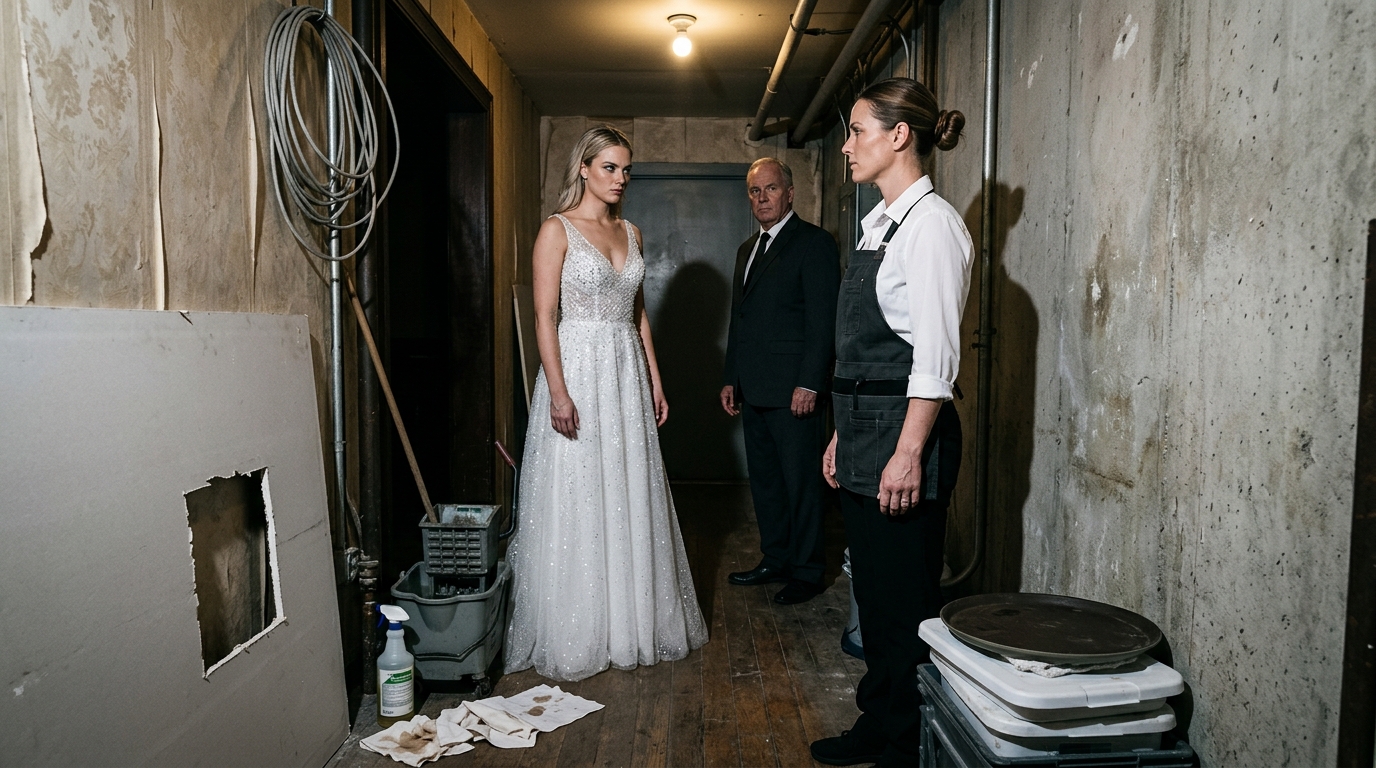
I turned my head slow, adjusting the heavy silver tray of appetizers on my forearm just as the white fabric of a bridal gown rounded the corner. Margot stood ten feet away. Up close, away from the soft lighting of the dais, the thousands of hand-stitched crystals on her dress looked less like diamonds and more like jagged shards of ice.
“Susan’s girl,” Margot said, her voice dropping into the quiet hallway with a terrifying sweetness. “Or is it just the hired help looking for a place to slip a few silver forks into an apron?”
She didn’t wait for an answer. She closed the distance between us, her movements silent despite the heavy silk train rustling behind her like dry leaves. The scent of jasmine rolled off her, thick and suffocating, but beneath it smelled of something sour—like old floor bleach and stale sweat.
“I was resetting the perimeter drapery for the cake cutting, ma’am,” I said, keeping my chin level and my eyes anchored right on the silver clasp of her necklace. If you look these people in the eye when they are hunting for a reason to ruin you, they take it as a challenge. Thirty years in these houses teaches you to look just past them, like they are nothing but a piece of heavy furniture.
Margot stopped exactly one foot away. Her sharp blue eyes didn’t look at my face; they dropped instantly to my hands. My right knuckles were white from gripping the edge of the heavy tray, but it was my fingertips she was staring at—the faint, gray smudges of old plaster dust caked under my nails from where I had pressed against the loose winsking panel.
A small, bloodless smile touched the corners of her mouth, but her eyes remained completely dead, like blue glass chips.
“Curiosity is an expensive trait for a woman who lives in a rented trailer, Emily,” she whispered, her voice barely carrying over the distant thump of the wedding band. She leaned in closer, the sharp edge of her diamond bodice pressing near my arm. “The last maid who thought she could look behind the doors in this house found herself out on the pavement before the sun went down. No references. No next paycheck. Do you understand how small this city gets when I tell people you steal?”
—I don’t steal, ma’am.
The words came out blunt, devoid of the shaking terror she was looking for. I shifted the watch in my pocket, letting the heavy metal casing thump against my thigh. I could hear the faint scratching start again inside the wall, right behind her glittering shoulder.
Margot’s eyes narrowed, the sweet mask fracturing for a fraction of a second to reveal a raw, twitching nerve near her jaw. She took a single step back, her fingers curling tightly around the fabric of her gown. “Get back to the kitchen. If I see your face on this side of the ballroom again, I won’t just have Henderson fire your mother. I will make sure the state takes a very long, very detailed look at how she raises her daughter.”
She turned on her heel, the white train sweeping the dust from the baseboards as she strode back toward the noise. I didn’t move until the sound of her heels vanished into the brassy roar of the trumpet section. My fingers were slick with sweat against the brass pocket-watch, but the cold weight of it reminded me of the simple math Grandpa Joe used to talk about.
Fear only works if you have something left to lose, and right now, the boy in the dark was running out of time.
CHAPTER 3: THE EXTENDED NEEDLE
The underbelly of the grand ballroom smelled of spilled wine and stale perfume. Up above, the oak floorboards groaned under the weight of two hundred dancing elites, their designer heels sending rhythmic, heavy vibrations through the darkness where I crawled.
I dragged my knees across the polished wood, my right hand clamping the bundle of plastic straws into my apron pocket. The silver tray was gone, abandoned behind the service doors, but the scratched brass pocket-watch thudded against my chest with every forward lurch.
A waiter’s black leather shoe stepped within two inches of my face, his ankle turning as he balanced a tray of clean flutes. I held my breath, my palm flattening against the cold floor until the fabric of his trousers moved toward the champagne station.
The distance between the ballroom floor and the safety of the dark corridor was barely thirty feet, but out in the open, Henderson’s tall shadow was already cutting through the crowd near the main exit. If the estate manager spotted me out of the kitchen a second time, the perimeter guards would have me at the gates before I could blink.
A sharp tear caught the hem of my uniform skirt. The metal brace of an extension table had sliced right through the cotton fabric, locking me flat against the floor.
I didn’t pull back. I reached into my apron, took the heavy brass watch, and jammed the metal casing directly into the table’s locking hinge, using the leverage to pop the brace loose with a dull metallic snap.
I crawled out from under the final white linen hem, slipping into the shadow of the heavy velvet drapes just as the hallway door swung open. The cool plaster of the service corridor hit my face like ice water.
The loose drywall panel was exactly where I left it, the dark gap smelling faintly of dust and sour masonry. I knelt, my fingers trembling as I pulled the long straws from my pocket and slid them together, fitting one narrow plastic tube inside the other until it stretched nearly twelve inches.
“Thomas,” I whispered into the blackness, my lips pressed flat against the jagged plaster edge. “Thomas, look for the white line.”
A weak, dry cough answered from the depths of the partition. The sound of his fingernails dragging against the rough inner brick was slower now, the friction fading into a light, desperate stutter.
I threaded the plastic line into the space between the studs, wiggling it blindly through the cobwebs until the resistance changed. The tube went taut.
“I… I have it,” a tiny, raspy gasp broke from the dark.
I unscrewed the cap of the water bottle with my teeth, tilted the mouth, and aligned the plastic tube with the opening. The water drained slow, the clear liquid disappearing down the narrow plastic throat as the sound of rhythmic, desperate swallowing echoed inside the hollow wall.
CHAPTER 4: THE LEDGER LEAKS
The heavy metal bit was massive, meant for boring deep into structural stone, and it shouldn’t have been drying next to the silver polish. I pulled my wet hand back, my thumb instantly dropping to the brass watch in my apron pocket to steady the surge of adrenaline.
I bypassed the main kitchen altogether, slipping down the narrow back stairwell that led directly toward the secondary butler’s pantry—the one storage zone the wedding coordinators weren’t using. The air down here was cold and thick with the scent of floor wax and old, built-in mahogany drawers.
My fingers caught the small iron handle of the built-in desk where the household accounts were filed before the wedding took over. The drawer resisted, stuck fast on its old wooden runners, until I wedged the edge of the watch casing into the groove and shoved forward with a heavy, grinding push.
A thick leather binder slid into view under the low-wattage bulb.
It wasn’t the daily grocery logs. The top document was a direct wire transfer receipt signed in thick, looping blue ink—Margot’s signature, dated exactly three days ago.
The numbers were staggering, a clean sweep of the boy’s educational trust fund transferred directly into a private offshore holding company under the label of “Specialized Medical Tuition.” But it was the second page that made the breath stick in my chest—an expedited work order for a local construction crew, stamped for six o’clock tomorrow morning, to permanently brick over the eastern foundational walls for historical preservation.
The door behind me swung open with a violent, air-cutting crack.
“Looking for a raise, Emily?” Margot stood framed in the narrow doorway, her diamond gown appearing monstrously out of place against the rough wooden shelves of the pantry.
Her jaw was locked tight, a tiny bead of sweat cutting through her thick foundation makeup as she eyed the open binder beneath my hand. The sweet bride mask had completely disintegrated, replaced by a cold, calculating ledger of her own.
—The trust fund is empty, ma’am.
The words came out flat and solid. I didn’t close the binder, keeping my palm resting flat across the wire receipt.
“A troubled child needs very expensive care abroad,” Margot said, her voice dropping into a low, vicious hum that vibrated against the narrow shelves. She stepped into the small room, her white train dragging over a discarded piece of packing twine. “And a smart servant knows exactly when to close her eyes if she wants to keep a roof over her head.”
She reached out, her iron-strong fingers wrapping directly around the edge of the leather binder to pull it from my grip. I held fast, the raw friction of the leather scraping against my calloused palms as the distant wedding trumpets blasted through the ceiling above.
CHAPTER 5: THE CHECKMATE TRAP
The crystal chandelier at the end of the hall cast long, splintered shadows across the dark oak wainscoting. Below us, the muted roar of the ballroom orchestra continued its rhythmic thumping, but up here, the air was dead and smelled heavily of dry plaster and the bitter bite of Margot’s jasmine perfume.
I kept my hand locked inside my apron pocket, my thumb pinning the heavy metal wire receipt firmly against the cracked casing of the brass pocket-watch. Margot stared directly ahead, her chin tilted high as if she were looking over a crowd of servants, but the sudden, tight twitch in her left eyelid shattered the polished facade of her bridal composure.
“You think you’ve stumbled onto a retirement plan, Emily,” she said, her voice dropping into a razor-thin whisper that barely stirred the stale air between us. She didn’t turn her head, her blue glass eyes locked onto the solid oak bedroom door at the end of the hallway. “A few numbers on a sheet of paper from a desk that doesn’t belong to you. Harrison doesn’t even look at the household accounts. He looks at me.”
—He will look at the construction order when the bricklayers arrive at six in the morning.
The statement fell between us like a block of concrete. I shifted my weight, the hard edge of the offshore wire transfer receipt rustling inside my pocket as the rhythmic, desperate scratching from inside the adjacent partition wall grew distinctly louder.
Margot’s right hand clenched into a white-knuckled fist against the fine silk tulle of her gown, a single diamond crystal snapping off the fabric and hitting the hardwood with a sharp, metallic ping. She stepped closer, her diamond bodice catching the dim hallway light as her shadow completely swamped mine against the dark paneling.
“A maid’s word against a signed contract, child,” she hissed, her breathing turning shallow and fast, leaving a thin film of condensation on her heavy foundation makeup. “The security team answers to the name Caldwell, and by tomorrow morning, that name belongs to me. You will hand over that binder, or I will ensure the police find the silver-service ledger in your mother’s locker before the cake is cut.”
She reached out, her fingers hooking like iron talons into the fabric of my apron pocket to tear the documents away. I didn’t drop my chin or back down, bracing my boots against the floorboards as the raw friction of her diamond sleeve scraped hard against my forearm, holding the boundary line right where the darkness met the light.
CHAPTER 6: THE DUSTY COLLAPSE
The wedding music from downstairs had finally sputtered out, replaced by a tense, hollow quiet that stretched down the long upper wing. Margot stood frozen against the wainscoting, her jaw working silently as a frantic, hunted look flickered across her blue glass eyes. She lunged forward one last time, her heavy silk train tearing against the baseboard as she grabbed for the metal shaft of the tool.
“Stop this madness!” she screamed, her voice cracking into a high, brittle screech that echoed off the high ceilings. “The boy is troubled—he ran away days ago! If you damage this architecture, I will have the guards throw you and your mother onto the streets before the police arrive!”
I didn’t argue. I didn’t trade dramatic cinematic threats. I simply shifted my weight, rammed the flat edge of the iron wedge deep into the center seam of the partition, and threw the entire weight of my shoulders against the handle.
The drywall split with a loud, violent crack. White plaster dust erupted from the seam, billowing out in a heavy cloud that instantly coated the glittering crystals of Margot’s gown. I drove the metal deeper, my muscles straining against the hidden wood studs as the raw friction of the pry-bar tore the screws straight out of the structural frame.
The panel popped completely loose, falling inward with a dull, heavy thud. A wave of musty, sour air rolled out of the dark cavity.
Curled on his side between the narrow two-foot space of the wall studs was Thomas. His small blue rocket pajamas were stiff with dust and sweat, his skin an ashen gray against the rough inner brick. He blinked weakly against the sudden hallway light, his cracked, dry lips moving without sound.
Margot dropped to her knees, her white gown pooling in the white plaster debris as she began to sob, twisting her diamond rings frantically around her fingers. “I was only trying to protect the inheritance… he was throwing tantrums… the family needed order—”
—Save it for the state investigator, ma’am.
The words left my mouth cold and flat. I leaned the iron crowbar against the wall, reaching down into the narrow dark space to gently pull the boy out of the grave she had built for him.
The house fell completely quiet after the local patrol car finally left the estate gates, the red and blue flashing lights fading into the early morning mist.
I sat alone at the stainless steel table in the main kitchen, the heavy smell of bleach replacing the stale scent of the wedding banquet. I reached into my apron pocket, pulled out my father’s scratched brass watch, and slowly turned the stem until the loud, steady click-clack filled the empty room. My mother Susan walked in from the break room, her face pale with exhaustion, and quietly set a hot white mug of black coffee right next to my bandaged knuckles.