The Iron Mill: A Weary Veteran Confronts the Unstoppable Machine of War
CHAPTER 1: THE SHATTERED BARN
The stench hit first. It was a rank brew of burnt rubber, cordite, and wet manure rotting under a barn roof that no longer existed.
Unteroffizier Klaus Bremer pressed his back against the crumbling brickwork of the farmhouse wall, his thumb flicking the hinge of his brass pocket watch. Click. Snap. Click. Snap.
Three kilometers to the west, the earth shuddered. Boom. Boom. Boom.
American artillery moved across the French pastureland in measured, deliberate steps. It didn’t bark like a German 88. It thudded with the heavy, unhurried rhythm of a factory steam hammer.
Bremer spat a speck of grit from his tongue and glanced at Gefreiter Müller. The boy was twenty years old, biting his lower lip until the skin turned white, his thumbs hooked nervously into his leather belt.
“Untersturmführer,” Müller whispered, waving a hand toward the dark corner of the collapsed barn. “You need to see this.”
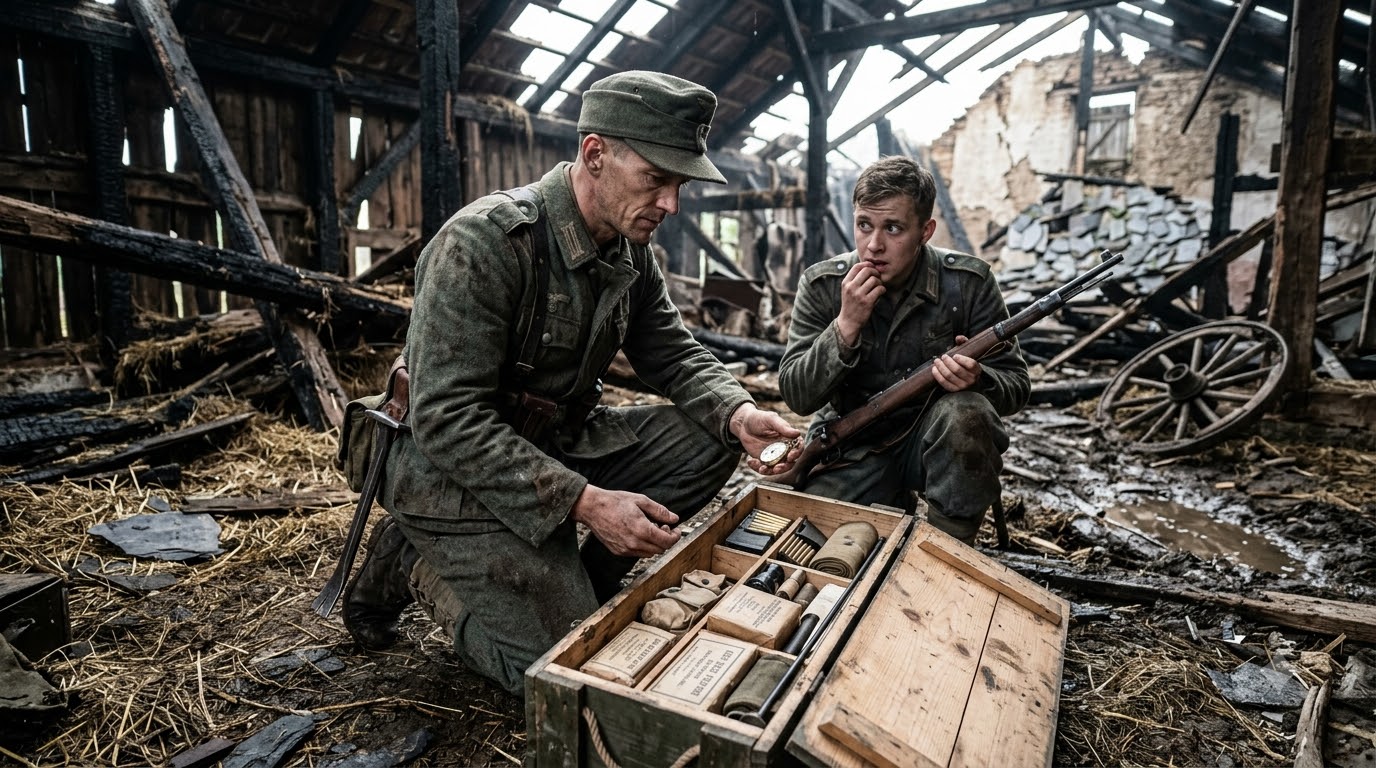
Bremer picked his way through the charred timber and loose straw, his boots crunching on broken slate. In the shadowed corner, four heavy wooden boxes sat wedged beneath a splintered support beam.
One box had split along its grain where the beam hit it, exposing a gleam of dull grey metal.
“American,” Müller muttered, wiping sweat from his forehead with the back of a filthy sleeve. “Did they drop them when the P-47 hit the road?”
“Or they just didn’t care enough to haul them off,” Bremer said, kneeling in the dirt.
He didn’t have a report, a radio transcript, or a intelligence brief to tell him what the enemy was doing. All he had was a six-inch steel pry bar pulled from his webbing and three years of surviving frozen trenches on the Don River.
He jammed the bar beneath the lid of the cracked crate and leaned his weight into it. The wood groaned, then popped open with a clean, sharp crack.
Bremer froze.
He had expected loose ammunition boxes, cloth bandoliers, or heavy belts of machine-gun rounds hastily stuffed into transport crates. That was how men packed for a war. You shoved metal into a box and shipped it to the front before someone starved.
This crate was something else entirely.
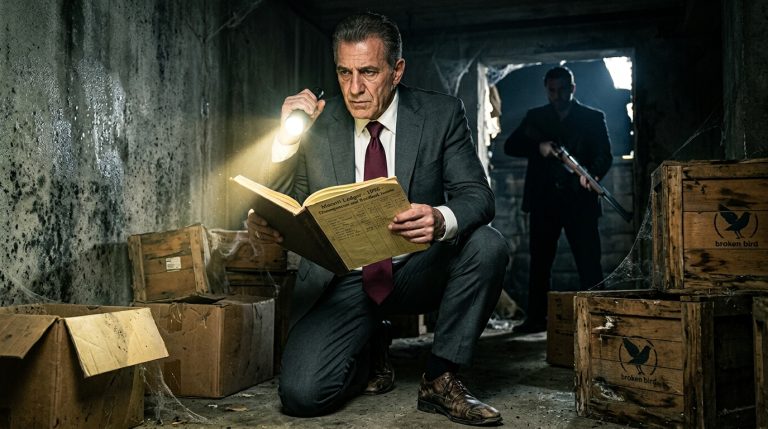
Inside, smooth pine partitions divided the space into neat, custom-fitted compartments like a watchmaker’s display case. On the left, twenty-four eight-round clips for the M1 Garand sat held firm in padded wooden slots. Below them lay paper-wrapped bundles of .30-06 cartridges, stamped with clear, black manufacturing dates.
“What is that?” Müller asked, squinting in the dim light. “Extra clips?”
Bremer didn’t answer. He reached out and lifted a canvas roll tied with a waxed cord from the right-hand compartment. Unrolling it on the dirty floor, he revealed a sectioned steel cleaning rod, two brass brushes, a rubber-stoppered bottle of solvent, and neatly cut squares of cleaning cloth tucked into dedicated canvas pockets.
Beside the roll lay spare firing pins, extractor springs, and gas cylinder plugs, each sealed in oiled paper with English labels.
“They didn’t pack ammunition,” Bremer said softly, his fingers tracing the smooth, clean edge of the oiled paper. “They packed a repair shop.”
Müller leaned closer, his eyes wide. “For one squad?”
“For whoever picks up the box,” Bremer corrected. He looked down at his own worn K98 Mauser resting against his knee. If his bolt jammed, he had to scrape the rust off with a pocket knife or strip parts from a dead man’s rifle.
The Americans didn’t expect their men to scavenge. They built boxes so a nineteen-year-old farm boy from Iowa could rebuild his rifle in the middle of a mud hole without asking a supply officer for permission.
Outside, the heavy guns thundered again, closer this time. The glass face of Bremer’s pocket watch rattled in his palm.
“How many of these crates do you think they have?” Müller asked, his voice cracking.
Bremer closed his watch with a quiet click. “Enough that they can leave four of them in a barn and not even care.”
CHAPTER 2: THE PHILOSOPHY OF WOOD AND IRON
Boom. Boom. Boom.
The rumble didn’t just rattle the shattered roof beams above us; it traveled right up through the damp clay floor and into the soles of my boots. American guns. Always three. Always three seconds apart.
I stayed on my knees, my thumb pressed against the rubber stopper of the cleaning fluid. Müller was staring at the open crate like a starved dog staring through a butcher’s window.
“Untersturmführer,” Müller whispered, his voice rasping from three days of breathing burnt cordite. “Look at the stencil on the side. The lot numbers.”
I dragged my gaze away from the neatly oiled firing pins and leaned over the pine edge. Stenciled in black ink: LOT 44-B-9912.
My mind spun backward three hundred kilometers, back to a supply depot outside Saint-Lô where we had scavenged three abandoned transport trucks before the retreat turned into a rout. The wooden ammo boxes dumped in the mud by the side of the road had carried the exact same stencil.
LOT 44-B-9912.
It wasn’t a local shipment. It wasn’t a special drop for an elite unit moving through Normandy. It was standard. A factory in Detroit or Pittsburgh had turned out a million identical boxes, packed them into identical ships, unloaded them at identical artificial harbors, and handed them to a million identical nineteen-year-old boys who didn’t even have to know how to fix a rifle to keep firing it.
“They aren’t fighting us with tactics, Müller,” I said quietly, letting the waxed cord of the canvas roll drop back into its fitted slot. “They’re fighting us with a calendar.”
“What do you mean?” He crouched lower as another shell detonated half a mile down the ridge, showering the field with dirt and shredded pine needles.
“When our Mausers break, we send them to an armorer in the rear,” I said, standing up. My knees popped in the damp silence. “When their weapons break, they open a box in a barn. They don’t waste time asking for help. They just fix it and keep walking.”
Müller swallowed hard, his eyes darting toward the open door where the sky was turning a sickly, bruised purple. “Should we take the clips? They’re .30-06. We don’t have the rifles for them.”
“No,” I said, grabbing my K98 from the brick wall. “We take the solvent. We take the oil. Leave the wood.”
He reached into the crate, his hands clumsy with cold grease, and pulled out two of the small rubber-sealed bottles. He shoved them into his coat pocket, the glass clinking against his spare Mauser rounds.
Outside, a sharp whistle cut through the low thrum of artillery—a runner’s whistle from the treeline two hundred meters north.
I didn’t need a radio or an intelligence report to know what that meant. The American vanguard wasn’t waiting for their supply lines to catch up. They were already moving through the wheat field.
“Müller,” I said, sliding the brass pocket watch into my breast pocket and clicking the cover shut. “Out the back. Move.”
We slipped through the jagged gap in the rear wall, leaving four pristine wooden crates sitting untouched in the dark, waiting for the men who built them.
CHAPTER 3: CUTTING THROUGH THE WOODS
A low rumble shook the hedge line fifty meters back. Not artillery this time, but the heavy, grinding clatter of rubber tires and iron treads chewing up gravel.
Müller slid into the ditch three paces to my left, his boots spraying a shower of wet mud against my thigh. His breath came in ragged, wheezing gasps, his hand trembling so hard he almost dropped his rifle into the standing water at the bottom of the trench.
“Are they coming?” he rasped.
“Quiet,” I muttered, resting the wooden stock of my K98 against the exposed tree root.
Through the tangled briars, I saw it—a short, squared-off transport truck painted dark olive drab, its canvas rear flapping wildly in the wind. It didn’t crawl cautiously like our supply lorries did when approaching an unmapped treeline. It moved with an arrogant, reckless speed, its engine roaring without a hint of strain.
Right behind it came twenty infantrymen on foot. They weren’t spread out in a cautious skirmish line, searching every bush for snipers. They walked in double file along the ditch, rifles slung casually over their shoulders, talking among themselves like men heading to a shift at a factory.
“Look at their boots,” Müller whispered, his eyes glued to the gaps in the brush.
I saw them. High, brown leather boots with double-buckled cuffs. Not a speck of improvised burlap or wire wrapping to keep the soles from falling off. They walked with the quick, unburdened stride of soldiers who hadn’t marched thirty miles on empty stomachs.
“They aren’t looking for us,” I said, shifting my weight to relieve the cramp in my left hip. “They know their guns already cleared the sector.”
“How can they be so sure?”
“Because their guns don’t miss,” I said flatly.
We had no radio to check if our regiment was holding the ridge ahead. We had no maps showing where the forward line was supposed to be. Without intelligence reports or captured signals, we were blind—two men relying strictly on sight, sound, and the sharp bite of cold rain starting to trickle down our necks.
The lead American truck bounced over a rut, its engine whining as the driver shifted gears. Something heavy shifted in the back with a dull metallic thud.
Müller reached into his coat pocket, his fingers compulsively checking the stolen bottles of American solvent. The glass clinked softly against his spare ammunition stripper clips.
“We cut east through the timber,” I said, pushing myself up from the mud until I was resting on one knee. “We avoid the roads. If we stay in the deep woods, their trucks can’t follow.”
“And if their foot soldiers are already in the woods?” Müller asked, his lower lip quivering again.
I flicked open my brass pocket watch, checked the face, and snapped it shut. “Then we move faster than their timber permits.”
I turned away from the farm road and plunged into the thick, dark wall of French oak and pine, leaving the roaring engine behind in the rain.
CHAPTER 4: THE UNSEEN OBSERVER
The ravine below us was silent, save for the steady drip of rain through the canopy. No footfalls. No voices.
“Why are we stopping?” Müller hissed, wiping rain from his nose with his glove. “We’re losing daylight, Untersturmführer.”
I didn’t answer. I pulled my brass pocket watch from my tunic and clicked the face open. The second hand swept past the numerals with a steady, mechanical tick.
Click.
Far across the ridge, two kilometers north, a faint pop echoed through the trees. A single mortar round leaving the tube.
I held the watch steady. One second. Two seconds. Three seconds.
The shell didn’t fall on the road behind us. It screamed down directly into the center of the ravine thirty yards ahead, tearing through pine branches and detonating in the mud with a violent, concussive roar. Shrapnel whistled through the high canopy, shearing off limbs and showering us with damp pine needles.
Müller pressed himself flat against the dirt, his hands clamped over his ears, his jaw hanging open in terror.
Before the smoke even cleared, a second round whistled overhead. It detonated precisely twenty meters to the left of the first crater. Then a third, twenty meters to the right. A perfect, mathematical line of fire walking across the forest floor.
“They can’t see us!” Müller screamed over the ringing in his ears. “There’s no forward observer up there!”
“They don’t need to see us,” I said, my voice dropping into a cold, flat register as I closed the watch casing. “They aren’t targeting men.”
“Then what are they shooting at?”
“The terrain,” I said, pointing through the haze toward the narrow ridge path crossing the ravine. “They registered every transit corridor on their grid map three days ago. They don’t wait for a spotter to call in coordinates. They just drop rounds on a schedule to keep the woods clear.”
Müller stared at the fresh crater, his eyes bloodshot. “That’s impossible. That takes thousands of shells a day.”
I thought of the standardized wood crates in the barn. The clean pine dividers. The oiled spare parts. The endless supply trucks roaring down the farm road without stopping to conserve fuel.
“They have the shells,” I said.
We had no radio chatter to intercept, no command maps to show us their artillery positions. But standing in the smoke, listening to the clockwork rhythm of the strikes, I didn’t need technical intel to understand the reality. We weren’t fighting an army that reacted to us. We were walking through an automated mill.
“If we cross during the interval,” Müller whispered, his fingers digging into the mud, “we have forty seconds before the next battery adjusts.”
“Thirty,” I corrected, shifting my rifle to my left hand and wiping dirt from the receiver. “And we don’t run. If you trip in the brush, you stay in the impact zone.”
I stepped out from behind the fallen trunk and began the slow, grueling climb down into the smoking hollow.
CHAPTER 5: THE MUDDY TRENCH LINE
Major Westerhaus didn’t look up from his map table when the blanket covering the entry flap swished open. The room smelled of wet wool, stale coffee, and cold fear.
A flickering candle stuck in a cognac bottle illuminated the map, its wax running down onto blue tactical arrows that meant nothing anymore.
“Report,” Westerhaus rasped, his voice sounding like two dry stones grinding together. He was fifty-three years old, but his shoulders sloped like a man carrying a wet sack of cement.
“Unteroffizier Bremer, 116th Division,” I said, bringing my heels together with a quiet thud. “Squad severed during the night strike. Two surviving.”
Westerhaus finally raised his head. His eyes were bloodshot, surrounded by dark rings of bruised skin. “Where is the rest of your column?”
“Scattered across the road to Argentan,” I said. “Major, we found a forward supply cache in a barn two kilometers back. American infantry gear.”
Beside him, Hauptmann Vogel—the signals officer, thin as a rail with round wire glasses—glanced up from a dismantled wire terminal. “Did you secure tactical documents? Codes? Signals logs?”
“No,” I said, setting one of the small glass bottles of solvent on the corner of the map table. The dark liquid sloshed against the rubber stopper. “We found maintenance kits. Replacement parts for Garand rifles. Standardized cleaning tools.”
Vogel stared at the bottle, frowning. “Maintenance kits? You risked crossing an active fire lane for solvent?”
“They aren’t running low on anything, Major,” I said, leaning over the table slightly, ignoring the protocol that usually governed a sergeant talking to a major. “They aren’t scrambling. Their crates are packed with custom pine dividers. Every squad carries spare parts.”
Westerhaus made a harsh, clicking sound in the back of his throat—a bitter half-laugh. “They are overextended. Berlin says their supply lines are stretched thin across Normandy. It’s a matter of days before their momentum collapses under its own weight.”
“Berlin isn’t sitting in this ditch,” I said flatly.
Vogel stiffened. “Watch your tone, Unteroffizier.”
“Look at the bottle, Hauptmann!” I snapped, my thumb hitting the brass casing of my pocket watch inside my tunic. “Their supply line isn’t a rope that snaps when you pull it too far. It’s an assembly line. They don’t adapt to friction—they built a system that eliminates it.”
Westerhaus reached out with a thick, dirty fingernail and tapped the glass bottle. He didn’t pick it up. He didn’t want to touch it. To touch it was to acknowledge what it meant.
“We hold this sector until high command reorganizes the line,” Westerhaus said, his voice dropping into that rigid, hollow authority men use when they have no other options left. “We have the high ground. We have entrenched positions.”
“They don’t care about your high ground, sir,” I said quietly. “They registered the coordinates three days ago. They don’t even need to look at us to destroy us.”
Outside, the air tore open with a sharp, rising scream.
CHAPTER 6: THE UNYIELDING CADENCE
The blast blew out the dugout’s single candle. Darkness hit instantly, thick with the smell of pulverized earth and hot copper.
Westerhaus didn’t move. I heard him exhale slowly in the blackness—a long, dry rattling breath from a man whose last illusion had just turned to smoke.
“Vogel,” Westerhaus said, his voice quiet, almost conversational over the ring in our ears. “Status on the line.”
A match scraped against cardboard. The tiny yellow flame flickered, casting sharp shadows across Vogel’s pale face. His wire-framed glasses were tilted sideways, one lens smeared with clay.
“The field phone is dead, Major,” Vogel whispered, setting the wire terminal down without bothering to pick up his tools. “The wire to regimental command was severed in three places during the first salvo.”
“Fix it,” Westerhaus ordered, though he didn’t look at the officer.
“There is no wire left to splice, sir,” Vogel replied. He took off his glasses, wiped them on his damp sleeve, and put them back on. His hand didn’t shake anymore. The terror had passed, replaced by the flat calm of a man who knew the math was finished. “They hit every junction box along the ridge within forty seconds.”
I stepped back toward the dugout entrance, my hand resting on the smooth wooden stock of my Mauser.
“Where are you going, Unteroffizier?” Westerhaus asked, turning his neck slowly toward me.
“Back to the squad, Major,” I said. “The barrage is shifting north. They’re rolling it forward to cut off the retreat road.”
“We haven’t ordered a retreat,” Westerhaus said, his fingers tightening on the edge of the map table until his knuckles turned yellow. He was holding onto that wooden table like it was the last piece of Germany left standing. “We hold the position.”
“The position is gone, sir,” I said plain and blunt. “The guns aren’t fighting your rank. They’re clearing grid squares.”
Westerhaus opened his mouth, a sudden flare of old authority flashing in his eyes—the urge to cite regulations, to threaten a court-martial, to demand obedience to a plan drafted three hundred miles away by men who had never seen an American supply box.
Then his gaze fell on the glass bottle of American gun solvent sitting in the middle of his paper map.
The dark liquid inside was perfectly still now.
He didn’t yell. He didn’t issue an order. He just let go of the table, his hand falling limply to his side. The audacity of high-command directives, the pride of military doctrine—it all collapsed under the weight of a ten-cent glass bottle filled with cleaning oil.
“Get your men out, Bremer,” he said softly, turning his back to the table.
I pulled back the canvas entry flap and stepped out into the trench.
Rain was falling hard now, washing the black soot from the shattered pine logs. Müller was huddled in the mud near the dugout entrance, his coat pulled tight around his neck, holding his K98 across his knees.
“Untersturmführer?” he asked, looking up at me through the downpour. “What are the orders?”
“We walk east,” I said, slinging my rifle over my shoulder. “Keep off the roads. Watch the treelines.”
I reached into my breast pocket, pulled out my brass pocket watch, and checked the time. Twelve forty-two. I wound the stem three tight turns until the spring clicked, then popped the cover shut and slipped it back into my coat.
To the west, three kilometers back, the heavy thud of artillery started up again with clockwork precision. Boom. Boom. Boom. Unhurried, industrial, and relentless.
I didn’t run. I pulled my collar up against the rain, stepped over the shattered pine beam blocking the trench, and kept moving forward.