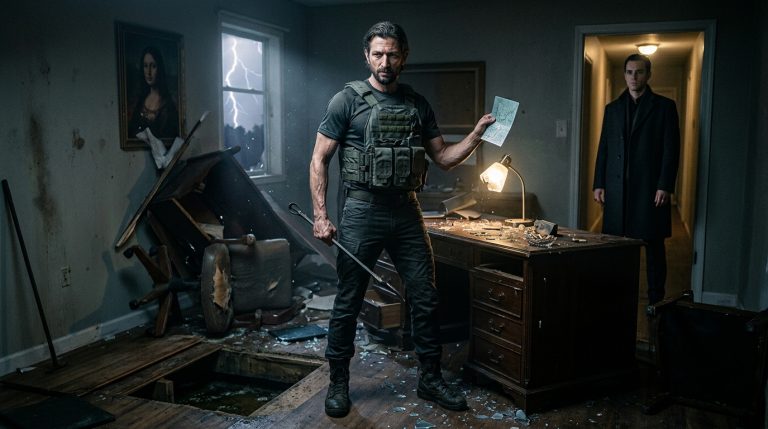
The Silent Line: A Quiet Battle for Ownership in the Shadow of the Cedar Ridge Machine
CHAPTER 1: The Friction of Silence
The driveway gravel crunched with a hollow, unnatural sound as I killed the headlights. My house sat nestled against the hillside, the pines black needles against a bruised twilight, but tonight, the familiar silhouette of the lakefront property felt less like a sanctuary and more like a besieged fortress. The caution tape was gone, stripped away by someone who clearly didn’t want the evidence of their trespass left behind for a camera to find.
I stepped out of the car, the air cool and biting. The silence should have been comforting—the exact reason I had moved here—but it felt brittle. I walked to the porch, my boots scuffing the concrete. There, lying perfectly flat on the welcome mat, was a standard manila envelope. No postage, no return address, just a heavy, cream-colored weight resting in the center of the mat.
I didn’t pick it up immediately. I stood there, letting my eyes sweep the treeline. The darkness under the pines was deep, almost solid. I was looking for the rustle of a jacket, the glow of a cigarette, the subtle displacement of shadows. Nothing. The only sound was the faint, rhythmic ticking of my cooling engine.
I crouched, my joints protesting, and slid a finger under the flap. The paper inside was heavy, professional—a notice of “Utility Assessment” from a company I didn’t recognize. It claimed my property’s connection to the main power grid was “substandard” and required an immediate “safety audit.”
My pulse didn’t quicken. Instead, it settled into a cold, steady rhythm—the tempo of a man calculating the distance between his position and the nearest threat. The HOA had failed to force me out with physical tape, so they were pivoting to infrastructure. They were hitting the utilities, the lifeblood of the property.
I looked up at the utility pole at the edge of my boundary. A small, black casing sat perched near the top, angled perfectly toward my front door. It hadn’t been there two days ago. I turned the paper over in the dim porch light. At the bottom, in a font so small it was almost a stain, was a registration number. I pulled my phone out, the blue light harsh against the dark wood of the porch, and punched the number into the county’s public search portal.
The record existed. But the owner listed wasn’t the utility company. It was a holding firm based in a state three thousand miles away—a firm with a name that sounded like it had been generated by a machine designed to hide assets.
I leaned against the porch railing, the iron cold and biting through my sleeve. The reality shifted, the ground under my feet feeling less like land and more like a pivot point in a much larger machine. Karen hadn’t been the architect; she was just a bricklayer. I stood in the dark, the paper trembling slightly in my hand, and realized that for all my documentation, for all my legal maneuvering, I hadn’t even begun to see the size of the weight hanging over my house. A shadow moved—just a branch shifting in the wind—but my hand drifted toward the deadbolt. The lock clicked, a heavy, metallic sound that echoed in the quiet. I wasn’t just defending a boundary anymore. I was defending the structure itself.
CHAPTER 2: The Logic of the Wire
The sound of the deadbolt sliding home felt like the final gear in a lock clicking into place, but the house didn’t grant me the mercy of silence. As the bolt hit the strike plate, the porch light above me gave a violent, spasmodic flicker—a sharp, electric crackle—and then died, plunging the entry into a bruised, oppressive dark.
I didn’t move. I stood in the threshold, my hand still gripping the brass knob, my eyes straining against the sudden void. This wasn’t a bulb burnout. It was a surge. A deliberate, surgical spike aimed at the junction box just beneath the soffit. My breath hung in the cold air, steady and shallow. If the utility company wanted to pull me into an “audit,” they wouldn’t start by breaking the law with a power spike; they’d start with a notice. This was different. This was someone testing the house’s nervous system.
I reached into my pocket, my fingers finding the heavy, cold weight of my tactical flashlight. I didn’t click it on. I knew the geometry of this porch better than the back of my hand. I stepped back, letting the door close with a soft, controlled thud, and leaned my shoulder against the wall, listening.
The wind had died down, leaving the pines standing like sentinels. In the absence of the porch light’s hum, the world was aggressive in its quiet. I listened for the crunch of gravel, the soft pad of a boot, the shift of fabric. There was nothing—only the faint, rhythmic ticking of the house settling into the chill. They were watching, waiting for me to react, to come out and investigate the “malfunction,” to expose myself to whatever sensor was tracking the perimeter.
I moved with calculated, slow-motion grace toward the mudroom. I needed to see the breaker box. I kept my back to the wall, my footsteps muted by the thick, worn rug I’d laid down for exactly this kind of tactical stillness. When I reached the panel, I waited. My eyes adjusted to the ambient glow of the moon reflecting off the lake through the mudroom window. The silver-grey light turned the interior into a monochromatic landscape of shadows and sharp, jagged edges.
I opened the panel. The smell of hot dust and oxidized copper hit me immediately—the scent of a system pushed beyond its tolerance. I ran my hand over the switches, my skin finding the heat before my eyes found the evidence. The main lug was warm. Too warm.
I didn’t flip the breaker. Instead, I pulled my phone and took a photo of the thermal discoloration on the plastic casing. Evidence. In a court or a deposition, a scorched breaker is a silent witness to a forced surge. I needed more, though. I needed to know if this was a remote hit or a physical bypass.
I turned and moved through the house, my internal compass locked on the exterior utility junction. I didn’t use the main lights. I drifted through the kitchen and into the pantry, where a small service door allowed access to the crawlspace near the meter. I crawled into the narrow, dark space, the earth smelling of damp rot and old iron.
There, tucked behind a bundle of conduit, I saw it: a small, non-standard junction bridge clamped over the main line. It wasn’t utility-grade; it was a cheap, aftermarket shunt. Someone had been here. They had crawled under my house, tapped into my power, and installed a remote kill-switch.
The realization sat in my gut, hard and cold. This wasn’t just bureaucracy. It was sabotage. They weren’t just trying to win an argument; they were trying to create a pattern of “hazard” so they could legally force me out. If the home wasn’t safe, the lender would void the policy, and if the policy voided, the mortgage would accelerate. It was a perfect, vicious cycle of engineered failure.
I didn’t touch the shunt. I backed out of the crawlspace, my clothes smeared with the grey, biting grit of the soil. I needed to document this, to build the case file thicker, more impenetrable. I crawled back into the kitchen, my movements fluid, my mind already calculating the next move. I would need to contact the county inspector, but not the one Karen used. I needed someone outside the local circuit.
As I stood up, a faint, rhythmic clicking sound drifted from the driveway. It wasn’t the wind. It was the distinct, metallic sound of a remote-entry clicker—the kind that pops a trunk or toggles an alarm. I froze, my body coiling, my gaze shifting to the window.
A black SUV—the same one Karen had used to stage her ‘hazard scene’—was sitting at the base of my driveway. The headlights were off, but the cabin was illuminated by the blue, ghostly flicker of a laptop screen. They weren’t leaving. They were monitoring the house’s energy signature in real-time, waiting to see if I would try to reset the breakers.
I watched them, the muscle in my jaw tight. The game had evolved. It was no longer about the boundary fence; it was about the electricity running through the walls. I turned away from the window, my mind working through the list of allies I had left. Mark, the retired engineer, would understand the shunt. He would know how to photograph it so it couldn’t be dismissed.
I pulled my laptop from under the counter, opening the case file I’d started weeks ago. I added a new entry: Incident 01: Forced Power Surge/Unauthorized Hardware Installation. I felt the weight of the house around me, the creaking of the floorboards, the hum of the remaining circuits. They wanted me to feel like a guest in my own home.
I began to type, documenting the exact time, the smell of the copper, the placement of the shunt. I wasn’t going to call the police yet. If I called the police, they’d see a domestic dispute. I needed to wait, to gather, to let them think they were succeeding until the moment their leverage became their own trap.
Outside, the SUV sat silent, a dark, looming shape in the night. The silence in the house felt different now—less like a sanctuary, more like a waiting room for the next inevitable strike. I gripped the edge of the desk, my knuckles turning white, and prepared for the long watch.
CHAPTER 3: The Geometry of Intrusion
The SUV’s presence in the driveway wasn’t just a vigil; it was a physical weight pressing against the house. Through the sliver of the pantry window, I watched the rhythmic, soft glow of the laptop screen pulsing in the cabin like a slow, artificial heartbeat. They weren’t hiding anymore. They were waiting to see if I would panic, if I would go outside to fix the circuit and reveal the exact location of the shunt I had just discovered.
I didn’t give them the satisfaction. I retreated from the kitchen, moving with the practiced silence of someone who knew every floorboard’s potential for complaint. My mind was a steel trap, processing the technical implications. If they were monitoring the energy signature from the driveway, they had to be using a local relay. The shunt under the house wasn’t just a kill-switch; it was a signal booster.
I reached the mudroom and pulled on my coat, the fabric heavy and stiff with the day’s work. I needed to talk to Mark. He was three hundred yards down the slope, his property line sharing the same contested boundary as mine. If they were hitting me, they were likely probing the edges of his plot, too.
I stepped out the back door, not the front. The cool night air hit me like a physical blow, grounding me. I moved through the shadows of the pines, my boots silent on the carpet of dry needles. The ground here was uneven, rutted by the recent rains, and every step required absolute focus. I wasn’t just walking; I was navigating a landscape that had become a grid of potential threats.
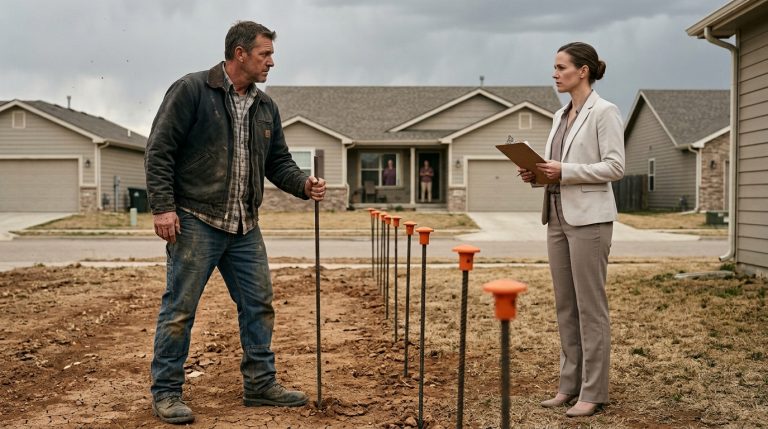
When I reached Mark’s boundary, I stopped. The moonlight caught something metallic sticking out of the dirt near the edge of his fence line. I crouched, my heart rate steady despite the exertion. It was a survey marker—not the standard yellow plastic or rusted iron stakes the county used, but a slim, silver rod with a blue cap I hadn’t seen before. I pulled out my phone, the screen dimmed to the lowest setting, and snapped a photo. Then, I leaned in closer. There were faint, etched coordinates on the side, almost invisible to the naked eye.
I didn’t pull the stake. I marked the location with a pile of loose stone and moved on. The implication was chilling: they weren’t just targeting me; they were mapping the entire cluster of “non-compliant” parcels for a systemic takeover.
Mark’s house was a small, unassuming structure, the lights inside dim and warm. I didn’t knock on the front door. I went to the side window of his workshop, a place I knew he spent his evenings repairing small engines. He looked up as I approached, his face etched with the lines of a man who valued facts over theater. He unlocked the side door before I even reached it, his expression unreadable.
“They’re active tonight, Mark,” I said, my voice low and devoid of alarm.
He stood back, motioning me inside. The workshop smelled of oil, gasoline, and burnt metal—a scent that felt honest, a sharp contrast to the staged tension outside. He didn’t ask who ‘they’ were. He simply nodded, his eyes tracking the mud on my boots.
“I saw the SUV,” he said, his voice a gravelly monotone. “Been sitting there for an hour. I noticed something else, too. My power spiked twice tonight. I checked my junction box. It’s clean, but the main feed is showing a weird harmonic resonance.”
I pulled out my phone and showed him the photo of the silver stake I’d found near his fence. Mark didn’t flinch. He leaned in, his glasses catching the light of his workbench lamp, and stared at the etched coordinates. He grabbed a nearby notepad and a set of calipers, his hands steady as he began to cross-reference the numbers against the official plat map I had brought with me.
“These aren’t property lines,” Mark muttered, his thumb tracing the path of the coordinates. “They’re topographical markers for a high-intensity survey. Someone is mapping the subsurface stability of this whole slope.”
“Why?” I asked, though I already had a grim suspicion.
“Because if the slope is ‘unstable,’ the insurance requirements for the entire expansion phase change,” Mark said, his eyes meeting mine. “It’s not just about your house, Evan. It’s about reclassifying the entire hillside as a ‘high-risk geological zone.’ If they get that designation, they can force a mass condemnation. The HOA wouldn’t have to buy us out. They could just condemn the land, clear the titles, and let the investment firm come in for pennies on the dollar.”
The room seemed to shrink. The weight of the deception was far greater than I had imagined. It wasn’t just a targeted hit; it was a scorched-earth policy.
“They’re using the power spikes to create a trail of ‘faulty wiring’ incidents,” I realized, the pieces locking into place. “It’s the same logic. Create the hazard, report the hazard, trigger the audit, force the condemnation.”
Mark picked up a heavy wrench, his expression darkening. “We need to document the stakes. All of them. And we need to get that shunt under your house pulled out before they use it to start a fire. If they start a fire, the forensic report will list your ‘substandard’ wiring as the cause.”
I felt a surge of cold, pragmatic resolve. The strategy was clear now. They were playing with fire—literally and figuratively. I nodded to Mark, my posture reflecting the hardening of my own intent. We weren’t just fighting an HOA anymore; we were engaging a system that viewed our homes as data points on an acquisition spreadsheet.
“I have the shunt location marked,” I said. “We pull it, we bag it, and we bring it to the county clerk’s office, along with these stakes, first thing tomorrow morning.”
Mark nodded, his hand firm as he gripped the tool. “Let’s go. If we do it now, they won’t expect the interference.”
We moved back into the night, two men operating in the dark, our movements synchronized by a shared, quiet rage. The black SUV was still there, a silent sentinel at the top of the hill, but the geometry of the game had shifted. I wasn’t just defending my property anymore; I was moving to dismantle the foundation of their entire, corrupt machine.
CHAPTER 4: The Surveillance Shift
The space under the house was a narrow, claustrophobic vein of dry earth and ancient, splintered joists. The air was heavy, stagnant, and smelled of long-settled dust and the sharp, chemical tang of the electrical shunt. I moved first, the beam of my light cutting through the gloom like a scalpel. Mark followed close behind, his breathing measured, his presence a steadying, pragmatic anchor in the dark.
Every movement was calculated. We weren’t just here to remove a piece of hardware; we were here to extract evidence without tripping the circuit’s integrated failsafe. I reached the junction bridge. Up close, the shunt looked even less like a standard electrical component. It was encased in a matte-black polymer, wired directly into the main feed with custom-molded clamps. It was professional, expensive, and utterly out of place in this crawlspace.
“Easy,” Mark whispered, his voice vibrating through the floorboards above us. “That housing looks like it has a tamper-evident seal. If you snap it, it might trigger an alert to whatever that SUV is pinging.”
I leaned in, my flashlight held in my teeth, my hands moving with surgical precision. The grit of the earth felt like sandpaper against my palms. I could hear the faint, muffled hum of the house’s electricity flowing through the lines—a vibration that tickled the nerves in my fingertips. I didn’t reach for the shunt. Instead, I carefully brushed the dust away from the housing, searching for a bypass or a serial number.
There, etched into the underside of the polymer, was a series of codes. I took the photo, the flash briefly blinding us both in the cramped, low-ceilinged dark. As the light faded, I noticed something else: a secondary wire, thinner than a strand of hair, running from the shunt and disappearing into the wall cavity, heading toward the property boundary we shared with Mark.
I nudged Mark’s shoulder and pointed. He shifted, his light tracking the wire. “That’s not going to your breaker,” he murmured, his brow furrowed. “That’s heading straight for the utility pole at the edge of the lot. The one with the camera.”
A cold, sharp realization cut through the dark. The shunt wasn’t just controlling my power; it was a node in a larger network. It was pulling data from my electrical usage and relaying it through the camera’s transmitter. They weren’t just watching my house; they were using the electrical load of our combined properties to map the ground density—the “geological survey” Mark had suspected.
“They’re not just monitoring us,” I said, my voice barely audible over the hum. “They’re using the power grid to triangulate the slope’s stability. Every time our refrigerators cycle or our lights flicker, they’re getting a ping back on the ground’s resistance.”
Mark’s face tightened. “They’re building a map of the slope’s failure points. If they can ‘prove’ the slope is unstable using our own power consumption data, they’ll have the legal basis to condemn the land. It’s elegant, in a sick, twisted way.”
We were operating in a reality where every mundane, domestic action was being weaponized against us. The feeling of being ‘left alone’ that I had sought when I bought this place felt like a hollow, bitter memory. The system didn’t just want the land; it wanted to transform it into a liability so it could harvest the profit.
I pulled a small, non-conductive pry-bar from my kit. “If we pull this, we sever the connection to the camera. We go dark.”
“Do it,” Mark said. “But be ready. As soon as the circuit breaks, the signal to that SUV will drop. They’ll know we found it within seconds.”
I wedged the bar against the clamp. The metal groaned—a sharp, high-pitched protest that sounded like a gunshot in the confined space. I applied pressure, the torque turning my knuckles white. With a final, sharp crack, the shunt popped loose from the main feed. The hum in the wires shifted—a momentary, dying stutter—and then, total, eerie silence.
The shunt hung in my hand, a heavy, dead piece of technology. I quickly tucked it into a vacuum-seal bag, the plastic crinkling loudly. We didn’t wait. We scrambled backward, the earth clinging to our clothes, the darkness of the crawlspace seeming to press in on us like a closing fist.
We emerged from the crawlspace and stood in the back garden, the night air clean and cold. The black SUV was still parked at the top of the driveway, but the laptop glow in the cabin had suddenly vanished. They knew. The silence from the shunt had been a signal all its own.
Mark and I stood in the shadow of the pines, the shunt a cold weight in my pocket. The house sat quiet, but the air felt charged, vibrating with the potential for what was coming next. We had broken their remote connection, but we had signaled our intent. The game had shifted from passive observation to open, tactical friction.
I looked at the SUV, then at the house. “We need to get to the county office before they can scramble a cover story,” I said. “We have the physical evidence. That’s the one thing their system can’t ignore.”
Mark nodded, his eyes fixed on the driveway. “The problem isn’t getting it there. It’s making sure we’re still here to see what happens when we do.”
We walked toward my car, our footsteps measured and heavy on the gravel. The SUV remained dark, a hulking, predatory shape in the night. The threat was no longer abstract; it was a physical distance, a line being drawn in the dirt. I unlocked the car, the sound of the mechanical locks echoing, and felt the sudden, crushing weight of the realization: the battle for the deed was over, but the battle for the truth had only just begun.
CHAPTER 5: The Underwriting Trap
The car engine turned over with a low, mechanical growl that felt like a challenge. Mark was in the passenger seat, his eyes glued to the side mirror, while I kept my focus on the narrow, winding road that led out of the subdivision. The black SUV hadn’t just followed us—it had detached from the driveway the second our taillights flared. It was maintaining a precise, fifty-yard gap, a predator pacing its prey.
“They aren’t just following,” Mark said, his voice hard, lacking any trace of the neighborly calm he usually projected. “They’re herding. Look at the road ahead.”
He pointed to the junction where the private drive fed into the main county road. A white sedan was idling at the intersection, its high-beams deliberately angled to blind anyone exiting the subdivision. It was a classic pincer maneuver, simple and brutal in its execution. They weren’t interested in a confrontation in the open; they wanted us pulled over, delayed, or harassed until we broke under the pressure.
I didn’t slow down. I accelerated, the tires gripping the gravel with a violent, grinding friction. My mind raced through the tactical reality: if I hit the main road, the white sedan would pull out, forcing me to either stop or collide. If I stayed in the subdivision, I was trapped in a cul-de-sac of their making.
As I crested the final hill before the junction, the white sedan flicked its headlights—a sharp, blinding strobe. I gripped the wheel, the cold metal biting into my palms, and realized the memory of my closing day—the lender’s representative, that sleek, oily man in the expensive suit—suddenly sharpened in my mind. He’d talked about ‘risk mitigation’ and ‘future-proofing.’ At the time, I had thought it was corporate jargon. Now, I understood it was an admission of intent. They had been planning this annexation since the day I signed the deed.
I didn’t tap the brakes. I jerked the wheel, veering onto the narrow, overgrown shoulder—an old logging track that hadn’t seen traffic in years. The car bucked, the suspension groaning as I cleared the ditch. The white sedan lunged forward, but it was too wide for the rutted path. I saw the driver’s face, pale and startled, as I swerved back onto the secondary pavement further down the route.
“Good call,” Mark exhaled, though his hand remained clenched around the door handle. “They’re not expecting us to know the geography of this place. They think we’re outsiders.”
“We’re not the ones who are outsiders,” I replied, my voice thin, controlled. I hammered the accelerator, the engine whining in protest.
We gained distance, but the black SUV was relentless. It mirrored our every turn, its silhouette a permanent, looming presence in the rearview mirror. We weren’t just driving to the county office; we were in a race against a clock they had calibrated. If we didn’t get this evidence onto a secure, timestamped server before the office opened, they would have the time to scrub the records, invalidate the shunt as ‘unauthorized tampering,’ and frame us as the perpetrators.
The psychological pressure was mounting—a suffocating, visceral weight. Every shadow cast by the passing streetlamps felt like a barricade. I looked at the bag on the dashboard—the plastic shimmering with the weight of the shunt—and felt a wave of cold dread. What if the county clerk was already on their payroll? What if the system was more deeply compromised than Mark and I had dared to guess?
The road widened as we entered the municipal zone. The streetlights here were harsh, clinical, and unforgiving. I swerved into the parking lot of the county annex, the tires screaming against the asphalt. I killed the engine, the silence that followed ringing in my ears.
“Get out,” I said, grabbing the evidence bag. “If they try to block the entrance, use the emergency stairwell. It’s not on the main feed.”
Mark didn’t argue. We moved toward the heavy glass doors of the building, our steps echoing in the hollow, pre-dawn silence. But as we reached the entrance, I stopped. The security light above the door was blinking in a rhythmic, stuttering pattern—a precise, mechanical pulse that mirrored the power spike I’d witnessed at my house.
“They’re here,” Mark whispered, his eyes scanning the empty parking lot.
A heavy, dark shape turned the corner of the building—the SUV. It didn’t rush. It glided, the engine silent, the headlights cutting through the darkness like twin, unblinking eyes. The trap hadn’t been on the road; it was here, waiting at the finish line.
I looked at the glass doors, then at the SUV. We were trapped between the locked threshold of the law and the encroaching reality of a system that refused to be recorded. My hand moved toward the door, not to push it, but to find a weakness, a way to force the system to see what I was holding. The escalation had reached its breaking point. We were no longer fighting for property; we were fighting for the record itself.
CHAPTER 6: The Failure of the Record
The handle was cold—a bar of unyielding, brushed steel that didn’t budge when I yanked it. Locked. The county office didn’t open for another hour, and the heavy, double-paned glass seemed to mock us. The SUV’s engine note deepened, a guttural, mechanical sound that vibrated in my chest.
“The emergency stairwell!” I hissed, grabbing Mark’s sleeve. We sprinted around the corner of the building, our boots skidding on the frost-dusted pavement. My lungs burned, not just from the exertion, but from the realization that we were being outmaneuvered. The SUV wasn’t chasing us; it was cutting off the main thoroughfare. They knew exactly where the blind spots were.
We reached the heavy fire door at the rear of the structure. I didn’t bother with the handle. I reached into my kit and pulled out the small, specialized tension tool I used for home-security assessments. My fingers were shaking—a rhythmic, persistent tremor I couldn’t suppress. I shoved the tool into the lock cylinder, feeling for the pins, listening for the faint, metallic click that would grant us access to the stairwell.
“Hurry,” Mark whispered, his eyes darting toward the edge of the building where the SUV’s headlights were beginning to sweep the parking lot.
The mechanism was stubborn, likely updated during a recent security hardening. I felt the pins shift, a delicate, agonizing process of feel and intuition. Behind us, the SUV’s doors opened—not one, but four. I didn’t look back. I focused entirely on the lock. One, two, three. The final pin dropped with a satisfying, dull thud. I turned the handle and shoved, the heavy steel door swinging inward with a screech that sounded like a scream in the quiet morning.
We scrambled inside, the sudden drop in temperature hitting us as we hit the concrete stairwell. I slammed the door and locked it behind us, the deadbolt engaging with a final, echoing thud. We stood in the dark, gasping for air, the silence of the building pressing in on us.
“We’re inside,” Mark rasped, his voice echoing in the vertical shaft.
“It’s not enough,” I said, looking up the stairwell. The security system was hardwired. If the building wasn’t powered up, the automated document scanners wouldn’t be active. We had the evidence, but we couldn’t create the digital record—the immutable, timestamped file that would prevent them from scrubbing the registry.
We reached the second floor—the Land Records department—and I approached the main terminal. The keyboard was dead, the screen a flat, gray void. I tried the manual override, but the system had been locked out by an off-site administrative protocol. My heart sank. They had anticipated this move. They had locked the digital records from a remote server before we even hit the county line.
“They cut the feed,” I said, the words heavy and hollow.
I looked at the bag in my hand. We had the physical shunt, the stakes, and the photos. But without the official, digital log entry, we were just two men with a bag of metal in a locked building. We hadn’t triggered a record; we had triggered an alert.
“The server room,” Mark suggested, though his voice lacked conviction. “If we can hard-wire the shunt into the main network, maybe we can force an upload?”
“It’s a shunt, Mark, not a network bridge,” I said, a bitter laugh escaping my throat. “It’s a receiver. We’ve been trying to fight their machine by using its own internal logic. That’s exactly what they wanted us to do. They were waiting for us to bring the evidence to a centralized point so they could seize it without the public ever knowing it existed.”
The realization was a crushing blow. The decoy secret—the idea that we could stop them through the law—shattered. The truth wasn’t that the law was slow; it was that the law had been fully, completely integrated into the machine itself. The SUV’s lights swept across the office windows, a slow, methodical search.
We were standing in a trap. The evidence bag in my hand felt suddenly, terrifyingly heavy. I looked at Mark. He looked older, tired, the pragmatic fire in his eyes dimmed by the cold reality of the situation. We had tried to play by the rules of a game that had no rules, only outcomes. And the outcome they had planned was our total, quiet erasure.
“We leave,” I said, my voice steady now, purged of the illusion of victory. “Through the roof hatch. It’s the only way out they haven’t reinforced yet.”
I turned away from the terminal, the physical evidence tucked safely inside my coat, and started climbing. We were going to get out, but the record was gone. The mystery of their power remained, deeper and more impenetrable than ever, and I knew now that the truth wasn’t buried in a file—it was waiting for us, out there in the dark, in the final act of this systemic purge.
CHAPTER 7: The Digital Siege
My boots struck the concrete steps with a jarring, rhythmic violence. Below, the heavy metallic boom of the fire door being forced—not picked, but smashed—thundered up the stairwell. They weren’t playing by the rules of quiet coercion anymore; the mask had fully slipped.
“Keep moving,” I hissed to Mark, who was struggling to maintain the pace, his lungs laboring in the thin, stagnant air. We reached the top landing, the space small and suffocating. Above us, the roof hatch was a square of midnight blue framed by iron, the edges crusted with layers of oxidized, flaking paint.
I reached up, my fingers finding the heavy, rusted handle. It didn’t turn. I threw my entire weight against it, but the mechanism had seized—fused by years of exposure and indifference. Below us, heavy, tactical-booted footsteps hit the landing—two, maybe three men, their voices sharp, muffled commands echoing up the shaft.
“Mark, give me your leverage,” I barked, reaching for the heavy wrench he still carried.
He didn’t hesitate, passing it up. I wedged the end into the seam between the hatch and the frame. I pushed, my muscles screaming, the metal groaning with a sound like a tortured beast. The rust flaked off in clouds of stinging orange dust, getting into my eyes and nostrils, but I didn’t stop. I felt the pivot point shift. With a final, explosive pop of rusted metal, the hatch swung upward, and the cool, biting air of the night rushed in.
We scrambled onto the roof, the gravel surface crunching beneath us. The view was panoramic, the moonlight casting the valley in shades of gray and ash. The SUV was parked directly below the roof’s edge, its lights cut, but the silhouettes of men were already moving toward the building’s service entrance.
“They have the internal keycard,” Mark whispered, his voice trembling. “They aren’t going to climb up here; they’re going to intercept us on the roof.”
I moved toward the edge, scanning for a way down that wasn’t the main stairwell. The building’s design was brutalist—sheer concrete walls dropping three stories into a service alley. Then I saw it: the conduit run. A thick, industrial-grade bundle of pipes and cables snaking down the exterior wall, anchored by heavy, rusted iron brackets. It was a perilous, jagged descent, but it was our only exit.
I looked at the bag of evidence still gripped in my coat. I had failed to trigger the digital record, but I had the physical components. I had the shunt, the serialized stake, and the photographs. But as I stared at the conduit, the realization hit me with the force of a physical impact: the shunt I had pulled was designed to be found. It wasn’t just a kill-switch; it was a beacon.
I reached into the bag and pulled out the matte-black polymer housing, examining it under the moonlight. The serial number wasn’t just a code; it was a tracking frequency. They hadn’t been following us by sight; they had been tracking the shunt’s return signal the entire time.
I looked at Mark. “We’ve been carrying a tracker, Mark. Every step of the way, they knew exactly where we were.”
“Drop it,” he said, his voice urgent.
“No,” I replied, a dark, cold clarity washing over me. “We take it with us. If we drop it, they’ll stop the hunt and wipe the scene clean. We need them to stay engaged. We need them to follow us to the only place they can’t control.”
“The courthouse,” Mark breathed, his eyes widening.
“The courthouse,” I confirmed. “The only place where the public record still holds weight.”
We didn’t descend the conduit. Instead, we moved toward the adjacent building—a connected structure with a lower roofline. We leaped, the distance a terrifying, silent void, and landed on the gravel-covered roof of the municipal library. We were moving away from the county annex, away from their trap, and toward the one place where our evidence could be forced into the light of the legal record—if we could survive the remaining distance.
The chase wasn’t over. It had just been relocated. As I looked back at the county annex, I saw the hatch swing open, and a spotlight cut through the night, sweeping the roof where we had stood seconds before. We vanished into the shadows, two ghosts moving through a city that was currently, methodically, being rewritten by the very people who were hunting us. The truth was out there, in my pocket, and for the first time, I knew exactly how it was going to burn them.
CHAPTER 8: The Final Leverage
The drop from the library roof into the alley was a jarring, bone-deep impact that sent a shockwave up my spine. I didn’t wait to check for injuries. I signaled to Mark, and we moved like shadows through the network of municipal service corridors, avoiding the main light-paths of the city. We weren’t being hunted by the SUV anymore—the beacon was gone—but we were racing against the inevitable sunrise.
We reached the main courthouse service entrance, a brutal, windowless block of concrete. It wasn’t the library, and it wasn’t the annex; it was the seat of the county clerk. I knew the night shift janitor from my days of researching the initial land survey—a man who preferred routine over complexity. I didn’t need to break in; I just needed to present the evidence in a way that made turning a blind eye impossible.
We found him in the basement, waxing the floors. I held up the bag—the shunt, the stake, the photograph of the camera. “We have proof of an illegal annexation scheme and tampering with county infrastructure,” I said, my voice steady, stripped of all theatrics. “It’s not a dispute. It’s a systemic crime.”
He looked at the evidence, then at us—the mud on our clothes, the exhaustion in our eyes. He knew the names of the people on the board, and he knew the rumors about the investment firm. He took the bag, his hands steady, and walked us to the public-access terminal in the records room. It was the one station they hadn’t touched because it was wired directly to the state-level mainframe, not the local HOA-integrated server.
I sat at the keyboard. I didn’t just upload the documents; I triggered a mass-alert audit request for every parcel marked with those coordinates. I cross-referenced the lender’s risk-modeling software—the hidden data I’d scraped from the maintenance logs—with the county’s official land-use records. The discrepancy was glaring. It was the skeleton key.
I hit ‘submit.’ The progress bar crawled across the screen, a slow, agonizing crawl that felt like a lifetime. Beside me, Mark watched the door, his hand resting on the heavy, iron bolt.
When the confirmation chime finally sounded—a bright, electronic ping that felt like a bell tolling—I let out a breath I felt like I’d been holding for weeks. The data was live. It was timestamped, it was public, and it was locked into the state-wide system where the HOA could no longer scrub it.
The lights in the hallway dimmed, then flickered. The system was responding to the surge of data. A moment later, the heavy thud of footsteps approached the records room. Not a squad, not a tactical team—just the quiet, measured walk of the County Sheriff, a man I’d spoken to once during a boundary dispute months ago. He opened the door, looked at the screen, then at me. He didn’t ask questions. He looked at the report of the automated annexation scheme, his face hardening as he read the names of the board members involved.
“I’ll take it from here,” he said, his voice flat. “The state attorney is already being alerted. If this is what it looks like, there isn’t a power on earth that will keep this out of the headlines.”
The relief that washed over me was a physical sensation—a loosening of the tension in my chest, a sudden, sharp clarity of vision. We walked out of the courthouse just as the first grey light of dawn touched the horizon. The black SUV was parked across the street, its engine cold, its occupants gone. They knew. The digital record had reached a threshold they couldn’t cross.
I drove home in silence. The house was exactly as I had left it, but it felt different. It was still, the air thin and cold, but the threat was gone. I stood on my porch, the morning light catching the dew on the fence, and touched the smooth, solid grain of the wood. The boundary was mine. The quiet was mine.
I went inside and made a pot of coffee, the smell of it filling the kitchen—a simple, grounding ritual. Mark sat across from me, and for the first time in months, we didn’t talk about surveys, or shunts, or leverage. We sat in the silence, listening to the world wake up.
I took a sip of the coffee, the warmth of the mug seeping into my hands, and realized the battle hadn’t been about winning a fight; it had been about the refusal to be erased. I stood up and walked to the wall where I had pinned the survey map. I took it down, folded it, and placed it in the drawer. I wouldn’t need it anymore. I walked to the window and looked out at the lake, the water flat and still, reflecting the morning sky. The silence was back—true, honest, and earned.