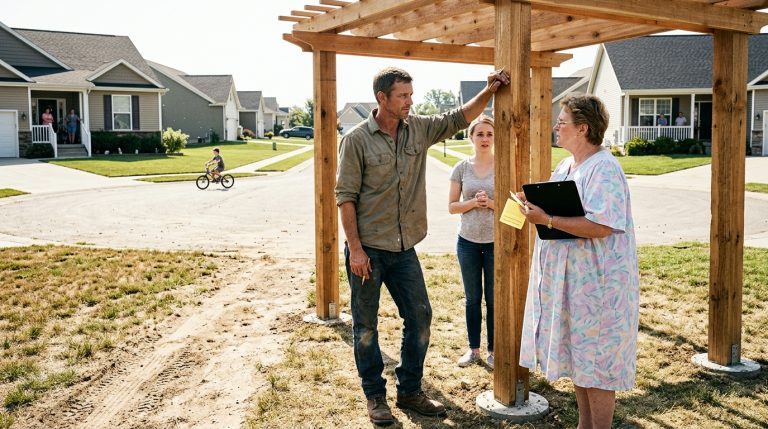
The Soil and the Sword: How a Weary Combat Engineer Grounded a Suburban Tyrant
CHAPTER 1: THE CHEMICAL LINE
The humid afternoon air smelled faintly of damp earth, rich compost, and crushed tomato leaves—until Karen stepped up to the edge of the property line.
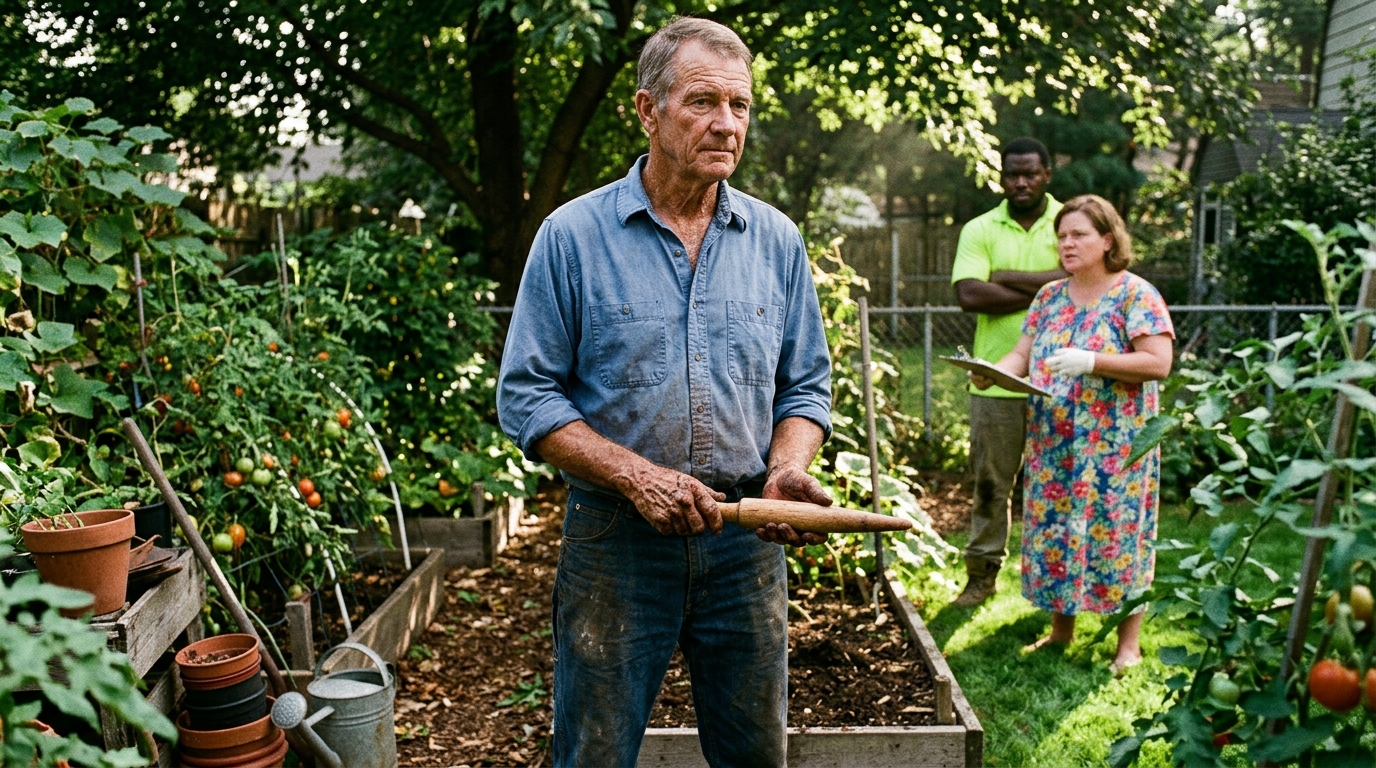
She stood barely three inches onto her side of the turf. Her lawn was a stark, unnaturally vibrant green, chemically scorched into absolute uniformity. My side was a chaotic tangle of dark soil, wood chips, and heavy heirloom vines heavy with early fruit.
“I’m having the EPA test your dirt for toxic runoff,” Karen said, her voice flat and cold like a steel rule. “And when they find it, Mr. Miller, you won’t just lose this garden. You’ll lose the house.”
She thrust a heavy wooden clipboard across the invisible boundary. Beside her, a man in a neon-green polo shirt bearing the logo Emerald Lawns shifted his boots in the grass, his thick arms crossed over his chest like a hired bouncer.
I didn’t reach for the paper. My hands were already coated in dark brown humus from tying up a drooping Cherokee Purple vine. Slowly, I wiped my fingers against my denim thighs and picked up a heavy, smooth cedar dibber—a hand-carved wooden spike I used for setting seedlings.
I rolled the polished cedar between my palms, feeling the solid weight of the wood against my callouses. One inch to the left, and her turf ended. One inch to the right, my soil began.
“You’re welcome to bring whoever you want, Karen,” I said, keeping my voice low and quiet. “The soil is open to the air.”
“Don’t get cute with me,” she snapped, her knuckles turning white around the edge of her clipboard. “This neighborhood has standards. CC&R Section 7, Article 4. Unapproved agricultural structures, foul odors, and hazardous runoff into the nature preserve.”
The guy from Emerald Lawns spat into my mulch. The dark liquid sizzled slightly on a dry pine chip.
“I know the bylaws,” I said, tapping the point of the cedar dibber against the wooden border of my raised bed. Tap. Tap. The sound was dull and dense in the muggy air. “And I know what’s in my ground.”
“We’ll see what the federal government thinks about your little science project,” she said, turning on her heel with a sharp flick of her floral muumuu. “You have forty-eight hours to clear those compost bins before the fines double.”
I stood still as she marched across her sterile green carpet, her hired muscle trailing a step behind her. My heart beat with a steady, rhythmic thud—not the panic of a cornered man, but the cold, familiar focus that used to settle in when a bridge span didn’t align under mortar fire.
She wanted a war over six inches of dirt. She was about to find out what twenty years in the Army Corps of Engineers actually taught a man about digging.
CHAPTER 2: THE PAPER FORTRESS
I stood motionless until the hum of Karen’s motorized lawn cart faded down the cul-de-sac.
The cedar spike in my hand was warm, holding the heat of my palm. I tossed it onto the potting bench, wiped my boots twice on the coarse coir mat, and walked inside.
Sarah was sitting at the oak kitchen table, her laptop open alongside three high school biology textbooks. She didn’t look up when the screen door slammed, but her shoulders were set in that tight, rigid line I knew from our second deployment to Mosul.
“I heard her,” Sarah said softly. “The windows were open.”
“She’s escalating,” I said. I pulled out a heavy wooden chair, its legs scraping against the tile. “Bypassing the local committee. She claims she filed a formal notice with the regional EPA office.”
Sarah finally turned her head, her dark eyes sharp behind her wire-rimmed glasses. She didn’t panic. She didn’t throw her hands up. She simply reached over to the side sideboard and dragged a four-inch thick binder into the center of the table.
The spine was cracked, the black vinyl peeling at the edges. Covenants, Conditions, and Restrictions of Oak Meadow Estates.
“She’s relying on intimidation,” Sarah said, her voice dropping into the quiet, measured cadence she used when correcting a student’s lab report. “People sign these papers at closing, drop them in a drawer, and assume the board has absolute power. But an HOA isn’t a sovereign state, Alex. It’s a non-profit corporation governed by contract law.”
“And contracts cut both ways,” I replied, leaning over the pages as she flipped to Section 7.
Without security cameras to log her daily walk-bys, every single claim she made had to be fought on the field of her own paperwork. If I couldn’t produce a time-stamped video showing her stepping onto my property to leave notices, I had to make her own paper trail choke her.
“Look here,” Sarah said, pointing a trimmed fingernail at a sub-clause in faded, ten-point font. “Article 4, Paragraph B. ‘Any alleged environmental hazard or violation of municipal codes must be accompanied by a certified third-party inspection report provided to the homeowner forty-eight hours prior to the assessment of daily fines.'”
I studied the dense block of text. “She hasn’t provided a third-party report. She just dropped a laser-printed sheet on the porch.”
“Exactly,” Sarah said. “She’s issuing fines without establishing a legal record. She’s operating on bluff.”
I reached into my pocket, pulled out a brass soil-pH tester—a small, mechanical gauge with a twin-metal probe—and set it on the open page. The heavy brass clinked against the paper.
“We don’t play her game,” I said, my voice cold and dry. “We don’t argue over whether tomatoes look pretty. We force her to prove every single word according to her own bylaws. Every notice she sends gets a ten-page certified reply.”
“It’s going to cost us,” Sarah noted quietly. “Certified mail with return receipt requested is eight dollars a pop.”
“Let it cost,” I said, rolling the brass probe under my palm. “We make her sign for every single sheet. We turn her paper war into a full-time administrative burden.”
Sarah looked at me for a long moment, the quiet tension in her face softening into a dangerous, thin smile. She reached for her red pen.
“Draft the first response,” she said. “I’ll highlight the procedural errors.”
CHAPTER 3: BUILDING THE COALITION
I pushed open Marcus’s garage door without knocking, the smell of burnt motor oil and hot exhaust hitting me before my eyes adjusted to the dim fluorescent lighting.
Marcus—a six-foot-three Marine veteran with a completely hairless skull and thick graying tattoos running up both forearms—was crouching beside a disassembled 1978 Harley engine. He held a brass wire brush in one hand, scrubbing a carbon-crusted piston over a metal pan.
“You look like hell, Miller,” he growled without looking up.
“Karen filed an EPA notice on my garden,” I said.
The wire brush stopped mid-stroke. Marcus set it down on the concrete floor, wiped his grease-stained palms on a shop rag, and turned slowly toward me.
“An EPA complaint?” he asked, his deep voice echoing off the exposed rafters. “She’s trying to run you out of the neighborhood.”
“She thinks she can,” I said, leaning against the frame of the workbench. I reached into my pocket, pulled out the brass soil-pH tester, and set it on top of a greasy toolbox. “She’s leveraging the board to force me into fines I can’t appeal. But she’s doing it to everyone, Marcus. You got three notices last month.”
Marcus snorted, a harsh, humorless sound. “About the flagpole. Said the brass eagle on top reflects glare into her master bedroom window. Told me to take it down or face a hundred bucks a day.”
“Did you take it down?”
“I told her to bring a ladder and try it herself,” he said, shaking his head. “But my wife is nervous, Alex. She doesn’t want trouble. That’s how Karen wins. She picks us off one by one because nobody wants to deal with the paper.”
“She’s not just picking on us,” I said, pointing down the street toward the cul-de-sac. “Mrs. Gable got cited for her bird feeders. The Rodriguez family is being fined fifty dollars a week because their kid’s basketball hoop is visible from the driveway.”
Marcus picked up a rag and slowly wiped down his tools, his knuckles raw and black with grease. “People are scared of her, Miller. She’s been running this board for six years. Nobody wants to get blacklisted.”
“They don’t have to fight her alone,” I said. “We bring them together. No speeches, no big public scenes. Just a quiet cookout in my backyard. We put all our notices on one table and compare the signatures.”
Marcus paused, staring at the brass gauge resting on his toolbox. “And if she sees ten cars parked outside your house?”
“Let her look,” I said, picking up the pH meter and slipping it back into my pocket. “Without cameras, she has to walk down here herself to count them. And every step she takes onto my block is another record I’m keeping.”
Marcus grunted, a tight, cold grin touching the corners of his mouth. “I’ll bring the ribs.”
CHAPTER 4: THE FEDERAL INSPECTOR
A dark blue sedan with government plates swung around the corner and pulled up to the curb precisely at nine o’clock.
Agent Morales got out of the driver’s side, wearing a gray polo shirt with a small EPA seal over the breast pocket and heavy leather work boots. He carried a silver metal briefcase in one hand and a clipboard in the other. He looked like a man who spent forty hours a week wading through bureaucratic paperwork and forty more arguing with hostile landowners.
I met him on the sidewalk near my driveway before he could take three steps.
“Agent Morales,” I said, holding out a hand. “I’m Alex Miller.”
He took my hand with a firm, quick grip, his eyes scanning the raised beds behind me before landing on my face. “Mr. Miller. I assume you received the formal notice regarding the soil inquiry?”
“I did,” I said. “And I welcome the inspection. But before you pull a single core, my legal counsel asked me to hand you this.”
I offered him a sealed white envelope. Inside was Anna’s three-page filing, demanding a complete boundary and watershed profile under federal testing guidelines.
Morales set his briefcase on the hood of his sedan, slid a thumb under the envelope flap, and read the first page standing in the sun. His eyebrows pulled tight as he reached the bottom.
“You’re requesting cross-boundary sampling,” Morales said, looking up with a neutral, unblinking stare. “And an analysis of the storm drain run at the terminus.”
“The complaint alleges chemical runoff into the nature preserve behind my lot,” I said calmly, pulling the brass pH tester from my pocket and holding it loosely against my leg. “A single soil core in my garden won’t tell you where a chemical originated. If you want an accurate profile of this block’s watershed, you need samples from my ground, the boundary line, the adjacent turf, and the drain where everything converges.”
Across the street, Karen’s front door clicked open.
She stepped onto her porch in a bright yellow tunic, arms crossed tightly over her chest, watching us like a hawk over a fence line. Beside her stood the guy from Emerald Lawns, holding a clipboard of his own.
Morales looked from my letter to Karen, then down at the heavy iron grate sitting thirty feet away at the curb.
“It’s unusual for a property owner to ask for broader sampling,” Morales noted, his voice flat. “Most people try to limit where I dig.”
“I spent twenty years in the Army Corps of Engineers,” I said, tapping the brass tip of the meter against my palm. Clink. “You don’t solve a contamination issue by looking at one square foot of earth. You map the entire site.”
Morales stared at me for a long three seconds. Then he unlatched his metal briefcase, revealing rows of sterile glass jars and stainless steel soil augers.
“Get your boots on, Mr. Miller,” Morales said. “We’re digging.”
CHAPTER 5: THE TOXIC FINGERPRINT
Sarah came up behind me, wiping her hands on a dishtowel, her breath hitching slightly as I pulled out the multi-page lab report.
The dry, dispassionate language of the federal government filled the first page. I skipped the boilerplate intro and went straight to the tabulated data under Section B: 412 Chestnut Lane.
Zero detectable synthetic pesticides. Zero restricted herbicides. High microbial density.
“Clean,” Sarah whispered, her shoulder pressing against mine as she read over my arm. “It says ‘model residential management’.”
“Read page three,” I said, flipping to the cross-boundary analysis.
The tone of the document shifted from neutral observation to stark, cold numbers. Under Section C: 410 Chestnut Lane—Karen’s lot—the lab had flagged four separate organophosphate compounds. Concentrations of 2,4-D were recorded at five times the legal residential threshold.
Worse, the core taken near her fence line contained trace residues of diazinon and chlorpyrifos—chemicals strictly regulated for residential application due to severe groundwater toxicity.
“She poisoned her own ground,” Sarah said, her voice turning hard as iron.
“It gets worse,” I said. I laid the final page flat on the table, tapping the bottom row with my thumb.
The chemical fingerprint from the cul-de-sac storm drain matched Karen’s turf sample item for item, molecule for molecule. The report explicitly identified her property as the primary source of toxic runoff flowing toward the municipal nature preserve boundary.
I picked up my brass pH tester, rolling the heavy metal probe across the lab sheets.
She had called in a federal investigation expecting to destroy my home. Instead, she had handed the EPA an irrefutable paper trail pointing straight at her own front yard.
“Call Anna,” Sarah said, setting her dishtowel on the table beside the report. “It’s time to send the notice.”
CHAPTER 6: THE BOARD CORNERED
Anna pulled her rimless glasses off, setting them beside her pen as she looked across the desk at me.
“By serving each board member individually, we bypass Karen’s filter,” she said, tapping the top document with a fingernail. “They think the HOA’s corporate insurance shields them. But gross negligence and intentional misrepresentation aren’t covered.”
“Have you confirmed the corporate filing on Emerald Lawns?” I asked, rolling my brass pH meter across the grain of the mahogany desk.
“Marcus found the registration last night,” Anna replied, sliding a printed Secretary of State record across to me. “The registered agent is Karen’s brother-in-law. Every landscaping fine she issued was designed to force homeowners into using his service.”
I looked at the four thick envelopes resting under my hand. Each contained a copy of the EPA lab report, the watershed contamination analysis, and a formal notice of pending civil litigation naming Karen, Henderson, and the two remaining board members as co-defendants.
“What about Henderson?” I asked. “He was shaking at the last meeting.”
“Henderson is weak,” Anna said calmly. “He’s a CPA. The moment he sees personal liability on a federal environmental claim, he’s going to consult his own lawyer. And his lawyer will tell him to cut Karen loose before he gets dragged into a toxic runoff suit.”
“We give them forty-eight hours before the monthly clubhouse meeting,” I said.
Anna clicked her pen twice. “A process server is delivering the packets to their front doors right now.”
I stood up, sliding my pH meter back into my pocket. “Let’s see if Karen’s board holds together when the price of her greed comes out of their personal bank accounts.”
CHAPTER 7: THE CLUBHOUSE COLLAPSE
Karen slammed her wooden gavel onto the folding table at the front of the room, the sharp crack cutting through the hum of the room.
“Order!” she shouted, her voice tight, a nervous blotch of red spreading across her neck above her floral blouse. “We will proceed according to the agenda. Item one: clubhouse lawn maintenance contracts.”
“We’re not talking about lawn contracts, Karen,” Marcus called out from the second row, his broad shoulders blocking the aisle. “We want to talk about the federal inspection notice.”
Karen’s hands tightened on the gavel until her knuckles turned yellow. “That is an ongoing administrative matter and will not be aired in a general meeting!”
Anna didn’t ask for permission. She stepped to the front corner of the room, unrolled a portable white screen, and plugged my projector directly into her laptop.
A bright beam of white light cut through the dim hall, throwing the first page of the EPA lab report across the screen in six-foot letters.
410 CHESTNUT LANE: ORGANOPHOSPHATE CONTAMINATION DETECTED.
A sudden, sharp hush fell over the room.
“My name is Anna Chen,” she said, her voice dry and steady. “I represent Mr. Miller and twelve other homeowners in this subdivision. What you are seeing on this wall is a federal environmental analysis of the runoff flowing into our storm drains.”
Karen leaped from her chair, knocking her wooden gavel off the table onto the carpet. “Turn that off! You are in violation of board procedure!”
Anna clicked her mouse. The next slide appeared: the Secretary of State corporate registration for Emerald Lawns, highlighting the owner’s name alongside Karen’s maiden name.
“For three years,” Anna continued calmly, “this board has issued thousands of dollars in fine notices to homeowners who refused to use Emerald Lawns. Those funds were funneled directly to a firm owned by the board president’s immediate family.”
The room erupted. Mrs. Gable stood up, pointing a trembling finger toward the stage, while two men in the back row began shouting over each other.
Karen whirled around to face Henderson, her eyes wide, her jaw trembling with cold fury. “Say something! Adjourn the meeting!”
Henderson looked at the screen, then down at the thick legal notice resting in his lap—the notice naming him personally in a federal contamination suit. He slowly pushed his chair back from the table.
“I move for the immediate removal of the president,” Henderson stammered, his voice shaking into the microphone. “And I second my own motion.”
Karen stared at him in absolute disbelief as the other two board members hastily raised their hands, refusing to meet her eyes.
“You can’t do this!” Karen screamed, slamming her fist onto the table so hard her plastic water bottle tipped over. “I built this community! I protected your property values! You’re all ungrateful fools!”
She grabbed her leather handbag, shoved past Henderson’s chair, and stormed down the center aisle, her rubber-soled shoes squeaking furiously against the linoleum. Nobody moved out of her way; they simply leaned back, watching her pass in icy silence.
CHAPTER 8: TENDING CLEAN GROUND
The evening air was cool, carrying the sharp, sweet smell of damp cedar mulch and blooming basil leaves.
Sarah walked out from the back patio carrying two mason jars of cold tea. She sat on the edge of the timber raised bed, setting one glass down on the wooden frame beside my work gloves.
“A real estate truck just pulled away from Karen’s house,” Sarah said softly, watching Lily carefully place a plastic ladybug onto a sunflower leaf. “The ‘For Sale’ sign went up in her yard twenty minutes ago.”
I rubbed the thumb of my free hand against my palm, feeling the thick, permanent callouses built over years of turning dirt and handling timber.
After the clubhouse meeting collapsed, Karen tried every administrative loophole left in her binder. She filed emergency appeals, threatened slander suits against the board, and even attempted to refuse process servers at her door.
None of it mattered.
The EPA’s formal findings locked the environmental liability directly to her property line. The state licensing board suspended Emerald Lawns’ commercial operations following an unannounced audit, and Marcus—now serving as the board president—signed the formal order expunging every phony fine levied against our block.
The neighborhood had settled into a quiet, easy rhythm. Marcus kept his flagpole flying at full height. Mrs. Gable put up two more cedar bird feeders along her porch rail.
“Is she moving out?” Sarah asked quietly.
“Doesn’t matter where she goes,” I said, setting the dark tomato carefully into a woven basket at my feet. “Her authority ended the moment she tried to govern this soil with lies.”
I reached into my pocket, pulled out the brass pH meter, and set it down on the dark, rich humus of the raised bed. The twin metal probes sank cleanly into the ground without resistance.
“What are you planting next?” Sarah asked, handing me the cold jar of tea.
I looked down at the dark earth beneath my boots—clean, deep, and completely free of poison.
“Winter wheat,” I said, taking a slow drink. “To prep the ground for spring.”