The Weight of a Quiet Life: A Former Sniper Finds Grace Among the Broken Recruits
CHAPTER 1: THE MORNING SILENCE
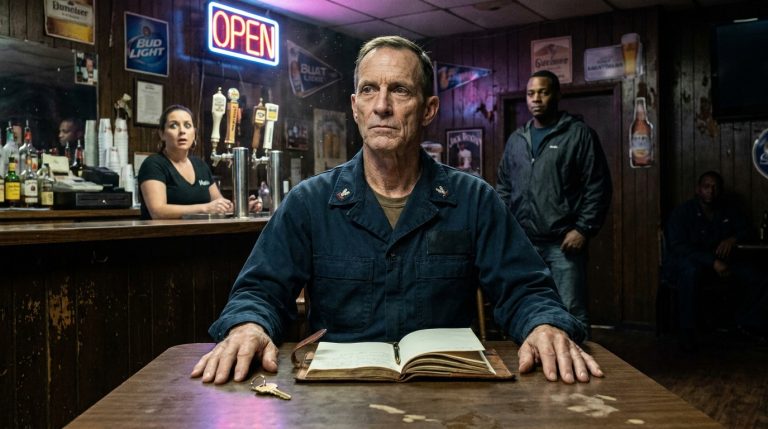
The kitchen at Fort Witmore had always been a sanctuary of predictable rhythm—the hiss of the griddle, the sharp scrape of spatulas, the mechanical hum of the industrial dishwasher. But this morning, the rhythm was broken. Gerald Mackey stood at the serving station, his movements as slow and deliberate as they had been for eleven years, yet the air in the room felt ionized, as if a storm were hovering just inches above the linoleum.
He laid out the trays with a steady hand, his knuckles slightly swollen from the humidity. Behind him, the mess hall was unusually quiet. The clatter of metal utensils against plastic plates, normally a cacophony of adolescent energy, had been dampened into a low, uneasy murmur. They weren’t whispering about the burnt edges of the hash browns or the dryness of the eggs. They were whispering about him.
Gerald didn’t look up, but he felt the gaze of the young corporal near the back—the one who had been struggling with his breathing at the range yesterday. The boy was staring at Gerald’s hands, not the food.
“Coffee, Corporal?” Gerald asked, his voice a low, gravelly rasp that seemed to cut through the tension.
The boy blinked, startled out of his trance. He looked at the coffee, then up at Gerald’s face, his expression shifting from curiosity to a fragile, sudden reverence. “Yeah. Thanks, Gunny.”
The title hung in the air, foreign and heavy. Gerald’s grip on the ladle tightened for a fraction of a second, his knuckles whitening against the grease-stained apron, before he forced his fingers to relax. He poured the coffee, the liquid splashing slightly against the rim of the mug.
“Just Mackey,” Gerald said softly.
“But—” The boy started to protest, his eyes darting to the others.
“The coffee’s hot, and the day is long,” Gerald interrupted, sliding the mug across the counter with a practiced slide. “That’s what matters.”
As the corporal moved away, Gerald glanced toward the mess hall entrance. He noticed a young recruit sitting alone at a corner table, pushing a plate of food around without eating. The boy’s hand was tucked deep into his cargo pocket, and he was staring intently at a folded, yellowed envelope tucked beneath his thigh. He wasn’t looking at the room; he was looking at a ghost.
Gerald looked away, the familiar ache in his hip pulsing in time with the distant rumble of a generator outside. He had come here to leave the ghosts behind, to exchange the roar of the rifle for the silence of the stove. Now, the silence was gone, replaced by a new kind of noise—the sound of expectation.
He reached for the next tray, but his hand froze. Near the edge of the service counter, he spotted it: a small, silver casing, likely shaken loose from a recruit’s pocket. It caught the harsh fluorescent light, gleaming like a jagged tooth against the industrial steel. It was a 5.56 round, misplaced, unwanted, and entirely out of place in a kitchen.
Gerald stared at it, his reflection distorted in the brass. He felt a sudden, sharp prickle of sweat at his hairline. He was the only one who noticed it, the only one who knew exactly what that casing represented.
Then, the mess hall door swung open with a heavy thud. Colonel Hail stepped in, her boots clicking rhythmically against the floor. She wasn’t carrying a clipboard or a mess tray. She was carrying a folder, and the way she walked told Gerald everything he needed to know: the peace he had built, the one he had protected for over a decade, was about to be dismantled.
She walked straight toward him, bypassing the line, and the room went completely still.
CHAPTER 2: THE COST OF ATTENTION
The air in the mess hall didn’t just stand still; it solidified. Colonel Hail stood by the serving line, her presence acting like a vacuum that sucked the oxygen out of the room. Gerald stood behind the steel barrier, his hands still resting on the ladle, his pulse thudding a slow, warning rhythm against his eardrums. The metallic tang of the 5.56 casing he’d spotted earlier—that jagged little tooth of his former life—seemed to hum with an electric charge against the surface of the counter.
“Gunny,” the Colonel said. Her voice was level, carrying the professional cadence of a command briefing, yet the inflection was softened by something that felt dangerously like pity.
Gerald looked at her, his expression a mask of practiced indifference. He didn’t want the title. He didn’t want the recognition. He wanted the steam rising from the oatmeal vats and the quiet, uncomplicated labor of feeding men who didn’t know who he was. “Colonel. It’s early for an inspection.”
“This isn’t an inspection,” she replied. She rested a gloved hand on the cold steel of the counter, a stark contrast to the grease-stained apron Gerald wore. “The range results were… illustrative. The base command is looking at the numbers, Gerald. Your numbers.”
“I cook breakfast, ma’am,” he said, his voice flat. He turned his back to her to reach for a tray, his movements slow and deliberate, a physical attempt to distance himself from the conversation. He focused on the faded texture of his apron, the way the cotton frayed at the hem, trying to ground himself in the mundane.
The scent of the percolating coffee—bitter, dark, and searingly hot—hit him suddenly, sharper than usual. It was a sensory trigger, violent and unbidden. For a fleeting second, the mess hall dissolved. The fluorescent lights flickered, and in their place, he saw the harsh, blinding glare of a sun-scorched roof in Kandahar. The smell of burning toast was replaced by the acrid, metallic stench of gunpowder and dry, pulverized stone. He could feel the weight of the rifle, not the ladle, in his hands—the cold, unforgiving precision of a weapon that never missed.
He squeezed his eyes shut, his jaw tightening until his teeth ached. Not here. Not now.
“Gerald,” the Colonel said, her voice closer now.
He forced his eyes open, dragging himself back to the reality of the mess hall. The ghost of the rooftop dissipated, leaving him breathless and disoriented. He turned back, carefully maintaining his composure. “I don’t need a formal role, Colonel. I’m fine where I am.”
“It’s not about what you need,” she said, her tone hardening. She tapped the folder in her hand. “It’s about what this base requires. We’re facing cuts. The training program is on the chopping block. If I can show the brass that our instructors—even our consultants—are operating at an elite level, we might get the funding to stay open.”
Gerald looked around the room. The recruits were still watching, their faces a mix of awe and confusion. They were waiting for him to do something—to lead, to speak, to become the legend they’d heard about. He felt the weight of their gaze like a physical pressure, pushing him toward a precipice. He could see it clearly now: the decoy, the “Hero Recruitment” campaign. They wanted the face of the veteran to mask the decline of the base.
“You’re asking me to be a poster child for a budget, Colonel?” he asked.
“I’m asking you to protect the people under your roof,” she countered.
It was a strategic blow, and she knew it. She wasn’t playing on his ego; she was playing on his duty. Gerald looked down at his hands. They were steady, but they weren’t the hands of a cook anymore. They were the hands of a man who had spent his life waiting for a target.
“I’ll think about it,” he said, though he knew the answer already. He would do whatever was necessary to keep the quiet. He would play the part if it meant the walls didn’t come down.
“I’ll expect an answer by the end of the shift,” she said, then turned and walked out. The click of her heels against the concrete echoed in the suddenly cavernous room.
Gerald watched her go, then looked back at the small, discarded casing on the counter. He picked it up, feeling the cool brass against his thumb. He slid it into his pocket, his movements sharp and precise. The mess hall was still silent, waiting. He looked at the line of recruits—the young, the broken, the hopeful—and realized that the quiet he had built was already gone. He had to navigate this now, with the same precision he had used on the rooftop.
He didn’t need to be a soldier again. He just needed to be smart enough to survive the peace.
CHAPTER 3: THE MESS HALL SIEGE
The silence that followed Colonel Hail’s departure did not break; it merely stretched, thin and brittle. Gerald stood behind the serving counter, his hands gripping the edge of the stainless steel until his knuckles ached. The heat from the oatmeal vats brushed against his face, a familiar, grounding warmth, but today it felt suffocating. He could feel the eyes of the twenty-three recruits boring into his back.
He didn’t turn around immediately. He kept his focus on the rhythmic scraping of his spatula against the serving tray. Every movement he made was a calculation, a series of deliberate actions designed to maintain the fragile order he had spent eleven years constructing.
“Gunny?”
The voice belonged to the young corporal from before—Stein, he recalled. The boy had been the first to reach the targets at the range. He stood at the front of the line, his tray held with a strange, hesitant posture, as if he were unsure whether it deserved to be filled by a man of Gerald’s hidden history.
Gerald turned, his expression carefully neutral. He scooped a serving of oatmeal into the corporal’s bowl. “It’s breakfast, Corporal. Just breakfast.”
“I… I wanted to say thank you,” Stein stammered, his gaze dropping to the gray, steaming oats. “For the range. Nobody ever explained the breathing like that before. It changed everything.”
Gerald looked at him, searching for the artifice. Was it gratitude? Or was it the beginning of the campaign the Colonel had mentioned? The lines between genuine human connection and the weight of his own myth were blurring. He felt a sharp, prickling sensation of paranoia—a cold, tactical awareness he hadn’t fully utilized since the days of shadows and high-altitude winds. He wondered if this boy was truly grateful, or if he was simply looking for a way to get closer to the man the Colonel had outed.
“The air is the same for everyone, Corporal,” Gerald replied, his voice sparse, stripped of any warmth he didn’t absolutely feel. “You just have to learn how to let it pass through you.”
As he served the next recruit, a wave of exhaustion hit him—not the physical tiredness of a long shift, but the deep, marrow-aching fatigue of a man forced to live a double life in the light. He found himself scanning the room, his eyes moving with a sniper’s cadence: left, right, center, check the exits, check the periphery. His perception felt dangerously skewed. He wasn’t seeing students anymore; he was seeing potential threats, or perhaps, potential disciples, and the distinction felt less meaningful than it should have.
He moved to the coffee station, the familiar clinking of the porcelain mugs serving as the only anchor in his shifting world. He poured a cup for a recruit, his hand steady as a stone.
“Gunny,” the boy said, his voice lowering to a conspiratorial whisper. “Is it true? About the rooftop in Kandahar? I heard someone talking in the barracks.”
Gerald’s grip on the carafe tightened. He didn’t look up. He poured, the dark liquid swirling into the mug. “Barracks talk is cheap, kid. Keep your focus on your sights. That’s all that matters.”
“But—”
“Focus,” Gerald repeated, firmer this time.
He walked to the far end of the counter, needing a moment to breathe. He looked out the window toward the firing range, visible as a cluster of earthen mounds in the distance. The sun was rising, casting long, desaturated shadows across the landscape. It looked like a graveyard from here, a place of dust and forgotten efforts.
He reached into his pocket and touched the cold, brass casing. It was a physical anchor, a reminder of the path he had walked. He had come here to hide in plain sight, to be the man who burned the toast and made the coffee, because that man was safe. That man couldn’t hurt anyone, and he couldn’t be hurt by the expectations of others. But the Colonel had stripped that mask away, and now, he was caught in the spotlight.
He looked back at the mess hall. The line of soldiers was growing. They were all looking at him—not as a cook, but as an oracle of their own potential success. And he realized, with a sinking feeling in his chest, that the Colonel had already won. She had created an expectation that he couldn’t simply ignore. If he stopped helping, he would be failing the very soldiers he had spent years feeding. If he kept helping, he was leaning into the legend, into the very thing he had tried to bury.
He wiped his hands on his apron, the fabric coarse and familiar. He had to be smarter than this. He had to find a way to navigate their need without surrendering his own peace. He looked at the next recruit in line, a young woman with a determined, exhausted face. She held her tray out, her hands trembling just slightly.
He took her tray, his movements slow. He gave her a nod—a quiet, singular gesture—and felt the weight of the moment. He wasn’t just a cook anymore. He was a beacon, and in this world, that was the most dangerous thing a man could be. He would play the part for now, but he would do it on his own terms, carefully, until he could find a way back to the silence he so desperately craved.
CHAPTER 4: THE NIGHT SHIFT
The transition from the serving line to the quiet, dim hours of the night shift usually brought Gerald a sense of reprieve, but tonight, the kitchen felt like a cage. He stood by the massive, industrial boilers, the metal humming with a low, vibrating intensity. He had spent the last three hours cleaning the grease traps, his movements rhythmic and repetitive, a desperate attempt to drown out the memory of the Colonel’s folder and the expectant eyes of the recruits.
He was deep in the middle of a routine scrub when the boiler began to groan. It wasn’t the usual rhythmic expansion of hot pipes; it was a jagged, discordant screech of metal on metal, followed by a violent hiss of steam that clouded the room in a thick, white fog.
Gerald didn’t flinch. He didn’t jump back or cry out. He simply dropped the brush and stepped into the steam, his body moving with the instinctual, fluid grace of a man who had navigated far more dangerous environments. His hands found the master pressure valve by touch alone, his fingers tracing the rusted surface of the wheel. He twisted it, feeling the resistance, the friction of time and neglect fighting him, before it finally gave way with a sharp, resonant clank.
The screeching died instantly. The steam began to settle, revealing the kitchen in the pale, blue light of the security lamps. Gerald stood there for a long moment, chest heaving, his apron soaked through with condensation.
He was alone, but for the first time in eleven years, he felt watched.
He moved toward the storage area, his limp slightly more pronounced in the damp air. He needed to find a wrench to tighten the release, but as he moved, he saw something that made him stop cold. Tucked behind the stack of flour sacks was a small, black notebook—the kind of standard-issue field journal the recruits used. It hadn’t been there when he finished the morning prep.
He picked it up, his thumb brushing the weathered cover. It was open. Inside, written in a cramped, hurried script, were detailed observations of his own daily routine: 04:00 – Arrival. 04:15 – Coffee brew. 04:30 – Prep. Observations: Movements consistent, posture rigid, ignores direct questions about service history.
Gerald felt a surge of cold, analytical rage. This wasn’t just curiosity; this was surveillance.
He heard a soft, rhythmic scrape of leather against tile coming from the mess hall entrance. He tucked the notebook into his apron pocket—a reflex born of decades of field operations—and stepped into the shadow of the pantry.
A figure moved into the blue light of the kitchen. It was the young corporal, Stein. He walked with a tentative, almost nervous step, his eyes darting toward the serving line, then toward the kitchen entrance. He stopped near the boilers, looking confused, as if he expected to find someone already there.
Gerald didn’t reveal himself. He watched from the dark, his breath perfectly controlled, his heart rate slowed to a deliberate, combat-ready crawl. The boy was looking for the notebook. He was checking the hide.
Gerald’s mind flickered back to that rooftop in Kandahar. The stakes were different, but the game was the same. The boy wasn’t a soldier; he was a pawn in the Colonel’s recruitment campaign, a scout sent to gather the data needed to build the perfect “Hero” narrative.
The realization was a punch to the gut. The “Light Echo” he had tried to foster—the Kintsugi of finding beauty in broken people—felt tainted. He wasn’t helping soldiers heal; he was feeding a machine that wanted to commodify his trauma.
Stein let out a frustrated sigh and reached for a flashlight, the beam cutting a jagged, dancing path across the stainless steel counters. He was getting closer to the pantry.
Gerald could step out, confront the boy, and force a confrontation. He could use the power he still possessed—the sheer, intimidating gravity of his past—to break the boy’s resolve. It would be easy. It would stop the surveillance, but it would also shatter the very image of the “kindly cook” he had cultivated. It would force him to be the Gunnery Sergeant, not the man who made the eggs.
He felt the weight of the brass casing in his pocket. It felt heavier now, an anchor dragging him down. He had to choose: maintain the lie and lose his sanctuary, or embrace the truth and lose his peace.
He watched the flashlight beam slide across the flour sacks, resting just inches from where he stood. He could feel the pulse in his fingertips, a steady, rhythmic tap. He wasn’t just a observer anymore. He was the target.
The boy turned, his flashlight swinging toward the pantry door. Gerald’s hand moved toward the handle of the service knife on the nearby prep table, not to use it, but to steady himself. The air in the room was thick with the scent of damp metal and the fading, burnt-sugar smell of the failed boiler.
He was at the edge of the world he had built, staring into the dark of the one he had tried to leave behind. He knew, with an agonizing, crystalline clarity, that the peace he sought was a ghost. It was never coming back.
CHAPTER 5: THE UNSPOKEN COMPROMISE
The flashlight beam danced across the floor, catching the dust motes and turning them into shimmering, suspended debris. Gerald held his breath, his back pressed against the cold metal of the pantry shelving. His heart rate was a metronome, ticking down the seconds. He didn’t need to look at Stein to know the boy was frightened; he could hear the ragged, uneven cadence of his breathing, the clumsy shuffle of boots that had never learned to move through a kill zone without announcing their arrival.
Gerald shifted his weight, his knee popping audibly in the quiet kitchen.
The flashlight beam snapped instantly toward the sound. “Who’s there?” Stein’s voice cracked, high and thin.
Gerald stepped out from the shadows, his expression carefully schooled into a mask of weary annoyance. He didn’t reach for the knife. He didn’t take a combat stance. He simply stood there, an old man in a grease-stained apron, holding the black notebook he had recovered. “You’re off-shift, Corporal. And you’re trespassing in a restricted storage zone.”
Stein jerked back, the flashlight beam hitting Gerald in the chest, blinding him for a heartbeat. Then, the boy recognized him, and the light dropped, illuminating the floor between them. Stein looked at the notebook in Gerald’s hand, his face draining of color. “Gunny. I—I was just looking for…”
“You were looking for answers,” Gerald said, his voice low, steady, and devoid of the warmth he usually reserved for his morning greetings. He stepped forward, closing the distance between them. He didn’t move fast, but he moved with a weight that made Stein retreat a step. “The Colonel sent you, didn’t she? To document the ‘legend’ so she could sell the narrative to the brass.”
Stein looked at the floor, his shoulders slumping. “She said it was for the base, sir. She said if the program shuts down, a lot of good people lose their jobs. She said you were a hero, but you were hiding. She said…”
“She said I was a commodity,” Gerald finished.
He looked at the boy—really looked at him—and saw the same confusion he had felt all those years ago in the desert. He saw the genuine, desperate belief that the uniform meant something more than the sum of its parts. It was a painful, fragile thing, that kind of idealism. It was what made soldiers follow orders, but it was also what got them killed when the orders were wrong.
Gerald held out the notebook. “Do you want to know what I saw in here, Corporal? Do you want to know what you wrote?”
Stein didn’t answer, his eyes fixed on the notebook.
“You wrote that I was ‘consistent.’ You wrote that I ‘ignored questions about service history.’ You turned me into a set of data points.” Gerald let the notebook fall to the floor with a dull thud. “You’re looking for a hero, Stein. But heroes are just people who did what they had to do when they were backed into a corner. And the moment you turn that into a story, you’ve already lost the truth.”
He walked past the boy, moving toward the supply cache tucked beneath the secondary prep counter. He needed to be sure. He pulled back the heavy plastic sheeting and began shifting crates. His hands moved with a predatory focus, discarding boxes and bags until his fingers brushed against a cold, synthetic texture—a second logbook, thicker than the first.
He pulled it out. It was a digital tablet wrapped in heavy-duty casing, its screen dark. He tapped the power button, and the screen glowed with an amber hue. It wasn’t just observations. It was data—biometric feedback, heart rate logs, stress response patterns, all gathered during his shifts over the last month.
His own body had been under the microscope without his knowledge.
Gerald stared at the screen, the cold, analytical reality of it washing over him. The Colonel hadn’t just wanted a story. She had wanted a weaponized asset. She had been testing him, pushing him, gathering the data to see if he could still be broken, still be used.
He looked back at Stein, who was standing frozen by the boilers. “Did she tell you about this, Corporal?”
Stein shook his head, his voice barely a whisper. “I don’t know what that is.”
Gerald believed him. The boy was just another casualty of the mission, another set of eyes doing what they were told.
He didn’t scream. He didn’t explode. He simply tucked the device into his own apron, the cold weight of it settling against his hip. He looked at Stein, the boy’s eyes wide with a mixture of fear and dawning realization. “Go back to your barracks, Corporal. And tell the Colonel that the next time she wants to observe the cook, she should come into the kitchen herself.”
Stein scrambled for the door, his boots clattering against the tiles, leaving Gerald alone in the dark, humming quiet of the kitchen.
He felt a deep, resonant tremor in his own chest. He had been avoiding the truth, trying to keep his peace buried under four a.m. coffee and burned toast. But the Colonel hadn’t just exposed his history; she had compromised his future. He wasn’t safe anymore. He couldn’t hide behind the apron, and he couldn’t hide behind the silence.
He stood in the center of the kitchen, the scent of old, stale coffee and metallic dust filling his lungs. He was tired, so deeply and profoundly tired. He had wanted to be nothing more than a man who served breakfast. But the world—the machine—wouldn’t let him.
He reached into his pocket, his fingers finding the brass casing. He held it tightly, feeling the sharp edge bite into his skin. He was going to end this. He didn’t need to be a soldier, and he didn’t need to be a legend. But he would be the man who finished the job.
He turned toward the mess hall, his stride steady, measured, and for the first time in eleven years, entirely without hesitation.
CHAPTER 6: THE THRESHOLD
The mess hall was dim, illuminated only by the faint, antiseptic glow of the security lights that spilled through the serving windows. Gerald walked across the polished floor, the weight of the digital tablet in his apron pocket feeling like a leaden reminder of everything he had lost—and everything he stood to lose again. He didn’t head for the exit. He walked straight toward the administrative office at the end of the hall, where a single sliver of light cut across the baseboards.
He pushed the door open without knocking.
Colonel Hail sat behind her desk, a fountain pen poised over a stack of formal requests. She looked up, her expression shifting from irritation to a rigid, guarded composure when she saw him. She didn’t seem surprised, which was its own kind of confession.
“Gunny,” she said, her voice steady. “I assume you found the hardware.”
Gerald didn’t answer. He reached into his apron, pulled out the tablet, and set it on the polished mahogany of her desk. He heard the faint click of the casing against the wood—a sound that seemed to echo in the small room. He looked at her, and for the first time, he didn’t see the commander he had respected in Kandahar. He saw a strategist who had forgotten that the pieces on her board were human.
“You weren’t just recording performance, Colonel,” Gerald said, his voice quiet, stripped of the gravelly rasp he used for the recruits. It was clear, precise, and cold. “You were building a profile. You were testing for a breaking point.”
Hail leaned back, her chair creaking softly. She didn’t deny it. “This base is struggling, Gerald. We are fighting to stay open in a climate that doesn’t value the training we provide. If I can show the brass that even our retired assets are capable of elite-level performance, I secure the future of this installation. I secure the future of everyone you’ve been feeding for the last eleven years.”
“By turning me back into a weapon?”
“By using the best tool I have,” she countered.
“I am not a tool,” Gerald said. The words weren’t a plea; they were a boundary. “I am a man who chose to put the weapon down. I chose this life because it was the only way to keep the part of me that is still human from eroding entirely.”
He watched her face, searching for a flicker of the woman who had once stood on a rooftop in a kill zone. He found nothing but the cold logic of command. He realized then that she hadn’t just changed; she had hardened into the very thing he had left behind.
“If I go public, if I release this data, the budget cuts won’t be your biggest problem,” Gerald said. “You’ll be looking at a board of inquiry, and you’ll be looking at the end of your career.”
Hail’s gaze didn’t waver. “And if you do that, the recruits you’ve been teaching, the soldiers you’ve been mentoring? Their training ends with you. The base closes. The work—the discipline—disappears.”
It was a stalemate of moral weight. She knew his weakness: he cared about the soldiers, and she was using that care to tether him to her mission.
Gerald turned toward the window, looking out at the darkened training grounds. He thought of Stein, of the fear he had seen in the boy’s eyes, and the genuine, fragile spark of potential. He thought of the coffee, the burnt toast, the quiet, slow shuffle of his life.
He didn’t need the machine to validate his existence. He didn’t need the Colonel’s data or the brass’s approval.
“I’m done,” Gerald said, his voice final. He pulled a small, ruggedized thumb drive from his pocket—one he’d pulled from the supply cache alongside the tablet—and set it next to the device. “That drive contains the only copy of the biometric data you collected. I’m keeping the original. You are going to sign the authorization to terminate the ‘Consultant’ position immediately. You will leave the marksmanship program to the instructors, and you will leave me in the kitchen.”
“And if I refuse?”
“Then I walk out that gate, and I take everything I know with me—not just about this base, but about why you were so desperate to weaponize an old cook.”
The silence in the room was suffocating. Hail looked at the devices on her desk, then at the man standing before her. She saw the truth of his resolve: he wasn’t afraid of the consequences anymore. He was already gone; he was just giving her the choice to follow him out.
She reached for the pen. “You’re making a mistake, Gunnery Sergeant.”
“I made the mistake eleven years ago,” Gerald said. “Today, I’m correcting it.”
She signed the paper, her movements sharp and decisive. She slid the release across the desk. Gerald took it, folded it into his pocket, and turned toward the door.
He walked back through the mess hall, the air feeling lighter, clearer than it had in weeks. He reached the kitchen, the space silent and waiting. He picked up his old, chipped porcelain mug—the one that had been tucked away in the back of the cupboard—and poured himself a fresh cup of coffee.
He sat at the prep table, the warmth of the mug seeping into his palms. The kitchen was just a kitchen. The soldiers were just soldiers. And he was just Gerald.
He reached into his pocket and pulled out the brass casing. He placed it on the table, then picked up his sharpening stone. He began to work on a damaged paring knife, his movements steady, measured, and rhythmic. It wasn’t a weapon; it was a tool, something meant to create, not destroy.
Outside, the first light of dawn began to bleed across the horizon, turning the desaturated gray of the base into a soft, golden hue. He closed his eyes, listening to the hum of the cooling boilers and the distant, rhythmic chirping of birds.
The weight was gone. The quiet had returned.
He was whole, broken in places, perhaps, but finally, finally, at peace.