The Weight of a Sapphire: How an Old Man Found the Truth in the Quietest Moments.
CHAPTER 1: THE SILENT WEIGHT
The velvet box felt unnaturally cold against my palm, a small, dark tomb for a stone that was supposed to represent four decades of a marriage I had finally realized I didn’t know at all. The chandelier above us at Harrow and Vance didn’t just cast light; it fractured it, sending cold, white shards across the polished granite floor. I looked down at the sapphire—a deep, perfect blue—and for the first time in my life, I didn’t see a gift. I saw a period at the end of a sentence I hadn’t yet learned how to read.
Beside me, Charles, the salesman with the hair like brushed silver and the smile that had been rehearsed since his yacht-selling days, leaned in. He was a man who smelled of expensive mint and absolute confidence. “It’s a legacy piece, Mr. Halverson. A stone worthy of a woman who has stood by your side through everything.”
His words hit the air with the weight of a professional script. Forty-two years. The number felt brittle, like dried leaves under a boot. I looked at the ring, then at Imani, the girl with the steady eyes and the mop bucket waiting behind the curtain. She was still standing there, unmoving, as if she were the only real thing in a room made of glass and polished lies. Her presence was a jarring note in the symphony of my curated life.
“Legacy,” I whispered, the word tasting like copper on my tongue. I looked back at Charles, who had already started to reach for my pen. He was so sure of the movement. He was so sure of the man standing in front of him—the old man who wouldn’t look twice, the old man who preferred the comfort of a lie to the cold, sharp edge of a truth.
I felt the silence of the shop start to stretch, tight as a guitar string tuned just a little too high. My pulse thrummed in my fingertips. I had spent my life building structures—concrete, steel, and reputation—believing that if the exterior held, the foundation was guaranteed. But as I watched Imani tilt the stone under the appraiser’s cold white bulb, I realized the foundation had been cracking for years. I had just been too busy pouring more concrete to notice.
The air in the room seemed to thin. I had come here to buy a memory, to solidify a history that was, in reality, a desert I had been wandering through without a canteen. And now, the girl was pointing at the blue. She was looking at the silk inside it, the absence of the natural zones of growth, the impossible perfection that only comes from a laboratory or a forgery.
“It’s a beautiful stone, Charles,” I said, my voice sounding older, thinner than I had expected. I didn’t pull the ring back, but I didn’t sign the contract. I watched his face—the way the mask didn’t slip, but the eyes, those practiced, hollow eyes, shifted a fraction of an inch, searching for the crack he thought he had successfully sealed.
I turned my head toward the storefront window. Outside, the Fifth Avenue traffic blurred into a stream of red and white light, a thousand lives moving toward their own destinations, none of them knowing that an old man had just stopped in a jewelry store and found the end of his world. A new, disturbing realization settled in my chest: the ring wasn’t just a fake stone. It was a mirror. And what I saw staring back at me wasn’t the man I had spent forty years believing I was.
It was someone else entirely. Someone I was going to have to meet, whether I wanted to or not.
CHAPTER 2: THE PERFORMANCE OF COMFORT
The transition from the Fifth Avenue jewelry store to the gravel driveway of my home was a blur of gray scenery that I didn’t actually see. My driver, Anthony, moved with a clinical, respectful efficiency, but the silence he maintained—usually a comfort—felt like a mirror held up to my own internal quiet. I kept my hand closed around the empty velvet box in my coat pocket. It felt heavier than the ring itself, a lead weight anchoring me to a version of reality that had dissolved the moment Imani had tilted that stone under the lamp.
I walked through the front door, the hinges whispering a greeting I no longer recognized. The house was a temple of my own design, all cream stone and muted elegance, but as I stepped into the foyer, it felt like stepping into a model home—staged, perfect, and devoid of breath.
“Henry?” Margaret’s voice drifted from the kitchen. It was the same pitch, the same cadence, the same melodic inquiry I had answered for sixteen years in this house, and for twenty-six before that.
I hung my coat with measured care. My hands were steady, a habit of a lifetime of blueprint reviews and contractor meetings, but inside, I was mapping the distance between the foyer and the kitchen as if I were surveying a blast site. I adjusted my posture, smoothing the invisible creases of the role I had played for decades: the provider, the partner, the husband who doesn’t look twice.
I entered the kitchen. Margaret was standing at the island, a glass of Chardonnay in one hand, the stem catching the soft, recessed lighting. She looked up, her face a masterclass in domestic warmth. “You’re late, darling. The traffic?”
“The traffic was a beast,” I said, leaning in to kiss her cheek. I felt the familiar scent of the perfume I had bought her in Paris—the perfume I had once thought was a sign of our shared history. Now, it smelled like a boundary. I pulled back, maintaining a smile that didn’t reach the tension behind my eyes. “And Harrow and Vance had a snag with the setting. They’re keeping it for another day.”
She didn’t miss a beat. She didn’t look worried or irritated. She just sighed, a sound that was precisely as melodic as it needed to be. “Oh, that’s a shame. I was looking forward to seeing it. But no matter. We have time.”
She moved toward the breakfast nook where the wine was already poured. It was a flawless performance, a script she had rehearsed to perfection. But then, the mundane reality of our life intervened. As she reached for a stray napkin, she caught the edge of a crystal vase—a gift from my brother-in-law, Raymond—and it tipped, spilling water across the granite island.
“Drat,” she said, her voice dropping an octave, becoming less like a performer and more like a woman suddenly caught off guard.
“Let me,” I said, moving forward. I grabbed a cloth, but as I reached for the spill, my hand brushed the surface of the granite. It was cold. Everything felt unnaturally, violently cold. I wiped the water, our movements synchronized, a dance we had performed thousands of times. For a heartbeat, the mask slipped. I saw her hand, the way she gripped the towel with a sudden, sharp intensity that vanished as quickly as it had appeared.
It was a butterfly detour—a spilled glass of water—that forced me to act, to improvise, to bridge the sudden gap between the man she expected and the man I was becoming. I stood up, handing her the damp cloth. “It happens. I’m a bit clumsy today. Must be the age.”
“You’re not clumsy, Henry,” she said, her eyes meeting mine. She was searching, I realized. She was reading the weather report on my face, looking for any sign of a change in pressure. “You’re just tired. Why don’t you sit? I’ll make us something simple. You’ve had a long day.”
“That sounds perfect,” I replied.
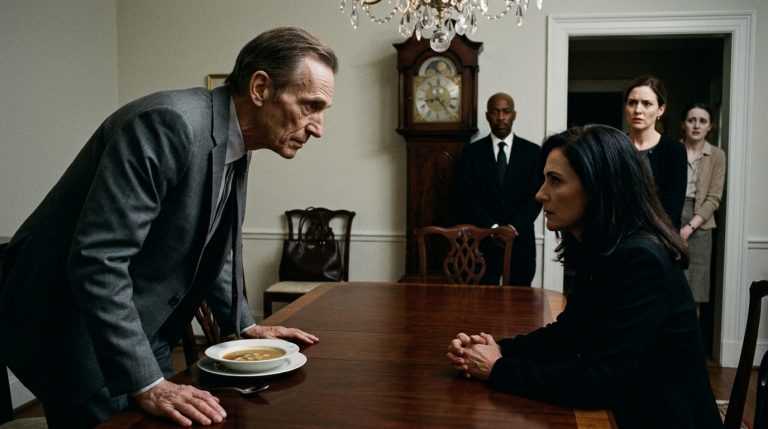
I sat in the breakfast nook, watching her. In the soft, fading light of the kitchen, the edges of our life together looked frayed. I watched her prep the soup, her movements efficient and graceful, the movements of a woman who was in complete command of her territory. And yet, I could see the ghost of the secret she was keeping—the way she avoided looking directly at the spot on the island where the spill had occurred, as if the water had revealed something underneath.
I was playing a game of chess against a grandmaster who had been playing with my pieces for three years. I needed to know what was in the safe. I needed to see the documents that David had warned me about. But first, I had to eat this soup. I had to continue the performance. I had to let her believe that the concrete I had poured for our marriage was still as solid as the day we broke ground.
I picked up the wine glass, the stem warming in my fingers. The house was quiet, and for the first time, I understood that the silence wasn’t a lack of noise. It was the sound of the foundation shifting.
CHAPTER 3: THE STUDY OF SECRETS
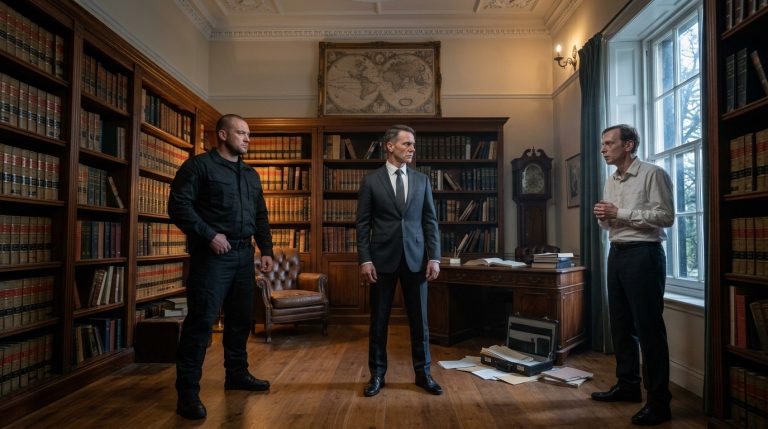
The door to the study closed with a heavy, final click, shutting out the muted domesticity of the rest of the house. I stood for a moment in the dark, the air thick with the scent of old paper and the faint, lingering aroma of pipe tobacco that I had stopped smoking years ago. It was a room of ghosts—the leather-bound books, the heavy oak desk, the safe hidden behind the painting of a bridge I had built in Newark in 1979.
I moved across the carpet, my steps silent. I didn’t turn on the lamp; the moonlight filtering through the tall, narrow windows was enough. My hands were steady as I shifted the painting, revealing the steel face of the safe. It had a combination dial, cold and precise, a mechanical sentinel that had guarded my life’s work for decades.
I dialed the sequence, each click of the tumbler reverberating in my ears like a hammer strike. The lock disengaged with a soft, metallic sigh. I pulled the handle.
David was already inside the room, emerging from the shadows by the window like a wraith. He didn’t speak, just pointed to the table where he had laid out the contents. Imani was curled in the wing chair, her small, steady eyes tracking every move we made, her notebook open but her pencil stilled. She was the anchor in the room, a silent witness to the demolition of my life.
I stepped toward the table. The papers were neatly organized, a cruel inventory of betrayal. Bank statements, trust amendments, property titles—they were all here, laid out in a sequence that formed a narrative of calculated, systematic theft. My gaze fell upon a ledger, and I felt the air vanish from my lungs.
“Look at the dates, Henry,” David whispered. His voice was devoid of judgment, which made it all the more terrifying.
I leaned in. The handwriting in the ledger was meticulous, familiar. It was Margaret’s, but there was a secondary hand—slanted, sharper, more hurried—that kept the running tally of the transfers. My stomach turned. It wasn’t just my wife. It was someone who had access to the files, someone who knew how to balance a ledger so that the losses were absorbed by the overhead.
“She wasn’t working alone,” I said, my voice barely audible.
“She never was,” David replied. “She had help. Professional help.”
I reached out to pick up a folder, but my finger caught on something tucked into the spine of the ledger—a small, blue piece of paper, a receipt from a private courier service. It was dated from three weeks ago, for a document shipment to a law firm in Delaware.
As I sifted through the piles, I noticed it—the discrepancy. The files weren’t just being accessed; they were being vetted. Someone had been systematically pulling out the documents that had my original signature and replacing them with high-quality copies, the kind that would pass a superficial glance but fail a forensic audit. It was a layer of sophistication that suggested more than just a desire to steal; it was a desire to erase the paper trail of our entire marriage.
“They weren’t just stealing the money, David,” I said, my heart rate accelerating. “They were deleting the ownership. If this went through, I wouldn’t just be broke. I would be legally erased from the assets I spent forty years building.”
“Michael tried to tell you, Henry,” David said, gesturing to a stack of letters—unopened—that he had pulled from the back of the safe. They were in my son’s handwriting. “He’s been trying to tell you for months.”
I opened the top envelope. It was dated February, written from Michael’s office. Dad, please look at the trust amendment Mom asked me to sign. It doesn’t look right. Something is being moved. Please just call me.
I felt a sudden, sharp ache behind my eyes. I had been so busy building, so focused on the horizon, that I hadn’t seen the person standing right in front of me, shouting to be heard over the noise of my own success. I looked at Imani. She was watching me, her expression unreadable, and for a moment, I saw the reflection of every father who had ever failed his son in the name of provision.
“He tried,” I whispered, the weight of the letters pressing down on me.
“He did,” David said. “Now, we have to decide how to use this. We have the proof, but she’s expecting the ring tonight. She thinks you’re still the man who doesn’t look twice.”
I looked at the documents, the ink and paper that defined my life. They were just objects—cold, inanimate, and utterly hollow. But the pain in my chest, the cold reality of my son’s ignored pleas, that was real. It was the only real thing in the room.
“She’ll be expecting me back in the kitchen soon,” I said, my voice hardening. I stood up, the man from Newark finally shaking off the dust of the last thirty years. “I’ll give her the performance she wants. But I’m going to make sure that when she tries to pull the trigger on this, the gun is empty.”
“Are you sure?” David asked, his eyes searching mine.
“I’m sure,” I said. “I’ve spent forty-two years being the architect of a life that wasn’t mine. It’s time I started taking it down.”
I turned toward the door, leaving the ledger and the letters on the desk. I was ready to go back into the kitchen, to sit at the nook, and to lie one last time. But as I reached for the handle, I realized that for the first time in my life, I didn’t care about the foundation of the house. I only cared about the person waiting for me in the kitchen. And I finally knew exactly what I was going to say.
CHAPTER 4: THE BRIDGE TO MAINE
The lobby of the Park Avenue building was a cavern of polished marble and cold, recycled air. I walked toward the elevators with the steady rhythm of a man who had long ago traded anxiety for a grim, functional clarity. Every step was a decision. I had left the safe unlocked, left the ledger on the desk, and left the performance of a husband behind in the kitchen.
When I reached the twenty-third floor, the office was quiet, save for the rhythmic clicking of a keyboard from an assistant’s station that I couldn’t see. David met me at the glass doors. He didn’t offer a handshake. He just looked at me—a long, searching gaze that seemed to weigh the cost of the last few hours.
“He’s inside,” David said, his voice dropping. “He’s been here since ten. He hasn’t asked for anything, hasn’t looked at his watch once.”
“Good,” I said.
I pushed through the heavy wood door. Michael was sitting on the leather sofa, his shoulders hunched slightly, looking at a framed map of the city on the opposite wall. When he heard the door, he stood up. He looked tired. It wasn’t the tired of a busy workday; it was the exhausted, hollow look of a man who had been holding up a falling ceiling for far too long.
We didn’t speak. I walked across the rug, the distance between us shorter than it had been in years, and yet, filled with the debris of a lifetime of missed connections. He met me halfway, and when he hugged me, it wasn’t the hesitant, polite gesture of a grown son toward his father. He collapsed into the embrace, a tremor running through his frame that he made no effort to hide.
I held him, and for the first time, I felt the terrifying fragility of the life I had built. I had built it out of concrete and “provision,” but the things that actually mattered—the things that held a person upright—were just this: the physical weight of another person, the shared breath, the quiet acknowledgement of a shared, bruised history.
“Dad,” he said into my shoulder. His voice was muffled, thick with a frustration he had been bottling up since he was a boy. “I didn’t want it to end like this. I just… I needed you to see it before it was too late.”
“I see it now, Michael,” I replied, my own voice tight. I pulled back, gripping his shoulders. They felt thinner than I had remembered. I had spent so much time looking at the man I thought I was that I had completely failed to see the man standing right in front of me. “I see everything. And I’m sorry. I don’t have a ledger for that, and I don’t have a balance sheet to fix it. I’m just sorry.”
He looked at me, his eyes rimmed with red, searching for the lie. He was looking for the architect, the man who would spin this into a project, a tactical problem to be solved with money and paperwork. But there was no project today. Just a man, an old man, standing in a room that felt too small for the truth.
“Sarah’s still waiting,” he said, his voice softer now. “The kids… they keep asking when they get to see their grandfather. I kept telling them you were just busy. That the work took a long time.”
“The work is finished,” I said. I looked around the room, the expensive decor now seeming like nothing more than a stage set for a play that had been cancelled halfway through. “I want to come to Maine. I want to see the kids. I want to know them, Michael. Not as a visitor. Not as a guest who comes to watch the play from the back row. I want to be there.”
He let out a long, shuddering breath, a sound of release that was almost painful to hear. “They’d love that, Dad.”
We sat on the leather sofa, the silence between us finally losing its sharp, serrated edges. We didn’t talk about the embezzlement or the lawyers waiting in the wings. We talked about a fishing trip from thirty years ago, the one where the boat motor had failed and we had spent four hours drifting, just talking about things that didn’t matter. It was the only memory of us that felt entirely real.
“I remember the blue,” Michael said, looking at the ceiling. “The lake was so blue that day, it looked like glass.”
“I remember,” I said. “I didn’t think it was important then. I thought we were wasting time.”
“It wasn’t a waste, Dad,” Michael said, and for a moment, the man in front of me was the boy in the boat again.
I looked at my son, and I realized that the house in Greenwich, the investments in the Caymans, the name on the building—it was all just sand. The only thing I had actually built that had any structural integrity was this connection, and I had spent decades trying to tear it down.
“Maine,” I said, repeating the word as if it were a prayer. “This summer?”
“This summer,” he agreed.
I looked at the door, where David was waiting. The reality of the coming days—the legal proceedings, the exposure, the absolute dismantling of Margaret’s carefully curated life—was still waiting for me outside. But in this room, for twenty minutes, I felt the weight in my chest shift. It wasn’t gone, but it was finally manageable. I had stopped building, and for the first time, I was simply listening.
CHAPTER 5: THE FINAL DISMANTLING
The drive back to Greenwich was a slow, agonizing process of re-entry. The sun had dipped below the tree line, casting long, bruised shadows across the parkway. Beside me, David was silent, his gaze fixed on the road, his briefcase sitting between us like a confession waiting to be opened.
I stepped onto the gravel driveway of my home and felt the crunch beneath my shoes not as the sound of home, but as the sound of an ending. I opened the front door, the air inside smelling of lavender and the expensive, cloying perfume I had bought in Paris—a scent that now felt like a chemical agent.
Margaret was waiting in the kitchen. She had not turned on the overhead lights. She stood by the island, a glass of wine in her hand, her silhouette framed by the darkening windows. She didn’t turn when the door clicked shut. She knew it was me.
“You’re late,” she said, her voice devoid of its usual melodic warmth. It was flat, a blade stripped of its sheath. “David has been calling the house. The troopers were at the gate.”
I walked into the room, my footsteps heavy on the tile. The kitchen, the place where I had eaten soup and lied to her just twenty-four hours ago, felt like a theater of ghosts. I remembered the dinner, three years ago, when she had spent the entire evening looking at her phone under the table—the night I had assumed was just another quiet anniversary. I had been talking about the contract in Newark, the pride of the build, while she had been looking at a screen, calculating the geography of her escape. The memory hit me with the force of a physical blow.
“They weren’t just checking on you, Margaret,” I said. My voice was steady, the clarity I had found in the study still holding me upright. “They were securing the perimeter.”
She turned then, her face a mask of calculated fragility. She didn’t cry. She just leaned against the granite, her eyes narrowing into the shape of a stone. “You’ve been digging, Henry. I told you, there was nothing to see. Raymond is a businessman. He was helping me manage our future.”
“Our future?” I let out a dry, mirthless laugh. “You were erasing me from it. You weren’t managing a trust, you were orchestrating a disappearance.”
She took a slow, deliberate sip of her wine, her fingers trembling just enough to be noticeable. “You never looked, Henry. For forty-two years, you looked at the buildings, the contracts, the steel. You looked at the reflection of yourself in the eyes of every man who wanted your money. But you never looked at the woman sitting across from you. You built a structure that only had room for one man. I was just the décor.”
“I loved you,” I said, the words feeling small in the cavernous, quiet kitchen.
“You loved the version of me that was useful to you,” she countered, stepping around the island. She stood close enough that I could smell the wine, the faint, sharp edge of her resentment finally piercing the veneer of her poise. “You didn’t love a person. You loved an object you had placed in your house. And when the object started to show its age, you didn’t even notice. You just looked at the mantle and the photograph and told yourself the house was perfect.”
The truth of it was so sharp that I couldn’t breathe. I hadn’t loved her; I had curated her. I had treated our marriage as a construction project, and like any project, I had neglected the maintenance until the roof began to cave in.
“The documents are with Walter,” I said, my voice dropping. “It’s over, Margaret. The police are downstairs, and David has the files. There is no recovery here. There is only the settlement.”
She looked at me, and for a split second, the mask dropped entirely. The woman from the church in Bay Ridge was gone, replaced by a stranger who looked at me with a profound, terrifying weariness. She didn’t scream. She didn’t fight. She just set her glass down on the counter with a soft, final clink.
“You think you’ve won, don’t you?” she whispered. “You think you’ve finally done the right thing, that you’ve finally become the man you were supposed to be.”
“I don’t think I’ve won anything,” I said. “I think I’ve finally stopped losing.”
She walked past me toward the foyer, her movements stiff, as if she were learning to walk all over again. She stopped at the door, her hand on the brass knob. She didn’t look back.
“The house is yours, Henry,” she said. “Enjoy the concrete. It’s all that’s left.”
I stood in the center of the kitchen, surrounded by the remnants of forty-two years. The lights were low, the house was silent, and for the first time, I felt the terrifying, empty weight of absolute truth. The dismantling was complete. I was a man standing in a palace of my own design, and I had never been more alone. But as I looked at the granite island, the spot where the water had spilled the night before, I realized that for the first time, the surface was clean. I had seen what was underneath. And that was enough.
CHAPTER 6: THE ARCHITECTURE OF PEACE
The house remained. That was the first thing I noticed the morning after. The cream stone, the slate roof, the heavy oak doors—they were all exactly as they had been for sixteen years. But as I walked through the rooms, the silence no longer felt like a weight. It felt like a blank canvas.
I sat in the wing chair in the study—my study—the room where the ledger had been laid out, where the betrayal had been stripped bare. The sunlight was coming through the window, striking the desk with a sharpness that revealed every scratch, every imperfection I had ignored in my rush to keep everything pristine. I watched a dust mote dance in the beam, and for the first time in my life, I didn’t feel the need to chase it away.
I picked up the two photographs on the side table. The one of Imani at her graduation, the level-eyed girl who had seen the truth in a blue stone, and the one of the boat in Newport, the deck filled with the sun of 1989. I held them side by side. For years, I had treated these as conflicting realities—the past I regretted and the present I hadn’t earned. But in the quiet of that morning, I saw them for what they were: the boundaries of a life.
I spent the day in the garden. I didn’t hire a crew. I took the shears myself. I spent hours clearing the hedges, thinning the overgrowth that had hidden the house from the road for years. I wanted to see the street. I wanted to be seen. My hands grew blistered, the skin of a man who had built concrete slabs for a living now raw from the simple, honest friction of garden work. It was a good ache. It was a reminder that I was here, in the present, doing the work that needed to be done.
By late afternoon, I walked to the edge of the driveway and stood by the gate. I didn’t have a checkbook. I didn’t have a meeting in the city. I had a phone call scheduled with Michael in an hour, and a plane ticket to Maine sitting on the kitchen counter, pinned down by a paperweight.
A neighbor, a man I had seen every morning for a decade and never spoken to beyond a polite nod, walked his dog down the lane. He slowed as he approached, his eyes scanning the cleared hedges.
“Looking good, Henry,” he said. His voice was casual, a neighborly observation. “Haven’t seen you out here in a while.”
“I decided it was time to let a little more light in,” I replied.
He smiled, a genuine, tired smile that acknowledged the effort. “Well, it’s a good look for the place.”
He kept walking. I watched him go, then turned back to the house. It wasn’t a fortress anymore. It was just a house. And I wasn’t an architect of empires; I was just a man living in the rooms he had chosen to occupy.
I walked back inside, the floorboards groaning under my feet—a sound I had never noticed before, a sound of settling, of the house finally catching its breath. I went to the kitchen. I didn’t pour wine. I put the kettle on. I stood by the counter and watched the water begin to shimmer.
I thought about Margaret. I thought about her in that apartment in Charleston, looking out at the water, finally living a routine that was truly her own. I didn’t feel the ache anymore. I didn’t feel the anger. I felt a strange, detached pity for the two of us—the people we had been, locked in that dance of convenience and silence. We had been two people building a life based on a blueprint that neither of us had bothered to read.
I reached into the junk drawer—the one drawer in the house I had never organized—and pulled out a roll of heavy tape. I walked into the hallway, knelt by the mantle, and took the frame containing the 1989 Newport photograph. The glass had a hairline crack from when it had been dropped years ago. I carefully opened the back of the frame, took out the photo, and placed it on the small table next to Imani’s graduation portrait.
I didn’t throw the old frame away. I just put it in a box. I wasn’t deleting the past; I was just finally filing it away where it belonged.
I went back to the kitchen and poured the tea. The steam rose in a gentle, erratic plume. My hands were steady. I looked out the window at the garden, the space I had opened up, and the golden, late-summer sun filling the yard.
I was seventy-four years old. I had three years, maybe more, maybe less. And as I sat at the breakfast nook, sipping tea in the quiet, empty house, I realized the most important thing of all. I was finally noticing. I was noticing the color of the tea, the way the light hit the floor, the absolute, profound beauty of a day that didn’t demand anything from me but my presence.
The phone in my pocket buzzed. I didn’t look at it right away. I let it finish its cycle, just listening to the sound in the silence. Then, I pulled it out. Michael.
I took a breath, the air filling my lungs with a sharpness I hadn’t felt in forty years. I didn’t answer with a performance. I didn’t answer with a strategy. I answered with the man I had become, the man who was finally, thankfully, here.
“Hello, son,” I said. “I’m ready when you are.”