The Weight of Altitude: A Calculated Descent Through the Storm’s Hollow Heart
CHAPTER 1: The Pressure of Silence
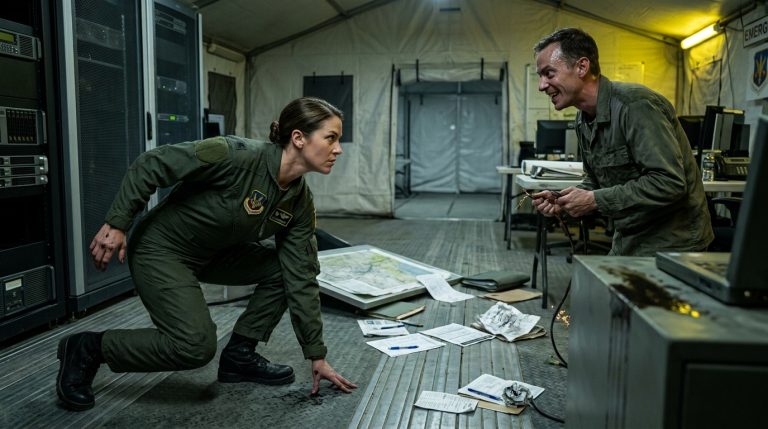
Maya didn’t waste time on the Captain’s pulse. The Boeing 737 was lurching, a violent, bone-rattling correction that signaled the autopilot was fighting a ghost. She slid into the jump seat, her hands already moving with a practiced, predatory rhythm. The cockpit was dim, lit only by the frantic amber and red pulsing of the overhead panels.
“Airspeed is erratic,” First Officer Park’s voice was brittle, barely holding together. “The storm—it’s not tracking right. It’s like the radar is lying to us.”
Maya didn’t answer immediately. She leaned forward, her eyes scanning the primary flight display. The digital horizon was weeping, the artificial line flickering as if it couldn’t decide where the sky ended and the chaos began. She noticed the small, etched scratch on the instrument panel—a imperfection that hadn’t been there in the simulator. It was deep, almost frantic.
“Give me the flight management system readout,” Maya commanded. Her voice was flat, devoid of sympathy. She wasn’t here to comfort the co-pilot; she was here to resolve an equation.
Park hesitated, then shifted the display. Maya’s breath hitched, just for a fraction of a second. The data stream wasn’t showing a standard severe weather pattern. The pressure differentials were inverted. The turbulence wasn’t coming from a storm front; the aircraft was flying through a self-generated vacuum, a localized anomaly that shouldn’t exist at thirty-five thousand feet.
Outside, the darkness wasn’t just night—it was a thick, impenetrable wall that seemed to press against the glass. Lightning flashed, but it was silent, soundless streaks of white that illuminated the clouds from within, revealing strange, angular formations that looked too mechanical to be vapor.
“The autopilot isn’t just fighting the wind, Lisa,” Maya said, her fingers dancing over the diagnostic console. “It’s fighting a signal.”
She reached out, her hand hovering over the navigation array. She felt a phantom sensation, the ghost of a metal object in her pocket—the fountain pen she’d left in her carry-on—and she used the memory of that weight to center herself. She wasn’t just a passenger anymore; she was the architect of this descent.
“Keep your hands light on the controls,” Maya instructed, her focus narrowing down to the flickering cursor on the screen. “We aren’t going to fight the storm. We’re going to shut down the system that’s calling it to us.”
As she moved to override the flight control interface, a warning light chimed—a low, discordant beep that didn’t match any pre-flight checklist. She froze. The screen shifted, and for a split second, a string of alphanumeric code scrolled across the display. It was a military-grade encryption key. The same key that had been stamped on the fuselage of the C-130s she’d flown years ago in the desert.
The realization sat in her chest like lead. This wasn’t a mechanical failure. This was a legacy, and it had just locked the cabin doors from the inside.
CHAPTER 2: The Logic of Resistance
The metallic ghost of the encryption key still burned behind Maya’s eyes, a sequence of alphanumeric characters that had no business living in the flight management system of a standard 737. But there was no time to dissect the origin of the code. The plane groaned—a deep, structural sound, like steel tendons stretched to the breaking point.
Maya’s hands didn’t shake. She reached past First Officer Park, her movements surgical, and cut the secondary bus power. The cockpit lights flickered and died, leaving them in the eerie, blue-tinged glow of the emergency battery bus.
“What are you doing?” Park’s voice was high, thin. She was staring at the blank navigation screen, her hands hovering uselessly above the yolk. “If you cut the power to the FMS, we’re flying blind. We won’t have an approach path, we won’t have…”
“We have exactly what we need,” Maya interrupted. Her tone was a physical weight, cold and grounding. “The system is compromised, Lisa. Whatever is feeding the navigation array is a feedback loop. If we stay connected, we’re just inputting data into a trap.”
Maya didn’t tell her about the military key. She didn’t have time to explain why a decommissioned Air Force project’s signature was bleeding into the avionics. Instead, she focused on the tactile reality of the cockpit. She could feel the vibration through her seat—a rhythmic, jagged pulse. It reminded her of a night in a C-130 over the Hindu Kush, a sensor check she’d botched during a whiteout, a moment where the instruments had lied to her just enough to make her bank into a mountain. She pushed the memory down, locking it behind the same mental wall she used to keep her empathy for the passengers contained.
“Give me the manual bypass,” Maya ordered.
“That’s for ground maintenance only,” Park protested, though she reached for the guarded switch.
“We are currently in a state of airborne maintenance,” Maya retorted.
The switch clicked. The mechanical silence that followed was heavy, punctuated only by the whistle of the wind against the windshield. Without the electronic hum of the flight management system, the aircraft felt stripped, exposed.
Maya looked out the side window. The clouds were churning, illuminated by that same soundless, mechanical lightning. The storm wasn’t dissipating; it was tightening around them like a noose. She looked at the control column. The vibrations were still there, but they were slower now, more methodical. The plane was searching for its lost signal, a desperate machine trying to reconnect with its master.
She looked over at Captain Morrison. He was slumped against his harness, his skin the color of ash. His chest rose and fell in shallow, shallow waves. He wasn’t just a man having a heart attack; he was a man holding a secret, and now that secret was trying to reclaim the flight.
“He knew,” Maya whispered, so low that even Park barely heard her.
“What?” Park turned, her face pale in the emergency light. “Who knew what?”
“The Captain,” Maya said, shifting her gaze to the throttles. She gripped the cold, hard metal, feeling the bite of the ridges against her palm. “He didn’t just have a heart attack because of the stress, Lisa. Look at his hands.”
Park leaned in. The Captain’s fingers were not merely curled; they were locked in a rigid, claw-like grip on the back of his seat, almost as if he were trying to pull the internal components of the flight deck closer to him, or perhaps trying to prevent them from being pried away.
“He’s been fighting this for the whole flight,” Maya realized, the logic clicking into place like a gear falling into its track. “He wasn’t flying us to Seattle. He was stalling.”
“Stalling?” Park asked, her confusion bordering on panic. “Why would he stall the aircraft?”
Maya didn’t answer. She pulled the throttles back a fraction, feeling the aircraft lose its bite on the air, dropping them into a shallower, more controlled descent. She needed to see the manual backups, the mechanical gauges that lived beneath the digital facade. She leaned down, peeling back a loose panel near the floorboard.
Behind the wire loom, she saw it: a small, black box grafted onto the redundant wiring. It wasn’t airline hardware. It was an unauthorized bridge, soldered directly into the primary flight controls.
“Keep the nose up, Lisa,” Maya said, her voice dropping into a register that brook no argument. “And whatever you do, do not touch the navigation frequency dial. If that box senses an uplink, we’re going to lose the rudder control entirely.”
As she reached for her utility knife, a sharp, metallic ping echoed through the flight deck—the sound of a circuit breaking. The aircraft bucked violently, a sudden, sharp jolt that threatened to throw them into a stall. Maya braced herself, her forearm slamming against the console, the skin breaking against the sharp edge of the aluminum frame. She felt the hot sting of blood, but she didn’t flinch.
The storm outside suddenly flared, the clouds parting for a split second to reveal not sky, but a dense, black field of telemetry towers scattered across the horizon, miles below—a vast, electronic grid that shouldn’t exist in the middle of a flight path.
“We’re not just flying,” Maya breathed, her eyes locked on the impossible grid below. “We’re being harvested.”
The plane shuddered, the control column going dead in Park’s hands. The silence that followed was the sound of a predator finally finding its prey.
CHAPTER 3: The Ghost Protocol
The yoke, once responsive and heavy with the inertia of flight, was now nothing more than dead weight in Park’s hands. She didn’t let go, but her knuckles were white, her breath coming in sharp, shallow stabs that filled the pressurized cabin with the smell of unadulterated fear. Maya didn’t give her a chance to spiral.
“Let go,” Maya said, her voice a low, hard anchor. She didn’t wait for compliance; she reached over and physically pried Park’s fingers from the metal column. “I have the manual controls. The hydraulic linkage isn’t severed, it’s just locked out by the override. I need you to pull the circuit breakers for the flight management computer. Row 4, bank B. Do it now.”
Park blinked, the professional training fighting through the haze of shock. She scrambled to the breaker panel behind them. “If I pull these, we lose everything. No autopilot, no autothrottle, no flight director. We’ll be flying a glider with two engines.”
“We’re already flying a glider,” Maya snapped, her focus fixed on the horizon—or what remained of it. The clouds were thick, swirling with a static-charged gray that seemed to hum against the glass. “If you don’t pull them, the telemetry loop is going to keep feeding false coordinates to the actuators. We’ll be flying straight into that grid, Lisa. Pull them.”
The audible clack-clack-clack of the breakers was the most beautiful sound Maya had heard all night. As the last one popped, the cockpit went dark, save for the standby gauges. The sudden absence of the electronic whine was jarring, like the world had been muted. The aircraft, freed from the digital ghost that had been steering it, shuddered and then settled into a clean, aerodynamic glide.
“Okay,” Maya whispered. She felt the plane beneath her—a living, breathing thing. “Manual trim. Roll left, heading two-four-zero.”
She began to fly by feel. In the military, she’d learned that a plane talks to you through the resistance of the column. Now, it was whispering. There was a faint, irregular vibration in the floorboards—not turbulence, but a mechanical stutter. It was coming from the center pedestal.
“Lisa, monitor the fuel flow,” Maya ordered, keeping her eyes scanning the dark, shifting clouds. “I’m going to isolate the physical bridge. Keep your hand on the backup radio. If you hear anything other than our call sign, shut it off.”
Maya unbuckled, leaving her seat. The movement was difficult; the plane was lurching in the wake of the storm, a relentless, churning sea of vapor. She reached the center pedestal and, using the small, sharp blade of her utility knife, she began to strip the trim cover. Her hands were steady, despite the cold sweat prickling her hairline.
As the plastic casing fell away, the light from the standby instrument illuminated the ‘bridge’—a cluster of wires, blackened and fused to the primary bus. It wasn’t just sabotage; it was a modification designed to draw power from the plane’s own electrical system to broadcast a signal. A beacon.
She saw the serial number etched into the casing of the box: Project Aethelgard.
Her pulse skipped. She remembered the classified briefings from her time at the Academy—a project involving remote telemetry manipulation, canned before it ever saw a flight test. It was a ghost story they told cadets to keep them wary of automation.
“Lisa, how’s the radio?” Maya asked, her voice tight.
“Dead air,” Park reported, her voice trembling. “Wait—no. I’m getting something. It’s a ping. Every three seconds.”
“Isolate the frequency,” Maya commanded.
She leaned in closer to the box, her skin brushing against the overheated casing. The smell of burning insulation was sharp, acrid, stinging her throat. She needed to cut the main feed, but the wires were woven into the hydraulic override system. If she cut the wrong one, the landing gear would deploy, or worse—they would lose control of the flaps entirely.
She took a breath, closing her eyes for a heartbeat. She thought of the pen in her pocket—the weight of it, the cold, steady reality of it. One cut. Don’t look for the solution, just remove the obstruction.
She brought the blade down, not on the wire, but on the connection point itself—a clean, precise strike against the soldering. The spark that jumped was small, a pinprick of violet light that lit the cockpit for a fraction of a second, revealing the shadow of the cockpit door behind her.
She froze. The door was open a crack.
Someone was standing there.
“Who’s there?” she called out, but there was no response. She didn’t turn around—she couldn’t afford to take her hands off the pedestal. But she saw the reflection in the standby glass.
It was the businessman from 8B. He wasn’t looking at the cockpit controls. He was looking at her. And in his hand, held tight against his side, was a device that looked identical to the one she was currently dismantling.
The plane dipped, a sudden, violent roll that sent Maya sprawling into the console. The businessman didn’t stumble. He stood there, perfectly balanced, his eyes devoid of fear, his gaze fixed on the broken box.
“You shouldn’t have done that,” he said, his voice quiet, almost mournful.
Maya’s grip on the knife tightened. The plane was falling now, the nose dropping into the clouds. The storm outside seemed to react to the silence in the cockpit, a deep, rolling thunder that shook the very foundation of the flight deck. She realized then that they weren’t just fighting a storm or a ghost in the machine. They were being hunted, and the hunter had been sitting in seat 8B the entire time, waiting for the system to break so he could see what kind of pilot would try to fix it.
CHAPTER 4: The Decoy Mechanism
Maya didn’t lunge. She shifted her weight, the sharp edge of the cockpit console digging into her hip, using the plane’s next violent yaw to mask a slight adjustment of her footing. She was braced; he was fluid. That was the primary difference between a pilot and an asset.
“I’m not interested in your harvest,” Maya said, her voice cutting through the mechanical groan of the fuselage. She kept her eyes locked on his, observing the way he didn’t blink. He was waiting for her to panic, for her to prioritize the box over the flight controls.
“It isn’t a harvest,” the man replied. His voice was devoid of malice, which was, in Maya’s estimation, far more dangerous. He took a single, deliberate step into the cockpit, his shoes making no sound against the rubberized mat. “It’s a refinement. The Captain knew. He was merely the custodian of the frequency.”
He held up the device in his hand—it was a near-exact replica of the sabotaged bridge she had just ripped from the pedestal. His lack of concern about the broken connection was the tell. He didn’t care about this specific node because it was only one of many.
“You’re a long way from Chicago,” Maya said, her hand inching toward the backup radio trigger.
“I am where I need to be,” he replied. He glanced at the pedestal, then at the unconscious form of Captain Morrison. “You think you’ve saved them by cutting the loop. You’ve only silenced the telemetry. The grid still knows where we are.”
The aircraft banked hard to the right, a correction triggered by a sudden atmospheric shift. The businessman didn’t reach for a handhold. He moved with the ship, his center of gravity shifting in perfect sync with the metal skin of the Boeing. It was a terrifying grace.
Maya looked down at his lapel. There, where a pin or a corporate badge should have been, there was only the faint, lighter outline of fabric. He had removed his identity. He wasn’t just an interloper; he was a ghost in the system, and he had been scrubbed clean.
“Lisa,” Maya said, her eyes never leaving the man. “Whatever happens in the next ten seconds, do not let go of the backup attitude indicator. If we lose pitch, we’re done.”
“Maya, what’s going on?” Park’s voice was fraying, a frantic wire about to snap.
“Focus, Lisa!”
Maya surged forward, not to attack, but to slam the cockpit door. She didn’t need to win the fight; she needed to create distance. The businessman anticipated the move, stepping back, but he didn’t follow through. He watched her with a detached, clinical curiosity. As the door latched with a heavy, final thud, the man remained in the galley, his silhouette visible through the small, reinforced glass window.
He didn’t try to force the door. He simply stood there, his hands loose at his sides, watching.
Maya turned back to the instruments. The air speed was climbing—too fast. They were descending into the teeth of the storm, the descent becoming a dive. She grabbed the yoke, feeling the heavy, stubborn resistance of the airframe. The controls were unresponsive.
“The actuators are jammed,” she muttered, panic threatening to break through her cool-headed calculation. “He didn’t need to be in here. The box was just a timer.”
She looked at the center pedestal. The wires she had cut were sparking again, but not with electricity—a thin, translucent vapor was leaking from the fuse box, a chemical bypass that was actively eating through the primary control cables.
It was a secondary failsafe. The decoy box hadn’t been the weapon; it had been the catalyst. By removing it, she had completed the final circuit of the true sabotage mechanism.
She felt a cold, sharp realization: everything she had done, every move she had made to ‘fix’ the plane, had been predicted. The manual was written in her own instincts. She was flying the plane exactly how they wanted it to fly.
“Lisa,” Maya whispered, her hands white on the yoke. “We aren’t landing in Seattle.”
The plane leveled off, a jarring, unnatural snap that sent the emergency masks dropping from the ceiling. Outside, the clouds vanished. They were flying through a corridor of pure, absolute darkness, a channel that seemed to exist outside of geography. The altimeter didn’t move; the airspeed didn’t fluctuate. They were locked in a steady, unyielding glide toward a destination that wasn’t on any map.
Maya looked at her reflection in the dark glass of the windshield. For the first time, she saw herself not as a pilot, but as a component—a human guidance system for a machine that had long ago decided where it belonged. The decoy was gone, and the truth of the flight was finally beginning to manifest in the crushing, absolute silence of the cabin.
CHAPTER 5: The Tactical Shift
The darkness outside wasn’t just an absence of light; it was a physical weight pressing against the cockpit windows, a silence so profound it felt like pressure in the inner ear. Maya gripped the control column until the tendons in her forearms ached. It didn’t move. The plane had locked into a rigid, predetermined glide path, ignoring every input she forced through the hydraulic lines.
“Lisa, get on the emergency radio again,” Maya commanded, her voice sounding thin and hollow in the pressurized tomb of the cockpit. “Sweep the lower bands. If this is a telemetry loop, it has to be broadcasting on a low-frequency pulse.”
Park, who had been staring at the blank, frozen displays for the last several minutes, jerked into motion. Her movements were jerky, uncoordinated, a stark contrast to the fluid grace of the man standing just outside the cockpit door. “I’ve tried, Maya. It’s… it’s just static. But it’s not random. Listen.”
Park turned the gain up. Through the headset, a rhythmic, pulsing sound emerged—not the erratic pop of atmospheric noise, but a structured, mathematical beat. It sounded less like a transmission and more like a heartbeat.
Maya looked at the man in the galley through the reinforced glass. He was leaning against the wall, eyes closed, as if he were listening to the same rhythm. He wasn’t guarding them; he was waiting for the plane to reach its destination. The realization hit Maya with the force of a physical blow: he wasn’t here to ensure they crashed. He was here to ensure they arrived exactly where the grid needed them to be.
“He’s the uplink,” Maya whispered.
“What?” Park asked, her fingers dancing over the radio dial.
“The businessman. He’s not carrying a device; he is the device. He’s the physical anchor for the telemetry.” Maya reached for her utility knife again, but her hands wouldn’t cooperate. A wave of lightheadedness rolled over her—a symptom of the cabin’s air quality, or perhaps something else entirely. The air tasted stale, metallic, like ionized dust.
“We have to break the line of sight,” Maya said, her thoughts feeling sluggish, as if she were moving through thick water. “Lisa, grab the manual emergency fire extinguisher. When I give the signal, you’re going to open the cockpit door and spray the galley. Not him—the vent. Just behind him.”
“That’ll vent the cabin,” Park countered, her voice trembling. “We’re at flight level, we’ll freeze.”
“We’re already dead if we stay on this path,” Maya replied, her focus narrowing to the small, distorted reflection of the man in the window. “Do it.”
Maya didn’t wait for a response. She grabbed the manual trim wheel, a heavy, iron-weighted mechanism that had been ignored in the age of digital flight. She began to crank it, putting her entire body weight behind every rotation. The plane groaned, the metal of the floorboards vibrating in protest.
One rotation. Two. Three.
The plane shuddered. The nose pitched up, ever so slightly, fighting the electronic grip of the invisible grid. Outside, the darkness rippled. For a fraction of a second, the light returned—a blinding, sterile white that didn’t come from the sun or the moon, but from the landscape below.
They were over a facility. It wasn’t an airport. It was a massive, concrete expanse covered in towers—thousands of them—all pointing upward toward the sky, all humming with the same rhythm she heard on the radio. It was a forest of antennas, a trap laid out in the middle of the Pacific Northwest.
“Now!” Maya screamed.
Park kicked the cockpit door open, the heavy steel panel swinging outward. She unleashed the canister of fire suppressant, a cloud of thick, white, chemical-smelling fog that filled the galley in an instant. The businessman flinched, his eyes snapping open. The rhythm on the radio distorted, shattered into a jagged, agonizing screech of feedback.
The plane banked violently, breaking the lock. Maya slammed the control column to the side, forcing the aircraft into a desperate, uncoordinated spin. The sensation of gravity shifting—the stomach-churning, sickening drop—was a relief. It was chaos. It was flight.
The man in the galley disappeared into the white cloud, his silhouette twisting as he tried to maintain his connection to the grid. The plane’s systems flickered to life—the displays, the warnings, the cacophony of an aircraft screaming about its own mortality.
“We’re descending, Maya! We’re coming down too fast!” Park shouted.
“I know!” Maya yelled back, her eyes fixed on the patch of real, dark, stormy sky appearing in the distance.
The businessman reached out, his hand slamming against the cockpit door, but the sudden, aggressive maneuver of the aircraft threw him into the bulkhead. The device he had been carrying—the one that had held the entire flight in its thrall—slipped from his hand, sliding across the floor and skidding into the dark, narrow space between the galley and the jump seat.
It was glowing. Not with electricity, but with an intense, burning crimson light that began to spread across the floorboards. The plane was no longer fighting them; it was dying. Maya gripped the column, forcing the nose up, but the ground was rising to meet them, and the horizon was no longer a promise—it was a looming, jagged wall of real, cold earth.
CHAPTER 6: The Descent
The manual trim wheel didn’t just resist; it kicked. Maya felt the iron weight of it wrenching against her palms, a violent, metallic recoil that tore a jagged gash across her thumb. The plane was falling, an ungraceful, tumbling stone through the thick, pressurized atmosphere of the storm. Every nerve in her body was screaming for a digital assist that no longer existed.
“Hold the nose!” Maya shouted, her voice raspy from the chemical suppressant still hanging in the air like a ghost.
Park was braced against the center pedestal, her shoulder shoved hard into the gear lever, using her body weight to keep the flaps from snapping under the pressure of the terminal velocity. The cockpit was a chaotic blur of strobe-like lightning flashes and the frantic, rhythmic chirping of the ground proximity warning system.
Maya looked down at the floor. The crimson light from the sabotaged device was spreading, a slow, viscous glow that seemed to be melting the very aluminum of the deck. It wasn’t fire—it was something colder, a chemical reaction that was liquefying the interface between the control cables and the airframe.
“The cables are slacking,” Maya realized, her blood running cold. “He didn’t just sabotage the FMS; he’s corroding the mechanical linkages.”
She didn’t have time to process the sheer, diabolical foresight of it. She shoved the trim wheel one last time, her shoulder muscles screaming as she forced the iron disc through the jam. With a sound like a gunshot, the rusted pin that had been hindering the movement snapped. The wheel spun freely, and the aircraft’s nose shuddered, fighting back toward the horizon.
They leveled out, but the ride was far from smooth. They were low—dangerously low. The altimeter was bleeding numbers so fast they blurred together. Below them, the forest of antennas rushed past, a blur of jagged, obsidian shapes that threatened to clip the wingtips.
“I have no rudder!” Park yelled, her voice bordering on a sob. “Maya, the left pedal is completely unresponsive!”
Maya didn’t answer. She took her right foot, braced it against the floor, and began to pulse the engine power. It was a crude, brutal tactic—using asymmetric thrust to yaw the plane, forcing the Boeing to dance through the air by sheer brute force. The engines roared, a deep, guttural thrum that shook the teeth in her skull.
“We have to clear this sector,” Maya said, her eyes tracking the flickering edge of the storm wall. “There. The ridge. If we can get enough lift, we can clear the transition zone and dump the signal.”
“We’re too heavy, we’ll never clear it!”
“We dump the fuel,” Maya countered, her eyes flicking to the fuel dump toggles.
“That’s a fire hazard with this corrosion!”
“Everything is a hazard, Lisa! Choose which one kills us first!”
Maya punched the release, and a fine, pressurized mist of jet fuel erupted from the wingtips. In the dark, the fuel caught the static charge of the storm, turning the trailing edge of the wings into a shimmering, electric arc of blue-white fire. It was a beautiful, terrifying sight—the plane burning its own lifeblood to carve a path through the dark.
The businessman was still out there. Maya could hear him now, a rhythmic thumping against the cockpit door, not the sound of a man trying to enter, but the sound of someone rhythmically tapping out a signal. He was still broadcasting. He was still tethered.
Maya reached into her pocket, her fingers brushing the empty space where her pen had been. She realized then that the pen hadn’t just been a comfort object; it had been a conductive element, a piece of calibrated brass she had unknowingly kept near the system during her training. She had carried the grounding rod for the very grid that was now trying to consume them.
She felt a surge of cold, sharp vindication. She wasn’t just a pilot; she was the architect’s unwitting tool, and she had been carrying the master key in her pocket for the last six months.
“Lisa, give me full thrust, center console,” Maya commanded, her hand hovering over the throttles. “We’re going to ride the heat signature.”
“If we go full power, the engine casing will buckle,” Park warned.
“Then let it buckle,” Maya whispered. “I’d rather burn on my own terms than be dismantled by their grid.”
She slammed the throttles forward. The Boeing surged, a metallic scream of straining turbines that drowned out the world. The ridge ahead loomed, a wall of jagged shadow, and for a fleeting, crystalline moment, Maya saw the entire pattern of the grid—not as towers, but as a nervous system, a web of lies cast over the sky, and she was the only one holding the shears.
CHAPTER 7: The Final Approach
The engines were screaming, a high-pitched, harmonic shriek that signaled the blades were beginning to warp under the thermal load of the fuel dump. Maya didn’t ease off. She poured every ounce of available thrust into the wings, forcing the 737 to climb at an angle that defied standard flight envelopes. The horizon ahead was a chaotic, churning wall of black cloud, but behind it, she could see the faint, mocking glow of the Seattle lights—a target she was no longer sure she could reach.
“The airframe is vibrating to pieces, Maya!” Park screamed over the roar, her hands clamped over the emergency breakers as if she could hold the aircraft together by sheer force of will. “The stabilizer jacks are shaking loose! We’re going to lose the tail!”
Maya didn’t answer. She was watching the primary flight display. It was pulsing again. The binary code was scrolling so fast it looked like a static waterfall. Project Aethelgard. The ghost of her own academy training. The lectures had been dry, filled with the jargon of remote-access signals and decentralized telemetry, but the reality was visceral, biting, and immediate. The grid didn’t want the plane to crash; it wanted to integrate it. The aircraft wasn’t just a vehicle anymore; it was a node.
She grabbed the manual radio toggle, the one she had isolated earlier. “Lisa, kill the main power to the avionics bus. Now!”
“If I do that, we lose the engine restart capability!”
“We don’t need to restart them,” Maya said, her voice strained, her vision tunneling at the edges. “We need to kill the signal. Cut it!”
Park slammed the guarded switch. The cockpit plunged into a sudden, jarring darkness. The silence was absolute, a void that seemed to swallow the screaming engines. For a second, the plane drifted, an unguided missile in the dead of the storm. Then, Maya felt it—the sudden, sharp snap of the controls returning to her hands. The aircraft responded to her touch again. It was heavy, sluggish, and damaged, but it was hers.
The businessman. He was still in the galley. The thumping had stopped, replaced by a low, rhythmic humming that seemed to vibrate through the cockpit floor.
“Stay here,” Maya said, unbuckling her harness. Her legs felt like lead, the adrenaline leaving her body in a cold, shivering wave. She reached for the cockpit door and pulled.
The galley was empty. The man was gone.
In his place sat the device—that glowing, crimson node of malice. It was embedded in the bulkhead, pulsing with the same light as the forest of towers below. It wasn’t attached to the plane’s systems anymore; it was leeching directly from the airframe’s metallic skin, converting the kinetic energy of the flight into the signal. It was a vampire, and it was feeding on the last of their momentum.
Maya grabbed the heavy, metal fire extinguisher from the wall mount. She didn’t hesitate. She swung it with everything she had, the heavy canister striking the node. It didn’t shatter; it rang, a deep, resonant chime that echoed through the entire fuselage. The node pulsed, brighter, the crimson light turning a blinding, sickly violet.
A wave of vertigo hit her—a flash of a memory she hadn’t visited in years: a classroom in Colorado Springs, the professor talking about ‘distributed intelligence.’ He had mentioned the lead designer of Aethelgard. A man who had vanished in the late nineties. A man whose signature was the same scratch she had seen on the instrument panel at the start of the flight.
The Captain. James Morrison wasn’t just a pilot. He was the architect.
Maya froze, the extinguisher poised for a second strike. Morrison hadn’t had a heart attack. He had triggered the integration. He had been trying to merge his own neural telemetry with the grid, using the flight as a massive, airborne processor to complete the sequence. The medical emergency was a cover for the upload.
The realization was a freezing, paralyzing weight. She looked back at the cockpit. Park was silhouetted against the dim, glowing standby instruments, unaware that the plane she was flying was a weapon, not a vessel.
Maya looked at the node again. She saw the seam—a tiny, physical gap in the casing where the energy bled out. She didn’t use the extinguisher. She reached into her pocket, found the small, metal tactical flashlight she’d carried, and jammed it into the gap.
The metal-on-metal grind was deafening. Sparks showered the galley, the smell of ozone turning thick and choking. The crimson light flared, once, twice, and then shattered.
The entire aircraft let out a single, prolonged sigh—the sound of a machine losing its purpose. The floorboards buckled, the cabin lights surged to a blinding brilliance, and then the plane dropped, a dead weight in the sky, falling toward the dark, jagged ridge of the mountains that now sat directly in their path.
“Maya!” Park’s voice came from the cockpit, small and terrified. “The flight controls are unresponsive again!”
Maya didn’t run back. She braced herself against the bulkhead, her hand gripping the torn edge of the interior panel, watching the horizon drop away. They were too low to recover. The grid was dead, but the plane was following it into the dark.
CHAPTER 8: The Weight of the Horizon
The impact wasn’t the fiery, structural disintegration Maya had braced for. It was a grinding, screeching slide that seemed to last for miles, the Boeing’s belly tearing against something impossibly hard and unforgiving—not earth, but the engineered surface of the facility itself. The plane groaned, the metal of the cabin echoing the sound of a giant, dying animal, before coming to a violent, neck-snapping halt.
Silence returned. Total, suffocating silence.
Maya pushed herself up from the floor, her ears ringing, the taste of blood thick and iron-sharp on her tongue. The cockpit was a ruin of shattered glass and dead electronics. She pulled herself to the door. The cabin was a cavern of debris, the overhead bins hanging open like broken jaws.
She saw him then.
Captain James Morrison was still in the left seat. He hadn’t collapsed from a heart attack. He had been dead, or near enough, for hours—his body held upright by the harness, his hand still fused to the yoke by a series of thin, capillary-like wires that snaked beneath his skin, connecting him directly to the plane’s flight computer. The medical emergency had been a lie; he was the primary server, the living processor for the grid he had helped construct.
“Maya?” Park’s voice was a whisper from behind her.
Maya didn’t turn. She stared at the Captain—at the way his chest didn’t rise, at the way the light in the cockpit reflected off his fixed, glassy eyes. He had sacrificed his humanity to ensure the integration succeeded, and even in death, he looked like a pilot.
“He wasn’t flying us, Lisa,” Maya said, her voice devoid of emotion, a flat, dead sound. “He was the autopilot.”
They climbed out through the shattered exit door. Outside, the night was cold and damp, smelling of rain and scorched circuits. They weren’t in the mountains. They were in the middle of a colossal, underground hangar, a subterranean cathedral of steel and glass, surrounded by the hum of thousands of dormant towers.
The businessman was there, waiting in the gloom. He didn’t look like a threat anymore; he looked like a curator. He stood amidst the wreckage, his hands tucked neatly into his pockets, his gaze fixed on the broken, smoking hull of the 737.
“You did exactly what he wanted,” the man said. His voice echoed in the vast space. “The integration required a pilot who could push the airframe beyond its structural limits. Morrison couldn’t do it. He was too tied to the code. You, however… you have a natural aptitude for breaking systems.”
Maya felt the weight of the moment, the cold, heavy realization that her entire career had been a selection process. She hadn’t been an anonymous passenger. She had been the test.
“I’m not going to finish the sequence,” Maya said. She reached into her pocket and pulled out the small, brass flashlight—the grounding rod she had used to shatter the node. She tossed it onto the concrete. It clattered, a tiny, insignificant sound in the vast silence.
The businessman didn’t move. “The sequence is already complete. The data was uploaded when the node shattered. You didn’t destroy it; you finalized the transfer.”
He turned and walked into the darkness, leaving them alone in the tomb of the hangar.
Maya stood there for a long time, watching the rain begin to leak through the hangar’s massive, overhead doors. She looked back at the plane—a twisted heap of metal that had been her home, her craft, and her pride. She reached down, picking up a stray fragment of the flight deck’s aluminum skin, and she held it. It was cold, jagged, and entirely, brutally real.
She turned to Park. “We walk,” Maya said.
“To where?” Park asked, her voice cracking.
“Until we find a horizon that isn’t engineered.”
Maya began to walk. The facility was vast, a labyrinth of concrete and silent machinery, but for the first time in her life, the sky above the open hangar doors wasn’t a coordinate—it was just the sky. She felt the heavy, aching fatigue of a person who had spent her life measuring the world in instruments, only to realize the world didn’t care about the math.
She didn’t know if the integration had changed anything, if the world outside was any different than it had been when they took off from Chicago, but as she stepped out into the rain, the cold, biting reality of it felt like a beginning. She had lost her craft, her career, and her understanding of the sky, but she had kept the one thing the grid couldn’t parse: the choice to keep moving, one step at a time, toward a truth that was, finally, entirely her own.
The hangar faded into the distance behind them, a monument to a ghost who had wanted to be a machine. Maya didn’t look back. She focused on the rhythm of her own heartbeat—irregular, fragile, and wonderfully human.