The Weight of Iron: A Mechanic’s Silent Reckoning Beneath the Shadow of a Collapsing Front Line
CHAPTER 1: The Anatomy of Spite
The rain in France didn’t wash things clean; it only turned the world into a suspension of grit and iron oxide. Ritter stood in the mouth of the barn, his boots sinking into the muck, watching the American Jeep shudder into the courtyard. It was a pathetic sight—a bent fender, a mismatched tire, and a chassis that seemed to sag under the weight of a thousand miles of punishment.
Behind him, the workshop smelled of cooling metal and the sharp, acidic tang of spilled diesel. It was a space defined by order, by the rigid geometry of tool racks and the precise, uncompromising tolerances of German engineering. But this American intruder, idling with a rhythmic, uneven cough, didn’t belong in that geometry.
The Feldwebel stopped beside him, his gray uniform stark against the gloom. “Another American toy, Ritter,” he said, his voice as dry as the dust on the vehicle’s hood. “See if you can learn why these nuisances keep turning up where they don’t belong. High Command has questions.”
Ritter didn’t answer. He walked toward the Jeep, his gait slow and deliberate. He laid a hand on the hood. The metal was warm, radiating a heat that felt less like a mechanical byproduct and more like a fever. Under his palm, the surface was scarred—not just by bullets, but by the relentless abrasion of a landscape that had tried to break it and failed.
“It’s a collection of compromises,” Ritter murmured, mostly to himself.
He unlatched the hood. It didn’t glide open with the oiled precision of a Mercedes-Benz; it jerked, the hinges groaning with the protest of years of neglect. As the metal rose, Hans, his youngest apprentice, crowded in. The boy’s eyes were wide, hungry for a glimpse of some marvelous secret.
“Just a four-cylinder,” Hans said, his disappointment palpable. “Nothing special, Meister.”
Ritter leaned in, the lantern light casting deep shadows into the engine bay. He traced the fuel line with a calloused finger. Vogle, the senior mechanic, snorted from the shadows of the tool bench. “Simple,” Vogle spat. “Over-engineered in its laziness. No elegance. No vision.”
Ritter ignored them. His eyes caught on something—a bracket near the distributor cap. He touched it, feeling the rough casting, and then looked at the bolt holding it. He reached into his pocket, pulled out his calibration wrench, and tried a standard size. It fit perfectly. He moved to the next bolt, then the next.
They all fit the same wrench.
Ritter felt a cold prickle of realization at the base of his neck. This wasn’t laziness. It was a deliberate, brutal suppression of inefficiency. He looked at the underside of the block, where a small, silver-colored seal had been broken. Something was missing—a locking pin that should have been there by every standard of proper engineering.
The Jeep looked at him, dark and defiant in the gloom. It hadn’t just survived the mud; it had been built to be abused, fixed in the dark, and forgotten—and yet, it still ran. Ritter glanced back at the barn’s tool wall, where a hundred different wrenches hung in perfect, useless order.
“It wasn’t built to be admired,” Ritter whispered, the realization settling in his chest like a stone. “It was built to be used until it shattered.”
He reached to pull the air filter, but his hand froze. Glinting in the dark recess behind the carburetor was a scrap of metal—not an American part, but a piece of German wire, twisted into a shape that defied every manual he had ever studied. It was a patch, a desperate, brilliant, and utterly unauthorized repair.
The Jeep hadn’t been abandoned. It had been kept alive by someone who understood that the machine was only as good as its ability to survive the man driving it.
Ritter looked up, his heart hammering against his ribs. The Feldwebel was watching him, a shadow in the doorway. He realized then that if he told the truth—that the machine was superior because it was intentionally imperfect—he wouldn’t just be questioning the war effort. He would be questioning the very soul of the army he served.
He reached for the wire, his fingers brushing the sharp edge, and as he pulled it free, a cold, heavy silence filled the workshop. The Jeep had been hiding more than just its mechanical secrets.
CHAPTER 2: The Anatomy of Spite
The silence in the barn wasn’t empty; it was pressurized. Ritter stood frozen, the thin strand of German wire coiled like a dead serpent against his grease-slicked palm. The metal felt impossibly sharp, a jagged testament to someone else’s ingenuity—a field-expedient fix that whispered a dangerous truth.
He didn’t turn around. He didn’t have to. The Feldwebel’s gaze was a weight against his back, a cold, probing presence that seemed to weigh his hesitation. Ritter’s heart hammered against his ribs, a rhythmic, frantic percussion that felt far too loud in the cavernous space. If he was caught, the excuse of ‘mechanical curiosity’ would not hold. This wasn’t just a part; it was evidence of a spirit that refused to be disciplined by the rigid manuals of the Reich.
“Meister?”
Hans’s voice cut through the air, pitched slightly too high. The boy was leaning over the engine block, oblivious to the gravity of the moment, his face smeared with a smudge of black oil. He pointed toward the transfer case. “There’s more rust inside the housing than I expected. Does it mean it’s been sitting in the rain?”
Ritter made his choice. In one fluid, practiced motion, he shoved the wire into his trouser pocket, his fingers curling around it until the sharp ends bit into his skin. He turned, forcing his expression into a mask of weary indifference. He wiped his hands on a rag, the coarse fabric scraping against his calloused knuckles.
“It means the machine was driven where it shouldn’t have been,” Ritter said, his voice steady despite the adrenaline. He looked at the Feldwebel, meeting the man’s eyes. “It was pushed through water, mud, and whatever else the terrain threw at it. That’s why it’s stained. Not neglect—punishment.”
The Feldwebel stepped forward, his boots crunching on the scattered metal shavings. He didn’t look at Ritter; he looked at the open belly of the Jeep. “And the conclusion? Is it salvageable for parts, or is it just another piece of American junk we should melt down to feed the furnace?”
“It’s a puzzle,” Ritter replied, stepping aside to let the Feldwebel get a closer look. He kept his hand deep in his pocket, ensuring the wire didn’t shift. “If we melt it, we lose the blueprint. The Americans have a way of building their machines that ignores the rules of logistics. If we can isolate what makes this frame hold up under that kind of abuse, we might be able to incorporate the design into our own recovery vehicles.”
He was lying, of course. He knew perfectly well that the German engineering machine would never adopt such crude, “unforgiving” standards. The brass would call it barbaric. But it was a hook—a logical, pragmatic lure that fed the Feldwebel’s own desperate need for a win.
Before the Feldwebel could respond, the barn’s exterior doors groaned. A sharp, mechanical shriek of metal-on-metal announced an arriving truck, followed by the frantic shouting of soldiers. A heavy spotlight swept through the barn’s interior, bathing them in blinding, white light.
“Ritter!” a voice barked from the yard. It was a courier, frantic. “The transport from the railhead is mired three kilometers back. They need a heavy-duty tow and a field mechanic who knows how to deal with transmission failure under pressure. Now!”
The interruption was the only thing that kept the Feldwebel’s focus from lingering on the Jeep. He cursed, his hand going to his sidearm in a reflex of irritation. He glared at the Jeep, then at Ritter. “Pack this up. Secure the engine bay. We can’t have components scattered if the base commander decides to drop by for an inspection.”
“Yes, Herr Feldwebel,” Ritter said, bowing his head.
As the officer marched out toward the shouting in the courtyard, Hans looked at Ritter, his face pale. “They’re going to kill the driver, aren’t they? For getting it stuck?”
Ritter didn’t answer. He turned back to the Jeep, his mind reeling. The “Butterfly Detour” had bought him time, but it had also forced him to leave the engine open, the evidence exposed to anyone who walked past while he was gone. He leaned over the engine, his movements suddenly hurried. He had to hide the evidence—not from the Feldwebel, but from the institution itself.
He began to reassemble the housing, his hands trembling. He wasn’t just fixing a machine; he was burying a secret. Every bolt he tightened felt like a betrayal of the logic he had spent his life adhering to. He had been trained to believe that if a machine failed, it was the operator’s fault—a lack of discipline, a lack of care. But here, looking at the scarred, mud-caked frame of this “ugly little goat,” he realized that the failure was in the philosophy itself.
He glanced toward the door, ensuring he was alone with Hans. The boy was occupied with a wrench, humming a low, tuneless melody. Ritter reached back into his pocket, retrieved the wire, and instead of throwing it away, he tucked it into the lining of his grease-stained overalls. He would need to study it later, under the cover of his own lamp, when the barn was finally still.
“Hans,” Ritter said, his voice dropping to a low, urgent murmur. “Don’t touch the transfer case housing again. It’s… sensitive. If the Feldwebel asks, tell him the gear ratios are standard. Don’t mention the load distribution.”
Hans looked up, puzzled. “Why? Isn’t that the most interesting part?”
“Exactly,” Ritter said, his eyes scanning the barn’s shadowed corners. “And in this place, the most interesting things are the first ones to get you shot.”
He stepped away from the Jeep, the weight of the wire in his pocket feeling like a leaden anchor. He had a tow to perform, a vehicle to repair, and an entire war effort to navigate—all while holding a secret that proved everything his superiors believed was a lie. He stepped out into the rain, the cold air biting at his skin, and began the long walk toward the front line.
CHAPTER 3: The Midnight Dissection
The transition from the open courtyard to the barn was less a movement and more a descent into a different kind of pressure. The rain had ceased, leaving behind a heavy, oppressive mist that clung to the barn’s wooden skin. Ritter pushed the heavy doors shut behind him, the thick timber groaning on rusted hinges. Inside, the air was stagnant, tasting of ozone, iron filings, and the lingering, sweet-sour scent of old grease.
He stood in the darkness for a moment, listening. The workshop was quiet, save for the rhythmic, distant drip of rainwater from the eaves hitting the mud outside. His hand, buried in the pocket of his overalls, clenched around the coiled wire. It felt like a live nerve, a direct connection to the impossibility he had uncovered in the Jeep’s transfer case.
He moved toward his workbench, his boots marking the floor in a slow, deliberate shuffle. He didn’t turn on the main overhead lantern. Instead, he reached for a small, hooded work lamp, its metal casing pitted with rust. He clicked the switch. A sharp, narrow beam of yellow light cut through the gloom, illuminating a small circle of his workspace—the tools, the stained rags, and the scattered remnants of a life spent in service to machines that demanded absolute perfection.
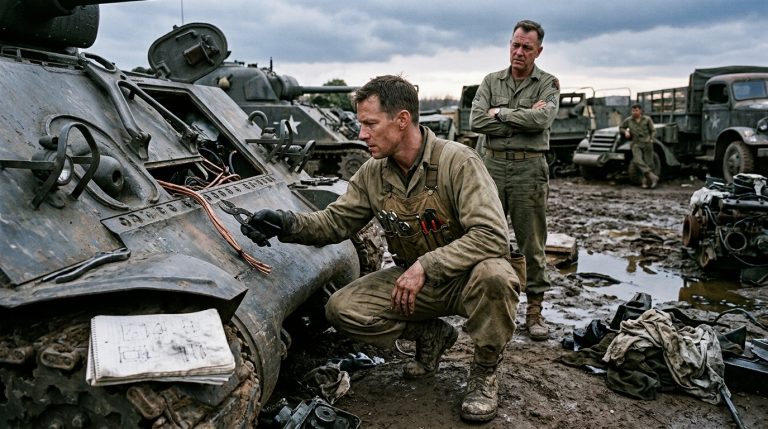
Ritter placed the wire on the scarred surface of the bench. It was a pathetic object, really—a piece of salvaged scrap, bent and twisted by frantic, desperate hands. But under the focused beam of the lamp, its shape became something else. It was a bridge. He reached for a micrometer, his movements mechanical, almost ritualistic. The tool was the pride of his career, a German-made instrument of exacting standards. He measured the thickness of the wire, then the gauge of the bolt-holes he had seen in the Jeep’s transfer case.
The numbers didn’t align with the manuals. They didn’t align with the engineering doctrines he had studied since he was an apprentice in Munich. The wire wasn’t a standard reinforcement; it was a shim, designed to distribute torque in a way that effectively bypassed the rigid limitations of the factory-cast steel. It was, in essence, a mechanical admission that the original design was meant to break.
“You weren’t built to be perfect,” he murmured, his voice barely a whisper in the cavernous room. “You were built to be survived.”
He reached for a clipboard, intending to cross-reference the Jeep’s component layout with the inventory logs he kept for the Feldwebel. He turned to the section detailing the “salvaged American parts” expected to be processed for the furnace. As he flipped the pages, his thumb caught on a discrepancy. The inventory list for the last three weeks was meticulous, yet there was a gap—an entire crate of salvaged drivetrain components, officially listed as “scrapped and melted” on Tuesday, which he knew, with absolute certainty, had never reached the incinerator.
He felt the hairs on the back of his neck rise. This wasn’t just his discovery; someone else—perhaps the very person who had driven that Jeep—had been siphoning off the “scrapped” parts, utilizing them for repairs that weren’t recorded in any official ledger. It was a shadow network of maintenance, a ghost-line of logistics running beneath the official, failing infrastructure of the German army.
He leaned into the light, his brow furrowed. If this was true, it meant the decay he was witnessing—the rusted hulls, the stalling engines, the breakdown of the front—wasn’t just due to incompetence. It was an intentional redirection of resources, a quiet act of sabotage performed by mechanics who had realized, long before he had, that the war was a machine that couldn’t be maintained.
A floorboard creaked behind him.
Ritter didn’t flinch. He simply covered the wire with a grease-stained rag and turned, his hand slipping into his pocket to rest on his own tools. Vogle stood in the doorway, his silhouette backlit by the faint, diffused moonlight filtering through the cracks in the barn wall. The older man was holding a mug of chicory, his posture slumped with a fatigue that went deeper than bone.
“You’re working late, Ritter,” Vogle said, his voice gravelly and devoid of its usual mocking bite.
“The transport needs the repair done by dawn,” Ritter replied, his heart rate steadying. He kept his tone flat, professional. “I needed to verify the gear ratios before I start the swap.”
Vogle walked into the circle of light, his eyes wandering over the workbench. He didn’t look at the rag-covered wire; he looked at the inventory logs, his gaze lingering on the pages Ritter had been studying. “The incinerator has been cold for three days,” Vogle said, his eyes meeting Ritter’s. There was no accusation in them, only a hollow, tired honesty. “The Feldwebel thinks it’s because of the fuel shortage. He doesn’t look at the ledgers anymore. He just wants the count to match the paperwork.”
Ritter watched him, sensing a shift in the air. “And does it?”
Vogle took a slow sip of the bitter drink, then set the mug down on the bench with a dull, heavy thud. “It matches whatever the paper needs it to match,” he said quietly. “We’re all just keeping the machines running until they don’t, Ritter. That’s the only truth we have left.”
Vogle turned and walked back toward the darkness of the barracks, leaving Ritter alone with the wire, the logs, and the cold, unyielding reality of the workshop. Ritter stood still for a long time, the smell of oil and damp wood filling his lungs. He realized then that he wasn’t just a mechanic documenting the failure of a Jeep; he was an observer of a total, systemic collapse. And the secret he was keeping—the wire in his pocket—was the only thing that felt real.
He pulled the wire out from under the rag, its jagged surface catching the light. He wouldn’t report the inventory discrepancy. He wouldn’t report the missing crates. He would do exactly what the Jeep’s driver had done: he would work in the shadows, keeping the machines of his own survival running, until the war, like a poorly designed engine, finally ran out of parts to break.
CHAPTER 4: The Field of Mud
The truck ride to the railhead was a study in controlled decay. Ritter sat in the passenger seat, his body jolting violently against the frame as the vehicle hammered over the cratered road. Beside him, the driver—a boy whose hands were white-knuckled around the wheel—fought the steering, the truck groaning in sympathy with every impact. The world outside was a smear of desaturated gray: skeletal trees, churned earth, and the hulking remains of vehicles that had succumbed to the terrain.
Ritter felt the jagged wire in his pocket with every bump, a sharp, constant reminder of the American Jeep he had left behind in the barn. It had been built to navigate exactly this—the chaos, the neglect, the absolute disregard for standard road conditions. His own army’s truck, by contrast, was a screaming beast of complicated parts and fragile tolerances, currently wheezing its way toward a total mechanical seizure.
“Keep it steady,” Ritter commanded, his voice barely audible over the mechanical protest of the engine. “Don’t force the gear. If the differential hits that rut, we lose the axle.”
“It’s already slipping, Meister,” the boy shouted back, his eyes darting to the temperature gauge. “It won’t hold.”
Ritter watched the needle quiver toward the red. He remembered a mission, six months prior, where a similar staff car had buckled under the weight of a retreat. He had been the one to attempt the repair in the field, working under mortar fire with nothing but standard-issue tools. He had failed, of course; the machine had required a specialized jig and a clean shop environment that didn’t exist in the middle of a war-torn forest. The memory was a ghost—the smell of burning rubber, the sound of the enemy closing in, and the crushing shame of a mechanic who couldn’t fix the world.
That ghost was in the passenger seat now, whispering that he was doomed to repeat the failure. He shook the thought away, focusing on the road.
“Stop,” Ritter said, his hand slamming down on the dash.
The boy braked, the truck skidding to a halt with a harsh, metallic screech. They were at the base of the incline where the transport convoy had stalled. The scene was worse than the Feldwebel had described. A heavy logistical vehicle was buried to its hubs in a mire of clay and rainwater, its wheels spinning in an aimless, impotent cycle. Around it, soldiers stood in the rain, their posture slumped, their faces mask-like in their exhaustion.
Ritter climbed out, the mud instantly claiming his boots. The air was thick with the scent of damp wool and panic. He walked toward the lead vehicle, his eyes scanning the chassis. It was a marvel of German engineering—complex, heavy, and utterly unsuited for the hellscape of 1944 France.
“It’s the axle,” a junior officer barked, approaching Ritter. “Can you patch it? We have the spare parts in the trailer.”
Ritter looked at the pile of specialized, intricate components sitting in the mud. He knew exactly what he was supposed to do: spend hours tearing down the assembly, aligning the precision gears, and praying that the tolerances held. He looked at the stalled truck, then thought of the Jeep—the way it would have simply bounced over the mire, its transfer case absorbing the impact, its design forgiving the very abuse that had crippled this behemoth.
“We don’t have time for a full rebuild,” Ritter said, his voice cold and detached. He reached into his kit, pulling out a heavy wrench. “I’m going to bypass the primary housing. We’ll brace the drive shaft and hope the structural integrity holds long enough to reach the hard-pack.”
“That’s not the regulation procedure,” the officer sputtered.
Ritter turned, his eyes locking onto the man’s. “Regulation is what got this truck stuck in a ditch. Do you want it out, or do you want to keep following the manual until the enemy arrives?”
He didn’t wait for an answer. He dropped to his knees in the freezing slurry of the ditch, the mud soaking through his trousers. He began to work, his movements rapid and instinctive. He wasn’t using the manual; he was using the logic of the American Jeep. He identified the points of maximum stress and began to brace them, creating a makeshift, temporary stability that defied the factory specifications.
As he worked, his hands felt the metal, searching for the inherent weaknesses. He could feel the frustration of the steel, the way the machine was vibrating with the strain of being forced to behave in a way it wasn’t designed for. He wasn’t just fixing a truck; he was fighting a war against the arrogance of the design itself.
A sudden, sharp pop echoed through the valley—not a gunshot, but the sound of a spring snapping inside the truck’s suspension. The vehicle listed heavily, the metal frame groaning. The soldiers around him ducked, their reflexes conditioned by the threat of fire. Ritter didn’t move. He kept his wrench steady, his focus narrowed to the single bolt he was tightening.
He was the “Sovereign Protector” of this hunk of iron, a master of a dying craft, trying to force a masterpiece of engineering to function like a crude, forgiving tractor. He realized then that if he succeeded, he was only prolonging the inevitable. If he failed, he was dead.
He tightened the final bolt, the metal biting into the frame. He stood up, wiping the grease and mud from his face with a ragged, blackened sleeve.
“Start it,” he said.
The driver turned the key. The engine roared, coughed, and then, against all odds, settled into a steady, vibrating idle. The truck strained forward, the wheels finally biting into the clay. It lurched, dragging itself from the mire, a wounded animal fighting to live.
Ritter watched it go, the realization of what he had done sinking into his marrow. He had saved the truck by stripping away its dignity. He had treated a piece of German art like an American toy. And as the truck disappeared into the mist, leaving him alone in the freezing, silent rain of the field, he felt the weight of the wire in his pocket, a secret anchor holding him to a truth he wasn’t yet ready to speak.
CHAPTER 5: The Report of Silence
The walk back from the front was a marathon through a graveyard of rusted metal. Ritter moved with a heavy, rhythmic cadence, his boots caked in a thick, clay-like mud that seemed to pull at him, demanding he stop, demanding he surrender to the exhaustion that clouded his vision. Behind him, the sound of the truck’s engine was a distant, dying hum—a ghost of the labor he had just exerted.
When he reached the workshop, the barn seemed smaller, darker, and infinitely more dangerous. The Feldwebel was already there. He was standing by the Jeep, his hands clasped behind his back, his presence a sharp, jagged contrast to the oily, cluttered reality of the shop.
“You took your time, Ritter,” the Feldwebel said without turning.
Ritter paused at the threshold, the cold air at his back feeling like an executioner’s breath. He stepped inside, the floorboards groaning in a way that made his teeth ache. “The mud is deep, Herr Feldwebel. The convoy required a specialized approach to salvage.”
“Specialized.” The Feldwebel turned, his face illuminated by the harsh, overhead lantern. He looked at Ritter, his eyes narrowing. “That is an interesting word. I’ve seen the reports from the transport unit. They say you bypassed the standard repair protocols. They say you used bracing methods that don’t appear in any manual.”
Ritter’s heart did not race. He was too tired for that. Instead, he felt a strange, detached stillness. He reached into his pocket, his fingers finding the sharp edge of the wire he had retrieved from the Jeep. “I used the tools available to ensure the machine reached the destination. That is the function of a mechanic.”
“The function of a mechanic is to uphold the integrity of the equipment,” the Feldwebel snapped, his voice rising, sharp and thin. He walked toward Ritter, his boots clicking with terrifying precision on the wooden floor. “We are not building tractors for American farmers, Ritter. We are building a war machine that requires absolute adherence to design. If we permit these… deviations… we aren’t just losing machines. We are losing the discipline that allows us to fight at all.”
Ritter looked past him, his eyes landing on the Jeep. It sat there, patient and ugly, a witness to the discrepancy between their two realities. He felt a sudden, sharp spike of paranoia. Did the Feldwebel know? Had he seen the wire? Was this interrogation a trap designed to confirm that Ritter had abandoned his duty? He looked at the shadows in the rafters, imagining the glint of unseen observers, the weight of a bureaucracy that watched every bolt, every weld, and every failure with a predatory hunger.
“I didn’t deviate,” Ritter said, his voice flat, professional. “I prioritized completion.”
“You prioritized a shortcut,” the Feldwebel corrected. He picked up a caliper from the bench, his fingers tracing the cold metal. “I have questions about this machine. High Command isn’t just asking about its longevity anymore. They are asking if it can be reverse-engineered for our own use. If I present a report that suggests our mechanics have started improvising, it looks like a sign of desperation. Or worse—subversion.”
Ritter felt the blood drain from his face. “I am not a saboteur.”
“Aren’t you?” The Feldwebel tossed the caliper onto the bench. It clattered, the sound like a gunshot in the silent shop. “You’ve spent weeks staring at this American toy. You’ve touched every gear, every shim, every bolt. And now, you return from a field repair performing the very same ‘shortcuts’ that define this machine’s inferior design. It’s a contagion, Ritter.”
Ritter watched him, his mind calculating the risks. If he spoke the truth—that the American design was superior because it was inherently forgiving—he would be discarded. If he lied and claimed it was inferior, he would be forced to continue the charade of maintaining a collapsing fleet with tools that weren’t built for the task.
“It isn’t a contagion,” Ritter said, his voice barely a whisper. “It’s a response to reality.”
The Feldwebel stopped, his face inches from Ritter’s. The air between them was thick with the scent of unwashed uniforms and the underlying decay of the barn. “Reality is a failure of will. We will not succumb to it. You will write the report. You will detail exactly why this machine’s design is a flaw, not a secret. You will explain that its successes are accidents of luck, not a result of superior intent. And you will ensure that from this point forward, no ‘specialized’ repairs are conducted without my written authorization.”
Ritter nodded, his jaw set in a line of hard, cold resolve. “I understand.”
“Do you?” The Feldwebel patted Ritter’s shoulder, a gesture that felt like a death sentence. “I’ll be back in the morning. If I find one more piece of unauthorized scrap metal—or one more repair that ignores the manual—we will have a different kind of conversation. One that doesn’t involve machinery.”
The Feldwebel turned and marched out, the heavy barn doors slamming shut with a finality that shook the walls. Ritter remained standing in the center of the shop, the silence rushing back in to fill the space. He walked slowly to his desk, his legs trembling with the residual strain of the day.
He pulled the sheet of paper toward him, the blank white surface glaring under the work lamp. He dipped his pen in the ink, the tip catching on the paper’s grain. He started to write, his words methodical, precise, and entirely hollow. He was burying the truth again, constructing a report that would satisfy the Feldwebel while simultaneously sealing his own fate.
He wrote about “excessive tolerances,” “unacceptable material stress,” and “inherent design weaknesses.” He dismantled the Jeep on paper, systematically destroying its reputation to preserve the comfort of the regime. But as he reached the bottom of the page, he paused. His hand hovered over the paper.
He didn’t write about the load-distributing part. He didn’t write about the wire. Instead, he wrote a single, final note, a hidden layer of defiance buried beneath the technical jargon. The machine performs within tolerances when allowed to operate outside of them.
It was a riddle. A mechanic’s secret. A small, quiet truth that sat on the page like a ticking bomb. He folded the report, placed it in an envelope, and sat back, listening to the rain begin to fall again, drumming against the roof in a steady, relentless rhythm that promised no relief and no end.