The Woodsman of Peleliu: How an Appalachian Turkey Hunter Saved His Encircled Platoon in the Coral Ridges
CHAPTER 1: THE WEIGHT OF CORAL
The humidity in the canyon sat like a wet wool blanket over twenty-eight sweating men.
Lieutenant Morrison dug his thumb into the notch of his brass compass, clicking the casing shut over and over until the quiet metallic tap began to grate on every set of nerves in the ditch. He looked up at the jagged coral walls enclosing the platoon, then down at the dry canteen sitting between his boots.
“Four hundred rounds per man,” Morrison muttered, his voice flat, stripped of authority by twelve hours without sleep. “Six grenades total. One BAR with two hundred rounds left in the cans. No radio to call the beach, and the main line is three hundred yards back through a wall of solid jungle.”
Caldwell sat on his heels against a jagged shelf of white rock, turning a smooth piece of oil-stained cedar wood between his calloused fingers. The cedar was worn soft from twelve years of sliding across a slate turkey call in the Monongahela timber back home.
“They aren’t going to charge down the middle, Lieutenant,” Caldwell said quietly, his voice carrying the slow, dry drawl of the West Virginia ridges. “They’re just feeling the edges of the porch right now.”
Sergeant Miller wiped a mixture of sweat and coral dust from his forehead with the back of a filthy sleeve and let out a harsh, rasping laugh. “This isn’t a porch in Morgantown, Caldwell. Standard doctrine says we assemble fire team wedges and push the narrow mouth of this canyon before they set up heavy mortars on the rim.”
“Pushing that mouth means walking twenty-eight men into three machine guns you can’t see,” Caldwell replied without raising his eyes from the wood in his hand. “You run out into that brush loud, and every man gets pinned in the open before he takes ten steps.”
Morrison looked down at Caldwell’s hands, then up at the thick, chaotic tangle of green vines choking the base of the canyon wall forty yards ahead. “You said this morning you wanted to go out there alone. What exactly are you proposing, Corporal?”
“You stay here in the dirt and keep your mouths shut,” Caldwell said, slipping the cedar block back into his breast pocket. “I go out thirty yards forward, find a hide, and wait. When they come through the brush, I take one shot at the man in the rear and I move. No automatic fire. No shouting.”
Miller spat onto the white dust between his boots. “That’s cowards’ work, sitting in a bush while the platoon waits to get slaughtered. You think hunting birds translates to a reinforced Japanese infantry company?”
“A turkey’s got eyes that can see you breathe from sixty yards out,” Caldwell said, his voice dropping into a cold, flat register. “A man in a hurry only sees what he expects to see. Give me until noon, Lieutenant. If I’m not back, you can order your charge.”
Morrison looked at the sun burning white-hot through the canopy above the coral ridge, then tapped his compass casing one last time. “Go. But if you draw a mortar barrage down on this position, I’ll shoot you myself.”
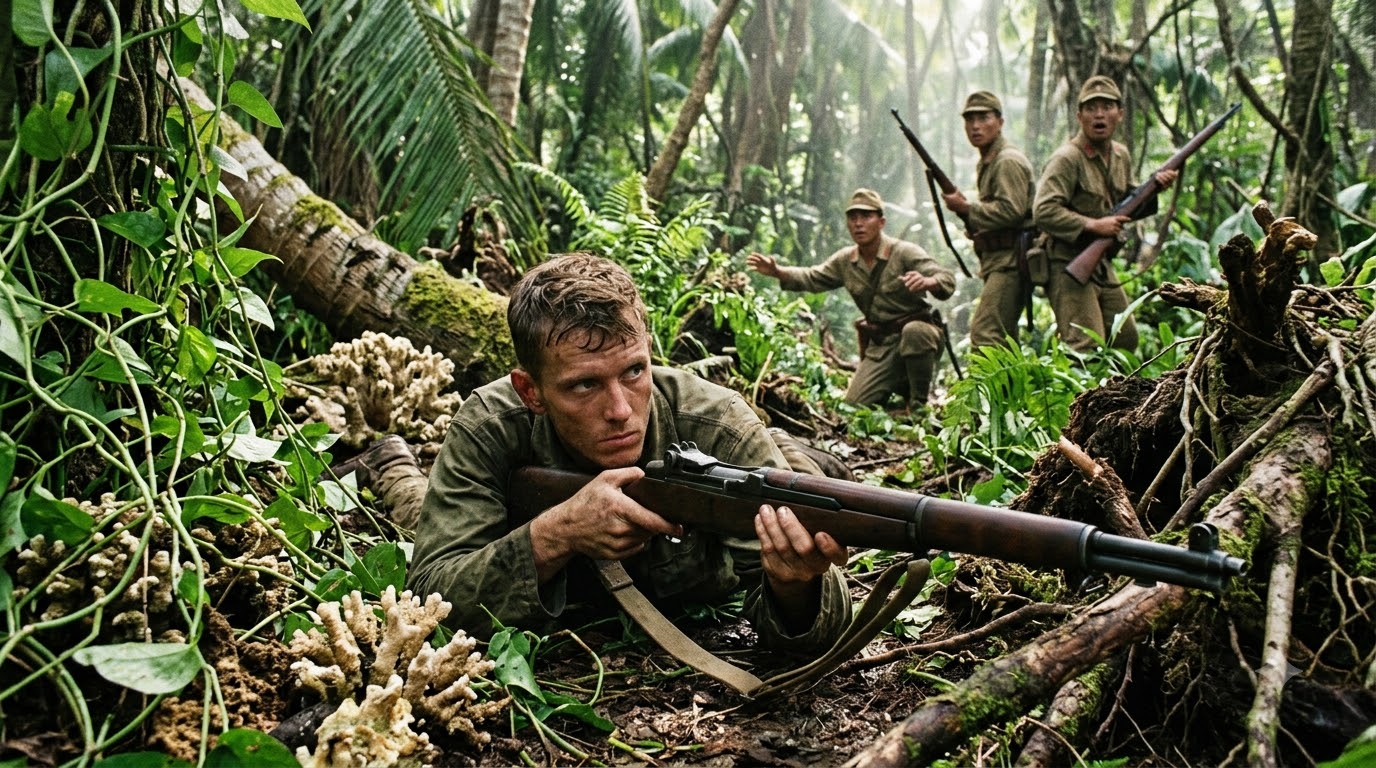
Caldwell didn’t answer; he adjusted the canvas strap of his M1 Garand, dropped onto his stomach, and slid forward into the humid, airless brush like an iron bar slipping into dark water.
CHAPTER 2: FIRST BLOOD IN THE BRUSH
The boots didn’t move for three long minutes.
Caldwell kept his body pressed flat into the hollow between two sun-bleached coral heads, his lungs expanding just enough to keep his blood moving without rustling the sharp grass overhead. A bead of stinging sweat gathered at the corner of his left eye, pooled against the Bridge of his nose, and dripped onto the cool steel receiver of his M1 Garand. He didn’t blink. He didn’t reach up to wipe it away. In the Monongahela brush, the second you moved a hand to brush off a horsefly was the exact second a gobbler spotted the motion and vanished into the timber.
Through the tangle of hanging vines, four figures resolved out of the green haze. They moved with a slow, deliberate caution, bayonets fixed, scanning the low canopy rather than the ground beneath their feet. They were searching for a line, a defensive trench, a helmet—anything that looked like a standard American position.
The lead soldier stepped over a fallen palm trunk, his boot bringing down a shower of dry bark. He paused, turned his head toward the canyon where Morrison and the rest of First Platoon were hiding in the dirt, and raised his hand to signal the three men behind him.
Caldwell’s right index finger rested against the cold curve of his trigger, but his eyes didn’t freeze on the leader. He looked past him. The rear soldier—a stocky man carrying a heavy canvas supply roll across his shoulders—had stopped near a dense cluster of wild ginger, looking back over his shoulder to cover their backtrail.
That was the anchor.
If Caldwell shot the man in front, the other three would hit the dirt, open up with full automatic fire, and pinpoint his position within five seconds. The rear man was isolated. The foliage behind him was thick enough to swallow a dropping weight without a sound.
Caldwell waited until the three point men took two steps forward into a wash of bright sunlight, their attention locked entirely on the canyon mouth. The rear soldier turned his head slightly to the left, exposing the side of his neck.
The Garand cracked once—a single, sharp slap that echoed flatly against the high coral walls.
The stocky soldier folded at the knees without a scream, his helmet thumping soft against the wet earth as he went down into the ferns. Before the spent brass casing had even struck the coral beside Caldwell’s elbow, the woodsman was already rolling.
He didn’t stand. He didn’t look back to check his work. He pulled himself six feet to his left on his stomach, sliding through a narrow crease in the rock like a copperhead snake, digging his elbows into the mud to pull his rifle clear of the low brush.
Twenty yards away, the remaining three soldiers spun around, their rifles coming up to their shoulders in a panic. They fired a ragged volley straight into the cluster of ferns where Caldwell had been lying half a second before, the high-velocity rounds shredding the leaves and sending showers of green mulch into the air.
“Keep shooting,” Caldwell whispered under his breath, his back wedged tight into a new crevice ten feet away, his thumbs already feeling for the smooth grain of the cedar block in his shirt pocket. “Spend your brass on the ghost.”
The three men advanced on the shredded fern bed, their boots crunching on the loose coral, completely unaware that the man who had fired was now lying behind them, watching their backs through the gap in a rotting root.
CHAPTER 3: THE GHOST IN THE COVER
The kneeling soldier reached out with a trembling hand to touch his comrade’s shoulder, his head turning erratically as he tried to scan three hundred degrees of blinding green jungle at once.
The other two soldiers stood six feet apart, back-to-back, their rifle barrels twitching toward every rustle of the sea breeze through the coconut palms. They were panicking now. The quiet had become a physical weight, pressing down on them harder than a heavy mortar shell. When a mortar falls, you hear the whistle; you know where to dig in. When a ghost takes a man from twenty yards away, every shadow looks like a muzzle.
Caldwell squeezed the trigger smoothly, taking the slack out of the steel until the hammer dropped.
The single report smashed through the humid air. The kneeling man went limp instantly, spilling sideways into the roots.
Before the remaining two soldiers could even process the sound, Caldwell pulled his knees to his chest, kicked off a jagged spur of limestone, and slid backward through a narrow tunnel of woven wire-grass. The sharp coral tore through his heavy canvas trousers, dragging across his shins, but he didn’t slow his pace. He knew the rule better than any manual ever printed: Shot fired, lease expired.
Pulled-up dirt and clipped branches flew overhead as the two surviving patrol members unleashed a panicked spray of automatic fire into the crevice he had occupied three seconds earlier. Slugs ricocheted off the white coral with terrifying metallic shrieks, showering the empty rock with hot stone dust.
Caldwell stopped ten yards east, lying belly-down behind a downed ironwood trunk.
He didn’t reload yet. He kept his fingers off the metal, listening. The firing stopped abruptly. The silence snapped back over the ridge, thick and suffocating.
Through a small notch in the bark, Caldwell watched the third soldier—a young man with his helmet strap dangling loose—break discipline entirely. The boy turned and sprinted back toward his own lines, crashing through the brush like an alarmed deer, making enough noise to wake the dead.
Caldwell raised his rifle, tracking the moving foliage ahead of the runner, calculated the lead, and pressed the trigger once.
The boy dropped forty feet out, the foliage swallowing his fall with a heavy thud.
The fourth man, however, didn’t run.
He went flat into the thick dirt beneath a wild banana tree and stayed there, completely motionless. Caldwell watched the patch of green where the soldier had vanished. Eight minutes ticked by. Neither man moved. A swarm of black flies settled over the sweat on Caldwell’s neck, biting deep into his skin, but he didn’t lift a hand to swat them.
This was the real test—the long, agonizing staring contest in the shade. Out in the Monongahela, an old gobbler would sit in the laurel thicket for half an hour, waiting for you to twitch a ankle or shift your hips before he bolted.
The Japanese soldier finally lost his nerve. He began to drag himself backward, inch by inch, trying to slide behind a thick root.
A single green leaf flipped upward as his boot pushed against it.
That tiny flash of movement was all Caldwell needed. He lined up the front sight post with the dark gap beneath the root and fired his fourth round.
The struggle beneath the tree ceased instantly.
Caldwell pulled his Garand back, pressed his thumb against the top round of a fresh clip, and snapped it down into the receiver with a crisp clack. He reached into his pocket, his calloused fingers brushing against the cool, smooth edges of the cedar call, grounding his heart rate before he began the long crawl back toward a fresh angle.
Behind him, fifty yards back in the canyon, Lieutenant Morrison was peering over his rock wall, his jaw slack as he counted the sudden silence.
CHAPTER 4: BREAKING THE SPEARHEAD
The officer’s voice was sharp, fast, carrying across the humid clearing in clipped bursts of frantic authority.
He wasn’t pointing toward the canyon where Morrison and the rest of First Platoon were pinned down. He was pointing toward a high crest of white coral fifty yards to the left—a ridge that was entirely empty except for jagged rock and hanging wild vines. To his mind, no single shooter could have wiped out two scouting patrols in under an hour; he was convincing his men that a fortified, heavy machine-gun nest was dug in on that high ground, anchoring the entire American forward line.
The arrogance of doctrine had locked his head in a vise. He couldn’t imagine a solitary woodsman lying in the mud beneath his feet; he could only see the textbook military threat he’d been trained to fight.
Caldwell pulled his shoulders tight, inching his rifle barrel across the damp limestone.
Around the officer, nearly forty men were checking their bayonets and lining up into assault columns, preparing to rush that empty coral ridge with everything they had. If that wave hit the ridge, they’d realize within thirty seconds that nobody was there—and then they’d wheel right and roll straight over Morrison’s exposed, under-armored flank in the canyon ditch.
Caldwell slid his right hand into his pocket, his knuckles brushing against the smooth, worn cedar box before closing around a single loose 30-06 round. He loaded it directly into the chamber with a silent, deliberate thumb press.
He didn’t aim for the soldiers in the front rank. He brought the front sight post up until the black iron notched directly over the brass insignia on the officer’s collar, seventy yards out through the thick canopy.
“You want to charge a hill that isn’t there,” Caldwell murmured under his breath, his voice flat as autumn frost. “Go ahead and try it without a driver.”
He exhaled slowly, letting half the air out of his lungs, and squeezed.
The Garand cracked, the heavy recoil shoving hard into Caldwell’s right shoulder.
The officer spun half a turn and dropped into the tall grass, his leather map pouch flying clear and landing open in the red mud.
The assembly area erupted into total chaos. Shouts echoed through the trees as squad leaders dropped to their knees, dragging their commander toward a tree trunk while soldiers fired wildly into the canopy overhead, convinced the shot had come from an elevated sniper post high in the palms.
Caldwell didn’t wait to watch the panic spread. He pulled his legs under his ribs and began a grueling thirty-yard low crawl, dragging his rifle through the sharp, skin-shredding coral dust, leaving the empty assembly area behind to reset his trap closer to the canyon mouth.
CHAPTER 5: THE QUIET AFTERMATH
The thunder in the distance wasn’t a sudden miracle; it was the heavy, rhythmic thumping of American marine batteries finally chewing their way through the outer ridge.
Through the darkening canopy, the sharp, chaotic crackle of small-arms fire began to thin, dissolving into the wide, hollow silence of a broken siege. The remaining enemy soldiers were pulling back toward the northern swamps, leaving their elaborate encirclement map scattered in the damp grass.
Caldwell didn’t jump up to cheer. He pulled his Garand back through the weeds, checked the chamber one last time, and locked the safety with a quiet click.
He stood up slowly, his knees popping in the damp evening heat, his heavy boots sinking three inches into the red mud as he walked back toward the canyon mouth. His shoulders ached with a deep, bruised fatigue, but his hands remained perfectly steady.
Lieutenant Morrison climbed out of the defensive ditch, his uniform caked in sweat and limestone dust, his eyes hollowed out by twenty-six hours of waiting for an assault that never came. He looked at Caldwell, then looked past him into the silent undergrowth where dozens of spent brass casings gleamed like gold teeth against the dark roots.
“How many, Caldwell?” Morrison asked, his voice rasping against his dry throat.
“Enough to keep them thinking there was a full company sitting in these bushes,” Caldwell said quietly, reaching into his shirt pocket. He pulled out the small piece of oil-stained cedar, turned it once in his palm, and slipped it back into the canvas pouch. “They were looking for an army, Lieutenant. They didn’t know how to look for one man sitting still.”
Behind them, the lead elements of the relief column broke through the narrow canyon neck, their boots splashing through the creek bed, rifles held high as they took in the quiet ground.
A relief captain walked past the line of twenty-eight surviving Marines, staring at the untouched defensive perimeter before turning his gaze to the thick brush forward of the position. He looked at Morrison, then at Caldwell, wiping a streak of engine grease from his cheek.
“Who held this pocket?” the captain asked, looking at the narrow choke point. “We were told you boys were completely cut off without fire support.”
“We were,” Morrison said, wiping the grit from his eyes and placing a hand on Caldwell’s shoulder. “The Corporal here just kept the woods quiet.”
Caldwell didn’t wait for the officers to finish writing their reports. He sat down on a flat spur of white coral, rested his rifle across his thighs, and took a slow sip from his canteen. The water was lukewarm and tasted of steel, but as he sat there in the settling dust of Peleliu, he wasn’t thinking about medals or military manuals.
He was thinking about a ridge in West Virginia, the smell of damp pine needles in late October, and the cold, patient silence of waiting for daylight in the mountains.