When Shadows Lengthen Across the Channel: The Quiet Courage That Saved a Free Nation from the Brink
CHAPTER 1: Shadows Over Whitehall
The pocket watch clicked shut with a dry, metallic snap. Winston turned away from the tall glass window, his boots grinding against the worn wool carpet. Outside, the gray London streets smelled of damp wool, coal smoke, and unwashed skin.
A column of men shuffled past the iron gates below. Their heads hung low, crowned with exhaustion instead of steel helmets. Not a single rifle caught the faint afternoon light. They walked with the hollow, stumbling gait of men who had carried the weight of a continent’s collapse across miles of burning French sand.
Major Hastings did not look up from the leather folder resting on the corner of the mahogany desk. The gray light cutting through the window pane illuminated the sharp, tired lines of his face.
Seventy-five thousand vehicles left behind in the salt spray. Two thousand four hundred artillery guns abandoned to the tide. The numbers were not ink on paper anymore; they were physical ghosts haunting every corridor of the government.
Winston reached into his waistcoat, his thumb tracing the deep, familiar dents on the watch casing. The silence in the room felt heavy enough to crack the floorboards.
Across the English Channel, three thousand armored hulls waited in the summer heat. Fourteen functional tanks stood between those steel monsters and the heart of London. The math was an executioner’s blade suspended by a frayed thread.
The heavy oak door drifted inward without a sound. Air Marshal Dowing stepped across the threshold, his boots heavy and slow. He carried a fresh sheaf of papers, the edges slightly curled from the damp air outside.
He didn’t speak. He simply placed the folder down beside the inkwell.
Winston watched the dust motes settle slowly in the gray air between them. The real war was not waiting across the water. It was sitting right here in the silence, daring them to yield.
CHAPTER 2: Unbroken Lines at Oxford
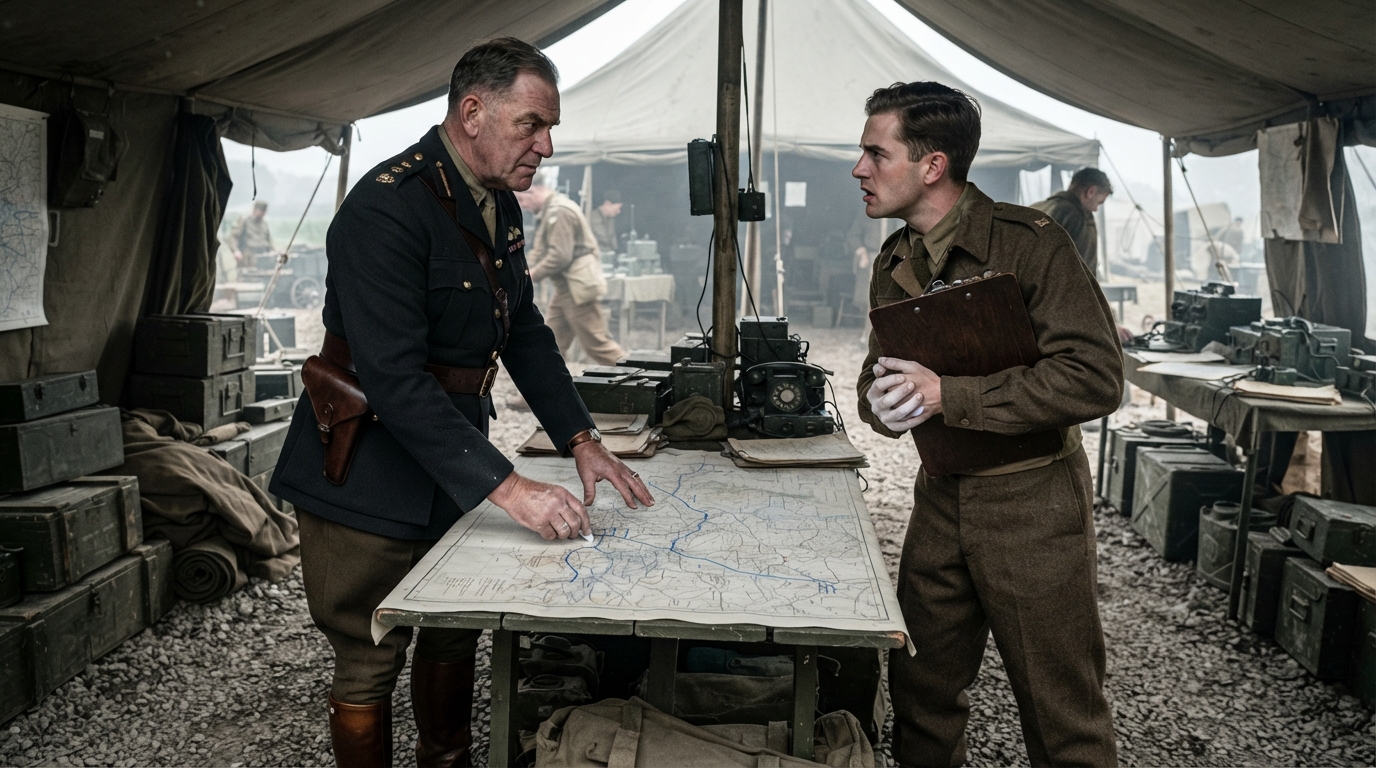
General McNaughton did not look up from the table as the fragment rolled into the groove of the wooden frame. His boots pressed hard against the floorboards, feeling the faint, rhythmic thrum of heavy engines idling in the damp morning air outside.
Every route leading out of the university town was marked in thick, deliberate strokes of blue grease pencil.
Ninety minutes to Southampton. Two hours to the chalk cliffs of Sussex.
The rails were clear, but the silence hanging over the command post felt heavier than any steel blockade.
Lieutenant James Macdonald stepped out from the doorway of the supply tent, his boots crunching sharply into the wet gravel. He held a clipboard pressed tight against his chest, his knuckles white against the dark wood.
The men had been loading the seventy-five-millimeter batteries since dawn without a single word of complaint.
Four minutes to drop a round. Six to secure the carriage.
Yet the grease pencil on the map remained frozen over an unmarked junction near Reading.
McNaughton traced the line of iron with the stub of his broken chalk, his jaw tightening as a distant whistle echoed across the yards.
The trains were ready to roll, but the paper trail authorizing their movement sat locked in an empty drawer four miles away.
James stepped closer, his breath pluming slightly in the chill June air.
—They are holding the dispatch riders at the gate again, General, he said, his voice dropping low enough to drown in the hiss of escaping steam from the locomotive yards.
McNaughton didn’t blink. He simply turned the piece of broken chalk over in his palm until the white dust coated his calloused thumb.
—Let them hold the gates, he muttered, staring past the canvas flap at the gray horizon.
The rails ran straight to the coast, and the men out there were not waiting for ink to dry before they dug their trenches.
CHAPTER 3: Whispers of Surrender in the Dark
Winston stepped out of the narrow corridor into the subterranean war room, his boots striking the stone floor with dull, flat thuds. The air inside smelled stale, thick with the scent of unvented coal smoke and cheap pipe tobacco.
Lord Halifax sat at the head of the heavy mahogany table, his manicured fingers steepled neatly beneath his chin.
The foreign secretary did not look up immediately as the prime minister approached, letting the silence stretch out like an unyielding wire.
—The French have made their position entirely clear, Winston, Halifax said, his voice dropping into a smooth, rhythmic cadence that grated against the nerves. We are standing alone against an impossible tide, and continuing this resistance is little more than a slow suicide for our remaining people.
Several men around the table nodded in quiet agreement, their eyes avoiding the direct gaze of the prime minister.
Winston felt a familiar, hot ache flare behind his temples, the heavy weight of the afternoon’s mathematical impossibilities pressing down on his chest.
—Mussolini has indicated a willingness to act as an intermediary, Halifax continued, leaning forward into the circle of yellow lamplight. A diplomatic settlement now preserves what little of the empire remains before the inevitable collapse occurs.
The suggestion hung in the damp air, offering a clean, coward’s escape from the brutal reality waiting outside the concrete walls.
Winston planted both palms flat against the scarred grain of the table, leaning his weight forward until his face caught the harsh glare of the overhead bulb.
—We did not cross oceans to negotiate terms with men who burn cities, Winston said, his voice low, gravelly, and entirely stripped of diplomatic polish.
Halifax sighed softly, smoothing the lapel of his tailored coat with an air of weary condescension.
—Stubbornness is not a military strategy, Prime Minister, and mathematics care very little for your speeches.
CHAPTER 4: The Royal Decree
King George stood motionless by the tall window, his fingers resting lightly against the polished mahogany sill while the distant rumble of city traffic filtered through the glass.
He did not turn around as Winston’s boots echoed across the parquet floor, keeping his gaze locked on the manicured lawns below where the morning mist still clung to the grass.
—I have heard reports of your cabinet meetings downstairs, Winston, the king said, his voice flat, steady, and carrying the quiet weight of absolute authority.
Winston stopped two paces short of the desk, his thumb automatically finding the dented metal casing of his pocket watch in his waistcoat.
—The foreign secretary believes prudence requires an open ear to continental mediators, Your Majesty, Winston replied, his words clipped and heavy with exhaustion.
The king finally turned away from the window, his shoulders squaring beneath his dark wool jacket as he met the prime minister’s eyes directly.
—Prudence is a convenient word for surrender when the floor gives way beneath your feet, George said, stepping closer with a sharp, decisive stride.
The silence in the room sharpened, stripping away the polite fiction that Whitehall’s politicians could legislate their way out of an invasion.
—The generals claim that parading unbloodied colonial troops through Westminster will insult our own broken regiments returning from the coast, Winston said, laying the administrative objection bare without embellishment.
The king’s jaw tightened, a faint twitch of muscle betraying his underlying fury at the cabinet’s hesitation.
—If men cross an ocean to stand guard over my capital, then my capital will look them in the eye, George snapped, his hand coming down flat on the edge of the mahogany table.
The royal decree hung in the air, instantly shattering months of bureaucratic obstruction with a single stroke of common-sense defiance.
—Prepare the route for July fourth, the king added, his voice dropping into an unyielding register that left no room for argument.
Winston felt the crushing pressure in his chest ease just enough to draw a full breath, knowing the battle lines had finally been drawn.
CHAPTER 5: March of the Defiant
Major Hastings adjusted the strap of his leather satchel, his fingers stiff against the cold brass buckle as seven thousand four hundred men fell into perfect, synchronized rows.
The gray mist clinging to the grass parted under the steady, crushing weight of boots moving with terrifying purpose.
Not a single head hung low. Not a single uniform showed the grease-stained shame of a retreat across continental sand.
Across the perimeter gates, two senior generals from the home defense command stood rigid, their arms crossed over their chests as they watched the formation lock into place.
—This public display is a direct breach of protocol, General Ironside muttered, his voice tightening into a bitter rasp as he glared past the iron rails.
The general’s jaw twitched, his face flushing a mottled gray-red at the humiliation of seeing colonial units drilling with pristine rifles while native regiments licked their wounds in silence.
—It is an insult to every soldier who swam back from the channel, Ironside snapped, turning his sharp glare toward Winston as the prime minister approached the tarmac.
Winston did not break his stride, his boots crunching heavily into the gravel path while his thumb hooked deep into his waistcoat pocket.
—They crossed an ocean when no one asked them to, Winston said, his tone dropping into a low, uncompromising growl that cut through the morning chill.
Ironside shifted his weight sharply, refusing to yield an inch of ground as the first rows of the Royal 22nd Regiment raised their bayonets in unison.
—They are peacetime amateurs playing at soldiering, and this stunt will unravel the entire command structure before the week is out, the general barked, doubling down on his absolute resistance.
Winston stopped dead in his tracks, his eyes locking onto the furious, entrenched defiance of a military establishment terrified of losing its traditional grip.
—Let them watch the streets, Winston said, signaling the lead bugler with a single, brutal flick of his wrist.
The heavy brass horns rose to the gray sky, tearing the morning silence apart with a sound that shook the very foundations of Whitehall.
CHAPTER 6: The Tide Turns East
General Halder stared across the wide mahogany table at the maps spread flat beneath the harsh bunker lights, his jaw clenched tight.
The intelligence reports from the Channel coast did not match a single pre-calculated projection of a defeated island.
Fresh battalions, fully armored and bristling with heavy mobile artillery, lined every gravel road from Oxford to the Dover cliffs.
Across the room, the high command officers shifted nervously, their pencils hovering uselessly over the invasion grids.
—The cost of a cross-channel landing has doubled since the reports from London, Halder said, his voice dropping into a flat, exhausted register.
The unyielding presence of organized, equipped defenders waiting on the beaches shattered the core assumption of an easy conquest.
A courier stepped forward from the shadows, placing a final intercepted transmission beside the inkwell with a quiet rustle of paper.
—Operation Sea Lion is postponed indefinitely, the courier murmured, reading the directive straight from the high command’s desk.
The officers stared in stunned silence as the reality of their failure settled over the concrete walls like a lead weight.
There would be no triumphant march through Westminster, no quick surrender signed in the damp London fog.
The prime minister’s gamble had held, anchored not by paper treaties, but by ordinary men who had crossed an ocean to stand in the rain.
Winston stood alone by the Whitehall window, his thumb tracing the smooth, warm metal of his pocket watch as the rain finally stopped over the city.
The heavy stone streets below were quiet, washed clean by the morning storm and free of doubt.
He pulled the watch open, watching the second hand sweep forward in a steady, unbroken rhythm.
The long night was far from over, but the door to despair had finally been bolted from the inside.
He slipped the watch back into his waistcoat and turned away from the glass to face the work waiting on his desk.