A Language of Echoes: Finding the Lost Resonance Between a Father, a Son, and a Legacy
CHAPTER 1: THE FIRST RESONANCE
The silence of the house was not an absence of sound; it was a pressurized weight. James Anderson walked the marble hallway of the West Wing, his Italian leather shoes striking the floor with a rhythmic finality that usually brought the house to heel. Tonight, the house refused to listen.
Underneath the low hum of the climate control, there it was. Tap-tap-pause-tap. A persistent, irregular staccato. It wasn’t a clock. It wasn’t a settle of foundation. It was deliberate.
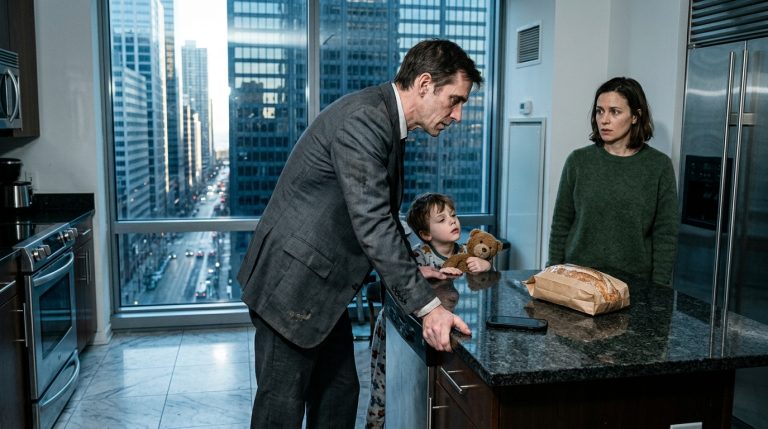
James adjusted his silk tie, the silk feeling oddly abrasive against his throat. He had just stepped off a corporate jet from Chicago, the air of the city still clinging to him, heavy with the phantom scent of high-stakes negotiations and closed deals. He had made a hundred million dollars today. He should have felt satisfied, but the house felt cold—a gallery of glass and curated stone rather than a home.
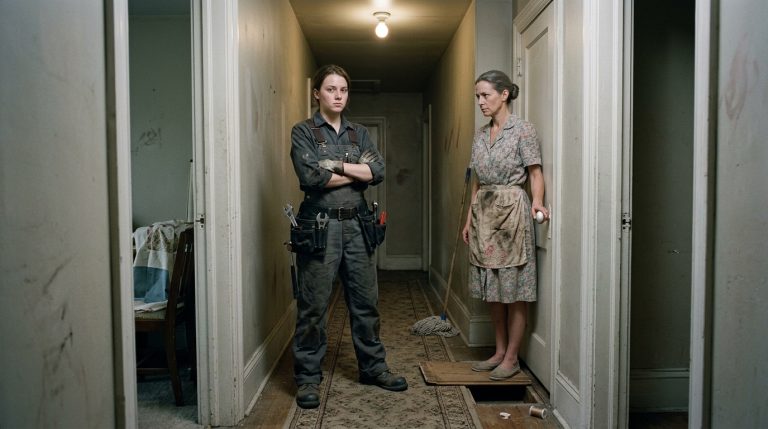
He pushed past the kitchen, where Emily Hayes was wiping down surfaces with practiced, invisible efficiency. She didn’t look up, but the rhythmic swish-swish of her cloth seemed to sync, just for a moment, with the tapping sound echoing from the old study.
James felt the familiar tightening in his chest. His seventeen-year-old son, Matthew, was failing school again. The tutors spoke of ‘profound disengagement,’ a polite term for a boy who had looked his father in the eye and offered only a sullen, empty silence. James had given him everything—a gilded cage of potential—and in return, he received the icy resistance of a stranger.
He reached the heavy oak door of the study. He didn’t knock.
The room smelled of dry paper and cold leather. When the door swung open, the scene inside halted him. Matthew was not at the desk. He was hunched on the floor, his long, awkward frame curled near an old leather armchair. Sitting opposite him on a small, worn footstool was the maid’s daughter, Sophie.
The girl’s blonde hair caught the stray light of the room. She held a polished wooden ruler in one hand and a pencil in the other. She wasn’t looking at Matthew. She was tapping the edge of the footstool with a sharp, complex cadence. Matthew, clutching a legal pad, didn’t speak. He listened, his head bowed, his hand moving in frantic, jagged lines across the paper.
It was a language of dots and dashes, a relic of a war that had nothing to do with this mansion.
“What is this?” James asked. His voice wasn’t loud, but it stripped the air out of the room.
Matthew’s head snapped up. The legal pad slid from his knee, the paper fluttering to the floor like a wounded bird. His face flushed, a deep, angry red. He didn’t look guilty. He looked trapped.
“Get out!” Matthew hissed.
Sophie didn’t move. She didn’t even flinch. She simply stopped the tapping, the sudden silence heavier than the noise had been. She turned her head slowly, looking at James with a clarity that felt like a physical probe. There was no fear in those eyes, only a quiet, unnerving acknowledgment that made James feel like a ghost in his own house.
He looked at the discarded pad on the floor. The page was covered in columns of neat, alien marks. A secret being written in the dark.
CHAPTER 2: THE KITCHEN CONFRONTATION
James did not turn away from the study. He stood in the doorway for a second longer than necessary, letting the cold, sterile air of the hallway wash over him, as if trying to scrub the phantom rhythm of the tapping from his skin. He walked, not with his usual fluid stride, but with a deliberate, heavy gait toward the kitchen. The mansion was a labyrinth of his own design, and every polished surface reflected a version of him that he was beginning to find increasingly difficult to recognize.
The kitchen was a cavern of stainless steel and industrial light. It was his sanctuary of order. Emily Hayes was standing by the central island, her hands gripping a microfiber cloth so tightly her knuckles were translucent against the fabric. The swish-swish of her previous cleaning had stopped. She was frozen in a posture of brittle obedience.
“Emily,” James said. His voice was low, contained, but it vibrated with the tension of the confrontation he had just left behind in the West Wing.
She turned. Her face was a study in controlled composure, though a single strand of blonde hair had escaped her tight bun, framing her forehead. “Mr. Anderson. You need something, sir? It’s past seven.”
“Your daughter,” James said, stepping into the center of the room. The space felt tighter than it had this morning. “She was in the study with Matthew. They were using a code. Morse code.”
The name of the language hung in the air, foreign and jagged. Emily’s brow furrowed, but the movement was measured, practiced. She did not look at him; she looked at the marble countertop, which was already gleaming. “Sir, I told her to study. She’s quiet. She likes the books.”
“She wasn’t reading,” James said, his voice rising a fraction. “She was teaching him. A rhythm. A game.”
“A game, sir?” Emily’s hands moved, a nervous, small gesture that she immediately stifled. “Sophie doesn’t play many games. She’s… observant.”
James felt the familiar, ugly surge of authority—the need to categorize, to label, to dismiss. He needed this to be a distraction. If it was a distraction, it was a problem he could solve with a check, a phone call, or a firm word. “It’s a useless, archaic habit. It’s a waste of my son’s time and, frankly, a drain on your focus. Your daughter is the maid’s child, Emily. She has a role to play in this house. Teaching my son to tap on furniture is not part of that contract.”
The words were sharp, meant to re-establish the boundary. But as he spoke, he saw the tremor in Emily’s hands. It wasn’t the tremor of a servant fearing for her job; it was the tremor of someone protecting a flame.
“It isn’t a game to her,” Emily whispered, her voice barely audible over the hum of the massive industrial refrigerator.
Before James could retort, the swinging door behind him shoved open. A junior kitchen hand, a boy barely out of his teens named Leo, burst in with a tray of fresh linens, his face bright with an oblivious, hurried energy. “Sorry, Mr. Anderson! Didn’t mean to—just getting these to the laundry room.”
The intrusion was like a needle popping a balloon. The tension that had been building—the heavy, quiet standoff between the billionaire and the woman who kept his house—evaporated, replaced by the mundane, chaotic friction of domestic labor. Leo scrambled past them, his sneakers squeaking on the polished floor, oblivious to the fact that he had just stepped into the middle of a war.
The door swung shut, the metallic thud reverberating.
James looked back at Emily. The moment of raw, vulnerable truth was gone, buried under the clatter of the boy’s arrival. But Emily hadn’t moved. She was still looking at the counter, her expression hardening into something more resilient.
“Mr. Anderson,” she said, her voice steadier now, stripped of the earlier trepidation. “If you believe Sophie is a distraction, then she will be in the kitchen. She will be doing her chores. But I cannot control what your son asks of her. He is a boy who is looking for a language he can actually understand.”
James felt a flash of cold, sharp anger. The defiance was unexpected. It wasn’t loud; it was quiet, iron-willed, and it felt like an accusation. “You are suggesting that my son doesn’t understand me?”
Emily finally looked up. Her eyes were clear, and for a terrifying second, James saw his own reflection in them—small, brittle, and profoundly isolated. “I am suggesting, sir, that you are the only one who can’t hear what he’s actually saying.”
She turned away, picking up a silver pitcher and beginning to polish it with a frantic, rhythmic intensity. The clink, clink, clink of the silver against the metal counter was a soft, mocking echo of the tapping in the study.
James stood there for a heartbeat, his hand reaching for the pocket of his suit jacket where the folded, coded paper still rested. The house felt too big, the lights too bright, and the woman in front of him suddenly seemed like the only person who knew where the exits were. He didn’t fire her. He didn’t threaten her again. He simply turned and walked out, his own footsteps sounding too loud, too heavy, and entirely out of sync with the quiet, rhythmic work behind him.
CHAPTER 3: THE LIBRARY DISCOVERY
The hallway leading to the home library felt like a descent into a different era. Unlike the West Wing, where the air was filtered and the temperature held at a precise, artificial constant, the library seemed to hold its own climate—stale, dry, and heavy with the scent of vanilla-tinged decay. James walked with a slow, deliberate cadence, his hand brushing against the cold, velvet-covered walls. He hadn’t been in here in years. It was his father’s room, a tomb of philosophy and outdated strategies that James had long ago decided were irrelevant to the world of modern finance.
He pushed the heavy mahogany door open. It groaned, a low, rhythmic sound of protest that made him wince. The room was bathed in the thin, grey light of the moon filtering through floor-to-ceiling windows, casting long, skeletal shadows across the floor. Dust motes danced in the light, swirling around the massive desk that sat in the center of the room like a sacrificial altar.
He didn’t turn on the lights. He didn’t want the harsh glare of modern electricity exposing the rot of the past. Instead, he moved toward the shelves, his eyes tracing the spines of books he hadn’t touched since he was a boy. History of the Signal Corps, 1943. Philosophy of the Common Soldier. They were lined up with obsessive, military precision.
His fingers hovered over the leather spines until they landed on a thin, dark blue volume, nestled between two thicker, gold-embossed biographies. He pulled it out. The book was surprisingly light, the cover worn down to the grain. As he slid it from the shelf, something else fell—a small, rectangular piece of cardstock, yellowed with age, that had been tucked behind the manual.
It fluttered to the floor, landing face-up in the sliver of moonlight.
James knelt, his knees popping in the silence. He picked up the card. It was a photograph, black and white, depicting two young men sitting on the edge of what looked like a wooden crate. They were thin, their uniforms ill-fitting, their eyes hollowed out by a starvation that the camera couldn’t fully capture. But it was their posture that caught him. They were sitting shoulder-to-shoulder, their hands resting on each other’s wrists, almost as if they were tethered together.
He turned the photograph over. In shaky, sprawling ink, someone had written: John and William. The silence kept us alive.
A cold chill crawled up James’s spine, sharper than any breeze from an open window. He had known his father was a veteran. He had known he served. But he had never known about John. He stared at the men in the photo, searching for a family resemblance, for a tie to his own face. He saw only a terrifying exhaustion.
He looked back at the shelf. Beside the spot where the manual had rested, there was a faint, clean rectangle in the dust—the only mark on the entire ledge. Someone had been here. Recently.
The realization tightened the knot in his stomach. He hadn’t been in this room for years, yet the dust told a different story. He looked at the floor, specifically near the foot of the desk. There, etched into the thick, dark-stained wood of the floorboards, were tiny, almost imperceptible indentations. Dot. Dash-dash. Dot.
His breath hitched. It was the same rhythm he had heard in the study—the same pattern Sophie had been tapping. Someone had been practicing here, sitting in the dark, using the same secret language of the two men in the photograph.
He leaned closer, the floorboards cold against his fingertips. The indentations were fresh; the wood hadn’t yet swelled to fill the marks. This wasn’t a relic of 1943. This was happening now.
James sat back on his heels, the photograph clutched in his hand. The library, which he had always viewed as a static repository of dead ideas, suddenly felt vibrant and dangerous. He realized with a jolt of alarm that he hadn’t just been losing control of his son; he had been oblivious to an entire history unfolding beneath his feet.
He glanced up at the photograph on the wall—the official portrait of William Anderson, smiling, clean-shaven, and utterly detached from the haggard, tethered man in the small photograph in his hand. The disconnect between the two versions of his father was a chasm, and for the first time, James felt the urge to jump across it.
He shouldn’t stay here. He should go upstairs, lock his bedroom door, and prepare for his next meeting. But the library, with its suffocating history, held him captive. He opened the blue manual. The pages were brittle, threatening to crack under his touch. Inside, tucked into the section on Rhythmic Communication, was another scrap of paper. It wasn’t just a manual; it was a diary of a shadow, a record of a friendship that had defied the laws of the prison camp and, apparently, survived the decades to arrive in his own mansion.
He heard a faint thud from somewhere upstairs—the sound of a bedroom door closing. It was Matthew. The boy was awake.
James didn’t rise. He remained on the floor, the manual open, the photograph pressed against his palm, waiting for the courage to translate what the silence was finally starting to whisper. He was no longer just the owner of this house; he was a tenant in a history he hadn’t yet earned the right to understand.
CHAPTER 4: THE MIDNIGHT TAPPING
The sound tore through the thick, stagnant air of the library like a gunshot. Clack. Clack-clack-clack. Clack. It was distinct, metallic, and impossible to ignore. James rose from the floor, his joints aching from the cold stone, the dark blue manual still clutched in his hand. He moved toward the window, pulling back the heavy velvet curtain just an inch.
Outside, the garden was a wash of monochromatic shadow. The moonlight turned the manicured lawn into a sea of silver and ink. Below, near the service entrance, a figure stood in the biting wind. It was Matthew. His son was illuminated only by the faint, clinical beam of a security light, his long frame hunched as he reached up to strike the vertical drain pipe that ran alongside the house.
James felt his heart hammer against his ribs—a rhythm that felt terrifyingly similar to the one being tapped outside. He hadn’t expected his son to be out here. He hadn’t expected the defiance to escalate so quickly, from the study to the physical walls of the estate itself.
He didn’t think. He unlocked the library’s French door and stepped out onto the terrace. The cold air hit him like a physical blow, numbing his skin and sharpening his focus. “Matthew!”
The tapping stopped instantly. The sound died, leaving a silence that was even more aggressive than the noise had been. Matthew froze, his hand still hovering near the cold metal of the pipe. He didn’t turn around immediately. When he did, his face was pale, his eyes reflecting the harsh overhead light in a way that made him look like a stranger.
“I told you,” Matthew said, his voice carrying clearly across the dew-dampened grass. “You can’t control what you don’t understand.”
James descended the terrace steps, his dress shoes sliding precariously on the slick stone. He felt ridiculous—a billionaire in a suit coat, standing in his own garden in the middle of the night, arguing with his son over a code he had spent thirty years trying to erase. But as he looked at Matthew, he saw something else. He saw the way the boy’s shoulders were braced, not in aggression, but in a kind of desperate, structural integrity. He wasn’t just being difficult. He was holding onto something that felt like his only lifeline.
“That’s enough, Matthew,” James said, keeping his voice low, trying to modulate the tremor of panic that he couldn’t quite contain. “Come inside. We can talk about this properly.”
“Talk?” Matthew laughed, a brittle sound that lacked any warmth. “You don’t want to talk. You want to audit. You want to see if my rebellion is cost-effective.” He gestured toward the apartment above the garage, where the windows remained dark and shuttered. “She’s not a line item, Dad. She’s the only person in this house who hasn’t lied to me.”
“I haven’t lied to you,” James replied, his throat tightening.
“You’ve been lying since the day I was born,” Matthew countered, his gaze dropping to the manual in James’s hand. “Why do you have that? I thought it was ‘useless.'”
James looked down at the dark blue volume. The photograph of the two men—the men who had kept their silence to survive—was still tucked inside, pressing against his palm. He felt a sudden, crushing wave of vertigo. The memory of his father’s own late-night sessions in the library, the way he would sit for hours staring at the wall, suddenly made a terrifying kind of sense. He had thought it was weakness. Now, it looked like endurance.
“I was wrong,” James said. The admission was small, barely a whisper, but it felt like the most significant thing he had ever uttered.
Matthew blinked, the hostility in his expression flickering. He clearly hadn’t expected the concession. For a moment, the only sound was the wind rustling through the pines at the edge of the property—a low, mournful sound that echoed the emptiness of the mansion behind them.
“You’re scared,” Matthew realized, his voice losing its sharp, defensive edge. He stepped away from the pipe, his boots crunching on the gravel. “You’re scared because you don’t know the code, and you know there’s a message you’re supposed to have received.”
James felt the cold bite of the night air deep in his chest. He didn’t answer. He didn’t have to. The silence stretched between them, thick with the weight of things that had gone unsaid for three decades. He looked at the garage apartment, then back at his son. He realized that the rebellion wasn’t about the code; it was about the vacuum of affection he had allowed to grow in this house. He had been so busy building an empire that he had forgotten to build a family.
“Go inside, Matthew,” James said, his voice finally finding a steady, authoritative register—not the authority of a boss, but the authority of a father who was finally beginning to understand his role. “I need to… I need to finish this.”
“Finish what?” Matthew asked, his eyes darting to the manual again.
“The translation,” James said. He walked toward the garage, his footsteps firm on the gravel, leaving his son standing in the moonlight, a silent sentinel of a secret that was slowly tearing them apart. He didn’t know what he would find, but for the first time, he didn’t care about the risk to his legacy. He cared about the resonance. He reached the door of the garage apartment, his hand hovering over the wood, and waited, listening to the rhythmic pulse of the night, waiting for the echo to answer back.
CHAPTER 5: THE DRIVE TO THE RED ROOSTER
The door to the garage apartment didn’t just open; it yielded, as if the space itself had been holding its breath. James stood on the threshold, the night air swirling around him, cold and charged with the metallic tang of the storm that was beginning to gather on the horizon. He expected to find the girl, Sophie, or perhaps Emily, huddled in the corner in a state of frightened paralysis. Instead, the small apartment was unnervingly orderly.
It was a modest space—a living area, a kitchenette, and a narrow hallway leading to a bedroom. Every surface was clean, though it bore the unmistakable mark of a life lived out of suitcases. Sophie was sitting at the small, laminate table, her back perfectly straight. She wasn’t playing with a ruler or a pencil. She was holding a small, worn-out volume that looked remarkably similar to the one James had left on his obsidian desk.
When she saw him, she didn’t jump. She didn’t look for a weapon or a place to hide. She just watched him, her eyes wide and dark, reflecting the single, flickering bulb hanging from the ceiling.
“You’re not supposed to be here, Mr. Anderson,” she said. Her voice was steady, despite the way her small fingers gripped the edges of the book.
James stepped inside, closing the door behind him. The sound of the latch clicking into place felt final, a severance of the world he had known until an hour ago. He looked at the girl, then at the book. “I found the photograph, Sophie. The one of John and William. I found the marks on the library floor.”
Sophie’s gaze flickered to the closed door, then back to him. A strange, almost imperceptible shadow passed over her face—not fear, but a weary kind of recognition. “My great-grandfather didn’t keep the code because he liked puzzles. He kept it because it was the only way to prove he had existed in that hellhole.”
“I know,” James said, his voice raw. He pulled the manual from his coat pocket and laid it on the table. “But my father didn’t keep it in his library to remember a friend. He kept it to bury the memory of who he really was. He wanted to be the Titan. He wanted to be the man who built an empire, not the boy who survived a prison camp.”
“And that’s why you’re here?” Sophie asked, standing up. “To bury it deeper?”
“No,” James said, the word coming out sharper than he intended. He looked at his own hands—the hands that had built, directed, and silenced others. “I’m here because the tapping is getting louder. Because I can’t live in a house built on a silence that isn’t mine.”
Suddenly, the front door of the apartment flew open. Emily Hayes stood there, her coat disheveled, her face flushed with a terrifying, wild intensity. “Mr. Anderson? What are you—” She stopped, her eyes darting between James and her daughter. She saw the manual on the table and her posture collapsed. She didn’t look like a maid; she looked like a woman who had been waiting for this exact, catastrophic moment for her entire life.
“He knows, Mama,” Sophie said softly.
“You don’t know anything,” Emily said, her voice shaking. She walked toward James, her movements frantic. “You think you’ve uncovered a mystery? You’ve uncovered a grave. These men, they didn’t just share a code. They shared a nightmare. John didn’t pass this down to be found by a man like you. He passed it down to remind us that we are nothing in your eyes. That we are always the ones left behind, the ones whose suffering is just the ‘noise’ you talked about.”
James felt the sting of her words, a visceral, physical pain. She was right. He had treated them as tools, as inconveniences, as things. “I’m not here to take it,” James said, his voice struggling to stay even. “I’m here to stop the noise. I’m here to figure out why my father’s silence was the loudest thing in my life.”
“You want to know why?” Emily walked until she was inches from him. Her eyes were burning with a desperate, ancient resentment. “Because your father knew that the moment he stepped out of that camp and into your world, he had to become a monster. He had to be louder than the tapping. He had to be more powerful than the memories. And in doing so, he made sure you would never have to be anything but a reflection of his own fear.”
The realization hit James like a hammer—a kinetic, brutal force that made the floor seem to tilt beneath him. He wasn’t the protagonist of this legacy. He was a byproduct of his father’s PTSD, a carefully constructed monument to a man who had been dead long before he was actually buried.
“We’re leaving,” Emily said, her voice dropping to a harsh, cold whisper. “Sophie, pack your things.”
“No,” Sophie said. She stepped between them, her small, resolute frame acting as a barrier. “He’s not the man he was this morning. Look at him, Mama. He’s listening.”
James looked at them—the woman who had carried the weight of her family’s history in silence, the girl who had dared to break it, and his son, who was standing in the doorway now, his silhouette framed by the moonlight, watching them all with an expression of shattered, youthful clarity. The escalation was complete. The decoy of “rebellion” had fallen away, leaving only the raw, exposed nerve of their shared, fractured past.
He reached out, his hand trembling, and touched the table. The wood felt cold, solid, and incredibly real. “I don’t want you to leave,” he said, his voice finally finding the weight it needed. “But I understand why you have to. Before you go, though, tell me… what was the message? The one you couldn’t keep? The one that was a burden?”
Sophie looked at her mother, who was staring at James with a mixture of terror and dawning, agonizing hope. The storm outside intensified, a low rumble of thunder vibrating through the floorboards, a physical, rhythmic precursor to the revelation that was about to shatter the last of his carefully curated life.
CHAPTER 6: THE DINER RECONCILIATION
The Red Rooster Diner was a relic of a time when the world moved at the speed of a transmission line, not the blink of a fiber-optic cable. The air inside was heavy with the smell of scorched coffee beans and a pervasive, damp-wood scent that seemed to permeate the cracked red vinyl of the booths. Outside, the rain lashed against the windows, a rhythmic, frantic percussion that felt like the code James had been trying to decipher for three days.
James stood just inside the door, the bell above it letting out a sharp, lonely ring. His tailored suit felt like a costume here—too expensive, too sharp, too detached from the reality of the linoleum floor and the humming neon sign that flickered with a rhythmic pop-hiss, pop-hiss.
Matthew was already seated in a corner booth, staring out at the rain-lashed darkness. He looked exhausted, his shoulders slumped in a way that made him look younger than seventeen. Opposite him, Emily Hayes and Sophie sat in silence. Emily held a chipped mug of coffee, her knuckles white, while Sophie was tracing patterns into the condensation on the windowpane.
James walked forward, the sound of his footsteps muffled by the worn carpet. When he reached the booth, no one looked up. He didn’t wait for an invitation; he slid into the seat opposite Emily. The booth was narrow, cramping his legs, forcing him to occupy a space that felt uncomfortably small for his stature.
“I didn’t come to force you back,” James said. His voice sounded thin, almost alien in the diner’s quiet expanse.
Emily looked at him then. Her eyes were rimmed with red, the exhaustion of the last few hours laid bare in the lines around her mouth. “You didn’t have to come at all, Mr. Anderson. My contract was clear. You fired me. We were leaving.”
“The contract is irrelevant,” James replied, his gaze shifting to the worn journal sitting on the table between Sophie and Matthew. He noticed something then, a detail that had escaped him in the frantic heat of the apartment: the journal’s binding was fraying, and a small gap appeared between pages fifty-four and fifty-five. There was a section missing—a thin, jagged strip of paper that suggested someone had been here, and they had taken the one page that might have explained why the ‘captain’ in the story never existed.
“Where is the rest of it?” James asked, his voice low, gesturing to the gap in the binding.
Sophie followed his gaze, her expression unreadable. “It wasn’t a page about the war, Mr. Anderson. It was a page about what happened when they came home. It was the part about how they tried to build a life that didn’t involve the noise. But the noise—the silence, the trauma, the Anderson name—it was already there, waiting for them.”
James felt a hollow ache in his chest. “You’ve been holding onto this for a long time,” he said to Emily. “Why? Why stay in my house, cleaning the rooms of the man who took everything from your family?”
“Because you were the only bridge left,” Emily said, her voice turning brittle. “Every day, I looked at you and I looked at your son, and I wondered if the cycle would finally break, or if you were just another gear in the machine. You think you’re in control, James? You’re just repeating a script written in 1944. You’re the captain who never got home, and your son is the prisoner who’s still trying to find the wall to tap on.”
The accusation hung in the air, heavy and undeniable. James looked at Matthew, who was still staring out at the rain. He saw his own arrogance reflected in the boy’s profile, his own cold determination, and he realized with a sickening clarity that Emily was right. He had been so focused on ‘winning’ that he hadn’t noticed he was losing the only thing that mattered.
“I don’t want the script anymore,” James whispered. He reached into his coat and produced the dark blue signal manual. He placed it on the table, not as a symbol of his power, but as a peace offering. “I don’t want to be the captain. I don’t want to be the legacy. I just want to know how to stop the noise.”
Sophie reached out and touched the cover of the manual. Her hand was small, but her presence in the booth felt massive. “You stop it by listening to the silences, not just the words, Mr. Anderson. And right now, the silence in this room is screaming.”
She looked at Matthew, then back at James. The rain surged against the roof, the rhythm of the storm a chaotic, unreadable code. James realized that the decoy secret—the rebellion, the code, the money—wasn’t the story. The story was the three of them, trapped in a diner in the middle of nowhere, waiting for a billionaire to finally stop leading and start existing.
“We’re going home,” James said, his voice finally firm, but devoid of the boardroom authority that had defined his life. “Not because I’m the boss, but because you are the only family I have left.”
Emily looked at him, her eyes searching for the lie. The neon sign flickered overhead, casting long, rhythmic shadows across the table. For the first time, James didn’t try to fill the silence with a solution or a promise. He just sat there, in the cold, drafty diner, and listened to the rain, waiting for them to tell him what came next.
CHAPTER 7: THE RETURN
The drive back to the estate had been a muted affair, the hum of the Bentley’s engine a stark contrast to the volatile energy that had filled the diner. James drove, his hands tight on the steering wheel, watching the road ahead through the sweeping arcs of the wipers. Matthew sat in the passenger seat, staring straight ahead, while in the rearview mirror, James could occasionally glimpse Emily and Sophie, two shadows silhouetted against the dim interior lights of their towed car, their faces obscured by the darkness.
When they finally rolled through the massive iron gates of the estate, James felt a sudden, sharp pang of recognition. The house—his empire, his statement, his fortress—looked different under the dying storm. The lights seemed too bright, too clinical, and the sprawling lawn appeared less like a manicured triumph and more like a vast, empty stage for a play that had long since lost its audience.
He parked in the circular drive and turned off the engine. The silence that followed was total.
Matthew stepped out of the car first, his movements stiff and cautious, as if he were walking onto unfamiliar terrain. James followed, the cold night air biting at his face. He watched as Emily and Sophie emerged from the service vehicle that had accompanied them. They stood together near the fountain, looking at the mansion. It was a picture of defiance and vulnerability all at once.
“Everything I promised,” James said, his voice carrying over the sound of the wind, “still stands.”
Emily didn’t answer immediately. She walked toward him, her gaze scanning the façade of the house. “You aren’t the same man who stood in my kitchen this morning, Mr. Anderson. I hope you know that.”
“I know,” James replied. He reached into his pocket and pulled out the set of keys to the main house. He hesitated, then pressed them into her hand. “The foundation starts tomorrow. You, Emily, will be its architect. And Sophie, Northwood is yours, if you want it.”
He looked at his son. Matthew was standing near the fountain, watching his father with an expression that was finally, tentatively, open. The anger had dissipated, replaced by a weary sort of peace.
“What about the study?” Matthew asked. “What about the code?”
James felt the weight of the dark blue manual in his pocket—a heavy, grounding presence. “The study is yours, Matthew. And the code… the code is just a way of speaking. We don’t need a secret language anymore. We just need to talk.”
They walked toward the house together, a strange, mismatched procession. As they entered the main foyer, the space felt vast and echoing. James felt a sudden urge to light every candle, to throw open every window, to fill the sterile air with the messiness of life.
He led them to the library. The door groaned open, revealing the room exactly as he had left it: the dust moes, the open manual on the floor, the photograph lying in the center of the moonlight. But as they entered, the room didn’t feel like a tomb anymore. It felt like a crossroads.
James moved to the desk and picked up the dark blue manual. He didn’t put it back on the shelf. Instead, he laid it open on the center of the desk, its pages exposed to the light for the first time in years.
“My father didn’t just keep a secret,” James said, his voice firming as he looked at them all—his son, the woman who had protected his past, and the girl who had unearthed it. “He kept a part of himself alive that he thought he had to kill to survive. I spent my life trying to perfect the version of him that he hated. That ends tonight.”
He turned to the wall and, with a single, deliberate motion, took down the framed portrait of William Anderson. The space behind it was pale, a rectangle of clean wallpaper where the portrait had protected the wall from the dust of decades. It was a physical manifestation of everything he had been trying to preserve—a hollow, empty legacy.
He set the portrait on the desk, face down. The room felt lighter, the tension finally beginning to drain away into the floorboards. But as he looked at the open journal on the desk, he noticed something he had missed: a small, handwritten note tucked into the back cover, hidden beneath the spine.
He pulled it out. It was a note from his father, dated weeks before he died. To James: The silence was not a weakness. It was the only way I knew how to protect you from the burden of the truth. If you’re reading this, the silence has finally broken. Do not try to fix the wall. Just walk through it.
James looked at the note, then at his son. He realized the resolution wasn’t in the wealth, the foundation, or the apology. It was in the act of walking through the wall he had spent his entire life building. The truth wasn’t a secret to be unlocked; it was an inheritance to be accepted.
He walked to the window and looked out at the estate. The storm had passed, leaving the world quiet and glistening under the moon. He didn’t feel like a billionaire anymore. He didn’t feel like a titan. He felt, for the first time, like a man—flawed, burdened, but finally, unequivocally, awake.
CHAPTER 8: THE OPEN STUDY
The morning sun didn’t just enter the library; it claimed it. After the long, suffocating night, the light felt cleansing, sweeping away the shadows that had clung to the mahogany desk and the heavy velvet curtains. James stood by the window, his hands tucked into his pockets, watching the estate begin its day. The groundskeeper was working near the fountain, his movements slow and measured, and in the distance, he could see Emily and Sophie walking toward the main house, their posture no longer burdened by the invisible chains of service.
The door to the study opened with a soft, natural click. It was Matthew. He stood in the doorway, hesitating for a moment, before stepping fully into the room. He wasn’t slouching. His frame, tall and awkward, seemed to have found a new center of gravity.
“It’s quiet,” Matthew said, looking around the room that had once been the site of their most painful clashes.
“It’s just quiet,” James replied, turning away from the window. “Not empty.”
He walked over to the desk, where the signal manual lay open. He didn’t pick it up. Instead, he turned to face his son, the man he was only just beginning to know. The 5-Pillar Catharsis he had been working toward wasn’t a sudden explosion; it was the steady, quiet accumulation of the last twelve hours. The payoff was the clarity of the air between them. The justice was the dismantling of the ‘Anderson’ persona that had nearly cost him his son’s life.
“I called the Board this morning,” James said. The words came out easily, devoid of the jagged edge of boardroom defiance. “I’m stepping back. The Foundation isn’t just a tax maneuver, Matthew. It’s the work now. Real work. I’m going to start by talking to the families—the ones who never got a message home. The ones who spent sixty years waiting for a tapping on the wall that never came.”
Matthew walked closer to the desk, his eyes tracing the faded dots and dashes in the manual. “You think you can fix it? The noise?”
“No,” James said, a small, genuine smile touching his lips. “I think I can learn to live with the echo. That’s enough.”
He reached into his pocket and pulled out a small, brass mending kit—a set of tools he had retrieved from the garage, the very tools he had used to try and force the door when he was angry. He laid them on the table. Beside the desk, the heavy leather armchair—the one his father had occupied for years—was missing a seam, the fabric pulled loose by time and neglect.
“Help me with this,” James said, gesturing to the chair.
It was a small, manual task, the kind he had never had the patience for. But as they sat together, the billionaire and his son, working the needle through the tough, aged leather, the tension that had defined their relationship for years simply dissolved. It was poetic justice in its quietest form: repairing the physical scars of the past to create a seat for the future.
The denouement felt like the settling of a ship after a long, turbulent voyage. The house hummed with the sounds of a new rhythm—Sophie’s laughter echoing from the kitchen, the muffled sound of Emily talking to a staff member, the rhythmic tick of the grandfather clock in the hall that James hadn’t bothered to wind in years.
He finished the final stitch and pulled the thread tight, knotting it with a steady hand. He ran his fingers over the repair. It wasn’t perfect, but it was sturdy. It would hold.
“You know,” Matthew said, his voice soft, “Sophie was right. I’m a slow learner.”
“We both are,” James said.
He leaned back, looking around the room. The portrait was still face-down on the desk, a discarded relic of a man he no longer felt the need to compete with. He had confronted the ghost of his father and found, not a monster, but a man who had tried his best in a world that didn’t allow for the truth.
James stood up, his legs steady. He walked over to the library’s French doors and threw them open. The morning breeze rushed in, carrying the scent of damp earth and blooming jasmine. It was the scent of a life that was finally growing in the light.
He heard footsteps behind him. Sophie stood there, holding a fresh cup of coffee. She didn’t say anything, but her gaze—clear, steady, and finally devoid of pity—met his. She nodded once, a small, appreciative gesture.
James looked at his son, then at the girl who had bridged the gap between his empire and his humanity. The narrative of the ‘Anderson’ name, a script he had been performing for thirty years, was officially closed. He didn’t know what the next chapter held, but as he stepped out onto the terrace and breathed in the cool, morning air, he knew one thing for certain: for the first time in his life, he wasn’t listening for a secret. He was finally, blissfully, just listening.