The Harbor We Build: A Wealthy Father’s Reckoning and the Quiet Strength of a Working Man’s Daughter
CHAPTER 1: THE BROKEN CREW
The twelfth nanny didn’t even pack her leather briefcase before she bolted down the marble driveway.
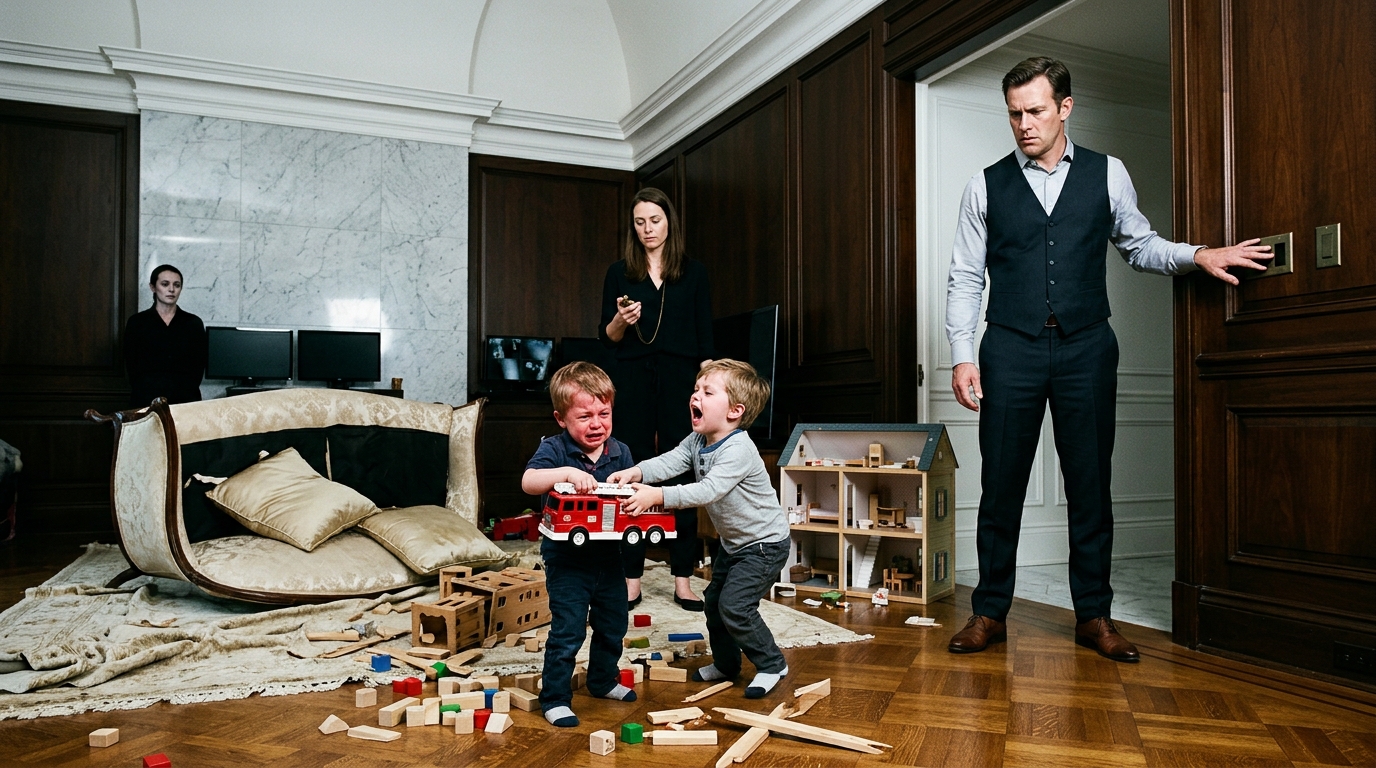
James Anderson stood in the doorway of the second-floor playroom, the heavy scent of imported cedar toy blocks hitting his throat like ash. On the floor, a massive, two-thousand-dollar tower of German oak lay splintered across the hand-woven rug. Six-year-old Leo held a heavy plastic fire truck by the ladder, his knuckles white, his face smeared with red, hot blotches of rage. Across from him, his twin brother Owen lunged, fingers clawing at the plastic chassis with a raw, guttural shriek that echoed off the twenty-foot ceilings.
“It’s mine!” Leo’s voice cracked, a small boot stamping hard into a pile of unopened books. “Get off!”
James shifted his weight, his Italian leather shoes stiff against the parquet flooring. His fingers twitched toward his vest pocket, a seasoned CEO’s instinct to check a watch, to call an assistant, to schedule a consultation with another five-hundred-dollar-an-hour specialist from Boston. But the digital security monitors on the wall behind him were dead—dark glass screens reflecting nothing but his own strained silhouette. The mainframe was down for the semi-annual server overhaul; there were no data logs to consult, no remote oversight to lean on. There was only the brutal, loud reality of two little boys turning a multi-million-dollar estate into a cage.
A soft, rhythmic clicking sound drifted from the hallway behind him.
Click. Click. Click.
James turned his head. Sarah Carter, the quiet housekeeper who had spent the last twelve months keeping her head down and her uniform immaculate, stood near the linen press. But she wasn’t the one making the noise. Beside her stood her eleven-year-old daughter, Emily. The girl wore a simple faded denim shirt, her blonde hair pulled back into a tight, no-nonsense ponytail. In her small left hand, she held a heavy, tarnished brass Navy mechanical stopwatch. Her thumb pressed the side button with mechanical regularity, the internal gears jumping in steady, quiet intervals.
Her eyes weren’t on James. They were locked on the playroom floor, tracking the chaotic arc of the fire truck as Owen finally ripped it away, leaving Leo sobbing violently against the baseboard.
“They’re not bad boys, Mr. Anderson,” Emily said, her voice dropping beneath the frequency of the crying. She didn’t look up, her thumb winding the clicking crown of the brass watch exactly three times. “They’re just lost. Their anchor is gone, so they’re making big waves to see if they can hit the shore.”
James let out a slow, heavy breath, the dry common sense of the words cutting straight through two years of clinical child psychology jargon. He crouched down slightly, the fabric of his bespoke trousers straining against his knees. “I seem to be fresh out of anchors, Emily.”
“My great-grandpa Elias was a Navy machinist,” she replied, finally looking him dead in the eye with a stillness that made the cavernous hallway feel small. “He said a ship in a storm without an anchor is just driftwood. It gets tossed until it breaks on the rocks. People do the same.”
Sarah’s hand dropped onto the girl’s shoulder, her face turning pale against the white crown molding of the hall. “Emily, hush now. Don’t bother Mr. Anderson while he’s dealing with the boys.”
“Let her speak, Sarah,” James said, his voice dropping into the quiet register he used when a corporate merger was teetering on the edge of collapse. He looked back at his sons, who were now staring through the doorway, their faces streaked with dirt and tears, arrested by the total lack of authority in the girl’s posture. “What do you propose we do then, Emily? I’ve hired the best captains in the country.”
“That’s the problem,” Emily said, stepping past her mother until her worn sneakers touched the edge of the playroom’s marble threshold. “New captains just try to steer. The crew doesn’t trust them. They just need someone to sit in the boat with them.” She held the heavy brass stopwatch against her palm, its steady ticking filling the sudden silence. “Give me one week. No titles. Just let me do it my way.”
James watched her walk right past him into the battlefield, her small frame completely unbothered by the scattered wreckage of his wealth.
CHAPTER 2: A GIFT WITH NO STRINGS
Thumb resting flat against the cold brass bezel of the Navy stopwatch, body perfectly still on the hardwood floor. Emily did not move toward the boys, nor did she pick up a single shattered block of German oak. She simply sat with her legs crossed near the dusty corner dollhouse, her eyes tracking the miniature wooden sofa she shifted an inch to the left.
Owen held the red fire truck like a weapon, his chest heaving under his monogrammed polo shirt, waiting for the lecture. Leo’s face was pressed against the mahogany baseboard, his small shoulders shaking as the final, exhausting waves of his tantrum ran out of oxygen. The grand playroom was built to impress foreign investors, not to harbor grieving children, and the cold marble borders only made their isolated crying sound louder.
James remained by the doorway, his hand hovering over a useless light switch grid that usually managed the closed-circuit monitors. Without the live feed humming in his pocket, the house felt dangerously exposed, stripped of the data he usually used to manage his life.
“I’m getting this house ready,” Emily murmured to the dusty miniature walls, her voice entirely flat, bypassing the screaming altogether. “The family that lives here, they’ve been on a long, hard trip. They’re finally coming home.”
Click.
The stopwatch jumped. Leo’s sniffing hitched. He pulled his cheek away from the baseboard, a red line pressed into his skin from the wood grain, his swollen eyes locking onto the weathered, silver-stamped spine of the book Emily had placed beside her knee. Owen lowered the plastic fire truck an inch, the heavy wheels catching the sunlight.
—What family? Owen demanded.
Emily didn’t lift her chin. “I don’t know yet. I’m still waiting for them to tell me their story.”
The silence that followed wasn’t the brittle truce the previous nannies had bought with gold star charts or tablet time. It was an empty space defined by a question. Leo dragged his socks across the floor, his movements cautious, stopping five feet from the dollhouse before dropping to his knees with a dull thud. Owen followed, the plastic truck left abandoned in the center of the splintered block tower, his fingers trailing along the edge of the dollhouse roof.
James watched from the threshold as the small, rhythmic clicks of the brass watch pulled the frantic energy out of the room, realizing he had spent two years shouting into a gale when all the crew needed was a steady hand on the deck.
CHAPTER 3: THE FORTRESS OF CUSHIONS
Velvet throw gripped tightly in Owen’s mud-stained fingers as he drags it past the pristine white sofa, the heavy fabric leaving a dark trail across the imported wool fibers. Leo hauled a thick silk back-cushion from the antique settee, his small frame straining under the weight until he dropped it with a heavy grunt against a mahogany coffee table. The pristine, multi-million-dollar symmetry of the living room was disintegrating by the second, converted into a chaotic engineering project under Emily’s watchful gaze.
James watched from the bottom of the grand staircase, his hands jammed deep into his pockets to stop himself from adjusting the lopsided arrangement. The absolute silence of the blank security monitor casing on the opposite wall reminded him that no data report would fix the mess developing on his floor.
—A fort needs an interior anchor, Emily murmured, her thumb steady against the side button of the Navy stopwatch as the internal gears clicked into place. “If the supports are soft, the whole roof caves when the wind shifts.”
Owen jammed a heavy leather-bound volume of corporate law beneath the corner cushion to keep it from slipping. The boy’s face was smeared with dust, a sharp contrast to the slick, combed-back hair he usually wore for formal family portraits. Leo was already crawling inside the dark, tight space beneath the heavy velvet roof, his breathing muffled by the thick fabric.
A sharp, metallic snap echoed from the front foyer, followed by the distinct click of high heels striking the marble floor with aggressive speed.
James stiffened as the heavy double doors swung open, admitting his older sister, Charlotte Davis, who stopped dead in her tracks, her silver monogrammed leather portfolio clamped tightly under her arm. Her perfectly manicured hand flew to her throat, her chest heaving as her eyes tracked the muddy streak running right across the center of the white Persian rug.
—Good heavens, James—she gasped, her voice sharp enough to cut the heavy, warm air in the room.—What on earth is this? It looks like a fraternity house.
James didn’t move from the base of the stairs, his face settling into a hard, exhausted mask as his sister’s familiar corporate authority invaded the space. “The boys are building, Charlotte.”
—Building? Charlotte scoffed, her heels clicking violently as she advanced toward the fortress, her eyes locking onto Emily with venomous precision.—They are six years old, James. The formative years are slipping away while you let the maid’s daughter turn your estate into a junkyard. They should be practicing their French, not wallowing in dirt.
From inside the dark hollow of the velvet cushions, Owen’s small face poked out, his eyes instantly losing their bright spark at the sound of his aunt’s voice.
CHAPTER 4: THE MUDDY ROSE
Charlotte’s sharp fingernail digging into the leather of her silver portfolio on the manicured backyard lawn, her breath coming in ragged, shallow gaps as she stared at the dirt-stained cuffs of her nephews’ expensive cotton shirts.
The three of them were down on their hands and knees in the narrow, neglected soil bed right behind the guest house. Owen held a rusty iron trowel, his small palm caked in damp dark earth, while Leo worked his fingers under a deep, stubborn dandelion root that refused to budge from the clay. Emily sat directly in the dirt beside them, her thumb resting on the cold brass button of the Navy stopwatch, its steady ticking completely ignoring the shadow stretching across the grass.
—James, look at them—Charlotte hissed, her heels driving deep into the soft sod as she spun around to face her brother.—They are doing manual labor with the maid’s daughter. This is an absolute farce. What possible methodology is this?
James leaned his shoulder against the rough brick wall of the guest house, his hands tucked inside his pockets, his gaze dropping to the dirt. With the main security monitoring deck completely dead for maintenance, he couldn’t hide behind a dashboard or split-screen metrics; he had to rely on his own eyes to measure the weight of the space.
—They’re cleaning the ground, Charlotte—James said, his voice entirely flat, missing the frantic panic his sister was trying to manufacture.
Emily moved her hand, pointing a slender finger toward the base of a wild, thorny bush struggling under a layer of dry crabgrass. “Elias used to say a garden behaves just like a ship’s crew. You have to clear out the rot and the weeds early, or the things you actually want to grow won’t have the space to breathe.”
—We want to save the roses—Owen grunted, his thumb pressing into the muddy soil with brute, messy determination, entirely ignoring the clean linen trousers his aunt had purchased for him the previous Tuesday.
Charlotte’s face went rigid, a bead of sweat breaking through her thick foundation near her temple as she pulled the monogrammed portfolio tighter against her ribcage.
—I am taking them to the city—she declared, her voice dropping into the icy, unyielding tone she used to dictate corporate compliance.—They need structure, not mud. We are leaving right now.
Leo didn’t pull his hands out of the dirt; instead, he gripped the base of the weed harder, the physical strain pulling his shoulders tight as he looked up at his father, waiting to see if the real captain was going to let the vessel be hijacked.
CHAPTER 5: THE GLASS TRAP
Charlotte’s heel frozen mid-step on the polished marble threshold of the dark living room, her eyes locked on a massive heirloom ceramic pedestal.
Before James could fully step past the entryway, his sister’s hand shot out sideways, catching the rim of the priceless grandmother’s porcelain vase. With a hard, deliberate jerk of her shoulder, she sent the antique plunging downward. The heavy ceramic shattered against the marble floor with a concussive roar, sharp shards exploding outward, scattering white dust across the dark grain of the baseboards.
Charlotte instantly dropped to the floor, drawing her knees toward her chest and clutching her forearm as if her bones were splintered, her eyes squeezing tight as she let out a piercing shriek that rattled the glass fixtures overhead.
—My arm—she screamed, a sudden mask of theatrical agony pulling her mouth wide as she pointed a shaking, manicured finger toward the hallway where Leo and Owen stood paralyzed in absolute shock.—They threw the ball! They hit me! That girl just stood there and encouraged them!
James stood entirely frozen, his eyes dropping from his sister’s writhing frame to the dead glass screen of the security terminal near the archway. The server mainframe was shut down for the scheduled maintenance window; no digital recordings were tracking the room, no instant playback could settle the friction. He was completely blind, stripped of his corporate safety net, forced to rely strictly on the sensory variables scattered right in front of his boots.
Emily stepped up from the dark corridor, her thumb pressing flat against the cold bezel of the Navy stopwatch, the internal gear jumping with a distinct, lonely click that seemed to challenge the screaming. Her gaze didn’t linger on the shards of porcelain; instead, her eyes traveled directly to Charlotte’s open monogrammed silver portfolio, where a thick, high-end Swiss boarding school brochure sat neatly tucked into the front sleeve, its glossy edges entirely unbent by the sudden fall.
—The boys didn’t throw the foam ball anywhere near you, Charlotte—Emily said, her voice dropping into a flat, icy register that cut directly beneath the theatrical sobbing.
Charlotte’s weeping stopped instantly, her jaw tightening as she glared at the maid’s daughter from the floor, her entitlement morphing into a raw, defensive snarl as she realized the trap was beginning to twist.
—You are a servant’s child—Charlotte hissed, her arm dropping from her chest as she stood up with terrifying speed, all pretense of injury vanishing from her posture.—James, look at this disaster. She is calling me a liar in your own home. You send her away this instant, or I will have the family lawyers handle this neglect before nightfall.
James looked down at the glossy Swiss brochure sticking out of the portfolio, the cold reality of the premeditated setup hitting his mind like a physical blow.
CHAPTER 6: THE TRUE ANCHOR
James’s boot pressing a sharp porcelain shard deep into the floor rug as he stands before a weathered porch swing, the tiny crushing crunch breaking the heavy silence of the evening air. He looked down at Emily, who sat with her worn denim jacket pulled tight against the chill, her thumb resting motionless on the silver rim of the Navy stopwatch.
The high-end Swiss boarding school brochure lay crumpled on the gravel driveway behind him, dropped the exact moment he had ordered Charlotte out of his house for good. His sister had screamed, weaponizing every old piece of family guilt she could muster, but the unbent paper in her portfolio had stripped her of every shred of leverage.
—I was wrong, Emily—James said, his voice dropping all corporate distance, sounding like an exhausted man who had finally checked his coordinates.—I spent two years trying to buy a new captain for the crew, when the ship just needed its father.
Emily didn’t jump off the swing; she simply watched him with those steady, summer-sky eyes, her thumb clicking the side button one final time.
Click.
The gears locked into place, the ticking stopping completely as she held the brass out toward him. “A harbor doesn’t run away from the storm, Mr. Anderson. It just stays put so the boats know where to steer when the water gets rough.”
Sarah appeared in the small doorway of the neat frame house, a quiet basket of folded laundry tucked under her arm, her posture cautious but entirely devoid of the fear that usually filled the mansion’s massive halls. James reached out, his calloused palm closing over the cold metal of the stopwatch, the weight of the tiny instrument anchoring his hands after months of frantic calculation.
Six months later, the early winter frost coated the thick wooden trellises in the backyard garden behind the guest house.
Inside the vast kitchen, the pristine white marble countertops were completely buried under a chaotic mess of spilled cocoa powder, sticky marshmallows, and three mismatched ceramic mugs. Owen stood on a sturdy wooden step stool, using a small plastic mechanical gear to aggressively churn the dark liquid, his cheeks flushed with absolute pride. Leo sat cross-legged on the floor rug right beneath the window, a bright blue streak of acrylic paint smeared across his chin as he carefully added a crooked line to a new canvas.
James stood at the stove, a stained dish towel flung over his shoulder, his deep belly laugh echoing off the tiled walls as a rogue splash of chocolate hit his linen cuff.
—Dad, the gear ratio makes the foam twice as thick—Owen shouted, his fingers gripping the plastic axle with messy, unbothered determination.
—The mess is the best part, Mr. Engineer—James replied, ruffling the boy’s hair without a single glance toward the dead, dark glass of the disconnected security monitors.
Emily sat at the rustic pine table by the pantry, her boots swinging inches above the floor, quietly paring the edge of a fresh red apple with a dull kitchen knife. The cracks in the mirror were still visible in the quiet corners of the house, but as the three of them worked together in the warm, chocolate-scented air, the lines no longer looked like wreckage. They looked like a map that had finally brought the crew back to port.