A Patchwork of Sunsets: The Journey Back to the Only Place That Ever Felt Like Home
CHAPTER 1: The Threshold
The hospital discharge papers were just a thin sheaf of white in Philip’s hand, but to Lilith, they felt like a heavy anchor being hoisted. She sat on the edge of the stiff hospital cot, her fingers tracing the faded floral pattern of the hospital gown she was discarding. It felt strange to be leaving this room, this space of sterile medicine and sharp, cold light, yet every fiber of her being felt raw, as if the last eight years of hardened shell had been stripped away by the sheer velocity of the last few days.
Victory stood by the window, clutching the small, worn sack of yams—a relic of the life they were leaving behind. She didn’t look at the bustling street outside, but at the reflection of the room in the glass, searching for something that wasn’t there.
“It’s time, Lilith,” Philip said. His voice was soft, conditioned by the new, tentative rhythm of their reunion. He stood near the door, his hands hovering in empty space, unsure of how much room to occupy.
Lilith stood up, her knees trembling slightly. She caught her reflection in the small vanity mirror hanging above the sink—pale, weary, the lines around her eyes etched with a decade of survival. She felt the phantom weight of the eyes she imagined watching her from the shadows of the hallway—Patricia’s reach was long, and even in this moment of grace, the air felt thin, like glass ready to shatter.
“I’m ready,” Lilith whispered, though her mind was still in the small, one-room apartment with the peeling paint and the leaking ceiling. She looked at Victory, who turned away from the window. The child’s face was a mirror of her own apprehension.
They walked out, the soles of their shoes tapping a rhythmic, hollow sound against the linoleum. Every nurse, every passerby, felt like a potential informant. When they reached the car, the cool, conditioned air hit Lilith’s face like a benediction. She sank into the passenger seat, closing her eyes for a fleeting second.
As Philip steered the vehicle onto the main road, the city of Lagos began to unfurl—a sprawling, chaotic tapestry of heat and movement. Lilith watched the shifting colors of the street—the sun-faded banners, the rusted edges of the roadside kiosks—and felt a sudden, sharp pang of loss.
She turned her gaze to Victory, who was staring intently at a high-end storefront passing by. The girl’s hand was resting on the sack of yams, her knuckles white. She looked up and caught Lilith’s eyes, her expression unreadable.
“Mommy,” Victory said, her voice barely rising above the low hum of the AC. “Did you leave the picture behind?”
Lilith felt her heart stutter. The photograph in the study—the one that had started this sudden, violent unfolding of their lives.
“It wasn’t ours to take, Victory,” Lilith said, though the truth sat like a stone in her throat.
“But it’s ours,” Victory insisted, her gaze shifting to her father’s profile in the driver’s seat.
Philip gripped the steering wheel, his knuckles tightening as he checked the rearview mirror, perhaps twice, perhaps three times. The reflection of the road behind them seemed to pulse with a life of its own, and for a moment, the sun glinting off the hood of a car behind them looked too much like the sharp, calculated gaze of the woman they had escaped.
CHAPTER 2: The Gilded Cage
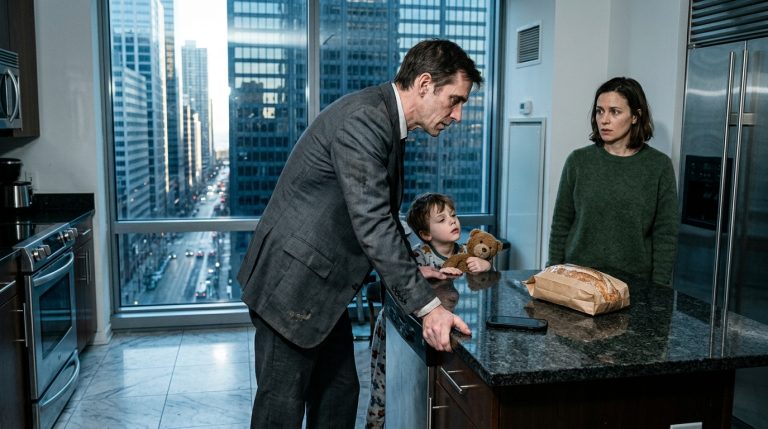
The apartment in Leki was everything Philip had promised and everything Lilith had never allowed herself to dream of. It was a sprawling space of white marble and floor-to-ceiling windows that looked out over the glittering, man-made serenity of the lagoon. There were no water stains on the ceiling, no peeling paint, and the kitchen was a landscape of gleaming steel and granite. Yet, as Lilith stood in the center of the living room, her small bag of meager belongings felt like an intrusion, a foreign object in a world of curated perfection.
“It’s safe here,” Philip said, though he seemed to be repeating the phrase for his own benefit as much as for hers. He walked over to the thermostat, adjusting it with a practiced, casual motion. “The building has private security, 24-hour monitoring. Nobody gets in unless I authorize it.”
Victory was already exploring, her footsteps muffled by the thick, cream-colored carpet. She touched the velvet cushions of the sofa, her fingers hesitant, as if she expected the fabric to evaporate under her hand. She looked back at her mother, her eyes wide, searching for the same warmth she had seen in the small, crowded room they had left behind. But Lilith found it hard to breathe. The air in the apartment tasted filtered, devoid of the grit and humidity of Lagos, and with that lack of grit came a sense of profound isolation.
“It’s beautiful, Philip,” Lilith said, and it was true, but the word felt thin.
She turned and walked toward the bedroom, her hand trailing along the wall. As she passed a small side table near the entryway, she paused. A sleek, black device, no larger than a coaster, sat near the base of the lamp. It didn’t look like a standard piece of home automation. It was too industrial, its single, tiny green light pulsing with a rhythm that felt almost like a heartbeat.
Lilith frowned, reaching out to touch it, but Philip’s voice drifted in from the kitchen, sharp and bright.
“I’ve got the pantry stocked with everything you like, Lilith. The fridge is full. You don’t have to lift a finger.”
She pulled her hand back as if burned, the sensation of being observed suddenly intensifying. She walked into the bedroom, the space cool and clinical. She sat on the edge of the king-sized bed, the mattress sinking beneath her with a sigh of luxury. She reached into her bag, her fingers brushing against the familiar, frayed fabric of her old shawl. The contrast between the two worlds was jarring, a physical dissonance that made her heart race.
She looked up, expecting to see the familiar stains on the wall, but saw only the stark, unblemished white of the ceiling. She closed her eyes, trying to focus on the sound of the ocean, but all she could hear was the faint, electronic whine of the building’s systems. It was a sound of constant surveillance, a hum that seemed to vibrate in the very floorboards.
“Mommy?” Victory stood in the doorway, clutching the sack of yams. She hadn’t left it behind, even here. It was a stubborn, ragged anchor in this sea of polish. “Why aren’t you happy? It’s nice here.”
Lilith stood up and went to her daughter, kneeling down to look her in the eye. She smoothed the hair back from Victory’s forehead. “I am happy, baby. It’s just… a lot to take in.”
“It feels like we’re hiding,” Victory whispered, looking around the expansive room with a strange, adult wisdom.
Lilith took a sharp breath. She looked toward the hallway, where Philip was busying himself with the kitchen, his posture tense, his movements rapid and slightly disjointed. He wanted so badly to be the savior, the architect of their peace. But the shadow of his mother, Patricia, seemed to linger in the corners of the room, stretched out by the very wealth he used to protect them.
“We aren’t hiding,” Lilith said, her voice stronger, though she wasn’t sure she believed it. “We’re starting over.”
She walked to the window, peering out at the horizon. The sun was beginning to dip, casting long, bruised purples and oranges over the lagoon. It was the same sunset she had seen from the hospital, the same one she had watched from the doorway of her old room, but here, it was framed by reinforced glass, insulated and distant. She felt the weight of her choice, the terrifying reality that by accepting Philip’s protection, she had stepped directly into the sphere of influence she had spent eight years running from.
She turned back to the room. The black device near the door still hummed, a tiny, glowing eye that tracked the rhythm of her breathing. She walked toward it again, her movements quiet, her intent sharp. She needed to know what it was. She needed to know if they were guests in a sanctuary, or prisoners in a gilded cage built with the best intentions and the most dangerous of ghosts.
CHAPTER 3: The Echoes
Lilith stood perfectly still, her fingers hovering inches from the slick surface of the surveillance device. She didn’t dare touch it again. The pulse of the green light seemed to accelerate, or perhaps it was just her own blood, drumming a frantic warning against her temples. From the kitchen, the clatter of silverware against porcelain sounded deafening, a sharp, metallic percussion that broke the suffocating quiet of the apartment.
“Everything alright in there, Lilith?” Philip’s voice came from around the corner. He sounded buoyed by a nervous, brittle optimism.
“Fine,” she managed to say, her voice sounding thinner than she intended. She stepped away from the table, her heart hammering. She moved toward the bedroom, her gait forced and unnatural, like someone trying to walk across a thin layer of ice. She couldn’t tell him. Not yet. If he knew that she had spotted the device, he would know that she was looking for the cracks in his fortress. And if she found cracks, what would that mean for the fragile peace they had spent the last week building?
She entered the bedroom and sat heavily on the bed. The scent of the room—a sterile, synthetic floral blend meant to evoke ‘freshness’—suddenly triggered a violent, involuntary memory. It was the smell of the hotel lobby where she had worked eight years ago, the place where Philip had first walked into her life. But beneath that memory, sharper and more intrusive, was the smell of damp earth and the sharp, metallic tang of the bus station where she had waited in the dark, fleeing for her life.
She shuddered, the cold of the room biting into her skin. Victory was sitting on the floor in the corner, playing with a small stack of books Philip had purchased. The girl looked so small, so devastatingly innocent in the middle of this pristine, white-walled cage.
Philip walked into the room, his tie loosened, his sleeves rolled up. He carried two glasses of chilled juice. He looked at her, his expression softening into that guarded vulnerability she was only just beginning to map. “You’ve been quiet since we got here. I thought this would be the start of our life, Lilith. The life we were supposed to have.”
“It’s just… a lot,” she repeated, taking the glass. The condensation on the side felt icy against her palm. “You’ve done so much, Philip. It’s overwhelming.”
“It’s not enough to make up for the time,” he said, sitting down beside her. He reached out to touch her arm, but she shifted slightly, her movement subtle but deliberate. He didn’t seem to notice—or if he did, he chose to ignore it. “I want you to be comfortable. I want you to feel like you don’t have to look over your shoulder every second.”
“And the building security?” she asked, keeping her eyes on the liquid in her glass. “Is it really that tight?”
“The best in the city,” he replied, a proud, sharp edge to his tone. “Private guards, restricted access, internal monitoring. My mother couldn’t get a letter through those doors, let alone a threat.”
Lilith looked at him, searching his face for a lie, but found only the earnest, desperate desire of a man who believed his own narrative. He didn’t know about the black coaster on the table. Or maybe, she realized with a cold, sinking feeling, he did. Maybe he had installed it himself, a layer of protection that he felt she didn’t need to know about.
“I’m going to take a bath,” she said, standing up. “Victory, come here, let me help you with your pajamas.”
As the evening wore on, the apartment transformed. The harsh afternoon light faded into the soft, indirect glow of recessed lamps. Every shadow in the room felt artificial, carefully placed. Lilith watched Philip move through the space; he walked with the confidence of someone who owned the air he breathed, yet there was a tension in his shoulders that never fully released.
Later, after Victory had finally fallen asleep, Lilith wandered back out into the living room. Philip was in the study, the door partially ajar, the glow of his computer screen spilling out onto the floor like a pale, rectangular trap. She stood in the hallway, listening.
“I don’t care what the legal team says,” Philip was saying, his voice a low, gravelly vibration. “I want them off the grid. No digital footprint. If anyone so much as whispers their names in the sector, I want a report.”
Lilith felt the blood drain from her face. She backed away, her bare feet making no sound on the floor. She retreated to the bedroom and sat in the dark, the weight of the apartment pressing down on her. The safety he offered was not a refuge; it was a containment field. They were being managed, tracked, and protected in a way that stripped them of their own history.
She reached into her bag, her hand finding the rough edge of the small, folded document she had tucked away at the very bottom, buried beneath old, stained receipts. It was the paper she had salvaged from the apartment, the one she had promised herself she would never look at. Her fingers trembled as she felt the texture of the old, brittle parchment. The truth wasn’t in the fancy, modern gadgets Philip had installed. The truth was in this, something old, something rusted, something that belonged to a past that Patricia had tried so hard to bury.
She didn’t open it. She couldn’t. Not yet. She simply held it, a secret anchor in the middle of a high-tech sea, waiting for the moment when the hum of the apartment would finally become too loud to bear.
CHAPTER 4: The Unraveling
The power flicker was barely a heartbeat—a momentary stutter of the recessed lights that left the apartment submerged in a thick, velvety blackness. Lilith held her breath, her fingers clutching the brittle document she had been harboring in the dark. For a long, suspended second, the sophisticated artificial climate of the room seemed to collapse, replaced by a sudden, biting chill that smelled faintly of ozone and old dust. Then, with a soft, electronic click, the systems groaned back to life. The lights hummed, the air circulation restarted with a hiss, and the tiny green indicator on the surveillance hub resumed its rhythmic, pulsing surveillance.
She didn’t move. She couldn’t. The proximity of the document, the way it felt in her hands—so thin, so seemingly insignificant—was overwhelming. It was the only thing in this sterile environment that wasn’t designed to be monitored, optimized, or sold.
“Mommy?” Victory’s voice came from the darkness of the doorway, thin and trembling. “The lights went out. Is it the storm?”
“It’s just a glitch, baby,” Lilith whispered, her voice steadying as she quickly tucked the document into the inner lining of her bag. She sat up, her movements stiff. “Come here.”
Victory climbed onto the bed, her small frame curling against Lilith’s side. She felt the child’s warmth, a stark contrast to the cold, polished surfaces of the room. Lilith looked toward the door. Philip was still in the study; the sliver of light beneath the door remained steady, an unwavering beacon of his focused, obsessive planning. He was out there, building a labyrinth to keep them safe, never realizing that he was building it with materials provided by the very person they were hiding from.
“I don’t like it here,” Victory murmured, her head resting on Lilith’s shoulder. “It’s too quiet. Even when the air blows, it’s quiet.”
“I know,” Lilith said. She realized then that Victory, in her eight years of life defined by the struggle for bread, had learned to listen to the world—the sounds of the market, the voices of the neighbors, the chaotic symphony of a living city. Here, the silence was manufactured, a product of exclusion and wealth. It was a silence that hid things.
She eased Victory back into the pillows and stood up. She needed to know. Not about the monitors—that was already confirmed in her gut—but about what Patricia was so desperate to hide. She walked to the bathroom, closing the door and locking it. She turned on the faucet, letting the water run to create a curtain of sound, and then, beneath the soft light of the vanity, she carefully unfolded the brittle paper.
It wasn’t a bank statement or a threat. It was a property deed, yellowed and stained with the uneven marks of age. Her eyes scanned the familiar, archaic legal script. Her pulse jumped. It wasn’t just any property; it was a survey map of the coastal tract that held the very mansion where Philip lived. And at the bottom, in faded, elegant cursive, was her own mother’s name—the grandmother she had never known.
Lilith stared at the name, her mind spinning. The mansion wasn’t just Philip’s; it was built on land that had been stolen through a legacy of silence and forced disappearance. The power, the prestige, the very walls that Patricia used to intimidate her—it was all a facade, a house of cards built on a foundation of legal theft.
She wasn’t a victim of circumstance. She was the rightful heir to the ground the antagonist stood upon.
The realization hit her with the force of a physical blow. She understood now why Patricia had been so cold, so terrifyingly focused on erasing her. It wasn’t just about bloodlines or social standing; it was about protecting a massive, illicit fortune that was never hers to keep.
She heard a floorboard creak in the hallway outside the bathroom. Her hand flew to the document, folding it with frantic, precise movements. She shoved it back into its hiding spot just as a shadow passed beneath the door.
“Lilith?” Philip’s voice was closer now. “Everything okay? The power fluctuation… I’m having the techs come by tomorrow to upgrade the stability.”
She opened the faucet wider, splashing water on her face to mask the tremors in her hands. She opened the door, her face a mask of practiced calm. Philip stood in the hallway, his face etched with a genuine, frantic concern that made her chest ache. He was a man fighting a war he didn’t even know the nature of.
“I’m fine, Philip,” she said, her voice steady. “Just a bit shaken. It’s a lot to get used to.”
He reached out, his hand cupping her cheek. His skin was warm, his thumb brushing against her jawline. “We have time,” he promised. “We have all the time in the world to make this right.”
She looked at him, really looked at him, and for the first time, she saw the vulnerability beneath his strength. He was a shield, but he was also a target. She knew then that she couldn’t tell him—not yet. If she brought this paper into the light, she would be forcing him to choose between his mother’s empire and the truth. She had to navigate this carefully, piece by piece, before the gilded cage they were living in turned into a coffin.
CHAPTER 5: The Uninvited Guest
The man was not the security Philip had promised. He didn’t wear a uniform; he wore a sharp, charcoal-gray suit that blended into the shadows of the foyer. He was holding a sleek, tablet-like interface that pulsed with the same green light as the device Lilith had found earlier. When he saw her—caught in the act of emerging from the hallway—he didn’t look startled. He looked bored.
“Mrs. Johnson,” he said, his voice flat, professional, and entirely devoid of warmth. “Please return to the master suite. There’s a system recalibration in progress.”
Lilith stood her ground, though the cold marble beneath her bare feet felt like a physical weight pulling her down. “Who are you? Philip didn’t mention any maintenance.”
The man didn’t look up from his screen. His fingers moved with practiced efficiency across the glass. “Mr. Johnson is currently occupied with his board meeting. This is a routine security sweep.”
“By whose authority?” Lilith asked, her voice steadying. She felt the heavy, brittle outline of the property deed against her leg, tucked safely in her bag, which sat on the entryway console just feet away. The realization that she was currently holding the weapon that could dismantle this man’s employer made her skin crawl with a mix of fear and electric clarity.
The man finally looked at her. His eyes were pale, devoid of any genuine humanity. He didn’t look like a guard; he looked like a data point. “By the authority of the trust, Mrs. Johnson. Please. Don’t make this difficult.”
The hum of the apartment—the artificial, filtered silence—was suddenly pierced by a sharp, high-pitched buzz emanating from the device in the man’s hand. It was the same frequency Lilith had heard during the power flicker. The lights overhead strobed once, a blinding white flash, and then the air conditioning cut out completely. The sudden absence of the hum made the silence deafening, a vacuum that sucked the oxygen out of the room.
Lilith didn’t go back to the bedroom. Instead, she took a slow, measured step toward the console where her bag sat. “Philip is the head of this household,” she said, her tone sharp, channeling the cold, hardened survivor she had been for eight years. “I suggest you tell me exactly what you’re searching for before I call him.”
The man tilted his head. “Searching? We aren’t searching, ma’am. We’re synchronizing.”
He gestured to the wall. Behind the pristine, cream-colored wallpaper, a faint glow appeared—a grid of sensors and wires, illuminated by the man’s device, spreading across the foyer like a nervous system. The apartment wasn’t just monitored; it was wired to be dismantled. Philip’s “safe house” was, in reality, a data trap designed to isolate them and harvest every piece of information they produced.
She realized with a jolt of terror that Philip had no idea. He thought he was building a cocoon; his mother was actually building a cage.
“You’re working for Patricia,” Lilith whispered, the name tasting like ash in her mouth.
The man didn’t blink. “I work for the preservation of assets. You are an unlisted variable, Lilith. And you are becoming highly volatile.”
Before she could speak, the front door—the one Philip had assured her was impenetrable—clicked open. It wasn’t Philip. It was a woman in a high-collared black coat, her movements fluid and regal. Patricia Johnson stepped into the foyer as if she were walking onto a stage. She didn’t look at the man in the charcoal suit; she looked only at Lilith.
“You have a knack for finding the wrong things, my dear,” Patricia said, her voice a calm, dangerous melody. She glanced toward the console where Lilith’s bag sat. “And you have a habit of taking things that don’t belong to you.”
The man in the suit stepped aside, his hand moving toward his jacket. Lilith’s heart slammed against her ribs. She was cornered, stripped of the illusion of safety, and standing in the very heart of the trap. But she had the deed. She had the one thing that could shatter Patricia’s hold on the land, and for the first time, she saw the flick of genuine, primal fear behind the older woman’s eyes.
“This house isn’t yours,” Lilith said, her voice ringing out in the dead, airless silence of the apartment. “And you know it.”
Patricia’s posture stiffened. She gestured to the man, and he surged forward, his hand snapping out to grab Lilith’s wrist. Lilith twisted, the momentum of her movement slamming her back against the wall, but her free hand shot out, catching the edge of the console and pulling her bag to the floor. The deed slid out, skittering across the marble, a piece of old, rusted history landing in the middle of this high-tech tomb.
Patricia froze. She looked at the paper, then back at Lilith, and the mask finally cracked. She lunged for the document, but the power in the apartment surged back to life with a violent, jarring pop, and the alarm began to scream—a shrill, rhythmic pulse that made it impossible to think, impossible to breathe, and impossible to hide the truth any longer.
CHAPTER 6: The Breaking Point
The screech of the security system was a jagged, mechanical blade slicing through the sterile air of the apartment. Lilith’s fingers scrambled against the cold marble, her nails clicking desperately as she fought to hook the edge of the property deed. The man in the charcoal suit moved with an unnatural, predatory grace, his boot heel smashing down inches from her hand, the sound muffled only by the absolute chaos of the siren.
“Get up,” he hissed, his voice stripped of the professional boredom he had worn like a mask.
Lilith didn’t look at him. She stared at the paper—that brittle, yellowed scrap of history. It felt heavier than it should, as if it held the gravitational pull of eight years of stolen life. She saw Patricia standing over her, the older woman’s face flushed with a rare, undiluted malice.
“You think a piece of paper matters?” Patricia sneered, the sound barely audible over the alarm. “That deed is as dead as your mother, Lilith. If you burn it, you’re just another ghost in the city.”
Lilith felt a flare of something hot and sharp in her chest—not fear, but a cold, crystalline resolve. She didn’t try to stand. Instead, she threw her entire body weight forward, hooking her arm around the man’s ankle and pulling hard. He grunted, his balance wavering as his polished shoe slipped on the marble.
In that micro-second of distraction, Lilith grabbed the paper. She rolled away, ignoring the sharp sting as her shoulder hit the wall, and scrambled to her feet. The apartment, once a sanctuary, now felt like a deathtrap—the walls were closing in, the grid-work of sensors flickering behind the wallpaper like a dying star.
She turned and ran. She didn’t head for the front door; she knew the guards would be there. She sprinted toward the kitchen, toward the service utility passage she had noticed during their first, terrified night.
“Catch her!” Patricia’s voice commanded, sounding distant now, eclipsed by the pounding of Lilith’s own heart.
Lilith hit the kitchen, the granite island blurred as she careened around it. Her lungs burned. She felt the phantom scent of that night eight years ago—the smell of burning rubber, the cold rain, the absolute, crushing loneliness of a woman with nothing but a child to lose. But this time, she had proof. This time, she wasn’t just a ghost.
She reached the utility door, a heavy, nondescript frame that looked like part of the cabinetry. She fumbled with the latch, her fingers slick with sweat. Behind her, the man in the charcoal suit burst into the kitchen, his breath ragged. He didn’t have his weapon drawn; he looked too confident, too sure that she had nowhere to go.
“There’s nowhere out, Lilith,” he said, stalking toward her. “The building is locked down. You’re just delaying the inevitable.”
Lilith didn’t answer. She pressed her palm against the emergency release—a small, red lever she had seen Philip point out in a careless moment during their tour. The door clicked, the heavy magnetic seal breaking with a low, pneumatic hiss.
She stumbled through, finding herself in a narrow, dimly lit service corridor. It smelled of industrial cleaner and stale ventilation air—a gritty, honest scent that made her head swim. She didn’t stop. She pushed forward, her feet pounding against the metal grating of the floor. She could hear the man chasing her, his heavy footsteps echoing in the cramped space, but she was lighter, faster, driven by the frantic, burning need to survive.
She reached a dead end—a heavy steel freight elevator. She slammed her hand against the call button, watching the light flicker. It was an agonizing, eternal crawl of seconds.
“Don’t,” the man called out, stopping at the mouth of the hallway. He wasn’t chasing her anymore. He was holding his radio, speaking into it in a low, monotone voice. “Subject is contained in Sector 4. Seal the perimeter.”
Lilith felt the floor beneath her vibrate. The elevator didn’t arrive, but the fire suppression system overhead—the very system designed to keep this cage ‘secure’—began to hiss. A fine, chemical mist began to fill the corridor, stinging her eyes and catching in her throat. She sank to her knees, the deed held tightly against her chest.
She looked up at the ceiling, at the tiny, blinking red eyes of the security sensors embedded in the steel. They were watching her. They were always watching. But as she gripped the paper, she realized that she was no longer afraid of the eyes. She was only afraid of what she hadn’t yet done. She had to get to Philip. She had to show him what his mother had built, and what she had stolen.
She closed her eyes and, for the first time in her life, she started to pray—not for safety, but for the courage to burn the cage down around them.
CHAPTER 7: The Inheritance of Silence
Lilith pushed herself up, the metallic grating of the service corridor floor biting into her knees. Her vision was blurred, the fine mist of the suppression system coating everything in a shimmering, abrasive film. She didn’t look back; she shoved the property deed deeper into the pocket of her coat, the paper crackling—a defiant, dry sound in the heavy, chemical-choked air. She had to find Philip. If he was the key to this architecture, then he had to be the one to see the cracks.
She moved with a desperate, stumbling gait, following the dim glow of the exit signs until she reached the heavy reinforced door that led back into the main residence. Her hand trembling, she swiped her wrist against the security panel. It chirped a flat, mechanical denied, but the override she’d seen Philip use—a specific, rhythmic tap-sequence he’d performed when he thought she wasn’t looking—suddenly flickered in her memory. She tapped the glass: three short, one long, two short. The lock groaned and clicked open.
She didn’t enter the study; she stood in the hallway, listening. The house was too quiet. The alarm had cut out, leaving behind a silence so absolute it felt unnatural, as if the very air were being held in suspense. She crept forward, her feet soundless on the polished marble. Through the open door of the study, she saw him.
Philip was sitting behind his massive desk, his head in his hands. The room was bathed in the harsh, blue light of a dozen monitors—a command center she had only ever seen from the hallway. He wasn’t working. He was watching a playback of the foyer, the footage playing in a silent, looping cycle of her own desperate flight.
“Philip,” she whispered.
He didn’t jump. He simply dropped his hands, his face aged by a decade in the span of a few seconds. He didn’t look at her; he looked at the screen, at the image of the man in the charcoal suit.
“She’s been watching us for years, Lilith,” he said, his voice devoid of his usual, protective fervor. “Not just for the last week. Not just since you returned. Since the day I signed the management contract for the holding company.”
Lilith stepped into the room. The air here was even colder, smelling of ozone and high-end electronics. “What are you talking about?”
“She never held my money over me,” Philip said, finally turning to look at her. His eyes were hollow, reflecting the blue glow of the screens. “She held my choices. Every investment, every move, every attempt I made to search for you—she controlled the flow of data. She didn’t have to stop me; she just had to steer me into dead ends.”
He gestured to the monitors. “This apartment isn’t a safe house. It’s an archival node. Everything we say, every breath we take, gets uploaded directly to her servers. I thought I was buying us freedom, but I was just building her a more efficient panopticon.”
Lilith walked toward the desk, her heart heavy. She reached into her pocket and pulled out the deed. She placed it on the polished mahogany, the yellowed, stained paper looking like a scar against the high-tech surface. “This is why,” she said. “It’s not about the money, Philip. It’s about the land. It’s about what she stole to build this ‘legacy’.”
Philip looked down at the paper. He didn’t touch it. He just stared at the name at the bottom, his breath hitching. “My mother told me this land was a gift from my father’s estate. She told me it was the bedrock of everything we were.”
“It’s a theft, Philip,” Lilith said, her voice soft but unyielding. “And she knew the only way to keep the land was to keep the people it belonged to from ever existing.”
He looked at her then, a profound, fractured realization dawning in his eyes. He realized that his struggle—the eight years of looking, the late nights, the defiance—had all been a choreographed performance. He wasn’t a hero in a war; he was a character in a script written by the woman he had spent his life trying to escape.
“She’s coming here,” Philip said, his voice barely a whisper. “To secure the asset. And that’s us, Lilith. We’re the assets.”
“No,” Lilith said, and for the first time, she reached out and took his hand. His skin was ice-cold. “We’re the truth. And we’re going to stop being assets.”
She heard the heavy, rhythmic thud of feet in the hallway—boots, purposeful and heavy. Patricia had arrived. The final act of the performance was beginning, but for the first time, Lilith had a prop that wasn’t in the script. She stood straight, her gaze fixed on the study door, waiting for the woman who had tried to build a kingdom on a foundation of lies.
CHAPTER 8: The Quiet Dawn
Patricia didn’t enter with a shout. She drifted into the study like a frost, the temperature in the room seemingly plummeting as she stepped between the light of the monitors and the two people who stood against her. Her gaze didn’t linger on Philip; she looked only at the deed, the crinkled piece of history that had survived eight years of forced absence.
“You really think,” Patricia said, her voice a calm, dangerous melody, “that a document from a forgotten branch of the family tree has any power in a world where I own the infrastructure, the law, and the memory of everyone who lives on this coast?”
“I don’t need the law,” Lilith said, her voice ringing clear against the hum of the cooling systems. “I just needed you to show up. You couldn’t let it go, could you? You couldn’t just let the ghost remain a ghost.”
Philip took a step forward, his shadow falling over his mother. “It’s over, Mother. Look at the monitors. Look at the data. You’ve been monitoring your own son, your own legacy, as if it were a hostile asset. You’ve turned this family into a file on a server.”
Patricia’s lips curled in a thin, joyless smile. “I turned this family into a fortress, Philip. You were too weak to build anything that would last. You wanted love; I gave you safety.”
“You gave me a cage,” Philip countered. He turned to the main console, his fingers dancing across the keys with the desperate, jagged precision of a man dismantling his own life. “And the cage is connected to the public ledger. If I push this, the history of this land—every deed, every forced relocation, every erasure of the original owners—becomes public record. It won’t just destroy the trust. It will collapse the holding company.”
Patricia’s poise finally fractured. She lunged, not for Lilith, but for the console, her manicured nails clawing at the air. But she was too slow. Philip hit the final, definitive key. The blue light of the monitors flickered, surged, and then turned a deep, steady white as the data packets were released.
The room went deathly quiet. On the screens, the private nodes were replaced by cascading lines of public, verifiable reality. The theft, the history, the names—everything was there. Patricia stood frozen, her hand suspended in the air, the cold reality of her obsolescence dawning on her. She wasn’t powerful; she was merely a person clinging to a lie that had finally run out of currency.
She turned, her face a mask of crumpled, aging desperation, and looked at Philip. “You’ve ruined everything.”
“No,” Philip said, his voice quiet, almost kind. “I’ve finished the work you started. You built a house on sand, Mother. I’m just letting the tide come in.”
She didn’t fight back. She turned and walked out of the study, her steps heavy, the regal grace of her presence stripped away, leaving behind only an old woman walking into an empty hallway.
The silence that followed was total. Philip sank into his chair, the weight of the last eight years finally settling into his shoulders. Lilith walked over to him and placed a hand on his shoulder. Outside, the first light of dawn was beginning to bleed over the horizon—a soft, golden amber that washed away the artificial blue of the room.
They spent the next hours not talking, but simply existing. Philip walked through the house, systematically turning off the monitors, disabling the sensors, and opening the curtains. He was effectively dismantling the fortress.
Later, they stood on the balcony. Victory was with them, her small hand tucked into Lilith’s, watching the city wake up. The air was cool and smelled of the coming day, of rain and salt—a real, textured world that existed beyond the filters.
Lilith reached into her bag and pulled out the old, frayed shawl she had carried through all those years of hiding. She folded it, then carefully used it to buff the edge of the balcony railing where a small scratch had marred the perfect finish. It was a small, almost meaningless gesture, but as she stood there, the sunlight warming her skin, she felt a profound sense of repair.
The mystery wasn’t about the secret—the secret was just a key. The mystery had been how to survive long enough to use it.
“What now?” Philip asked, looking at the city.
Lilith leaned against the railing, feeling the vibration of the world beneath her feet. “Now,” she said, looking at her daughter, then back at the man who had finally earned his way home, “we stop running. And we start building something that doesn’t need a fortress.”
The sun rose fully, casting long, honest shadows across the deck, and for the first time in eight years, the shadows were not something to fear—they were simply a part of the day.