The Echo of a Small Voice: How One Shattered Wedding Built a Foundation of Healing
CHAPTER 1: The Squeak on the Marble
The sound was small, a rhythmic, frantic clicking of rubber against polished stone that should have been swallowed by the swell of the string quartet. But it hit the room with the force of a tectonic shift. Three hundred guests, a sea of silk and tailored wool, froze.
Nathaniel Hawthorne felt the weight of his own life pressing down on him—the four billion dollars, the shipping routes, the woman beside him whose perfume was a soft, floral lie. He stared at the plate, his fork hovering. The boy, Elijah, stood just feet away in a white serving jacket that engulfed his thin frame. His breathing was ragged, a staccato rhythm that seemed to measure the dying music.
Camille shifted beside him. The rustle of her white silk gown sounded like a death rattle in the sudden, suffocating quiet. Nathaniel saw the boy’s eyes, wide and terrified, yet anchored by a conviction that bypassed the polite conventions of the room. He wasn’t looking at the billionaire; he was looking at the poison.
Nathaniel’s pulse spiked—a cold, rhythmic drumming in his ears. He looked at Camille. Her face was a masterclass in porcelain composure, but the corners of her mouth tightened, a micro-tremor that Nathaniel had missed a thousand times before. He had spent his life negotiating with sharks in charcoal suits, learning to read the subtle dilation of an eye or the tension in a jaw. He had read them all, yet he had been blind to the predator sitting at his own right hand.
The air in the room thickened, smelling faintly of expensive wine and the metallic tang of fear. The photographer’s shutter clicked once, a jarring, mechanical interruption that severed the last thread of pretense. Nathaniel set his fork down. The silver made a hollow, final sound against the china.
“Elijah,” Nathaniel said. His own voice sounded foreign to him—hollowed out, stripped of its usual authority.
The boy didn’t flinch. He didn’t look at the crowd, the cameras, or the woman who was currently staring at him with a gaze as sharp as a razor. He looked only at the plate, then back at Nathaniel. The information gap between them—the boy’s secret and Nathaniel’s ignorance—was a yawning abyss.
“Don’t eat it,” the boy repeated. His voice was small, but it carried the weight of a truth that no amount of money could silence.
Then, Camille moved. A single, graceful motion, she turned toward the boy, her diamond tiara catching the light and refracting it like a fractured star. Her smile was a beautiful, terrifying thing, one that didn’t reach her eyes, which remained cold, calculating, and already mourning the loss of a future she hadn’t yet secured.
Nathaniel reached out, his hand trembling just enough to be felt. He didn’t reach for his bride. He reached for the boy.
CHAPTER 2: The Weight of the Unspoken
The ballroom was a tomb of high-society etiquette. Three hundred people stood in suspended animation, their breath caught in their throats, the silence pressing against the eardrums like deep-water pressure. Nathaniel’s hand remained extended toward Elijah, a gesture that felt less like a greeting and more like a lifeline. He felt the cold shock of the marble beneath his own feet, a sharp contrast to the suffocating warmth of the estate’s lighting.
The boy, Elijah, finally reached out. His fingers were small, calloused in a way that spoke of a life far removed from the velvet-lined world of the Hawthornes. When his hand met Nathaniel’s, the contact sent a jolt of clarity through Nathaniel’s system. It was the weight of a child who knew the cost of his actions, a gravity that anchored Nathaniel to the floor.
“Sir?” Elijah’s voice was a thin thread in the vast, hollow space.
“Nathaniel,” the billionaire corrected, his voice raspy, barely audible above the low hum of the chandelier’s crystals. He turned his head, just enough to catch Camille’s reflection in the silver rim of a nearby champagne flute. She hadn’t moved. She stood like a marble statue, her features sculpted into a mask of wounded elegance, but the light hit her eyes at a new angle, revealing the sharp, predatory geometry beneath.
Nathaniel’s mind flashed to his late wife, Clara. It was a phantom memory, unbidden and cold—Clara sitting in this very parlor years ago, her eyes scanning a contract with that same hesitant flicker. ‘Check the fine print, Nathaniel,’ she had warned him, her voice a soft, faded texture in the back of his mind. ‘You look at the world and see the architecture, but you miss the rot in the joists.’
The smell of red wine reduction, sickly sweet and metallic, wafted up from the plate. It was the scent of a trap.
“Mr. Hawthorne?” The head chef, Donovan, hovered at the edge of the dais, his face a map of professional terror. He was twisting his apron, the white cotton fraying at the edges.
Nathaniel didn’t look at him. He looked at Marcus, the boy’s father, who was now crossing the room with long, measured strides. Marcus’s face was an open book of protective grief—he knew his son had just set their lives on fire, yet he stood with a rigid, desperate dignity.
“I’m here, son,” Marcus whispered, his voice a low vibration that seemed to calm the erratic pulse in the room. He reached them, his hand falling heavily onto Elijah’s shoulder. The touch was a quiet command, a grounding, a reminder of the world beyond the crystals and the silk.
“Nathaniel,” Marcus said, the name feeling heavy and unpracticed on his tongue. He looked toward the head table where Camille still stood. “We should go. The boy… he’s said what he needed to say.”
“No,” Nathaniel said, the word emerging sharper than he intended. He felt the shift—the transition from the man who managed assets to the man who was being hunted. “Not yet. We need a place that doesn’t have an audience.”
He beckoned to the family parlor, a space he had ignored for years, a room filled with the faded textures of his childhood—worn leather, dry wood, and the stale air of secrets kept in the dark. He watched as Marcus and the boy turned, their movements fluid and unhurried despite the chaos. They were survivors in a room of spectators.
As they walked, Nathaniel felt the gaze of his bride-to-be fixed on his back. It was a cold, physical pressure. She wasn’t pleading; she was calculating. He could almost hear the gears turning behind that perfect, porcelain forehead—a strategy being re-mapped, a new path through the wreckage. He didn’t look back. He followed the boy, whose polished black shoes clicked with rhythmic precision against the marble, each step a small, defiant note in the silence.
They reached the heavy oak doors of the parlor. Nathaniel pushed them open, the hinges groaning in a protest of neglect. Inside, the room was dim, illuminated only by the dying embers in the fireplace. It was a space where the world of the Hawthorne empire felt miles away.
“Sit,” Nathaniel said, gesturing toward the armchairs.
Elijah climbed into the chair, his small legs dangling, his eyes scanning the shelves of dusty books with an intensity that made Nathaniel feel exposed. He was being weighed, judged by a child who operated on the currency of pure observation.
“You did a hard thing, Elijah,” Nathaniel said, standing by the fireplace, the heat of the embers doing nothing to thaw the sudden, sharp chill in his bones.
“I did what I saw,” the boy replied.
Nathaniel felt a ghost of a smile touch his lips. He moved to the side table, his hands trembling as he poured water into a glass. He didn’t offer them anything from the kitchen; the thought of it made his throat tighten. The reality of his situation began to sink in, not as a business problem to be solved, but as a slow, corrosive erosion of his own life.
He looked at Marcus. The man was still standing, his posture rigid, eyes flickering toward the door. He was waiting for the inevitable: the security to arrive, the dismissal, the quiet eradication of their presence from the estate.
“Marcus,” Nathaniel said, his voice dropping an octave, losing its corporate polish. “You aren’t leaving. And you aren’t going to be afraid.”
Outside the room, the ballroom hummed with the sound of a thousand whispered questions, but in here, there was only the sound of a fire settling into ash and the soft, steady breathing of a boy who had just changed the trajectory of a billion-dollar legacy. Nathaniel looked at the pair—the father and the son—and for the first time in years, he saw the world not as a game of chess, but as a fragile, fraying tapestry, one he had to learn to mend with his own hands.
CHAPTER 3: The Architecture of Deception
Nathaniel led the way, his steps measured, a sharp contrast to the frantic energy that had dominated the ballroom. Marcus and Elijah followed a few paces behind, a small, quiet unit of reality moving through the gilded unreality of the Hawthorne estate. The hallway, usually a corridor of prestige adorned with portraits of ancestors whose gaze felt like an indictment, was now a gauntlet of shadows.
Every flicker of the overhead sconces felt like a spotlight on Nathaniel’s failures. He felt the weight of his own history—decades of deals, acquisitions, and handshakes—now feeling like so much brittle parchment. He had prided himself on his ability to read people, to dismantle them in negotiations, to see the rot before it turned the structure. And yet, for months, he had been breathing in the poison of his own making, blinded by the very social scaffolding he had helped build.
The East Library was locked.
The security chief, Walter, stood outside the door like a sentinel, his posture rigid. He bowed slightly as Nathaniel approached, the movement tight and professional.
“She is inside, sir,” Walter said, his voice a low monotone. “Dr. Webb is with her. She hasn’t spoken for fifteen minutes.”
Nathaniel nodded, his hand hovering over the cold, brass handle. He glanced back at Elijah. The boy stood beside his father, his dark eyes wide but alert. He wasn’t afraid. He was witnessing. It was a terrifying thought: that the innocence he was trying to protect was now the very thing dissecting his world.
“Stay here, Marcus,” Nathaniel said softly. “Elijah, you come with me.”
Marcus looked as if he might object, but he saw something in Nathaniel’s face—a desperate, fractured plea—and he gave a stiff, almost imperceptible nod.
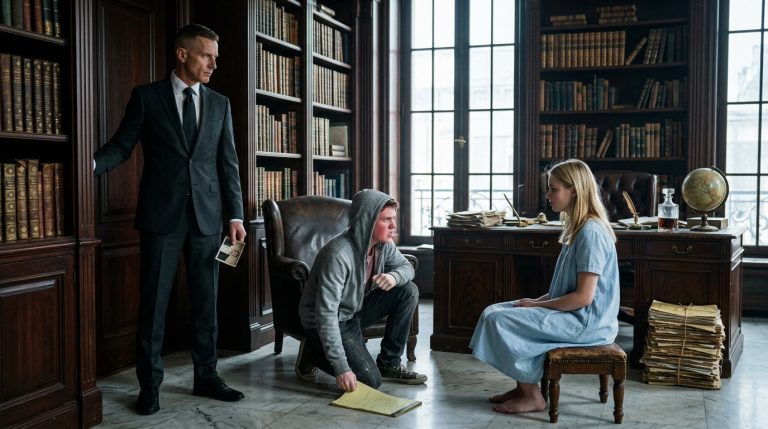
The door opened with a slow, agonizing creak. The room beyond was a cavern of history. Leather-bound spines lined the walls, absorbing the sound, creating a space where silence was a physical weight. Camille sat at the long mahogany table, her white silk dress shimmering in the dim, lamp-lit air. She looked like a ghost of the wedding that never was, her posture composed, her hands resting on the table as if they were made of porcelain.
Dr. Harrison Webb stood near the window, his silhouette stark against the moonlight. He turned as they entered, his face etched with a fatigue that made him look a decade older than he had that morning.
“Nathaniel,” Webb murmured, his eyes lingering on the boy.
Camille didn’t turn around. She remained perfectly still, a sculpture of defiance.
Nathaniel walked toward the table, the soles of his shoes finding no purchase on the polished floor. He felt a sudden, sharp spike of paranoia—a V-4 moment—where the very walls of the room felt like they were leaning in, as if the books themselves held the records of his blindness. Had he truly never seen it? Or had he, in his arrogance, simply chosen to look away?
He reached the chair at the head of the table and sat. He didn’t speak. He allowed the silence to stretch, pulling it thin until it began to vibrate.
“You’re making a mistake, Nathaniel,” Camille said, finally turning. Her voice was thin, sharp, and entirely devoid of the warmth he had spent months falling for. She didn’t look like a woman who had been caught; she looked like a strategist evaluating the next move in a game she still believed she could win. “Humiliating me in this room, in front of this… child. Do you think the press will care about a catering boy’s story when they see the cost of your breakdown?”
Nathaniel stared at her. He looked past the silk, past the diamonds, and for the first time, he saw the predator. It was a cold, clinical observation.
“The press is already at the gates, Camille,” Nathaniel said, his voice steady, though his heart hammered against his ribs like a trapped bird. “But they aren’t here for me. They’re here for the truth.”
“Truth?” She laughed, a short, dry sound that had no mirth in it. “You’ve built your life on the same foundations I have. You think you’re better than me? You just had a head start. You think this estate, this legacy, these books—they’re clean? I was just trying to balance the ledger.”
Elijah, standing by the door, took a step forward. His movement was small, but in the oppressive silence of the library, it sounded like a gavel falling. “You put the drops in the wine,” the boy said, his voice clear and untrembling.
Camille’s eyes snapped toward him. For a fleeting second, the composure faltered. Her lips parted, and in that gap, Nathaniel saw a flicker of genuine hatred—a raw, unchecked emotion that was so far removed from the ‘wounded bride’ persona that it felt like a physical blow.
“You,” she breathed, the word a curse.
Nathaniel stood up. He felt the cold, hard reality of the situation settle into his bones. This wasn’t about a marriage or a betrayal; it was about the survival of his own soul. He looked at the white pearl clutch resting on the table, a decoy of innocence that now felt like a lead weight in his stomach.
“Walter,” Nathaniel said, not turning away from her. “Call the authorities. Tell them we are ready.”
The room seemed to shrink. Camille’s hands, once steady, began to tremble. It was a subtle movement, a minute fraying of the mask, but Nathaniel didn’t look away. He was recording every detail, memorizing the texture of her downfall. The library smelled of dust, of decaying paper, and of the sharp, metallic tang of an ending that had been brewing for months in the shadows of his own house.
He didn’t need to ask why anymore. He didn’t need her justification. He only needed to see it, to own the fact that he had been standing in the center of a storm and calling it a gentle rain. The architecture of his life was collapsing, and as he stood there, watching the woman he had almost married unravel, he realized that for the first time in his life, he wasn’t trying to manage the situation. He was simply letting the truth be.
CHAPTER 4: The Shattering of the Silk
The air in the East Library changed the moment Walter Briggs exited. It shifted from the heavy, suffocating silence of a confession to the sharp, electric current of an interrogation. Nathaniel stood at the head of the mahogany table, his knuckles white as he gripped the polished wood. Opposite him, Camille sat with a stillness that was no longer composed, but paralyzed. The mask was not just cracking; it was dissolving, revealing the jagged, raw ambition he had been too blinded by his own vanity to see.
“You’re doing this because you’re afraid,” Camille said, her voice a low, raspy whisper that barely traveled across the table. Her eyes were fixed on the pearl-studded clutch. “You’re afraid that if you don’t destroy me, you’ll have to admit that you were never the one in control. You were just the mark, Nathaniel. A comfortable, predictable, wealthy mark.”
Nathaniel didn’t flinch. The V-4 paranoia had surged and receded, leaving behind a cold, clear resolve. “If that’s true, then I’m the most expensive mistake you’ll ever make.”
The library doors pushed open again, but it wasn’t Walter. It was the frantic, rhythmic clatter of heavy-soled shoes—detectives. The estate’s quiet, curated atmosphere was shattered by the arrival of the local precinct’s investigative team. They moved with a clinical disregard for the Hawthorne legacy, their flashlights cutting through the library’s dim interior like surgical blades.
The lead detective, a woman with tired eyes and a coat that smelled of wet asphalt and cigarette smoke, moved straight to the table. She didn’t look at Nathaniel’s paintings or the first editions; she looked at the silver tray and the small, brown glass bottle.
“Mr. Hawthorne,” she said, her voice brisk. She ignored Camille entirely, treating her as a solved equation. “I’m Detective Rays. I’ve been briefed on the situation.”
“He’s making a mistake,” Camille interjected, her voice rising for the first time. “He’s acting on the word of a child. My attorney is on the way, and this… this entire production will be laughed out of a courtroom.”
Detective Rays paused, glancing at Camille with the detached boredom of a woman who had heard every defense in the book. “We’ll see, Miss Devo. But right now, this room is part of a forensic site.”
The chaos escalated in a blur of motion. Forensics technicians began pulling samples from the table, their movements synchronized and efficient. The scent of ozone from the camera flashes and the crisp, aggressive rustle of official paperwork replaced the smell of old paper and lemon polish. Nathaniel watched, feeling a strange, detached exhaustion. He was the master of this house, yet he was an observer in his own library, watching as the evidence of his near-death was cataloged and bagged.
A sudden, sharp movement caught his eye. Elijah, who had been standing silently by his father near the door, stepped forward. He watched the technicians with an intensity that went beyond simple curiosity. He was watching the bottle being sealed—the physical evidence of the secret he had brought into the light.
“Detective,” Elijah said.
The lead investigator turned, surprised by the clarity of the boy’s tone. “Yes, son?”
“She had another one,” Elijah said, his voice quiet but carrying across the room.
The library went still. Camille’s face drained of all color, a sharp, sudden transformation that signaled the start of a new, more dangerous escalation.
“What did you say?” Detective Rays stepped toward the boy.
“In the kitchen,” Elijah continued, his eyes locked on Camille. “When she poured the first bottle, she dropped another one behind the rolling cart. She didn’t see it. I saw it.”
Camille bolted. It was a frantic, desperate scramble of white silk and desperation. She didn’t go for the door; she lunged for the tray, for the bottle already bagged by the technician. Her fingernails, perfectly manicured, clawed at the air as she tried to knock the evidence to the floor, to shatter it, to destroy the remaining proof of her intent.
“Stop her!” Nathaniel roared.
The room erupted. Two officers intercepted her before she could reach the table, her body hitting the floor with a dull thud. The white silk of her dress, the vision of the wedding that was never to be, became a tangled, desperate mess against the dark, polished hardwood. She didn’t scream. She fought with a cold, silent tenacity, her face pressed against the floor, her eyes locked on Elijah.
Nathaniel rushed over, his own equilibrium shattered by the sudden violence. He looked down at the woman he had spent months loving, seeing now the calculated predator who had been waiting for the exact right moment to sever his life from his empire. The decoy secret—the “freedom from patriarchy”—was utterly shredded, replaced by the ugly, undeniable truth of her greed.
Detective Rays hauled Camille to her feet, her handcuffs clicking with the finality of a prison sentence. Camille didn’t struggle anymore. She stood straight, her tiara hanging crooked, her hair loose and unkempt. She turned her gaze to Nathaniel, a look of profound, chilling clarity.
“You think this changes anything?” she whispered, the hatred finally fully realized. “You think by locking me away, you’re safe? You’re still the man who didn’t see it until a child pointed it out. You’re still the man who bought a mask and called it a wife.”
She was dragged toward the door, leaving behind the scent of her perfume, a fragrance that would forever be associated with the metallic tang of hospital-grade poison. Nathaniel remained in the center of the library, the technicians moving around him like scavengers. The room felt vast, empty, and terrifyingly cold. He had failed to protect his home, his heart, and his legacy, but he had survived.
He looked over at Elijah. The boy was standing by his father, his hand gripped tightly in Marcus’s palm. He looked tired—a nine-year-old child who had seen too much—but there was a steadiness in his gaze that Nathaniel had never possessed. The system was shattered. The pretense was gone. And as the police sirens began to wail in the distance, cutting through the silence of the estate, Nathaniel realized that the real work—the labor of building something that wasn’t just a shell—was only just beginning.
CHAPTER 5: The Weight of the Aftermath
The library had been stripped of its sanctuary status. It was now merely a room—an assembly of mahogany and leather, haunted by the lingering scent of ozone and Camille’s perfume. Nathaniel stood where she had stood, his hand resting on the back of the high-backed chair. The room felt immense, stripped of the layers of artifice he had spent months wrapping around it. The forensic team had cleared out, leaving behind only the sterile impression of their presence: empty bags, a few stray latex gloves on the floor, and the gaping absence of the pearl clutch that had held his fate.
He turned to the door. Marcus and Elijah were still there, standing in the corridor like ghosts waiting for an invitation to move. Nathaniel felt a sudden, crushing wave of exhaustion—not just the physical fatigue of a night that had spanned a decade, but the deeper, structural tiredness of a man who had finally put down a burden he hadn’t realized he was carrying.
“Marcus,” Nathaniel said. His voice echoed, thin and reedy in the vaulted space.
Marcus stepped into the room, his eyes scanning the library with a mixture of reverence and unease. “The police said we’re free to go, sir. To the room, I mean.”
“Nathaniel,” the billionaire corrected, though the word felt tired. “It’s Nathaniel.”
He looked at Elijah. The boy was staring at the spot where Camille had been pinned to the floor. He didn’t look triumphant. He looked thoughtful, his young face processing the jagged edges of a world that had tried to eat them both.
“She was really just an actor,” Elijah said quietly.
Nathaniel didn’t ask what he meant. He knew. “Yes, Elijah. She was.”
They didn’t move toward the guest rooms yet. Nathaniel walked to the window and pulled back the heavy velvet curtains. The estate grounds were a tapestry of darkness, the gardens he had meticulously maintained now appearing as a tangled thicket. The golden lights of the house, which had been designed to project an image of invulnerable, old-money stability, now looked garish and forced against the honest night.
“I have spent my life building walls, Marcus,” Nathaniel said, addressing the empty room. “I thought if I stacked the stone high enough, if I refined the exterior to a perfect shine, I would be safe from the noise outside. I wanted a life that was quiet and managed.”
“You built a castle, Nathaniel,” Marcus said, his voice measured. “But castles are designed to keep things out. Sometimes they end up keeping the wrong things in.”
Nathaniel turned away from the window. He looked at the library, the shelves lined with first editions he had never truly read, the furniture he had never truly enjoyed. It was a museum of a life he had been expected to lead, not the one he had chosen.
“I need to dismantle this,” Nathaniel said, the thought surfacing with a clarity that surprised him. “Not the estate. The way we live here. The silence. The pretense.”
“That’s a heavy job,” Marcus replied, his eyes steady.
“It’s the only job left.”
He moved to his desk and opened a drawer, pulling out a set of keys—the master set for the estate. He pushed them across the mahogany table toward Marcus.
“I don’t need a manager who keeps the house running for guests who aren’t coming back,” Nathaniel said. “I need someone who can help me take the place apart, brick by brick, until it’s something I can actually live in. Something that doesn’t feel like a cage.”
Marcus looked at the keys, then at Nathaniel. The unspoken understanding between them was the first real, unvarnished connection Nathaniel had felt in years. It wasn’t the transactional respect of a board meeting; it was the shared, heavy breath of two men who had stood in the fire and refused to burn.
“You’re sure?” Marcus asked.
“I’ve never been more sure of anything.”
Nathaniel looked down at his own hands. They were steady now, but he could still feel the phantom weight of the poison glass, the cold, smooth surface of the bottle Camille had wielded like a weapon. He wouldn’t forget. He wouldn’t let the tragedy slide into the comfortable, soft-focus myth that the estate demanded.
He walked over to where Elijah stood, his small hand still tucked into his father’s. He knelt—a difficult movement for a man who had forgotten how to be anything but upright.
“Elijah,” he said, looking the boy in the eye. “You saved my life. And I don’t mean the poison. You saved me from the life I was building. You gave me back the truth. I don’t know how to repay that.”
Elijah looked at his father, then back to Nathaniel. He reached into his pocket and pulled out a small, smooth stone—something he’d clearly picked up from the gardens earlier that day, a simple, unrefined piece of granite. He placed it in Nathaniel’s hand.
“You don’t have to repay it,” the boy said. “You just have to be different now.”
Nathaniel closed his hand around the stone. Its rough, jagged edges bit into his palm, a sharp, grounding sensation that cut through the haze of the night. He stood up, the silence of the library no longer feeling oppressive, but expansive, a blank page waiting for a story that he would finally write for himself. The estate was quiet, the world outside was waiting, and for the first time in his life, Nathaniel Hawthorne wasn’t afraid of what he would find when the sun finally rose.
CHAPTER 6: The Resonance of Truth
The sunrise arrived not with a fanfare, but with the quiet, persistent inevitability of a new season. Nathaniel stood on the terrace, the air crisp and clean, tasting of dew and damp earth. He looked out over the gardens, no longer seeing them as an ornamental barrier to be managed, but as a living, breathing space. The jagged granite stone was still clutched in his hand, its surface a constant, grounding reminder of the fragility of the peace he was finally beginning to inhabit.
Behind him, the sliding glass door opened. He didn’t turn; he knew the measured, deliberate step of Marcus.
“The cars are moving out, Nathaniel,” Marcus said, his voice low, lacking the performative deference that had defined their first few weeks. He walked to the railing and looked out toward the horizon, where the edge of the estate bled into the wilder, unmanicured landscape of the county. “The legal team is done with the final paperwork. It’s over.”
Nathaniel nodded. He felt a profound, quiet weight lift from his shoulders—not a disappearance of his history, but a settling of it. Camille’s conviction had been secured by dawn, her appeals hollow and predictably futile, and the final threads of her influence—the shadow contracts, the fabricated estate updates—had been methodically shredded.
“She tried one last thing,” Nathaniel said, the words coming out without malice. “She sent a final letter. Not to me. To Elena.”
Marcus shifted, his posture alert. “And?”
“It wasn’t a confession. It was a mirror.” Nathaniel opened his hand, looking at the smooth, rough-hewn stone. “She wrote that if I had truly loved her, I would have seen the monster because I would have recognized it in myself.”
“Is that why you’re still holding the stone?” Marcus asked.
“I’m holding it because she was right about one thing,” Nathaniel replied. “I was a man who lived in a house of mirrors. I saw only what I expected to see, and I rewarded anyone who reflected that back at me. Camille was just the most talented reflection I ever found.”
He turned to look at the estate—the sprawling, cold majesty of the Hawthorne home. It had been a tomb of expectation, but now, the windows were open, the curtains drawn back, and the air was finally circulating. The “5-Pillar Catharsis” he had promised himself was settling into reality. The antagonist was gone, dismantled by the very truth she had tried to poison. The cool down had begun, the world settling into an atmospheric, if scarred, peace.
“Where’s Elijah?” Nathaniel asked.
“Chess club preparation,” Marcus smiled, a genuine, relaxed expression that lit up his features. “He’s got a match on Saturday. He’s been studying those books you bought him. He’s got Henderson worried, Nathaniel. He’s starting to catch the tells.”
Nathaniel laughed—a sound that still felt rusty, but honest. “Good. Henderson’s been overdue for a loss.”
They moved back toward the house. Inside, the library, once a place of interrogation and deception, had been transformed. The books were being reorganized, the heavy, oppressive furniture moved to make space for a desk where Marcus could manage the new foundation.
Nathaniel walked to the center of the library and stopped before the mahogany table. He picked up a small, ornate letter opener—a silver-handled blade that had been a gift from his grandfather, a man who had built this empire on the same rigid, unforgiving principles that had almost destroyed his grandson.
He looked at the blade, then at the table, where the gouges from the police forensics team still marred the surface. He didn’t cover them. He didn’t polish them away. He placed the letter opener down, then reached into his pocket and pulled out the small, rough granite stone Elijah had given him. He placed it squarely on the center of the table, a stark, unfinished piece of nature against the dark, polished wood.
It was his symbolic closure. The empire wasn’t being dismantled, but it was being re-centered. It was no longer a vessel for status, but a base for something durable and real.
“I have a meeting with the board at ten,” Nathaniel said.
“They’re expecting a strategy on the shipping routes,” Marcus noted, standing in the doorway.
“They’ll get a strategy,” Nathaniel said, turning toward the door. “But it won’t be about routes. It’ll be about the people who chart them.”
He walked through the house, the rhythm of his own footsteps no longer sounding like an intrusion in a mausoleum, but like the steady, purposeful stride of a man returning to his life. He found Elijah in the dining room, sitting at the long banquet table with a chessboard spread out before him, studying a position with the intensity of a grandmaster. The boy didn’t look up immediately, his mind deep in the geometry of the game.
Nathaniel pulled out a chair and sat opposite him. He watched the boy move a pawn, the placement deliberate and final.
“You’re thinking too far ahead,” Nathaniel said, his voice soft. “Look at what’s right in front of you.”
Elijah looked up, his eyes meeting Nathaniel’s with an clarity that always seemed to cut through the noise of the world. “I am,” the boy said. “I’m looking at the next move.”
Nathaniel smiled, the tension in his chest finally, completely dissipating. He looked around the room—at the morning light, at the man he had come to trust, and at the boy who had saved him. The Hawthorne estate was no longer a place of shadows and secrets; it was a home, imperfect and scarred, but finally, rightfully, theirs.