The Architect of Silence: A Cold Calculation of Property, Territory, and the Price of Total Control
CHAPTER 1: THE GATEKEEPER
The air at 7,000 feet was thin enough to taste, metallic and clean. It carried the faint, dry scent of pine needles and the looming threat of the storm season. My hand remained on the gear shift, the leather cold against my palm. I watched the two men. They weren’t professionals—not really. Their vests were brand new, the nylon stiff and uncreased, and their posture lacked the weight of authority. They were just warm bodies meant to act as a physical buffer until the paperwork could catch up to the lie.
I looked past them at the gate. It was a simple structure, steel pipe and heavy-duty hinges I had welded myself three years ago, when the first hint of interest in the upper parcels began to surface. Seeing that notice zip-tied to the mesh felt like a personal insult—a smear of ink on a canvas I had spent years painting with sweat and heavy equipment.
“You’re blocking a private drive,” I said. My voice wasn’t loud, but it cut through the idling of the truck with surgical precision.
The older man, the one with the sun-weathered neck and the nervous habit of tugging at his belt, glanced at the laminated paper. “Board instruction, sir,” he repeated, his voice strained. He wasn’t looking at me; he was looking at the horizon, waiting for a signal that wasn’t coming. “We’re here until the route gets finalized.”
Finalized. The word was a poison pill, designed to sound administrative and inevitable. I shifted the truck into neutral, but I didn’t reach for the door handle. Not yet. I wanted them to feel the space I occupied. I wanted them to realize that while they were standing on asphalt that belonged to someone else, they were standing in front of a man who knew the exact depth of the gravel and the precise tension of the culvert beneath their heels.
I pulled my phone from the dash mount and held it up, the camera lens catching the light. The younger guard tensed, his hand twitching toward his vest.
“Who issued the closure?” I asked, tracking the flicker of hesitation in his eyes.
“Ms. Harmon,” the older one conceded, the name sounding small and vulnerable in the open air.
I recorded the admission, the timestamp, and the exact coordinates pinned to my GPS. Then I backed the truck up—not because I was retreating, but because I needed the angle to document their post placement. They watched me, confused, likely waiting for me to yell or throw a punch. They didn’t understand the strategy. You don’t fight a shadow by swinging at it. You fight it by exposing the lack of light.
As I pulled away, leaving them standing there in their stiff vests, a sudden, sharp realization flickered in my mind: the notice wasn’t just a threat. It was a countdown. They weren’t waiting for the route to be finalized; they were waiting for the ground to be broken elsewhere. And I realized, with a cold, hollow ache in my chest, that the gate wasn’t the target—it was just the distraction.
CHAPTER 2: THE PAPER WEAPON
The door to the cabin groaned—a sound of old pine settling into its frame—as I pulled it shut and threw the deadbolt. The click echoed, solid and absolute. Outside, the wind was picking up, rattling the loose shingles, but in here, the silence was thick, heavy, and mine.
I didn’t take off my coat. The cold from the drive still clung to my shoulders, a sharp reminder of the two men standing on my gravel, and I didn’t want to lose the edge it provided. I moved straight to the desk, the floorboards offering the familiar, rhythmic creaks that had become the background music of my life. My pulse was still steady, but my mind was moving at the speed of a landslide.
If the gate wasn’t the point, then the road was the mechanism.
I flicked on the desk lamp. The harsh, focused light cut a clean circle into the darkness, illuminating the stacks of binders that occupied the room like silent sentinels. I reached for the binder labeled ‘Construction Log: Phase 1’ and felt the weight of it in my hands. It was heavy, a tactile representation of years of labor.
I opened it. The pages were crisp, filled with meticulous notes, hand-drawn diagrams of runoff patterns, and receipts for base rock and culverts. I had built this access not for vanity, but for survival—for the absolute certainty that if the world fell apart, I could reach my own front door without needing someone else’s permission.
My gaze drifted to the wall where I kept the topographical map. I grabbed a dry-erase marker and traced the line of my road, my mind running through the math of the trench the guards were watching. It was four hundred yards upslope. A strange, illogical place for a “safety” diversion.
I stared at the map, my vision blurring slightly as I tried to force the patterns of the land to reveal the intent. Was I being paranoid? The guards had been too stiff, the notice too clean, the timing too convenient. It felt like a trap set by someone who didn’t understand that I wasn’t playing a game of real estate—I was playing a game of territory.
I felt a sudden, sharp tightness in my chest—a phantom sensation of being watched. I glanced toward the window. Outside, the darkness was absolute, a void that pressed against the glass. I knew there was nothing out there, just the trees and the long, winding descent to the HOA, yet for a split second, my grip on the marker tightened until my knuckles turned white. I could hear Celeste Harmon’s voice in my head, soft and weaponized, talking about “neighborhood resilience.”
I shook the feeling off. Paranoia was just another word for lack of data.
I pulled out the ‘Cooperation Proposal’ the HOA’s lawyer had sent. I laid it flat next to the construction logs. This was the paper weapon. I began to cross-reference their claims with my own records. Clause 4: ‘Temporary hazard controls.’ I circled it. I matched the date of that demand against my own log for the installation of the drainage pipes in the turnout.
The dates were off. They weren’t using the road because of wildfire season; they were using the excuse of fire safety to occupy the land before I could legally challenge their claim to the drainage rights. They weren’t just trying to move the gate; they were trying to control the water. Whoever held the drainage rights held the keys to the entire slope.
I picked up my phone and opened the digital folder where I stored the drone footage. I scrolled back, frame by frame, looking for the contractor’s staging area. There, in the corner of a high-resolution shot, was a survey stake marked with a symbol I didn’t recognize—a small, red ‘X’ within a circle.
I had seen that mark before.
I stood up and moved to the shelf, pulling down a file of old property records from the county. I thumbed through them, the smell of dust and stagnant air rising from the paper. I found the original filing for the Aspen Veil expansion, a document I had ignored years ago because it didn’t concern my parcel.
I found the signature at the bottom of the development permit. It wasn’t the HOA board. It was a holding company—’Harmon & Associates.’ Celeste’s family name.
The silence in the cabin suddenly felt much colder. It wasn’t just a move to share a road. It was a commercial expansion disguised as a community service. She wasn’t an HOA president protecting her neighbors; she was a business owner clearing the path for a construction project that required my property to make the math work for a, most likely, lucrative drainage contract with the county.
I sat back, the chair groaning under the shift in weight. The pieces were locking together.
I reached for my phone and started a new log: Date: July 17. Subject: Intent identified.
I didn’t feel relief. I felt a cold, hard sense of purpose. I had the records, the history, and now, the motive. The “Paper Weapon” was no longer just a legal defense; it was a target. I grabbed my camera and a fresh roll of film, my movements precise and deliberate. I was going back out. I didn’t need to yell or fight. I just needed to see the survey stakes with my own eyes, to capture the exact, undeniable evidence of where their ‘community’ project stopped and my property line began.
I stepped back into the coat I had just taken off, the fabric cold and stiff. The cabin was a sanctuary, but the truth wasn’t in here. It was buried in the dirt four hundred yards upslope, waiting for me to dig it up. I walked to the door, checked the locking mechanism one last time, and stepped out into the night, the darkness no longer feeling like a void, but like an ally.
CHAPTER 3: THE POISONED NEGOTIATION
The air outside the cabin hit like a physical weight, dropping several degrees since I had stepped inside. I didn’t rush. The darkness under the tree canopy was absolute, save for the narrow, piercing beam of my headlamp that cut through the needles and swirling mist. Every footfall was deliberate, the gravel crunching under my boots—a sound that felt amplified in the quiet, as if the mountain itself was listening to my intrusion.
My hand checked the bag over my shoulder, ensuring the camera was secure and the spare lenses were buffered against the vibration of the climb. I wasn’t just walking; I was measuring the distance, marking the slope in my mind. Every change in elevation, every shift in the drainage angle, was a piece of information.
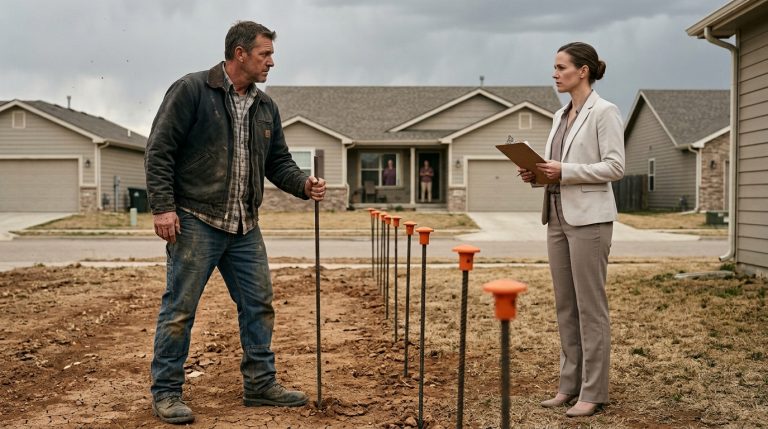
I reached the site of the contractor’s staging area in silence. The trench was a jagged, raw wound in the earth, its edges already beginning to slump in the damp night air. I stepped carefully, avoiding the mud that would betray my presence if someone were looking for footprints, and knelt beside the steel pedestal that had been the subject of my earlier, fleeting observation.
The survey stake was exactly where I remembered it.
I pulled the ‘Cooperation Proposal’ from my inner coat pocket. The paper was stiff, the ink dark and authoritative, but here, in the cold mud, it looked like what it was: a bluff. I checked the language again, using the headlamp to scan the small, dense text of the ‘hazard controls’ section. It was a masterpiece of obfuscation—shifting legal responsibility onto me while granting them the ‘operational discretion’ to move the earth as they saw fit.
I traced the line of the trench with my finger, then looked at the stake. Then I looked at the legal text again. There was a discrepancy. The proposal explicitly mentioned the ‘North Drainage Corridor,’ but the stake in front of me was planted squarely on the ‘East Turnout.’ They weren’t just moving dirt; they were building a foundation for a legal argument that didn’t exist in the physical reality of the slope.
A twig snapped in the distance—a sharp, high-pitched crack that sent a jolt of pure adrenaline through my spine.
I went still. I became part of the landscape, my breathing slowed to a rhythmic, shallow cycle that wouldn’t betray me. I watched the treeline. Minutes passed, the cold seeping through my coat, but no one appeared. It was likely just the wind, or a deer shifting in the brush, but in this atmosphere, it was a warning. The ‘poisoned negotiation’ wasn’t just a legal maneuver; it was the beginning of an occupation.
I pulled out the camera, the shutter click sounding like a gunshot in the stillness. I took the photos—one of the stake, one of the trench, one of the geographic markers that proved this was my parcel. I didn’t linger. The data was the victory. I turned and began the descent, my boots finding the firm ground I knew by heart, the weight of the camera bag no longer just equipment, but a collection of facts.
Back at the truck, I didn’t start the engine. I sat in the darkness, the cab smelling of old oil and dry upholstery. I pulled out my phone and drafted an email to my attorney, but I didn’t send it. Not yet. I wanted to see the lawyer’s face when he realized that the HOA’s ‘hazard’ claim was physically impossible given the drainage angle of the slope.
I reached into the glove box and pulled out a small, worn leather notebook—my own, not theirs. It contained the real history of the road, a list of every load of base rock, every hour spent with the skid steer, every culvert placed. I turned to the final page and wrote: ‘They think they’re buying time. They’re actually buying a record of their own fraud.’
I looked out the windshield. The first hint of dawn was bleeding into the sky, a thin, bruised purple light that revealed the silhouette of the mountain. It was mine, but it was being pulled out from under me, one fraudulent page at a time. The ‘cooperation proposal’ sat on the passenger seat, the edges already curling slightly in the humidity. I knew what I had to do. I wouldn’t decline the offer with a simple letter. I would decline it with a correction—a technical, legal, and physical dismantling of their reality that would leave them no room to maneuver.
I started the truck, the engine roaring to life and shattering the dawn silence. The strategy was set. The ‘decoy’ of the fire safety route had served its purpose. Now, it was time to move the target onto the drainage rights, where they were most vulnerable. I pulled the truck onto the track, the tires biting into the gravel, and began the long drive down. Every bump, every turn, was a confirmation: I was the one who built this, and I was the one who would decide when the story ended.
CHAPTER 4: THE DECOY UNMASKED
The engine cut out in front of the brick-faced building in the valley, the silence of the street feeling suddenly heavier than the mountain air. This was the headquarters of the firm linked to Celeste’s brother-in-law—the place where lines on a map were moved with a mouse click and where reality was systematically rewritten. I didn’t get out immediately. I watched the front entrance, the reflection of the morning light off the glass panels obscuring the interior like a one-way mirror.
My hand rested on the manila folder sitting on the passenger seat—the ‘corrected’ evidence. If I was right, this place was the engine room of the fraud. I stepped out of the truck, the soles of my boots hitting the pavement with a sound that felt alien compared to the gravel of my own road. The city atmosphere was sterile, smelling of ozone and exhaust.
I walked into the lobby. A receptionist in a suit that cost more than a load of base rock looked up, her expression a programmed mask of professional indifference.
“I have an appointment,” I said. I didn’t, but the lie felt like the right key to open the door.
“Name?”
“The Aspen Veil Road Committee. I’m here regarding the drainage corridor project.”
The word ‘drainage’ acted like a flare. She hesitated, her hand hovering over a phone. I didn’t give her time to verify. I walked past the desk, ignoring her protest, and headed straight for the hallway marked ‘Planning & GIS.’ I knew the layout from the public records I’d spent all night cross-referencing. My pulse was a steady, rhythmic thrumming in my ears, not of panic, but of calculated precision.
I reached the door of the lead consultant, the nameplate matching the one on the metadata files I’d pulled from the exhibit. I didn’t knock. I pushed the door open.
The man inside was hunched over a backlit drafting table, his face illuminated by a glow that cast long, distorted shadows against the office wall. He looked up, his eyes widening in confusion before sliding toward annoyance. “You’re not supposed to be here.”
“I’m here to talk about the ‘historic reliance’ of my road,” I said, my voice quiet, flat. I walked over to the desk and dropped the folder on top of his monitor, the impact a dull thud.
He didn’t look at the folder. He looked at me, and in that split second, I saw the flicker of recognition. He knew who I was. And more importantly, he knew that the documents in that folder—the overlay of the GIS files against the original construction logs—would finish his firm’s reputation.
“You’re making a mistake,” he said, his voice regaining its professional polish. “We’re working on the county’s behalf to ensure infrastructure safety.”
“You’re working for the Harmon family,” I corrected, leaning over the table. “I have the metadata from the exhibit you submitted to the county hearing. I know you moved the lines. I know you carved a ‘shared’ corridor out of a private parcel because it was cheaper than engineering a proper solution around my property.”
He stood up, his chair clattering backward. His gaze darted to the door, checking for security, but the hallway remained empty. The V-3 detour had worked; I had bypassed the secretaries and the gatekeepers and forced the architect of the fraud into a corner where his professional mask couldn’t hold.
“If you go to the board with this,” he began, his voice dropping into a conspiratorial register, “you’re going to destroy a project that benefits everyone on that mountain. We can adjust the corridor. We can negotiate a secondary easement—”
“I’m not here to negotiate,” I said. “I’m here to tell you that the county inspector is already on his way to this building. He’s going to want to see the original source files for that exhibit. Not the copies. The original. With the timestamps.”
The color drained from his face. It was the “defection” moment I had gambled on. He wasn’t the mastermind; he was just the technician, and he had too much to lose to burn for Celeste’s ambition.
I walked to the door, leaving the folder on his desk. I didn’t need to stay and watch him decide. I knew the look of someone who had just realized their leverage had evaporated. I stepped back out into the hallway, the receptionist staring at me with a mix of shock and confusion, but I didn’t stop. I walked through the lobby and out into the bright, harsh sunlight of the morning.
My legs felt heavy as I reached the truck, the adrenaline finally beginning to subside. The “decoy” secret—the idea that this was just a simple, misguided community safety project—was effectively dead. What remained was the raw, ugly truth of the Harmon connection. I started the truck, the engine turning over with a familiar, mechanical growl.
The next step would be the hearing, but the dynamic had shifted. I wasn’t just defending my property anymore; I was now the one who had dismantled the entire framework of their defense before they’d even had a chance to present it. I drove away from the building, the road ahead stretching out toward the mountain, feeling the shift in the air. The trap hadn’t just been avoided; it had been turned inside out. I looked at the rearview mirror, checking for anyone following, my eyes narrowing at the road behind me. The escalation was complete, and now, there was nowhere left for them to hide.
CHAPTER 5: THE PAPER SIEGE
The courthouse hallway was a sensory vacuum, stripped of warmth and color. The air smelled of floor wax and stale, recirculated oxygen, a sharp contrast to the grit and pine of the mountain. I walked down the corridor, my boots clicking against the linoleum, each step resonating with the finality of what I carried. In my briefcase was the packet I had spent the last forty-eight hours perfecting: the GIS overlays, the original construction logs, and the sworn statement from the consultant who had finally chosen self-preservation over collusion.
Celeste Harmon stood near the hearing room door, her silhouette framed by the harsh, overhead lighting. She wore a tailored charcoal blazer, her posture a masterpiece of practiced composure. Even from twenty feet away, I could see the tension in her jaw—a microscopic crack in the facade. She had expected to walk into this hearing and cement her administrative theft with a wave of a hand. She didn’t expect the paper siege I was bringing to her door.
I didn’t acknowledge her. I didn’t need to. The conflict had moved beyond the need for words or performative gestures. As I passed her, I felt the phantom weight of a heavy steel shovel in my hands—a memory of the first day I had broken ground on the road years ago. Back then, the sweat had been honest, the labor clear-cut and sovereign. Now, the labor was legal, but the exhaustion was the same. The memory anchored me; it reminded me that the road wasn’t just a strip of asphalt or gravel, but the physical boundary between my autonomy and the world that wanted to own it.
My attorney, a man whose silence was as sharp as a scalpel, signaled from the doorway. He had already laid out the exhibits on the mahogany table inside. I entered the hearing room, the door clicking shut behind me, sealing the vacuum. The county planner was already there, looking over the documents with a furrowed brow. Celeste’s lawyer followed, his face pinched, his hands clutching a file that looked significantly thinner than mine.
The hearing was a blur of tactical exchanges. I sat, listening to the monotonous drone of legalese, but my mind was elsewhere. I was calculating the timing of the next move. Celeste took the stand, her voice steady, weaving a narrative of “community emergency” and “public safety.” She was good—calculated, poised, and utterly devoid of the messy truth. But she didn’t know that the consultant had already spoken.
When my attorney opened the second packet—the one detailing the illicit drainage contract and the specific, engineered deception of the survey lines—the room’s climate shifted. The county planner stopped mid-sentence. He looked at the overlay, then at the original build records, then finally at Celeste.
I watched her. For the first time, I saw the predator-prey dynamic flip. She wasn’t leading the narrative anymore; she was being dragged along by the weight of her own paper. She looked toward the back of the room, perhaps searching for an ally, but found only the cold, hard reality of the documentation I had spent years meticulously gathering.
The hearing didn’t end with a bang, but with a slow, agonizing dissolution of her position. Every time her lawyer tried to pivot, my attorney countered with a physical record—a receipt, a timestamped photo, a digital export. It was a methodical dismemberment of the HOA’s manufactured authority.
As the session drew to a close, the county chair called for a recess, his gaze lingering on the exhibit that showed the ‘pre-existing route’ instruction. The room was heavy with the silence of things finally coming to light. I stood up, my joints feeling stiff, the adrenaline of the last few days beginning to give way to a hollow, driving fatigue.
Celeste was still sitting at the table, her hands flat against the mahogany. She looked up at me as I gathered my files. There was no rage in her expression, only a profound, hollow shock—the look of a woman who had invested everything into a story and realized, at the very end, that the audience had stopped believing.
I didn’t stop to gloat. I walked out into the hallway, the light of the late afternoon filtering through the high, arched windows. My job wasn’t done. The injunction was the next step, the formal, physical removal of their presence from my parcel. But as I pushed open the double doors and felt the first hit of the evening breeze on my face, I knew the outcome was already written in the ink on those pages. I walked toward the truck, the weight of the briefcase feeling lighter, the air finally starting to taste like freedom again.
CHAPTER 6: THE RETURN TO STILLNESS
The ride back to the cabin was different. The truck didn’t feel like a tool of defense anymore; it was just a vehicle, its engine humming a steady, rhythmic tune that matched the settling of my pulse. I didn’t stop at the lower gate to check for guards. I didn’t need to. The notice was gone, the posts had been pulled, and the gravel looked undisturbed under the deepening twilight. The authority they had tried to project had evaporated, leaving behind only the simple, stubborn reality of the road I had built.
I pulled up to the cabin and shut the engine off. The silence that followed was not the tense, watchful silence of the last few weeks—it was expansive, heavy, and settled deep into the valley. I stepped out, my boots biting into the familiar, packed dirt of the turnout. The air tasted of pine resin and the first chill of night.
I walked to the edge of the turnout where the drainage culvert I had installed years ago sat. I knelt, my fingers tracing the cold, rusted rim of the corrugated steel. It was here, in this physical detail, that the entire battle had been fought. This culvert was the anchor—the “Layer 2” truth that I hadn’t realized I was defending. It wasn’t about the HOA or the drainage contract or Celeste’s ambition; it was about the fact that I had created a functioning piece of order in a world that insisted on chaos. Losing this road would have been an existential fracture, a reminder that even the most meticulous work could be erased if the world decided to rename it.
I reached into the back of the truck and pulled out a heavy bag of gravel. I worked for the next hour, methodically filling a small depression in the shoulder where the contractor’s crew had torn up the turf. It was tedious, unglamorous work, but the friction of the shovel against the earth was deeply grounding. This was the five-pillar catharsis, played out in the quiet dark.
The Payoff: I thought of Celeste. Her downfall hadn’t been explosive; it had been a quiet, expensive subtraction. She had been defeated by the very things she despised—the tedious, bureaucratic paper trail and the unyielding evidence of a private life lived with purpose.
Poetic Justice: She had tried to occupy the road by weaponizing ‘order,’ but it was her own ‘order’—her organized petitions and staged site briefings—that had become the noose. The paper weapon she built had simply been turned back around.
The Cool Down: The sky had turned a bruised, deep indigo, the first stars beginning to prick through the canopy. The intensity that had driven me to drone-scout the trenches and hunt for metadata in office buildings felt like a memory from a different life. The mountain didn’t care about legal injunctions; it only cared about the gravity of the water and the slope of the land.
Symbolic Closure: I finished leveling the shoulder and stood up, wiping the grit from my palms onto my jeans. I walked back to the gate, the steel cool and solid beneath my hand. I adjusted the latch, the click of the pin dropping back into place a final, satisfying sound. I had restored the road exactly as it was before the noise began. The trespasses were wiped clean.
Character Arc: I went inside the cabin and lit the lamp. The light spilled across the room, illuminating the binders that were once shields but now were just books. I opened the construction log and wrote a final entry: Road restoration complete. All conditions met. I didn’t feel a need to look over my shoulder anymore. The road was a part of the mountain again, and I was part of the road.
I poured a glass of bourbon, the liquid amber and warm, and stepped out onto the porch. The valley below was beginning to light up with the scattered, distant warmth of other homes, but here, it was just me, the timber, and the quiet. I had fought to keep my life exactly as it was, and in doing so, I had learned that the only way to hold onto a thing is to build it so well that no one can reasonably claim it’s anything other than yours. The mystery was gone, the truth was settled, and the road was open.