The Weight of a Small Hand: A Fragile Mending of a Billionaire’s Shattered Life
CHAPTER 1: THE ARCHITECTURE OF MORNING
The floorboards in the East Hallway did not creak under Laura’s feet; she had learned, over weeks of practice, exactly where the wood was weakest and where it sighed. She carried the porcelain mug—a faded blue, chipped at the rim—with a steady hand. It was 6:47 AM, the exact point in the morning when the light hit the hallway rug, turning the threadbare patterns into a map of dust motes.
She reached the study door. It remained open, just as it had been for three days, revealing a slice of the room that felt different than it had a month ago. The air didn’t smell of stale stagnation anymore; there was the sharp, clean scent of black coffee and the faint, dusty aroma of old books being pulled from shelves.
Ashford Crane sat at the heavy mahogany desk. He wasn’t staring at the garden. He was looking at a stack of documents, his brow furrowed, a pen gripped firmly in his right hand. The cartoon bandage on his left hand, decorated with fading stars, looked like a child’s bright protest against the drab professionalism of the room.
Laura set the coffee down on the small side table near the door. She didn’t announce her presence. She didn’t need to. The silence was not a wall today; it was a bridge.
“The inventory for the pantry is on the kitchen counter, Mr. Crane,” she said, her voice soft, keeping her eyes fixed on a point just past his shoulder.
Ashford looked up. He didn’t look through her; he looked at her. For the first time, he seemed to notice the frayed cuff of her sweater, the way she held her shoulders—guarded, yet present. He didn’t answer immediately. He leaned back, the leather of his wheelchair creaking, a sound that usually signaled his desire for isolation. Today, it sounded like a heavy sigh of relief.
“Thank you, Laura,” he said. The name felt strange in the air, a formal garment he hadn’t worn in years.
He shifted, his gaze moving toward the doorway where Lena was currently sitting, her back to them, carefully arranging three mismatched coasters in a row on the hardwood. She was humming, a tuneless, joyful sound that cut through the sterile gravity of the house.
“She’s been very quiet this morning,” Ashford said, his tone low, conversational.
“She likes the light in this room,” Laura replied, finally meeting his eyes. “It’s different here than in the kitchen.”
He nodded, a slow, deliberate movement. His fingers touched the edge of the documents on his desk, then drifted, almost instinctively, toward the cartoon stars on his hand. He smoothed the corner of the bandage. It was peeling at the edges, a tiny imperfection in a room designed for order.
“I’m expecting a visitor today,” he said, and the air in the room seemed to drop in temperature. His voice was no longer that of a man observing his life from a distance; it was the voice of someone bracing for an impact. “A necessary complication.”
Before Laura could respond, the front door downstairs clicked shut with a heavy, final sound that echoed up the staircase. It was not the soft chime of the mail carrier or the quick tread of Mrs. Patton. It was the deliberate, measured cadence of expensive shoes on hardwood.
Ashford’s hand went still on the desk. He looked at the doorway, then at Laura, his expression shifting from a fleeting moment of peace into a rigid, defensive mask. The information gap hit Laura like a sudden, cold draft—the realization that the peace of the last few weeks was being hunted, and they were all sitting in the middle of an open, unprotected space.
CHAPTER 2: THE VISITORS SHADOW
The sound of the door closing wasn’t just a physical event; it was a disruption of the house’s internal geometry. Laura stood at the study doorway, her fingers still brushing the edge of the mahogany desk. Ashford’s reaction was instantaneous. The rigidity that seized him wasn’t the trembling of fear, but the bracing of a man preparing for a collision he had known was coming for weeks.
“Laura,” Ashford said, his voice clipped, stripped of the warmth he had shown only moments before. “Take Lena to the kitchen. Now.”
He didn’t wait for her to acknowledge the order. He was already maneuvering his chair, his hands gripping the wheels with a frantic, rhythmic intensity. The cartoon bandage on his hand caught the morning light, a bright, misplaced splash of color against the dark wool of his sweater.
Laura moved without question. She didn’t have to look back to know that the visitor was already moving through the foyer. She scooped Lena up from the floor, the girl’s small body warm and heavy against her chest. Lena murmured something about Rabbit, but Laura pressed a finger to her own lips, her heart hammering against her ribs like a trapped bird. She navigated the transition from the study to the hallway, her steps muffled by the runner rug, her focus entirely on the physical necessity of putting distance between her daughter and the man who had just entered the house.
She reached the break room, the small converted supply closet, just as the footsteps in the hallway stopped outside the study door.
“Ashford,” a voice said. It was smooth, dry, and sounded like paper rubbing against paper. Marcus Webb. Laura recognized the cadence from the phone calls, though in person, the voice carried a weight that made the air in the small room feel thin. “You’ve been avoiding my calls. It’s unprofessional.”
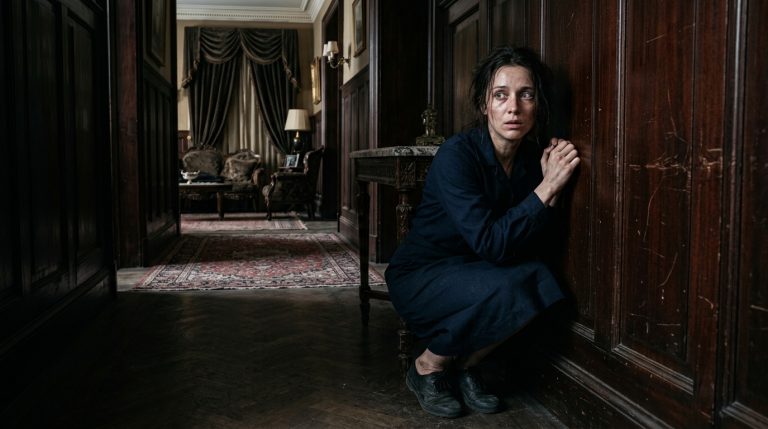
Laura didn’t close the door entirely. She left it a sliver open, a gap no wider than a blade, and hunkered down on the floor next to the shelf of cleaning supplies. She could smell the bleach and lemon oil, a familiar, grounding texture, while outside, the conversation began.
“I didn’t invite you here, Marcus,” Ashford replied. His voice was steady, though there was a tremor in the way he enunciated the syllables.
“You didn’t need to,” Webb replied. He moved into the room; she could hear the scrape of a chair against the floorboards—the same chair Ashford usually kept tucked neatly under the desk. “The board of directors is finished waiting. They’ve seen the reports, Ashford. They know about the caregiver turnover. They know about the financial stasis. You aren’t just failing to manage your estate; you’re failing to exist as an executive.”
Laura leaned closer to the gap. She could see them, framed in the narrow sliver of the doorway. Ashford was backed into the corner of the room, his chair angled away from the desk. Webb was standing, holding a thin, crisp leather portfolio that looked entirely out of place in the lived-in, slightly dusty atmosphere of the study.
“I am working,” Ashford said, his voice rising, sharp with a sudden, desperate pride. “I’ve been reviewing the quarterly projections. I’ve been—”
“You’ve been staring at a garden,” Webb interrupted, his tone devoid of cruelty, which made it all the more devastating. It was the tone of a surgeon describing an inevitable amputation. “This isn’t a reprimand, Ashford. It’s an intervention. I’ve prepared the paperwork for the conservatorship. It’s all here. Your signature, the medical evaluations, the recommendation of the firm.”
Webb placed the portfolio on the desk with a sound that felt like a gavel hitting a block. The silence that followed was total. It wasn’t the peace of a settled house; it was the suffocating silence of a life being erased.
Laura looked down at Lena, who was playing with the hem of her sleeve, oblivious to the fact that the floor beneath their feet felt like it was shifting. She thought of the letter she had seen propped against the fruit bowl weeks ago, the one that had signaled the agency’s abandonment. She had assumed it was the end of the line, but seeing Webb now, standing there with the quiet arrogance of a man who owned the air he breathed, she realized the abandonment hadn’t been an accident. It had been a strategy. A way to starve the house of support, to push Ashford into a corner where his only remaining option was the one Webb was presenting.
She looked at the edge of the study door, noticing a stray piece of mail that had fallen out of the visitor’s portfolio and landed in the hallway. It was a crisp, legal-sized envelope, stark white against the dark wood.
She needed to know. Not for herself, but for the man who had stopped drinking his coffee cold.
She waited until the voices in the study rose again, Webb outlining the timeline of the transition, the legal inevitability of the handover. She shifted her weight, the floorboards silent under her socks, and crawled toward the opening of the break room. She didn’t stand up. She stayed low, a shadow within the shadows of the hallway.
She reached the envelope. Her hand trembled as she snatched it up, her fingers sliding against the textured, heavy stock of the paper. She didn’t open it—she couldn’t—but as she pulled it back toward the safety of the break room, she caught the header embossed on the document inside, visible through the translucent window of the envelope. Power of Attorney: Voluntary Relinquishment.
The realization hit her with the force of a physical blow. Ashford hadn’t just been isolated by circumstance. He had let this happen. He had signed away his own autonomy, and now, he was being liquidated by his own design.
She retreated, her breath catching in her throat, the paper crinkling faintly in her hand. Outside, the conversation had shifted to the logistical reality of the estate’s sale. Ashford was quiet now, his head bowed, his hands folded in his lap as if he were waiting for a sentence to be passed.
Laura closed the door to the break room, the latch clicking shut with a sound that felt like a prison door locking. She held the envelope to her chest, the weight of the secret pressing against her ribs. They were in the middle of a takeover, and the man who was supposed to be the defender of this home was the one who had handed over the keys.
CHAPTER 3: THE GARDENS THRESHOLD
The break room was silent save for the rhythmic, uneven breathing of Lena, who had curled up against a pile of microfiber cleaning cloths. Laura sat on the floor, her back against the door, the legal envelope—Power of Attorney: Voluntary Relinquishment—clutched so tightly in her hand that the edges were beginning to crimp. The words she had glimpsed through the window were not just a suggestion of change; they were a death warrant for the house.
Ashford hadn’t been coerced, at least not in the way she had imagined. He had surrendered.
She turned her head, pressing her ear to the wood of the door. The low, melodic rumble of Webb’s voice continued. He was discussing the “liquidation of assets,” a phrase that sounded like dry leaves being crushed. Laura felt a sudden, frantic need for air. The small, windowless closet, once a sanctuary for her and Lena, now felt like a tomb. She had to move. She had to know if there was a crack in the foundation of Webb’s plan that Ashford—in his self-imposed haze—had missed.
She stood up, her joints protesting, and peered through the sliver of the doorway. The hallway was empty. Webb and Ashford were still in the study; the shadows of their silhouettes were cast long and distorted against the hallway floor by the morning sun streaming through the East Wing windows.
She didn’t run. She moved with the slow, deliberate grace of a ghost, stepping over the squeaking floorboards. She reached the threshold of the garden—the glass door that had been left unlocked for the first time in years. The transition was jarring. The stale, recycled air of the house gave way to the sharp, verdant scent of damp earth, crushed petals, and the dry, heat-stressed fragrance of late-spring roses.
The garden was a labyrinth of memory, and as she stepped onto the stone path, the sound of the grandfather clock in the foyer—a deep, resonant tock-tock-tock that hadn’t been audible in months—began to filter through the open doors, a mechanical heartbeat that filled the void left by the silence. It was rhythmic, steady, and entirely out of place, as if the house itself were waking up and demanding to be accounted for.
She walked toward the stone bench, her feet crunching softly on the gravel. She didn’t look at the study windows. She went straight to the plaque. The sun was hot against her neck, and the sight of the inscription—Claire, 19XX-20XX—felt like looking at an open wound.
This was where Ashford spent his afternoons. This was the place where he came to mourn, to wait, to exist in the shadow of what he had lost. Laura knelt, reaching out to trace the cool, weathered surface of the stone. Underneath the bench, tucked into a small crevice where the stone met the earth, she saw a scrap of paper—a folded, yellowing piece of stationery.
She hesitated. Her professional code, the bedrock of her survival, told her to walk away. She was staff. She was invisible. But as the clock in the foyer chimed, a hollow, echoing sound that seemed to mark the passage of a time they no longer possessed, the moral ambiguity of her position collapsed. She wasn’t an employee anymore. She was a witness.
She picked up the paper and unfolded it.
It wasn’t a business document. It was a fragment of a letter, written in a hand that was sharp, frantic, and unmistakably Ashford’s. I cannot keep the house, but I cannot give it up. If they take the legal ground, I must ensure the soul of it is already gone.
Laura froze. The air around her seemed to grow heavy. The “voluntary relinquishment” wasn’t a capitulation; it was a distraction. A decoy. Ashford was setting a fire to his own legacy, and Webb—in his corporate arrogance—was so focused on the legal takeover that he wasn’t looking at the actual ground they were standing on.
A floorboard creaked in the study, and then the sound of a wheelchair’s hum—that soft, electric buzz—vibrated through the stone beneath her knees. Ashford was coming out.
She shoved the letter into her pocket, her heart hammering against her ribs. She couldn’t be caught here, not yet. She ducked behind the thick, overgrown trellis of climbing jasmine, the rough vines scratching her arms.
Ashford appeared in the doorway, his chair moving with a new, aggressive velocity. He wasn’t the man she had seen staring at the window for two years. He was leaning forward, his jaw set in a line of hard, flinty resolve. He didn’t come to the bench to mourn. He came to the fountain, his eyes scanning the garden with a cold, calculated precision that reminded her of the man in the wedding photo.
He stopped, his eyes drifting to the spot where she had been kneeling only seconds before. He saw the disturbed gravel. He saw the empty space where the paper had been.
“Laura,” he said, his voice carrying clearly across the garden, devoid of warmth, but heavy with a strange, burgeoning recognition. “I know you’re there. And I know you’ve seen the letter.”
Laura stepped out from behind the jasmine, the paper burning in her pocket. She didn’t look down. She looked at him, truly looking at him, and for the first time, she saw the shared burden—not of the past, but of the dangerous, fragile immediate future. They were no longer parallel lines. The tragedy had forced them into the same, narrow, broken path.
“It’s not what it looks like, is it?” she asked, her voice steady despite the adrenaline. “The conservatorship. The relinquishment. You’re playing a game with him.”
Ashford looked at her, and the mask of the broken, paralyzed man slipped just enough to reveal a flicker of something raw, something alive. “It’s not a game,” he said, the sound of the foyer clock ticking louder, counting down the seconds of their remaining time. “It’s a scorched earth policy.”
CHAPTER 4: THE BOARDROOM SHADOW
Ashford’s wheelchair tires cut grooves into the soft, damp mulch of the garden path as he turned back toward the house. He didn’t look at Laura again. He moved with a clinical, tactical efficiency, his hands dancing over the wheels. The “scorched earth” he spoke of wasn’t a metaphor—it was a plan. And as Laura followed him, her boots sinking slightly into the earth, she realized with a jolt that she was no longer a bystander. By holding the letter, by acknowledging the truth, she had become a participant in a sabotage she barely understood.
They reached the study door just as Marcus Webb emerged from the desk area. Webb looked at the two of them—the maid with dirt on her apron and the billionaire in his chair—and his thin, professional mouth curled into a faint, indulgent smile. He reached into his breast pocket and produced a gold-plated fountain pen, the nib catching the light like a small, predatory blade.
“I trust you’ve had a moment to reflect, Ashford,” Webb said, his voice smooth and devoid of any awareness that the power dynamic in the room had shifted. “The board is convening in two hours. This document—the voluntary relinquishment—is your insurance. Sign it, and the transition remains private. Resist, and we begin the public filings. The press will have a field day with the ‘tragic decline’ of a captain of industry.”
Webb stepped forward, placing the pen on the desk next to the portfolio. The move was a test. He was waiting for Ashford to break, to beg, or to retreat into the shell he had inhabited for two years.
Ashford didn’t reach for the pen. Instead, he looked at Webb, his expression stripped of the performative grief he had worn for so long. “You’ve always been efficient, Marcus. That was why I hired you. You like clean lines. You like the appearance of order.”
“I like outcomes,” Webb corrected, his gaze shifting to Laura, his eyes narrowing for a fraction of a second. He noticed the slight bulge in her pocket where the letter rested, but he dismissed it—a piece of paper, a minor nuisance. He was too focused on the billionaire to notice the maid.
“The outcome you want,” Ashford continued, his voice low, “is the estate. The holdings. The legacy. You want to strip the assets and sell the corpse.”
“I am securing your future,” Webb retorted, his voice hardening. “You are not capable of managing the volatility of your own life. The accident saw to that.”
Laura stood by the door, her hands clenched at her sides. She felt the weight of the letter in her pocket, the physical proof that Ashford was deliberately inviting this destruction. She saw the way Webb held his pen—the specific, elegant flick of his wrist—and for a fleeting moment, her mind flashed to a memory she didn’t own: the memory of Claire, laughing in this very room, the same light reflecting off a similar pen. It was a phantom thought, an intrusive surge of empathy that made her breath hitch. She understood now what Ashford meant by scorched earth. He wasn’t trying to save the money; he was trying to ruin the value of the prize so that when Webb took it, he would be inheriting a hollow, meaningless shell.
“The accident didn’t take my mind, Marcus,” Ashford said, a dangerous, thin smile touching his lips. “It just gave me a different perspective on what is worth keeping.”
Webb reached for the portfolio, his patience clearly fracturing. “Sign it. Now. I don’t have time for your philosophical posturing.”
The room felt suddenly smaller, the air thick with the smell of mahogany polish and the biting, chemical tang of printer toner. Laura realized that the “decoy secret” Webb was chasing—the idea that Ashford was simply a broken, aging man—was a masterful lie. The real secret was the vacuum Ashford had created. Every action, every missed meeting, every “unpredictable” caregiver dismissal had been a calculated withdrawal of data, of presence, of legitimacy. He had turned himself into a ghost so that no one would notice he was actually building a bomb.
“I need to check on Lena,” Laura said, her voice cutting through the tension. It was a tactical retreat, a way to signal to Ashford that she understood her role.
“Stay,” Ashford commanded, his eyes not leaving Webb. “You’re part of the record now, Laura. You’re the primary witness to the fact that I am, indeed, of sound mind.”
Webb laughed, a short, sharp sound. “A witness? She’s a cleaner, Ashford. She’s a liability.”
“She’s the only person in this house who hasn’t been paid to ignore me,” Ashford countered.
The grandfather clock in the foyer struck the hour. The sound—a deep, booming reverberation—seemed to shake the very foundations of the study. Webb’s composure wavered. He wasn’t used to resistance; he was used to inertia. And the man in the chair, the man who had been a statue for two years, was suddenly moving with a velocity that Webb couldn’t predict.
“The portfolio is empty, isn’t it, Marcus?” Ashford said, his tone casual, almost conversational. “You didn’t bring the actual contracts. You brought the bluff. You’re not here to handle a conservatorship today. You’re here to force a snap decision because the board is already panicking about the missing revenue.”
Webb froze. The fountain pen in his hand wavered. Laura held her breath, the silence in the room stretching until it felt ready to snap. She had seen the truth—the emptiness in Webb’s eyes, the slight, involuntary tremor in his hand. The corporate predator had been outmaneuvered by his own hunger.
“You’re making a mistake,” Webb hissed, the mask of professional detachment finally slipping to reveal the raw, desperate greed underneath.
“I made my mistake two years ago,” Ashford said, his voice chillingly calm. “Today, I’m correcting the accounts.”
CHAPTER 5: THE PRICE OF SILENCE
Marcus Webb didn’t move for a long time. The office—a space of leather, heavy mahogany, and the crushing weight of two years of stagnation—felt like it was shrinking. The fountain pen lay on the desk, a small, golden relic that no longer held any power. Webb’s hand was still hovering near it, his fingers twitching in a reflex of misplaced authority.
“You think you’re being clever,” Webb said, his voice dropping an octave, losing its polished professional veneer. It was now thin, reedy, and vibrating with a genuine, ugly fear. “You think you can burn the estate down and walk away, but there are contracts, Ashford. There are legal precedents. The firm owns your power of attorney. They own your legacy.”
“They own a shell,” Ashford replied, his back straight, his eyes locked onto Webb’s with a terrifying, unblinking intensity. He adjusted his position in the wheelchair, the electric motor whirring with a sharp, high-pitched whine that cut through the silence. “You wanted the assets. You wanted the control. But you never bothered to look at what was actually in the accounts. You saw the loss of revenue, the lack of management, the decline. You saw a business failing. You didn’t see a man emptying the house.”
Laura stood frozen by the door. She felt like a trespasser in a private war, yet she couldn’t leave. The stakes were no longer just about the estate; they were about the absolute, brutal stripping away of the lies that had kept this house in a state of living death for two years.
“What are you talking about?” Webb whispered. He reached for the portfolio, his fingers tearing the leather binding in his haste. He flipped through the pages, his face turning an ashen gray as he realized the reality of what he was holding—or rather, what he was not holding.
“The accounts are already gone, Marcus,” Ashford said, his voice almost gentle. “Transferred to a foundation that doesn’t exist on your ledgers. The assets have been liquidated and tied into legal trusts that will take you five years to untangle. By the time you find a single cent, the entity you’re trying to seize won’t even have a name anymore. I haven’t been failing to exist. I’ve been systematically erasing my presence from your world.”
Webb looked up, his eyes darting toward the door as if searching for an escape. Laura blocked his path, her heart hammering. She wasn’t just a maid anymore; she was the final piece of this wall. She saw the desperation in Webb’s expression, the way he looked at the room as if it were a sinking ship. He was a man of systems, and his systems were failing. He had come here expecting to dominate, to harvest, and instead, he had stumbled into a trap that had been set long before he even arrived.
“You’re insane,” Webb spat, though it lacked conviction. “You’ve ruined yourself.”
“I ruined the version of me you could control,” Ashford corrected. He turned his chair toward Laura, and for the first time, he looked at her with a raw, painful recognition. He looked at the girl in the kitchen, the small life that had walked into his study and shattered the silence. “Laura, go to the break room. Get Lena. Mrs. Patton is waiting by the garden gate. She has the documents for the transport.”
“I’m not leaving you,” Laura said, her voice firm, the stubbornness she had always considered her finest quality now fully ignited. She wasn’t going to let him face this alone—the destruction of his own identity was a heavy, lonely thing, and she had spent two years observing loneliness. She wasn’t going to let it end that way.
Ashford’s expression softened, just for a second. “You’ve already done enough, Laura. You’ve given me the one thing I didn’t think I could have again: a reason to be someone other than a memory.”
Webb saw his chance. He lunged, not for Ashford, but for the open door, his shoulder slamming into Laura. She stumbled, grabbing the doorframe to keep from falling, but Webb was already in the hallway, his face twisted in a mask of fury. He stopped at the stairwell, his hand gripping the banister so hard his knuckles turned white.
“This isn’t over, Ashford!” he screamed back into the study. “The legal system doesn’t care about your scorched earth! I’ll tear every inch of this place down until there’s nothing left!”
“There’s already nothing left, Marcus,” Ashford called back, his voice echoing through the silent, dusty hallway. “That’s the beauty of it.”
Webb didn’t respond. He turned and descended the stairs, his footsteps echoing like gunshots in the quiet house. Laura walked back into the room, her breath coming in shallow, jagged gasps. She looked at Ashford. He was sitting in the middle of his study, surrounded by the ghosts of his former life—the desk, the books, the cold coffee cup, the cartoon bandage on his hand. He looked small, but for the first time since she had started working for him, he looked entirely, completely present.
“We have to move,” she said, her voice low.
Ashford nodded. He looked at the corkboard above the desk, where the two wobbly circles and stick-figure arms—the drawing Lena had made—remained pinned. He reached up, his fingers brushing the paper. “We have to leave the shell,” he whispered. “The foundation is still somewhere else.”
The house seemed to exhale around them, the grandfather clock in the foyer finally winding down, the ticking slowing, stretching, and then coming to a complete, final halt. The silence that returned wasn’t empty. It was expectant.
CHAPTER 6: THE UNLOCKED GATE
Laura didn’t look back at the desk. She didn’t look at the corkboard or the empty portfolio that had threatened to swallow their lives. She moved to the break room, her pulse finally finding a steady, rhythmic cadence. Lena was awake, sitting on the pile of cloths, her small hands clutching Rabbit. The girl looked up as Laura entered, her expression one of calm, unshakeable trust.
“Time to go?” Lena asked, her voice small and clear in the quiet room.
“Yes,” Laura whispered, her voice thick with the sudden, overwhelming relief of a long, dark winter finally breaking. “Time to go.”
She gathered their things—a few spare clothes, the small bag she had brought in months ago, the weight of which now felt negligible against the magnitude of what she was carrying away. They moved through the hallway, the hardwood floors feeling different under their feet—not like a path of eggshells, but like a solid, forgiving foundation.
Mrs. Patton was waiting at the garden gate. She stood with her hands folded over her apron, her face as inscrutable as it had been for the last two decades. She held a set of keys—the original iron keys to the estate’s secondary residence, a small cottage on the edge of the property that hadn’t been occupied in years.
“It’s ready,” Mrs. Patton said, her voice devoid of its usual clipped, professional distance. She pressed the keys into Laura’s palm. “The transport is at the gate. Everything is documented.”
“Why?” Laura asked, the question escaping her before she could hold it back.
“Because for nineteen years, I watched a man die in slow motion,” Mrs. Patton replied, her gaze drifting toward the rose bushes, which were vibrant and thick with color. “I didn’t think he could be reached. I was wrong. And a house that is finally lived in again shouldn’t be governed by ghosts.”
Ashford emerged from the study, his wheelchair navigating the stone path with a newfound ease. He had changed his sweater, shedding the dark, heavy wool for something lighter, something that didn’t swallow the light. As he approached them, the early summer sun caught the cartoon bandage still taped to the back of his hand—the final, stubborn vestige of the beginning of this change.
He stopped in front of the stone bench. He didn’t look at the plaque with the heavy, paralyzing weight he had carried for two years. He looked at the roses. He looked at the way the light played across the petals, creating patterns that were fleeting, beautiful, and entirely alive.
He reached out, his hand trembling only slightly, and touched the stone bench—not as a mourner, but as a man closing a book.
“I signed the papers, Marcus,” he said, the words meant for the wind, for the garden, for the ghost of the life he was leaving behind. “You have the papers. You have the shell. You have the accounts that are now nothing more than a labyrinth of legal frustration. But you don’t have the house. You don’t have the time.”
He turned his chair toward the gate, toward the world that existed beyond the perimeter wall. He looked at Laura, and for the first time, he smiled—a genuine, tired, but profoundly human expression that transformed the lines on his face.
“I don’t think I can walk yet,” he said, his voice quiet, lacking any of the bitterness that had defined his existence for so long. “But I think I can move forward.”
They moved together toward the gate, a strange, mismatched procession. Laura, the woman who had spent her life cleaning away the messes of others; Lena, the toddler who had walked through a closed door and refused to see the barriers; and Ashford, the man who had realized that he was not the prisoner of his tragedy, but its architect.
As they reached the gate, Ashford stopped. He reached into his pocket and pulled out a small, metallic object—a fountain pen, the one Webb had left on the desk. He turned it over in his hand, the gold glinting in the sun, and then, with a quiet, deliberate movement, he placed it on the gatepost. It was a relic of a life built on transaction and control, and he was leaving it behind, a symbolic offering to the gate he was finally walking through.
“Repair the rabbit,” Ashford said, looking down at Lena’s stuffed toy, which had lost an eye and a bit of stuffing over the months of their journey. “There’s a sewing kit in the cottage. We can fix it together.”
“Together,” Lena echoed, her voice certain.
Laura pushed the gate open. The sound of the hinge, a light, smooth movement, signaled the end of the long silence. She stepped out into the bright, unshielded light of the afternoon, the smell of rain on the stone path promising a future that was not yet written, but was theirs to build. Behind them, the house stood quiet, no longer a cold, museum-like monument to the past, but a simple, sturdy structure that would wait for the next chapter.
There was no grand fanfare, no applause, no final confrontation with the forces of their old lives. There was only the weight of the air, the warmth of the sun, and the quiet, steady progress of a man who had discovered that the only thing more powerful than holding on to what you’ve lost is the act of simply, stubbornly, moving into what you’ve found.