The Weight of the Wrecker: A Neighborhood Audit on the Fault Lines of Bureaucratic Pride
CHAPTER 1: THE FIRST SHUDDER
The cul-de-sac tasted like heated asphalt and impending rain. It was the smell of a neighborhood that had forgotten how to be quiet, a place now defined by the jagged friction of Beverly Caldwell’s ambition. I stood near the edge of my drive, where the concrete had been scarred by the unauthorized tow, and watched the amber beacons of the wrecker pulse against the fading daylight. They were rhythmic, mechanical, and entirely indifferent to the woman standing twenty feet away.
Beverly held her clipboard as if it were a shield, her knuckles white against the black plastic. She had spent the morning dictating the temperature of the street, ordering removals and calculating daily fines with the confidence of a landlord, but the arrival of the heavy unit had tilted the axis. She looked toward the patrol cruisers, then back at me, her eyes darting like trapped birds seeking an exit that didn’t exist.
“You’re making a mistake,” she called out, though the conviction had drained from her voice, leaving behind only the sharp, thin edge of panic. “I told you, this is a residential zone. There are ordinances, there are—”
“There are permits,” I said, my voice hitting the still air with a heavy, flat sound. I wasn’t looking at her. I was watching the driver step down from the cabin of the wrecker, his movements efficient, practiced, devoid of theatrics. He didn’t check the neighborhood aesthetics or the property values. He checked the chains.
The wrecker was an anchor of iron and grit, a 50-ton machine that brought the cold, undeniable logic of heavy transport into a space that had lived on gossip and unwritten rules. It was the antithesis of Beverly’s paper kingdom. Every rust-colored fleck on its steel boom seemed to mock the fluorescent tape she had plastered on my mailbox earlier that morning.
Behind me, the street felt like a wire pulled to the point of snapping. Curtains were drawn back just an inch. The silence of the neighborhood wasn’t peaceful; it was the heavy, suffocating silence of spectators waiting to see which way the debris would fall.
The driver walked past Beverly without a glance, his boots scuffing the dry earth of the curb. He walked toward me, his hands empty, and for the first time, the true weight of the situation landed on my chest. I reached into my pocket, my fingers brushing the bent corner of the memorial plate I’d salvaged from the trash. It was a small, cold object, but it was the only thing on the street that felt real.
The driver stopped in front of me, his gaze fixed on the space where my truck had been violated. “You’re the owner,” he stated. It wasn’t a question.
“I am,” I replied, the words feeling dusty in my throat.
He nodded once, a brief movement that acknowledged the chain of command, the paper trails, and the long, weary process of calling in a recovery unit. He turned back to the wrecker, and as he began to signal for the booms to lower, the ground beneath us gave a low, resonant groan. It was the sound of the street settling under the sheer, immovable truth of iron.
Beverly stepped forward, her voice rising into a sharp, brittle crack. “Stop this! I am the president of this association, and I forbid this obstruction!”
The driver didn’t even look over his shoulder. He just reached out, touched the release valve, and let the steel sigh into place. That was the moment the gap opened—the space between the rules as she imagined them and the rules as they actually existed. I watched her face, the way the certainty drained out of it, replaced by a dark, sudden realization. She wasn’t holding a clipboard anymore; she was holding onto a wreck.
CHAPTER 2: PAPER WALLS
The silence that settled over the cul-de-sac was not the absence of sound, but the presence of a new gravity. Beverly’s voice, which had spent weeks carving out the borders of what was permitted and what was prohibited, had become nothing more than a static frequency, easily tuned out. She stood on the edge of the asphalt, her posture rigid, her hands still clutching that clipboard as if it could stabilize the tilting world around her. She didn’t look at me; she looked at the wrecker, her gaze tracing the thick, hydraulic lines as if she could dismantle them with a sharp enough glare.
I turned away from the heavy machine and walked back toward my house. My boots felt heavy, crunching on small bits of loose gravel—the residue of a neighborhood that was slowly being picked apart by its own governance. I didn’t look back to see if she was watching. I didn’t need to. I knew the rhythm of this game now. It was a game of protocols, of filing dates, and the suffocating weight of verified signatures.
Inside, the house felt unnervingly still. The air was dry, smelling of old coffee and the metallic, ozone tang that seemed to cling to my clothes from the street. I moved to my desk, the surface cluttered with printouts and highlighted maps. The light from the window was slanting, long and golden, catching the dust motes dancing in the air. I sat down and pulled the fluorescent notice I’d peeled from my mailbox from my pocket. It was crumpled, the tape tacky against my thumb, a small, insignificant piece of paper that had been used to build a wall of pseudo-legal authority around my own property.
The memory of past tactical briefings surfaced, sharp and unbidden—the smell of diesel, the precise, low-frequency hum of mission-critical systems, the way a team would stop talking when the briefing started, focusing purely on the mechanics of the objective. It was the same sensation here, in the middle of a quiet suburb, looking at the fraudulent site plan I had pulled from the county records. The realization hit me with the force of a physical blow: Beverly wasn’t a leader; she was a looter. She had weaponized the HOA’s bylaws, turning a neighborhood’s desire for order into a shell game that funneled funds into the pockets of a shell company her own cousin controlled.
I spread the maps out. The easement cut through my corner lot with surgical precision. It wasn’t there to improve sightlines; it was there to clear a path for the contractor, a private developer who had already lined up the heavy machinery for a road modification that didn’t need to happen. It was a clean, brutal piece of engineering, designed by someone who understood how to exploit the quiet, trusting nature of a community that didn’t know how to look beneath the surface.
My phone vibrated on the desk—a short, percussive sound that seemed out of place in the stillness. I didn’t reach for it immediately. I let the screen glow, the notification pulsing like a heartbeat. The heavy unit outside was still idling, its engine a low, distant thrum that vibrated through the floorboards of the house, a constant reminder that the ground had shifted.
I leaned back, the leather of my chair creaking. The urge to act—to walk back out there and dismantle her arguments piece by piece—was strong, but I forced myself to stay put. This was the discipline of the wait. If I went out there now, I would be playing by her rules, engaging in the theater of the argument. I needed to move in the shadows of the documents. I needed to let the bureaucracy—the very thing she had tried to wield against me—do the work of the demolition.
I picked up the phone. It was a notification from the county clerk’s portal: Update to Case File 88-B: Preliminary Documentation Uploaded.
I opened the file. It was everything I’d compiled—the inconsistent invoices, the lack of board minutes for the easement filing, the missing signatures. It was a digital dossier of collapse. I looked out the window one more time. Beverly was still standing there, though she had moved closer to her own porch, her cell phone pressed to her ear. She was pacing, her gestures frantic, small, and disconnected. She was calling for backup, for a lifeline, for some way to rewrite the last hour.
She was trying to build a wall out of paper, but the wind had already changed direction. I looked down at the memorial plate on my desk—the one I’d retrieved, the one with the bent corner—and touched the metal. It felt cold, grounded, and immovable. My next move wasn’t a reaction; it was a deployment. I began to draft the final request for the financial audit, keeping the language clinical, precise, and devoid of the heat I felt in my veins.
The house felt like a bunker, secure and focused. Outside, the neighborhood continued its slow, silent observation, but the atmosphere had changed. The fear, the unspoken pressure that had held everyone in a state of suspended animation, was beginning to dissipate, replaced by a cold, sharp curiosity. They were starting to look at the HOA not as a source of authority, but as a source of fraud. And in the quiet of my office, I knew the hardest part wasn’t the confrontation; it was waiting for the truth to finish its descent.
CHAPTER 3: THE PAPER TRAIL
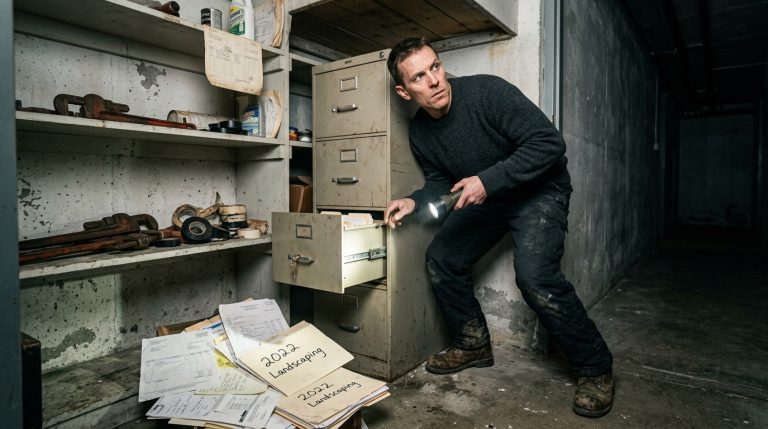
The office was a graveyard of ambition. Floor-to-ceiling stacks of HOA records, property tax assessments, and zoning maps covered every available surface, casting long, sharp shadows in the evening light. My desk was the epicenter of this disorder, centered around the single, damning piece of evidence that linked the easement filing to a shell entity known as ‘R&M Development.’
I leaned back, the leather chair protesting with a slow, drawn-out squeak. Outside, the cul-de-sac had largely emptied, though the wrecker remained, a dormant titan of cold steel. Its presence felt like a structural change to the geography of the street, a permanent alteration of the landscape that Beverly Caldwell would never be able to negotiate away. I watched the shadows lengthen across my carpet, feeling the weight of the last few hours settle into my bones.
My eyes burned, a dry, gritty sensation that made the text on the screen swim. I blinked, rubbing my temples. There was a moment—a fleeting, uncomfortable fraction of a second—where I caught my reflection in the dark monitor. The person staring back looked less like a resident reclaiming his property and more like someone constructing a prison of his own making. I had spent the day tracking every decimal point, every rounded invoice, and every signature. I knew the cadence of the fraud by heart. I knew that the $120,000 consulting fee was just a placeholder, a variable in an equation of greed that Beverly had been running for at least six months.
I pushed the thought away, focusing instead on the rust-colored edge of a folder. Obsession was a friction, and friction eventually wore down the very thing it was meant to polish. I was becoming as rigid as the rules I was dismantling, a realization that felt like swallowing cold metal. I stood up and walked to the window. The neighborhood was quiet, but it was a brittle, fragile quiet—the kind of silence that usually precedes a structural collapse.
The front door of Beverly’s house remained shut. No lights were on in the living room. It was a dark, hollow box. I turned from the window, my pace deliberate as I returned to the desk to finalize the secondary filing for the county investigator. This was the ‘Paper Trail’ phase—the point where the investigation moved from circumstantial to lethal. I didn’t need to shout; I just needed to verify the links.
I pulled up the bank routing numbers associated with the shell company. They were messy, layered through three separate holding entities, but the trail inevitably wound back to a single residential address in a neighboring county—Beverly’s cousin. It was so clumsy, so unimaginative, that it felt like an insult. She hadn’t even tried to build a real labyrinth. She’d just relied on the fact that no one in the Ridgerest Mesa HOA had ever bothered to pull the thread.
My phone chimed, a notification from the investigator. File received. Initial review complete. We have enough to trigger an emergency audit of the association’s primary accounts.
That was it. The gate was open. I closed the laptop, the screen going black and leaving the room in deep, heavy shadow. The smell of the office—old paper, dried toner, and the faint, lingering scent of the outdoors—was oppressive. I stepped out into the hallway, the floorboards groaning under my weight. My house had become a tactical command center, filled with the debris of a war that was being fought in footnotes and appendices.
I walked to the kitchen and poured a glass of water, the sound of the tap hitting the glass unnaturally loud. My hands were steady, but my mind was still cycling through the documents, checking for errors, looking for the one thing I might have missed. That was the trap. I was starting to hunt for connections where there might only be coincidence, a symptom of the very paranoia I had spent the last two years of my professional life trying to avoid.
I took a sip of the water and looked out the sliding glass door toward the backyard. The shadows were absolute now. I could hear the faint, metallic creak of the wrecker’s boom shifting in the wind, a lonely, mechanical sound. I was waiting for the final domino, the moment when the board would be forced to look at the numbers and realize that their president hadn’t been protecting the neighborhood; she had been feeding on it.
The phone buzzed again, a continuous, urgent vibration against the granite countertop. It was a board member—the same one who had stood near the curb earlier, stunned and silent. I let it vibrate for a moment, listening to the rhythmic, frantic sound of it, wondering if he was calling to offer support or to ask me to stop. I didn’t answer.
I leaned against the counter, my arms crossed, and stared at the dark reflection of the kitchen window. The truth was simple, but it was heavy, and it required a certain kind of endurance to carry. I had the documents. I had the timeline. I had the proof. But as I stood there in the dark, I felt the sharp, cold edge of the realization that once I turned this key, there would be no going back to the version of the neighborhood that existed twenty-four hours ago. The rust had been exposed, and there was no way to paint over it now.
CHAPTER 4: THE PUBLIC STAGE
I didn’t answer the phone. The buzzing stopped, then started again, a jagged, persistent rhythm that mirrored the tightness in my chest. I left the device on the granite countertop and stepped out of the house. The heat of the afternoon had settled into the concrete, radiating upward through the soles of my boots. The cul-de-sac was no longer a place of quiet suburban routine; it had become a stage, and the actors were already in place.
Two patrol cars were parked at awkward angles, their blue and red lights cut, but their presence effectively bisecting the street. Neighbors had drifted out, hovering near the periphery of the lawns, their faces masks of muted, anxious curiosity. They didn’t speak. They watched. And in the center of it all, Beverly Caldwell stood exactly where she had been hours ago, though her posture had lost its sharp, predatory edge. She looked smaller now, a frayed figure against the backdrop of the massive, idling wrecker.
As I walked down the driveway, the gravel crunched underfoot—a sound that seemed to carry for miles. The county investigator, a woman in a sharp, slate-gray suit that looked entirely too professional for a residential street, stood near the wrecker’s massive tires. She held a folder, its cover dull and worn, containing the weight of everything I had spent the day organizing.
Beverly saw me coming. Her eyes flicked toward me, a flash of pure, unadulterated venom, before she quickly pivoted back to the investigator. “This is harassment,” Beverly said, her voice strained, cracking in the middle of the sentence. “You’re taking the side of a man who brought military-grade equipment into a civilian area. Look at it! It’s an obstruction. It’s an eyesore.”
The investigator didn’t even look up from the document she was reading. “The equipment is permitted, Miss Caldwell. Your actions, however, are currently under administrative review.”
I closed the distance, stopping a few feet away. I could smell the faint scent of diesel from the wrecker and the dry, baked-earth smell of the neighborhood. The atmosphere was brittle. Every movement felt laden with consequences. A courier van—unmarked, nondescript—pulled up to the curb of the HOA office building nearby. The driver stepped out, holding a large, padded envelope, looking confused by the scene in the street. He hesitated, glanced at the police cruisers, and then, finding no clear way forward, dropped the package near the door of the office before scrambling back into his van and driving off.
No one moved to collect it. The package sat there, a small, out-of-place detail that felt like a breach in the static tension of the scene. Beverly’s gaze shifted to it, and for a fleeting moment, her face went deathly pale. It was a micro-mystery, a detail that didn’t fit into the narrative she had been spinning, and the sight of it clearly rattled the few remaining pieces of her composure.
“I need to speak to the board members,” I said, my voice cutting through the thick, stagnant air. I kept my eyes fixed on the investigator, acknowledging the presence of the law as the only authority that mattered now. “The files are in order. The signatures are fraudulent. The easement was filed without a quorum.”
Beverly let out a sharp, hysterical laugh. “He’s a disgruntled tenant! You’re going to listen to him over an elected official?”
The investigator finally looked up. Her eyes were flat, professional, and entirely unimpressed. She signaled to the two patrol officers. “The board members are already here, Miss Caldwell. They’ve requested to review the findings.”
Two men—the ones I had seen earlier—stepped out from the shade of a nearby oak tree. They looked exhausted, their shirts damp with sweat, their expressions haunted by the dawning realization of what they had been a party to. They walked toward us, their gait hesitant, as if the ground itself might betray them. They were the ones who had signed the documents, the ones who had looked the other way while Beverly engineered her private kingdom.
The investigator stepped forward, handing a copy of the audit to the lead board member. “This is not an HOA matter anymore,” she stated, her voice projecting clearly for the benefit of the neighbors on the sidewalks. “This is a matter of public record and financial fraud.”
Beverly’s mouth opened, but no sound came out. The shift was absolute. The neighbors began to step closer, the wall of silence breaking into a low, rumbling murmur of realization. I stood my ground, feeling the cold, hard weight of the memorial plate in my pocket, the one tangible object that had survived the destruction she tried to wreak. The stage was set, the evidence was laid bare, and the curtain was about to fall on the most expensive, poorly managed performance in the history of the neighborhood.
I looked at the wrecker one last time. It remained, a silent sentinel of procedure, waiting for the order to move. The friction of the day, the grinding, slow-motion crawl of the bureaucratic machine, had finally reached its boiling point. Everything that had been built on a foundation of lies was now shivering in the light of the truth.
CHAPTER 5: THE COLLAPSE
The paper didn’t just rattle; it trembled in the slight breeze, a white flag of surrender caught in the mechanical landscape of the wrecker’s boom. The board members stood clustered in a tight, awkward knot, their eyes darting between the investigator’s calm, precise gestures and the increasingly erratic movements of Beverly Caldwell. She was backing away, her heels clicking a staccato rhythm against the driveway—a sound that, in the deepening silence, seemed loud enough to wake the street.
“I can explain the consulting fees,” she said, her voice thin and reedy, devoid of the command it had held only hours before. “They were for… for infrastructure analysis. You don’t understand the complexity of the budget. It’s all in the bylaws. There are provisions—”
The lead board member, a man who had spent the last ten minutes looking like he might lose his dinner, cut her off. His voice wasn’t loud, but it was decisive, weighted with the sudden, sharp clarity of someone who realized they were sinking. “There were no provisions, Beverly. I checked the minutes. We never voted on an infrastructure project. We never saw a contract for R&M Development.”
He looked at me, his gaze lingering on the memorial plate I was still holding, as if searching for some kind of absolution in the metal. I didn’t give it to him. I just kept my face neutral, the posture of a man who was merely observing the consequences of a system being reset to zero.
Beverly spun around, her face flushed with a dark, blotchy heat. “You! You orchestrated this!” She pointed a trembling finger toward me, the clipboard still clutched in her other hand. “You couldn’t handle being told you didn’t belong here, so you went digging through things you didn’t have the clearance to understand. You’re not a victim, you’re an insurgent.”
The irony of the word hit me with a phantom-like weight—the memory of a structural collapse on a dusty, forgotten mission years ago, the way the steel had groaned and twisted before finally giving way. The same sound was in the air now: the sound of a structure that had been pushed too far, too fast, by someone who didn’t understand the physics of what they were building. She had tried to project authority, but she had only succeeded in creating a pressure vessel. And now, the seams were bursting.
The investigator stepped into the space between us, her presence effectively silencing Beverly’s rant. She didn’t look at Beverly; she looked at the board members. “The audit is formal, and the findings are currently being transferred to the county attorney. As of this moment, Miss Caldwell, you are suspended from all association duties. You are prohibited from accessing any HOA financial records, digital portals, or resident communication channels.”
“Suspended?” Beverly’s voice hit a shrill note. “I’m the president!”
“Not anymore,” the lead board member said, his voice flat. He signaled to the other member. “We need to call a special meeting. We need to secure the office. Now.”
The neighbors on the sidewalks didn’t cheer. They didn’t jeer. They just watched with a grim, solemn intensity, the kind of look people wear when they witness an accident they’ve been waiting to happen. The atmosphere was heavy, saturated with the smell of exhaust and the cooling asphalt. My phone, which I had ignored for the better part of the hour, vibrated again in my pocket—a persistent, rhythmic pulse that I knew was the final confirmation of the impound release.
Beverly looked around, her eyes wide and wet, scanning the faces of the people she had once dictated to. She was looking for an ally, a defender, anyone to validate the version of reality she had been constructing for the last six months. She found only cold, distant stares. The shell game was over, and the shell company was now a liability she couldn’t afford to keep.
The investigator turned to me, a faint, almost imperceptible nod of acknowledgment. “The recovery can proceed,” she said.
The driver of the wrecker didn’t hesitate. He climbed back into the cab, the engine turning over with a deep, throaty roar that reclaimed the space. As the chains began to shift, as the hydraulics hissed and the massive steel frame groaned, I walked forward. I didn’t look at Beverly. I looked at the driveway. I looked at the spot where my truck had been violated, where the asphalt was scarred, and where the neighborhood was finally, agonizingly, starting to breathe again.
The collapse wasn’t a sudden explosion; it was the slow, inevitable slide of a building that had been built on sand. And as the wrecker began to pivot, moving into position to finish the job that had been started in malice, I knew that the rust hadn’t just been exposed—it had been scoured clean.
CHAPTER 6: THE DUSTY HORIZON
The wrecker began its slow, deliberate reversal, the tires chewing into the asphalt with a rhythmic, grinding persistence. I didn’t move. I stood in the exact spot where my truck had been positioned hours ago, watching the amber beacons fade as the massive machine cleared the turn. It wasn’t a triumph; it was a calibration. The neighborhood was returning to its natural state, the artificial pressure of Beverly’s ’emergency enforcement’ vented and gone.
Beverly was still there, but she had become a ghost in her own kingdom. She sat on the curb, the clipboard discarded in the grass beside her, her gaze fixed on the empty space where the wrecker had been idling moments before. She looked small—not just defeated, but erased. The heavy SUV belonging to the county investigator idled a few yards away, the engine note a low, steady purr, while the two patrol officers stood nearby, their presence now purely administrative. They weren’t arresting her, not yet—the audit had to finish its crawl through the bureaucratic machinery—but they were ensuring that the neighborhood didn’t dissolve into the kind of chaos she had tried to manufacture.
The board members were huddled near the office, their voices low, their movements jerky and uncertain. They were already beginning to talk about the ‘next steps,’ about how to distance themselves from the filings, about how to explain the $120,000 consulting fee that had never existed. They were trying to build a narrative of innocence, but the rust was deep, and it wouldn’t be easily painted over.
I reached down and picked up the memorial plate. It was cool to the touch, the metal scarred from its time in the trash, the corner still bent at that sharp, jagged angle. I didn’t walk to the HOA office. I didn’t go to the investigator. I walked to the edge of my drive and knelt. I pulled a small, multi-tool from my pocket, the steel biting into the wood of the mailbox post where the plate had once lived.
One by one, the neighbors started to head inside. They weren’t talking, not yet. The weight of the afternoon—the realization of how easily their trust had been leveraged for a shell company’s profit—was something they would have to carry for a long time. It was a shared burden, a collective scar that would define the neighborhood’s identity for the next season. The cul-de-sac was returning to a state of quiet, but it was a different kind of quiet now. It was the silence of a structure that had been stress-tested and found wanting.
I aligned the plate, the metal clicking softly against the wood as I tightened the screws. It wasn’t perfect. The bend in the corner remained, a permanent reminder of the day the order was broken. But as I stood back up, wiping the grit from my palms onto my jeans, the plate looked stable. It looked like it belonged.
The investigator stepped out of her SUV and walked toward me. She didn’t look at the plate. She looked at me, her expression unreadable, a mask of pure professional detachment. “The compliance order will be delivered to the board by morning,” she said, her voice steady. “They’ve been instructed to open a full disclosure period for all residents. Everything is going to be accounted for. The shell entities, the easement filings, the unauthorized towing.”
“And Beverly?” I asked.
The investigator looked toward the curb, where the former president sat in the deepening shadows. “She’s the first one they’ll interview,” she replied. “The law doesn’t favor the person who calls the police to commit a crime. She’s going to have a lot of time to reflect on the difference between procedure and power.”
She turned back to her vehicle, the door clicking shut with a heavy, final sound. The engine revved, and the SUV pulled away, its taillights cutting a red path through the twilight. I was left alone in the driveway, the evening air cooling rapidly, the smell of dust and dry earth settling over the street.
I looked at the house. It was just a house—a collection of bricks, mortar, and lived-in memories. But the neighborhood felt different. The air didn’t feel as heavy. The tension had been replaced by a slow, methodical exhaustion, the kind that follows a long-delayed task. I walked to the front door, the key feeling solid in my hand.
I didn’t think about the HOA. I didn’t think about the court filings or the audit. I thought about the plate on the post, the way it shimmered in the fading light. It was fixed, it was secure, and it was mine. I opened the door and stepped inside, the house welcoming me into the quiet, dark space. The war of paper was over, and as I locked the door behind me, I finally let myself exhale, the sound disappearing into the vast, hollow stillness of the house. The dust had settled, and for the first time in a long time, the horizon was clear.