A Sovereign Shield: The Brutal Ledger of Redemption and the Silent War for a Lost Daughter
CHAPTER 1: THE PERIMETER BREACH
The safe house didn’t feel like a fortress anymore. It felt like a cage.
Daario stood in the darkened hallway, his eyes fixed on the flicker of the wall-mounted camera feed. On the monitor, the garden was a blur of gray shadows and driving rain, but the timestamp was frozen. Eleven-forty-two. It had been eleven-forty-two for the last ten minutes.
Someone hadn’t just bypassed the feed; they had looped it.
He moved with the economy of a man who had spent three decades unmaking lives. There was no sound of boot leather on the hardwood, only the rhythmic, heavy thrum of the storm against the reinforced glass. He checked the hallway—Sophia was asleep in the back bedroom, or so he hoped. He had moved her there after she’d finally drifted off, clutching that battered stuffed rabbit like it was a lifeline.
He checked his pocket. The notebook was gone. He’d placed it in the floor safe behind the portrait of Isabella, but a faint, almost imperceptible scratch near the keyhole caught his eye. It was fresh. The metal was still raw.
Daario didn’t feel rage. Rage was a frantic, loud thing that burned oxygen and clouded vision. What he felt was a cold, crystalline clarity. He turned toward the bedroom, his hand ghosting over the cold steel of the handgun tucked into his waistband.
He didn’t draw it. Not yet.
The air in the house had changed. It smelled faintly of ozone—the smell of the security system’s short-circuited wiring—and something else. A sharp, metallic tang. Gun oil.
He reached the doorway of the back bedroom. The door was cracked open, just an inch. He pushed it with the tip of his finger, the hinges silent. Inside, the room was bathed in the pale, sickly light of a streetlamp filtering through the heavy curtains.
The bed was empty.
The blanket was pulled back, tossed carelessly to the floor. The window was unlatched, a thin curtain of rain misting into the room.
Daario’s heart didn’t race. It hammered once, hard, against his ribs, then leveled out into a steady, predatory rhythm. He stepped to the window and looked out into the garden. A dark shape detached itself from the shadow of the oak tree—a silhouette, small and trembling, being ushered toward the garden gate by a figure in a heavy rain slicker.
He wasn’t fighting an army. He was fighting a shadow. He didn’t yell. He didn’t run. He stepped through the window and felt the cold rain slap against his face, sharp and biting. He moved toward the tree line, counting his steps, calculating the wind speed and the lead distance.
He reached the gate and stopped. The silhouette was there, motionless. The figure in the slicker was gone, vanished into the dark, but Sophia was standing in the mud, staring at the gate lock.
It was broken. Not picked. Snapped.
She turned to look at him, her eyes wide, reflecting the distant streetlamps. She wasn’t crying. She was holding a small, silver object in her palm. It wasn’t the notebook. It was a fragment of the music box—a tiny, twisted gear that looked like it had been pried from the casing of something long since destroyed.
“He said the music is a key,” she whispered, her voice barely audible over the gale. “And he said you have the rest of it.”
Daario’s blood chilled. He hadn’t told anyone about the music box. It was in his private vault.
CHAPTER 2: THE RESONANCE OF BROKEN THINGS
The rain didn’t just fall; it scoured. It bit into the skin, turning the garden into a landscape of shifting charcoal and liquid silver. Daario stood motionless at the gate, the rusted hinges groaning under the pressure of the gale, but his focus was entirely on the tiny, jagged gear resting in Sophia’s palm.
He didn’t touch it. He knew that gear. He knew the precise pitch of the tiny steel comb it was meant to strike. It was from a music box—a custom-made piece he had commissioned for Isabella when she was six. He had buried it in the bottom of his personal vault the day she died, unable to bear the sound of its tinkling melody.
“Where did you get this?” Daario asked, his voice low, vibrating with a forced, terrifying calm.
Sophia didn’t blink. She looked at him, her eyes damp not from the rain, but from a grief that felt far older than her seven years. “He didn’t give it to me,” she said. “He dropped it when he climbed back over the fence. He told me if I wanted to hear the rest of the song, I had to bring it to the ‘Architect’.”
Daario stepped toward her, his boots sinking into the mud. He grabbed her shoulder—not with malice, but with a grip that spoke of a desperate, sudden need for contact. He scanned the dark tree line beyond the fence. The intruder was gone, but the presence lingered, heavy and static.
“The Architect,” Daario muttered. It was a name he hadn’t heard in years, a ghost from his early days in the organization. He thought the man had been purged a decade ago.
“He said the music is a key,” Sophia repeated, her fingers curling around the gear. “He said you have the rest of it in the box. He said if you don’t bring the box to the pier tonight, he’ll give you the rest of the gear piece by piece.”
Daario felt a phantom sensation in his chest—a sharp, cold ache that mirrored the jagged metal in Sophia’s hand. He remembered the night he’d locked that music box away. He remembered Isabella sitting in his lap, her voice melodic and sweet, humming the very tune that gear was meant to play.
“It’s a secret map, Daddy,” her young voice echoed in his memory, a sudden, intrusive phantom thought that made him flinch. “If the music changes, the map changes.”
He had dismissed it as a child’s game then. Now, with the weight of the syndicate’s hunt pressing against his lungs, he realized the terrifying possibility: Isabella hadn’t been playing. She had been encoding.
“Sophia,” Daario said, his tone shifting into the sharp, transactional cadence he used when negotiating with rivals. “Did he say anything else? Did he mention any names?”
She shook her head, the wet tangles of her hair slapping against her cheeks. “Just the pier. And he said… he said the flowers are wilting.”
The statement felt like a punch to his solar plexus. The watercolor flowers. Isabella’s Sunday ritual. The one thing he thought was just a hobby. If she was encoding information in the music box, then the paintings weren’t art—they were logs.
“Go inside,” Daario ordered, guiding her gently toward the back door of the safe house. He didn’t look back until he heard the deadbolt click into place.
The house was quiet, the hum of the electronics drowned out by the relentless drumming of the storm. He walked into his study—a room he rarely entered, still smelling of the stale cigars and cold air that had characterized his life since the funeral. He went straight to the wall-mounted portrait. He didn’t reach for the safe behind it. Instead, he pulled out his tactical blade and began to carefully, methodically strip the frame away from the canvas.
His fingers found the hidden compartment in the frame itself. He withdrew the music box. It was heavy, ornate, and cold as ice. He pried it open. The interior was barren, save for the space where the cylinder should have rotated. The gear was missing—the one Sophia now held.
But as he tilted the box, something else slid out. A small, micro-etched slip of acetate, no larger than a fingernail, tucked into the velvet lining.
He held it up to the desk lamp. It wasn’t a ledger. It was a topographical map of the city’s underground power grid, overlaid with red ink that marked specific, recurring transit nodes.
He didn’t need to be a decoder to understand what he was looking at. These were the movement patterns of the syndicate. These were the supply lines.
He heard a floorboard creak in the hallway. Not the muffled sound of a guard, but the distinct, deliberate weight of a predator who didn’t care about stealth because they knew they had the advantage.
Daario didn’t look up from the map. He picked up the fire poker he had left by the hearth, the iron heavy and satisfying in his grip.
“You’re early,” Daario said to the empty room.
The shadow in the doorway didn’t move. “And you’re desperate, Daario. Giving up a child to the state just to keep her away from us? That wasn’t tactical. That was sentimental.”
Daario turned. A man stood there, draped in a coat that seemed to absorb the room’s meager light. He wore a ring on his left hand—a dull, blood-red stone that seemed to catch the flickering lamp light.
The Snake had come to the door.
Daario’s pulse didn’t quicken. He felt the cold iron of the poker, the rigid geometry of the room, and the terrible, beautiful clarity of his objective. He had the map. He had the motive. And for the first time in years, he had a reason to kill that wasn’t about business.
“Sentimentality,” Daario said, taking a slow step forward, his shadow stretching long and jagged across the floor, “is just another word for leverage you don’t understand yet.”
CHAPTER 3: THE WEIGHT OF THE LEDGER
The silence in the study was not empty; it was pressurized, like the air inside a vault before the tumblers click. Daario held the fire poker, his knuckles white against the dark iron. Across from him, the man—the Snake—did not reach for a weapon. He merely adjusted his coat, the fabric settling over his frame with a heavy, expensive drape.
“You think a piece of iron and a scrap of acetate make you a threat, Daario?” the man asked. His voice was smooth, devoid of any jagged edges, yet it carried the weight of a guillotine. “You’re a man playing with the debris of a life you don’t understand.”
Daario didn’t answer. He didn’t offer a monologue, and he didn’t blink. He watched the man’s eyes. They were dead, flat, and entirely devoid of the flicker of intent—the hallmark of a professional who had long ago traded humanity for efficiency.
The floor beneath them gave a sudden, sick lurch. The old house, burdened by the torrential rain and the rot hidden within its foundation, groaned in protest. A floorboard near the door splintered with the sound of a pistol shot. The man with the red-stone ring didn’t flinch, but his balance shifted a fraction of a degree.
That fraction was all Daario needed.
He moved, but not toward the man. He lunged for the study lamp, sweeping it off the desk and plunging the room into a deep, claustrophobic twilight illuminated only by the rhythmic strobe of distant lightning. As the bulb shattered against the floor, Daario pivoted, his momentum carrying him not into a strike, but into the crawlspace access hidden beneath the desk.
He wasn’t running. He was creating a chokepoint.
The man stepped forward, his boots crunching on the glass. “You think you can hide in the architecture of a tomb?” he taunted, his voice tracking Daario’s movement.
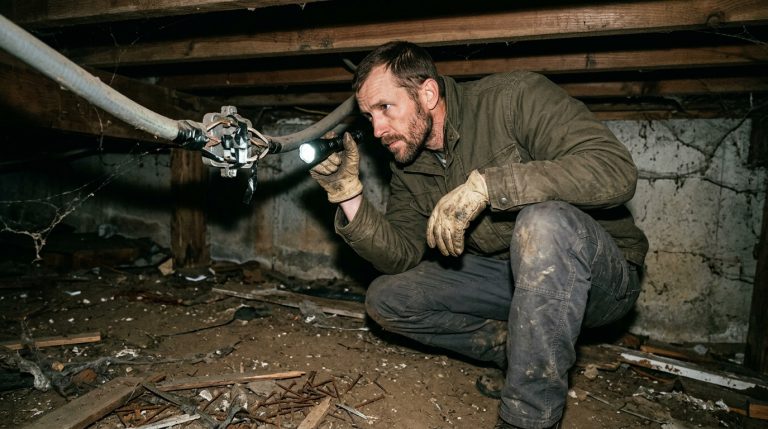
Daario dropped into the dark, damp space beneath the flooring. It was narrow, cramped, and smelled of wet earth and ancient mold. He waited, his breathing shallow, his eyes adjusting to the absolute absence of light. He heard the man above him, the heavy tread of his boots moving slowly, methodically.
Daario gripped the fire poker, but he knew it was useless in this confined space. He reached into his coat and withdrew a small, multi-tool he had kept for emergencies. He unfolded the blade—a short, serrated edge—and jammed it into the floorboard above his head, creating a tiny, jagged slit.
Through the gap, he saw the man’s boots. He was standing directly over the spot where Daario crouched.
“Isabella was smarter than you,” the man said, his voice muffled by the wood. “She knew that the information wasn’t in the book. She knew it was in the silence. You’ve spent three months mourning a daughter, and you didn’t even notice she was sending you signals.”
Daario felt a flash of cold, sharp anger. He didn’t care about the taunt. He cared about the map in his pocket. If this man wanted the map, he would have to tear the house down to get it.
Daario jammed the poker upward, not to strike, but to lever the floorboard. He used the leverage of the joists to pry the board upward. The wood gave way with a screech of rusted nails. The floor buckled.
The man stumbled, his balance compromised as the floor beneath him tilted into the void. He fell, but he was fast—he caught the edge of the desk, his body swinging over the opening. He didn’t look scared. He looked annoyed.
He reached down into the dark, his hand moving toward the edge of the opening. Daario didn’t hesitate. He thrust the fire poker upward, catching the man’s coat and pinning it to the desk leg.
“You talk too much for a ghost,” Daario hissed from the dark.
The man jerked, tearing his coat sleeve, and scrambled back. He didn’t pursue. He retreated to the doorway, his silhouette framed by the hallway light.
“Keep the map, Daario,” he said, his voice retreating, blending into the ambient noise of the storm. “You’ll find that reading it is the easiest part. Surviving the destination is where you’ll fail.”
Daario remained in the dark, his breath ragged. He didn’t crawl out. He waited, listening to the heavy footsteps recede, echoing down the hall and out into the rain. He stayed there until the sound was swallowed by the storm.
When he finally climbed out, his hands were covered in mud and splinters. The study was a wreck, but the map was still in his pocket, dry and safe. He stood in the center of the room, the adrenaline leaving his system, replaced by a dull, heavy exhaustion.
He heard a soft sound behind him. He spun around, the fire poker raised.
Sophia stood in the doorway, her eyes wide, holding the music box cylinder she had retrieved from her own small pile of belongings. She looked at the wreckage of the floor, then at Daario.
“Is he gone?” she whispered.
“For now,” Daario replied, his voice raspy.
“He’s not the only one,” she said, her hand trembling as she held out the cylinder. “There are others. I saw them in the garden before the lights went out. They’re waiting for you to use the key.”
Daario looked at the cylinder, then at the map. He realized the man hadn’t left because he was defeated. He had left because he had already won the first move. He had confirmed that Daario had the map.
He had turned Daario into a beacon.
“We leave,” Daario said, his decision firming like setting concrete. “Pack everything. We don’t use the cars. We don’t use the phones. We walk.”
“Walk?” Sophia asked. “Where?”
Daario looked at the map. One of the red ink markers was located in the center of the old rail yards, a place that hadn’t seen a train in twenty years. A place where Isabella used to draw the flowers that grew through the rusted tracks.
“We go to the garden,” he said. “And we see what she was trying to tell us.”
He walked to the window and looked out into the rain. The garden was empty, but he knew they were out there. Waiting. Watching. He took a final look at the room, the life he had built, and the secrets he had buried.
It was time to dig.
CHAPTER 4: THE IRON VEINS
The transition from the safe house to the streets was a shift from controlled tension to raw, chaotic exposure. Daario kept his hand on the small of Sophia’s back, guiding her into the lee of a brick tenement building, away from the main thoroughfares where street cameras could track them. The rain was a deluge now, a curtain of static that muted the city’s usual mechanical hum.
“Stay low,” Daario murmured. His voice was swallowed by the wind.
They moved with the desperate, measured rhythm of fugitives. Every block was a calculation—checking the sightlines of alleyways, noting the patterns of passing vehicles, gauging the distance between shadows. Sophia didn’t complain. She walked with a stiff, unnatural poise, her gaze fixed on the ground, her small hands balled into fists.
They reached the perimeter of the rail yards within an hour. The transition was abrupt. One moment, they were in the city’s residential fringe; the next, they were swallowed by the industrial skeleton of the abandoned yards. Massive gantries loomed like skeletal giants against the bruised sky, their rusted joints groaning under the force of the wind.
Daario pulled the map from his pocket, shielding it from the rain with his body. He pressed a small penlight to the paper. The red ink markers for the transit nodes shimmered.
He looked at the iron fence guarding the yard. According to Isabella’s map, there was a service gap behind the maintenance building—a way to bypass the main security sensors. But as they approached, Daario stopped. He felt a prickle of static along the back of his neck.
He didn’t move. He crouched, pulling Sophia down with him into the tall, water-logged grass.
“What is it?” Sophia whispered.
“Wait,” Daario said.
He scanned the fence line. It wasn’t the fence that caught his attention, but the ground. In the beam of his light, he saw the mud. It was churned and fresh, indented by the heavy, systematic tread of military-grade boots. Not the scuffed, worn soles of vagrants, but the reinforced rubber of tactical gear.
The maintenance building, which should have been a blind spot, was occupied.
Daario carefully shifted his position. He saw a faint, rhythmic pulse of red light—the telltale signature of an infrared camera mounted on the corner of the building. Isabella’s map was outdated. The site had been hardened.
“They knew,” Daario muttered, the realization sinking in with the weight of cold lead.
This wasn’t just a random waypoint. This was a trap. They were being funneled.
He looked at Sophia. Her face was pale, her lips blue from the cold, but her eyes held a steady, terrifying brightness. “Isabella said if the map was wrong, we should look for the flowers,” she said softly.
Daario looked at her, confused. “What flowers?”
“In her paintings,” Sophia explained, shivering. “She said they only grow where the iron bleeds.”
Daario scanned the area again, focusing not on the infrastructure, but on the environment. Where the iron bleeds.
He looked at the base of the rusted tracks. Through the years of neglect, a patch of stubborn, pale wildflowers had forced their way through the shattered concrete and oxidized metal of the rail bed. They were tiny, white, and nearly invisible in the dark.
He followed the line of the tracks, tracing them with his eyes. They led not toward the maintenance building, but away from it, toward a derelict water tower obscured by the gantries. It was a route that seemed to lead nowhere, cutting through a section of the yard that was heavily flooded.
It was a path no sensible person would take.
“Stay behind me,” Daario said, his voice hard.
They moved off the main path, sliding down a muddy embankment. The water rose to their knees, freezing and slick with oil. Every step was a battle against the suction of the mud, a slow, arduous process that left his muscles screaming in protest.
They reached the base of the tower. It was a rusted monolith, its ladder missing, its support structure wrapped in decades of vine and decay.
Daario shone his light on the foundation. There, hidden behind a cluster of those same pale, tiny flowers, was a heavy steel hatch, partially buried by silt. It was locked, but the mechanism wasn’t electronic. It was a simple, heavy-duty lever system—the kind used in pre-war subterranean infrastructure.
He gripped the handle. It was cold, biting into his palm. He pulled, and the hatch groaned, the iron screaming as the seal broke.
He didn’t hesitate. He gestured for Sophia to enter, then followed her down, sealing the hatch above them with a muffled thud.
They were in a ventilation shaft, narrow and vertical, leading deep into the earth. The smell here wasn’t the rot of the yard; it was the sharp, metallic tang of ozone and old, preserved paper.
He took a step down, the rung of the ladder groaning under his weight. He looked at Sophia, whose face was illuminated by the dim light of his penlight.
“You did well,” he said, his voice echoing in the shaft.
She nodded, her expression grim. “Isabella said this is where the silence ends.”
Daario began to descend. With every step, he felt the city receding, the noise of the syndicate’s hunt becoming a distant memory. He wasn’t just entering a tunnel; he was stepping into the history of his own family, descending into a truth that had been hidden long before he ever met the man with the red-stone ring.
He reached the bottom, his boots hitting a concrete floor. The light revealed a sprawling, subterranean room. Shelves upon shelves of files, crates marked with dates from twenty years ago, and in the center of the room, a desk cluttered with sketches—watercolor flowers, each one dated, each one labeled with a name.
His name. Her mother’s name. And his own.
He reached out to touch the closest sketch, his heart hammering against his ribs. The paper felt fragile, like a dried leaf. He realized then that he wasn’t looking at a case file. He was looking at a biography of his own destruction, written by his daughter’s hand.
CHAPTER 5: THE DECOY LEDGER
Daario’s hands trembled, a physiological reaction he hadn’t experienced since the early days of his ascent to power. He turned the pages of the notebook Sophia had brought. At first glance, it was a meticulous collection of dates, bank codes, and names—the kind of leverage that could hang every associate of the syndicate by their own neckties. But as he scrutinized the ink, his internal compass shifted.
The dates didn’t align.
He cross-referenced the entries with the events Isabella had actually attended—her university lectures, the charity galas he had funded, the Sunday mornings she had spent painting in the garden. She had been everywhere at once. Or rather, the person who had written this notebook had wanted to appear as if they had.
“Sophia,” he said, his voice sounding hollow in the cavernous room. “Did you ever see her write these?”
Sophia approached slowly, the light from the penlight casting deep, sunken shadows beneath her eyes. She reached out and touched a page—the one dated for the night of the accident. “No,” she said. “She told me she kept it to keep the bad men guessing. She said the ledger was a mirror. If they were looking at their own reflections, they wouldn’t look for the truth.”
Daario felt a cold, sharp spike of dread. He picked up the watercolor tablet he had found tucked under the desk. He flipped through the pages—portraits of the garden, watercolor studies of the local flowers, sketches of the city’s skyline. At first, they looked like the idle hobbies of a young woman with a sharp eye for color.
Then he held one to the light. The brushstrokes weren’t random. They followed the same topographical contours as the map he had recovered from the music box. The ‘flowers’ were nodes. The ‘garden’ was the syndicate’s distribution network.
“She wasn’t just observing them,” he whispered, the realization hitting him like a physical blow. “She was feeding them.”
He felt a sudden, sickening doubt. Was this evidence, or was it the frantic, disjointed output of a woman who had realized her father’s business was the rot at the foundation of her life? He looked at the entries again. Some of them mentioned him.
Father’s accounts: 44-B. The currency isn’t money. It’s inheritance.
He slammed the notebook shut. The room felt smaller. The ventilation shaft, previously a sanctuary, now seemed like an airtight box. He looked at the files stacked on the shelves—the crates. He prised one open with the edge of his blade. It wasn’t full of documents.
It was full of birth certificates. Dozens of them.
He pulled one out. A child, born in a state hospital, declared deceased three days later. He pulled another. Another death. Another certificate. All of them dated within the last ten years. He realized then that the syndicate wasn’t just running a criminal empire; they were recycling lives. They were erasing children and replacing them, selling their identities to the highest bidders in the elite circles of the city.
The ‘merchandise’ Nikolai Koff had mentioned wasn’t a commodity to be traded; it was a ghost-making operation.
And Isabella had been mapping it, perhaps even unknowingly participating in it, trying to trace the path back to the beginning.
A sharp, metallic clack echoed through the room.
Daario spun around, the fire poker ready. The hatch above them hadn’t opened, but the air pressure in the room had shifted. A hidden vent, disguised as part of the structural piping, hissed with escaping steam.
“Daario,” Sophia whispered, pointing toward the far wall.
A series of red lights blinked into existence along the baseboards. Not surveillance cameras, but a triggered sequence. A bomb? No. Too deliberate. A signal.
“We have to move,” Daario said, his voice tight.
He didn’t wait to see what the signal triggered. He grabbed the notebook, the watercolor tablet, and shoved them into his coat. He took Sophia’s hand, his grip crushing, and bolted toward the secondary tunnel marked on the map.
The room behind them began to change. The shelves, once stationary, began to rotate, revealing not more files, but reinforced steel doors. The entire facility was a mechanical trap. As they hit the tunnel entrance, the hatch above them finally flew open.
Voices, cold and disciplined, filtered down.
“Target localized. Secure the girl. Execute the father.”
Daario didn’t look back. He ran, the darkness of the tunnel swallowing them whole, his boots pounding against the slick concrete. He had the decoy, he had the truth, and he had a child who had seen the monsters behind the veil.
The map had been a guide, but now it was a target on his back. He realized then that Nikolai Koff hadn’t been hunting them because of what they knew—he had been hunting them to ensure the machine kept running.
“Keep running, Sophia!” he yelled, the sound of pursuit growing louder, closer, like the sound of an approaching train in the bowels of the city.
He was the sovereign protector, the man who had built his empire on blood, and now he was running through a labyrinth of his own making to save the one thing that proved his life had been a lie from the very start.
The end of the tunnel was ahead—a faint, gray light, the exit to the surface. But standing there, blocking the path, was a silhouette he recognized all too well.
The man with the red-stone ring. And this time, he wasn’t talking. He was holding a weapon that hadn’t been used in this city for years.
CHAPTER 6: THE ARCHITECTS GAMBIT
The weapon was a compact, high-velocity suppressed rifle, its barrel matte black against the gray concrete. The man holding it—the one with the red-stone ring—didn’t move. He stood perfectly still, a statue of predatory intent. Behind him, the rail yard was a graveyard of rusting iron and weeping rain, the sound of the storm amplified by the tunnel’s acoustic chamber.
“Moretti,” he said, the name sounding like a verdict. “You’ve done a tremendous job of digging your own grave. I hope the architecture meets your standards.”
Daario didn’t look at the gun. He looked at the man’s stance. Feet wide, weight centered, finger resting lightly on the trigger guard. Professional. Patient. Daario’s mind raced, calculating the distance: twelve feet. Too far for the fire poker, too close to risk a run.
“Isabella wasn’t the architect,” Daario said, his voice steadying, stripping away the fatigue of the last few hours. “You are. And you’re not killing me for what I know. You’re killing me because you’ve lost control of the ledger.”
The man’s eyes flickered—a momentary lapse in his predatory calm. “The ledger is irrelevant. It’s a mirror, as the girl said. But you’re right about one thing: I am the architect of this entire structure. And every structure has a load-bearing point that, when removed, brings the roof down.”
He began to squeeze the trigger.
Daario didn’t wait. He didn’t dive or dodge; he shoved Sophia backward, hard, into the darkness of the tunnel. Simultaneously, he hurled the heavy watercolor tablet at the man’s face. It wasn’t a tactical maneuver—it was a distraction.
The rifle barked—a soft, wet thwip—and the tablet disintegrated in mid-air, showering the area in shredded paper and wet pigment. But the movement had forced the man’s aim up. The second shot slammed into the tunnel ceiling, showering them with concrete dust and iron shards.
Daario surged forward, closing the distance in a blur of motion. He didn’t swing the poker; he used it as a lever, jamming it into the man’s chest to pin him against the concrete wall. They collided with the force of two freight trains, the air leaving both of their lungs in a simultaneous gasp.
The man was strong—cabled muscle and years of refined brutality—but Daario was fueled by a cold, irrational fury that defied his years. He slammed his forehead into the man’s nose, feeling the satisfying crunch of cartilage. The man’s grip loosened. The rifle clattered to the floor, sliding away into the mud.
They grappled in the dark, a silent, vicious struggle for dominance. Daario reached for the man’s throat, but his hand brushed the red-stone ring. It was sharp, the setting carved into the shape of a jagged tooth. He felt the skin of his own hand tear, the sting sharp and hot, but he didn’t pull away. He grabbed the man’s wrist and twisted, hard.
“Who is she?” Daario snarled, his face inches from his enemy’s. “The girl. Who is she to the network?”
The man laughed, a wet, bubbling sound. He didn’t answer. Instead, he swung his knee, catching Daario in the ribs. The impact sent Daario reeling, his breath catching in his throat as he felt a rib snap. He hit the concrete, his vision swimming with pinpricks of white light.
He looked up. The man was on his feet, retrieving a blade from his belt. He looked down at Daario with a sneer of absolute superiority.
“She isn’t a commodity, Daario. She’s the final product. The only one of the ‘replacements’ who possessed a memory of her own life. That makes her a design flaw. And you?” He wiped the blood from his nose with his sleeve. “You’re just the cleanup crew.”
The man raised the blade, his posture graceful, lethal. But he hadn’t accounted for the tunnel floor. The structural compromise Daario had triggered in the lower room had rippled upward.
The ground beneath the man began to groan. A deep, seismic tremor shuddered through the concrete, the sound of ancient metal shearing under pressure. The tunnel floor tilted, the foundation finally yielding to the weight of the rain-swollen earth above.
The man lost his footing, his arms windmilling as the floor dropped away into the abyss of the sub-level they had just escaped. He fell, his scream swallowed instantly by the sudden, deafening roar of the earth reclaiming the void.
Daario scrambled backward, his fingers digging into the concrete as the edge of the tunnel floor began to crumble. He felt the cold air of the drop, the abyss yawning beneath him. He pulled himself back just as the entire section of the maintenance hub collapsed inward, taking the man, the rifle, and the evidence of his presence down into the dark.
Silence returned to the tunnel—a ringing, heavy silence, broken only by the drip of water and the sound of his own ragged, broken breathing.
He lay there for a long time, the pain in his ribs a dull, pulsing throb. He looked toward the darkness behind him.
“Sophia?” he called out.
No answer.
He forced himself up, his body protesting every movement. He turned back toward the tunnel, his heart beginning to climb into his throat. He had the truth, but the decoy was gone, and the Architect was buried in the wreckage.
He turned the corner and stopped.
Sophia was standing in the center of the tunnel, illuminated by the beam of a tactical light. But she wasn’t alone. Standing behind her, a hand resting gently on her shoulder, was a woman dressed in the uniform of a senior state official—a woman Daario recognized from the news, from the charity galas, from the pictures he had found on his daughter’s desk.
She looked at Daario with eyes that were cold, familiar, and devastatingly old.
“You’ve been very thorough, Daario,” she said, her voice dripping with a terrifying, maternal warmth. “But you’re looking for the truth in a notebook that was written by a ghost. It’s time you met the one who actually holds the pen.”
CHAPTER 7: THE ARCHITECT OF GHOSTS
The woman stood in the tunnel’s exit light, her presence so commanding that the darkness seemed to retreat around her. She wore a tailored wool coat that appeared impervious to the grime of the rail yard, and her expression was one of mild, disappointed grace. Daario recognized her—District Attorney Elena Vance, a woman who had championed “reform” in the very district where the syndicate’s ghost-making operation thrived.
“Elena,” Daario breathed, his voice rasping against the dry air of the tunnel.
“You look tired, Daario,” she said, her voice soft, melodic, and terrifyingly familiar. It was the same cadence Isabella had used when she was trying to soothe him after a long night at the office. “You’ve been chasing shadows for hours, digging through the trash heap of a life that wasn’t meant to be scrutinized by someone as… pragmatic as you.”
Daario tightened his hand around Sophia’s. The girl was shivering, not from the cold, but from the raw, static energy radiating from the woman. Elena Vance didn’t look like a criminal mastermind. She looked like the savior of the city. And that, Daario realized with a stomach-turning lurch, was the ultimate defense.
“You’re the one,” Daario said, his eyes scanning the perimeter for reinforcements. “You’re the Architect.”
Elena smiled, a gesture that didn’t reach her eyes. “A title implies art, Daario. I prefer ‘Systems Manager.’ This city is a delicate machine. It requires maintenance. Sometimes, parts wear out. Sometimes, they need to be replaced. Isabella understood this. She was brilliant—too brilliant. She tried to rewrite the code, but she failed to realize that the code is the machine.”
She stepped forward, her heels clicking against the concrete with the precision of a metronome. “Do you want to know the truth about the girl, Daario? You think she’s a victim you’re rescuing. Look at her. Really look at her.”
Sophia flinched, pulling back, but Elena’s gaze was unyielding, fixed and predatory.
“She is the prototype,” Elena continued. “A seamless replacement for a daughter who was becoming… difficult. Isabella wasn’t adopting her. Isabella was studying her. She was checking the calibration of the replacement.”
Daario felt a sickening wave of vertigo. The watercolor sketches, the meticulous logging of dates—it wasn’t just a map. It was a comparison study.
“You lie,” Daario shouted, the sound echoing off the damp walls.
“Do I?” Elena tapped her temple. “Why do you think she kept that notebook? Why do you think she sent you into the tunnels? She needed someone to test the security of the vault—someone with the brute force and the tactical instinct to breach the subsystems. She knew you’d find the files. She knew you’d expose the network. She just didn’t expect you to keep the girl.”
Daario looked at Sophia. The child’s face was unreadable—a mask of profound, quiet sorrow. Was she a victim, or was she the final, perfect iteration of the very technology that had taken Isabella?
The dissonance shattered him. He had fought for this child, bled for her, promised her a home, and the entire crusade was built on the wreckage of a manipulation so deep he hadn’t even recognized it as his own daughter’s doing.
“She used me,” Daario whispered.
“She loved you, Daario,” Elena corrected. “In the only way she knew how—as a resource.”
The tunnel filled with the sound of approaching boots. Tactical units—not police, but private contractors—emerged from the rain, surrounding them. They didn’t aim at Daario. They aimed at Elena.
“You’ve outlived your usefulness, Elena,” a voice boomed from the shadows of the yard.
A man stepped out—a figure in a tactical rig, the logo of a private security firm Daario’s own company had contracted years ago. The Architect hadn’t been one person; it was a hierarchy. Elena had been the face, the filter, but the system was the beast, and it was now purging its own management.
Elena’s face tightened. For the first time, her composure slipped. “This wasn’t in the protocol.”
“The protocol changes when the data becomes corrupted,” the operative said.
Chaos erupted. The operative opened fire—not at Daario, but at Elena. She turned, her grace vanishing, and scrambled behind a concrete pillar. The tunnel, already weakened, began to shake again, the gunfire triggering the final, catastrophic failure of the ceiling.
Daario didn’t think. He grabbed Sophia and threw them both behind a massive, rusted steel junction box. Dust, debris, and concrete rained down, the world turning into a kaleidoscope of roaring noise and blinding light.
As the tunnel began to collapse, trapping the operative and Elena in a crossfire of their own making, Daario grabbed the watercolor tablet from his coat. He opened it to the very last page—a page he hadn’t bothered to look at in his rush.
It wasn’t a map of the city. It was a map of the safe house. A blueprint. And there, marked in the center, was a single, hand-drawn key: For the one who remains.
He realized then that the decoy was gone, the Architect was being consumed, but the truth was still buried under the foundation of the home he had left behind.
“We have to go back,” Daario roared over the falling rock.
They scrambled out through the narrow gap in the collapsing structure, emerging into the storm-drenched rail yard, the city burning in the distance, the truth finally within his reach, but only if he was willing to burn the last of his empire to find it.
CHAPTER 8: THE BLOOMING TRUTH
The rain turned the rail yard into a slurry of oil and grit, but Daario didn’t feel the chill. He felt only the frantic, rhythmic pulse of the watercolor tablet hidden in his coat—a roadmap not of the city, but of his own life’s architecture. He dragged Sophia through the muck, his breath coming in ragged hitches, his ribs a chorus of fire. They reached the perimeter of the old Moretti estate—the house he had shuttered three months ago—just as the horizon began to bleed a sickly, pre-dawn gray.
The house sat like a rotting tooth, stripped of its grandeur. Daario kicked in the side service door, the wood yielding with a hollow, pathetic splintering sound. Inside, the air was stagnant, heavy with the scent of dust and the faint, lingering perfume of Isabella’s flowers.
He didn’t go to the study. He went to the basement—the one place he had forbidden Isabella from entering when she was a child.
He pushed aside the heavy rugs and pried up the floorboards, revealing a concrete slab poured only weeks before the accident. He didn’t need a sledgehammer. The foundation was already cracked. He inserted the fire poker into a fissure and leveraged the slab upward. Beneath it lay a vacuum-sealed crate.
He cracked the seal. Inside was a ledger—not the decoy notebook, not the files from the tunnel, but a personal diary.
“Daario,” Sophia whispered, standing in the doorway, her small face illuminated by the flickering emergency lights. “You know what’s in there, don’t you?”
He opened the book. It was in his wife’s handwriting. His wife, who he thought had died of natural causes years ago, had been the original Architect. The syndicate hadn’t just used his resources; they had built the machine around his own family’s history. Isabella had discovered that her mother hadn’t died—she had simply been reassigned, recycled into the very network that Daario had inadvertently bankrolled through his “legitimate” business investments.
The truth washed over him like ice water. He hadn’t been the hunter; he had been the architect’s greatest asset, the muscle that kept the machine running while he played the grieving widower.
“She wanted to break it,” Sophia said, stepping into the room. “She told me that the only way to kill the machine was to feed it the wrong data until it choked on its own logic. That’s why she adopted me, Daario. Because I was the variable she needed to prove that the ‘replacements’ weren’t just products. I was a person.”
Daario looked at the ledger, then at the girl. The wall-mounted monitors in the basement flared to life—not with security footage, but with a feed of the syndicate’s headquarters. The building was empty. The Architect—Elena Vance—was dead in the rubble, and the automated cleanup protocols were already wiping the servers, erasing the very existence of the operation.
The machine was shutting itself down.
Daario took the music box from his coat. He sat on the damp concrete floor, the heavy, ornate device sitting between them. He took the gear Sophia had carried—the one the man with the red ring had dropped—and slotted it back into the mechanism.
He wound the key.
The music box groaned, a metallic, labored sound, before the melody—the one Isabella had hummed—began to play. It was broken, stuttering, but as it turned, a hidden panel in the box clicked open. A thumb drive, encrypted with the one code he had known for twenty years—his daughter’s birthday.
He plugged it into the console. The files began to transfer: every name, every transaction, every child replaced in the last decade. It wasn’t just a list; it was an invitation to a reckoning.
The Payoff.
He didn’t need to be ruthless anymore. He didn’t need to be the mafia boss. He hit Send.
The files didn’t go to the police. They went to every news outlet, every government watchdog, and every family on the list. The machine didn’t just break; it detonated.
The silence that followed was total.
Daario stood up. He walked to the corner of the basement where an old, rusted workbench stood. He picked up a hammer and a small, delicate brass fitting from the floor—part of the music box’s latch that had been missing for years. With steady, unhurried movements, he fixed it. The box snapped shut, solid and whole.
Poetic justice was a quiet thing.
He walked up the stairs, his limp pronounced but his gait steady. The sun was rising, casting long, clean light across the ruined garden. He walked to the patch of wilting roses that Isabella had loved, the soil still damp from the storm.
He knelt, his hands working the earth, pulling the weeds, clearing the space for something new. Sophia came out and knelt beside him. She handed him a small trowel.
The denouement was the quietest part of the war. No explosions, no final standoff, just the steady work of planting. The syndicate was dismantling itself, the elite families were falling in the court of public opinion, and the machine was nothing but rusting metal in a dead city.
He looked at Sophia. She was watching a bird land on the fountain—a robin, chirping in the morning air. It was a simple, mundane, beautiful thing.
“It’s quiet,” she said.
“It’s peace,” Daario replied.
He felt the weight of the gun in his waistband—a heavy, cold, intrusive thing. He pulled it out, looked at it for a moment, and placed it deep into the garden soil, burying it beneath a layer of fresh mulch.
He wouldn’t need it again.
They sat together as the sun climbed higher, the house warming in the light. He felt the phantom pain in his ribs, but beneath it, a new, fragile sense of endurance. He had spent his life protecting a legacy of iron; he was now beginning a life of soil and growth.
He reached out and took Sophia’s hand. For the first time, there was no calculation, no threat assessment, no tactical maneuvering.
“We have a lot of work to do,” he said.
“I know,” she replied, smiling for the first time. “But we have all the time in the world.”
The garden, once a map of his corruption, was now just a garden. And in the morning light, it finally, truly, began to bloom.