A Portrait of Resilience: How a Single, Quiet Truth Shattered the Silence of a Gilded World
CHAPTER 1: The Weight of a Whisper
The auction room was a cathedral of curated light and whispered millions, where the scent of expensive perfume masked the underlying current of cold, transactional greed. Naomi felt the familiar, crushing pressure of her uniform—a polyester skin that separated her from the wealthy patrons occupying the front rows. Behind her, Maya was a small, solid weight against her hip, her hand gripping the wool of Naomi’s coat with an intensity that spoke of a child sensing the tremor of a collapsing bridge.
“That painting is fake,” Maya breathed.
It wasn’t a shout. It was a truth, spoken into the vacuum of the room with the terrifying clarity of the innocent.
Naomi’s stomach did a slow, sickening roll. She had spent eleven years moving through these halls like a ghost, keeping her head down, her eyes lowered, and her daughter quiet. She knew the mechanics of this building—the way the floors were polished to mirror the status of the buyers, and the way voices like Maya’s were expected to be muted, if not silenced entirely.
“Baby, hush,” Naomi whispered, her voice a frantic, low hum. She could feel the gaze of the woman in the sequin jacket, the sharp, judgmental flick of eyes that saw Naomi as a fixture of the room rather than a person.
But Maya was already leaning into the aisle. The painting, a Monet landscape of wisteria and stone, sat under the warm glow of the gallery lights. To everyone else, it was an investment; to Maya, it was a physical impossibility.
“Sir, please,” Maya called out, her voice climbing with a fragile, piercing courage. “The reflection is wrong.”
The auctioneer paused, his gavel hovering like a guillotine. A man in the front row, William Hartwell, turned. He looked at Maya not with anger, but with the hollow, practiced indifference of a man who owned the world but had forgotten how to look at it. Beside him, Sloan Witford sat, her lipstick a sharp, aggressive slash of red. She leaned forward, her movement fluid, graceful, and utterly predatory.
“Ignore the child,” Sloan said, her voice a silk-wrapped warning.
Naomi took a step forward, the velvet rope digging into her knuckles as she clutched it for balance. The security guard to her left moved, his radio chirping a jagged, static-filled command. The room seemed to expand, the distance between the front row and the exit becoming a vast, uncrossable desert.
Maya didn’t back down. She stepped onto the carpeted aisle, her loafers scuffing against the pristine floor. She walked toward the painting as if approaching a holy relic, oblivious to the security closing in.
“The signature,” Maya said, pointing to the lower right corner where the CM curled with a wrong-handed loop. “He didn’t sign it that way.”
The room went deathly still. It wasn’t the silence of boredom; it was the silence of a house of cards beginning to sway in a sudden draft. Naomi’s heart hammered against her ribs, each beat a frantic countdown. She saw the guard reach for her arm, the fabric of her uniform straining.
Then, Hartwell raised a hand, and the world stopped. He turned to the girl, and in that fleeting moment, the power structure of the room fractured, leaving only a man and a child, and the terrifying, beautiful possibility that the truth was about to break everything open.
CHAPTER 2: The Architecture of Fear
The air in the room was brittle, charged with the sudden displacement of power. Naomi stood by the velvet rope, her lungs burning, her hand still locked onto Maya’s shoulder. The guard, whose face was a mask of professional apathy, looked toward Sloan Witford for the signal to finish what he had started. Sloan, however, was no longer looking at Naomi. Her gaze was fixed on William Hartwell’s raised hand, her face a pale, strained study of composure.
For the first time in eleven years, the invisible barriers that dictated who belonged in the auction house and who was merely a piece of the scenery had been breached. Naomi did not wait for the room to exhale. She pulled Maya back, her movements measured, calculated, the instinctual flight of a mother who knows that a reprieve is not a pardon.
“Mrs. Brooks,” Hartwell’s voice was a low, resonant anchor in the sudden tide of whispers.
Naomi stopped. She didn’t turn around at first. She looked at the floor, at the intricate, faded patterns of the carpet—a texture she had scrubbed by hand on night shifts, now representing the threshold of a different life. She felt the heavy, stifling weight of the conservation department’s policy manual in her mind: Staff are not to interact with bidders. Staff are not to disrupt proceedings. Staff are invisible.
She was anything but invisible now. She felt the weight of three hundred gazes, a physical pressure that prickled the back of her neck.
“Come,” Hartwell repeated, not as a command, but as a space he was clearing.
Naomi turned, her posture as rigid as the steel of the display racks in B3. She guided Maya through the aisle, the world narrowing down to the space between her and the man in the charcoal suit. She moved with a silent, feline grace born of years spent cleaning these rooms after hours, an expert in the architecture of the shadows.
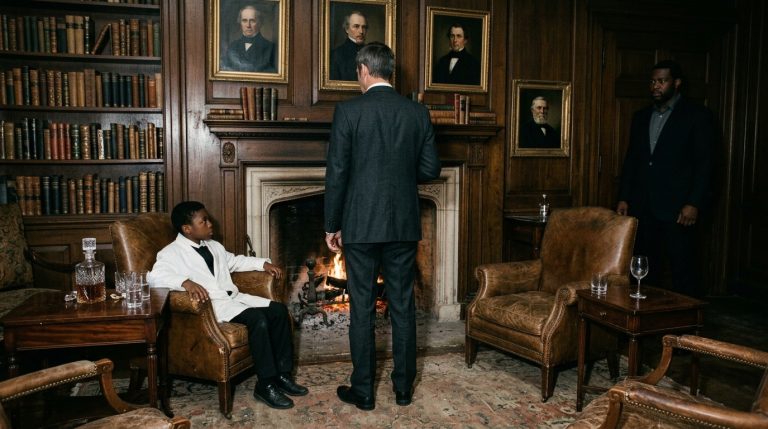
As they reached the green room, the door clicked shut, muffling the roar of the gallery into a distant, muffled hum. The room was a stark contrast to the opulence outside—cream walls, leather chairs, and the faint, dusty scent of fireplace soot that had not seen a flame in a decade.
“Sit,” Hartwell said, gesturing to the seating arrangement. He remained standing for a moment, his hands clasped behind his back, looking at them with a curiosity that felt almost heavy.
Naomi sat, pulling Maya into her lap. Her hands were trembling, so she folded them tightly into the fabric of her uniform. She kept her eyes on the walnut table, tracking the light as it caught the grain, a faded, weathered surface that felt honest compared to the blinding polish of the auction floor.
“You have disrupted a process that has been carefully constructed over decades,” Hartwell said, his voice stripped of the performative edge he used in the auction house. “You understand what that means for your employment.”
“I understand that I am a mother, Mr. Hartwell,” Naomi said, her voice steadying. She looked up, her gaze meeting his with a clarity that surprised her. “And I understand that my daughter has a right to see a world that isn’t built on a lie. If that costs me my job, then it is a debt I am prepared to pay.”
She felt a flicker of phantom movement—a sensation of being watched from the vents, of a shadow shifting in the corner. Her mind caught on the thought: They know. The house knows. It was the paranoia of the survivor, the belief that the system could not be broken without the system eventually reaching out to reclaim its parts.
Hartwell didn’t flinch. He sat, the leather of the chair groaning under his weight. He leaned forward, his focus shifting entirely to Maya. “Maya, tell me—how did you know the water was wrong?”
Maya, usually quiet, leaned forward, her small hands tracing the air. “Monet didn’t paint in mirrors. He painted in time. The water moves. The reflection moves with it. They just… they put the paint down and left it there. It didn’t breathe.”
Hartwell’s expression shifted, a shadow of genuine pain passing through the lines of his face. He looked at the empty fireplace, the Faded Texture of the cold stone catching his hollow gaze.
“Grace,” he murmured, more to himself than to them. “It’s a matter of breathing, isn’t it?”
Naomi watched him, the V-4 variance of her own internal fear gnawing at her. She realized then that Hartwell was not just a bidder, and she was not just a cleaner. They were two people standing on the wreckage of a house of cards, and the real danger—the danger that Sloan Witford represented—was just beginning to form on the other side of the door. The house was not just selling fakes; it was erasing the evidence of the truth. She realized the conservation ledger on B3, the one she had been ignoring for a year, was no longer just an inventory issue. It was a target on her back.
“Mr. Hartwell,” Naomi began, her voice dropping to a whisper. “There is something else.”
CHAPTER 3: Shadows in the Basement
Naomi didn’t look at the fireplace again. She kept her eyes locked on Hartwell, watching for the moment the “businessman” mask slid back into place, but it didn’t come. Instead, he simply nodded, a slow, deliberate movement that acknowledged the shift in the room’s atmosphere. The air felt heavy, saturated with the weight of what she hadn’t said for eleven years.
“B3,” Naomi began, her voice gaining strength, scraping against the back of her throat like sandpaper. “The storage archives. There’s a closet behind the solvent canisters in the southeast corner. It’s not meant to be there. Most of the staff doesn’t even know it exists.”
She could see the ledger in her mind’s eye—the worn, cloth-bound spine, the way the butcher paper felt under her fingers during those midnight inventories. The psychological phantom of that book, the sheer, damning accumulation of dates and names, hit her with a sudden, visceral force. Her hands, resting in her lap, began to ache with the memory of the heavy, cold brass of the closet key.
“If the paintings are part of a cycle,” Hartwell said, his voice quiet, “then there must be a record. A ledger of the commissions.”
“That’s exactly what it is,” Naomi whispered. “I found it a year ago. I didn’t open it for weeks because I was afraid of what I might find. When I finally did, it wasn’t just a list of sales. It was a list of origins—studios in Marseille, Brooklyn, Buenos Aires. It was the birth certificate of every fake that has moved through these doors.”
Hartwell stood up, his movements fluid, the refined grace of a man accustomed to navigating power. He didn’t ask her why she had kept it a secret; he didn’t need to. He saw the way her hand drifted protectively toward the pocket where Maya sat nearby, lost in her own quiet thoughts. He understood the economics of her fear.
“We go tonight,” Hartwell said.
The transition from the green room to the logistics of the heist was jarring, a descent into a reality Naomi had spent a decade avoiding. The plan was terrifyingly simple: an emergency inspection of his own property. It was the kind of maneuver that relied on the arrogance of the Witford family, on the assumption that no one would dare question a man of Hartwell’s stature, even at midnight.
The journey down to the service entrance was a blur of cold, industrial corridors and the hum of an elevator that felt like a coffin. Howard Pace, the building manager, met them with a clipboard and a look of terrified compliance. When they stepped into the B3 archive, the air changed. It was thinner, sharper, tasting of dust and chemical solvent—the smell of the secrets Naomi had kept for herself.
“I need a moment alone to check the cleaning supplies,” Naomi said, her voice sounding foreign in the vast, echoing space.
“We stay within sight of the cameras,” Hartwell agreed, his eyes scanning the periphery.
Naomi walked toward the back wall. The corridor was long, the shadows elongated by the flickering, low-wattage fluorescent tubes that buzzed like trapped insects. Each step was a gamble. Her badge felt heavy in her pocket, the electronic key to her own ruin. She reached the southeast corner, the silence of the archive pressing against her ears.
She knelt behind the row of solvent canisters, the cold metal biting into her knees. Her fingers found the edge of the butcher paper. The texture was exactly as she remembered—stiff, unyielding, a barrier between her and the truth. She pulled it out, the rustle of the paper sounding like a gunshot in the sterile silence of the basement.
She unfolded the corner. The dates, the names, the commissions—it was all there, a roadmap of the corruption that had sustained the Witford name. She felt a surge of adrenaline, a sharp, cold clarity that pushed away the fear. She wasn’t just a cleaner anymore; she was the custodian of the truth.
She tucked the package under her conservation smock, grabbing a roll of cotton wading from the shelf just as she had practiced in her mind a hundred times. As she turned to leave, she caught a glimpse of her own reflection in a discarded, silver-backed mirror leaning against the wall. She looked tired, frayed, a woman holding a secret that could destroy her. But then she caught the glimpse of a shadow near the elevator bank—a figure moving with the precise, practiced stillness of someone who didn’t belong to the night crew.
Sloan. Or someone acting on her behalf.
Naomi’s breath hitched. The fear she had successfully suppressed flooded back, not as a paralyzing force, but as an acute, sensory alert. She didn’t run. She didn’t draw attention. She turned the corner, the cotton wading held loosely in her hand, her heart rhythmically slamming against her ribs, and walked directly toward Hartwell, her face a mask of absolute, calculated composure.
“I found it,” she whispered, her voice barely a breath. “But we aren’t alone.”
CHAPTER 4: The Fragile Evidence
Naomi didn’t look back toward the elevator bank. She pressed her spine against the cold, unyielding concrete of the pillar, her heart rate spiking into a frantic rhythm that threatened to betray her. Beside her, Hartwell stood perfectly still, his silhouette a dark, immovable shape in the dim archive light. He didn’t ask for details; he possessed the rare, tactical intelligence of a man who knew when to listen to the silence and when to act.
“Three o’clock,” she breathed, the words barely vibrating in the air. “Near the service rack. I saw a movement. The shadows don’t fall that way at night.”
Hartwell adjusted his stance, his presence providing a sudden, grounding anchor. He didn’t reach for a weapon, didn’t panic; he simply observed. The archive, usually a place of quiet, orderly decay, now felt like a predatory organism. Every creak of the building—the rhythmic thrum of the HVAC, the metallic settling of the shelving—sounded like an impending confrontation.
Suddenly, the overhead fluorescent lights buzzed with a violent, electric stutter. A flash of white glare illuminated the long aisle, revealing the empty, sterile rows of storage units, and then—darkness. The sudden loss of light left Naomi blind, the afterimage of the shelves burned into her retinas. The smell of ozone—the sharp, acrid bite of a short circuit—flooded the narrow space.
“Stay behind me,” Hartwell commanded, his voice a low, steady rumble.
Naomi felt the brush of his coat against her arm as he guided her toward the cover of the main shelving racks. This was the Butterfly Detour—the artificial failure of the building’s infrastructure designed, she realized with a cold certainty, to force their hand. They were no longer conducting an inspection; they were being hunted in a space they had spent their lives believing was their own.
She reached out, her hand grazing the rough, textured surface of the metal shelving. The grit of concrete dust coated her fingers, a stark reminder of the reality beneath the auction house’s polished veneer. She navigated by touch, each step a calculation of physics and fear. She had to move, yet she had to remain hidden. Her fingers found the edge of the ledger—still tucked securely under her smock—and she felt the terrifying weight of it, the evidence that was currently tearing her world apart.
They reached the conference room on B2. It was a glass-walled box that felt dangerously exposed, yet it was their only path to the forensic photographer. Hartwell slipped inside, his keycard clicking with a sound that felt deafening in the quiet of the basement. Once inside, the darkness was less absolute; the moonlight filtered down through the high-level street vents, casting long, fractured ribbons of gray across the conference table.
“Dolores is waiting,” Hartwell whispered, gesturing toward the back door of the suite.
Naomi didn’t wait. She moved to the table, her hands trembling as she laid the butcher-paper-wrapped ledger on the polished wood. The act of unwrapping it felt like performing surgery on a living, breathing secret. As the pages fanned out, the ledger seemed to hum with the history of the fraud—dates, names, addresses in Brooklyn, Marseille, Buenos Aires—the sprawling, parasitic network that the Witford family had built on the bones of their reputation.
“We have to be fast,” Naomi said, her voice sharp with the need for precision. “Every second we are here, we are making ourselves a target.”
Dolores, a woman with the steady hands of a veteran, appeared from the shadows, her equipment already prepped. She didn’t speak; she simply began the process, the rapid-fire click-whirr of the camera shutter echoing like gunfire against the glass walls. Naomi stood watch, her eyes constantly darting toward the corridor. She was the active driver now; the fear was no longer a weight, but a fuel. She realized that by holding this ledger, she had already crossed the line from passive employee to a force of chaos in the Witford order.
Then, the sound came—a rhythmic, deliberate tapping against the glass of the conference room door. It wasn’t the tentative knock of a night guard; it was the slow, arrogant rhythm of someone who knew exactly who was on the other side.
Naomi’s gaze locked with Hartwell’s. Through the distorted glass, she saw a figure standing in the corridor. A woman in a cream blazer. Sloan.
“Don’t stop,” Hartwell commanded, his voice devoid of emotion.
The tapping turned into a slow, sliding pressure against the glass. Naomi realized with a jolt of horror that the room was being locked down from the outside, the smart-glass systems responding to an executive override. They were being sealed in, and the truth, for all its weight, was suddenly worth less than the price of their silence.
CHAPTER 5: The Glass Threshold
Naomi did not scream. The instinct to make noise, to call out for help, died in her throat, strangled by the cold reality that in this building, there was no one left to hear her. Sloan Witford stood outside the glass, her hands tucked neatly into the pockets of her cream blazer. She didn’t look angry. She looked satisfied, the way a curator might look at a difficult installation finally locked into place.
“He thinks he’s playing a game,” Sloan said, her voice muffled but resonant through the smart-glass barrier. She wasn’t speaking to Naomi; she was speaking to the room, to the history of the house, to the air itself.
Hartwell took a step forward, his shadow stretching across the polished floor toward the door. He tried the handle, but it remained stubborn, fused by the electronic override. He turned, his gaze scanning the ceiling, the wall panels, the subtle, high-tech sensors that had betrayed them.
“The ledger,” Sloan said, her eyes flicking toward the table where the pages were still spread out, the forensic photography interrupted by their sudden imprisonment. “You think that book is a sword, Naomi. You think you’ve finally found the leverage that justifies your long, quiet years in the basement.”
Naomi felt a cold tremor run through her, not of fear, but of profound, aching clarity. She looked at the ledger—at the neat, handwritten entries, the meticulous accounting of a life’s work built on deception. It was just paper. It was just ink. The system Sloan protected wasn’t held together by the contents of that book; it was held together by the people who believed the system was untouchable.
“It’s not a sword,” Naomi said, her voice steady, despite the way her heart thudded against her ribs. She moved to the glass, her hand pressing flat against the cold surface. “It’s a mirror. And you’re terrified of what you see when you look at it.”
Sloan’s smile thinned, a microscopic fracture in her composure. “You’re a cleaner, Naomi. You spend your life erasing the evidence of other people’s existence. Do you really think anyone will care about a ledger found in a supply closet? Evidence, by definition, requires a witness. And tonight, you are both the witness and the liability.”
The room seemed to shrink. Naomi felt the Faded Textures of her life—the years of scrubbing, the late nights, the silent sacrifices for Maya—crystallizing into a single, unbreakable resolve. Sloan was right about one thing: she had been an eraser. But she had also been the one to observe the debris. She knew the layout of this building better than the people who owned it. She knew the service tunnels, the air shafts, the manual override for the freight elevator that Howard Pace had been too terrified to mention.
“Hartwell,” Naomi said, not turning her eyes away from Sloan. “The emergency egress in the ceiling tiles. The fire suppression loop.”
Hartwell looked up, his eyes narrowing as he traced the seam of the ceiling. “You’re certain?”
“I’ve cleared the ducts,” she whispered. “It’s tight, but it leads to the sub-basement freight access. It’s the only way.”
Sloan leaned closer to the glass, her expression shifting from arrogance to a sharp, predatory curiosity. She reached into her pocket, withdrew a slender, gold-plated device, and tapped a command into the console. The lights in the conference room flickered, then dimmed to a harsh, blood-red emergency pulse.
“You can climb through the ceiling, Naomi,” Sloan said, her voice dripping with a casual, cruel elegance. “But where will you go? The lobby is sealed. The staff entrance is flagged. You are trapped in the geometry of this house. And geometry, as I’m sure your daughter would tell you, is a closed system.”
Naomi ignored the bait. She was already moving, dragging a heavy conference chair toward the wall. She climbed onto the upholstery, her hands reaching for the drop-ceiling tile. The grit of fiberglass bit into her skin—a rough, tactile sensation that grounded her. She felt the heavy, metallic frame of the vent, the cool air of the exhaust system pulling against her face.
She looked down at Hartwell. “Take the ledger. Hide it in the lining of your coat. If they catch me, I’m the only one with the key. You have to be the one to carry the truth out.”
“We go together,” Hartwell said, his voice hard.
“No,” Naomi said, her fingers finding the latch. “You are the witness. I am the distraction.”
She didn’t wait for his protest. She pushed upward, the tile yielding with a hollow, scraping sound. As she squeezed into the cramped, dark space of the duct, she looked back one last time. Sloan was still standing there, watching, her face illuminated by the pulsing red emergency light, a woman waiting for the system to correct itself.
Naomi crawled into the darkness, the smell of dust and stagnant air filling her lungs. She had no plan for what happened after she reached the sub-basement, but she knew the texture of the path ahead. It was cold, it was dangerous, and for the first time in eleven years, it was hers. She began to move, the friction of the metal walls against her shoulders a rhythm she could survive. She was the ghost of the auction house, and the house was about to learn that ghosts didn’t just haunt—they broke the structure from within.
CHAPTER 6: The Weight of the Morning
The journey through the service arteries of the auction house had been a study in tactile survival: the rasp of metal against her uniform, the pungent, metallic tang of dust-caked vents, and the singular, frantic focus of preserving the ledger tucked against her ribs. When Naomi finally pushed through the service door into the cold morning air of Madison Avenue, the city felt like a strange, muted landscape.
She did not head for her apartment. She walked directly to the park, the ledger heavy and real against her side. She found a bench near the perimeter, the wood cold and damp with the residue of the night, and sat. Her body was a map of exhaustion, each muscle fiber humming with the lingering vibration of the ductwork. She took the ledger out. It was no longer just a book of crimes; it was a testament.
She reached for her phone—the one Hartwell had given her—and dialed the number for Margaret Voss.
The conversation was brief, transactional, and final. By the time the sun began to bleed over the horizon, painting the limestone facades of the East 70s in a soft, Faded Texture of rose and gold, the machinery of the law had been set into motion. Naomi did not need to be the one to knock on the doors; she only needed to be the one who had opened them.
The weeks that followed were a blur of depositions and quiet, systematic unraveling. The indictment was not a sudden explosion; it was a surgical extraction. Sloan Witford, the woman who had once navigated these floors with the poise of an empress, was escorted from the building not in a blaze of glory, but in the subdued, gray light of a Tuesday morning, her cream blazer wrinkled, her expression finally betraying the fear she had worked so hard to project onto others.
The “Systemic Forgery” was the Layer 1 decoy—the easy answer for the press. But the Layer 2 truth—the “Institutional Erasure”—was what remained in the quiet aftermath. The auction house had functioned not by selling art, but by selling the idea that the institution was above the reach of history. They had cultivated a silence that required the complicity of everyone, from the department heads to the night cleaners. Naomi had been expected to be part of that silence. Instead, she had become its undoing.
On a warm Saturday, months later, Naomi sat on a bench in the Metropolitan Museum of Art. She wasn’t scrubbing floors or checking inventory; she was waiting for Maya, who was finishing a private tour with the curator of the European department.
William Hartwell sat beside her. He looked older, the lines around his eyes etched deeper by the long, arduous process of the trial, but there was a lightness to his posture that hadn’t been there before.
“The Met has finalized the restoration of the Monet,” he said quietly, his eyes tracking a group of students moving through the gallery. “It’s authentic. The forensic team found the true signature underneath the later layers of varnish. It was buried, Naomi. Not by time, but by design.”
Naomi nodded, looking at the painting—the wisteria, the bridge, the water that seemed to catch the light in a way that defied the static nature of canvas. She reached into her bag and pulled out a small, physical object she had carried since the night of the archive: a brass skeleton key from the B3 supply closet, now filed down and smooth.
“They thought they could own the truth,” Naomi said, her voice soft, lacking the sharp edges of her previous fear. “They thought they could lock it away in a basement and leave it to gather dust.”
“They forgot that truth has its own weight,” Hartwell replied. “It doesn’t stay buried.”
She turned the key over in her palm. Symbolic closure. It wasn’t about the ledger anymore; it was about the fact that she had kept the key, not as a weapon, but as a reminder. She had spent eleven years erasing the marks of others, and in the end, she had simply had to stop, and let the truth write its own story.
Maya emerged from the gallery, her face bright, her movements fluid and confident. She walked to the bench and sat between them, her presence an effortless, grounding center. She didn’t talk about the auction, or the trial, or the people who had lost everything because of a small girl’s observation. She talked about the way the light hit the colors in the Monet, and the specific, honest struggle of an artist trying to capture a world that was always moving.
Naomi felt the warmth of the sun on her shoulders. The fear was gone, replaced by a quiet, persistent resilience. She looked at her daughter, then at Hartwell, and then at the painting across the hall. The world was still a complicated, often unfair place, but for the first time, it felt like a world she was no longer just cleaning—it was a world she was finally part of.
She stood up, taking Maya’s hand. The walk toward the exit was slow, the rhythm of their footsteps steady and sure on the polished marble. They didn’t look back. There was no need. The silence of the house had been broken, and in the space where the fear used to live, there was now only the quiet, enduring light of the truth.