The Paper Border: A Siege of Procedure where Silence and Documentation Prove More Lethal than Force
CHAPTER 1: The Gauge of Distance
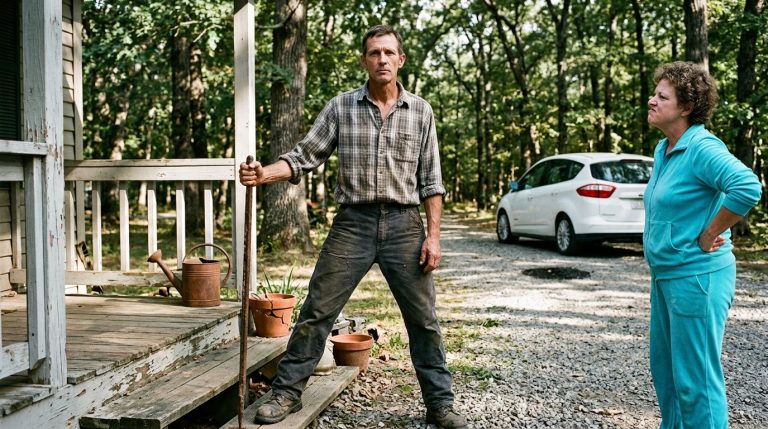
The post stood like a dark finger pointed at my porch, a temporary anchor for a barrier that wasn’t meant to protect, but to possess. Cara Carver stood three feet behind the vendor, her stance relaxed, the practiced smile of a woman who had already drafted the victory speech for the evening board meeting. She didn’t look at me; she looked at the property line, treating the air between us like a physical wall she had successfully conquered.
“Mr. Holloway,” she said, her voice carrying that clipped, professional veneer that irritated the skin like wool. “This is a courtesy. The committee is simply mitigating the liability you’ve created.”
I stood on the edge of the decking, watching the vendor step back, his boots scuffing the gravel that I had raked smooth only yesterday. The gravel was the only thing that moved. The pines were still, the air thick with the smell of dry needles and the metallic tang of the drill battery heating up. It was a sterile, calculated invasion, devoid of the messiness of real anger.
I didn’t answer her. I was counting. One, two, three—the steps to the property line. The distance was exactly twelve feet from where I stood to where the vendor’s boot rested on the edge of my dirt. I focused on the post. It was a cheap, plastic-coated thing, meant to last a season at most. It felt like an insult.
“You’re standing on private property,” I said. My voice wasn’t loud, but it cut through the hum of the departing drill.
“We are defining the safety zone, Nate,” Cara corrected, stepping forward until her toe touched the invisible threshold of the curb. “For the safety of the community, we have to restrict access to hazardous parcels.”
I looked at her, then at the camera mounted on a tripod near the SUV. It was pointed at my porch, framing the chipped paint on my railing and the slight lean of my porch swing—the details they’d use to argue for my irrelevance. They were building a case, not for a court, but for a folder in a cubicle somewhere three counties away.
I let the silence stretch. It was a weapon I’d mastered back when I worked in project management, watching contractors sweat as I waited for them to explain away a missed deadline. Cara checked her watch. She was ready to move to the next phase of her script.
“Your compliance period ends in six hours,” she said, her smile faltering just a fraction at the edges. “If the obstructions aren’t cleared, the carrier will be notified of total non-cooperation.”
I walked down the steps, my boots crunching on the gravel, each step a measured distance. I stopped exactly at the line, inches from her reach. I looked at the post, then at the vendor who was now holding a laminated sign that read RESTRICTED: SAFETY HAZARD.
“You’re not notifying a carrier, Cara,” I said, my voice low. “You’re selling a lie.”
She blinked, the first sign of a crack in the veneer. Then she reached out, grabbing the sign from the vendor. “We are protecting residents.”
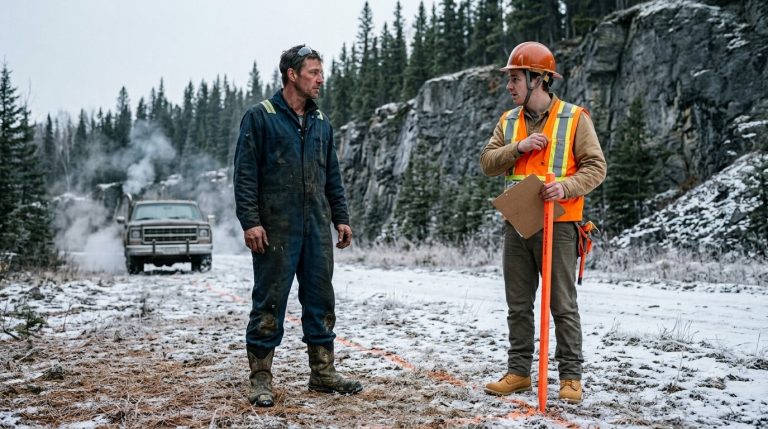
I watched her hand. It was trembling slightly, hidden well by the stiffness of the lamination. That was the detail—the flicker of uncertainty behind the steel. I looked past her to the post and noticed something that hadn’t been there when I checked the driveway this morning: a small, bright orange plastic stake driven deep into the dirt next to the post. It wasn’t HOA equipment. It was a surveyor’s marker.
The realization hit me with the weight of a stone. This wasn’t about aesthetics. It wasn’t even about the insurance.
I turned back to her, and for the first time, I smiled. It wasn’t a friendly expression, and it made her take a half-step back. “That marker,” I said, pointing to the orange stake. “Who put that there?”
Cara’s face went completely blank, the smile vanishing as if someone had flicked a switch. She glanced at the post, then at the vendor, and finally back to me, her eyes hardening into something predatory. “You’re not a resident, Nate. You’re just a hazard we’re about to clear.”
CHAPTER 2: The Geometry of Exposure
Cara’s silence was not the silence of someone who had been caught; it was the silence of a calculator processing a new variable. She didn’t retreat. Instead, she adjusted her posture, pulling her shoulders back until the seams of her blazer strained, and shifted her gaze from me to the orange stake at her feet. It was a small, vibrant piece of plastic, but in the gray, flat light of the morning, it looked like a flag planted on a conquered hill.
“The stake,” I repeated, keeping my voice steady. The cold air felt thin in my lungs, sharp and metallic. “It’s not HOA standard. Who requested the survey, Cara?”
She finally met my eyes, and the performance of the neighborhood committee head evaporated. In its place was someone far more clinical, someone who viewed the landscape not as homes and pines, but as a grid of coordinates and liabilities. “You’re reading too much into a utility marker, Nate. Cedar Ridge is expanding its infrastructure. We’re simply identifying the boundaries of the easement.”
“There is no easement for expansion on this plot,” I said. “I’ve checked the county records twice.”
“Records change,” she replied, her voice dropping an octave, losing the bright, practiced lilt. “Development priorities shift. If you weren’t so obsessed with playing the hermit, you’d realize that fighting the tide only makes the drowning take longer.”
She turned and signaled to the vendor. He didn’t hesitate. He packed the drill into his case, the metallic clack of the latches echoing off the gravel. They were leaving, but they weren’t backing down. They were simply changing the venue.
I watched them climb into the white SUV. As the engine turned over, the sound was guttural—a low, mechanical rumble that vibrated through the soles of my boots. I didn’t move until the vehicle cleared the drive and turned onto the main road, its tires kicking up a spray of dust that hung in the stagnant air.
I walked over to the orange stake. It was driven deep into the earth, the soil around it packed tight and damp with morning frost. I gripped the plastic head and pulled. It resisted, held fast by the clay-heavy ground, suggesting it hadn’t been planted by a casual worker, but by someone who knew exactly how to anchor a perimeter. My pulse spiked, a steady, rhythmic thrum in my temples. It wasn’t fear; it was the cold, clarifying focus of a problem that finally had a shape.
I went back inside. The kitchen was still quiet, the hum of the refrigerator the only sound. I sat at the table and opened my laptop, pulling up the county’s GIS portal. I pulled the parcel map for Cedar Ridge, overlaying the aerial imagery. For years, I’d looked at this map as a shield, a visual representation of my autonomy. Today, I looked for the seams.
I toggled the layers—utility easements, sewage lines, historical mineral rights. Most of the subdivision was flat, predictable, designed on a grid. But as I zoomed in on my three acres, I noticed a jagged, irregular line slicing through the northeast corner of my property, a remnant of a 1940s survey that had never been properly reconciled with the modern subdivision plat. It was a ghost line, a technical discrepancy that shouldn’t have mattered—unless someone was specifically looking for a way to break the grid.
My phone buzzed against the wood of the table. A text from Maya.
The carrier just escalated. They’re no longer asking about the HOA complaints. They’re asking about the mineral survey discrepancy flagged by a third-party developer. They want a response in 48 hours.
I stared at the screen. The developer wasn’t just working with the HOA; they were using the HOA to force a “risk evaluation” that would expose the survey error to the insurers, creating a manufactured crisis. Once the insurance carrier deemed the land “high risk” due to the undefined easement, the utility expansion wouldn’t just be an encroachment—it would be a legal necessity.
I stood up and walked to the window. The mist was beginning to burn off, revealing the outline of the pines, their branches stark against the pale, bruised sky. I needed to see what was behind the “Hearthsafe” consultant company. If they were the ones feeding the data to the carrier, they had to be traceable.
I grabbed my coat. I wasn’t going to call a lawyer again—not yet. I needed to do what the HOA was doing, but with better data. I grabbed my camera, checked the battery, and headed out toward the back of the property, where the trees gave way to the overgrown buffer zone that bordered the main access road for the proposed development.
The air was biting, but the movement helped. Every step was a calculation. I avoided the main path, staying low within the tree line. The forest here was dense, the ground soft and uneven. I reached the edge of the rise overlooking the development site. Down below, hidden by the rise and a screen of thick brush, was a small, temporary trailer office. It had no branding, no signage, just a bank of external lights and a high-gain antenna pointed toward the subdivision.
I pulled out my camera and zoomed. Through the lens, I could see two men standing by the entrance, holding a roll of blueprints. They weren’t dressed like construction workers or HOAs. They were dressed like architects, their movements precise, their attention fixed on the digital tablet one of them held.
I took a series of high-resolution shots. I was looking for a logo, a project name, anything that connected this site to the “Hearthsafe” consultant. Then, the man holding the tablet tapped the screen, and for a split second, the light reflected perfectly off the glass, illuminating a project name in bold, crisp letters: CEDAR RIDGE UTILITY CORRIDOR – PHASE 1.
It was the smoking gun. The “community safety” project was a lie; it was a commercial utility corridor designed to bypass the expensive easements on the main road by cutting through the neglected “ghost line” on my land.
I felt a sudden, sharp draft of wind through the trees, making the pines sway and groan. I crouched lower, my breath hitching as I realized that the HOA hadn’t just been bullying me; they had been scouting for a corporate entity that was about to make my quiet, three-acre sanctuary the centerpiece of a multi-million dollar expansion. And the clock was already ticking.
CHAPTER 3: The Weight of Evidence
The sound of their voices drifted down through the floorboards of the trailer, muffled and rhythmic, like the steady thrum of an idling engine. I pressed myself flat against the damp earth, my cheek grazing a patch of coarse, wet gravel. My heart hammered against my ribs, each thud a frantic counting of seconds. I had the photo—the CEDAR RIDGE UTILITY CORRIDOR sign was burned into my camera’s digital memory—but the evidence was useless if I didn’t survive the next three minutes to walk away with it.
Above me, the heavy tread of boots vibrated through the metal frame of the trailer. They were moving toward the exit. I held my breath, the taste of soil and damp pine needles filling my mouth, and focused on the space between the trailer’s support beams. If they walked around the perimeter to inspect the site, they would pass within inches of my position.
“The survey error in the northeast corner is the linchpin,” a man’s voice said, crisp and devoid of any hesitation. It wasn’t Cara. This voice was colder, more authoritative, the kind of voice that spoke in budgets and legal contingencies. “Once the carrier flags the policy, the liability issue becomes insurmountable. He’ll be forced to sign the easement or face foreclosure. It’s simple pressure.”
“And if he doesn’t?” a second voice asked.
“He’s a single homeowner with a three-acre parcel,” the first voice replied, followed by the metallic click of a lighter. “Nobody fights a utility expansion indefinitely. We’ll just increase the pressure until he breaks. The HOA is the blunt instrument; we’re the surgeons.”
The footsteps stopped directly above me. My muscles burned, locked in a painful, static tension. I didn’t dare shift, didn’t dare blink. I watched a pair of polished, black oxfords appear in my field of vision, standing just outside the trailer’s frame. They weren’t the boots of a construction manager. They were the footwear of a corporate executive, clean and absurdly out of place in the mud of a development site.
I needed to move, but the risk was absolute. If I was caught, I wouldn’t just be an “obstruction” anymore; I would be a security threat. I waited for them to move, my gaze fixed on the shadow of the man standing just a few feet away. The wind shifted, rustling the heavy canvas of the nearby equipment shed, and in that split second of auditory cover, I began to crawl.
It was slow, agonizing work. I moved inches at a time, my elbows and knees sinking into the soft mud. I had to ensure that not a single twig snapped, not a single pebble skittered. My shoulder brushed against one of the trailer’s concrete footings, and a tremor ran through my arm. The man above shifted his weight, the metal frame groaning in protest, but he didn’t look down.
I kept moving, back toward the dense brush that served as the property’s natural boundary. I didn’t stop until I reached the base of a large pine tree, its thick, furrowed bark offering the first real concealment. I stood up slowly, my joints popping in the quiet air, and looked back once at the trailer. The two men were still talking, oblivious to the fact that their entire legal and operational strategy had just been overheard and documented.
I didn’t head straight back to my property. That would be too predictable. I cut a wide, jagged arc through the woods, keeping low, my mind racing through the implications of what I had heard. The mineral survey error—that was the key. They weren’t just guessing; they knew exactly where the weak point in my deed was. The HOA was merely the hammer, but this developer was the one holding the compass.
When I finally reached the gravel of my own drive, the sun had already begun to dip behind the ridge, casting long, bruised shadows across the pines. I walked to my back door, the familiar creak of the hinge a small, comforting note in the silence. Inside, the house felt different—not a sanctuary anymore, but a fortress under siege.
I went to my desk and opened my laptop, pulling the files I had gathered. I uploaded the photos to a secure, off-site cloud server, then backed them up to two separate encrypted drives. I looked at the images of the trailer, the blueprints, and the men in their polished oxfords. I was playing a game of chess where the pieces were made of legal maneuvers and professional reputations, but the board had been shifted under my feet.
My phone rang. It was an unrecognized number. I let it go to voicemail, watching the screen light up in the dimming room. A moment later, the notification pinged. “Mr. Holloway. We noticed you enjoying the view today. Perhaps you should reconsider the wisdom of wandering into private construction zones. It would be a shame if your insurance review were to discover unauthorized trespass on your own record. Think about it.”
I deleted the message without listening to it. The intimidation was predictable, a blunt attempt to trigger the very panic I had trained myself to suppress. But as I sat in the darkening room, the silence of the house pressing in on me, I realized that the “survey error” wasn’t just a technicality. It was a structural vulnerability in my life.
I walked to the kitchen window and stared out at the dark, silent pines. The HOA, the developer, the carrier—they were all moving in tandem, closing the circle. I needed someone who could navigate the legal machinery of land rights, someone who saw the world in the same cold, pragmatic geometry as I did. I picked up the phone and dialed Julia Reyes’s office. It was well past business hours, but she was the only one who understood that this wasn’t about a neighborhood dispute. It was about defining the border of my existence before they decided to move it for me.
“Julia,” I said, when she finally picked up. “Forget the TRO. We need to go after the mineral survey records. They’re building a case on a phantom line, and I need to prove it’s a fabrication before the carrier finishes their review.”
“Nate,” she replied, her tone sharp and cautious. “If we do that, we’re not just defending your property. We’re declaring war on the entire development project. You realize the cost of that, don’t you?”
“I’m already in the war, Julia,” I said, watching the shadows stretch across the kitchen floor. “I’m just deciding who gets to set the terms.”
CHAPTER 4: The Friction of Authority
The air in the county records office was heavy, saturated with the scent of dust and the faint, chemical tang of toner. It was a space designed to suppress urgency, where time moved in the slow, grinding cycles of bureaucratic processing. I stood at the high oak counter, my hands gripping the edge of the wood until my knuckles turned white. Across from me, a clerk with thick-rimmed glasses and a permanent expression of professional detachment slowly thumbed through a stack of requisition forms.
“The 1944 mineral survey for the Cedar Ridge quadrant,” I said, my voice sounding unnervingly loud in the quiet chamber. “I requested the digital copy this morning. My attorney, Julia Reyes, filed the inquiry.”
The clerk didn’t look up. She finished her page, made a slow, deliberate mark with a red pen, and then finally tilted her head. “That file is currently under review, Mr. Holloway. It was pulled this morning by a representative from the county safety board.”
The floor seemed to tilt beneath me. “The safety board? They have no jurisdiction over mineral records.”
“They do when the file is linked to an active zoning or utility easement claim,” she replied, her tone as flat as the paper she was shuffling. “Per the instruction, that record is now restricted. You’ll need to file a formal request for access through the board’s legal liaison.”
I leaned in, my shadow falling across her desk. “That record is a public document. It’s part of the foundational deed registry. You can’t just seal it because someone from a utility project asks for a review.”
“I don’t make the policy, sir,” she said, her voice dropping into a register that signaled the conversation was effectively over. “If you have a grievance, the board office is on the third floor. I suggest you hurry; they close in twenty minutes.”
I left the counter without another word. The walk to the third floor felt like moving through deep water, every second ticking away the stability of my insurance policy. The threat wasn’t just physical anymore; it was foundational. They were stripping the truth out of the archives, effectively erasing the record of my land’s boundary so they could write their own history into the deed.
When I reached the board office, the door was already cracked open. Inside, a woman in a sharp, slate-gray suit was standing at a shredder, her back to me. She was feeding a thick file into the machine, the mechanical whine of the blades shredding the paper in a continuous, rhythmic stream. I recognized the silhouette instantly. It was a junior partner from the firm that represented the developer I’d seen in the trailer the night before.
I didn’t knock. I stepped into the room, the sound of my boot on the polished floor causing her to freeze. She turned, her face a mask of practiced calm, though her eyes betrayed a flash of genuine surprise.
“Mr. Holloway,” she said, her voice smooth and entirely devoid of heat. “You’re lost. This is a private planning session.”
I walked toward the shredder, my gaze locked on the pile of documents still resting on the desk. My pulse was a dull roar in my ears, but my movements were precise. “That’s my deed history you’re destroying,” I said, my voice tight. “That’s a felony, Counselor.”
She leaned back against the desk, crossing her arms, her expression shifting into one of pity. “It’s a redundant filing error, Nate. We’re streamlining the survey discrepancies for the infrastructure upgrade. You really shouldn’t be here. It’s a violation of the building’s restricted access policy.”
“You don’t get to erase history because it’s inconvenient for your utility corridor,” I said, reaching for the remaining stack of papers.
She didn’t move to stop me, which was the first sign that I had already lost. Two security guards stepped into the doorway, their presence quiet and professional, their hands resting near their belts.
“Mr. Holloway,” the woman said, gesturing toward them. “You’ve been warned about trespassing on ongoing utility assessments. If you don’t step out of this room, I will have the deputy on the first floor escort you out, and your insurance carrier will be the first ones to receive a report on your erratic and disruptive behavior.”
The cold reality of the situation washed over me. I had been playing a game of procedure, assuming that the truth was a fixed point, but they weren’t interested in the truth. They were interested in the process. If they could frame me as a violent, unhinged property owner, the carrier wouldn’t even look at the survey discrepancies. They would just cancel the policy, and with it, my ability to fight back.
I looked at the shredder, then at the guards, then back at the counselor. She held my stare, her expression one of utter, terrifying indifference. I turned and walked out of the office, the weight of the moment pressing down on me like lead. I had hit the wall—the point where the paper-thin reality they were building around me was about to become the only truth that existed.
As I walked out of the building, the sun was already gone, replaced by a cold, unrelenting drizzle. My phone buzzed in my pocket. It was Maya.
Nate, I’m sorry. The carrier just called. They’ve decided to move forward with the non-renewal. They cite ‘unstable site conditions’ and ‘ongoing litigation risk.’ Your coverage lapses in forty-eight hours.
I stopped on the sidewalk, the cold rain soaking into my jacket. The streetlights flickered to life, bathing the city in a sickly, yellow haze. They had won the first round—they had stripped me of my protection. I wasn’t just an obstacle now; I was an exposed target. I walked to my truck, my movements stiff and calculated, my mind already running the numbers. I was alone, outmaneuvered, and the clock was counting down, but I had one piece of information they didn’t know I had. I knew exactly where the ghost line began, and if they wanted to destroy the record of it, they’d have to get past the physical reality of the land itself.
CHAPTER 5: The Geography of Deception
The silence in my kitchen was no longer a comfort; it was a pressurized container. Outside, the rain had turned into a steady, gray curtain, blurring the edges of the pines and making the driveway look like a river of black oil. I didn’t pace. I didn’t check my phone. I went to the back of the house, to the crawlspace access I hadn’t opened in years, where my father’s old blueprints and property files were stored in rusted steel cabinets.
The air in the crawlspace was stale, heavy with the scent of damp earth and aging paper. My flashlight beam cut through the dark, illuminating the thick layer of dust covering the metal boxes. I worked with the methodical, low-energy efficiency of a man who knew he was running out of time. I pushed aside old tax returns and half-forgotten architectural sketches, my hands moving until they touched the cold, flaking edge of a leather-bound folio.
I pulled it out, the leather cracking under my grip. Inside, tucked behind a brittle, yellowed diagram of the original homestead, was the document I needed: the original 1944 mineral survey map. It was hand-drawn in ink that had faded to a sepia tone, the lines delicate but precise. As I spread it out on the dusty concrete, I saw it—the discrepancy. The “ghost line” wasn’t just a survey error. It was a notation indicating a mineral vein that hadn’t been documented in the modern plat. The developer wasn’t just building a utility corridor; they were positioning themselves to claim the mineral rights through a forced easement.
It was a land-grab hidden in the language of infrastructure, and it was brilliant. If they could get the land declared “unsafe” and force a re-survey under the guise of an easement, they would legally inherit the rights to the underlying mineral seam.
I heard a sound then—the crunch of tires on wet gravel.
I didn’t need to look out the window to know who it was. The rhythm of the vehicle, the way it stopped just short of the curb, was a signature I had learned to recognize. I folded the map, slid it into my inner jacket pocket, and stood up, my knees popping in the quiet. I walked back into the kitchen just as the front door rattled. A heavy, insistent knock echoed through the house.
I opened the door to find Cara Carver standing on my porch, drenched by the rain, her hair clinging to her face. She wasn’t smiling. She looked tired, her eyes rimmed with red, her composure eroded by the same high-stakes pressure she had tried to apply to me.
“We need to talk, Nate,” she said, her voice lacking its usual, razor-sharp edge. “The developer—they’re not playing by the rules. You think you’re fighting me? You’re a footnote to them.”
“You’re the one holding the hammer, Cara,” I said, stepping back to let her in, though I kept my hand near the door frame, ready to shut it. “Don’t pretend you’re an innocent bystander.”
She stepped inside, shaking water from her coat onto the floorboards. She looked around the house, her gaze lingering on the stacks of files and the open laptop on my table—the evidence of a counter-campaign she hadn’t expected. “They’re cutting the board out,” she said, her voice dropping to a whisper. “The safety audits, the insurance threats—that was all their initiative. They needed to clear the path, and they’ve decided the easiest way to do that is to dissolve the HOA’s current standing and move straight to eminent domain. You’re going to lose the house, Nate, and I’m going to lose my position.”
“Why tell me now?” I asked, watching her closely.
“Because I realized something,” she said, finally meeting my gaze. “They don’t care about the community. They care about what’s under the soil. And once they get what they want, they’ll discard everything in their way.”
She reached into her bag and pulled out a digital tablet, sliding it across the table. It was a live feed—not of my house, but of the developer’s private server. It showed a list of properties marked for immediate transition, and at the top was mine.
“I’m done with them,” she said. “But I don’t know how to stop the insurance cancellation. If that policy lapses, you have no legal standing to contest the eminent domain filing. You’re a non-entity without that insurance.”
I looked at the tablet, then at the map tucked in my pocket. The pieces were shifting. She wasn’t changing sides out of morality; she was changing sides because she’d realized she was a disposable asset in a larger game.
“I have the original survey,” I said, watching her face for a reaction. “The one that proves their easement is based on a fraudulent plat.”
Cara went still. The air in the room seemed to vanish. “If you take that to the county now, the developer will bury you before the clerk even logs the file. They own the administrative oversight.”
“Then I don’t take it to the county,” I said. “I take it to the source.”
I grabbed my jacket. The rain was still falling, a relentless, rhythmic drumming on the roof that seemed to underscore the absurdity of the situation. We were two people who had spent weeks trying to destroy each other, now standing in a drafty house, both of us realizing that the real enemy was standing just outside the gate, waiting for the policy to lapse so they could tear everything down.
“Where are you going?” she asked, her voice tight.
“To find out who actually holds the title to the mineral rights,” I said, opening the door. “If it’s not the developer, then their entire easement claim is a legal fiction.”
I didn’t wait for her to answer. I walked out into the rain, the cold water soaking through my clothes instantly, my mind already calculating the next move. I was going to force them into a confrontation on my terms, not theirs. And I was going to do it before the clock hit zero.
CHAPTER 6: The Quiet Boundary
The rain had intensified, a relentless percussion on the roof of the trailer office. I stood in the doorway, the original 1944 survey map shielded under my jacket, feeling the weight of it—the paper brittle and thin, yet heavy enough to collapse their entire operation. The lead architect, a man whose expensive suit looked ridiculous against the backdrop of the muddy construction site, stared at me with a mix of shock and dawning realization. He knew what the map meant: the mineral rights were never in play. The vein they had been hunting was located on state-owned land a mile north; they had been targeting my property only because of a clerical error they had hoped to hide.
“You don’t understand the reach of this project,” he said, his voice straining to regain the authority he’d held minutes ago. “We have the county, the board, the insurance—”
“You have a lie,” I cut him off, my voice steady against the roar of the downpour. “I’ve already transmitted the scan of this map to the state inspector and the local district attorney’s office. You don’t own this land, and you don’t own the mineral rights beneath it. You were just hoping I wouldn’t know the difference between a survey error and an easement.”
The silence that followed was total. Even the rain seemed to recede into the background. The architect’s eyes flickered to the trailer’s door, then back to me, measuring the distance. He knew. The game wasn’t just over; it had been rigged in my favor the moment I’d found the physical evidence they had tried to destroy. The threat of the insurance lapse, the staged compliance visits—it all fell away, revealed as the desperate, frantic maneuvering of a thief caught in the act.
He didn’t move. He didn’t speak. He simply stood there, his confidence crumbling as he realized the weight of the investigation that would follow. I turned around, walking back toward my truck, the gravel crunching under my boots with a sound that felt, for the first time, like the foundation of my own home. I didn’t look back to see him scramble for his phone. I didn’t need to. The mechanism of their power had broken; the truth had been reasserted.
The drive back to the house was slow. The road was slick with mud, the tires struggling for grip, but I felt a strange, detached calm. When I pulled into my drive, the porch lights were on, casting a warm, steady glow against the encroaching dark. Cara was still there, sitting on the porch steps, her coat wrapped tightly around her. She looked up as I stepped out of the truck, her face unreadable.
“Did it work?” she asked, her voice barely audible over the wind.
“It’s over,” I said, walking past her to the front door. “They’re packing up. The DA has the map. The insurance carrier already received a rescission of the non-renewal notice.”
She stood up, her movements slow, uncertain. “What happens to the HOA now?”
“The HOA survives, if it wants to,” I said, pausing at the door. “But you’re going to have to decide if you want to keep playing the architect of someone else’s greed, or if you actually want to be a neighbor.”
She didn’t answer. She looked out toward the dark, quiet line of the pines, then turned and walked back toward her own car. I watched her go, the tail lights fading into the mist, and for a moment, I felt the immense, crushing weight of the last few weeks lift.
I went inside and closed the door, the heavy bolt sliding home with a final, satisfying click. I went to the kitchen and found the small section of fence they had tried to mark with their sign. I pulled the zip ties loose—the plastic snapping with a sharp, clean sound—and tossed the laminated warning into the recycling bin. It was junk. It had never been anything else.
I sat down at my table, the silence of the house finally returning to its natural state. I pulled out my tools—a small set of hand-planes and some wood glue—and turned my attention to the porch swing I had been meaning to fix for months. I spent the next hour working, the rhythmic sound of the plane smoothing the wood, the smell of fresh cedar filling the room. It was slow, manual work—the kind of work that had a beginning, a middle, and a resolution.
When I was finished, I stepped back out onto the porch and sat down. The swing moved once, a soft, steady motion, and then settled into the dark. The pines were still. The property line, once a place of tension and maneuvering, felt like what it had always been: just dirt and trees. I took a deep breath, the air clean and cold, and let it out. The war was over, but the work—the slow, quiet, manual work of living here—was only just beginning. I leaned back, watched the sky begin to clear, and listened to the silence.