The Mountain Remembers Every Deed: How a Quiet Local Outsmarted a Million-Dollar Corporate Takeover
CHAPTER 1: THE FRESH ASPHALT
The grease on my knuckles was cold by the time the diesel rumble rattled the tin roof of the shop. I didn’t look up from the universal joint I was cleaning in the solvent tank. Down on the lower ridge, the heavy machinery was chewing through sixty years of packed gravel and frozen pine needles.
Vivien stood beside a shiny yellow bobcat, her cashmere sweater looking entirely out of place against the gray granite cliffs. She pointed a manicured finger toward the tree line, barking instructions at a crew of contractors who looked thoroughly uncomfortable.
My grandfather Ezra had laid that gravel down with a rusted Ford dump truck and a bad back fresh off the boats from Europe. He didn’t build it for luxury. He built it so winter didn’t mean starvation or isolation for forty families huddled against the Montana frost.
The machine blade scraped iron-hard earth, lifting a screech that set my teeth on edge. Vivien pulled a sleek tablet from her pocket, recording the destruction with a bright, triumphant grin that didn’t reach her eyes. She wasn’t just clearing a path; she was putting a neon sign over my family’s history.
I wiped my hands on a greasy rag, the rough cotton catching on the calluses across my palms. My chest tightened with a slow, heavy heat, but my breathing stayed steady. Out here, panic didn’t fix a busted axle, and it certainly wasn’t going to stop a corporate lawyer with an HOA budget.
She turned her head, catching me watching her from the dark doorway of the shop. Her chin lifted higher, a silent challenge wrapped in expensive perfume and unearned authority. She thought she had won the mountain before the snow even started falling.
I didn’t wave, and I didn’t shout across the clearing. I just rolled a scarred brass plumb bob between my fingers, feeling its cold weight anchor my temper. Let her pave all she wanted. Asphalt didn’t change what was written in the county records.
CHAPTER 2: THE FAKE SURVEY
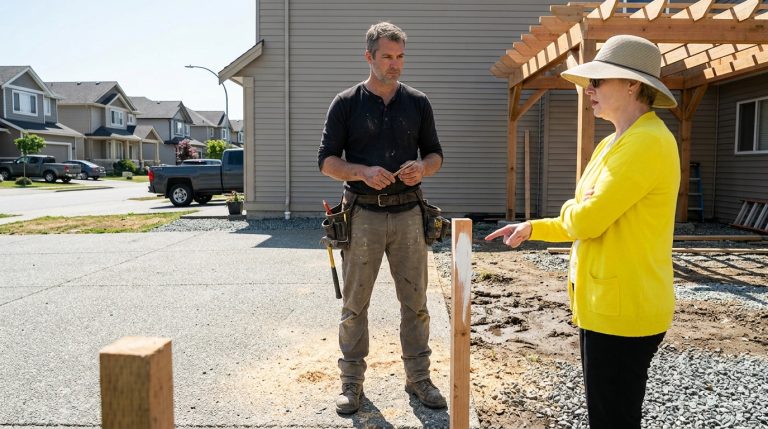
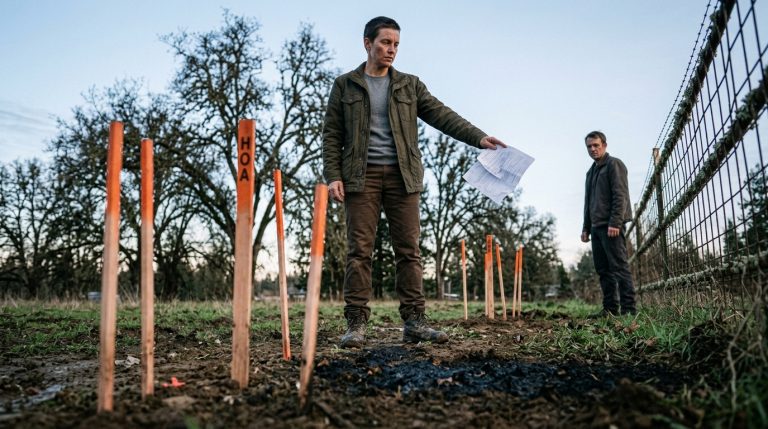
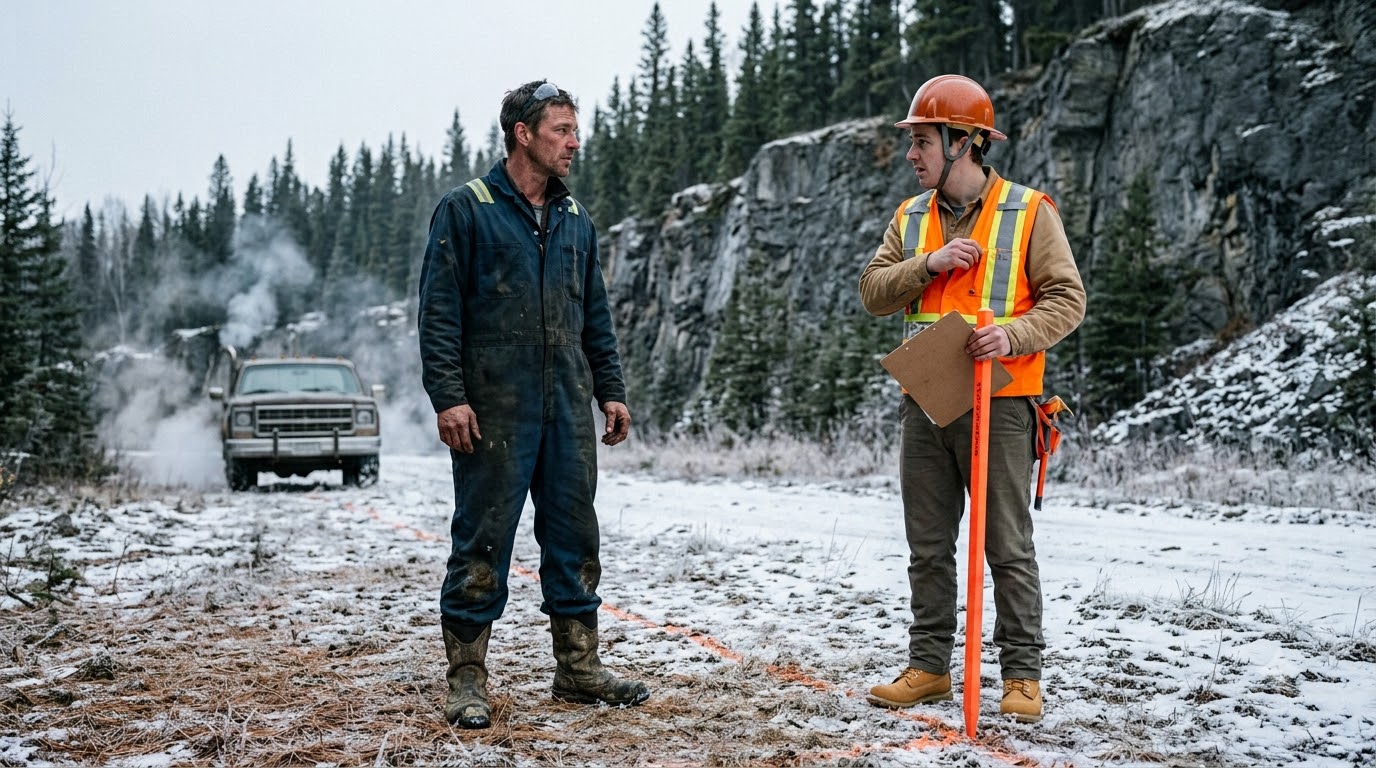
The orange plastic stakes looked entirely too bright against the dull gray slate of the timberline. I stepped out of the shed just as a man in a crisp high-visibility vest slammed a wooden mallet into the frozen sod fifteen feet inside my northern boundary.
He didn’t look like any county surveyor I had ever seen. His boots were pristine, and his transit scope still had the factory sticker peeling off the side housing.
“You’re off by half a football field,” I said, my voice carrying flat across the frozen gully.
The man jumped, nearly dropping his clipboard onto the frost. He forced a thin, corporate smile and adjusted his hard hat. “State environmental boundary assessment under the new Glacier Ridge development charter. We are just making sure your drainage matches code.”
He reached down to pick up a brass-tipped marker, but his fingers slipped twice against the cold metal. His professional gear looked entirely brand-new, the kind of equipment bought in a hurry from a catalog when you expect it to break before the job is finished.
“The county surveyors use heavy brass plates stamped in Helena,” I said, walking slowly toward him down the frozen path. “They don’t use spray-painted pine dowels from a hardware store.”
The surveyor’s eyes flicked nervously toward his truck idling on the track, the exhaust puffing thick white clouds into the mountain air. “Look, I’m just doing what the management firm paid me to do. They want the buffer zone widened.”
Management firm. Not the state. Not the county.
I stopped three paces from him, keeping my hands loose at my sides while the wind whipped dry pine needles across our boots. “Pull out your license number and your state authorization card.”
He fumbled in his breast pocket, his fingers trembling slightly under the cold and the unexpected pressure. “Left it in the glove box. I can go grab it.”
“Don’t bother,” I said, pointing at the truck door where a faded decal had been hastily scraped off, leaving a pale square of bare paint. “The number on your side panel belongs to a defunct landscape outfit out of Billings that went under three years ago.”
He swallowed hard, his throat working visibly beneath the chin strap of his hard hat. He didn’t argue, and he didn’t try to defend the fake paperwork.
He just dropped the mallet into the frozen grass, turned on his heel, and scrambled back toward his truck without another word. The gravel flew as he threw it into reverse, sliding on the icy grade before gripping the track and vanishing down toward the valley.
I walked over to the freshly driven stake, pulled it out of the ground with a sharp tug, and tossed it into the back of my truck. Vivien wasn’t just trying to bully us with lawyers anymore; she was manufacturing physical evidence right on my land.
CHAPTER 3: THE FABRICATED VIOLATION
Dakota stepped out of her truck holding a clipboard thick enough to stop a bullet. She wore heavy mud boots and looked like someone who had spent her entire life walking rough country instead of sitting behind a corporate desk.
“I received a forty-page complaint about severe watershed contamination and ecosystem collapse on this ridge,” she said, her voice cutting sharp through the morning wind.
“Take a look around,” I answered, gesturing toward the pine-lined slope. “Does this look like Chernobyl to you?”
She flipped open the report, her eyes scanning the glossy printouts before looking up at the trail itself. The path was lined with native rock barriers and hand-dug drainage ditches my grandfather had engineered back when Eisenhower was in office.
“The paperwork claims chemical runoff from snowmobiles destroyed a protected alpine flora habitat,” Dakota said, her brow furrowing as she pulled a photograph from the file.
I leaned closer, pointing a grease-stained finger at the corner of the state’s photographic evidence. “Look at the corner of that flower patch. That’s a plastic price tag sticking out of the dirt. You can buy those down at the garden center in town.”
Dakota stared at the photo, then down at the actual ground beneath her boots. She crouched, brushed aside a dusting of pine needles, and let out a short, dry chuckle that held no humor.
“These species don’t even grow above three thousand feet,” she muttered, standing back up and tapping the clipboard against her thigh. “And this erosion pattern isn’t from fuel leakage. It’s standard spring snowmelt runoff from two years ago.”
She tucked the false report back into her folio, her jaw tightening with professional irritation. “Whoever compiled this didn’t just exaggerate. They fabricated the data to build a land-use restriction case.”
“It’s a front for a resort expansion down in the valley,” I said, rolling the brass plumb bob in my pocket. “They need the easement locked down so tourists don’t cross their property line.”
Dakota looked down the mountain toward the sprawling frame of the new chalets rising in the distance. “They picked the wrong trail to target.”
She didn’t write a single citation against my land. Instead, she pulled a fresh notepad from her jacket, asking for copies of my grandfather’s forty-year maintenance logs.
CHAPTER 4: THE ADA TRAP
The envelope contained forty-seven pages of federal paperwork claiming our narrow mountain track had systemically discriminated against disabled recreationists for six decades. Vivien was demanding two point seven million dollars in damages or an immediate rebuild featuring concrete switchbacks and wheelchair ramps across forty-degree granite slopes.
You couldn’t even stand upright on those grades in summer, let alone push a chair.
“They’re throwing federal compliance codes at a primitive utility easement,” I said, sliding the document across the kitchen table.
Dennis, a retired master sergeant whose porch sat three doors down from mine, didn’t even look at the numbers. He just rubbed his thumb over the jagged scar along his jawline, his eyes locking onto mine with grim intensity. “She thinks federal paperwork scares mountain folks who survived sixty winters out here.”
“The law exempts primitive trails established before nineteen-ninety,” I answered, tapping the edge of the table. “Retroactive enforcement won’t stick unless there’s an actual public utility mandate.”
“Doesn’t matter what the law says if her lawyers bleed us dry in district court first,” Dennis muttered, leaning forward and resting his palms flat on the grain.
We didn’t wait for a formal town meeting. Dennis made two phone calls to the regional veterans chapter, and within forty-eight hours, a dozen men and women who had spent their lives defending real borders mobilized like it was D-Day. They didn’t come with signs or megaphones; they came with organized legal defense funds and decades of institutional memory.
The local American Legion hall opened its back conference room for our strategy sessions, filling the space with the smell of cheap coffee and burning resolve. Vivien’s attempt to weaponize disability guidelines against a mountain community had completely backfired, uniting every veteran and hunter from here to the county line.
She thought she had us trapped in a corner. She didn’t realize she had just woken up a hornet’s nest.
CHAPTER 5: THE SILENT CHECKMATE
We let them spend the millions.
While Vivien and her corporate backers poured concrete barriers across our family’s trail and booked four thousand skiers for the upcoming holiday weekend, we stayed silent.
I sat at my workbench late into the night, tracing the faded ink of the 1963 contract my grandfather signed with the original land syndicate. Buried deep in appendix section four was a single, reciprocal clause that the high-priced California attorneys had completely glossed over.
If the resort ever blocked or shut down the historic mountain easement, all reciprocal rights to cross our quarter-mile access road were instantly and permanently revoked.
Every chairlift delivery, every guest shuttle, every plumbing truck and kitchen supply run depended entirely on that quarter mile of dirt road crossing my property.
By pouring permanent concrete over the trail, Vivien hadn’t just blocked us—she had triggered a trap door beneath her entire business model.
The heavy machinery finished its work on Friday afternoon, sealing the upper ridge with thick grey barriers while the resort management popped champagne in the main lodge. I didn’t call the sheriff, and I didn’t file an emergency injunction.
I just loaded a heavy steel pipe gate onto the back of my truck, drove down to the intersection of our quarter-mile road, and waited for Monday morning.
CHAPTER 6: THE IRON GATE
Four thousand guests woke up trapped on the wrong side of the mountain while delivery trucks idled in long, confused lines down the highway. The chairlifts hung silent and still against the morning frost, motionless because not a single drop of fuel or staff member could cross my quarter-mile easement.
Vivien stormed up the access road within the hour, her designer boots slipping in the frozen mud as she confronted the heavy steel padlock.
“You can’t do this,” she screamed, her face flushed with frantic rage as she shook the chain links. “We have reservations! We have millions in bookings!”
I leaned against the fender of my truck, rolling the brass plumb bob slowly in my palm while the cold wind whipped across the ridge. “You should have read the fine print in the nineteen-sixty contract before you poured concrete over my grandfather’s trail.”
She scrambled for her phone, screaming threats about federal injunctions and immediate arrests while her voice cracked under the weight of her sudden financial collapse.
She tried every trick in the book, denying her actions, shifting blame to her contractors, and demanding the authorities tear down my gate by force. But the county sheriff and the federal marshals stood back, flipping through the certified copies of the reciprocal deed clause that Dennis and I handed them.
The resort went into receivership by the end of the week, its millions in luxury investments turning into an expensive paperweight almost overnight. Vivien faced federal charges for bribery and fraudulent land manipulation, leading straight to her trial and subsequent conviction.
The property was eventually acquired by a regional trust, restoring public access to the trail and securing our family’s legacy for good.
Back in the shop, the solvent tank was quiet, and the smell of fresh coffee drifted from the old tin pot on the burner. I wiped a smudge of grease off the corner of my grandfather’s ledger, closed the heavy leather cover with a soft thump, and set it back on the shelf where it belonged.