The $50,000 Blockade: How an Ex-Engineer Broken an Entitled HOA Tyrant Without Breaking a Single Law
CHAPTER 1: THE GRANITE WALL
Three three-ton granite boulders sat right where my tractor tires were supposed to roll, and the woman who put them there was smiling like she’d just won the lottery.
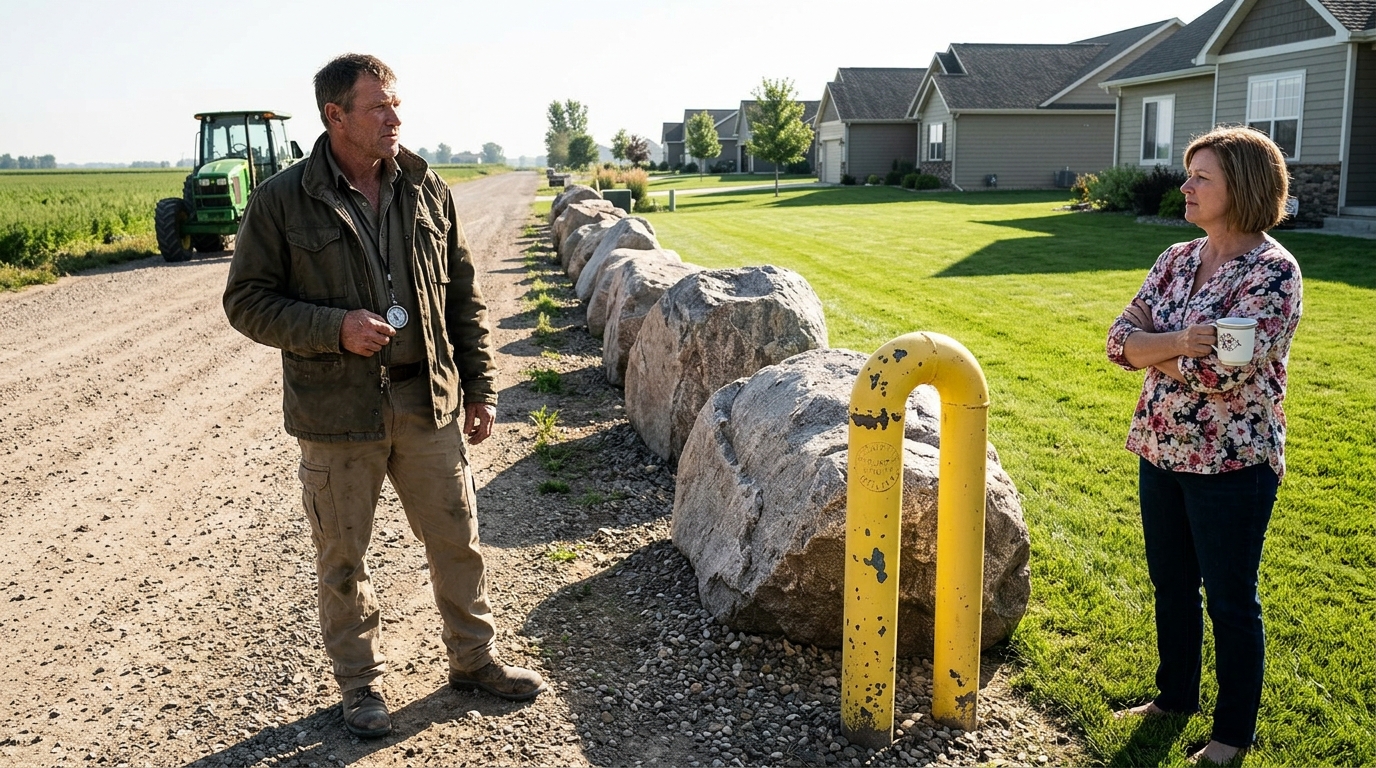
I killed the diesel engine of the John Deere 8R. The sudden silence settled heavy over the gravel access road, broken only by the ping of cooling metal and the distant hum of a lawnmower inside the Oak Meadows subdivision. I slid my hand into my pocket, my knuckles brushing the cool, worn brass of my old Corps of Engineers pocket compass. I didn’t pull it out. I just felt the heavy weight of it, grounding myself before I stepped down off the cab ladder.
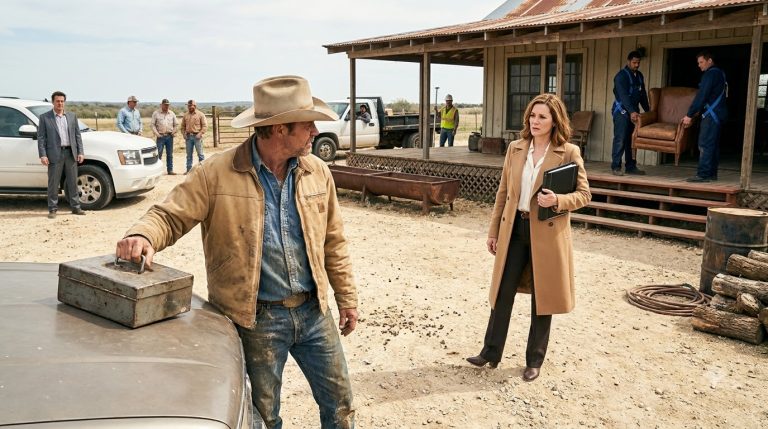
Karen Bishop stood at the edge of the gravel line, arms crossed over a loud floral blouse that looked like a crime scene. Her sneakers were planted firmly on the manicured turf of the HOA common area, inches from the dust of my deeded easement.
“That machine is a commercial vehicle, Mr. Thompson,” Karen said, her voice carrying that sharp, nails-on-a-chalkboard cadence she’d perfected over three years as HOA president. “By Law 7.14 prohibits industrial traffic on association property.”
“This isn’t association property, Karen,” I said, keeping my voice down in the lower register. Twenty years in military engineering taught me that shouting meant you’d lost control of the field. “This path is a sixty-year-old deeded agricultural easement. It’s on my deed, and it’s on the county plat map.”
She didn’t flinch. She just tapped a manicured fingernail against her elbow. “The board updated the common area access rules last Tuesday. This gravel connector falls under our aesthetic umbrella now. If you attempt to move those rocks or run that tractor through here, you’ll be fined five hundred dollars per violation, per hour.”
I looked past her shoulder to the southern forty acres. My alfalfa crop was standing waist-high, lush and green, ready for the cutter. The weather radio in my truck cab had already confirmed it: a massive low-pressure system was sweeping in from the west. Rain by Thursday morning. If that hay wasn’t cut, dried, and baled in the next forty-eight hours, fifty thousand dollars in winter fodder would turn into a rotted, moldy carpet in the mud.
“I have two days before a storm rolls in,” I said, watching her eyes closely. “You’re deliberately blocking my harvest.”
“Then I suggest you purchase a smaller lawnmower, or take up a less intrusive hobby,” she said, a thin, triumphant smirk curling her lips. “This road is closed.”
She turned on her heel, her floral blouse swishing as she marched back toward her pristine two-story colonial. I didn’t yell after her. I just stood in the hot morning sun, rolling the brass compass in my pocket, staring at the yellow iron pipe casing sticking up out of the gravel beside the nearest boulder. She thought she was protecting her manicured neighborhood from a dirty farmer. She had no idea she had just started a war against an engineer who knew how to read terrain.
CHAPTER 2: THE BUREAUCRATIC WALL
My thumb traced the outer brass ring of the compass in my right pocket while the diesel exhaust from the idling John Deere hung warm and sour in the heavy morning air.
I climbed down off the cab tread, pulled the ignition key, and slipped it into my jeans. The engine gave one final, heavy shutter before silence swallowed the gravel path again. Karen was already back on her wrap-around porch, sipping from a white porcelain mug, watching me through the distance like a hawk perched on a freshly painted railing.
I pulled out my phone and dialed Dan Miller’s direct line.
“Miller,” the sheriff answered on the third ring, his voice sounding like two dry river stones grinding together.
“Dan, it’s Jack Thompson,” I said, my boots crunching on the loose shale as I walked the perimeter of the boulders. “I’ve got an illegal obstruction on my agricultural easement. Three granite blocks, straight across the access lane.”
There was a long beat on the line, followed by the faint rustle of paper. “Let me guess. Oak Meadows? Karen Bishop?”
“She put them down twenty minutes ago,” I said, stopping beside the middle boulder. It was roughly four thousand pounds, unpolished gray stone with raw, jagged edges. “My alfalfa cut starts today, Dan. If I don’t get the rig through by noon, I lose the Thursday window before the rain hits.”
“Jack, I’m sending Deputy Evans out to write a report,” Miller sighed, his tone heavy with the weary caution of a county lawman who knew where the political landmines were buried. “But I’m telling you now, if she’s claiming board authority over a common-access boundary, my hands are pinned until a magistrate signs off.”
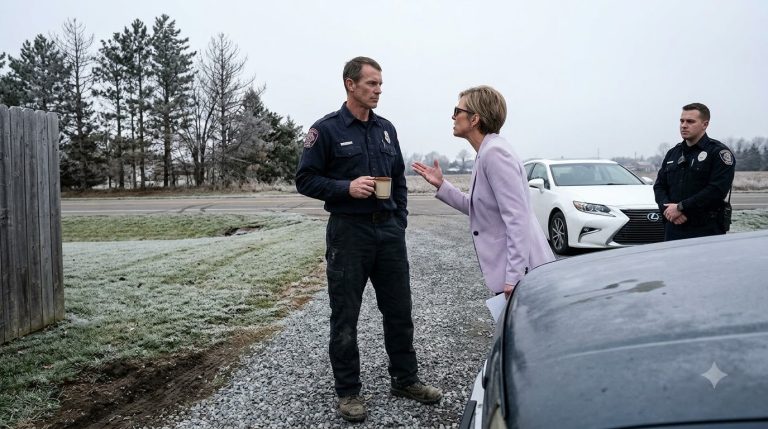
Deputy Evans pulled up twenty minutes later, his cruiser’s tires kicking up a fine white dust that settled over the polished surface of the lead boulder. He got out slowly, adjusting his utility belt, his eyes darting toward Karen’s porch before he even looked at me.
“Mr. Thompson,” Evans said, tipping his hat back an inch. “She’s got a folder full of HOA bylaws sitting on her coffee table. Claims this connector road was designated as a community green-belt buffer back in ’08.”
“The deed on my farm predates her entire subdivision by sixty years, Deputy,” I said, pulling my wallet from my back pocket and unfolding a worn, laminated copy of the county land grant. I pointed to the red-ink boundary line. “This right-of-way is recorded at the county courthouse. It’s an unrestricted agricultural easement.”
Evans looked at the document, then looked at the four-foot gap between the boulders and the tree line. “She says you can use the north access.”
“The north access is a drainage ditch along State Route 9 with a ten-foot drop-off,” I said, keeping my voice dead level. “I bring a twenty-ton harvester over that shoulder, the bank collapses and the rig flips into the culvert. She knows that.”
Karen walked down the steps, holding a green plastic clipboard against her chest like a riot shield. “Deputy, this man is harassing our board. He was served notice of the common-area restriction last month. This path is private association land.”
“It’s a civil matter, Jack,” Evans said, looking genuinely pained as he stepped between us. “Without a specific injunction ordering the immediate removal of physical barriers on a disputed easement, we can’t tow those rocks. If we move them on county authority and a civil judge rules the HOA had temporary jurisdiction, the department gets sued for property damage.”
Karen didn’t say a word. She just adjusted her clipboard, her eyes narrowed into two hard slits of absolute satisfaction. She knew how the system worked—or rather, how it stalled. She had turned a legal guarantee into a waiting game, and she knew I had forty-eight hours before the sky turned black.
“Understood, Deputy,” I said, turning my back on her before she could see the heat rising in my jaw. “Thanks for coming out.”
I walked past the tractor, picked up my phone again, and hit the speed-dial for a number I hadn’t called in three years.
“Cole,” a voice snapped. Fast, sharp, no preambles.
“Mark,” I said, leaning my shoulder against the warm metal of the John Deere’s rear tire. “I need a JAG mindset in a civil court, and I need it before the sun sets.”
“Who am I hitting, Jack?” Mark asked, the sound of a pen clicking rapidly filling the receiver.
“An HOA president who thinks three tons of granite can override a county property deed,” I said. “She’s holding my harvest hostage.”
“Did she give you a paper trail?”
“Five years of it,” I said, watching Karen walk back to her house with the rigid posture of a victorious general. “Every letter, every fine, every threat. She thinks she wrapped me in red tape.”
“Good,” Mark said, his voice dropping into that cold, calculated register he used back when we were coordinating supply lines through hostile territory. “Bring the file to my office in town. If she wants to fight over territory, we aren’t going to negotiate for the road, Jack. We’re going to take her entire ground.”
CHAPTER 3: THE DOORTODOOR INSURGENCY
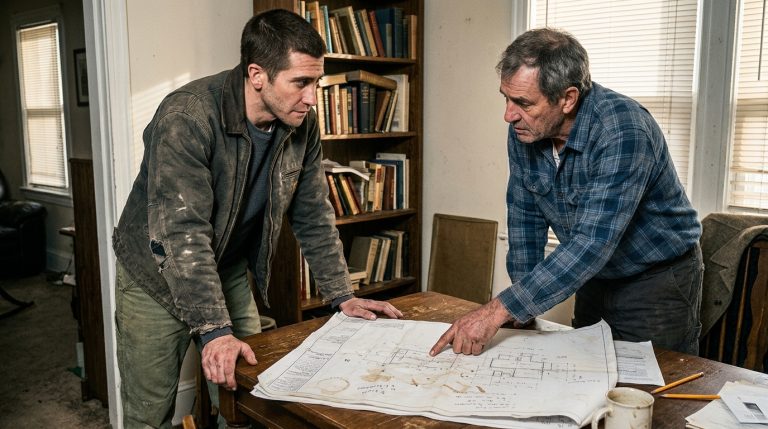
Mark tapped his pen twice against the edge of the table, looking down at my five-year paper trail of violation notices.
“The easement deed is bulletproof, Jack,” Mark said, leaning back in his swivel chair. “But an emergency injunction needs more than just a property map. We have to show a judge that she’s acting with deliberate, targeted malice to inflict financial damage.”
“She thinks she owns the entire ridge,” I said. “And everyone living on it.”
“Then we need her victims on paper,” Mark said, pushing a legal pad toward me. “Sworn affidavits. Neighbors testifying to her pattern of behavior. If we can show the court this isn’t an isolated border dispute, but a systemic abuse of power, a judge will slap her with a restraining order before lunch tomorrow.”
I left Mark’s office and drove straight back to the edge of Oak Meadows, parking my truck at the end of Blossom Lane. I didn’t take the John Deere. I took a clipboard, a pen, and a stack of blank affidavit forms.
My first stop was David Harrison’s house, directly across from where my tractor sat useless in the gravel. David opened the front door, his eyes immediately cutting past my shoulder to Karen’s living room window down the block.
“Jack,” he said, keeping his voice barely above a whisper. “Look, I saw the sheriff out there earlier. I don’t want any trouble with the board.”
“I’m filing for an emergency court injunction tomorrow morning, David,” I said, holding his gaze. “I’m asking if she’s ever targeted your family.”
David hesitated, his hand gripping the edge of the storm door until his knuckles turned white. His wife stepped up behind him, holding their toddler. She looked at me, then at her husband.
“Show him the letter, Dave,” she said quietly.
David swallowed hard and reached into a drawer by the entryway, pulling out a white envelope. “Two hundred dollar fine last month. My four-year-old left her plastic tricycle on the paved driveway overnight. Karen took a picture at six in the morning and cited us for storing unauthorized vehicles in public view.”
“Sign an affidavit stating that,” I said, offering the pen. “Help me put it on a judge’s desk.”
He looked at the form, took a deep breath, and signed his name in firm, heavy strokes.
I spent the next three hours walking the sidewalks of Oak Meadows. House by house, the picture filled in. Mrs. Gable, a seventy-year-old widow, showed me a three-hundred-dollar citation for hanging a bird feeder that allegedly attracted vermin—though everyone knew Karen just hated sparrows landing on her SUV. A retired marine two streets over had been ordered to dismantle a custom flagpole because it exceeded association height limits by three inches.
People weren’t just annoyed. They were exhausted, terrified of liens, and starved for someone to stand up to the noise.
As I walked back toward my truck, I stopped at the yellow iron pipe casing sticking out of the gravel near the boulders. I knelt down, brushing away the loose dirt. The yellow paint was chipped, but underneath was an old county utility stamp—a detail Karen had completely overlooked when she picked this spot for her barricade.
My phone buzzed in my pocket. It was Mark.
“Jack, I’m finalizing the court filing,” Mark said. “Did you get enough signatures?”
“I have fourteen signed affidavits,” I said, standing up and dusting the gravel from my knees. “And I just found something else on the access line that’s going to make her lawyer sweat.”
CHAPTER 4: THE INJUNCTION TRAP
Across the aisle, Karen Bishop sat behind a pristine mahogany table, flanked by an attorney named Davies who looked like he had been dragged out of a golf club lounge. Karen wore a lavender jacket and held her chin elevated at a rigid forty-five-degree angle, entirely convinced that three centuries of English common law were about to fold to her board authority.
Judge Albright shuffled the thick stack of papers Mark had submitted two hours prior, her dark eyes scanning the text with methodical speed.
“Counsel,” Judge Albright said, her voice dry as parchment. “We are here on an emergency petition for injunctive relief regarding a blocked agricultural right-of-way. Mr. Davies, your client has placed multi-ton granite blocks across a gravel access path.”
Davies stood up slowly, smoothing the front of his jacket. “Your Honor, Oak Meadows HOA Bylaw 7.14 explicitly empowers the board to regulate common area access to prevent commercial nuisance. Mr. Thompson’s industrial farming operations pose a direct threat to suburban road safety and aesthetic value.”
“It’s a deeded agricultural easement, Your Honor,” Mark said, remaining seated with his hands folded cleanly. “It has been recorded with the county clerk since 1964. The association’s bylaws have zero legal jurisdiction over non-member real estate rights.”
“Be that as it may,” Davies countered, pulling a sheet from his brief. “Our preliminary title search indicates a 2008 zoning modification that designated all connecting paths within the subdivision footprint as secondary green-belt zones. Under county code, commercial traffic on green-belt paths requires express board authorization.”
Karen allowed herself a subtle, triumphant nod from the table. She thought she’d caught us in a local ordinance loop.
Mark stood up, pulling a single laminated document from our pile and stepping toward the bench.
“Your Honor, if we are looking at county designations, I direct the court’s attention to Exhibit F,” Mark said calmly. “Specifically, the 1978 County Master Infrastructure Plan. That ‘green-belt connector’ contains a high-pressure municipal water main and is formally classified as an unrestricted Emergency Fire and Rescue Access Artery.”
The courtroom fell completely still. Davies blinked, looking down at his own notes as if the ink had suddenly rearranged itself.
“A fire access artery, Mr. Cole?” Judge Albright asked, peering over her glasses.
“Yes, Your Honor,” Mark said, gesturing toward me. “As noted by the yellow utility casing currently sitting two inches from Ms. Bishop’s granite blocks. Under State Code Section 42-10, physically obstructing an designated emergency service route is a Class 2 misdemeanor carrying personal civil and criminal liability.”
Judge Albright turned her eyes toward Karen. The lavender-jacketed president leaned toward her lawyer, her face suddenly losing every trace of color as she began whispering furiously into his ear. Davies reached out and pulled her hand off his arm, his mouth set in a tight, pale line.
“Mr. Davies,” Judge Albright said, her voice dropping into a register that made the court reporter pause over her keys. “Did your client place three-ton boulders directly over a marked county emergency utility access route?”
“Your Honor—” Davies began.
“—I am asking a simple question, counsel,” the judge interrupted. “Did she or did she not?”
“Ms. Bishop believed she was acting within her board authority regarding common-area aesthetics—”
“I don’t care what she believed,” Judge Albright snapped, bringing her palm down on the bench with a heavy thud. “I care about county public safety statutes and ironclad property deeds.”
Karen surged to her feet, ignoring Davies’ desperate gesture to stay down. “Your Honor! That man runs heavy, dirty machinery right past my front yard! It ruins our property values!”
“Sit down, Ms. Bishop,” Judge Albright warned, her eyes locking onto Karen with glacial weight. “You are one sentence away from a contempt citation.”
Karen swallowed hard, her throat working against her tight collar as she sank back into her leather chair, her fingers twitching uselessly against her purse strap.
“The court finds that the petitioner has demonstrated immediate, irreparable financial harm and an absolute legal right of access,” Judge Albright declared, pulling her gavel toward her. “An injunction is hereby issued. Those obstructions will be removed immediately.”
CHAPTER 5: THE CRANES RETURN
Gus, the crane operator, stepped down from his high cab, a wooden toothpick tucked between his teeth. He tapped a rolled copy of Judge Albright’s court injunction against his thigh, glancing toward the line of three granite blocks.
“Order says clear the fire lane and relocate the obstructions at the defendant’s expense,” Gus said, his deep voice carrying over the idle hum of the diesel engine. “Where’s the destination point, Sheriff?”
Sheriff Miller adjusted his belt, pulling a folded county plat map from his coat pocket and pointing directly to 121 Blossom Lane. “Front yard turf, fifty feet down. Under the court order, they stay on the president’s parcel until the final hearing.”
Karen’s front door banged open. She marched down her porch steps in a bright pink tracksuit, clutching a leather-bound bylaw binder against her chest. Her eyes were bloodshot, her hair unbrushed, but her jaw remained locked in absolute defiance.
“Get off my street!” Karen shouted, stopping three feet from Sheriff Miller. “This is an illegal invasion of private property! You have no right to operate industrial machinery on an association road!”
“Ma’am,” Sheriff Miller said, stepping into her path without moving an inch back. “Judge Albright signed this mandate yesterday afternoon. If you step within twenty feet of these rigging cables, I will handcuff you for interference with a court officer.”
“My rose beds!” she shrieked, her voice cracking as Gus’s crew wrapped two heavy nylon slings around the core boulder. “That turf won the regional neighborhood award three years in a row!”
“You should have thought about your roses before you dropped six tons of stone over a municipal emergency line, Karen,” I said, leaning against my truck door with my hands in my pockets.
The steel winch cable snapped taut with a sharp, metallic ring that made the watching neighbors jump. Slowly, smoothly, the four-thousand-pound granite block lifted into the air, dripping dark mud back onto the gravel before swinging wide over Karen’s manicured lawn.
David Harrison stood on his front porch across the street, his toddler on his shoulders, silently watching the stone hover in mid-air. Mrs. Gable sat in a folding lawn chair near her bird feeders, her hands folded in her lap, giving a slow nod as the crane’s boom rotated.
The operator lowered the main hook. With a heavy, subterranean thud that shook the soil under our boots, the first boulder settled directly into the center of Karen’s prized rose garden. Stems snapped. Velvet petals scattered across the torn sod.
“You’re going to pay for every inch of this!” Karen screamed at me, her fingers digging into the cover of her binder until the leather creaked. “I’ll file a motion for property damage by noon! I’ll have your farm auctioned off!”
“The invoice for this crane rig is being billed directly to your personal address, Karen,” Mark said, walking up beside me with a signed copy of the filing receipt. “And you have twenty-four hours to clear my client’s access before we file for statutory civil damages.”
Gus swung the second stone into position, dropping it two feet from her paved walkway, blocking her private golf cart. The third boulder landed squarely on her front lawn, crushing two ornamental shrubs into the dirt.
Karen stood between her ruined flower beds, surrounded by the three massive rocks she had bought to starve my harvest out. She wasn’t weeping. She was quivering with an unhinged, silent rage, her eyes locked on my John Deere sitting ready at the end of the lane.
I didn’t smile. I just pulled the tractor keys from my pocket, unlocked the cab door, and climbed up into the driver’s seat. The path was clear.
CHAPTER 6: THE UNRAVELING REALM
I pushed the throttle forward, and the heavy diesel tractor rumbled down the cleared gravel path toward the southern forty acres. By nightfall, the entire crop was cut, conditioned, and baled into heavy green rolls, sitting dry beneath the barn overhang just as the first fat drops of rain began to hit the tin roof.
The storm raged through Wednesday night, but inside my home, the heat was on, and the harvest was safe.
On Thursday morning, the rain cleared into a cool, crisp sun. Karen made one final, desperate counter-move: she stood on her front porch as a county sheriff’s deputy arrived, screaming that my tractor had damaged her curb and demanding an emergency arrest for property destruction.
Sheriff Miller didn’t even draw his notebook. He handed her a copy of the final court order signed by Judge Albright.
Because the path was classified as a county emergency fire artery, Judge Albright had ruled that Karen’s placement of physical barricades constituted an intentional violation of public safety laws. The court imposed a mandatory fine of five thousand dollars directly against Karen Bishop as an individual, explicitly forbidding her from using HOA funds to cover her legal liabilities.
Furthermore, the injunction made her personally liable for the four-thousand-dollar crane bill and all of Mark’s legal fees.
Her lawyer, Davies, formally withdrew from her defense within forty-eight hours, leaving her to face three civil countersuits filed by the neighbors whose property she had targeted with arbitrary fines.
By Friday afternoon, a white ‘For Sale’ sign was driven into the sod on Blossom Lane, standing two feet behind the three granite boulders that still sat embedded in her crushed rose beds. She couldn’t afford to pay a secondary crew to haul them away before listing the property.
I walked down to the edge of the access road with a cup of black coffee in my hand.
David Harrison was out on his driveway, teaching his little girl how to pedal her tricycle back and forth across the clean pavement without looking over his shoulder. Down the block, Mrs. Gable was hanging a fresh wooden bird feeder on her oak tree, waving to me as I passed.
I stopped at the gravel boundary line. The yellow pipe casing sat flush against the earth, silent and untouched.
I took a slow sip of coffee, pulled the worn brass pocket compass from my pocket, and let the cool weight sit in my palm for a second before slipping it back into my jeans. The road home was quiet, clear, and completely mine.