Suburban Association Evicts Rancher from Multi-Generational Land Until Forensics Prove Documents Were Forged
CHAPTER 1: THE RUSTED THRESHOLD
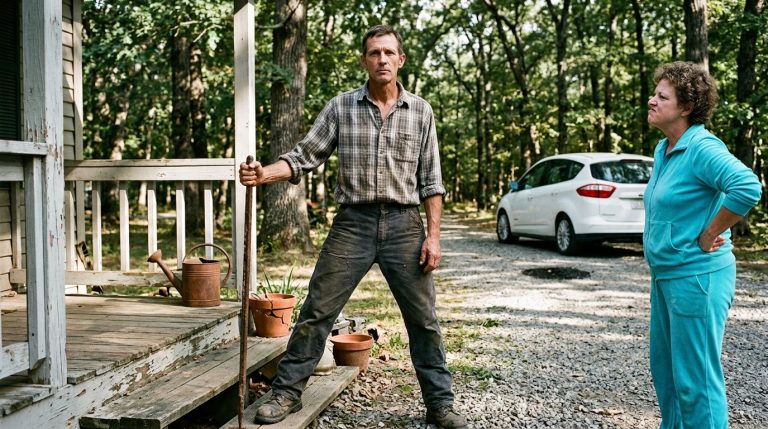
The brass padlock clamped through the cattle gate wasn’t his father’s hardware. It was fresh, zinc-plated steel, unscarred by road salt or grease, biting cold into weathered chain where the latch had swung free for fifty-six years.
Ethan cut the truck’s diesel engine. The silence settled hard over the dry caliche lane, broken only by the scrape of work boots dragging Walter Carter’s split-leather armchair backward across the porch deck.
On the top step stood Karen Whitmore, wrapped in an ironed camelhair coat, a black vinyl binder tucked under her arm. Behind her sat an open cardboard box labeled Family Photos in faded blue marker.
“Drop the chair,” Ethan said, walking up the drive before his truck door had even finished swinging shut.
The two movers stopped, the oak frame hovering two inches off the redwood decking.
“Your father doesn’t reside here anymore, Mr. Carter,” Karen said, her voice dry and steady. “He complied with an administrative possession notice yesterday morning.”
“Put it down,” Ethan repeated to the men. The heavier mover clocked Ethan’s grease-stained canvas shoulders, glanced at Karen, and lowered the leather flat onto the porch floor.
“Walter has lived in this section fifty-six years,” Ethan said, stepping onto the bottom tread. “Your subdivision threw up its first tract frame eleven years back. Where’s my father?”
“He vacated.”
Ethan tapped speed dial on his phone. Walter answered before the second ring finished, the line hollow with the rattle of a cheap motel compressor.
“Ethan?” Walter’s voice had an edge of rust to it.
“Where are you, Dad?”
“Sunset Motel. Room fourteen,” the old man rasped. “Woman from the board showed up yesterday with three cars. Told me the county authorized the transfer.”
Ethan kept his eyes locked on Karen. Her pupils didn’t widen; she watched him like a driver waiting for a railroad arm to drop.
“Did you sign a release, Dad?”
“Hell no. Didn’t sell an inch either.”
Karen projected directly toward the phone’s microphone. “The transfer was recorded with the county clerk at eight-thirty yesterday morning. Under the Heritage Expansion District bylaws, failure to contest administrative annexation within sixty days constitutes formal consent.”
“You don’t annex deeded ranch acreage with a clipboard,” Ethan said, ending the call.
Tires crunched hard on the gravel behind them. A white suburban SUV braked hard enough to pitch its bumper down. Mark Benson climbed out, tie loose, his face flushed red under the thin morning sun.
“Karen,” Mark said, walking up fast. “What the hell is this? The board never voted to take physical possession of Walter’s house.”
“I have executive discretion to secure association assets prior to formal review,” she said, tapping the vinyl binder against her hip.
Ethan turned back toward his truck without another word.
“Leaving is the smartest thing you’ve done today, Mr. Carter,” Karen called down the steps.
Ethan hauled open the rear cab door, reached under the bench, and dragged out a battered steel lockbox. He slammed it down on the hood of his truck and tripped the latch with a dull metallic snap.
The parchment inside smelled of cedar shavings and dry attic heat.
“This is the patent deed from 1968,” Ethan said, spreading the yellowed sheet flat across the warm steel. “Signed by the state land commissioner. Walter J. Carter. No association rider. No annexation.”
Mark stepped over immediately, his eyes darting across the county seal.
Karen descended two steps, the click of her heels sharp on the wood, but stopped short of the dust. “That instrument is obsolete. It doesn’t reflect the current status.”
“Then pull your recorded deed out of that binder,” Ethan said, pressing his open hand flat against the hood. “Show Mark the county stamp.”
Karen’s hands tightened around the vinyl folder, her knuckles pale beneath the skin.
Across the south pasture, the low rumble of a flatbed cut through the dry air as Miguel Alvarez crested the fence line, heading straight for the open gate.
CHAPTER 2: THE FRACTURE ON THE HOOD
The dust cloud from Miguel’s flatbed had barely settled against the caliche before Susan Keller’s county sedan wedged itself between the fence line and Mark Benson’s utility vehicle.
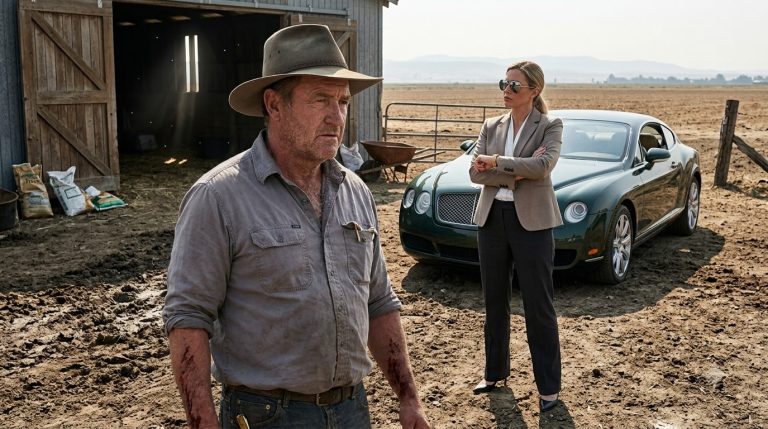
Miguel hit the gravel with both boots, iron pipe rattling in his truck rack as he rounded the fender. He didn’t look at Karen. He pointed a grease-stained thumb straight at the split-leather chair stranded on the porch deck.
“South pasture line touches my alfalfa ditch,” Miguel said, his voice flat as dry timber. “County surveyor staked that boundary three weeks back. Walter paid twelve hundred dollars to make sure your sprinkler runoff stayed on your side of the dirt.”
Karen’s gaze flicked toward the west fence, her jaw tightening by an eighth of an inch. “Private surveys don’t preempt municipal utility annexations. This parcel is incorporated under district authority.”
“You didn’t file an annexation,” Ethan said. His palm stayed flat over the 1968 patent deed, the dry paper crackling under his calluses. “Pull the recorded instrument out of that binder, Karen. Show Mark the county stamp.”
Mark Benson stepped closer, his shadow falling across the truck hood, his silk tie fluttering in the draft off the pasture. “Karen, if you recorded an acquisition deed yesterday, pull the file copy. You carry the executive binder for a reason.”
Karen drew a single white sheet from the inner sleeve of the vinyl binder and laid it beside the state deed.
It was titled Property Surrender and Boundary Acknowledgement.
At the bottom line, typed in clean twelve-point font, sat the name Walter J. Carter, capped with a long, sweeping stroke of blue ink that curved back over the lowercase letters like a wire loop.
Ethan leaned over the warm steel, his pulse steady, his eyes narrowing on the ink line.
“That’s not Dad’s hand,” Ethan said.
“It’s his legal signature,” Karen said, folding her arms. “Executed yesterday morning.”
“Walter broke his index and middle knuckles pulling a hay rake off a tractor axle in December,” Ethan said. He tapped the paper with a split thumbnail. “He signs with a block W now. Stiff. He can’t loop a cursive J without his knuckle locking up.”
Mark bent over the sheet, squinting against the harsh morning glare. “Where did this format come from, Karen?”
“The records office maintains signature cards for all abutting easement holders,” Karen replied without blinking. “He signed the ditch access permit six months ago.”
“And somebody traced it,” Ethan said. He pulled his phone from his coat, opening the high-resolution photo of the autumn road drainage receipt. The sweep was identical down to the microscopic break where the ballpoint had skipped over a dry grain in the cardstock.
“You cannot substantiate document fraud with a telephone screen,” Karen said, her voice dropping into a hard, metallic register.
Susan Keller stepped up to the fender, her county credential bouncing against her olive windbreaker as she set a ruggedized tablet flat on the truck hood.
“I pulled the parcel register before I left the county annex,” Keller said, scrolling the screen with a bare finger. “Walter Carter is still the sole titleholder of record. An assumed possession filing is an administrative notice, not a conveyance. It does not extinguish deeded ownership without a district court judgment.”
Keller paused, zooming into a scanned document on the state registrar’s portal. Her eyes narrowed as she looked up directly into Karen’s face.
“There’s an attached affidavit here,” Keller said. “Witnessed and notarized yesterday afternoon. Who is Lisa Whitmore?”
The wind died down across the caliche, leaving only the dull metallic tick of Ethan’s cooling engine.
Karen’s hands tightened around her binder until the plastic seams turned white.
“Lisa Whitmore is my sister,” Karen said, her chin lifting half an inch. “She’s also a certified state notary.”
“She’s an interested party executing an unverified conveyance,” Keller said.
Before Karen could counter, the iron cattle guard at the highway entrance clattered like a dropped chain. Three heavy flatbed trucks turned into the lane, trailing a rolling wall of brown grit, followed by a dual-axle trailer loaded with fresh dimensional lumber, acoustic ceiling panels, and demo bars.
CHAPTER 3: THE STAGED INVASION
The air brakes of the lead flatbed let out a sharp, metallic hiss as the front bumper cleared Miguel’s tailgate by four inches, bringing three tons of framing timber and demolition iron straight into the ranch yard.
A burly foreman in a sun-faded safety vest swung down from the cab, clutching a clipboard stacked with yellow carbon slips.
“Where do you want the demo dumpster dropped, Ms. Whitmore?” the foreman shouted over the diesel clatter. “Staging crew has a twelve-thirty window.”
Karen didn’t hesitate. She pointed a manicured hand toward the cedar windbreak sheltering the master bedroom. “Back it into the soft shoulder. Clear the master suite first.”
“Don’t unhook a single chain,” Ethan said.
He stepped off the caliche drive and planted his boots dead center in front of the lead flatbed’s iron grille.
The foreman frowned, looking Ethan up and down—the oil-stained canvas coat, the steel-toed boots, the lack of hesitation. “We’ve got a paid mobilization order from Willow Creek Management. Clear the lane, buddy.”
“This is private, deeded land,” Ethan said, his voice dropping below the engine hum. “You put one tire on that rose bed, you’re trespassing under state penal code.”
“We hold an active structural alteration permit,” Karen cut in, stepping between Ethan and Susan Keller. “Signed by the record owner six weeks ago. The contract is non-refundable.”
Ethan didn’t break eye contact with the contractor. “Six weeks ago, my father was in Amarillo bidding on stock cattle for fourteen days straight. He wasn’t in this county, and he wasn’t signing permits at your kitchen table.”
Mark Benson surged past the truck hood, his phone clutched in a white-knuckled grip. “What deposit, Karen? What did you spend?”
“Twenty-eight thousand dollars,” she said, her voice dropping all pretense of procedural warmth. “Site preparation, hazardous demo, and framing mobilization. The Willow Creek Heritage Center starts framing at noon.”
“Twenty-eight thousand?” Mark’s face went chalk-white. “Our total quarterly emergency reserve is forty thousand. You emptied seventy percent of the association’s contingency capital without a board quorum?”
“I used presidential emergency discretion to protect community acquisition rights,” Karen said coldly. “The parcel had to be secured.”
Gravel sprayed behind them as a county cruiser whipped through the gate, its low-profile lightbar flashing red and blue against the chalky dust.
Deputy Harris stepped out, his hand resting naturally on the leather strap of his utility belt. He looked from the loaded lumber trailers to the papers pinned to Ethan’s hood.
“Got a dispatch about a breach of peace and an illegal lockout,” Harris said. “Susan, what’re we looking at?”
“Disputed conveyance,” Keller answered, extending her tablet. “The HOA is attempting an administrative possession without an eviction warrant. The title of record is still Walter Carter.”
Harris turned his gaze toward Karen. “Ma’am, do you have an eviction order signed by a magistrate?”
“We hold an executed surrender,” Karen said, her posture rigid. “The owner vacated voluntarily yesterday.”
“He went to a motel because you told him deputies were rolling out to drag him off his porch,” Ethan said.
Harris didn’t blink. His jaw tightened as he looked Karen dead in the eye. “Did someone from my department authorize you to state that?”
“I explained standard enforcement procedure,” she replied, her voice tightening.
“No,” Harris said. “You don’t cite sheriff’s authority to an elderly man on his own porch. Shut down the heavy equipment. Now.”
The lead foreman cut his ignition, the diesel rattle dying into an abrupt, hollow silence.
“You’re interfering with a commercial contract, Deputy,” Karen said, the edges of her voice fraying into sharp indignation. “The association will hold the county liable for every hour these machines sit idle.”
Susan Keller didn’t look up from her tablet. Her fingers flew across the county registrar’s portal, cross-referencing document IDs.
“Karen,” Keller said, her voice cutting through the wind with absolute precision. “If this was an association acquisition, why does the state database show a quitclaim deed filed three hours ago routing title directly to an entity called Whitmore Property Holdings LLC?”
CHAPTER 4: THE PAPERWORK TRAP
The yellow county cab shuddered over the cattle guard with a rattle of loose sheet metal, its muffler scraping dry stone before it stalled dead in the shadow of Deputy Harris’s patrol car.
The rear door creaked open. Walter Carter stepped out onto the caliche, hauling a single nylon duffel bag with a frayed shoulder strap. His wool flannel was buttoned crooked at the throat, but his jaw was locked like an anvil.
He didn’t glance at the idling flatbeds or the patrol lights. His gaze cut straight to his split-leather armchair sitting exposed on the raw porch planks.
“Who told you boys to haul my chair out into the weather?” Walter asked, his voice rough as unwashed gravel.
The movers shifted back, eyes locked on their boot toes. Nobody answered.
Karen adjusted her camelhair coat, though her fingers trembled against the vinyl binder. “Walter, you shouldn’t be here. The administrative transition is already in progress.”
“My grandfather laid those porch footings in fifty-eight,” Walter said, his gait slow, deliberate, and heavy against the stones. “The only transition happening here is you getting off my dirt.”
A silver sedan swung into the lane, brakes squealing as Mercer, the association’s managing accountant, jumped out before the tires stopped rolling. He held an open laptop balanced flat across his forearm, his breathing ragged.
“Mark,” Mercer called out, shoving past the fender. “The hosting server just cleared the administrative audit logs. We pulled the digital trail from the portal.”
Mark Benson leaned over the glowing display. “Show me the authorization files.”
Mercer rotated the screen toward the center of the hood.
Under an internal directory labeled Carter_Heritage_Acquisition, three files sat with identical timestamps: Walter_Signature_Old.png, Benson_Signature.png, and Acquisition_Resolution_Approved.pdf.
“These were uploaded twenty-eight days ago,” Mercer said, his finger tapping the screen. “Directly from Karen’s administrative account. Authenticated through her registered cellular MAC address.”
Ethan leaned in, his shadow cutting across the display. “Twenty-eight days ago. That was two weeks before you sent the first drainage notice.”
Karen didn’t flinch, though the tendons in her neck strained tight. “Standard project preparation. Board officers compile conceptual assets ahead of execution.”
“You don’t compile my signature into a transparent image file for a conceptual project,” Mark said, his voice rising with sharp disgust. “You stamped my name on a unanimous resolution that the board rejected in open session.”
Walter reached the truck hood, resting his scarred right hand flat against the sun-warmed metal. The index and middle knuckles were thick, fused bone, scarred white where the tractor axle had crushed them.
Susan Keller turned her county tablet toward him. “Mr. Carter, did you execute a quitclaim deed transferring this parcel to Whitmore Property Holdings for one hundred and eighty-five thousand dollars?”
“I don’t know what Whitmore Holdings is,” Walter said. “And nobody gave me a red cent.”
“The escrow transfer was cleared forty-eight hours ago,” Mercer said, pointing to a red ledger entry. “Drawn straight from the association’s capital reserve fund. One hundred and eighty-five thousand dollars, routed to a commercial account in Reno.”
Karen’s knuckles turned chalk-white against the binder seam. “It was structured as an interim acquisition vehicle to shield the community from outside bidding wars. The parcel would have been deeded to the association at the close of probate.”
“What probate?” Ethan took a single step forward, towering over her. “My father is standing right in front of you.”
“He was incapable of maintaining the property,” she said, her voice dropping into a desperate, hurried pitch. “The perimeter fence has been out of compliance for eighteen months. The ditch was an active drainage liability.”
“So you forged a deed to clear a ditch?” Mark asked, staring at her in disbelief.
“I secured the asset before developers split it into high-density tracts,” Karen said, her chin lifting in frantic defiance. “This board lacked the backbone to act.”
Deputy Harris took two slow steps forward, unfastening the retention snap on his radio harness. “Ms. Whitmore, step away from that binder and keep your hands where I can see them.”
Before she could speak, a second sheriff’s cruiser turned into the lane, its tires throwing gravel against the cattle guard as Detective Mason stepped into the clearing dust.
CHAPTER 5: THE SHELL INTERMEDIARY
Detective Mason didn’t unholster his service weapon; he simply unclipped a small steel pocket notebook and stepped directly into the dry path Karen Whitmore had calculated as her exit.
“Deputy Harris briefed me on the road in,” Mason said, his voice flat and unhurried. “Who is the managing member of Whitmore Property Holdings?”
Mercer tapped the trackpad on his laptop, rotating the screen so the open Nevada business registry caught the hard midday glare. “Karen Whitmore. Registered in Reno four months ago. Lisa Whitmore is listed as the secondary statutory agent.”
Karen didn’t look at the screen. Her fingers slid toward the inside pocket of her camelhair coat, but Mason raised an open palm.
“Keep your hands visible, Ms. Whitmore,” Mason said. “We’re well past an administrative misunderstanding.”
“This is an internal board matter regarding capital land reserves,” Karen said, the cadence of her voice stretching thin and brittle. “The executive bylaws grant broad discretion for defensive acquisitions.”
“I never signed an acquisition voucher,” Mark Benson said, stepping up to the truck fender. “Neither did the rest of the board. You extracted our digital signatures from road-patching invoices and pasted them onto an unauthorized quitclaim.”
Walter took two slow steps off the bottom porch rail, his hand resting firm on Ethan’s shoulder. His knuckles were gray with caliche dust, the fused joints stiff as rusted rebar.
“She stood on these planks yesterday morning and told me the sheriff’s department would lock me in a cell if I wasn’t packed by sundown,” Walter said, looking straight at Mason. “Told me calling Ethan would just double the daily municipal fines.”
“That is a severe misrepresentation of administrative notices,” Karen said, her chin lifting in a brittle jerk.
The lead mover stepped forward from the tail of the lumber trailer, holding up a cracked smartphone.
“It’s not,” the mover said, his voice cutting clean through the pasture wind.
Karen whipped her head around, her eyes widening. “You were contracted for cargo transport, not legal testimony.”
“Company policy on contested residential lockouts,” the mover said, holding the screen toward Deputy Harris. “We record the initial greeting for insurance. You told the old man deputies were scheduled to clear him out at six.”
The audio played loud from the small speaker: Karen’s clipped, measured tone informing Walter that refusal to hand over the gate keys constituted criminal trespass on county-annexed property.
Harris watched the screen once through, then looked back at Karen. “You invoked the authority of this office to execute an unlawful dispossession.”
“The filing was initiated,” Karen said, her jaw working furiously. “The transfer of deed was an administrative certainty.”
“No,” Susan Keller said, tilting her ruggedized tablet. “The county halted the recording two hours ago. Mr. Carter’s recorded signature on file is a block stroke. The instrument you filed was a traced script from an outdated easement receipt. The county attorney’s office has already flagged it as an invalid filing.”
Mercer’s phone vibrated hard against the steel hood. He answered, listened for six seconds, and clicked off.
“That was First Western,” Mercer told Mark. “The wire transfer for one hundred and eighty-five thousand dollars to Whitmore Property Holdings has been frozen under federal fraud notification. The account is locked.”
Karen took half a step backward toward her sedan, but Deputy Harris shifted his stance, closing the gap between the rear bumper and the cedar fence.
“Ms. Whitmore, don’t move,” Harris said.
Mark Benson raised his phone to his ear, his voice tight and formal. “I’m calling an emergency quorum of the board right now. I have three directors on speaker.”
The call lasted less than three minutes in the dust of the driveway. The votes were swift, recorded, and unanimous: emergency revocation of Karen’s presidential powers, formal repudiation of the acquisition project, and total submission of all association server logs to the county prosecutor.
The contractor foreman spat into the caliche, pocketed his carbon forms, and waved his arm toward his drivers. “Pack the demo bars. We’re off this job.”
The flatbeds roared to life, their air brakes releasing with a heavy hiss as the three trucks backed down the drive, tires churning empty gravel.
Detective Mason shut his notebook with a dull snap. “Ms. Whitmore, leave the binder on the truck hood. Walk with Deputy Harris to the rear of his vehicle.”
Karen stood frozen for three long seconds. The camelhair coat seemed suddenly two sizes too large, the rigid posture collapsing as the wind whipped dust against the hem of her trousers. She didn’t look at Mark, or Keller, or the movers.
She dropped the black vinyl binder onto the warm steel of Ethan’s truck hood and walked toward the patrol car, her leather heels catching on the loose stones.
Ethan watched the cruiser doors shut. He didn’t smile, and he didn’t raise his voice. He simply turned back toward the porch.
“Pick up the chair, boys,” Ethan told the movers. “Carry it right back where you found it.”
The two men hoisted the oak frame without a word, hauling it across the threshold and setting it down against the cedar wall, exactly where it had sat for fifty-six years.
Walter walked up the three redwood steps, his scarred hand running smooth along the rail. He lowered himself into the worn split leather, leaned back into the sun, and took a long breath of clean pasture air.