The Architect of Silence: A Cold-Blooded Dismantling of Institutional Arrogance and the Preservation of Private Sovereignty
CHAPTER 1: THE FIRST STRIKE
The orange notice was pinned to the wire like a biopsy result on a patient who didn’t know they were sick. It was vibrant, almost neon against the muted, dusty green of the creek bank. I stood there for a long moment, the morning air heavy with the scent of damp soil and iron. I didn’t touch it—not yet.
The zip tie was tightened with a clinical precision that suggested a professional hand, not the work of a disgruntled neighbor. I pulled my phone from my pocket and toggled the camera to high resolution. I took the wide shot first, framing the notice against the expanse of the Blackwood Estates fence line visible in the distance. Then, I closed in.
The text was a collection of bureaucratic buzzwords—emergency access, covenant compliance, immediate inspection. It referenced a book and page number that I knew, with the certainty of a man who spent ten years in county records, had no business being linked to my plot. The error was deliberate. It was the first move in a game of administrative attrition.
I shifted my stance, feeling the crunch of dry grass beneath my boots. The fence line here was the edge of my world. Beyond this perimeter, the HOA managed a landscape of manicured hedges and identical rooflines. On my side, there was only the creek, the silence, and the autonomy I had traded three years of service to afford.
The silence of the morning was shattered by the distant, rhythmic hum of a leaf blower from the subdivision. I focused on the notice. If someone had moved fast enough, they likely assumed the paperwork would be the last thing I checked. They were counting on the shock of the “emergency” label to force a panicked, voluntary concession.
I recorded the time on my phone screen, then hit the email icon. The photos went to my own secure server and a blind copy to the county recorder’s office. Every image was timestamped, every pixel a witness.
When I looked up, a white SUV was idling at the edge of my drive. It didn’t belong on this gravel. It sat there, a clean, white, geometric shape in a place meant for mud and trees. A woman stepped out, her posture radiating the kind of practiced authority that usually evaporated the moment the cameras turned on.
She began walking toward the fence, her heels finding purchase on the uneven ground with an audible, measured click. She looked at me, then at the orange notice, her expression settling into a mask of professional concern. She hadn’t come to talk; she had come to finalize the claim.
I didn’t offer a greeting. I didn’t step forward. I stayed by the post, hands loose at my sides, watching the way she calculated the distance between us, her eyes tracing the fence line as if she were already measuring the square footage she intended to claim. She was already inside the perimeter, and she hadn’t even realized she was the one being watched.
CHAPTER 2: THE CALCULATED INTRUSION
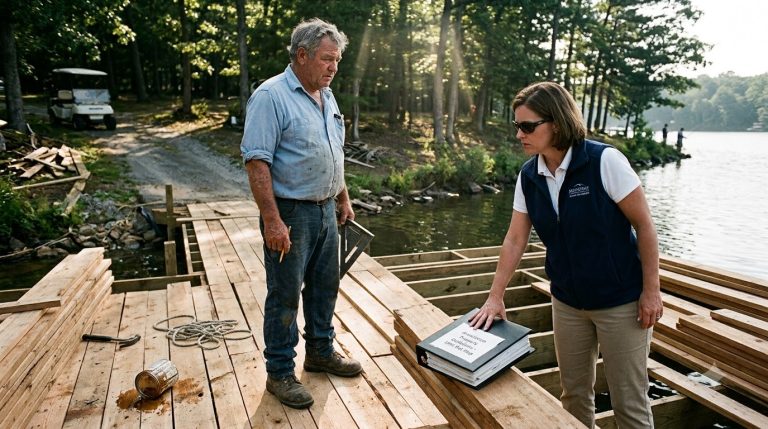
Pamela did not move toward the fence, nor did she retreat. She stood at the edge of my gravel drive, her cream blazer a jarring, synthetic brightness against the backdrop of the unkempt, tangled greenery of the creek bank. She held her posture with the stiff rigidity of a mannequin, her gaze fixed not on me, but on the orange notice she had zip-tied to my wire.
“Mr. Walker,” she began, the tone too smooth, too rehearsed. It was the voice of a professional facilitator, the kind that smoothed over inconvenient truths with a veneer of civic responsibility. “I noticed you were inspecting the emergency notice. I wanted to ensure you had the proper context before you jumped to any unnecessary conclusions.”
I didn’t move. I kept my hands at my sides, my weight balanced on the balls of my feet. My phone, tucked securely into my chest pocket, was still recording. I could feel the heat of the device against my skin, a constant, buzzing reminder of the evidence I was collecting in real-time.
“The context is printed on the page, Ms. Wexler,” I said, my voice steady, stripped of the reflexive defensiveness she was clearly fishing for. “And it references a book and page number that have no legal standing on this parcel.”
Her smile didn’t falter, though it didn’t reach her eyes. Those were busy, darting toward the fence line, assessing the structural integrity of the posts I’d set. “Regulations are often fluid in growing communities. We’re simply trying to prevent a bottleneck during the storm season. Your cooperation would save everyone a great deal of… friction.”
Friction. It was an interesting choice of words. She was trying to frame my legal boundary as an obstruction, a nuisance that, if removed, would allow the subdivision’s flow to continue unimpeded. She treated the land as a mere vector for her own objectives, entirely discounting the fact that it was my sanctuary.
Before I could respond, the low, mechanical rumble of a heavy engine interrupted the quiet. A delivery truck for the subdivision, loaded high with pallets of landscaping stone, rounded the corner of the lane. It slowed, the driver clearly expecting to turn toward the access corridor that my fence blocked.
Pamela glanced at the truck, then back at me, her eyes sharpening. This was the moment she had engineered. She wanted to see if the pressure of a public, semi-workplace confrontation would make me bend. If I moved the fence to let them through, I’d be acknowledging their right to access it. If I stayed, I would be the one “blocking” the safety route in front of their own contractors.
The truck idled, the engine’s vibration rattling the loose gravel at our feet. The driver leaned out, a confused expression etched onto his face.
I didn’t turn to the truck. I kept my focus squarely on Pamela. “The lane is closed, Ms. Wexler. And it’s not an emergency route.”
“For now,” she said, her voice dropping into a register of quiet, cold intimidation. “But the HOA board has a long memory, Mr. Walker. And we have significant resources to ensure that the community’s safety takes precedence over individual stubbornness.”
She signaled the driver with a sharp, impatient wave of her hand. The truck didn’t move. She waited, watching me, her breath hitching slightly in the cool morning air. She was waiting for me to be the first one to blink, to say the wrong thing, to lose the composure that was currently my strongest defensive tool.
I simply stood my ground, my posture relaxed but alert. I allowed the silence to stretch, heavy and thick, forcing her to dwell in the discomfort of her own intrusion. The driver, realizing the stalemate, finally shifted gears and backed the truck away, tires spinning slightly on the loose gravel before finding traction to pull back toward the subdivision entrance.
Pamela’s mask slipped, just for a fraction of a second. A flicker of irritation crossed her face, a hairline fracture in her composure. She had expected compliance; she had received an immovable object.
“We’ll be in touch, Mr. Walker,” she said, turning on her heel. The sound of her heels on the gravel was less steady now, more hurried.
I watched her walk back to the white SUV. She didn’t look back. She climbed in, and as the vehicle pulled away, leaving a faint trail of dust in the morning light, I didn’t breathe a sigh of relief. I knew this was just the prologue. She had tested the perimeter, and now that she knew I was watching, she would pivot.
I pulled my phone out, ended the recording, and checked the file. The audio was clear, the timestamp accurate. I had the confirmation of the request, the refusal, and the implicit threat. I stood by the gate, looking out over the creek. The trees stood silent, indifferent to the maneuvering of the subdivision, but I knew the truce was over.
I needed to check the title company records again. Not just the deed, but the original vesting files for the Blackwood Estates development. If they were claiming an easement that didn’t exist, I had to find out why. There was a reason they were targeting my specific parcel, and it wasn’t just about storm runoff or convenience.
I walked back toward my house, the cold air biting at my cheeks. The game was no longer about a fence. It was about finding the lever they were using to justify this, and then, piece by piece, stripping it away until their whole architecture collapsed under its own weight.
I sat at my desk and pulled up the digital archives. The screen glowed, a stark, clinical blue against the darkening room. I began to cross-reference the plat maps. It wasn’t long before I noticed the discrepancy: a secondary, internal audit trail linked to the subdivision’s infrastructure budget. They were filing for reimbursement on these “improvements” before they had even been approved.
The pieces were beginning to align. It was a cycle of forced expenditure, a mechanism designed to generate paperwork for work that was never meant to be completed. I was just the final hurdle in a much larger, much grimmer operation.
CHAPTER 3: THE FABRICATED PAPER TRAIL
The blue light of the screen washed out the room, turning the wood grain of my desk into a flat, lifeless gray. I sat back, the chair springs creaking in the silence of the house. On the monitor, two documents sat side-by-side: a PDF of the HOA board’s meeting minutes and a scanned invoice from the contractor, ‘Blackwood Infrastructure Services.’
The discrepancy wasn’t a typo—it was a surgical error in their deception. The minutes claimed the project was authorized on the twelfth, yet the invoice was dated and processed for payment on the tenth. They hadn’t just put the cart before the horse; they had invoiced for a road that, according to their own internal records, didn’t exist until two days later.
I leaned in, my eyes tracking the data. If they were billing the community for this “emergency” work before it was even discussed, they were running a shell game. I pulled up the parcel’s vesting file again, looking for any other anomalies in the subdivision’s previous contracts. My fingers moved with the practiced, rhythmic pace of an investigation, the kind of work that felt like second nature after years in the county.
I wasn’t just looking for the error anymore; I was looking for the pattern. I traced the signature blocks. The ‘Community Enforcement Supervisor’ name appeared on every document, but the handwriting on the approvals was inconsistent. A sudden, sharp realization cut through the fog of the data—these weren’t just rushed documents; they were distinct fabrications, likely drafted by different people with different agendas, all funneled through Pamela’s office.
I printed both pages. The paper emerged with a series of mechanical clicks and whirs, the sound disproportionately loud in the quiet study. I walked to the drafting table in the corner and laid them out, side-by-side. I took a red pen and circled the date disparity.
I needed to know if the title company had the original physical records, not just these digitized proxies. If I could get my hands on the physical paperwork, the ink-and-paper trail might reveal more—maybe a pressure mark, a different paper stock, or a signature that didn’t align with the digital seal.
The next morning, the air was crisp, the sky an unforgiving, pale blue. I drove into town, the gravel of my lane giving way to the smooth, monotonous asphalt of the county road. The title company office was a sterile, temperature-controlled environment of glass and polished aluminum. I entered, the bell above the door chiming with a hollow, synthetic cheerfulness.
“Mr. Walker,” the clerk said, her voice dropping to a practiced, sympathetic register. She was a woman who lived in a world of property lines and legal jargon, and she looked tired of the drama. “You’re back for more of the Blackwood files?”
“Everything in the current vesting file,” I said, my tone as neutral as a stone. “I need the original, not the scan.”
She hesitated, her gaze shifting to the thick, glossy folder resting on the edge of her desk. “I’m not sure if we can release the originals without a request from your counsel. The HOA is… sensitive about their documentation.”
I didn’t argue. I didn’t get angry. I simply stood there, a presence of calm, immovable logic. “These documents are tied to an active, contested claim on my property, one that is now bordering on civil trespass. If those records aren’t provided for independent verification, I’ll have to escalate this request through a formal sub-poena. I’d rather keep this between us and the files, if possible.”
She watched me for a heartbeat, measuring the weight of the request. Then, she slid the folder across the counter. “You have thirty minutes. And no copying equipment. Just your own notes.”
I opened the folder. It was a goldmine of bad intentions. As I flipped through the pages, I found more than just the invoice discrepancy. I found a note, handwritten in the margin of a memo to the board, detailing a projected “infrastructure recovery” fee that seemed to have no basis in the actual maintenance budget. It was a, subtle, jagged piece of evidence—the kind that Pamela would never have expected someone to look for.
I traced the margin note with my finger. It was written in a cramped, anxious hand. This wasn’t the work of a board; this was the work of someone trying to cover a hole in the ledger. The paper felt slightly thicker here, as if it had been handled often, folded and unfolded in the heat of a crisis.
I spent the next twenty minutes transcribing the details, noting the exact phrasing of the unauthorized fee structures. Each line of my notebook was a record of their institutional failure, a ledger of their hubris. I wasn’t just defending my land anymore; I was mapping the anatomy of their collapse.
When the clerk cleared her throat to signal the end of my time, I closed the folder. My mind was already racing, calculating the next step. I didn’t need to shout; I just needed to file. I walked out of the office, the cool air of the street greeting me like an old friend. The sun was higher now, casting long, sharp shadows across the sidewalk. I looked at the courthouse building across the square, its stone facade reflecting the same rigid, unyielding logic that I had just uncovered in the file.
I wasn’t done yet. I had the documents, but I needed to find the one person who would have been forced to witness these entries—a former board member, or perhaps an accountant who had been pushed out when the books began to bleed. The trail didn’t end at the office; it led straight back to the subdivision, to the heart of the machine Pamela Wexler had built, and I knew exactly how to make it start to stutter.
CHAPTER 4: THE ANATOMY OF A COLLAPSE
The road back to the parcel felt different now. The familiar curves and the encroaching trees, which had always felt like a buffer against the world, now looked like a perimeter I had to defend. I didn’t rush. I kept the truck at a steady pace, the tires humming against the asphalt, my mind running through the information I had culled from the title office.
The handwriting in the margin was the key. It was cramped, hurried, and unmistakably distinct from the formal type of the invoices. I had seen that same idiosyncratic style before—on a community newsletter delivered to my mailbox months ago, signed by the board’s secretary. Pamela hadn’t been acting alone, but she had been the one forcing the pace, the one ensuring that every document bore the weight of administrative authority.
I pulled into my driveway, the gravel crunching with a sound of settled intent. I didn’t go inside immediately. I sat in the truck for a moment, letting the silence of the woods wrap around me. The air was dry, carrying the scent of pine and distant, baked earth. It was a good place, and that was exactly why I would not let them turn it into a footnote in some developer’s balance sheet.
I entered the house and laid the notes out on the kitchen island. I needed to construct a timeline that the county engineering department could not ignore. If the invoice pre-dated the board’s authorization, then the entire ’emergency’ claim was a fraudulent document created after the fact to justify the trespass. It wasn’t just a regulatory breach; it was a criminal misrepresentation of authority.
My phone vibrated on the granite countertop. An email notification from the county clerk. I opened it, my eyes sweeping over the text. It was the permit log I had requested—a clean, digital record that showed absolutely no activity for the emergency grading the HOA had claimed. It was the final nail.
I didn’t reach for the phone to call Pamela. That would have been a waste of energy. Instead, I reached for my contact at the county engineering department, a man who, like me, had a low tolerance for administrative arrogance. I typed a concise, fact-based inquiry, attaching the digital scans of the invoice and the meeting minutes. I didn’t need to lead him to the conclusion; the contradiction was so stark it was practically an insult to anyone who read it.
I then shifted my attention to the fence. The restoration of the boundary was the next immediate objective. I walked out to the property line, the sun casting long, sharp shadows across the disturbed earth where the excavator had bitten into the bank. The ground looked raw, like a wound that had been poorly stitched. I took a measuring tape and began to map the extent of the damage, documenting every foot of the breach with the cold, methodical precision of a crime scene technician.
Every action I took was calculated to create an unbreakable sequence of events. If Pamela wanted to play with the rules of the subdivision, she was going to have to do it on my terms, in a court of law where the only currency was accuracy.
As I worked, the wind picked up, rustling the high canopy of the trees above me. I stopped for a moment, looking toward the Blackwood Estates fence line. There were no workers today. The silence coming from their side was brittle, a tense, expectant quiet. They were watching, waiting for me to react, to come at them with anger. They were waiting for me to lose my temper, to make a mistake.
I went back to the house and pulled out my tool kit. I needed to reinforce the gate, not just as a barrier, but as a clear statement of presence. I spent the afternoon working in the quiet of the late day, my movements fluid and focused. I was stripping away the possibility of them moving against me again without triggering a massive, irreversible response.
The sun began to dip below the tree line, painting the sky in shades of bruised purple and deep orange. I stood by the gate, my hands stained with the dust of the work, watching the last of the light fade. I had laid the groundwork. The evidence was in the hands of the county, the physical site was being prepared for restoration, and the administrative trap was set.
I wasn’t just a man protecting his land anymore. I was a man who had successfully inverted the power dynamic. Pamela thought she was playing a game of intimidation, but she was really participating in a process that was now accelerating toward her own exposure. I closed the gate, the latch clicking with a solid, definitive sound that echoed in the cooling evening air. I was ready for whatever move she made next, knowing that every action she took would only serve to tighten the noose of her own making.
CHAPTER 5: THE CRACK IN THE LEVERAGE
The hallway of the county building smelled of floor wax and stale coffee. I walked toward the hearing room, the folder in my hand feeling heavier with every step. Beside me, my lawyer—a man who preferred brevity over bluster—checked his watch. He didn’t look back. He didn’t need to. He knew, as I did, that the HOA’s side was already unraveling.
When we pushed open the heavy double doors, the room was already filled with the air of an impending collision. Pamela sat at the table with her board members, her posture so rigid it looked painful. She was dressed in a sharp, slate-gray suit, her hair pulled back into a severe, perfect knot. She didn’t look at us. She kept her gaze fixed on the mahogany surface of the table, her hands folded over a leather-bound folio.
I took my seat, the chair scraping against the linoleum with a jarring, high-pitched protest. The hearing officer, a woman with iron-gray hair and eyes that seemed to see right through the bureaucratic posturing, tapped her pen on the desk. “Case number four-oh-two. Blackwood Estates versus Walker. Let’s begin.”
Pamela’s lawyer stood up. He was a man of practiced theatrics, his voice pitching perfectly for the room. “Your Honor, this isn’t merely a dispute over a fence. This is a matter of public safety. My client represents a community that is currently at risk due to the obstruction of a vital emergency egress route. The defendant has acted not as a neighbor, but as an agent of chaos.”
As he spoke, a sudden memory flashed through my mind—a case from years ago, a man who had lied about a fire hazard to force a neighbor off a prime piece of real estate. The similarity was chilling. I saw the same desperate glint in the lawyer’s eyes, the same reliance on high-minded vocabulary to mask a low-minded objective. It wasn’t about safety. It was about acquisition.
My lawyer stood, his movement slow and deliberate. He didn’t raise his voice. He didn’t need to. “Your Honor, we submit that the ‘emergency’ mentioned by the plaintiff is, in fact, a manufactured scenario. We have evidence of an invoice from the contractor, Blackwood Infrastructure Services, dated two days prior to the board’s authorization meeting. If the board hadn’t even discussed the project, how could they have authorized it? And why is the invoice for an ‘improvement’ that engineering has no record of approving?”
The room went still. I watched Pamela. For the first time, I saw the mask slip. Her jaw tightened, her gaze darting toward the compliance officer sitting next to her. The man, a pale, nervous creature who looked like he’d rather be anywhere else, stared fixedly at his own shoes.
The hearing officer leaned forward, the overhead lights reflecting in her glasses, obscuring her eyes. “Mr. Wexler, is there a discrepancy in the record?”
“The records were… adjusted to reflect the urgency of the situation, Your Honor,” Pamela’s lawyer said, his voice losing its confident edge. “It was an administrative oversight during a critical safety initiative.”
“An oversight that involves financial transactions?” the officer asked, her tone dry.
“It is… complicated.”
I opened my folder and slid a copy of the invoice toward the officer. It was a simple document, but in this room, it was a wrecking ball. I watched the officer’s eyes trace the dates. The silence in the room deepened, the air becoming heavy, almost metallic. I could feel the tension radiating from the table across from me—a palpable, nervous energy that suggested the HOA’s foundation was beginning to shift.
They weren’t just losing the argument; they were losing control. Pamela’s face was a study in controlled panic. She kept reaching for her phone, then stopping, her fingers trembling. The board members were shifting in their seats, their previous united front fracturing as they realized they were being tied to a lie that was now being stripped bare on the record.
The hearing officer looked up, her expression unreadable. “I am going to need to see the original, signed authorization documents for this project, and I want them by the end of the day. If these dates are as inaccurate as they appear, I am going to have to reconsider the validity of this entire enforcement action.”
She turned to me. “Mr. Walker, you have a formal injunction request regarding the trespass on your land. Given what we have just discussed, do you have any reason to believe this will be resolved without further court intervention?”
“I don’t,” I said, my voice steady. “They have already crossed my fence line once. Without a clear directive, they will do it again.”
Pamela finally looked at me. Her eyes weren’t filled with anger anymore; they were filled with a cold, desperate fear. She knew that I had not only seen through the ruse, but I had documented the lie so thoroughly that there was no way for her to pivot back to a position of authority.
The hearing officer adjourned the session, the sound of her gavel ringing out like a closing door. People began to rise, the movement a slow, hesitant shifting of chairs. I stood, the weight of the folder in my hand now a tool of finality. I hadn’t won yet, but I had done something much more important: I had forced them to acknowledge that their manufactured reality no longer held any weight.
As I walked toward the exit, I passed Pamela. She stood frozen, a statue in a suit that no longer looked sharp, but rather like a cage. She didn’t say a word. She didn’t have to. The look on her face told me everything—she knew that the thread she had pulled to unravel my life was now, piece by piece, unravelling her own.
CHAPTER 6: THE SHATTERED FACADE
The gravel in the courthouse parking lot crunched beneath my tires as I backed out, the sound harsh and lonely in the late afternoon. My mind was still replaying the hearing officer’s cold, analytical gaze. I had the documents, I had the timeline, and I had the moral high ground, but the emptiness of the victory bothered me. Pamela Wexler was not the type to simply dissolve when faced with a few pages of contradictory dates. She was a creature of structure, and if her structure was failing, she wouldn’t just walk away—she would attempt to bring the entire roof down with her.
I drove toward the parcel, but instead of the usual, grounding comfort of the trees, I felt a prickle of tension along my neck. It was the intuition of a former deputy: the feeling of being observed. I pulled over onto the shoulder, a mile out from my property, and sat in the quiet of the cab. I watched the rearview mirror. A dark, unremarkable sedan passed by, its windows tinted deep enough to render the driver a silhouette. It didn’t slow down, but it lingered in my peripheral vision a second too long.
I waited five minutes, then pulled back onto the road, my senses tuned to the subtle vibrations of the vehicle and the rhythm of the surrounding woods. When I finally reached the gate, I didn’t get out right away. I checked the lock. It was intact, but something—a slight, unnatural angle to the chain—caught my eye. Someone had been here. Not to vandalize, but to probe.
I stepped out, my boots hitting the dirt with deliberate force. The air was colder now, the sun barely clinging to the western horizon. I walked the perimeter, my hand resting on the utility knife in my pocket. I found the traces near the creek bank: the distinct, deep imprint of a heavy-soled boot that didn’t match anything I owned. They weren’t just looking for access; they were looking for a weakness in my defense.
I moved to the house, but the structure felt suddenly vulnerable. I spent the next hour moving through the rooms, double-checking the locks and securing the digital records. I felt a strange, cold clarity descending over me. If the HOA board was this desperate, if they were willing to send people to my land to monitor my movements, then the ’emergency lane’ wasn’t just a project for financial gain. It was a shield. They were using it to hide something, or someone, and I had accidentally wandered into the center of their perimeter.
I sat at the kitchen table, the laptop open, and began to dig deeper into the contractor’s background. Blackwood Infrastructure Services. I searched the state business registry, then shifted to tax filings. The records were dense, but as I cross-referenced the names of the board members against the company’s registered agents, a new pattern emerged. It wasn’t just embezzlement; it was a complex web of self-dealing that spanned three different subdivisions. Pamela wasn’t just the president; she was the architect of a system designed to siphon funds through inflated ‘infrastructure’ contracts.
The weight of it was staggering. It wasn’t just about my creek bank. It was about a deliberate, cold-blooded extraction of value from every single resident in the subdivision. She was essentially taxing her own neighbors to pay off debts that, given the scale of the operation, surely had to be tied to something much worse than simple mismanagement.
I looked at the notes on the kitchen island. The invoice discrepancy from Chapter 3 was just the tip of a massive, frozen structure. My perception of the conflict shifted. I wasn’t just fighting an HOA president; I was fighting an entire system of exploitation. And I realized, with a chill that bypassed my skin and settled into my bones, that I was no longer the only one who knew.
My phone pinged. A message from an unknown number: “Stop looking at the contracts, Mr. Walker. Some structures are not meant to be dismantled.”
I stared at the screen, the blue light reflecting in the dark windows of the kitchen. They had crossed the line from bureaucratic annoyance to active intimidation. I stood up, feeling the resolve harden in my chest like cooling steel. They wanted me to be afraid. They wanted me to retreat behind the veil of ‘property boundaries’ and ‘legal process.’
I walked to the window and looked out at the creek. The darkness was absolute now, the trees standing like sentinels in the night. I didn’t draw the curtains. I left the light on, a single, unwavering beacon in the gloom. I reached for the phone and started typing, not a response to the message, but a draft for the state attorney general’s office. If they wanted to play a game of shadows, I was going to turn on every light in the house until there was nowhere left for them to hide. I had the documents, I had the timeline, and now, I had the proof of their desperation. The escalation was no longer avoidable. It was the only way forward.
CHAPTER 7: THE UNRAVELING OF THE LEDGER
The meeting took place in the corner of a dimly lit diner, the kind of place where the air smells perpetually of scorched coffee and forgotten ambition. The board member, a man named Henderson whose nervous energy made him look like he was trying to shrink into his own coat, didn’t wait for me to sit.
“She’s burning the records,” he whispered, his eyes darting toward the front door. “Not just the digital stuff. Everything. The project files, the historical invoices, the internal audit notes. She’s cleaning house, Walker, and she’s doing it because she knows the state is sniffing around.”
I leaned back, my hand steady on the table, and watched the panic ripple across his face. This was the crack in the facade I had been looking for. “Why tell me, Henderson? You were there for the votes. You were the ones who signed off on the ’emergency’ improvements.”
He swallowed hard, his Adam’s apple bobbing. “We signed off because she told us it was a county-mandated stabilization. We never saw the invoices. She kept the billing under lock and key, insisting it was proprietary to the contractor. She had us over a barrel, Walker. She knew about the zoning violation on my property—she threatened to trigger an inspection if I didn’t vote the way she wanted.”
The pieces fell into place with a sickening, crystalline clarity. It wasn’t just a conspiracy of greed; it was a hierarchy of fear. Pamela had been leveraging the personal secrets of every board member to force them into a loop of complicity. I reached into my bag and pulled out the invoice I had retrieved from the title office, sliding it across the table.
“Look at the date,” I said, my voice low and hard.
Henderson stared at it, his fingers brushing the paper as if it were contaminated. The color drained from his face until he looked like a ghost. “This… this isn’t possible. This invoice pre-dates the board’s actual authorization by forty-eight hours.”
“That’s because it was a fabrication,” I said. “She was billing for work she never intended to perform, to pay off debts she couldn’t account for in the official ledger. She didn’t just embezzle from the community; she used the community as a laundromat for her own failures.”
“She’s going to pin it on the contractor,” Henderson said, his voice gaining a sudden, desperate strength. “She’s already moved to terminate his contract, claiming he was the one who forged the documents. She’s going to make him the scapegoat and vanish into the night.”
I looked at him, my mind already calculating the next move. If she was already preparing to cut the cord, I didn’t have days. I had hours. I needed to lock down the physical evidence before the paper trail was reduced to ash.
“I need access to the central server,” I said. “The one where the administrative logs are kept.”
Henderson went pale. “That’s impossible. It’s behind a biometric lock in her home office. But… I have a key to the secondary backup drive she keeps at the subdivision clubhouse. She uses it to sync the files every Friday.”
“When is the next sync?”
“Tonight. At midnight.”
I left the diner, the cool night air hitting me like a physical barrier. I didn’t go home. I drove toward the Blackwood Estates clubhouse, my senses heightened, the familiar weight of the situation now pressing down with an almost physical force. The standoff had evolved; it was no longer a battle of filings and injunctions. It was a race against a deliberate, orchestrated destruction of evidence.
The clubhouse was a glass-and-steel structure that loomed over the neighborhood, a monument to the very arrogance I was here to dismantle. I parked the truck in the shadows and walked to the service entrance. The lock turned under Henderson’s key with a soft, metallic snick. I stepped inside.
The silence of the clubhouse was absolute, the air sterile and cooled to a temperature that felt designed for hardware, not people. I found the backup drive in the admin suite. It was a small, unassuming black box blinking with a slow, steady pulse of blue light. As I connected my laptop, the screen flickered to life.
There it was. Not just the invoices, but a master spreadsheet—an unauthorized ‘Project Ledger’ that detailed every illicit transfer, every fake emergency repair, and a series of alarming, private bank records that confirmed my deepest suspicion: the money wasn’t just being embezzled; it was being funneled into a defunct, shell-company bank account that held a lien against Pamela’s personal assets.
I hit the download key, the progress bar moving with agonizing, heartbeat-like steps. 30%. 50%. 80%.
Suddenly, the security lights in the office flared to life, the sudden, violent brightness forcing me to squint. A door slammed down the hall, followed by the rapid, uneven cadence of footsteps. I didn’t panic. I watched the bar hit 99%.
I wasn’t an intruder anymore; I was a witness. I grabbed the drive, disconnected the cables, and turned toward the door just as Pamela Wexler burst into the room. She was breathless, her hair disheveled, a look of pure, unadulterated fury on her face. She stopped dead when she saw me, her eyes locked on the drive in my hand.
“You have no idea what you’re doing,” she said, her voice shaking with a mix of rage and terror. “You’re not just destroying a board, Walker. You’re destroying everything.”
“I’m destroying a lie, Pamela,” I said, my voice steady, the cold, sharp truth of the ledger now resting firmly in my pocket. “And this time, there’s no paper trail left for you to burn.”
She lunged, her hand reaching for the alarm trigger on the wall, but I moved first, stepping between her and the panel, my body a physical barrier she couldn’t move. The confrontation was no longer a matter of protocol; it was the final, inevitable collision of the truth and the one who had spent a lifetime trying to outrun it.
CHAPTER 8: THE PRICE OF THE LEASE
Pamela didn’t lunge again. She stood frozen, the blue light from the server rack casting sharp, unforgiving shadows across her features. Her breath was shallow, the sound of it harsh in the quiet room. She looked at the drive in my hand, then at the monitor where the ledger files remained open, a digital map of her entire life’s work in fraud.
“If you release that,” she said, her voice stripped of its practiced authority, reduced to a low, trembling rasp, “you’re not just ruining me. You’re destroying the community’s reputation. Everyone who lives here—the families, the property values—they’ll all pay the price for your crusade.”
“That’s the trap you set for everyone, Pamela,” I said, stepping away from the alarm panel. “You made the community your hostage. You thought if you tied your survival to their comfort, no one would dare pull the string.”
She slumped, the tension draining from her shoulders as if the marrow had been sucked from her bones. She didn’t look like a president anymore; she looked like an empty suit, a shell held together by the very documents I now held. The contractor, who had been hovering in the hallway, caught sight of the open ledger on the screen and simply turned around, vanishing into the night without a word. He knew the game was over.
The aftermath didn’t happen with an explosion, but with a series of quiet, inevitable clicks—the sound of locks turning, of doors closing, of a life constructed on sand finally surrendering to the tide. By morning, the state inspectors had arrived. They didn’t need to do much digging; I had provided the roadmap. The ledger, the invoices, the shell company bank records—every piece of evidence fit together like the teeth of a gear.
The payoff was as clinical as it was thorough. I watched from the safety of my porch as the sheriff’s deputies escorted Pamela from her home. She didn’t look at the houses as she passed. She didn’t look at the gate. She looked straight ahead, her face a mask of absolute, hollowed-out indifference. The poetic justice was in the details: she was taken away in the same vehicle that, weeks ago, she had tried to weaponize against me.
The cool-down came with a sudden, overwhelming silence. The machinery was gone. The ’emergency’ notices had been peeled from the wire, leaving only faint, sun-bleached rectangles on the galvanized steel. I walked out to the creek bank, the earth finally quiet under my feet. The burm was still scarred, but the grass was already beginning to push through the disturbed soil, a stubborn, green resilience that defied the human drama that had played out above it.
I pulled my tool kit from the back of the truck and knelt by the fence. The gate had been wrenched during the first trespass, the hinge slightly bent, a small, tangible legacy of the conflict. I took a wrench and a level, my movements slow and deliberate. I loosened the bolts, aligned the frame, and tightened them back down. The metal gave a satisfying, solid click, the gate swinging true and silent, just as it had the day I bought the land.
The symbolic repair felt like the final step of a long, difficult extraction. I stood up, wiping the grease from my hands onto a rag, and looked out over the creek. The water flowed over the stones with a low, rhythmic murmur, an ancient sound that didn’t care about liens, bylaws, or the hubris of subdivision presidents.
The legal proceedings would drag on, of course—lawyers, depositions, and the long, grinding machinery of the courts. But the conflict itself was resolved. The land was still mine. The perimeter was secure. I sat on the tailgate of my truck, watching the sunlight play across the surface of the water. My wife came out of the house, carrying two mugs of coffee. She didn’t ask what happened. She didn’t need to. She just sat down beside me, the warmth of the mug seeping into my palms, and we watched the day settle into an atmospheric, unshakable peace.
There was no victory lap, no triumphant announcement. Just the quiet, steady rhythm of a life reclaimed. I reached into my pocket, pulled out that first orange notice—still stiff, still bright—and let the wind catch it, watching it tumble down toward the creek bed, eventually settling into the mud where it belonged. The truth had finally finished its long, quiet work.