The Silence of Ownership: A Cold War for the Deed of an Inherited Life
CHAPTER 1: THE FRICTION OF METAL
The sound was subtle—a metallic rasp that had no business being on my porch at three in the morning. I was sitting at the kitchen table, the estate’s timeline spread out before me like a map of a trench, when the front door shivered. Not a knock. A probe.
I stood, the floorboards under my feet groaning in a pitch I’d memorized over the last week. The house was a quiet beast, and right now, it was telling me someone was testing its armor.
I didn’t turn on a light. In the darkness, the edges of the room—the sharp corner of the oak table, the serrated edge of the letter opener I’d kept near the documents—took on a predatory clarity. I moved to the hallway, my steps muted by the worn runner. The deadbolt, the one the locksmith had stared at with such professional detachment just days ago, was vibrating.
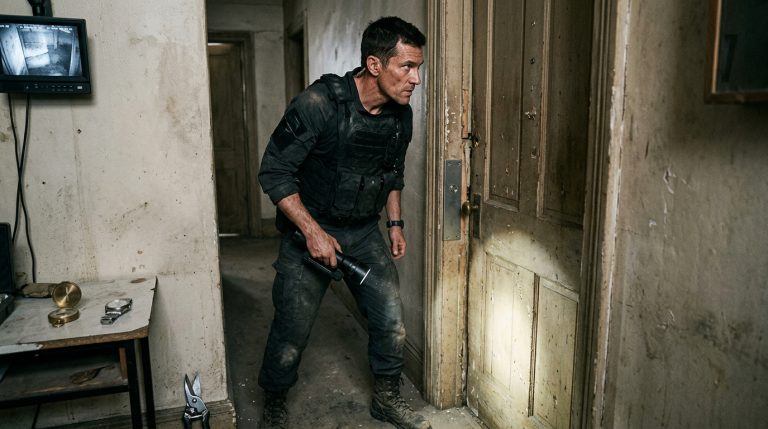
It wasn’t a break-in attempt of brute force. It was delicate. A rhythmic, calculated pressure. A pick.
I didn’t shout. I didn’t reach for a phone to call the police, knowing the HOA’s reputation-laundering had already flagged my address as a site of “unauthorized occupancy” in the local dispatch system. Instead, I leaned against the doorframe, my palm pressed against the cool, smooth wood of the jamb. I watched the cylinder.
The tool—a slim, silver sliver of steel—pushed through the keyhole, dancing with the pins. It was the movement of someone who believed they were invisible, someone who thought they were simply performing a mundane maintenance task on a vacant asset.
Then, I saw it. A reflection in the brass house numbers mounted on the exterior brick. A camera lens, small and unblinking, fixed to the lapel of the figure on my porch. They weren’t just here to pick the lock; they were here to record me catching them in the act of “securing” a property that was supposed to be empty. If I opened the door, I’d be the aggressor. If I screamed, I’d be the unhinged tenant.
The lock clicked, the bolt sliding back with a sound like a guillotine.
I didn’t move toward the door. I moved to the light switch. I didn’t click it on. I grabbed the heavy, iron-bound ledger of my aunt’s original property surveys—a book heavy enough to dent steel—and placed it firmly against the interior handle. I wasn’t going to let them in, but I wasn’t going to play their game of optics either.
The door nudged inward an inch, meeting the resistance of the ledger.
“I know you’re recording,” I said, my voice cutting through the space between us, stripped of all tremor.
The pressure on the door ceased instantly. The figure on the other side didn’t run; they stood there, framed by the moonlight, waiting for me to break my own silence. I looked down at the threshold and saw a small, bright blue plastic tag wedged into the door frame—a marker, a ‘Property Inspected’ tag, placed there as a claim of jurisdiction.
The silence that followed wasn’t empty. It was heavy with the realization that they weren’t just trying to move me out. They were trying to stake a claim, and they had just left their signature on my frame.
CHAPTER 2: INVENTORY OF WEAKNESS
The blue plastic tag didn’t just sit in the door frame; it pulsed in the dim light of the porch. It was an aggressive, artificial color—that specific shade of corporate cyan designed to denote order, compliance, and institutional authority. It was a lie manufactured to look like a standard operating procedure.
I left the ledger against the door for three minutes. My pulse slowed, not from a sense of safety, but from the transition into a cold, tactical rhythm. I pulled my phone from my pocket and snapped a photograph of the tag, the flash cutting a sharp, clinical rectangle into the darkness. I didn’t touch it. I didn’t want my skin oils to contaminate the only physical evidence of their unauthorized entry.
I retreated into the living room, leaving the door braced. The house felt different tonight. The dust motes dancing in the sliver of moonlight from the window seemed to hang with a heavier, more expectant gravity.
The HOA wasn’t going to break the door down in the middle of the night. That was too loud, too desperate, and too easily punished by the law. No, they were playing a longer game—a war of attrition fought with stickers, emails, and the slow, agonizing erosion of my privacy. They wanted me to tire out. They wanted me to feel like a trespasser in my own inheritance.
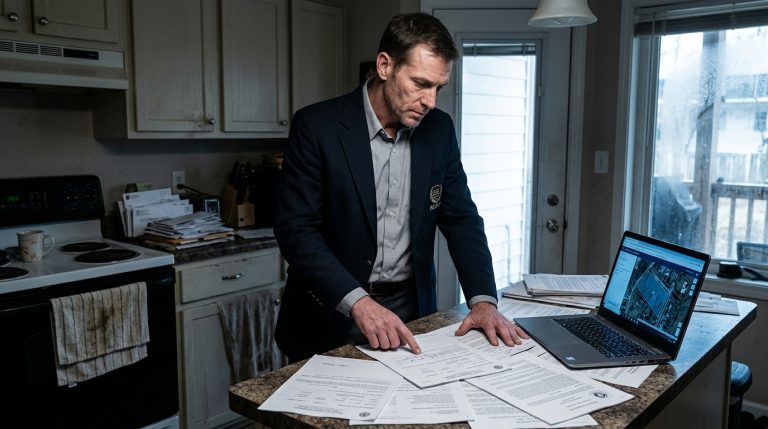
I walked to the kitchen island, where my timeline was spread out. I picked up the pen, my grip firm, and logged the event: 03:00 AM. Intrusion attempt. Blue compliance tag affixed to the frame. I didn’t write “scared.” I didn’t write “angry.” I wrote “documented.”
As I sat there, the V-2 variance struck—the psychological phantom of my aunt. I could almost hear her voice, dry and pragmatically sharp, telling me that the house was just a shell, but the land was a legacy. She had survived through two recessions and three real estate busts by treating every conflict as a math problem.
If they want this property, I thought, looking at the layout of the lot on the survey map, why this one?
There were forty houses on this cul-de-sac. All of them held the same layout, the same footprint, the same architectural aspirations. But the Keller property sat at the lowest topographical point, a small, stubborn rise of land that dipped toward the wooded buffer zone. I leaned over the map, tracing the lines with my finger. It was the only lot that didn’t connect to the main utility grid via the standard easement path. It had its own, older, subterranean access.
The house was an obstacle. Or perhaps, the land beneath it was the prize.
I pulled my laptop closer, the screen’s backlight biting into my tired eyes. I bypassed the neighborhood’s “Safety Liaison” platform—arguing with them there was like screaming into a void—and instead navigated to the county’s public mapping site. I spent the next four hours shifting through layers of GIS data, looking for the one thing the HOA would have tried to hide beneath their polished veneer of “community compliance.”
I found it buried in an archived zoning report from twenty years ago—a note about a ‘natural water easement’ that had been silently reclassified. The data was gray, desaturated, and cold. If the HOA could declare the property vacant, they could force a re-zoning classification, effectively bypassing the deed’s original protections and opening the land for whatever “infrastructure” their financiers had planned.
My phone buzzed. A new notification from the “Safety Liaison” account: Final notice regarding unauthorized occupancy. Legal recourse initiated.
The threat didn’t carry the same weight as it had yesterday. Now, it was just another variable in the equation. They weren’t just trying to move me out; they were trying to move me out before the municipal records were updated. They were running a clock.
I stood up, the chair scraping sharply against the hardwood—a harsh, dissonant sound in the silence. I wasn’t going to play defense anymore. I had the timeline. I had the photograph of the tag. I had the zoning discrepancy.
I looked at the hallway mirror, catching a glimpse of my own reflection. I looked tired, my eyes rimmed with the exhaustion of the last few days, but my stance was steady. I walked to the kitchen drawer, pulled out a small, heavy-duty utility knife, and walked back to the front door.
I didn’t remove the ledger. I simply reached around it, my hand moving with surgical precision, and sliced the blue plastic tag from the door frame. I didn’t throw it away. I dropped it into a clear plastic Ziploc bag, sealed it, and labeled it with a sharpie: Exhibit A.
The house settled again, the wood groaning as if in relief. I realized then that I wasn’t just defending a building. I was holding a line. And if they wanted to play with the history of this land, they were going to find that the occupant wasn’t an “unauthorized hazard,” but a curator of exactly what they were trying to bury.
I turned off the kitchen light. The silence that rushed back into the room was no longer menacing; it was a weapon. I sat back down at the table and began to draft a list of every neighbor who had ever complained about the HOA’s sudden change in management policies. If the HOA wanted to isolate me, I would do the inverse: I would map every fracture in their foundation.
The first name on my list was Gavin Reed’s own assistant—a name I’d seen on a CC’d email weeks ago. It was a reach, a long, thin wire of a possibility, but it was a start.
The sun began to bleed over the horizon, casting long, angular shadows across the kitchen floor. The fight wasn’t over; it had merely shifted from a physical intrusion to a surgical, data-driven siege. And I was ready to operate.
CHAPTER 3: THE FORGED ALLIANCE
The sunrise was an intrusive, pale lemon light that revealed the dust I hadn’t noticed while tracking GIS coordinates all night. I was still sitting at the kitchen table, the laptop hum the only sound in the house, when the front door received a sharp, rhythmic rap. It wasn’t the tentative probe of the night before. This was a polite, localized strike—the knock of someone who knew the perimeter and didn’t want to alert the street.
I rose slowly, my joints stiff from the four hours of rigid focus. I didn’t reach for the utility knife this time. Instead, I checked the hallway mirror—my appearance was disheveled, but the sharp edges of my resolve remained intact. I walked to the door and peered through the security peephole.
It was Sarah Jenkins, a woman who lived three doors down. I’d seen her gardening most weekends—she was the type of person who meticulously pruned her hedges with a level, a woman whose life seemed governed by the same unspoken rigidities the HOA championed. She wasn’t a friend. She was a witness.
I unbolted the door and opened it just enough to keep the security chain engaged.
“I saw the locksmith van on Monday,” Sarah said. Her voice was low, devoid of the performative brightness Melissa Hart used. She was clutching a grocery bag, her knuckles white. “And I saw the police welfare check last week. You’re the one holding out against the board, aren’t you?”
“I’m the one exercising my legal rights,” I corrected, my tone neutral.
Sarah looked over her shoulder, checking the empty street. “I’m not here to argue policy. I’m here because I received a ‘Service Fee’ invoice yesterday for ‘Community Infrastructure Upkeep.’ It was for three hundred dollars. The board never voted on that, and our bylaws clearly state that any fee over fifty dollars requires a general assembly vote.”
This was the V-3 variance—the Butterfly Detour. The HOA’s overreach wasn’t just targeting me; it was beginning to squeeze the residents who had been quiet, compliant observers up until this point. If they were looking to fund their legal “war” against me, they were bleeding their own base to do it.
“I haven’t paid mine,” she added, her eyes meeting mine with a flicker of shared defiance. “I went to the management office to ask for the meeting minutes where this was authorized. Gavin Reed told me it was a ‘discretionary safety assessment.’ He wouldn’t give me the minutes.”
I felt the shift in the room. The isolation campaign they’d waged against me had created a blind spot: they assumed that by alienating me, they could move unchallenged against the neighborhood. They were wrong.
“Step inside,” I said, unhooking the chain.
She hesitated, then crossed the threshold. She didn’t look like a spy; she looked like a tired woman who was realizing her neighborhood wasn’t the well-oiled machine she’d bought into. I led her to the kitchen, where my timeline was still splayed out. I didn’t apologize for the clutter. I pointed to the document I’d printed: the fraudulent change-of-address complaint.
“They’re using the same boilerplate language for everyone,” I said, pointing to the ‘discretionary safety assessment’ phrase. “It’s a linguistic trap. If you accept the assessment, you accept the authority behind it. Once you pay the fee, you’ve signaled that you acknowledge their right to charge it without a vote.”
Sarah leaned in, her gaze lingering on the stack of evidence. “If you have a log of their inconsistencies, why haven’t you taken it to the regional board?”
“Because they control the flow of information to the regional board,” I explained. “They’re not just managing the HOA. They’re gatekeeping the truth. If I take this to the regional manager, they’ll just call me a ‘hazard’ and feed them a modified version of the story. I don’t need to win the argument; I need to make the argument too expensive for them to maintain.”
We sat in the quiet of the kitchen. Sarah didn’t ask for a favor. She pulled a notepad from her bag and laid it on the table. “My husband is an accountant. He doesn’t like surprises, and he hates being lied to about money. If you have a log of the discrepancies, I have a list of every resident who was billed for that ‘infrastructure fee’ without a vote.”
It was an unscripted alliance, forged not by friendship, but by the friction of their arrogance. I looked at the notepad—a list of names, amounts, and dates. It was the missing piece of the mosaic. I had the legal framework to stop the eviction, but Sarah had the economic proof to shatter the board’s legitimacy.
“They’re trying to seize my property to bypass the zoning grid,” I said, the words feeling heavy and true in the morning air. “They’re not just after my house. They’re after the infrastructure beneath the entire block.”
Sarah looked up, her expression hardening. “If they’re going to play with our equity, we’re going to play with their tenure.”
We worked in silence for an hour, cross-referencing my timeline of events with her list of unauthorized billings. Every time we found a match—a date when I was being harassed, followed by a sudden ‘fee’ for the neighborhood—the pattern became unmistakable. It wasn’t just chaos. It was a calculated, daily campaign to extract capital from the neighborhood to fund the legal effort to isolate me.
As she prepared to leave, the sun had fully risen, casting long, sharp shadows across the kitchen floor. The house felt less like a bunker and more like a command center.
“I’ll reach out to the others,” Sarah said, reaching for the door. “Keep your phone close. And be careful—Gavin has been seen driving around the cul-de-sac every night since the locksmith incident. He’s looking for something.”
I watched her walk back to her house, her stride purposeful. I turned back to the kitchen, the sunlight hitting the edge of the survey map. I had the timeline, I had the legal status, and now, I had the neighbors. The HOA’s “authority” was just a mask, and I was starting to see the cracks underneath.
I picked up the ledger and walked to the window. Down the street, a silver sedan sat idling at the curb—Gavin Reed’s car. He wasn’t doing anything illegal. He was just sitting there, watching, waiting for the pressure to make me slip. I didn’t look away. I stood in the glass, a static, unyielding silhouette, and waited for him to make the next move.
CHAPTER 4: THE SHADOW AUDIT
I didn’t watch him for long. Staring back felt like admitting he had an audience, and the moment I stepped away from the glass, the shadow of the silver sedan felt less like a threat and more like a tactical error. Gavin was out there, exposed, while I was inside, building a case. I kept the lights low and moved to the den, where the physical files—the ones that hadn’t been digitized, the ones my aunt had kept in a fireproof lockbox—sat waiting.
The air in the den was thick with the scent of old paper and dust, a sharp contrast to the antiseptic, artificial atmosphere the HOA tried to impose. I sat on the floor, the box before me like a treasure chest of liability. I began to feed the documents into the scanner, one by one. I wasn’t just looking for proof of ownership; I was looking for the history of the land itself.
My aunt June hadn’t been a hoarder, but she had been an architect of records. She had kept every permit, every survey, and every correspondence regarding the property dating back to the late nineties. As I scanned a series of hand-drawn topographical maps, the discrepancy became impossible to ignore. A note, scrawled in her sharp, uncompromising handwriting in the margins of a 2004 easement agreement, caught my eye.
Water table access restricted by subsurface geological variance. No excavation permitted.
I cross-referenced that note with the GIS data I’d pulled that morning. The “natural water easement” the HOA was trying to reclassify as an infrastructure project wasn’t just a simple plumbing issue. It was a restricted, high-value water vein that bypassed the municipal grid entirely. If the HOA could condemn the property, they wouldn’t just be securing a house; they’d be seizing the land rights to a massive, private, and entirely unregulated water source. The “infrastructure project” was a cover story, a decoy to hide the fact that they were trying to commodify a resource that wasn’t even technically theirs to manage.
The phone on the desk buzzed—a text from Sarah. Gavin just met with someone from ‘Evergreen Consulting’ at the corner of Oak and Vine. They’re carrying blueprints.
I felt a cold, hard focus settle in my chest. The HOA wasn’t just working for the neighborhood; they were acting as an acquisition firm. My aunt’s house was the only obstacle between them and total control over that water vein. If they could get me out—even for a week, even for a day—they could perform a ‘safety inspection’ that would trigger a condemnation order.
I didn’t call Tessa. Not yet. A lawyer would send a letter, and a letter would just make them more careful. I needed to document the illegality of the inspection itself. I grabbed my camera, checked the battery, and pulled on my coat. I didn’t go out the front door; I exited through the service gate in the back, moving through the narrow space between the hedges where the neighbor’s security lights couldn’t track me.
I moved with a precision I hadn’t known I possessed. I kept low, staying in the shadows of the fence lines, tracking the movement of Gavin and his associate. They were standing near the storm drain at the end of the cul-de-sac, their faces illuminated by the harsh white glare of a tablet.
I leaned against the trunk of an oak tree, fifty feet away, and brought the camera up. I didn’t need to hear what they were saying. I just needed the visuals—the blueprints, the association with Evergreen Consulting, the proof that this wasn’t about “community safety.” It was about corporate resource theft.
The shutter clicked, a sound that felt deafening in the silence, but the wind was blowing toward me, carrying the sound of their voices away. I watched as the man from Evergreen handed Gavin a document—a physical one, a contract. Gavin signed it without looking, his posture relaxed, even arrogant. He was confident that the neighborhood was asleep, that I was isolated, and that the paperwork would shield him from any consequence.
He was wrong. Every frame I captured was another nail in the coffin of their manufactured authority.
As I watched, a sudden noise—the snap of a dry twig under my own boot—echoed. I froze. Gavin stopped talking. He looked in my direction, his eyes narrowing as he scanned the darkness. I pulled my face back behind the oak tree, holding my breath, my heart hammering against my ribs.
He didn’t move toward me. He just paused, listening to the silence. Then, he laughed—a short, jagged sound that carried clearly across the street. He turned back to the man from Evergreen and gestured toward my house. He wasn’t afraid. He was amused. He thought he was hunting me, but he was actually just providing me with all the evidence I needed to destroy him.
I waited until they walked away, retreating toward the association office, before I moved. I didn’t return the way I came. I doubled back through the wooded buffer zone, my boots sinking into the damp, soft earth. I felt a strange, detached clarity. The HOA wanted to make me a hazard; they wanted to force me into a defensive crouch. Instead, they had inadvertently turned me into a ghost in their own machine.
I reached the house and slipped back inside, the door clicking shut behind me. I didn’t turn on the lights. I sat in the dark of the den, the camera in my hand, and looked at the files on the screen. The zoning easement was the lie. The water vein was the truth. And the contract I’d just photographed was the link that would connect the HOA to a massive, illegal corporate play.
I opened a blank document and began to type. No emotions. No rhetoric. Just the facts. Time, place, participants, and the clear visual evidence of their collusion. I was building a bunker of truth, and for the first time since my aunt died, I felt the house shift from being a burden to being a fortress. They were trying to take my life, but they had given me the one thing I needed to keep it: a target.
CHAPTER 5: THE DECOY STRIKE
The dark screen of my laptop flickered, the reflection of my own tired face staring back from the glass. I turned the computer off, the silence of the den returning like a physical weight. My camera sat on the desk, the SD card containing the images of Gavin and the Evergreen consultant a small, plastic promise of leverage.
I didn’t sleep. The house felt too alert, as if the walls were listening for the next move from the cul-de-sac. By five in the morning, I was already at the kitchen table, breaking down the photographs. I didn’t need a lawyer to see the story they told; it was written in the way Gavin held the blueprints, the way he leaned toward the associate with that desperate, hungry posture. He wasn’t just managing a neighborhood; he was liquidating it.
Just as the first true light of day touched the countertop, my phone signaled an incoming email. Not a notification from the “Safety Liaison”—a direct, unformatted message from the management office’s official address.
Subject: NOTICE OF ADMINISTRATIVE ENTRY
Body: Per the community safety ordinance, inspection of the plumbing infrastructure is required for property compliance. Entry is scheduled for 10:00 AM. Failure to permit access will result in immediate fine and locksmith intervention.
I stared at the screen. They weren’t hiding anymore. They had dropped the pretense of a “waiting period” and were moving straight to the decoy reveal. This was the “administrative inspection”—the trap they’d been building toward. They knew I wouldn’t let them in, which meant they would use that denial as the final justification to declare the house “hazardous” or “abandoned,” allowing them to seize control under the guise of municipal safety.
It was crude. It was obvious. And it was exactly what I needed to trigger the next phase of our counter-move.
I didn’t reply. Instead, I stood up and moved to the storage closet in the hallway. I pulled out a heavy-duty box of file folders and began to organize the “shadow audit.” I pulled out the original deed, the survey maps, and the photographic evidence of Gavin’s meeting. I placed them in a binder, labeling it with the name of the county’s property records office.
The V-1 variance hit me then: as I pulled the binder from the shelf, a folder fell out from behind it. It wasn’t one of mine. It was a faded, thin manila file labeled Keller Property – 1998. I hadn’t seen it in the lockbox, and it didn’t belong with the current probate documents. I opened it. Inside was a hand-drawn map of the property, but it was marked with strange, cross-hatched lines that didn’t correspond to any building plans.
The lines followed the exact path of the water vein I’d identified. But there was a note at the bottom, written in a different hand—not my aunt’s, but a signature from a long-defunct civil engineering firm. Do not disturb the natural pressure valve. If the vein is breached, the subsidence will collapse the north foundation.
I froze. The decoy was worse than I thought. The HOA wasn’t just trying to steal a water vein; they were planning to siphon it using a method that would physically destroy the house. They didn’t care about the property. They wanted the land cleared, and they were willing to destabilize the very foundation of the block to get it.
The gravity of it pulled the air out of the room. My phone buzzed again—Sarah. They’re gathering at the management office. There’s a white van. They’re bringing equipment, not just paperwork.
I looked at the map again, the cross-hatched lines forming a pattern of intended destruction. My focus sharpened into something cold and crystalline. I walked to the front door, the utility knife in my pocket, and waited. If they were coming for a “plumbing inspection,” I would give them one. I had the records, I had the warning about the foundation, and I had the proof of their collusion.
The sound of an engine—a heavy, idling diesel—echoed from down the street. It was ten o’clock. The decoy strike had arrived.
I checked the front door, the deadbolt, and the chain. I walked to the kitchen and placed the 1998 file on the counter, right next to my phone. I wouldn’t let them in. But when they arrived, I wouldn’t just be the “unauthorized occupant” they were expecting to intimidate. I would be the only person in the neighborhood who knew exactly what they were trying to steal, and exactly how they planned to burn the world down to get it.
I took a breath, the air in the house feeling cool and steady. I didn’t feel afraid. I felt ready. The trap was set, but for the first time, it felt like the trap was theirs, not mine. I stood in the center of the kitchen, waiting for the first knock, my eyes fixed on the door, listening to the crunch of gravel as the van pulled into the drive.
CHAPTER 6: THE ANATOMY OF A SIPHON
The gravel crunching under the tires of the maintenance van wasn’t just noise; it was a rhythmic, mechanical countdown. I stood behind the reinforced solid-oak core of my front door, my palm resting against the cool metal of the deadbolt. I didn’t look through the peephole. I didn’t need to see them to know the choreography. Gavin would be in the lead, clipboard ready, followed by his ‘technicians’—men who were more hired muscle than plumbers.
The engine cut out, leaving a ringing silence that amplified the sound of footsteps on the porch. My breathing was shallow, controlled, a habit picked up from weeks of this slow-motion siege. The paranoia that had been a low hum in the background of my thoughts was now a sharp, stabbing note of clarity. Every shadow in the hallway felt like a potential breach; every floorboard creak felt like a signal. I forced myself to stay grounded, staring at the 1998 file still lying on the kitchen island.
The first knock came—sharp, authoritative, and impatient.
“Open the door,” Gavin’s voice drifted through the wood, muffled but distinct. “We have a work order for a safety inspection. If you don’t grant entry, we have the authority to bypass the lock.”
I didn’t answer. I stepped back, reaching into my pocket to ensure the utility knife was there, not as a weapon, but as a reminder of the physical stakes. They weren’t just here to inspect plumbing. They were here to perform the “administrative entry” that would legally render my home insecure, opening the door for the condemnation they needed to access the water vein.
The second knock was harder, the door shuddering in its frame.
“I’m going to count to three,” Gavin said, his tone shifting into that polished, training-video cadence that always made my skin crawl. “This is for the safety of the community. Don’t make this a liability issue.”
I moved to the kitchen island, picked up the phone, and tapped the recording button on my secondary app—the one linked directly to the cloud. I also triggered the alert to Sarah. She was already in position, likely watching from her window, ready to signal the others. I took the 1998 file and laid it open on the counter. The map with its grim warning—do not disturb the pressure valve—was my only real defense.
“One,” Gavin said.
I walked back to the entryway, my footsteps deliberate, measured. I reached the door and placed my hand on the deadbolt.
“Two.”
I unlocked the door, but I didn’t open it. I stayed on the other side, the weight of the frame acting as a barrier. The house felt suddenly, terrifyingly fragile. I knew that if they breached this threshold, they would move with the calculated speed of a demolition crew, not a plumbing team. The paranoia flared, a sudden, blinding thought: what if they’d already compromised the foundation? What if the house was already vibrating, ready to collapse the moment they cracked the pressure valve?
“Three.”
The door was shoved from the other side. Gavin didn’t wait for a polite opening. He slammed his shoulder into the wood, but he hadn’t expected the heavy oak I’d braced earlier. The door groaned, but held.
I grabbed the handle and pulled it open, not out of compliance, but to force the confrontation out into the open, where the neighbors could see it. I stood in the doorway, blocking the path, my face a mask of absolute, icy calm.
Gavin stood there, his face flushed with the exertion of the push, his eyes darting toward the van where the Evergreen consultant was waiting. Behind him, the two technicians stood, their tool bags heavy with equipment that looked far more suited for excavation than maintenance.
“You’re not coming in,” I said, my voice steady, barely above a whisper. “And before you try to cite the board, you should know that I have the original 1998 geological survey. The one that specifically prohibits excavation on this site due to structural subsidence.”
Gavin’s smile didn’t fade, but his eyes locked onto mine, a flicker of genuine shock crossing his expression. He hadn’t expected me to have the history of the land. He’d expected an emotional outburst, a screaming match he could record and edit into a reel of “unstable behavior.”
“That document is obsolete,” he said, stepping onto the threshold, his presence filling the entryway. “We have new municipal assessments. We’re authorized.”
“Show me,” I said, holding his gaze. “Show me the permit, the signature, and the engineering stamp. Because if you set one foot over this line with excavation tools, you aren’t just trespassing. You’re performing an illegal, unpermitted demolition on a protected property.”
The tension in the air was absolute, a wire pulled to the point of snapping. One of the technicians behind him took a step forward, his hand drifting toward his bag. Gavin held up a hand, stopping him. He looked at me, then at the house behind me, his gaze sweeping the interior with a cold, hungry intensity. He wasn’t looking for a pipe to fix. He was measuring the house for the fall.
“You don’t understand what you’re holding onto,” Gavin said, his voice dropping to a low, intimate register. “This house is a liability you can’t afford. You think you’re protecting a legacy? You’re sitting on a ruin. We’re doing you a favor.”
“Then leave,” I said. “And take your liability with you.”
Gavin looked at the Evergreen consultant in the van, then back at me. He was calculating the cost—not the cost of the legal battle, but the cost of the public exposure if he pushed this now, in front of the neighbors who were starting to pull their curtains back. The decoy strike had failed. He hadn’t expected the wall.
He didn’t step forward. But he didn’t step back, either. He stood there, the master of the neighborhood, caught in a moment where his authority didn’t just fail—it simply ceased to exist.
CHAPTER 7: LEVERAGE
The silence that Gavin left behind was heavier than the confrontation. It sat in the entryway, thick with the smell of exhaust and dampened adrenaline. I didn’t move for a long time, my hand still gripping the deadbolt until my knuckles turned a chalky, bloodless white. I wasn’t just standing guard; I was anchored to the physical reality of the house, terrified that if I let go, the illusion of my control would shatter along with the calm.
I walked to the kitchen and sat in the dark. The 1998 file lay open, the cross-hatched lines of the pressure valve appearing to mock me. I had stopped the inspection, yes, but the victory felt shallow, a mere pause in a storm. They knew I had the documents. They knew I was the obstruction. The next move wouldn’t be a knock on the door; it would be a legal or administrative blow that I wouldn’t see coming.
My phone vibrated on the counter. It was Sarah. They’re at the management office now. There’s a lawyer there—someone I’ve never seen. They’re filing something, and they’re moving fast.
The paranoia returned, sharper than before. I began to pace the kitchen, my boots clicking rhythmically against the hardwood. The “psychological phantom” of my aunt haunted the space—I found myself glancing at the doorway, expecting her to walk in with a cup of tea and a practical, cutting remark about the absurdity of men in polo shirts. But there was only the cold, unyielding architecture of the house.
I needed to move. I needed to solidify the alliance before they could fracture it.
I grabbed my coat and the binder of evidence. I had to get to the county records office. If I could officially register the 1998 survey as a protective covenant, it would complicate their ability to claim the property for “infrastructure improvement.” It was a bureaucratic shield, but against an HOA that thrived on the appearance of legal total control, a stamp from the county was an impenetrable wall.
I slipped out the back way again, keeping to the tree line as I navigated toward the main road. The neighborhood felt like a stage set—quiet, orderly, and deeply suspicious. As I walked, I saw a familiar silver sedan idling near the subdivision exit. Gavin wasn’t following me; he was waiting. He knew I’d have to leave eventually. He was playing the long game of containment.
I didn’t head for the main exit. I moved through the woods, the undergrowth snagging at my coat, my senses hyper-tuned to every snap of a twig. The walk was long, grueling, and forced me into the uncomfortable reality of my own vulnerability. I wasn’t a warrior; I was an executor of an estate, and every mile I covered felt like a betrayal of the life I’d intended to lead.
When I finally reached the county office, my clothes were damp with sweat and mud, and my face felt wind-burned. I pushed through the glass doors, the sudden transition from the woods to the climate-controlled silence of the government building feeling surreal. I walked up to the records counter, my hands shaking as I presented the binder.
“I need to record an amendment to the property covenant based on the 1998 geological survey,” I said to the clerk, who barely looked up from her computer.
She took the files, her brow furrowing as she flipped through the pages. “This isn’t a standard amendment. This requires a formal request from the current association, or a court order.”
“It’s a protective easement,” I insisted, my voice tight. “It’s a foundational safety requirement.”
“Sir,” she said, looking at me with weary professional detachment. “Without a signature from your HOA representative, this file is just a historical document. It doesn’t hold legal weight on the current deed.”
The realization hit me with the force of a physical blow. The HOA had already pre-empted this. They had scrubbed the covenant records, ensuring that the old protections were no longer recognized. I was holding a shield that they had already rendered transparent.
I stood at the counter, the weight of the binder suddenly unbearable. The 1998 file wasn’t enough. It was a fragment of a lost history, and in the world of modern administrative power, it was worthless.
I turned away, the clerk already moving on to the next person. I had failed. The main conflict hadn’t been resolved; it had evolved into a direct, administrative assault that I didn’t have the tools to counter. As I stepped back out into the bright, indifferent sun, the silver sedan turned the corner, pulling up to the curb of the government building. Gavin stepped out, his expression one of polite, lethal pity.
“You’re working very hard, you know,” he said, gesturing to the binder in my hand. “But you’re fighting for a ghost. The property isn’t yours anymore than the history is. Do you want to know what’s coming next, or would you prefer to stay ignorant until the sheriff serves the order?”
I didn’t answer. I just looked at him, my mind racing through the options—none of which ended well. The escalation had reached its peak, and I was the one who had shattered, not them. I turned and began to walk, but Gavin followed, his pace steady, his voice a low, constant pressure against my resolve.
“This is the end of the line,” he said. “Give me the files, and we can make the transition quiet. Keep holding on, and I promise you, you’ll lose everything.”
I kept walking, my heart pounding, the realization dawning that I had no more moves left. The decoy had been stripped away, and I was staring into the abyss of the truth.
CHAPTER 8: THE PUBLIC EXPOSURE
Gavin stayed in step with me, a shadow draped in a pressed suit. He didn’t loom; he didn’t need to. He simply occupied the space, his presence acting as a persistent friction against my momentum. My heart beat against my ribs like a trapped bird, but I kept my eyes fixed on the pavement ahead, counting the cracks in the sidewalk to stay anchored.
“You’re making a mistake,” Gavin repeated, his voice low enough to be intimate, high enough to be heard by the few neighbors lingering near their mailboxes. “The county doesn’t care about a historical map. They care about utility, and right now, the utility of your lot is being re-evaluated.”
I stopped. I didn’t turn to face him immediately. I stood still, feeling the cool autumn breeze on my neck, and let the silence stretch until it was nearly unbearable. Then, I turned.
“You aren’t evaluating anything, Gavin,” I said, my voice cutting through the ambient noise of the suburban afternoon. “You’re looting. And you’re doing it with a borrowed badge.”
I reached into my pocket, not for the utility knife, but for my phone. I didn’t pull up the photos of the meeting; I pulled up the email thread Sarah had been curating—the one containing the list of every resident who had been illegally billed. I held the screen up, the light harsh against the gray sky.
“Sarah Jenkins, Mike Ross, the retirees on Elm Street,” I listed, my voice steady, gaining a cold, resonant clarity. “Every one of them has received an ‘infrastructure fee’ that was never voted on. That’s not management. That’s embezzlement. And if you think a zoning easement can hide a paper trail of stolen money, you’ve fundamentally underestimated the people you’re trying to move.”
Gavin’s face remained a mask, but the muscle in his jaw tightened. The V-1 variance—a small, buzzing notification on my screen—flashed. A message from Sarah: The regional board just replied. They’re aware of the unauthorized billings.
The timing was precise, a surgical strike. Gavin looked at the notification, then back at me. For the first time, the polished confidence fractured. He realized I hadn’t just been hoarding documents; I’d been building a network. He looked past me, toward the houses where curtains were beginning to draw back—not in fear, but in observation.
“You think you’ve won?” he hissed, stepping closer. “This doesn’t stop the condemnation. It only changes the speed of it.”
“It changes the visibility of it,” I retorted. “You wanted to make me an outlier—a hazard. But you’ve made yourself a target. Every resident who has seen that bill is now watching you, and every one of them has a reason to speak to the authorities.”
He tried to recover, stepping back and straightening his tie, but the gesture looked tired, worn thin. “The board will fire me, sure. And then they’ll hire someone else who will do exactly what I’m doing. Because they don’t want the vein protected. They want it tapped. You’re fighting a corporation, not an HOA president.”
“Then I’ll fight the corporation,” I said, my voice devoid of doubt.
He didn’t wait for a rebuttal. He turned, his movements sharp and hurried, and walked toward his sedan. He didn’t look back. He started the engine, the aggressive growl of the diesel exhaust filling the cul-de-sac, and backed out, leaving a scent of burnt rubber and failure in his wake.
I stood there for a moment, the phone still held in my hand. The neighborhood was quiet, but the air felt different. It was less like a cage and more like a field of potential. The residents weren’t just watching anymore; they were opening their doors. Sarah stepped out onto her porch, her gaze locked on mine. She didn’t wave. She simply nodded.
I turned and walked back toward the house. The fear hadn’t vanished—it had transformed. It was now a lean, hungry necessity. I had exposed the decoy, but the deeper, darker reality of the water vein remained. The HOA would retreat, but they wouldn’t stop. They were cornered now, and a cornered beast is dangerous in ways that a calculating manager never could be.
I entered the house and locked the door, leaning my head against the wood. My hands were finally shaking, the adrenaline of the confrontation crashing down on me. I walked to the kitchen and stared at the 1998 map. The cross-hatched lines seemed darker, more ominous. They were planning to tap the vein, and they were going to burn the north foundation to do it.
I had the leverage, but I was running out of time. The legal battle was just the beginning; the real fight was for the land itself. I pulled a notebook toward me and began to map out the next move. If they wanted the vein, I would give them something else entirely—a fight they hadn’t planned for.
CHAPTER 9: THE INSTITUTIONAL COLLAPSE
The alarm didn’t sound like a standard fire sensor. It was a low-frequency, oscillating pulse that vibrated through the very foundation of the kitchen, a warning of geological shift. I dropped the pen I was holding. My first thought, the only thought, was the 1998 survey: If the vein is breached, the subsidence will collapse the north foundation.
They hadn’t waited for an administrative order. They had tapped the vein from the municipal access point behind the property.
I didn’t think; I moved. I grabbed the binder, the physical evidence of the collusion, and shoved it into my bag. I slammed the door to the den and sprinted to the living room, the house groaning around me. The walls were shivering—a subtle, rhythmic movement that made the windows rattle in their casings. It wasn’t an earthquake; it was the house being pulled apart from beneath.
I burst out the front door, the sunlight blinding after the gloom of the den. The scene at the end of the cul-de-sac was pure chaos. The “Evergreen” van was hooked up to a heavy, industrial-grade pump that was currently drawing water at an impossible rate. Gavin was there, shouting into a radio, his face a mask of panic, not authority. He wasn’t in control anymore; he was watching the monster he’d unleashed start to feed.
I ran toward the street, not away from the house, but toward the gathering crowd of neighbors. Sarah was there, her phone held high, recording the spectacle. Other residents were spilling out of their homes, their faces pale as they realized the danger wasn’t just my property—the street itself was beginning to buckle. The asphalt near the storm drain was rising, a jagged, asphalt-and-dirt wave caused by the rapid pressure drop.
“Gavin!” I screamed, the sound tearing through the chaotic noise of the pump.
He didn’t look at me. He was staring at the ground, at the way the earth was shifting. The Evergreen consultant was already retreating toward the cab of the van, his hands up, trying to distance himself from the disaster.
I didn’t stop. I ran until I reached the pump controls. I didn’t know how to operate them, but I knew what a wrench did to a valve. I grabbed a heavy iron lug wrench from the side of the van—left discarded in the haste—and slammed it into the primary intake pipe’s shut-off. The metal groaned under the force, but the bolt sheared.
“Stop it!” I shouted, the iron wrench feeling like a lightning rod in my hand.
Gavin lunged for me, but he was too slow, his footing uncertain on the shifting pavement. I swung the wrench, not at him, but at the control panel of the pump. The glass shattered, the display dying in a spray of sparks. The pump whined, stuttered, and finally groaned into a terminal silence.
The ground settled, the violent vibrating ceasing as quickly as it had begun. The silence that followed was terrifying—the sound of the neighborhood holding its breath.
Gavin stood a few feet away, his chest heaving, his suit jacket torn where he’d stumbled. He looked at the shattered pump, then at me. There was no pity left in his eyes, only a hollow, empty realization. The “infrastructure project” was exposed, the water was flooding the cul-de-sac, and the foundation damage was visible to anyone with eyes.
“You killed it,” he said, his voice a ghost of the man who had walked to my door earlier that morning. “The access. The rights. The whole board is going to fall for this.”
“The board fell the moment you started stealing from the residents,” I said, my voice cold, ringing across the quiet street.
A siren wailed in the distance—not a private security car, but the high, clean, unmistakable sound of the police. Sarah hadn’t just called the neighbors; she had called everyone. The police cars turned the corner, their lights reflecting off the fractured asphalt.
I dropped the wrench. It landed with a final, heavy thud. I looked at the house—my house—standing solid, though the foundation was surely compromised, a scar on the north side now visible to the world. It was bruised, damaged, and scarred, but it was standing.
Gavin didn’t try to run. He just stood there as the officers exited their vehicles, his gaze lost somewhere in the wreckage of the street. He looked smaller than I had ever imagined, just a man who had tried to build a kingdom on a shifting, stolen foundation.
I turned away from the scene, the adrenaline fading, leaving behind a profound, hollow exhaustion. I walked back toward the porch, my steps slow, the earth beneath me feeling firm again. I hadn’t just won a battle; I had survived a collapse. I sat on the steps, the same steps where the blue compliance tag had been affixed only days before.
The house was quiet now. The neighborhood was in motion, a frenzy of police tape and questions, but here, on the porch, there was only the stillness of the afternoon. I reached into my pocket and felt the smooth, cold surface of the skeleton key I’d found in my aunt’s desk—the key that opened nothing. I held it tightly, feeling the weight of the past and the uncertainty of the future. The fight was done. The reveal had happened in the open, in front of the world. Now, there was only the cleanup.
CHAPTER 10: THE RUSTED PEACE
The house remained when the shouting stopped. The police had cleared the perimeter, the Evergreen van had been towed, and the flashing blue lights had faded into the dusk, leaving the cul-de-sac in a state of stunned, hollowed-out quiet. I sat on the porch steps, the wood cool beneath me, watching the neighborhood wake up from the nightmare.
Gavin was gone, processed and removed from the scene with a speed that spoke volumes about how quickly his “authority” had evaporated. The regional management office had sent a representative—a man in a dark suit who didn’t look at the residents, didn’t offer apologies, and simply focused on the logistical nightmare of the ruptured pipe and the destabilized street. They were already distancing themselves, framing Gavin as a “rogue agent” who had exceeded his mandate. It was the oldest play in the corporate handbook, but today, it lacked its usual sting. The damage to the foundation was visible; the truth was written in the fractured asphalt.
I stood up, my legs feeling heavy, and walked back into the living room. The silence here was different now. It wasn’t the silence of a bunker; it was the silence of a place that had survived a siege.
I walked to the kitchen and found the skeleton key I’d kept on the counter. I looked at the old, ornate desk in the corner—the one my aunt had used for decades. I had never bothered to check the lock on the lowest drawer, assuming it was just another part of the antique furniture that held nothing of importance. But tonight, the key felt heavy, magnetic. I slid it into the keyhole. It turned with a smooth, oiled click that echoed in the quiet room.
Inside was a thin, leather-bound journal and a single, heavy-duty cap for an industrial water valve. I opened the journal. It wasn’t about probate or property lines. It was a technical log, written in my aunt’s hand, detailing the exact location and pressure points of the water vein. She hadn’t just been protecting a house; she had been acting as the steward of an ancient, non-mapped resource, keeping it secure from exactly this kind of exploitation. The journal explained everything: why she’d updated the trust, why she’d been so meticulous about the documentation, and why she’d known that the moment she was gone, the vultures would come for the land.
The 5-pillar catharsis settled over me, not as a storm, but as a settling of dust.
The Payoff: The regional manager had already contacted me. They weren’t there to evict me; they were there to settle. The evidence I’d gathered—the collusion, the illegal billing, the structural damage—had made the property too expensive to touch. Gavin would face the fallout of the infrastructure failure, his reputation permanently tied to the disaster he’d engineered.
Poetic Justice: The very water vein they had tried to steal was now the reason the property was under a permanent municipal protection order. By trying to tap it illegally, they had forced the city to survey the land, officially recognizing the vein’s existence and restricting all commercial development on the block. The resource they coveted was now legally untouchable.
The Cool Down: I spent the next week in the house, letting the world settle. The frantic energy of the fight bled out of the walls, replaced by the steady, rhythmic ticking of the wall clock. I walked the perimeter of the lot, checking the foundation. The damage was manageable, a crack that could be sealed and reinforced. The house held. It always had.
Symbolic Closure: I hired a contractor, not one associated with the HOA, to fix the north foundation. I watched them work, the smell of fresh concrete mixing with the scent of damp earth. When they finished, I walked to the spot where the vibration had been the worst. I pressed my hand against the wall, feeling the cool, solid strength of the repair. I had protected the inheritance. I had honored the steward.
Character Arc: I wasn’t the person who had arrived here weeks ago, frightened and seeking a “clean” way to handle an estate. I had learned that peace wasn’t something you were granted by an authority; it was something you had to define and defend. I walked into the kitchen and made a cup of coffee. The morning light was hitting the table, the same light that had been there for a hundred years, indifferent to the theater of the HOA.
I took the 1998 survey and the journal and placed them in the safety deposit box, alongside the probate papers. The house was mine. The history was safe. I walked to the front door and opened it, letting the morning air flow through the rooms. The neighborhood was quiet, the residents moving about their lives, the shadow of the HOA finally lifted. I didn’t look for cars at the curb or cameras on lapels. I just watched the road, feeling the quiet rhythm of the house beneath my feet.
The struggle hadn’t broken me. It had revealed the foundation. I took a sip of my coffee, the warmth spreading through my chest, and stepped out onto the porch. The world was still, the air clear, and for the first time, I felt like I was finally home.