The Paper Tyrants: A Calculation of Power, Betrayal, and the Meticulous Reclamation of Willow Creek
CHAPTER 1: The First Fracture
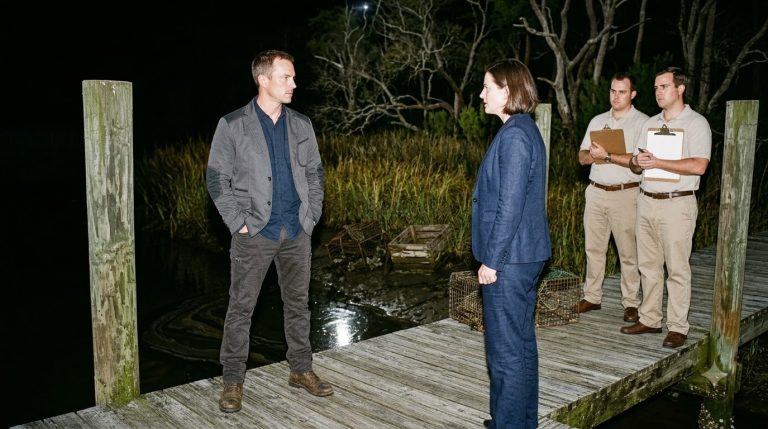
The smell of rosemary-crusted lamb filled the dining room, a warm, savory anchor to a night that felt, for the first time in months, like progress. Senator Hson sat at the head of my table, his gray blazer perfectly pressed, his wine glass held with the calculated ease of a man who spent his life dissecting policy. Beside him, Kaye was leaning in, her folder open, ready to present the evidence that would finally tie the HOA’s predatory fines to their fabricated meeting minutes.
Then, the doorbell rang.
It wasn’t a chime; it was a rhythmic, impatient jab. I excused myself, feeling a prickle of static tension at the back of my neck. I wiped my hands on a cloth, the heat of the kitchen lingering on my palms as I walked to the foyer.
I opened the door and found the night air cold and sharp, smelling of ozone and wet pavement. Standing on my porch, silhouetted against the streetlamp, was Karen Whitmore. She didn’t look like a neighbor; she looked like an indictment. Her eyes were fixed, bright and hungry, and before I could utter a word, she pushed past me, her presence a sudden, sharp edge in the warm air of my home.
“Darren, this is absolutely, unequivocally unacceptable,” she snapped. Her heels bit into my hardwood floor—a sound like a firing pin striking a primer.
“Karen, we’re having a private dinner,” I said, keeping my voice level, though my heart was already accelerating. “You need to leave.”
“There are six cars parked on the street,” she retorted, gesturing wildly toward the window, her silhouette jagged and rigid. “Subsection twelve of the parking code. You are in direct, flagrant violation.”
Behind me, the dining room went deathly quiet. I felt the weight of Hson’s gaze turn toward us. He didn’t stand up, but his posture sharpened, his hand lowering his glass with deliberate, rhythmic care.
I took a step toward her, closing the distance, needing to keep her away from the threshold of the dining room where the folders—the proof—were laid out. “This is a social gathering, Karen. It’s private property.”
“It’s a violation,” she hissed, her face pale, eyes darting toward the living room where Kaye had stood up, her hand hovering near her phone.
Then, from the dining room, the Senator spoke. His voice was not loud, but it possessed a gravity that seemed to pull the oxygen out of the foyer. “Ma’am,” he said, rising slowly, “you are currently trespassing on private property during a meeting of public interest. I suggest you reconsider your next move.”
Karen spun around, her face twisting as she realized who was watching. For a split second, her confidence faltered, a flickering light in a dark room. But then, she straightened her blazer, her fingers twitching at her side. She didn’t retreat. Instead, she leaned in, her voice dropping to a low, serrated whisper that only I could hear.
“You think you’re so clever with your little gathering,” she murmured, her eyes cold as polished steel. “You have no idea what’s already in motion.”
I felt the floorboards vibrate under my feet. She wasn’t just here about the parking; she was checking for something, or someone, and the way her gaze shifted to the edge of my hallway, where my home office door sat slightly ajar, sent a cold spike of dread through my chest. Something was missing—the flash drive I’d left on my desk that morning, the one containing the internal audit.
I realized then that she didn’t come here to enforce a rule. She came here to see if we were as smart as we thought we were. And as I stared at her, I realized with a sick, sinking feeling that the office door wasn’t just ajar—it had been forced.
CHAPTER 2: The Silent Audit
The door clicked shut, but the sound didn’t bring closure. It brought an echo. Karen’s departure was not a retreat; it was an abandonment of a battlefield she had already picked clean.
I didn’t move. I stood in the foyer, the cold air from the doorway still stinging my skin. Behind me, the dining room remained frozen. Senator Hson had not moved, his wine glass still held at the same precise, mid-air angle. Kaye was standing, her phone held out like a shield. They were waiting for me to dictate the gravity of the moment.
“Darren?” Kaye’s voice was a soft, jagged rasp.
I turned back to them, my movements feeling stiff, calculated. I felt the phantom weight of my office door handle in my mind—a lock that had been brushed aside, a security that had been illusory. I thought back to the flash drive I had set on my desk that afternoon, a small, plastic piece of technology that was supposed to be the keystone of our entire defense.
“She wasn’t just here for the cars,” I said, my voice sounding distant to my own ears. “She was here for the office.”
Hson set his wine glass down on the table with a soft clack. The sound was deafening in the stillness. He looked at me, his eyes sharpening, the politician’s mask fully dropped to reveal a tactical mind. “Did you lose anything?”
“I don’t know yet,” I said. I walked toward the hallway, each step deliberate, placing my feet carefully to avoid the creaky boards near the kitchen. My internal compass was spinning, searching for a path through this. I didn’t reach for my phone; I reached for the light switch. I didn’t want to alert whoever might be watching—not that they were still outside, but the habit of caution was overriding the need for visibility.
I pushed the office door open. The room was bathed in the thin, silver light of the moon filtering through the blinds. Everything looked exactly as I had left it: the chair pushed under the desk, the stack of papers squared at the corners, the monitor dark. But as I walked toward the desk, the air felt wrong. There was a faint, lingering scent of ozone—the same smell I’d noticed in the foyer, and deeper, the metallic tang of something that didn’t belong in a home office.
My eyes dropped to the desk. The flash drive was gone.
I didn’t curse. I didn’t panic. I simply stood there, letting the cold reality settle into my marrow. This wasn’t just petty harassment; this was a surgical strike. They knew exactly what they were looking for, and they knew exactly when to take it.
“Darren?” Kaye was in the doorway now, her face pale. She saw my hand hovering over the empty spot on the desk. She didn’t have to ask. She saw the void where our leverage had been. “They took the audit.”
“They took the version I was working on,” I corrected, my voice turning into something hard and flat. I felt a sudden, sharp clarity. The frustration I had felt during dinner was gone, replaced by the cold, mechanical logic of a machine reset. “But they don’t know about the cloud server or the secondary backup at your office, do they?”
Kaye shook her head, though her hands were trembling. “No. I haven’t moved those files.”
“Good.” I stepped back, looking around the room. I noticed something else now—a minute scratch on the wood of the desk, just near the edge where the drive had sat. It wasn’t an accident. It was a message. A signature of someone who was comfortable with force.
I turned back to Kaye, my eyes locked on hers. “We need to go. Right now. If they took the drive, they’re going to assume we’re panicked. They’ll expect us to try and hide what’s left. Instead, we’re going to mirror them.”
“Mirror them?”
“They want us to play by the rules of their little neighborhood code,” I said, my mind racing through the logistics, the ‘Therefore/But’ of the next twelve hours. “We’re going to make sure they’re the ones who have to worry about the law.”
I walked back into the living room, feeling the eyes of the other guests on me. I didn’t explain. I didn’t apologize for the interruption. I went straight to the Senator.
“Senator,” I said, my voice low and steady. “The situation has changed. They’ve moved from civil harassment to breaking and entering. I need your team to secure the secondary evidence, and I need it done before they realize the flash drive I left them was a decoy.”
Hson looked at me, a flicker of surprise—and then, a slow, appreciative nod. “A decoy?”
“I keep my working files on an encrypted partition,” I said. “The drive they took has nothing but a recursive loop of useless tax receipts. It’ll keep them busy for a few hours, but we have to move before they find the real stuff.”
Hson stood up, buttoning his blazer with a decisive snap. “Then we don’t have time for lamb. Let’s get to work.”
The shift was instantaneous. The dinner party died, replaced by the machinery of an investigation. Guests were ushered out with polite but firm insistence, and the house began to feel less like a home and more like a forward operating base. I watched them leave, my pulse steadying into a rhythmic, efficient hum.
I went to the kitchen and began the process of wiping down the surfaces. Not for cleanliness, but to clear the space. I looked at the tray of roasted lamb, sitting there, cooling into fat and bone. It seemed like a relic from a different lifetime.
Kaye joined me, her energy now focused and sharp. “I’ve got the encrypted files on a drive in my bag. I’m heading to the office to upload the master copies to the secure server.”
“Wait,” I said, catching her arm. “Do it from the café across the street from your office. Use their open Wi-Fi. If they’re monitoring your home connection, you’ll be compromised before you finish the upload.”
“You’re assuming they’re already watching me.”
“I’m assuming they’re already winning,” I said, and for the first time that night, I allowed myself to see the shadow in the window—the reflection of a man who was no longer just a homeowner, but a participant in a game where the cost of losing was everything. “And that’s the only way we’re going to stay ahead of them.”
I grabbed my coat. The house was finally quiet, but the silence wasn’t empty. It was pressurized, waiting for the next move in a game that had only just begun.
CHAPTER 3: The Geometry of Surveillance
The streetlights of Willow Creek hummed with a low-frequency vibration, casting elongated, jagged shadows across the asphalt. I sat in my driveway for a long moment, my hands gripping the steering wheel until my knuckles burned. The house behind me was dark, save for the porch light that Karen had likely left on as a taunt, or perhaps just a reminder that they were still watching.
I didn’t turn the key. Not yet. I watched the rearview mirror, tracking the intersection two blocks down. A dark sedan—an nondescript model with plates I hadn’t managed to memorize—had been idling there since I stepped out of my front door. It didn’t move when I pulled out. It just sat there, a silent sentinel in the geometry of the neighborhood.
I started the engine, the ignition’s rumble feeling uncomfortably loud in the quiet night. I pulled away slowly, keeping my speed steady, deliberate. I wasn’t going to Kaye’s office yet. If they were watching the house, they were watching the paths to the office. I took the long way, circling through the winding, manicured labyrinth of the newer developments, the ones with the uniform mailboxes and the aggressive, non-standard lawn gnomes.
The aesthetic was suffocating. Every house was a clone of the next, a testament to the “optimization” Karen and Mark had been pushing. I turned onto Maple Drive, the street where they’d claimed a non-existent sinkhole had appeared. The road was smooth, paved with fresh asphalt that hadn’t seen a day of utility work in years. It was a lie carved into the ground, and as I drove over it, the lack of friction only emphasized the depth of their deception.
I pulled into the parking lot of a twenty-four-hour coffee shop, the neon sign flickering with a harsh, ultraviolet buzz. It was empty, save for a lone trucker nursing a cup at the window. I parked at the far end of the lot, keeping the car’s nose pointed toward the exit. I didn’t want to be boxed in.
I pulled the laptop from my bag, the screen’s backlight cutting a sharp, blue square into the darkness of the cabin. My fingers moved with a practiced, mechanical rhythm, bypassing the external networks and tunneling directly into the secure cloud server Kaye and I had set up weeks ago—the one the HOA didn’t know existed.
As the files populated, I saw it: the digital footprint of the “Special Assessment” documentation. I compared the PDFs I had downloaded from the county clerk’s archive with the versions the HOA had sent to the residents. The discrepancies were microscopic but absolute. The font weight on the signatures was off by a fraction; the timestamps on the meeting minutes were generated by a program that didn’t even exist when the meetings supposedly took place.
They weren’t just greedy. They were using a template.
I tapped the screen, magnifying the metadata. The document properties pointed to an external IP address, not a local one, and certainly not anything based within the neighborhood. The trail led to a holding company, Veridian Realty Holdings, based in a skyscraper three states over. I had heard the name before, whispered in the back halls of regional housing committees, but I had never seen it attached to something as pedestrian as a parking dispute in a suburb.
The cold truth hit me then: this wasn’t a local conspiracy. Willow Creek was a testing ground. They were using the HOA as a laboratory to see how much pressure a group of residents could take before they snapped, and how quickly they could be dispossessed of their homes once they did.
I felt a presence.
I didn’t look up immediately. I kept my eyes on the screen, my peripheral vision catching the movement of a car pulling into the lot. It rolled in slowly, headlights off, guided by the flickering neon of the coffee shop. It came to a stop two rows behind me, close enough to see the interior, far enough to claim it was just another late-night traveler.
I closed the laptop, the screen going black, and felt the sudden, sharp drop in the temperature inside the car. The sense of being hunted was no longer a theory; it was a physical weight, pressing against the glass.
I didn’t move to start the car. I reached under my seat, my hand closing around the digital recorder I always kept there—the one that had captured the PI’s admission last week. I took a deep breath, the air in the car tasting of stale coffee and apprehension. If they wanted a confrontation, they were going to get one, but it would be on my terms, not theirs.
The driver of the sedan remained inside. I watched them in the mirror—a dark shape behind the wheel, perfectly still. No cell phone glow, no motion. Just waiting.
I realized then that they weren’t going to attack. They were doing exactly what Karen had said: they were keeping us distracted. If I stayed here, I was stuck. If I moved, I was exposed. They wanted me to be the one to break the rhythm, to make the first mistake.
I looked back at the screen, my fingers hovering over the trackpad. I initiated an automated script, a “ping” directed at the Veridian IP address. It was a simple, aggressive move—a digital signature that would alert their internal security that someone was digging through their trash.
I wasn’t just going to defend Willow Creek anymore. I was going to make sure that whatever they were building here, they wouldn’t be able to finish. I started the engine and reversed, not toward the exit, but straight toward the dark sedan. The driver didn’t wait. The moment my headlights caught their windshield, they kicked the car into gear and fled, tires screeching against the asphalt.
I didn’t follow. I watched them disappear into the night, the red glow of their taillights a dying ember. I had my leverage, and for the first time, I had a name. Veridian. The game had shifted, and I was holding the board.
CHAPTER 4: The Senators Gambit
I didn’t head home. I didn’t head to the office. I drove until the neon of the suburbs faded into the industrial grays of the city center, guided by a coordinate the Senator’s chief of staff had texted to my encrypted burner phone.
The building was a nondescript brick warehouse, its windows dark and its entrance tucked behind a shipping bay. I pulled up, the tires crunching over loose gravel, and saw a familiar silhouette standing by a side door. Senator Hson. He wasn’t wearing his blazer anymore; he was in a sweater, his sleeves rolled up, looking less like a statesman and more like a man accustomed to working in the trenches.
I stepped out, the cold air biting at my skin. “They’re watching, Senator,” I said, my voice barely audible over the hum of a distant transformer.
Hson didn’t offer a greeting. He gestured toward the interior, and we moved inside. The space was a makeshift command center. Monitors lined the walls, casting a sterile, white light that made the air feel thin. Cables snaked across the floor like vines, connecting server towers that hummed with a deep, rhythmic thrum.
“Your digital footprint has been active,” Hson said, turning toward one of the screens. He didn’t look at me, his focus entirely on the scrolling data. “You pinged the Veridian server, didn’t you?”
“I had to know if they were local,” I said, leaning against a workbench covered in schematics. My hands were still shaking, just a little, from the adrenaline of the parking lot. “They’re not. It’s all coming from three states over. We’re dealing with a holding company that thinks they can treat Willow Creek like a Monopoly board.”
Hson stopped scrolling. He zoomed in on a map—a plot of the neighborhood, with red lines connecting several houses to a single shell corporation. “It’s bigger than Willow Creek, Darren. We’ve been running a parallel analysis on other HOAs in this district. Veridian is at the center of a spiderweb. They find neighborhoods with aging infrastructure, manipulate the board, inflate the maintenance costs, and then step in with the ‘buyout’ solution.”
“Why the parking code?” I asked, looking at the screen. “Why the lawn gnomes?”
“Control,” Hson said, his voice flat. “It’s psychological warfare. If they can make you feel like your own home is a battleground—like you can’t even park your car without fear of a fine—they can break your resolve before the actual financial squeeze begins. They don’t want to buy houses; they want to buy broken people.”
I looked at the map, my stomach twisting. I had been fighting Karen and Mark, thinking they were the architects of my misery, but they were just the janitors. They were the ones assigned to sweep the residents out the door so the real owners could walk in.
“We have to stop them,” I said, my voice hardening. “If they get the maple cluster, the rest of the neighborhood will fold.”
“We are stopping them,” Hson said, pulling a file from a drawer. It was thick, bound in blue plastic—the formal indictment paperwork. “But we need a pivot. If we go after the board for fraud, Veridian will just burn their local proxies and move to the next neighborhood. We need to tie the board directly to the corporate entity. We need a document that shows the financial nexus, not just the management contract.”
I thought of the flash drive I had lost—the one they had stolen from my office. “They have the audit, Senator. They know we’re looking at the books.”
“Let them,” Hson said with a cold, humorless smile. “We’ve got something better. I sent my team into the county archives at 3:00 AM. We found the original land deeds from when the neighborhood was first incorporated. There’s a clause—an old one, buried in the original charter—that explicitly prohibits any entity that owns more than 10% of the properties from voting on board initiatives.”
“If we can prove Veridian already owns the vacant units through their shell companies…”
“They do,” Hson confirmed, clicking a key to reveal a list of property owners. “Every shell company ends in the same PO Box in Tallahassee. They’re already at 12%. They’ve been voting illegally for months.”
I felt the weight of the room shift. The fear I had felt in the parking lot was still there, but it was being eclipsed by a different, more powerful sensation: the clarity of a trap. We weren’t just playing defense; we were laying a minefield.
“I have a meeting with the rest of the homeowners tomorrow,” I said, my mind already running through the steps of the ‘therefore/but’ logic. “If I tell them we have this, they’ll want to move now.”
“Tell them to wait,” Hson cautioned. “We need to catch the Board during their next vote. We need them to commit the perjury on the record, in front of witnesses. If they vote with those illegal holdings, the State Housing Oversight Committee can declare the entire election cycle void. That gives us control.”
I looked at the Senator, seeing the politician beneath the sweater, and realized he wasn’t just helping me save my neighborhood—he was using it as the spearhead for the entire reform bill. And for the first time, I didn’t mind. If his ambition was the engine that would drive this car, I would happily steer it.
“I need to get back,” I said, pushing off the workbench. “If they haven’t seen me all night, they’ll be watching the house.”
“Take the back road,” Hson said, handing me a slip of paper. “And Darren? Don’t let them see you blink. They’re coming to the clubhouse meeting tomorrow to try and silence the room. That’s where you hit them.”
I walked back out into the night. The warehouse was an island of light in a sea of darkness. I felt the cold air hit my face, and for the first time, I didn’t feel like a target. I felt like a hunter. The geometry of the neighborhood had changed, and I was no longer the one being measured. I was the one holding the tape.
CHAPTER 5: The Pressure of the Storm
The rain didn’t just fall; it hammered. It turned the manicured lawns of Willow Creek into slick, dark canvases and obscured the view of the neighborhood entrance, where I knew—with a certainty that chilled my blood—that someone was sitting in a sedan, waiting to see if I’d return.
I didn’t take the main road. I took the fire-access trail the Senator had marked on the slip of paper, the car’s suspension groaning as I navigated the rutted mud. The woods were a blur of movement, and every snap of a branch sounded like a footstep. I felt exposed, a single point of light in a dark, shifting terrain, but I also felt a strange, humming clarity. The confrontation was coming.
I parked behind the community center, hidden by the thick canopy of trees. The structure was a low, brick building that usually hosted book clubs and HOA board meetings. Tonight, it was a fortress. Cars lined the parking lot, even in the downpour, a testament to the neighbors who had finally stopped staying silent.
I moved through the rain, my coat soaking through in seconds. When I pushed open the side door, the roar of the storm was instantly replaced by the muffled, frantic hum of dozens of conversations. The room was packed. People stood in the corners, arms crossed, their faces lit by the harsh, overhead fluorescent bulbs. Kaye was already at the front, her laptop open, standing next to a stack of printed documents that looked like a stack of armor.
The moment I stepped inside, the room stilled. All eyes turned to me. I was wet, my hair plastered to my forehead, and I felt the weight of the flash drive in my pocket—the real one, the one that held the truth about the shell companies.
I walked toward the podium, the floorboards groaning under my boots. I didn’t see Karen or Mark yet, but I saw their proxies: two men in grey suits sitting in the back row, their eyes scanning the room with the practiced detachment of professional enforcers. They were the ones who would move if things got loud.
“We have the evidence,” I said, my voice cutting through the silence like a blade. “We know who Veridian is, and we know exactly how they’ve been manipulating the board.”
A murmur rippled through the room. A neighbor in the second row—a woman who had lost her home to a bogus foreclosure last year—stood up, her voice shaking. “How? How are they doing it?”
“They’re using the bylaws as a weapon,” I said, moving to the board table. I didn’t wait for permission. I cleared the space, shoving aside the neat piles of HOA propaganda and laying out the land deed copies. “They’ve been falsifying the ownership logs to pad their voting power. They don’t just control the board; they’ve rigged the system to ensure that no resident can ever outvote their shell companies.”
“That’s a lie!”
The voice came from the back. Mark Reic pushed through the crowd, his face flushed, a stack of papers clutched in his hand. He looked frantic, his suit jacket wrinkled, his movements erratic. Karen was right behind him, her usual composure fractured, her eyes darting between me and the two men in the back row.
“Darren is just trying to incite a panic because he’s being fined for his own violations!” Mark shouted, his voice cracking. “He’s trying to disrupt the order of this neighborhood for his own personal vendetta!”
“The order?” I walked toward him, not stopping until I was within arm’s reach. I could see the sweat beading on his forehead. “You mean the order where you steal from your neighbors? Where you use the money they worked for to fund your brother’s shell company in Tallahassee?”
The air left the room. It was as if someone had pulled a vacuum seal over the community center. Mark’s eyes widened, his lips parting in a silent, desperate shape. He tried to take a step back, but the crowd pressed in, a solid wall of human weight.
“We have the records, Mark,” I continued, my voice low and steady. “We have the timestamps. We have the bank deposits. It’s over.”
Karen tried to step forward, her hand reaching for her phone. “You don’t know what you’re doing,” she hissed, her voice vibrating with a frantic, serrated edge. “If you do this, you’ll burn the whole neighborhood down with us. None of these houses will be worth a cent once the investigation starts. You’re destroying your own investment!”
“My house isn’t an investment,” I said, looking around at my neighbors—at the people who had lived here for twenty years, the people who had built lives here, the people who were finally realizing that their power had been stripped from them by a piece of paper. “It’s my home.”
“Get them out,” Mark whispered, his gaze flickering toward the men in the back.
The two enforcers stood up, but they didn’t move forward. They were looking at the door. I followed their gaze and saw a blue uniform standing in the entrance. Then another. Then a third.
Detective Lanier stepped into the room, his hand hovering near his belt. He didn’t say a word. He just walked to the front of the room, the silence trailing him like a wake. He stopped next to me and looked at Mark, then at Karen.
“Mr. Reic? Ms. Whitmore?” Lanier’s voice was polite, clinical. “I have a warrant for your arrest. I suggest you step outside. Quietly.”
Mark’s knees seemed to buckle. He dropped his stack of papers, the sheets scattering across the floor like dead leaves. Karen didn’t look at him. She looked at me, her face pale, her eyes burning with a hatred that felt cold and hollow.
“You think you’ve won,” she said, her voice a fragile, trembling ghost of its usual authority. “But you’ve just opened a door you can’t close.”
She turned and walked past Lanier, her head held high, though her hands were shaking. Mark followed, his shoulders slumped, the facade of his power finally, irrevocably shattered.
As they were escorted out into the rain, the room erupted. It wasn’t cheers, though. It was a sound I hadn’t expected—a collective, ragged exhaled breath. People were sitting down, some putting their heads in their hands, others just looking at one another, dazed by the speed of the collapse.
I looked at the floor, at the scattering of documents that had once held us captive. The rain was still hammering against the roof, a constant, rhythmic beat that felt like the pulse of a heart. We had won the battle, but the room felt heavy. I realized then that the fight wasn’t over. We had unmasked the local tyrant, but the corporation—Veridian—was still there, out in the dark, watching the fallout of their failed experiment.
Kaye walked over to me, her face tired. “What now?”
“Now,” I said, picking up one of the scattered papers, “we start from scratch.”
CHAPTER 6: The Paper Trail of Ghosts
I knelt amidst the ruin of the board’s defenses. The community center was still echoing with the receding shouts of the neighbors and the heavy, rhythmic tread of the police escort taking Mark and Karen out. I picked up a document, the edges damp and curling from the humidity of the rain-soaked air. It was a wire transfer authorization—part of the evidence Kaye had been so meticulous about gathering.
My thumb brushed against the signature line at the bottom. It wasn’t Mark’s. It was a digital stamp, sharp and uniform, belonging to a subsidiary I hadn’t seen in the initial sweep of the Veridian files. Veridian Logistics Operations.
I looked up at Kaye. She was standing by the podium, watching the door, her face a mask of exhaustion. She hadn’t seen the signature yet. I stood, my knees popping, the damp paper sticking to my fingers like a second skin.
“Kaye,” I said, my voice barely audible over the remaining chatter of the neighbors. “Look at this. The subsidiary.”
She walked over, her movements slow, mechanical. She squinted at the paper, then frowned. She reached into her folder and pulled out the primary contract we’d been using to build the case. She compared the two, her eyes tracking back and forth, the fluorescent light casting deep, tired shadows under her brows.
“This doesn’t match the management group,” she whispered. “This isn’t Veridian Realty. This is… logistics. Why would a real estate holding company need a logistics subsidiary to sign off on maintenance invoices?”
“Because they weren’t doing maintenance,” I said, the realization hitting me with the force of a physical blow. “They were moving assets. These invoices—the sinkhole repair, the non-existent irrigation work—they weren’t just overbilling. They were laundering.”
The logic clicked into place with the cold, precise snap of a gear. Veridian wasn’t interested in the houses themselves; they were using the HOA to funnel capital through a series of shell companies, cleaning money under the guise of municipal infrastructure. Willow Creek was just a pipe. The displacement of residents? That was just a side effect, a way to clear the ‘inventory’ so they could flip the properties and close the pipe before any state auditor got curious.
“We thought it was displacement,” Kaye said, her face draining of color. “We thought it was about the property values. It’s not. It’s about the flow. They don’t care who lives here, as long as the accounts are active.”
“Which means,” I said, my eyes scanning the room, “they didn’t just target us because we were long-term residents. They targeted us because we were a stable, quiet community with an active bank account. We were the perfect target for a high-volume laundering cycle.”
I felt a sudden, sharp spike of vertigo. The psychological phantom of the neighborhood’s original blueprints—the ones Miguel had shown me, the ones that spoke of a simple, honest development—flashed through my mind. They were a lie, or at least, they had been turned into one. The neighborhood wasn’t a home. To Veridian, it was just a series of ledger entries.
“We have to get this to Lanier,” Kaye said, reaching for her bag. “If this isn’t just real estate fraud, if this is money laundering, then the stakes are completely different. The DA isn’t just going to look at the board anymore. They’re going to look at the corporate structure.”
“No,” I said, catching her hand. “Not yet.”
“Why not? Darren, this is federal territory now. We can’t handle this alone.”
“If we give this to Lanier, the investigation will be locked down for months. They’ll seal the records, they’ll subpoena the servers, and we won’t see a cent of the truth until it’s buried in a courtroom three years from now.” I paced the small aisle between the rows of chairs, the floorboards groaning under my boots. “We need to know who is signing these. We need a name. Not a subsidiary. A human being.”
I looked at the window. The rain had slowed to a steady, rhythmic tap. I could see the reflection of the room in the glass—the neighbors, the empty chairs, the lingering police tape. I felt a sudden, intense need to be back in the office, but not my office. The clubhouse.
“The clubhouse,” I said. “The new oversight panel hasn’t secured the back office yet. Mark had a private safe behind the motivational poster.”
“Darren, that’s trespassing.”
“No,” I said, my voice steady. “It’s protecting the evidence. If Veridian gets wind that their logistics trail has been found, they’ll wipe those servers before the sun comes up. We have to beat them to the clubhouse.”
Kaye looked at me, her eyes searching mine for a flicker of hesitation. She didn’t find it. She let out a long, ragged sigh and zipped her bag. “You’re going to get us both arrested, you know that?”
“Maybe,” I said, grabbing my coat. “But at least we’ll know why.”
We walked out of the community center, the cold night air hitting us like a physical weight. The rain was slick on the pavement, reflecting the distant city lights in shivering ribbons of neon. We didn’t talk as we moved toward my car. We didn’t need to. We were already in the rhythm, the tactical, heartbeat-pounding rhythm of a game that had long ago stopped being about lawn gnomes and zoning bills.
We reached the car, the metal cold to the touch. As I unlocked it, I glanced back at the community center. For a brief second, I thought I saw a shadow move near the trees—a figure, tall and still, watching us. I blinked, and it was gone, just a trick of the shifting rain and the dim, flickering security light.
“Did you see that?” Kaye whispered, her hand tightening on her bag.
“Doesn’t matter,” I said, starting the engine. The car purred to life, a low, predatory sound in the dark. “Whatever it is, it’s about to be on the losing side.”
We pulled out, the tires spraying water across the lot, headed toward the clubhouse. I had the name, I had the motive, and I had the drive to see it through. The storm was clearing, and in the space it left behind, the path ahead was finally, brutally sharp.
CHAPTER 7: The Clubhouse Vault
The rain had tapered to a fine, freezing mist that clung to the windows of the clubhouse. I didn’t reach for my keys. I stood by the door, listening. The building was dead silent, but it was the silence of a held breath, not an empty space. Kaye stepped out behind me, her boots silent on the wet pavement. She didn’t say anything, but the way she gripped the strap of her bag told me she felt it too.
“I’ll go first,” I whispered, pulling a small, thin shim from my pocket—a habit picked up from a decade of home renovations and the occasional lock-out.
The door to the back office wasn’t just locked; it was magnetized. I heard the faint, high-pitched whine of an active circuit as I pressed my ear to the wood. My skin crawled. The HOA board hadn’t just secured their files; they had wired the office for an alarm system that shouldn’t have existed.
“They bypassed the main breaker,” I muttered, my fingers tracing the door frame until I found the small, recessed camera lens hidden in the molding. I blocked it with a piece of electrical tape I’d stripped from my own car’s dash camera earlier that night. “Kaye, keep watch on the entrance. If you see a car, anything, signal me.”
I went to work. The lock was a standard deadbolt, but the magnetic plate made it stubborn. I felt the vibration of the alarm’s current against my shim, a warning that if I slipped, the police—or worse, Veridian’s own ‘security’—would be here in minutes. I forced the mechanism, my focus narrowed to the tiny, metallic friction of the pins. With a soft, mechanical thunk, the bolt retracted.
I slipped inside. The office was smaller than I remembered, stripped of its furniture, leaving only the bare, cold walls and the smell of ozone and burnt plastic. And there, against the back wall, was the safe—a heavy, fire-rated floor model that had been hidden behind the motivational posters Mark Reic loved so much.
I crouched before it, my heart hammering against my ribs like a trapped bird. I didn’t have the combination, but I had the documents we’d pulled earlier. I looked at the signatures again. Veridian Logistics Operations. I started tapping the keypad, trying the birthdates of Mark’s children, his anniversary, the neighborhood’s founding date. Nothing.
“Darren,” Kaye hissed from the hallway. “Headlights. Two cars, coming fast from the main gate.”
“Give me a minute,” I growled, my sweat slicking the keys.
I looked at the server rack in the corner, the one I hadn’t noticed before. A single, tiny LED was blinking—a steady, rhythmic green. It was sending data. It was connected to a hidden uplink buried in the floorboards. I scrambled toward it, not caring about the safe anymore. I ripped the cable from the wall, the signal dying instantly. The silence that followed was heavy, absolute.
I pulled a handheld drive from my pocket and jammed it into the server’s local port, running a rapid-dump script. The screen flashed: ACCESSING… UPLINK ACTIVE…
“Darren, now!” Kaye’s voice was sharp, urgent.
The download bar crawled: 20%… 40%… 60%…
Outside, the crunch of gravel reached a crescendo as the cars skidded to a halt. Doors slammed. Voices, cold and clinical, drifted toward the building. I didn’t look. I watched the progress bar, my knuckles white against the metal casing of the drive.
80%… 95%…
The door to the clubhouse burst open with a crash that shook the floorboards. I snatched the drive from the port, the data transfer completing just as the beam of a high-powered flashlight cut through the office doorway, blinding me.
“Drop it,” a voice commanded. It wasn’t the police. It was a voice I’d heard on the audio recordings—one of the men who’d been following us.
I didn’t drop it. I rolled, throwing myself behind the heavy metal desk as the first shot shattered the wall plaster above my head. It wasn’t a bullet; it was a non-lethal deterrent, a pepper-spray canister fired from a pneumatic gun. The room filled instantly with a searing, choking fog.
“Kaye, get out!” I screamed, my eyes already stinging, my lungs burning.
I kicked the office window out, the glass shattering into a thousand diamonds. I scrambled through, the cold, wet air hitting me like a slap. I heard Kaye grunting as she followed, the sounds of our escape muffled by the thick, biting haze of the pepper fog.
We didn’t stop to look back. We sprinted into the woods, the rain turning the ground into a slide of mud. My breath came in ragged, burning gasps, the taste of the chemical mist coating my throat. I clutched the drive in my hand, my fingers numb, my head spinning with the realization of what we had just done. We hadn’t just found the name. We had poked the beast, and it was now, without a doubt, hunting us.
CHAPTER 8: The Architecture of Justice
The courthouse was a monument to order, all polished marble and echoing silence, a jarring departure from the mud-slicked chaos of the woods. I stood near the back, Kaye beside me, watching the proceedings. The room was packed with neighbors—the same faces that had populated the community center, now transformed into witnesses, their expressions anchored by the weight of their own stories.
At the front, the district attorney was methodically dismantling the defense’s claims. It wasn’t a spectacle. There were no grand speeches, no dramatic flourishes. It was just the relentless, surgical presentation of the data I had pulled from the clubhouse server—the real data, the unvarnished reality of Veridian Logistics Operations.
Mark Reic sat at the defendant’s table, his shoulders hunched, staring at the polished wood of the table as if he could read the history of his own downfall in the grain. Karen was not there; she had cut a deal the night before, trading the names of the regional handlers for a reduced sentence. Her absence was a testament to the cowardice that had fueled her authority.
I looked at the judge’s bench. Justice wasn’t a thunderbolt. It was a ledger being balanced, one transaction at a time. The DA displayed the maps on the overhead screen—the same spiderweb of shell companies I had stared at in the Senator’s warehouse. The connection was clear now: Veridian wasn’t just laundering money through Willow Creek; they were using it as a template for a massive, multi-state displacement scheme, a “corporate slum” factory designed to thrive on the ruins of municipal governance.
The judge leaned forward, his spectacles catching the courtroom lights. “The court finds that the defendant, Mark Reic, in coordination with Veridian Logistics Operations, willfully subverted the fiduciary duties of the Willow Creek Homeowners Association to facilitate illicit financial transactions and systematic property displacement. The motions to freeze all remaining operating accounts and initiate a federal audit of the Veridian corporate structure are hereby granted.”
The gavel fell—a small, sharp sound that seemed to shatter the final tension of the room.
I looked at Kaye. Her hand was in mine, her grip tight, her eyes shimmering with a quiet, exhausted relief. We hadn’t just saved our homes; we had broken the pipe.
“It’s over,” she whispered.
“Not quite,” I said, though I didn’t feel the need to move.
We stayed for the denouement, watching as the bailiffs approached Mark. There was no struggle, no last-minute reprieve. He stood, his face a hollow mask of shock, and held out his wrists. The cold, metallic click of the handcuffs was the final period on a sentence written in the language of greed and arrogance. It was a small act of poetic justice, the very man who had obsessed over every rule, every fine, and every minor violation now finding himself bound by the most absolute of legal constraints.
We walked out into the crisp, clear air of the afternoon. The storm had passed, leaving the city washed clean, the sky a deep, expansive blue. The neighborhood wasn’t the same. It would take years to undo the damage, to rebuild the trust, to repair the fences that had been neglected or spitefully destroyed.
I drove back to the house, the silence in the car feeling different than it had for weeks. It wasn’t the silence of suspicion; it was the silence of a house that was finally mine again. I parked in the driveway, the same spot where the PI had sat, where the mailbox inspectors had lurked.
I walked to the front yard. A few of the neighbors were out—Grace, pruning her roses; Miguel, working on a new bench in his workshop. They looked up as I approached, and for the first time, there was no nod of fearful recognition, no anxious glancing toward the street. There was just the quiet, grounded acknowledgement of people who had been through a fire and remained standing.
I reached down and picked up a piece of the old HOA sign that had been kicked into the grass, a splintered bit of plastic. I held it for a moment, then dropped it into the recycling bin.
I walked inside. The kitchen was just as I had left it, the remnants of that fateful dinner party finally cleared away. I opened the pantry and found a small, chipped ceramic bowl—the one I’d been meaning to fix for months, the one that had broken during the first week of the harassment. I sat at the table and began the long, meticulous work of gluing it back together, the Kintsugi process a slow, meditative act of repair.
The house settled around me, the creaks and groans of the structure no longer sounding like threats, but like the house itself catching its breath. I looked out the window. The sun was dipping low, casting a long, warm light across the street. The shadows were lengthening, but they were soft, natural, and for once, completely, utterly harmless.
I was home.