The Survey of Lies: A Defiant Standoff Over Land, Law, and the Quiet Weight of Property
CHAPTER 1: THE WEIGHT OF THE LATCH
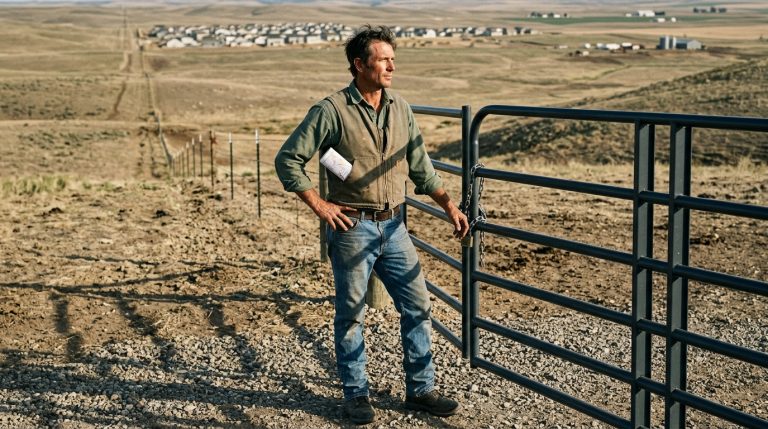
The steel gate latch felt cold and unforgiving under my palm. It was a simple mechanism—a rusted bolt sliding into a weathered keeper—but tonight, it felt like the only thing separating my autonomy from their collective fiction.
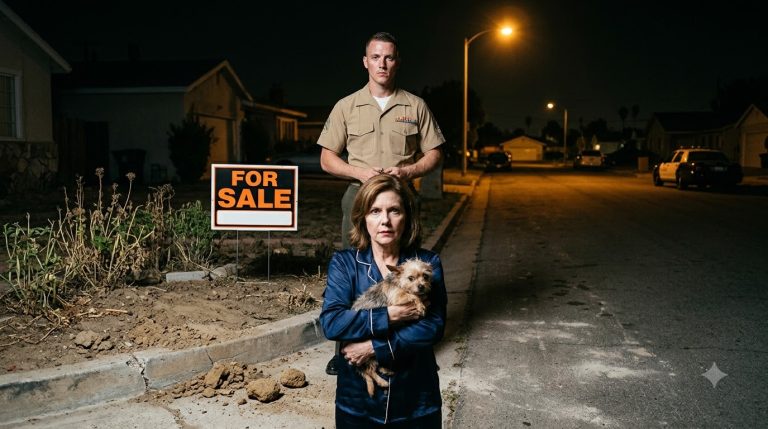
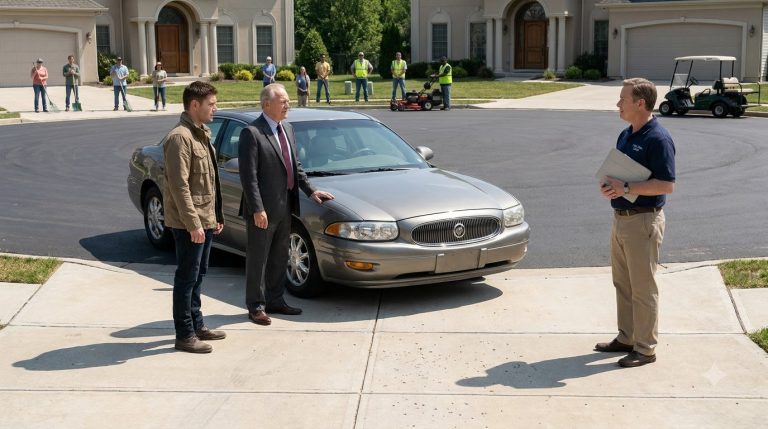
Karen Mckllen stood ten feet away, her posture a masterclass in performative calm. Her son, the man in the polished jacket, hovered at her shoulder. He looked restless, his eyes darting toward the pond, then back to my gate. They didn’t see a boundary; they saw an obstacle to their marketing brochure.
“You’re making a tactical error,” the son said, his voice dropping into the register of a man who usually bought his way out of trouble. “This is an HOA matter. You don’t want the county involved in your private affairs.”
I didn’t blink. I didn’t reach for the gate. I kept my hand on the latch, my pulse steady against the iron. “The county is already involved, Mr. Mckllen. They have the survey. They have the deeds. And they have the timestamped recordings of your mother’s crew dumping chemicals into my water.”
Karen’s smile didn’t falter, but the light in her eyes went flat, clinical. She shifted her weight, a subtle adjustment of her silhouette against the darkening trees. “You think facts matter more than the neighbors’ perception of what’s right. The neighborhood needs that pond for the runoff. It’s for the collective safety.”
There it was. Not a request, not a complaint, but a justification for theft.
My phone, mounted on the tripod near the dock, caught the glint of the setting sun. Gina’s voice had faded from the line, but the recording was still active. I leaned against the gate, feeling the biting texture of the rusted metal through my jacket.
“Safety doesn’t grant eminent domain,” I said, my voice low and devoid of the agitation they were looking for. “And you aren’t the government, Karen. You’re just a woman with a printer and a grudge.”
The tow truck driver shifted gears, the engine groaning as he prepared to reverse. The son looked at his mother, his jaw tight. He reached out, his hand hovering near the gate, an invitation to a physical escalation I wasn’t going to provide.
“Don’t,” I said, the word barely a whisper, yet firm enough to make him pause.
He stopped, his fingers inches from the latch. In that silence, I heard the faint, rhythmic ticking of the cooling truck engine. The air smelled of wet earth and impending rain. It was the smell of my land—a truth the HOA couldn’t rewrite with a flyer or a fake violation notice.
Karen stepped forward, her heels sinking slightly into the soft, unmanicured soil of my driveway. She stared at me, then at the camera, then back to the darkness of the pond. She looked like someone calculating the cost of a war she was beginning to suspect she might lose.
“This isn’t over,” she said, her voice dropping to a near-hiss.
“No,” I agreed, finally pulling my hand away from the latch and watching them retreat into the shadows of their own neighborhood. “It’s just starting.”
As the truck backed away, its taillights cutting jagged red streaks through the dusk, I noticed a bright orange surveyor’s stake hammered into the ground just six inches inside my property line—a detail that hadn’t been there at noon.
CHAPTER 2: THE ANATOMY OF A TRESPASS
The orange plastic of the surveyor’s stake looked garish against the deep, muted green of the tall grass. It was a neon scream in a landscape of quiet, rusted earth. My boots crunched over the dry soil as I walked toward the property line, the sound unnaturally loud in the evening stillness.
I didn’t touch the stake. I didn’t want my prints on it, and I didn’t want to grant it the legitimacy of a removal until I had documented its placement. I pulled my phone from my pocket, the screen glowing against the encroaching twilight, and took three photos from different angles. Then, I bent low. The ground here was soft—damp from the recent evening mist—and the hole was clean, precise. It hadn’t been here this morning. It was a deliberate, tactical insertion.
A memory flared—not of the pond, but of my father standing over a similar stake twenty years ago, his face tight with the same grim understanding. “They don’t move the fence,” he’d said, his voice like grinding gravel. “They move the lines on the map, and then they wait for you to stop looking.”
I pushed the phantom thought away, focusing on the friction of the reality at hand. The HOA was testing the perimeter. They weren’t just making threats; they were physically redefining the boundary, inch by inch, creating a new “truth” for their records. If I allowed this stake to remain, I was tacitly accepting the encroachment.
I walked back to the shed, the metal siding cold and damp under my touch. I needed the laser measure and the original plat map I’d pulled from the county recorder’s office. The air smelled of iron and stagnant water, a bitter reminder of the chemicals they’d poured into the pond just days ago. The toxicity report from the lab was still sitting on my desk, a document I had yet to file but that I knew would confirm my suspicions: the runoff wasn’t just pollution; it was a desperate, failed attempt to prove the water was “unstable,” an engineered hazard designed to justify a mandatory county takeover.
Inside the house, the light was sparse. I didn’t turn on the lamps. I preferred the shadows; they gave me a clearer view of the road. I spread the certified plat map across the kitchen table. The paper was stiff, heavy with the weight of officialdom. I compared the measurements, my pencil moving with calculated precision.
The stake was exactly four feet onto my land.
My phone buzzed against the table—a short, sharp vibration. A message from Gina. “Court order served to the HOA president’s office. They are lawyering up. Be careful with any physical interactions. They are looking for a reason to claim you were the aggressor.”
I typed a single word back: Understood.
I looked at the cameras on my monitor. The feed was grainy, washed out by the infrared, but it showed the lower trail clearly. There was no one there now. The HOA had retreated, but they had left a silent, synthetic sentinel in the grass.
I grabbed my heavy coat and a flashlight. If I was going to fight this, I needed to know exactly what else they had planted under the cover of their “community maintenance.” I stepped out the back door, the cold air hitting my skin like a physical challenge. I walked toward the pond, my boots navigating the uneven ground by memory. The water was dark, unmoving, mirroring the night sky.
As I approached the dock, I saw it: a second stake, further down the trail, near the stand of oaks. And then a third, obscured by the brush. They weren’t just marking a point; they were drawing a new curve. They were carving out a basin. The realization settled into my gut, cold and heavy. They weren’t just stealing land for prestige; they were re-routing the neighborhood’s drainage. They were trying to solve their own structural failing—a sinking neighborhood, a failed drainage plan—by turning my pond into their sacrificial retention pool.
I stood there, the flashlight beam cutting a sharp, lonely path through the dark, listening to the silence. No crickets, no rustling—just the distant, muffled sound of a car engine on the main road. The fight wasn’t just about my privacy anymore; it was about the survival of the land itself. I reached out, my fingers finding the rough, jagged edge of an oak tree, and for the first time since the standoff, I didn’t feel the need to remain composed. I felt the sharp, clean edge of a decision. I wouldn’t just defend the property. I would document the fraud until their entire foundation began to crack.
I turned back toward the house, my pace steady, leaving the stakes where they were. Let them think I hadn’t noticed. Let them think the silence was confusion. I had the map. I had the cameras. And now, I had the motive for their madness.
CHAPTER 3: THE PERIMETER AUDIT
The dawn didn’t bring warmth; it brought a flat, gray clarity that stripped the landscape of its nighttime ambiguity. I didn’t wait for coffee. I walked straight out the back door, my boots finding the familiar ruts in the dirt that led to the lower trail. My mind was still running the numbers from the plat map, calculating the exact trajectory of the land theft.
The air was sharp, smelling of pine needles and damp, decaying leaves. As I reached the edge of the pond, the stillness was absolute. No birds. No wind. Just the low, rhythmic slapping of water against the old wooden pilings of the dock.
I kept my eyes on the ground, scanning the brush where I’d seen the stakes the night before. I wasn’t just looking for the markers; I was looking for the debris that human activity always leaves behind. People, even those confident in their “administrative” power, are inherently sloppy.
A few yards from the first stake, tucked beneath the low-hanging branches of a hickory, I saw something. A splash of synthetic blue against the brown leaf litter. I knelt, the damp ground soaking through the knees of my jeans immediately. It was a heavy-duty work glove, the kind used for hauling rock or handling raw timber. It was stained with a mixture of mud and a peculiar, chalky residue—the same pale, dusty substance I’d seen in the chemical-clouded water days ago.
I didn’t pick it up with my bare hands. I used a small branch to lift the edge, revealing the palm. It was worn, the fabric frayed, and someone had written a name in permanent marker inside the wrist: Sorenson.
I didn’t recognize the name, but I knew the association. Sorenson Excavation was a local firm—the same one that had been doing the “remediation” work for Clearbrook Shores for the last six months. They were supposed to be building a community gazebo, or so the permits claimed.
The glove wasn’t just litter. It was a connection.
I stood up, holding the glove suspended by the branch, and looked toward the upper ridge where the HOA development began. The trees were thin there, a screen of scrub oak that barely masked the manicured lawns of the community. From this vantage point, I could see the heavy machinery parked near the edge of their project site. They were closer than they had any right to be.
I walked the perimeter, my pulse settling into a steady, predatory rhythm. Every twenty feet, I found a trace: a crushed beer can, a discarded roll of surveyor’s tape, a footprint pressed deep into the mud that was far too large to belong to Karen Mckllen. These were the laborers, the ones doing the heavy lifting for the fraud. They were the ones who would know exactly where the retention pipes were meant to go.
The logic was beginning to tighten. The HOA wasn’t just trying to claim the pond for “quiet hours” and aesthetic value. They were prepping the ground to bury a problem. If the land in Clearbrook was shifting, if their own drainage plans had failed, they needed a place to dump the excess water. My pond, situated at the base of the natural topography, was the perfect sink.
I reached the spot where the three stakes formed a definitive arc. It was a calculated geometry. If they dug here, they wouldn’t just be accessing the water; they would be re-engineering the natural flow of the valley, effectively turning my six acres into a flood zone to protect their own investment.
My phone rang. It was a restricted number. I didn’t answer it immediately, watching the screen until the caller ID remained blank. Then, I swiped it open.
“We saw you by the dock,” a voice said. It wasn’t Karen. It was a man, his tone devoid of her polished, predatory condescension. It was tired. “Stop digging, and stop looking at the markers. You have no idea what’s under that water.”
“Then tell me,” I said, my voice as neutral as a stone.
“It’s not for sale,” the voice replied, and the line went dead.
I didn’t rage. I didn’t shout into the receiver. I looked at the glove, still balanced on the branch, and then back at the pond. The threat was a confirmation. They were afraid of me finding something specific—something buried deep, something that made a simple land grab seem almost innocent by comparison.
I tucked the glove into a plastic bag I’d brought from the shed. It was evidence, a piece of the puzzle that linked the HOA to the contractors, and the contractors to the damage.
I didn’t head back to the house. I walked toward the edge of my boundary, the point where my land met the common space of the development. I needed to see what they were hiding on the other side of the screen of trees. I moved quietly, the Rusted Truth of the situation grounding me. I wasn’t the victim; I was the auditor. And for the first time, I felt the thrill of being the one who knew the secret.
They wanted a fight over a pond? I was going to show them exactly how expensive their drainage plan was about to get. I found a gap in the trees and stepped through, not onto their lawn, but onto the edge of their active construction site. The smell of fresh, turned earth was overwhelming. And there, partially exposed by a recent rain, was the end of a corrugated concrete pipe—the size of a man’s torso—poking out of the dirt, pointing directly toward my pond.
It was a smoking gun, cast in concrete. I raised my phone and began to record.
CHAPTER 4: THE SILENT INVITATION
The concrete pipe looked like a throat gaping in the earth, raw and exposed. Behind the screen of thin, scrubby oaks, the sounds of the neighborhood—a distant lawnmower, the chime of a wind ornament—felt like an intrusion into a crime scene. I didn’t linger. My thumb brushed the screen to save the video, then I slid the phone into my pocket, the device feeling suddenly heavy, a piece of leverage I wasn’t yet ready to use.
The transition from the disturbed soil of the construction site back to the relative wildness of my own land felt like stepping across a fault line. The transition required care; I moved with the slow, deliberate grace of someone who knew the ground was being watched. My boots found the same path I’d taken to enter, stepping carefully over the mud to avoid leaving any fresh, identifiable tracks.
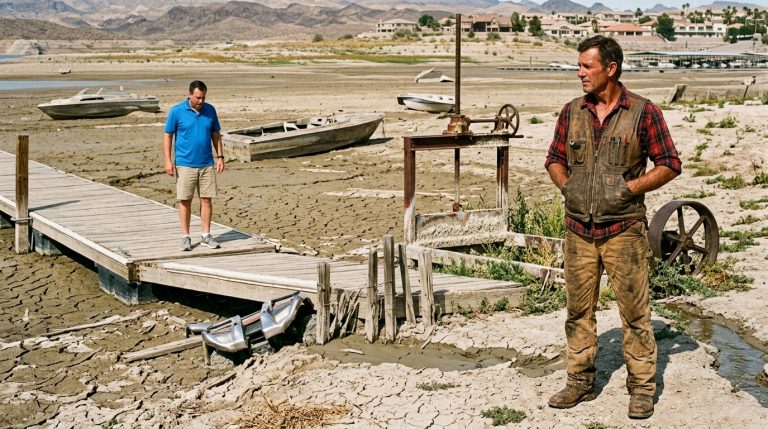
The silence of my property, once a source of comfort, now felt like a vacuum waiting to be filled by the noise of the conflict. I reached the edge of my dock, the wood slick with morning condensation, and stopped. A truck was parked near the main gate.
It wasn’t the tow truck from the night of the standoff. This was a dark, unmarked pickup, the kind of vehicle that suggested local utility work—or surveillance. A man sat in the driver’s seat, his silhouette sharp against the windshield, watching the gate. He didn’t move when I emerged from the brush. He didn’t start the engine. He simply waited, an anchor of stillness in a day that had just begun to fracture.
I didn’t head straight for the house. I walked toward the gate, not with the intent of confrontation, but with the pragmatic intent of observation. As I drew closer, the man in the truck cracked his window. The sound of the glass sliding against the rubber seal was thin and high-pitched.
“You’re trespassing on the access road,” I said, my voice steady, carrying clearly across the thirty feet of gravel.
The man didn’t look at me directly. He focused on a clipboard resting on the passenger seat. “Survey crew. We’re doing a routine check on the Clearbrook drainage easements.”
“There are no easements on this parcel,” I replied, the words practiced and cold. “The county records are clear. If you’re checking a drainage easement, you’re at the wrong address.”
The man finally turned his head. His face was weathered, etched with the lines of someone who had spent too many years staring into the sun. He looked tired—not the tired of a man who enjoyed his work, but the hollowed-out exhaustion of a man who was being paid to do something he knew was wrong.
“My boss told me to mark the boundary,” he said. He didn’t sound like a soldier for the HOA. He sounded like a man who needed the paycheck. “He said there’s a discrepancy in the original survey. He told me the pond edge is considered municipal land.”
“Your boss is lying to you,” I said. “And if you drop a single stake on my side of that line, I’ll have the sheriff here in ten minutes to document criminal trespass. I have the certified plats. I have the court order. Who exactly is your boss?”
The man hesitated. His hand hovered over the gear shift. “Sorenson,” he muttered. “The firm. That’s all I know.”
He didn’t wait for a response. He shifted into reverse, the tires crunching against the gravel, and backed out with a rhythmic, mechanical clatter. He didn’t look back. He didn’t offer a challenge. He simply vanished back toward the main road, leaving behind the faint, lingering scent of diesel exhaust.
I stayed at the gate for a long time, watching the dust settle. Sorenson. The glove I had found earlier was beginning to make sense. They weren’t just hiring muscle; they were hiring the infrastructure of the neighborhood to legitimize their theft. They were creating a bureaucratic paper trail, stake by stake, truck by truck, trying to make the lie look so mundane that the truth would eventually seem like an anomaly.
My phone buzzed. Another message from Gina. “I’ve been looking into the municipal filings for Clearbrook. There’s an internal document, dated three years ago—a feasibility study for a water management system. It mentions a ‘secondary basin’ needed to prevent flooding in the lower tier of the development. It doesn’t name your land, but the grid coordinates overlap with your pond by nearly eighty percent.”
I leaned against the iron gate. The reality was settling in. They hadn’t just made a mistake; they had planned for this years ago. They had bought the land around me, built their vision, and then realized their own foundation was floating on a marsh. I wasn’t just a property owner in their way; I was the essential component of their survival.
I looked at the water. It was perfectly still, a dark mirror. I realized then that my resistance wasn’t just a legal battle. It was a race. They needed the basin before the next major rain cycle, and I was the only thing standing between their desperate, flawed architecture and the disaster they were trying to bury in my soil.
I turned back to the house, the weight of the day pressing into my shoulders. The fight had moved from the gate to the very earth beneath my feet. I went inside, sat at the table, and pulled out the plat maps again. If they wanted to play with coordinates, I would give them a map they couldn’t ignore—one that mapped out their fraud, from the first survey to the final, failed pipe.
CHAPTER 5: THE HIDDEN SURVEY
The air turned heavy, the scent of ozone and wet dust signaling a storm that arrived with unnatural speed. I stood at the kitchen table, the plat maps spread out like a battle plan, when the first thunder rattled the windowpanes. It was a deep, resonant sound that vibrated through the floorboards, a reminder that the land was not as stable as the HOA pretended.
I shoved the maps into a weather-proof portfolio and grabbed my keys. If the storm hit with the intensity the sky suggested, the construction site would be a mud-slicked nightmare. The drainage pipe I’d found earlier—the one pointing directly at my property—was currently just a suggestion of theft. If the neighborhood began to flood, the HOA would turn that suggestion into an act of God.
The drive to the county recorder’s office was a blur of gray rain and windshield wipers fighting a losing battle. My knuckles were white against the steering wheel, my mind focused entirely on the archival records. If this basin was part of a master plan, it had to be somewhere in the municipal history, buried beneath layers of benign zoning changes and “environmental impact” waivers that no one ever bothered to read.
I arrived at the building just as the sky opened up. The walk from the car was short, but by the time I reached the lobby, my coat was soaked. I didn’t care. I headed straight for the microfilm station, the clerk giving me a wary look as I dripped water onto the linoleum.
“I need the original 2018 zoning approvals for the Clearbrook corridor,” I told her, my voice clipped.
She tapped the screen, her expression unreadable. “That’s a deep archive. It’s going to take time.”
“Make it happen,” I said, the pragmatism of the situation overriding any courtesy.
As I sat there, the light from the microfilm reader casting a harsh, artificial glow on my face, the urgency of the moment felt like a physical weight. Every minute I spent here was a minute they were potentially preparing to breach my boundary. The screen flickered, the old documents dancing in front of my eyes: building permits, environmental audits, signatures from Karen Mckllen and a host of civil engineers.
I scrolled past the fluff, searching for the engineering schematics. My heart hammered against my ribs when I hit page forty-two. It was a cross-section of the Clearbrook development. I stared at it, the lines of the diagram clear and cruel. They hadn’t just made a mistake in their drainage; they had designed the neighborhood with a built-in point of failure—the exact location of my pond. They had labeled it a “Natural Mitigation Zone” in their internal filings, a term that essentially granted them the right to treat the land as an overflow basin whenever the neighborhood drainage was overwhelmed.
It wasn’t a land grab for luxury. It was a necessity for their survival. If my pond wasn’t used to catch the runoff, the entire upper tier of Clearbrook—including Karen’s house—would eventually wash away in a heavy season.
The discovery was a jagged piece of reality that didn’t fit the picture I’d built. I wasn’t just fighting a greedy HOA; I was fighting their desperate, looming obsolescence.
The phone in my pocket vibrated. A text from an unknown number: “The storm is hitting. The drainage gate is being opened. Check the lower trail.”
I didn’t think. I stood up, the microfilm reader left buzzing in the quiet room, and bolted for the door. The rain was torrential now, turning the parking lot into a shallow, rushing river. I drove back to the property, the engine whining as I pushed it over the limit, my mind screaming with the realization of what they were doing. They were using the storm as cover. They were going to force the runoff onto my land and then use the subsequent flooding as “evidence” that the area was an ecological hazard, justifying a state-led takeover.
When I pulled up to my gate, I didn’t bother with the lock. I drove around the side, my tires spinning in the mud, and leaped out. The lower trail was a mess of running water and debris. I ran, my lungs burning, until I reached the spot near the oaks.
There, a group of men in bright yellow slickers were operating a portable pump, its nozzle jammed directly into the mouth of the concrete pipe I’d found earlier. They were actively siphoning the neighborhood’s rising water, pushing it with artificial pressure onto my acreage.
I didn’t yell. I didn’t approach them. I stayed back in the shadows of the trees, recording the entire scene. The man operating the pump looked up, his face obscured by a hood, but I knew who he was. He was the man from the truck.
I stood there, the rain soaking through to my skin, watching them accelerate the destruction of my land. I had the records now. I had the proof of their planned failure. They thought they could use the storm to drown me out, but they’d made a critical error: they had given me the final piece of the puzzle I needed to bring the entire system down on their heads.
I turned and slipped back into the darkness, leaving them to their work. They had the machines, but I had the truth—and the truth was about to become much more powerful than any pump they could bring to bear.
CHAPTER 6: THE CHEMICAL EVIDENCE
The morning light was thin and bruised, cutting through the kitchen curtains with a clinical sharpness that made the room feel like an interrogation cell. My clothes from the night before were pooled in a sodden, muddy heap by the back door, and the floor felt tacky under my feet where I’d tracked in the silt of the lower trail.
I didn’t reach for the phone. I didn’t reach for the coffee. I walked straight to the counter where I’d left the jar of water I’d taken from the pond days ago—the sample I’d been waiting for the lab to certify. The clear glass now looked opaque, the water swirling with a faint, iridescent film that hadn’t been there when I first collected it. It was a visceral reminder of what was happening to the land: a slow-motion poisoning, a deliberate degradation of the environment to suit a logistical end.
I took the jar and moved to the table, clearing away the plats and the microfilm printouts. I needed to see this clearly. I pulled out my magnifying glass and a small kit I kept for water testing—a relic from my days in agricultural surveying. I tested for acidity, for heavy metals, for the common runoff agents found in residential developments.
The reagent strips changed color with alarming speed.
It wasn’t just fertilizer or lawn-care chemicals. The chemical profile was complex, filled with petroleum residues and concrete leaching agents. It was the exact chemical signature of an active, industrial-scale drainage site. They weren’t just flooding the land; they were using my property as a disposal unit for the construction runoff that they couldn’t legally process within their own boundaries.
My hands, usually steady, felt a tremor as I logged the findings. This was the Layer 1 decoy: they wanted me to think it was just a local contamination dispute. They wanted me to drag them into court over environmental regulations, a process that would take years and allow them to finish their drainage project before a single judge ruled on the toxicity.
I looked at the notes Gina had sent over. The secondary basin mentioned in the feasibility study. The pieces snapped together with the cold, hard logic of a machine. My pond was the overflow. My land was the containment vessel. And the poisoning was the catalyst to force the “safety” designation they needed to seize the title.
A knock at the door, soft but insistent, jolted me. I didn’t move. I kept my eyes on the jar of water, waiting. The knock repeated, three quick, rhythmic strikes that felt more like a signal than a request.
I walked to the door, my posture loose, the way I had learned to move when the air felt thin and charged. Through the peephole, I saw the man from the truck—the one who had been surveying the line the day before. He wasn’t wearing his vest. He looked smaller, less defined, his shoulders hunched against the morning chill.
I opened the door, but I didn’t unhook the security chain.
“The survey,” he said, his voice barely audible over the wind. “The markers. You were right. They’re wrong.”
“I know they’re wrong,” I replied. I didn’t offer him a way in. I watched his eyes, which were darting toward the woods, toward the construction site on the ridge.
“Sorenson knows you found the pipe,” he whispered. “They’re planning to bring in the heavy equipment tomorrow, under the guise of an emergency flood-prevention order. They have a letter from the county council, signed by the vice-president—the one Karen Mckllen is married to. They’re not going to wait for a court injunction anymore. They’re going to dig.”
“Why are you telling me this?” I asked, my voice as cold as the iron of the latch.
“Because I have a daughter,” he said, and for a second, the mask of the paid laborer slipped, revealing a raw, jagged exhaustion. “And I know what happens when you build on top of a lie. The whole Clearbrook project is already settling. The north foundations are cracking. If they dump that much pressure into this basin, the pond wall will collapse, and the entire lower valley will go with it. They’re not trying to save the neighborhood. They’re trying to move the damage from their properties to yours.”
The silence stretched between us, thick with the weight of his admission. He wasn’t a hero; he was a man who didn’t want to be responsible for a collapse.
“Do you have that letter?” I asked.
He reached into his jacket and pulled out a folded, damp piece of paper. He slid it through the gap in the door, his fingers trembling. “If you show them this, tell them I left town. I can’t be here when they start digging.”
He turned and walked back to his truck, not waiting for a thank-you or a confirmation. I closed the door and leaned against it, the paper feeling hot and sharp in my hand. The stakes had been raised. They weren’t just stealing land anymore; they were risking lives to cover their tracks.
The battle wasn’t a disagreement over property lines. It was a confrontation with a disaster that was waiting to happen. I walked back to the table and laid the letter next to the water sample. It was time to stop documenting and start dismantling.
The storm had passed, leaving behind a world that felt quiet and brittle. I knew what I had to do next. I had the evidence, the documents, and the motive. I didn’t need to play by their rules, and I didn’t need their permission. I had the truth, and for the first time in this entire ordeal, I knew exactly where to aim it.
CHAPTER 7: THE MIRROR IMAGE
The paper felt like a live wire against my skin. I didn’t return it to the folder. I kept it out, the ink sharp and incriminating. The signature at the bottom—the vice-president of the council—was the anchor that would pull the entire Clearbrook facade down. It was the proof of collusion, a direct line from the HOA board to the political machinery that was supposed to protect the county, not facilitate the theft of its soil.
I didn’t head for the phone. I headed for the car. My movements were stripped of all unnecessary motion, a series of calculated steps honed by the mounting pressure. I wasn’t going to the sheriff. Not yet. I was going to the one place where they kept the records they couldn’t sanitize: the HOA’s local office, a small, nondescript building on the edge of the community that functioned as their administrative hub.
The drive was quiet. The rain had ceased, leaving the world slick and reflective under the moonlight. The streets of Clearbrook were dark, the houses looking like monuments to a life that wasn’t as stable as it appeared. I parked two blocks away and walked the rest, keeping to the shadows of the manicured hedges.
The office was empty, but the security light over the rear door cast a pool of harsh, yellow luminescence over the gravel. I knew the layout. I had spent hours reviewing the site plans for the neighborhood back when I was planning my own home’s security. There was a service entrance for the IT maintenance, a small metal hatch that was rarely checked after hours.
I reached the back of the building, my boots silent on the damp mulch. The hatch was locked, but the hinge was rusted—a weakness born of the same neglect that plagued the rest of their “perfect” community. I used a small flathead screwdriver from my pocket, the metal biting into the screw, the friction of the iron against the frame a familiar, grounding sensation. With a sharp twist, the lock gave.
Inside, the air smelled of stale coffee and cooling server racks. The office was a temple to bureaucratic perfection—organized, labeled, and completely blind to the reality of the structural rot beneath their feet. I navigated to the server closet, my flashlight cutting a focused, narrow beam through the dark.
I didn’t need to steal anything. I just needed to verify the digital paper trail. I plugged my laptop into the terminal, the screen blinking to life. It took me less than five minutes to find the directory labeled “Water Management – 2026.”
I opened the log files. There, listed in plain text, was the operational sequence for the drainage valves. The system wasn’t just designed to channel water; it was designed to prioritize the protection of the HOA board’s properties over the common land. The logs showed dozens of instances where the drainage was redirected—to my pond, to the public greenbelt, to the edge of the development—all to avoid the inevitable shifting of the foundations under the homes of the board members.
I started the export, the progress bar a slow, agonizing crawl of green.
A shadow shifted on the wall behind me.
I didn’t turn. I felt the change in the air, the subtle displacement of space that signaled I wasn’t alone. I closed the laptop, the device already heavy in my hand, and reached for the flashlight.
“You’re a long way from your pond,” a voice said.
I turned. Standing in the doorway was the son—the man in the polished jacket from the standoff at my gate. He wasn’t smiling. He held a small, black radio in his hand, his thumb resting near the button.
“The drainage plan is failing, isn’t it?” I asked, my voice steady, the rhythm of my heart controlled.
He didn’t answer. He walked closer, his eyes scanning the server rack, then my face. “You don’t understand the scale of this. If this gets out, the insurance companies won’t just pull the coverage. They’ll condemn the entire neighborhood. Hundreds of families. All gone.”
“They’re already gone,” I replied. “They’re living in houses that are literally falling into a sinkhole. You just haven’t told them yet.”
“We were going to fix it,” he said, and for a moment, he sounded like a child caught in a lie. “The retention basin was going to stabilize the pressure. We just needed more time.”
“You weren’t going to fix anything. You were just moving the catastrophe to someone else’s land.”
He took another step, his hand tightening on the radio. He looked like he was about to call for help, to signal someone, anyone, to stop me. But then he looked at the open server rack, the blinking lights of the data export, and his shoulders slumped. He looked older, tired, the polished sheen of his jacket looking frayed and cheap in the harsh light of the room.
“Karen doesn’t know you’re here,” he whispered, a sudden, sharp realization flickering in his eyes. “She thinks we have it handled. She thinks the county is on our side.”
“The county is on no one’s side,” I said. “They’re just waiting for a reason to tear the whole thing down.”
I stepped past him, the laptop tucked under my arm like a shield. He didn’t stop me. He watched me go, his hand falling away from the radio. He knew as well as I did that the truth was already out, the files were already uploaded, and the game they had been playing was over. I walked out into the cool night air, the silence of the neighborhood now feeling like the calm before the final, inevitable collapse.
CHAPTER 8: THE WEIGHT OF THE TRUTH
The drive back to the property was a study in stillness. I kept the laptop buckled into the passenger seat—my single, heaviest piece of ammunition. The night had retreated, replaced by the bruised, pre-dawn gray that characterizes the Missouri landscape. I didn’t rush. I didn’t speed. I moved with the precision of a man who had already won, though the battle hadn’t technically been decided.
I arrived at my gate just as the first streaks of real light hit the trees. The property was quiet, but the air was wrong. I heard the low, guttural growl of heavy machinery before I saw it. Two excavators were sitting at the edge of the lower trail, their yellow frames stained with the mud of the previous night’s storm. A crew was unloading a series of reinforced drainage conduits from a flatbed truck. They weren’t just working; they were prepared to tear the bank open.
Karen Mckllen stood near the lead excavator, her coat pulled tight against the damp cold, her phone held to her ear. She looked sharp, brittle, the picture of a woman who had convinced herself that momentum was the same thing as authority.
I pulled my car to the gate and stopped. I didn’t get out immediately. I let them see me. I watched as Karen’s gaze snapped toward my vehicle, her posture stiffening. She signaled the foreman, her hand cutting a sharp, impatient arc through the air. The excavator’s arm lifted, the heavy bucket hanging like a guillotine over the boundary line.
I stepped out, my boots crunching on the gravel. I didn’t carry a weapon. I carried the laptop, tucked under one arm, and the folder containing the county documents and the emergency order under the other.
“The order is active,” Karen shouted across the field, her voice high and thin in the morning air. “We have the mandate. If you step on that line, the sheriff will remove you.”
I stopped at the gate. I didn’t cross. I didn’t need to. I set the laptop on the hood of my car and turned it toward the machines, the screen open, the file directory listing the HOA’s own internal drainage logs clearly visible even from the distance.
“The order is based on a fraud, Karen,” I called back. My voice was calm, carrying the weight of the facts I now possessed. “And I’ve already sent the drainage logs, the feasibility study, and the county collusion records to the state engineering board and the local news desk. They’re uploading now.”
The foreman hesitated, his hand on the ignition key. Karen walked toward me, her heels sinking into the mud. She was smiling, but it didn’t reach her eyes—it was the rictus of a predator that had finally been cornered by something it couldn’t intimidate.
“You have nothing,” she said, her voice dropping to a low, venomous register. “Those documents are meaningless. They’re internal, private records. They don’t prove anything.”
“They prove you knowingly allowed the foundations of the homes you sold to fail to save the board’s own property value,” I said. “They prove this ’emergency’ is the result of your own negligence. And that makes you personally liable for every cent of the damage.”
She stopped ten feet from me. She looked at the laptop, then at the forest of trees that separated her project from mine. For the first time, I saw the truth of her situation reflected in her eyes: she realized she was finished. The machines, the order, the political influence—it all collapsed under the weight of the paper trail.
“You’ll never work in this town again,” she whispered, a desperate, pathetic attempt at a parting strike.
“I’m not trying to work here,” I said, my gaze steady. “I’m just trying to live here.”
She stared at me, then looked at the foreman. He was watching us, his hand off the ignition, the excavator idling, a useless, hulking piece of metal. Karen turned, her face pale, and walked toward her SUV. She didn’t look back. The foreman stared at me for a moment, then shut down the engine. The silence that rushed in to replace the growl of the machines was profound, heavy with the weight of a conflict that had ended not with a bang, but with the sudden, undeniable pressure of reality.
The denouement came not in a flurry, but in a slow, settling quiet. By noon, the trucks were gone. The excavators sat parked in the HOA staging area, silent sentinels of a failed enterprise. The county inspector arrived—not to enforce the HOA’s order, but to serve a notice of suspension on the entire Clearbrook development pending a safety audit.
I spent the afternoon walking the perimeter of my pond. The air had cleared, the sky turning a brilliant, high-altitude blue. The damage to the bank was minor—a few gouges in the earth, some trampled brush—but the land was alive, breathing, the water reflecting the sky in a way that felt entirely mine again.
I stopped at the boundary line, where the orange surveyor’s stake was still driven into the earth. I reached down, the soil cool and resilient against my fingers, and pulled it up. It came free with a soft, sucking sound. I carried it back to the shed and tossed it into the scrap bin, a relic of a war that had been fought in the shadows but won in the light.
I walked to the front gate. The hinges were stiff, the iron rusted by years of humidity, but they moved when I pushed them. I took a wire brush and a can of oil from the workbench, kneeling in the dirt. The rhythmic scraping of the steel against the rust was a meditative, healing sound. One by one, I cleaned the joints, removing the buildup of seasons, the friction yielding to the simple, patient application of labor.
When I finished, I swung the gate open and shut. It moved smoothly, silently, a perfect, functional thing.
I sat on the front porch as the sun began to dip below the horizon, painting the pond in shades of gold and violet. I didn’t think about the HOA, or Karen, or the lawsuit that was sure to follow. I thought about the land. It was still here. It was still mine. I took a breath, the air clean and cold, and felt the tension that had lived in my shoulders for weeks finally dissipate, leaving behind only the quiet, steady rhythm of the earth beneath my feet.
The struggle was over. The land was silent, safe, and for the first time in a long time, there was nothing to do but watch the light change.