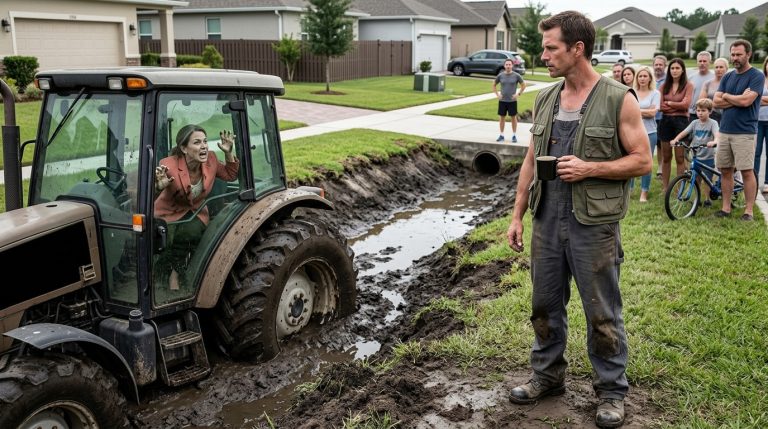
The Concrete Empire Built on Stolen Water Collapses Into the Dry Gray Mud of Reality
CHAPTER 1: THE DEMAND LETTER
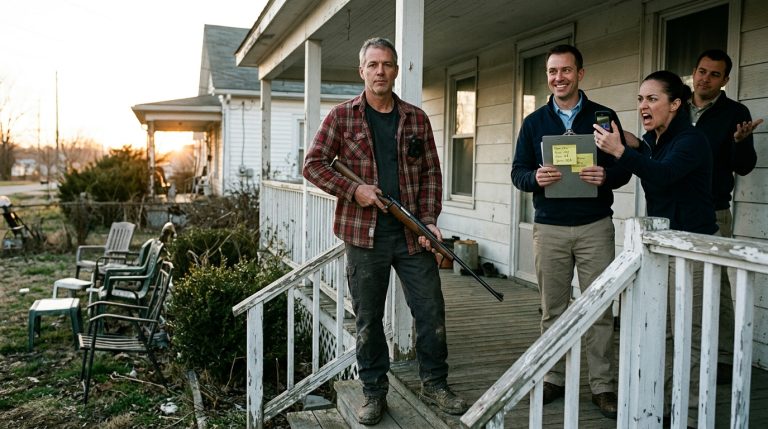
The kitchen window was smudged with fine yellow dust from the hayfields. Emmett kept his thumb pressed against the margin of the envelope until the paper bowed.
Diane Hollis had used thick cardstock for the letterhead, purple ink stamped at the top with a stylized wave that looked nothing like the jagged, stubborn flow of the northern stream.
“Dredge the eastern shallows,” Emmett read aloud, his voice dry and flat against the empty room. “Install lighting by the marina. Maintain minimum water levels year-round.”
He set the paper down next to his coffee mug. The ceramic was chipped at the rim, gray clay showing through the white glaze like a scar.
Outside, a red-tailed hawk dropped low over the ridge timber, hunting for field mice in the tall grass. It did not care about marina slips or property values.
Emmett reached out and pulled his father’s 1976 log book toward him, the leather binding cracked and soft from forty years of grease and sweat.
The HOA president lived in a fantasy built on glossy brochures and imaginary easements. She wanted him to manage his own water for her convenience.
He didn’t yell. He didn’t pick up the phone to argue. He simply opened the ledger to the decree number WD-1976-00008 and ran his calloused finger down the column of flow measurements.
The rules hadn’t changed since the county recorded them. The only thing that had changed was how loud the trespassers were willing to shout before they looked down at the ground.
CHAPTER 2: THE VALVE OPERATION
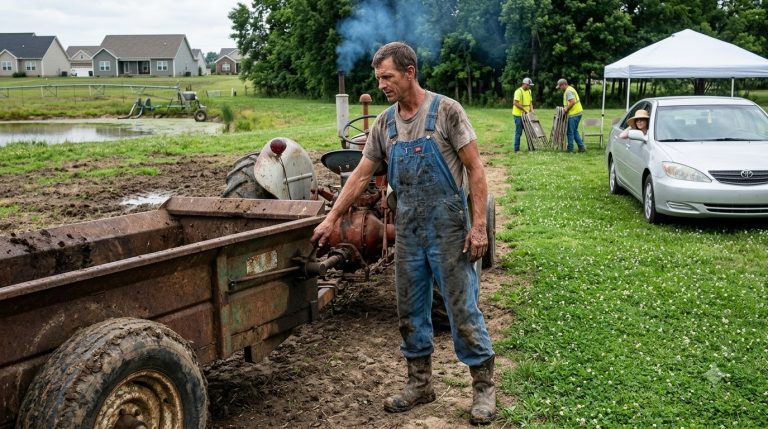
The northern stream moved with the slow, greasy laziness of late spring. Emmett did not look back toward the ridge where the rooftops of Harborview Estates caught the morning glare.
He planted his boot against the rusted frame of the distribution gate and gripped the heavy steel wheel.
The mechanism groaned, crusted with forty-three years of mineral scale and windblown grit.
A garter snake slid out from beneath the damp sill, disappearing into the tall dry weeds without a sound.
Emmett ignored the heat climbing into his neck and threw his weight into the turn, feeling the bronze gears grind against decades of accumulated silt.
With a sharp metallic snap, the internal wedge gate unseated.
The rushing sound of water shifted instantly, the heavy volume parting company with the intake channel that fed the reservoir below.
Instead of spilling southward toward the marina slips and the fiberglass boats, the entire flow hooked hard down the western ditch.
It surged into the dry irrigation furrows of his hayfields, soaking into the cracked clay with a thick, rushing hiss.
Emmett locked the wheel in place with a heavy iron padlock, slipping the brass key into his vest pocket.
There was no applause, no audience, and no speech to be made.
There was only the sight of the northern stream abandoning the basin it had filled for a generation, heading right where the 1976 decree said it always belonged.
CHAPTER 3: THE MUD FLAT REVELATION
The afternoon sun baked down on the exposed shoreline, drawing a thick, sulfurous smell from the drying lake bed.
Emmett stood on the high ground with his hands in his pockets, watching the transformation take place hour by hour.
Seventy-two hours earlier, boat hulls had bobbed against polished plastic bumpers in deep water.
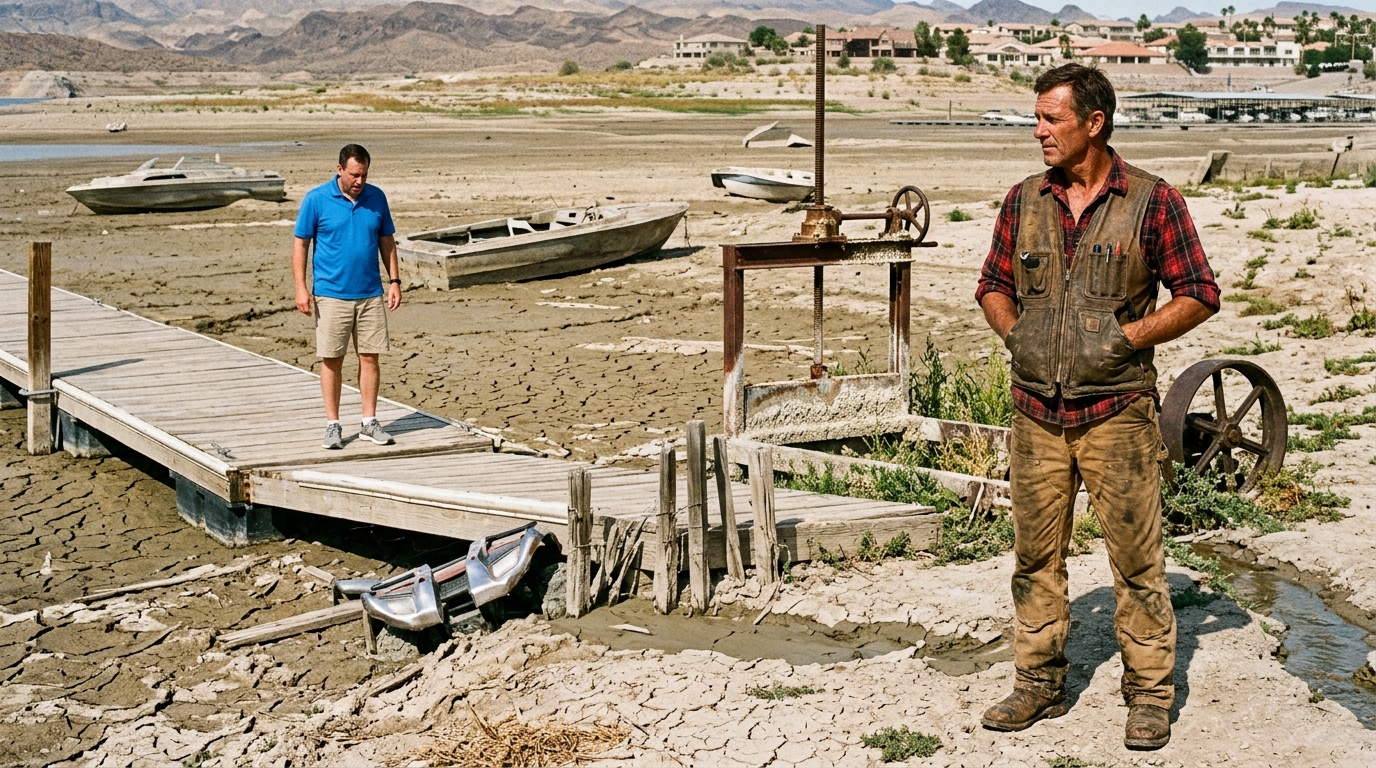
Now, the outer slips rested at awkward angles, leaning hard into gray silt like abandoned fence posts.
A fiberglass hull cracked with a sharp, dry pop as the keel settled entirely onto the hard-baked bottom.
Down by the marina, a man in a bright blue polo shirt stood on the end of the wooden dock, staring down at his sneakers resting inches above dry earth.
He didn’t move. He just looked down at his feet, then out across the wide, empty flat where the main body of the reservoir used to be.
Emmett turned away from the ridge and walked back toward his truck.
The physical reality of a property line didn’t need a loudspeaker or a committee meeting to make its point.
It just needed gravity and time, two things that didn’t care much for marketing brochures.
By evening, the water level would drop another three feet, and the illusion of Harborview Lake would officially run out of depth.
CHAPTER 4: THE HIDDEN FILE
Marcus dragged a heavy cardboard storage box off the top of the filing cabinet, his polo shirt damp with sweat from standing out by the ruined marina.
He didn’t care about the noise. He shoved past a stack of laminated Harborview Lake welcome signs, pulling the heavy metal drawer all the way out until it hit the stops.
The community page was already melting down. Thirty angry comments in an hour, people demanding to know why their expensive pontoon boats were currently resting on a bed of dry gray dirt.
Diane had promised them a lake. She had sold them a lake.
Marcus started yanking thick manila folders out, dropping them onto the carpet.
Landscaping. Snow Removal. Holiday Decor.
He kept digging, past the glossy brochures that never quite matched reality, searching for the raw property deeds Diane always insisted were too boring to review.
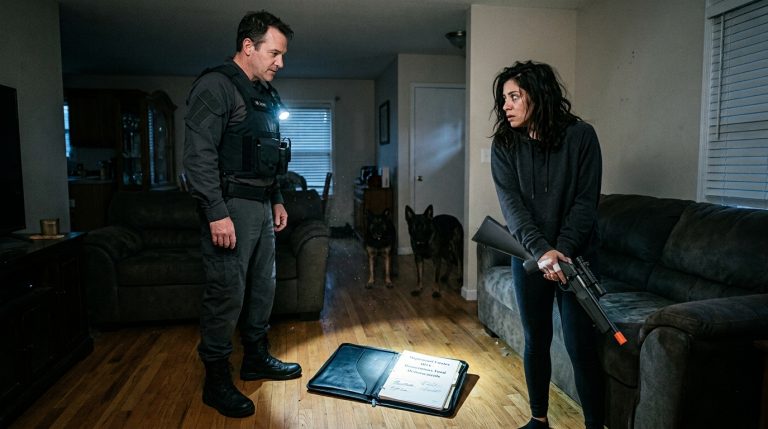
His hand stopped on a thin, faded green folder tucked in the very back, wedged tightly against the metal frame as if someone had tried to make it disappear.
He pulled it out.
Inside was a single piece of paper, folded in thirds. A certified mail receipt was stapled to the top left corner, dated 2009.
It was a letter from Emmett Crane, stating in plain, uncompromising English that the reservoir was private property, there was no access agreement, and the HOA needed to remove their structures immediately.
Marcus read the signature at the bottom.
Then he looked at the margin of the paper. There, in Diane’s unmistakable purple ink, was a scribbled note: Ignore. Developer said county won’t enforce without a lawsuit.
The hum of the fluorescent lights felt louder suddenly.
The developer hadn’t just made a mistake. They knew the easement didn’t exist. Diane knew the easement didn’t exist. They had all just banked on an old farmer never having the nerve to turn off the tap.
Marcus grabbed the folder, leaving the drawer hanging open, and headed for the community clubhouse doors.
It was time to have a very loud conversation in front of a lot of very angry people.
CHAPTER 5: THE RESIGNATION
Diane Hollis stood at the front of the hall, her fingers clamped white against the edges of the podium as seventy angry homeowners pressed inward from the foyer.
Her expensive blazer was slightly askew, a faint sheen of sweat catching the track lighting overhead.
“We are taking immediate steps to resolve the water shortage with the county,” Diane said, her voice pitching up an octave before she could catch it.
Marcus stepped past the front row of folding chairs, holding a single, folded sheet of paper by the corner as if it carried an odor.
“You aren’t resolving anything with the county, Diane,” Marcus said, his voice dropping flat and heavy over the room.
He didn’t yell. He didn’t need to.
He tossed the faded manila folder right onto the center of the wooden podium, scattering a stack of printed neighborhood newsletters onto the floor.
“That is a certified letter from Emmett Crane dated 2009,” Marcus continued, pointing a stiff finger straight at the purple handwritten note in the margin. “And that is your signature telling the board to ignore it because the developer said nobody would check.”
A sharp collective gasp rippled through the front rows.
Diane looked down at the paper as if it might bite her, her jaw tightening until the skin across her cheekbones turned chalk white.
“That document is irrelevant,” Diane snapped, slamming her palm down onto the wood so hard the microphone rattled. “We have a community standard to maintain, and a stubborn farmer cannot just—”
“He owns the dirt your boat is sitting on,” Marcus interrupted, his eyes fixed cold on hers. “And you knew it before you ever sent us a bill.”
The room erupted behind him, voices stacking on top of each other in a wall of pure, unadulterated fury.
Diane opened her mouth to argue, to spin another excuse out of thin air, but the shouting drowned her out entirely.
She grabbed her leather handbag off the shelf, shoved past the podium without looking at a single person, and pushed through the side exit into the parking lot.
Her manufactured authority had finally run out of room.
CHAPTER 6: THE RESTORED BASIN
Emmett signed his name at the bottom of the final page, the ink biting deep into the coarse grain of the paper.
The terms were clear, recorded, and settled without a single courtroom argument.
The unauthorized marina structures had already been hauled away in flatbed trailers, leaving clean cedar shiplap and empty gravel where the ramp used to sit.
Marcus had delivered the final paperwork himself that morning, his handshake firm and dry, carrying the quiet weight of a community finally forced to live with reality.
Emmett picked up his coffee mug, walked over to the west window, and looked out across the ridge.
The water was back, rising smooth and steady against the natural contours of the basin he had surveyed forty years ago.
There was no cheering crowd, no speeches, and no triumphant fanfare.
Just the steady, familiar sound of the northern stream spilling over the weir, filling the reservoir the exact way the numbers always said it should.
He opened his leather-bound log book one last time, dipped his pen into the inkwell, and wrote down the final entry.
Eastern inlet restored, basin full, matter closed.
He closed the cover with a soft thud, the sound settling comfortably into the quiet afternoon air.