The Rusted Gate And The Price Of Entitlement In The Shadow Of The Old Family Farm
CHAPTER 1: THE RUSTED BOUNDARY
The metal wire bit into my thumb, leaving a streak of grey grease that matched the sky. Eight years of pulling this old fence line straight had taught me one thing: wood rot doesn’t care about property values.
A white SUV idled near the property line, its pristine paint looking ridiculous against the rusted iron of my grandfather’s tractor. The driver didn’t bother turning off the engine.
She rolled down the glass just enough to let a manicured hand rest on the frame. Her sunglasses stayed firmly in place, reflecting the peeling red paint of my barn.
The HOA’s annual summer gala will be held on your property this Saturday, she called out across the gravel, her voice clipped and entirely devoid of a question mark.
I kept my pliers clamped around the staple, twisting until the wire bit deeper into the cedar post. We’ve hired caterers, tents, one hundred and twenty-five guests. Be ready by noon.
She didn’t wait for an answer. The SUV reversed with a soft beep, kicking up dust from my driveway before gravel could even settle back into the ruts.
CHAPTER 2: THE PAPER TRAIL
I walked back inside the kitchen, wiping the grease from my thumb onto a rag that had seen better decades.
The screen door banged shut behind me with its familiar, uneven rattle.
My laptop sat on the laminate counter, plugged into a surge protector that buzzed faintly whenever the refrigerator compressor kicked on.
I opened the local HOA portal using the guest view link I’d found taped to a public notice board three months ago.
The digital bulletin board was pristine, plastered with pastel graphics and smiling digital avatars.
Right there on the front page was a digital flyer for the upcoming summer gathering, complete with a countdown clock and a bold registration fee.
Exclusive access to the historic south meadow. Admission: fifty dollars per person.
I clicked through to the contact page and drafted a short, polite message to the board regarding their liability coverage for events held on private acreage.
I didn’t mention the deed, and I didn’t mention my granddad.
I just asked who would carry the insurance if someone tripped over a rusted plowshare in the grass.
The reply came back in under two hours, bypassing the rest of the board entirely.
The HOA president’s response popped up in bold text, sharp enough to cut.
Don’t be difficult. The event is happening whether you like it or not, and please make sure the manure smell is gone before Saturday.
I stared at the screen, watching the cursor blink against the white background.
She didn’t address the liability, and she didn’t ask whose land she was standing on.
I closed the browser tab and pulled up the county property appraiser’s mapping tool in another window.
The blue property line overlay cut a sharp, unyielding rectangle right through the middle of their neatly planned subdivision fence.
CHAPTER 3: THE GATHERING STORM
I stepped off the porch and walked past the rusted teeth of my old disc harrow, letting my fingers trail over the cold iron.
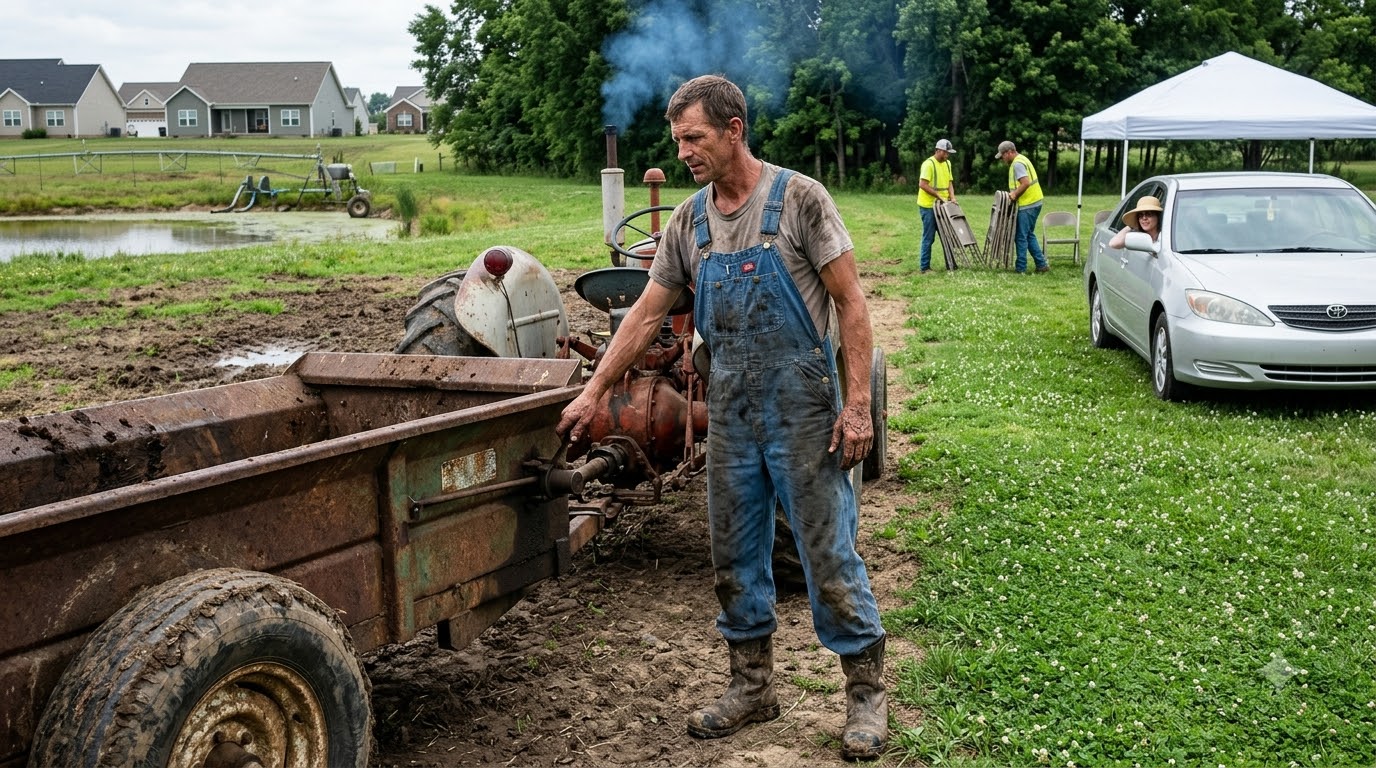
Up at the subdivision edge, two workers in high-visibility vests were unloading metal folding chairs from the back of a flatbed truck, stacking them in neat rows directly on my southern clover.
They weren’t looking at property markers, and they didn’t care about the boundary lines painted decades ago.
I fired up the old tractor, the blue smoke coughing twice before settling into a deep, rhythmic chug that rattled the loose tin on the machine shed roof.
My grandfather always said you don’t argue with a man who has his mind made up; you just change the grade of the dirt he’s standing on.
I backed the rusty manure spreader into position near the tree line, right where the gentle afternoon breeze would catch whatever draft rolled off the open tank.
Next to it, I hauled out the intake hose for the diesel irrigation pump, dropping the brass strainer deep into the murky center of the duck pond.
The water down there didn’t run clear; it held a rich, heavy blend of decaying silt and organic fertilizer accumulated over a quarter-century of livestock management.
If they wanted a historic agricultural experience, they were going to get the full sensory portfolio.
A silver sedan slowed down on the subdivision access road, a woman in a wide-brimmed sunhat peering through her windshield at what I was doing.
She rolled down her passenger window, her expression tightening against the scent drifting up from the pond.
What on earth are you spraying back there? she called out, waving a gloved hand in front of her nose.
Just preparing the soil for your grand opening, I shouted back over the roar of the diesel engine, never slowing my hands as I locked the discharge valve into place.
She hit the gas pedal without another word, spraying loose gravel across the lane as she hurried toward the paved sanctuary of the cul-de-sac.
CHAPTER 4: WHITE LINEN AND MUD
The midday sun beat down hard on the open meadow, turning the crisp white canopies into glaring sails against the dull green of the pasture.
Caterers in matching black aprons rushed back and forth between long folding tables, carrying trays of crystal glassware that looked entirely out of place beside my grandfather’s rusted disc harrow.
By twelve-thirty, the first wave of guests began trickling across the property line from the subdivision cul-de-sac.
They wore summer dresses and linen suits, stepping gingerly over the uneven sod as if inspecting a museum exhibit they had already paid to enter.
The HOA president stood near the center platform, holding a clipboard and directing traffic with the sweeping gestures of a stage conductor.
She didn’t glance toward the barn once, entirely convinced her unauthorized dominion over the acreage was complete.
A group of elderly neighbors stopped near my old tractor, admiring its weathered iron with polite, uncomprehending smiles.
Wonderful venue choice, isn’t it? one man remarked, adjusting his sunglasses as he smoothed his collar. The community really outdid themselves securing this historic space.
I leaned against the weathered timber of the barn door, wiping my hands on a dry rag while watching the crowd swell past the hundred-guest mark.
They were laughing, taking photos under the midday glare, completely unaware that the ground beneath their expensive shoes was zoned strictly for agricultural livestock.
The caterers fired up a portable sound system, and a smooth jazz track drifted across the grass, competing softly with the distant clucking of my roosters.
It was an impressive illusion of ownership, built entirely on fabricated authority and bold-faced invitations.
The air grew heavy with the sweet scent of expensive cologne mixing with the raw, stubborn aroma of open pasture land.
I looked down at my watch, noting the exact minute the clock struck one.
CHAPTER 5: THE FREIGHT TRAIN ROAR
I shoved the throttle forward, and the old diesel engine caught with a deafening roar that shook the loose dust from the barn rafters.
The heavy intake hose dropped deep into the murky duck pond, instantly drawing up a thick, nutrient-rich blend of silt and aged organic fertilizer.
Outside in the open meadow, the lightweight aluminum sprinklers shuddered, rotated, and sent a wide arc of pressurized mist sweeping across the property line.
A gentle afternoon breeze picked up right on cue, carrying the unmistakable, heavy aroma of the pasture directly toward the white linen canopies.
The background chatter among the guests died down within seconds, replaced by sudden gasps and the frantic scraping of folding chairs against the grass.
Several attendees dropped their crystal glasses, coughing and waving their hands in front of their faces as the mist settled over their designer outfits.
The HOA president dropped her clipboard, spinning around on her heel with her face flushed bright crimson.
She marched straight toward the barn door, her expensive shoes sinking into the damp clover with every furious step.
You turn that infernal machine off right this second! she shrieked, slamming both palms against the weathered wood of the frame.
I cut the throttle just enough to let my voice carry over the mechanical thrum, looking down at her with calm exhaustion.
This is just agricultural maintenance, ma’am—you said yourself the ground needed clearing before your party.
She opened her mouth to scream another demand, but the sharp wail of approaching sirens cut her off entirely.
CHAPTER 6: SIRENS AND SILENCE
The fire marshal trailed close behind, clipboard tucked firmly under his arm like an unyielding shield.
The HOA president threw her hands up, her voice pitching into a frantic defense before the deputies could even speak.
This is community property—he’s just trying to sabotage our annual gathering!
The deputy pulled a sheaf of printed property records and emails from his breast pocket, sliding the pages under her nose.
The deed says otherwise, and unless you have written permission and county permits for one hundred and twenty-five paying guests, this assembly is trespassing.
She stammered, pivoting sharply to point a trembling finger at the gathering crowd.
They paid the site fees to the association fund—it’s completely legal!
Several guests stepped forward, shaking their heads as the reality of the fraudulent ticket sales settled over them.
We gave her fifty dollars a piece for this venue, an older gentleman muttered, crossing his arms tight against his chest.
The deputy’s pen scratched across his notepad, noting every confession while the catering managers began aggressively packing their folding tables.
Within an hour, the fancy white tents emptied out, leaving behind tire ruts in the clover and an ex-president sitting in her immaculate white SUV, furiously tapping at a dead phone screen as her leverage dissolved into thin air.
The county fines arrived by Tuesday, followed quickly by civil judgments ordering her to refund every single dollar of stolen ticket money.
By the end of the week, she resigned from the board in total disgrace, leaving the neighborhood to elect folks who understood property lines.
The new board president sent a formal, written apology promising absolute peace for the acreage.
Now, every morning at four-thirty, my new rooster crows from the top of the fence post, his voice ringing loud and clear across the property line.
I sat on the front porch with a ceramic mug of hot coffee, listening to the sun break over the old red barn while the morning mist rose clean from the meadow.
The world was quiet, the boundary was secure, and justice sounded exactly like a rooster greeting the dawn.